
Bag Filter Market Analysis, Size, and Share by 2034
Coverage: By Filter Type (Shakers, Reverse Air, and Pulse Jet) and End-Use Industry (Chemical Processing, Food & Beverages, Pharmaceuticals, Paper & Pulp, Water Treatment, and Others) and Geography
- Status : Data Released
- Report Code : TIPRE00003146
- Category : Manufacturing and Construction
- No. of Pages : 150
- Available Report Formats :


- Last update date : July 17, 2026


2025 Market Size
US$ 5.86 Bn
Base year value
2034 Forecast
US$ 9.09 Bn
Projected by 2034
CAGR 2026-2034
5.0 %
Growth rate
Addressable Market
US$ 67.85 Bn
(2026-2034)
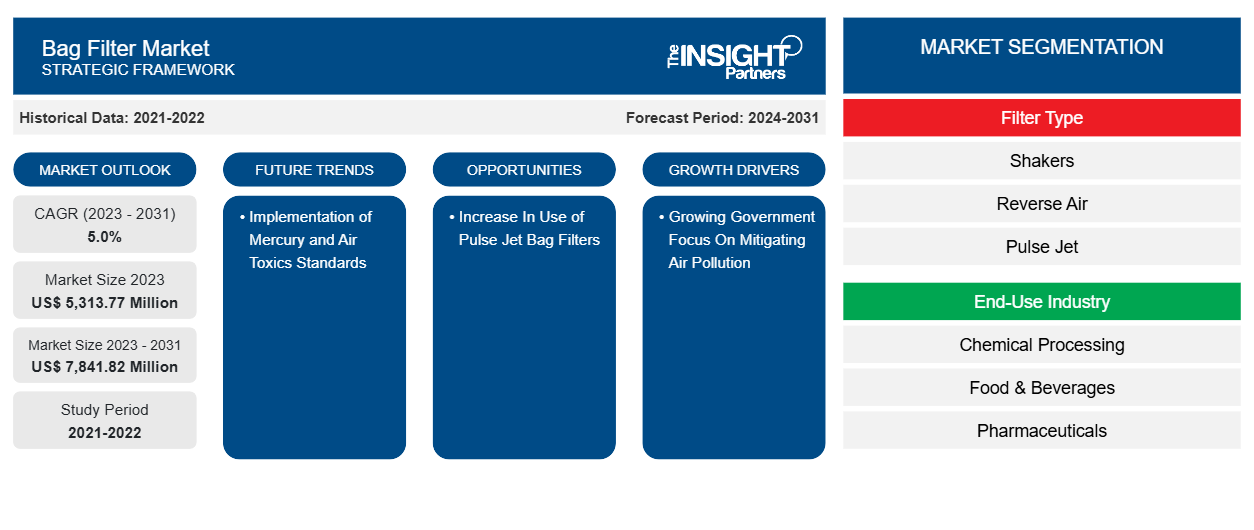
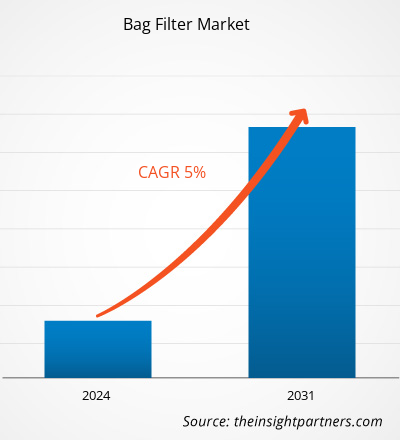
The bag filter market was valued at US$ 5.86 Billion in 2025 and is projected to reach US$ 9.09 Billion by 2034; it is expected to register a CAGR of 5.0% from 2026 to 2034. Demand is supported by industrial particulate control, tighter emission compliance, and broader use of fabric filtration in chemical processing, food and beverages, pharmaceuticals, paper and pulp, and water treatment facilities.
North America remains a mature yet investment-intensive region, with the bag filter market size supported by replacement demand, OSHA-linked worker exposure controls, and EPA particulate matter requirements. The regional market is estimated to expand at a 4.4–4.8% CAGR during 2026–2034 as manufacturers retrofit aging dust collection assets, add pulse jet systems, and prioritize energy-efficient filter media for food, chemical, and pharmaceutical plants.
Bag Filter Market Assessment and Insights
- North America accounted for 27–29% share in 2025 and is expected to grow at a CAGR of 4.4–4.8% between 2026–2034, led by industrial retrofits and particulate compliance.
- US represented 74–78% of North America in 2025 and is projected to grow at a CAGR of 4.3–4.7% between 2026–2034.
- Europe held 24–26% share in 2025 and is forecast to grow at a CAGR of 4.2–4.6% between 2026–2034, with Germany, the UK, France, Italy, and Spain leading adoption.
- Asia Pacific captured 34–36% share in 2025 and is projected to grow at a CAGR of 5.6–6.1% between 2026–2034, led by China, India, Japan, South Korea, and Australia.
- Largest Segment Pulse Jet held 48–52% market share in 2025 and is expected to grow at a CAGR of 5.2–5.7% during 2026–2034.
- High Growth Segment Pharmaceuticals held 10–13% market share in 2025 and is projected to grow at a CAGR of 5.8–6.4% during 2026–2034.
- Key companies analyzed in detail: Babcock & Wilcox Enterprises, Inc., BWF Offermann, Waldenfels & Co. KG, Camfil AB, Donaldson Company, Inc., Mitsubishi Heavy Industries, Ltd., Parker-Hannifin Corporation, Thermax Limited, FLSmidth & Co. A/S, Nederman Holding AB, and Hamac-Hansella GmbH.
Source: The Insight Partners' analysis based on proprietary research, government publications, company annual reports, investor presentations, industry databases, and expert interviews.
The process industries are evolving from simple dust collection methods to engineered filtration solutions, which integrate material choice, cleaning technology design, optimal air flow, and digital monitoring capabilities. Pulse jet platforms have become favored due to their ability to offer compact size and continuous operations, whereas reverse air and shaker systems are still relevant for large volumes and low pressures. The filter media providers have been highlighting PTFE membranes, aramids and antistatic materials for the dusty environments, where the air is corrosive, hot, or flammable.
The growth opportunities in the coming years will largely depend on brownfield modernization of facilities in regulated markets and greenfield capacity additions in Asia Pacific and the Middle East region. The emission standards, cleanroom manufacturing requirements, food safety concerns, and recycling projects will be driving new procurement specifications. The buyers are looking beyond the initial capital costs and considering the total lifecycle cost, pressure loss, bag life, and maintainability.
Bag Filter Market Report Scope
| Report Attribute | Details |
|---|---|
| Market size in 2025 | US$ 5.86 Billion |
| Market Size by 2034 | US$ 9.09 Billion |
| Global CAGR (2026 - 2034) | 5.0% |
| Historical Data | 2021-2024 |
| Forecast period | 2026-2034 |
Bag Filter Market Analysis
Industrial demand for the bag filter market growth is anchored in particulate emission control, product recovery, and indoor air quality management. Chemical plants require corrosion-resistant media, food processors need hygienic dust capture, and pharmaceutical sites prioritize containment. Supply dynamics depend on fabric availability, cage fabrication, valve assemblies, and aftermarket service networks that reduce downtime during planned maintenance windows.
The ecosystem includes equipment OEMs, filter bag manufacturers, media converters, engineering contractors, and plant maintenance teams. Increasing automation in dust collection is changing procurement from component replacement to performance-based system upgrades. The bag filter market benefits when plants monitor pressure differential, pulse frequency, compressed air use, and emissions data to extend bag life and avoid regulatory excursions.
The competitive positioning will depend on the scope of technology, number of installations, service coverage regionally, and capability to offer engineered retrofits. The analysis of the bag filters market reveals that the competitors like Donaldson Company, Inc., Camfil AB, Parker-Hannifin Corporation, Babcock & Wilcox Enterprises, Inc., Thermax Limited, and FLSmidth & Co. A/S compete on application knowledge whereas BWF Offermann, Waldenfels & Co. KG and Nederman Holding AB build up strengths in media and dust collection expertise.
More investment is flowing into modular collectors, advanced monitoring systems, low pressure drop bags, and retrofitting programs related to plant reliability. Mitsubishi Heavy Industries, Ltd. and Hamac-Hansella GmbH cater to the specialized requirements of industrial systems, whereas regional companies compete on fast installation and fast service response.
● REPORT CUSTOMIZATION
Tailor This Report To Align With Your Specific Business Requirements
This report can be customized to align precisely with your business objectives, scope, and target markets. Customization options include tailored segmentation, geography, competitive analysis, and strategic insights to support informed decision-making.
Customize This Report →WHAT YOU CAN ADJUST
- ● Segmentations
- ● Geography
- ● Competitive Analysis
- ● Language Preferences
Bag Filter Market: Strategic Insights
Regional Insights
North America Bag Filter Market
North America accounted for 27–29% of the bag filter market share in 2025 and is projected to expand at a 4.4–4.8% CAGR through 2034. The region’s demand is replacement-led, with mature chemical, food, pharmaceutical, and pulp facilities upgrading aging baghouses to reduce pressure drop, improve particulate capture, and align with air permitting requirements.
Adoption is also supported by worker exposure management and combustible dust risk reduction. Plants increasingly prefer pulse jet collectors with automated controls, because compressed-air optimization and online cleaning reduce shutdown requirements. Retrofit opportunities are strongest in the US Gulf Coast chemical corridor, Midwest food processing clusters, and Canadian industrial facilities.
U.S. Bag Filter Market
In 2025, the United States will constitute 74–78% of North America and is anticipated to have a CAGR of 4.3-4.7% during the forecast period of 2026-2034. End users are chemicals, food ingredients, pharmaceutical, paper mill, and municipalities having water treatment facilities where the application is crucial for regulation compliance, product quality, and equipment performance.
There is a presence of Donaldson Company, Inc., Parker-Hannifin Corporation, Babcock & WIlcox Enterprises, Inc., and Camfil AB companies in the United States owing to their equipment and media portfolio along with services offered. Some of the application trends are pleated bag replacements, advanced media technology, explosion venting systems, and preventive maintenance solutions.
Europe Bag Filter Market
Europe held 24–26% share in 2025 and is projected to register a 4.2–4.6% CAGR. Germany is the leading country because of its chemical, pharmaceutical, machinery, and process engineering base. UK demand is supported by food manufacturing, waste handling, and water utilities, where dust control and asset modernization remain recurring expenditure priorities.
Germany benefits from domestic engineering depth and stringent industrial emission expectations. France, Italy, and Spain contribute through pharmaceuticals, paper, food processing, and specialty chemicals. European buyers emphasize energy performance, documented filtration efficiency, and supplier traceability, which supports premium media adoption and replacement contracts across multi-plant operators.
APAC Bag Filter Market
In 2025, APAC accounted for 34%–36%, and it is expected to grow by a CAGR of 5.6%–6.1%, being the fastest-growing regional segment. China dominates on production capacity, whereas India fuels demand through the chemicals industry, pharmaceuticals, food processing industry, and infrastructure-based industries.
Japanese and South Korean companies concentrate on producing highly-efficient systems for advanced manufacturing purposes, and Australia fosters demand through mining, food, and water treatment. Regulations related to air quality, industrial relocation, and growing compliance awareness drive demand towards pulse jet systems and high-end media.
Middle East & Africa Bag Filter Market
Middle East & Africa is projected to grow at a 4.8–5.3% CAGR during 2026–2034. Saudi Arabia is the leading country, supported by industrial diversification, petrochemicals, desalination-linked water treatment, and infrastructure expansion.
The UAE relies on high-end facilities for industries and food processing. On the other hand, South Africa provides contribution in the form of mining, paper, and chemical uses. The needs of Rest of MEA are projects based, linked with cement, utilities and process industries that need strong filters in harsh dust environments.
Segmentation Analysis
Filter Type
The filter type segment is expected to grow at a 4.9–5.4% CAGR during 2026–2034. The bag filter market scope across cleaning mechanisms is shaped by dust loading, temperature, air volume, maintenance access, and uptime requirements. Pulse jet systems dominate new installations, while shaker and reverse air units remain relevant where operating conditions favor gentler cleaning or larger housings.
- Shakers remain important in smaller or intermittent duty applications where mechanical cleaning is acceptable and compressed air infrastructure is limited, particularly in workshops and lower-volume process lines.
- Reverse Air systems serve large baghouses handling high gas volumes, offering gentle cleaning that extends fabric life in applications where shutdown access and compartmentalized maintenance are feasible.
- Pulse Jet systems lead demand because continuous online cleaning, compact design, and compatibility with advanced media improve productivity across chemical, food, pharmaceutical, and water treatment facilities.
End-Use Industry
The end-use industry segment is projected to register a 5.0–5.5% CAGR from 2026 to 2034. Adoption patterns differ by process risk: chemicals prioritize corrosion resistance, food facilities focus on hygiene and product recovery, pharmaceuticals require containment, paper and pulp mills address fiber dust, and water treatment plants manage sludge handling and odor-control particulates.
- Chemical Processing remains a major demand base because powders, catalysts, pigments, and intermediates require reliable capture systems that tolerate corrosive streams and variable particulate loads.
- Food & Beverages uses filtration for flour, sugar, starch, spices, and ingredient dust, where sanitation, explosion protection, and product recovery influence equipment selection.
- Pharmaceuticals is the high-growth segment, driven by containment needs, clean manufacturing expansion, and stringent control of active ingredient dust during blending, granulation, and drying.
- Paper & Pulp facilities deploy bag filters to manage fiber, coating, and boiler-related particulates, supporting process reliability and compliance in mills with aging equipment.
- Water Treatment applications are expanding as utilities and industrial plants handle dried sludge, lime, activated carbon, and odor-control materials that require controlled dust capture.
Opportunity Snapshot
| End-Use Industry | Revenue Contribution | Trend Tag | Adoption Stage |
| Chemical Processing | High | Corrosion Control | Mature |
| Food & Beverages | High | Hygienic Capture | Scaling |
| Pharmaceuticals | Medium | Containment Upgrade | Scaling |
| Paper & Pulp | Medium | Fiber Dust | Mature |
| Water Treatment | Low | Sludge Handling | Emerging |
Bag Filter Market Growth Drivers and Impact Analysis
Tightening particulate emission compliance
There is an increasing level of regulatory emphasis being put on particulate matter, exposure to dust in the work environment, and visible emissions from industrial facilities. Baghouse filtration technology is preferred since it is highly efficient in collecting both fine and coarse particles and allows specific filters to be used based on the process requirements. These compliance regulations apply not only to new construction but also old facilities in industries like chemicals, pulp, food, and pharmaceuticals. The effect on the market is clear when considering retrofit investments, ongoing monitoring, and documentation of the filtration performance.
Shift toward lifecycle-cost procurement
The growing trend in assessing filtration systems is based on power consumption, bag changing rate, maintenance requirements, compressed air usage, and the cost associated with downtime. This trend makes pulse jet systems, pleated bags, low-pressure drop media, and digital gauges favorable since they enable facilities to take preventive actions against system deterioration. Therefore, the bag filter business moves away from pure equipment sales towards offering services and upgrading solutions. Suppliers with application laboratories, regional engineers, and references are better prepared for this challenge, as end-users demand consistent performance throughout the year.
Expansion of regulated process industries
Chemical processing, food manufacturing, pharmaceuticals, paper, and water treatment are expanding in regions where industrial policy encourages local production. These sectors generate dust streams that cannot be managed through generic ventilation alone, because product purity, worker safety, and regulatory control are linked. New plants create demand for properly sized systems, while existing facilities require upgrades as production lines are debottlenecked. The impact is strongest where multinational manufacturers standardize environmental and safety practices across sites, creating repeatable specifications for collectors, cages, valves, and replacement media.
Bag Filter Market Future Trends
Connected filtration performance management
The most visible bag filter market trends will center on connected monitoring that links pressure differential, pulse valve activity, compressed air consumption, and emissions data. Future systems will allow plant teams to compare collector health across multiple facilities and schedule bag replacement based on actual performance rather than fixed intervals. This trend will support lower operating cost, fewer compliance surprises, and better inventory planning. Equipment suppliers are expected to embed diagnostics into control panels, while service providers will use data to recommend media changes, airflow balancing, and cleaning cycle optimization.
Advanced media for harsher process streams
Filter media innovation will become more application-specific as plants process hotter, stickier, finer, or chemically aggressive dust streams. PTFE laminates, aramid blends, nanofiber layers, and anti-static treatments will be selected to balance capture efficiency, pressure drop, thermal resistance, and cleanability. This trend will be important in pharmaceuticals, chemicals, biomass-related combustion, and specialty food ingredients. Suppliers able to validate media performance under real dust conditions will gain advantage, because buyers need longer bag life without sacrificing emission compliance or process throughput.
Bag Filter Market Opportunities
Retrofit programs for aging industrial plants
Retrofit activity offers a practical opportunity because many plants operate older collectors with high pressure drop, limited access, and inconsistent emissions performance. Suppliers can create value by offering audits, airflow studies, bag upgrades, pulse cleaning optimization, and compartment refurbishment. The bag filter market forecasts indicate that replacement demand will remain resilient even when new capital projects slow, because compliance and reliability spending cannot be deferred indefinitely. Service-led business models, bundled consumables, and documented payback from energy savings can help vendors convert maintenance budgets into structured modernization programs.
High-specification demand in pharmaceutical and food facilities
Pharmaceutical and food manufacturers present attractive opportunities because filtration affects product quality, occupational exposure, sanitation, and explosion risk. Vendors can differentiate through stainless-steel housings, validated media, cleanable designs, containment features, and documentation packages aligned with regulated production. Growth is particularly promising in India, China, the US, and Europe as companies expand local manufacturing and upgrade older lines. Partnerships with engineering, procurement, and construction firms can improve early specification influence, while aftermarket bag supply creates recurring revenue after installation.
Recent Developments
- September 2025: Camfil AB — expanded its Manesar, India manufacturing facility with additional HEPA and ULPA filter production capacity, strengthening regional supply for high-efficiency air filtration used in pharmaceutical, healthcare, and industrial clean manufacturing environments. The expansion supports localized production and shorter lead times for advanced filter products.
- April 2024: Eaton Corporation plc — introduced SENTINEL MAXPO and DURAGAF MAXPOXL polypropylene needle felt filter bags with melt-blown inner cores for particle retention and oil absorption in industrial processes such as paints, coatings, and water treatment. The launch reflects broader demand for multifunctional bag media.
- November 2025: Parker-Hannifin Corporation — announced an agreement to acquire Filtration Group Corporation for US$ 9.25 billion, expanding its filtration platform across industrial, life sciences, and process applications. The transaction is expected to strengthen Parker’s aftermarket filter media and engineered filtration capabilities.
Frequently Asked Questions

- Comprehensive Market Sizing and Forecast Analysis
- Detailed Segmentation Analysis
- In-Depth Market Dynamics Assessment
- Regional and Country-Level Insights
- Competitive Landscape and Company Benchmarking
- Strategic Business Intelligence
Recent Reports
Testimonials

The Insight Partners' SCADA System Market report is comprehensive, with valuable insights on current trends and future forecasts. The team was highly professional, responsive, and supportive throughout. We are very satisfied and highly recommend their services.
RAN KEDEM Partner, Reali Technologies LTDs
I requested a report on a very specific software market and the team produced the report in a few days. The information was very relevant and well presented. I then requested some changes and additions to the report. The team was again very responsive and I got the final report in less than a week.
JEAN-HERVE JENN Chairman, Future Analytica
We worked with The Insight Partners for an important market study and forecast. They gave us clear insights into opportunities and risks, which helped shape our plans. Their research was easy to use and based on solid data. It helped us make smart, confident decisions. We highly recommend them.
PIYUSH NAGPAL Sr. Vice President, High Beam Global
The Insight Partners delivered insightful, well-structured market research with strong domain expertise. Their team was professional and responsive throughout. The user-friendly website made accessing industry reports seamless. We highly recommend them for reliable, high-quality research services
YUKIHIKO ADACHI CEO, Deep Blue, LLC.
This is the first time I have purchased a market report from The Insight Partners.While I was unsure at first, I visited their web site and felt more comfortable to take the risk and purchase a market report.I am completely satisfied with the quality of the report and customer service. I had several questions and comments with the initial report, but after a couple of dialogs over email with their analyst I believe I have a report that I can use as input to our strategic planning process.Thank you so much for taking the extra time and making this a positive experience.I will definitely recommend your service to others and you will be my first call when we need further market data.
JOHN SUZUKI President and Chief Executive Officer, Board Director, BK Technologies
I wish to appreciate your support and the professionalism you displayed in the course of attending to my request for information regarding to infectious disease IVD market in Nigeria. I appreciate your patience, your guidance, and the fact that you were willing to offer a discount, which eventually made it possible for us to close a deal. I look forward to engaging The Insight Partners in the future, all thanks to the impression you have created in me as a result of this first encounter.
DR CHIJIOKE ONYIA MANAGING DIRECTOR, PineCrest Healthcare Ltd.Reason to Buy
- Informed Decision-Making
- Understanding Market Dynamics
- Competitive Analysis
- Identifying Emerging Markets
- Customer Insights
- Market Forecasts
- Risk Mitigation
- Boosting Operational Efficiency
- Strategic Planning
- Investment Justification
- Tracking Industry Innovations
- Aligning with Regulatory Trends





 Get Free Sample for