
Barrier Systems Market Demand, Trends & Forecast by 2034
Coverage: By Type (Fences, Bollards, Drop Arms, Guardrail, Others); Material (Metal, Plastic, Concrete, Others); Function (Active, Passive); Application (Airport, Roadway, Railway, Others), and Geography (North America, Europe, Asia Pacific, and South and Central America)
- Status : Data Released
- Report Code : TIPRE00014550
- Category : Manufacturing and Construction
- No. of Pages : 150
- Available Report Formats :


- Last update date : November 05, 2026


2025 Market Size
US$ 25.99 Bn
Base year value
2034 Forecast
US$ 62.03 Bn
Projected by 2034
CAGR 2026-2034
10.15 %
Growth rate
Addressable Market
US$ 391.21 Bn
(2026-2034)
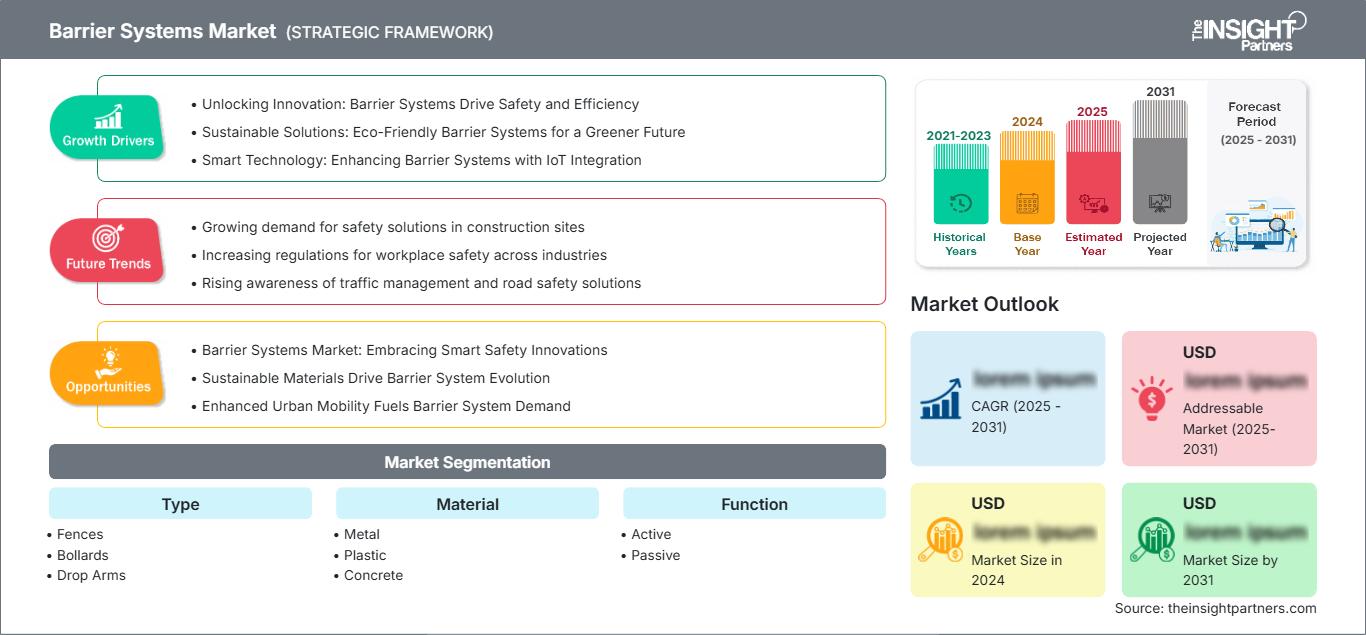
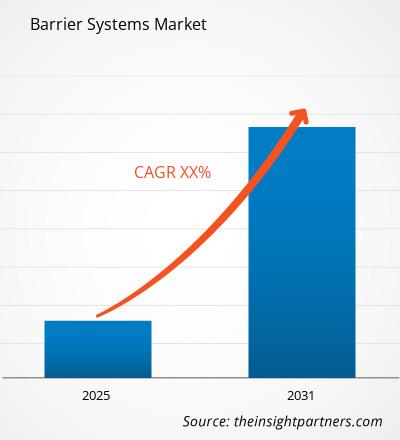
The Barrier Systems Market was valued at US$ 25.99 Billion in 2025 and is projected to reach US$ 62.03 Billion by 2034, registering a 10.15% CAGR from 2026 to 2034. Growth is supported by roadway modernization, airport and railway infrastructure development, rising safety requirements, and increasing adoption of engineered systems designed to manage vehicle intrusion and protect people and assets. The market is expanding as transportation agencies, infrastructure owners, airports, and industrial facilities increase investment in physical protection, access control, and roadside safety.
North America represents a mature but resilient demand center, supported by roadway rehabilitation, work-zone protection, airport security upgrades, and replacement of aging safety infrastructure. The Barrier Systems Market size in the region is influenced by government transportation expenditure, stricter roadside safety requirements, and modernization of bridges and highways. The region is expected to expand at a ~8% CAGR through 2034, with demand increasingly favoring crash-tested, low-maintenance, modular, and technologically enabled barrier solutions.
Barrier Systems Market Assessment and Insights
Regional Outlook
- North America: ~27% of the global market in 2025 | ~8% CAGR through 2034. Market position: North America remains a major mature market because of extensive highway infrastructure, replacement requirements, work-zone safety programs, airport security investment, and established standards governing crash performance and roadside protection.
- US: ~79% of North American market revenue in 2025 | ~8% CAGR through 2034. Market position: The US is the largest national market within North America, supported by extensive highway and bridge networks, federal and state safety programs, airport infrastructure, and strong adoption of tested crash barriers and temporary traffic-management systems.
- Europe: ~24% of the global market in 2025 | ~9% CAGR through 2034. Market position: Europe is a mature but expanding market led by Germany, with the UK, France, Italy, and Spain contributing through roadway modernization, railway investment, perimeter protection, and regulatory emphasis on transportation safety.
- Asia Pacific: ~38% of the global market in 2025 | ~12% CAGR through 2034. Market position: Asia Pacific is the largest and fastest-growing regional market, supported by highway construction, airport expansion, railway development, urbanization, and rising investment in road-safety infrastructure. China leads the region, followed by India, Japan, South Korea, and Australia.
Segment Outlook
- Fences: ~31% Share in 2025 | ~10% CAGR through 2034. Market position: Fences lead the type structure because they address perimeter protection, pedestrian separation, roadway applications, airport boundaries, and industrial security. Their broad applicability creates demand across both infrastructure and private facilities.
- Airport: ~18% Share in 2025 | ~12% CAGR through 2034. Market position: Airport applications offer the strongest growth outlook because expanding passenger and cargo infrastructure requires perimeter control, vehicle access management, jet-blast protection, and protection of critical airside assets.
Competitive Coverage
A-SAFE, Automatic Systems, Avians, BBSBarriers, CT Safety Barriers Ltd, Hill & Smith Holdings PLC, Lindsay Corporation, Tata Steel, Transpo Industries, Inc., Trinity Highway Products, LLC., Valtir LLC
Methodology
The Insight Partners follows Data Collection & Secondary Research, Primary Research, Data Analysis, and Data Triangulation & Final Review to validate market estimates and insights.
Source: The Insight Partners' analysis based on proprietary research, government publications, company annual reports, investor presentations, industry databases, and expert interviews.
Barrier Systems Market has moved from traditional steel guardrails and fixed perimeter fencing systems to systems which integrate crash resistance, modularity, impact absorption, access control, and environmental application-based safety. In addition, barrier manufacturing has diversified from traditional steel-based manufacturing methods to polymer, concrete, composite, and hybrid forms. Active barriers have been designed with more integration of automation, sensors, and connected control technology along with maintenance, whereas passive barriers focus on containment and energy absorption. Therefore, future development in this market would be more inclined towards integrated safety systems customized to the specific environment for roadways, railways, airports, and security.
In coming years, the infrastructure investments in Asia Pacific, the Middle East, and certain emerging markets would provide new installation opportunities, whereas North America and Europe would continue to dominate in replacement market. Regulatory requirements, crash testing standards, airport security measures, and railway safety standards would push companies in enhancing their capabilities in product validation and engineering. The investment would also be focused on using light weight materials, corrosion resistant design, modular barriers, and active barriers which use digital monitoring system. The above factors should increase the addressable market for engineered barrier solutions.
Barrier Systems Market Report Scope
| Report Attribute | Details |
|---|---|
| Market size in 2025 | US$ 25.99 Billion |
| Market Size by 2034 | US$ 62.03 Billion |
| Global CAGR (2026 - 2034) | 10.15% |
| Historical Data | 2021-2024 |
| Forecast period | 2026-2034 |
Barrier Systems Market Analysis
The infrastructure expansion, transport safety measures, and asset protection demands are the driving forces behind the Barrier Systems Market's development. Road infrastructures need guardrails, fences, temporary barriers, and impact protection systems for guiding traffic flow and protecting construction zones. Airports require perimeter fences, bollards, drop arms, and vehicle barriers; railroads use barrier systems for grade crossing protection, pedestrian guidance, and access control. The value chain comprises of steel, aluminum, polymers, concrete, paints, electronic equipment, actuators, and controls, followed by manufacturing, design, testing, installation, inspection, and maintenance stages.
The dynamics of supply are very different depending on the product category. Conventional fences and guardrail systems can be mass-produced and marketed via established construction distributors; but crash-tested barriers and access control systems need engineering and certification besides being installed on a project-specific basis. Such factors as material cost, galvanization, anti-corrosion treatment, testing requirements, and installation conditions have an effect on the economics of particular products. Manufacturing facilities and established contractor connections are sufficient for participating in the standard infrastructure projects; but engineering skills become important for airports, railroad, security, and high risk roadways.
Competitive landscape is demonstrated by barrier systems manufacturers, infrastructure providers, road safety firms, access control suppliers, steel manufacturers, and engineered protection firms, according to the Barrier Systems Market Report. Hill & Smith Holdings PLC and Lindsay Corporation remain strong within transportation safety market segment, while Tata Steel takes advantage of its knowledge of steel as well as the ability to create advanced crash-barrier materials. Transpo Industries, Inc. is specialized in providing protection for roads, bridges, railways and airports. While Automatic Systems concentrates on automated vehicle access and security barriers, A-SAFE is specialized in polymer protection. Trinity Highway Products, LLC and Valtir LLC reinforce the competitive position within the roadway safety sector.
Current investment priorities include crash testing, composite and polymer materials, automation, remote monitoring, and modular installation. For instance, Automatic Systems has created connected barriers that have predictive maintenance capabilities, while Lindsay Corporation keeps developing its range of temporary barriers and roadside impact management solutions. Strategic positioning thus is defined by the combination of product certification, production capability, application engineering, installation services, and after-market support.
● REPORT CUSTOMIZATION
Tailor This Report To Align With Your Specific Business Requirements
This report can be customized to align precisely with your business objectives, scope, and target markets. Customization options include tailored segmentation, geography, competitive analysis, and strategic insights to support informed decision-making.
Customize This Report →WHAT YOU CAN ADJUST
- ● Segmentations
- ● Geography
- ● Competitive Analysis
- ● Language Preferences
Barrier Systems Market: Strategic Insights
Regional Insights
North America Barrier Systems Market
North America is estimated to account for ~27% of the total market in 2025 and is expected to witness a ~8% CAGR up to 2034. North America is characterized by the presence of a high number of highways, bridges, airports, railway tracks, and industrial complexes that need regular maintenance and replacements. Programs for roadway rehabilitation generate demand for guardrails, crash barriers, temporary barriers, and impact attenuators, while airport and industrial security projects drive demand for fences, bollards, and access control products.
The US is the main consumption hub due to the presence of extensive transportation network along with standardized specifications for roadside safety products. Contributions come from highway rehabilitation, bridges, railroad infrastructure, and industrial use in Canada. Purchasers favor tested performance, quick installation, reduced maintenance requirements, and compatibility with current infrastructure. Modular barriers become important in case of work zones with ever-changing traffic setups.
U.S. Barrier Systems Market
America is estimated to contribute nearly 79% of North American market revenue by 2025, while its CAGR growth rate is expected to reach ~8% between 2026 and 2034. Roadway safety, bridge rehabilitation, temporary traffic management, airport security and infrastructure protection have become the main demand drivers. The federal, state and local transportation programs generate repeat business opportunities related to guardrails, crash cushions, temporary barriers and other safety products.
Lindsay Corporation, Hill & Smith Holdings PLC, Transpo Industries, Inc., Trinity Highway Products, LLC, and Valtir LLC work in various segments of the US transportation safety market. Automated Systems and A-SAFE supply solutions to the requirements of vehicle access and industrial protection. Current application trends include systems that can be quickly installed, can withstand multiple impacts, pass standard testing and require little maintenance. Retro-fittability of the solutions is also an important factor, since transportation authorities tend to upgrade existing corridors rather than reconstruct the facilities entirely.
Europe Barrier Systems Market
Europe represents approximately ~24% of global market revenue in 2025 and is expected to expand at a ~9% CAGR through 2034. Germany is the leading country in Europe, supported by its substantial road and rail infrastructure, advanced industrial base, engineering capabilities, and strong emphasis on transportation safety. Germany also provides an important manufacturing and technology base for active access-control and passive protection systems.
There have been continuous requirements for highway safety, perimeter security, railway infrastructure, and rehabilitation of infrastructure in the UK. In France, there is a combination of roadway modernization along with the requirement for airport and public infrastructure security. Opportunities in Italy include motorway rehabilitation, bridge constructions, railways, and urban transportation infrastructures. Spain has its opportunities arising out of the need for road infrastructure maintenance, airport constructions, and transport facilities for tourism.
European manufacturers now increasingly compete in engineering customization, modular products, corrosion resistance, and lifecycle services. Since Europe has reached a maturity stage in terms of infrastructure, hence replacements and modernizations form a major part of the demands here. Besides, there are active barriers that gain importance at sites requiring automated access control and monitoring systems. In addition to active barriers, passive barriers such as guardrails, fences, and bollards continue to be significant in large transportation infrastructures.
APAC Barrier Systems Market
Asia Pacific accounts for approximately ~38% of global Barrier Systems Market Share in 2025 and is expected to grow at a ~12% CAGR through 2034, making it the largest and fastest-growing regional market. China is the leading country in Asia Pacific, supported by extensive highway, railway, airport, and urban infrastructure development.
The role played by Japan and South Korea is in terms of their sophisticated transportation and industrial infrastructure, and the rapid expansion of India takes place through highways, airports, railways, and cities. The need in Australia arises from its requirements in road safety, mining, transport, and perimeter. Regional procurement now takes into account crashworthiness, durability, quick installations, and material savings, providing chances to global players and regional producers.
Middle East & Africa Barrier Systems Market
Middle East and Africa demand is supported by transportation infrastructure development, airport expansion, urban security, highway projects, and industrial facilities. Saudi Arabia is the leading country in the Middle East & Africa region where evidence supports a clear position, reflecting large infrastructure programs, new transportation assets, and investment in secure access and perimeter protection.
The UAE will profit from projects in airports, logistics, tourism, and urban infrastructure, and South Africa will retain projects for highways, railroads, industrial estates, and public infrastructure. Rest of MEA markets will be affected by road construction, border infrastructure, industrial development, and security considerations. Companies that can cater to high temperatures, dust, corrosion, high traffic volume, and difficult installation situations will enjoy a competitive edge.
Segmentation Analysis
Type
The Type segment in the Barrier Systems Market includes Fences, Bollards, Drop Arms, and Guardrail. Fences represent the largest type category and are expected to record a ~10% CAGR from 2026 to 2034. Their broad application across perimeter protection, transportation corridors, airports, industrial sites, and pedestrian separation supports a diverse demand base. Guardrails remain essential for roadway containment, while bollards and drop arms are increasingly used for controlled vehicle access and asset protection.
- Fences: Fences provide continuous perimeter control and separation across airports, roadways, railway properties, industrial facilities, and secure sites. Demand is influenced by security requirements, pedestrian management, asset protection, and the need for durable boundaries that can be integrated with access-control systems.
- Bollards: Bollards protect buildings, pedestrians, equipment, and restricted areas from unauthorized or accidental vehicle movement. Fixed and retractable designs serve different security requirements, with demand increasingly influenced by urban safety, industrial protection, and automated access management.
- Drop Arms: Drop arms provide controlled vehicle access at entrances, parking areas, restricted facilities, and transportation sites. Their strategic value lies in combining rapid opening and closing with straightforward visual control, allowing operators to regulate vehicle movement without large physical gates.
- Guardrail: Guardrails are central to roadway safety because they redirect errant vehicles and protect hazards, bridge edges, medians, and roadside assets. Demand is closely linked to highway construction, rehabilitation, crash-testing requirements, and replacement of aging roadside systems.
Material
The Material segment covers Metal, Plastic, and Concrete and is projected to expand at a ~9% CAGR from 2026 to 2034. Metal remains important for structural strength and roadside containment, while plastic solutions are increasingly used where flexibility, corrosion resistance, visibility, or lightweight deployment is valued. Concrete continues to serve high-strength permanent applications where mass and durability are central to performance.
- Metal: Metal barriers dominate applications requiring structural strength, impact resistance, and established crash-test performance. Steel remains especially important for guardrails, fences, and roadway systems, while coatings and galvanizing extend service life in demanding outdoor environments.
- Plastic: Plastic systems provide lightweight handling, corrosion resistance, flexibility, and reduced installation complexity. They are particularly relevant for temporary traffic management, industrial impact protection, channelization, and applications where repeated deployment or relocation is required.
- Concrete: Concrete provides substantial mass and durable containment for permanent roadway, bridge, median, and infrastructure applications. Its use is strongest where physical separation, resistance to vehicle impact, and long service life outweigh the logistical advantages of lighter barrier materials.
Function
The Function segment consists of Active and Passive systems and is expected to grow at a ~10% CAGR from 2026 to 2034. Passive barriers remain fundamental to roadway and perimeter protection, while active systems are gaining importance where controlled movement, automated access, monitoring, and rapid response are required. Integration with sensors and centralized controls is broadening the role of active protection.
- Active: Active systems control access or movement through mechanisms such as rising arms, automated gates, retractable bollards, and other powered devices. Their strategic importance is increasing at airports, high-security sites, parking facilities, logistics centers, and controlled transportation entrances.
- Passive: Passive barriers provide continuous protection without requiring powered movement. Guardrails, fixed bollards, fences, and permanent containment structures remain widely deployed because of their durability, straightforward operation, and suitability for protecting infrastructure from vehicle intrusion or accidental impact.
Application
The Application segment includes Airport, Roadway, and Railway. Roadway applications represent the largest demand pool, while Airport applications are expected to grow at a ~12% CAGR from 2026 to 2034. The Barrier Systems Market scope increasingly encompasses systems that protect transportation infrastructure, manage access, reduce collision consequences, and separate people from moving vehicles.
- Airport: Airport applications include perimeter fencing, jet-blast protection, bollards, vehicle barriers, and controlled access systems. Demand is driven by expansion of airside infrastructure, security requirements, asset protection, and the need to separate vehicles, pedestrians, aircraft, and sensitive operational areas.
- Roadway: Roadway applications include guardrails, temporary barriers, crash cushions, fences, bollards, and traffic-control systems. Demand is strongly linked to highway construction, bridge rehabilitation, work-zone safety, median protection, and requirements for tested vehicle-containment performance.
- Railway: Railway applications require barriers for crossings, station access, perimeter control, pedestrian separation, and infrastructure protection. Investment in rail networks and urban transit systems creates opportunities for systems that improve access management while reducing interaction between people, vehicles, and rail operations.
Opportunity Snapshot
| Application | Revenue Contribution | Trend Tag | Adoption Stage |
| Airport | High | Airside Security | Scaling |
| Roadway | High | Crash Protection | Mature |
| Railway | Medium | Crossing Safety | Scaling |
Barrier Systems Market Growth Drivers and Impact Analysis
Expansion of Highway and Bridge Infrastructure
Highway and bridge construction is a fundamental demand driver because every new or rehabilitated transportation corridor requires some combination of guardrails, median barriers, temporary systems, impact attenuators, fences, and access-control products. Expanding road networks in Asia Pacific are creating new installations, while mature markets are generating replacement and retrofit demand. Bridge rehabilitation can require specialized containment systems capable of addressing constrained geometries and changing traffic patterns. The commercial impact extends beyond initial equipment supply because transportation agencies also require replacement components, inspections, maintenance, and temporary protection during construction. Manufacturers that can provide certified products alongside engineering and installation support are therefore positioned to participate across the project lifecycle rather than relying solely on new construction orders.
Rising Requirements for Transportation Safety and Vehicle Containment
Road-safety authorities and infrastructure owners increasingly emphasize systems capable of containing, redirecting, or stopping errant vehicles while reducing risks to occupants and roadside workers. Crash-testing and performance standards influence product selection, creating a technical barrier to entry for manufacturers without validated designs. This environment favors suppliers that invest in testing, engineering simulation, materials development, and field performance. Demand is also expanding beyond conventional highways into urban corridors, work zones, bridges, tunnels, and specialized facilities. As agencies seek measurable safety outcomes, purchasing decisions increasingly consider tested performance, repairability, deployment speed, and compatibility with existing infrastructure. The result is a shift toward engineered products rather than purely commodity-oriented barrier components.
Growth of Airport, Railway, and Critical-Infrastructure Protection
Transportation infrastructure is becoming more complex, increasing the need to separate vehicles, pedestrians, restricted assets, and operational areas. Airports require perimeter fencing, bollards, vehicle barriers, and jet-blast protection, while railway projects need crossing barriers, pedestrian controls, and secure boundaries. Data centers, logistics facilities, industrial plants, and government sites also use barrier systems to reduce vehicle intrusion and manage access. These applications expand the market beyond traditional roadside safety and support higher-value products with active controls, sensors, automated operation, and specialized materials. The impact is particularly important for suppliers that can integrate barrier hardware with access-control platforms and monitoring systems, allowing them to address security, safety, and operational requirements through a unified infrastructure solution.
Barrier Systems Market Future Trends
Connected and Predictive Barrier Management
Barrier Systems Market trends are expected to increasingly center on connected systems that provide operating status, access events, impact information, fault alerts, and maintenance indicators. Active barriers can be integrated with sensors, cameras, access-control software, and centralized facility-management platforms, allowing operators to monitor equipment without continuous physical inspection. Predictive maintenance can reduce unplanned downtime by identifying motor, actuator, or mechanical issues before failure. For airports, logistics centers, toll facilities, and high-security locations, connected barriers can also generate operational data that helps optimize traffic flows and improve incident response. Over time, connectivity is likely to become a differentiating feature rather than an optional enhancement in higher-value active barrier applications.
Material Substitution and Lightweight Barrier Engineering
Manufacturers are expected to increase development of polymer, composite, aluminum, and hybrid barrier solutions alongside conventional steel and concrete products. The objective is not simply to reduce weight but to improve corrosion resistance, impact absorption, installation speed, repairability, and lifecycle economics. Polymer systems can provide flexibility and energy dissipation, while composite materials can address corrosion and weight challenges in specialized environments. Steel will remain important for high-strength roadway containment, but material engineering will increasingly be application-specific. This trend can create opportunities for suppliers capable of validating alternative materials through rigorous testing while maintaining compliance with transportation and infrastructure safety requirements.
Barrier Systems Market Opportunities
Modernization of Transportation Corridors in Emerging Economies
Emerging markets provide substantial opportunities as governments expand highways, airports, railways, logistics corridors, and urban transportation systems. Procurement programs can create demand for complete barrier packages rather than isolated components, particularly where new corridors require fencing, guardrails, access controls, and temporary construction protection. The Barrier Systems Market Forecasts should therefore be assessed alongside infrastructure investment pipelines, roadway safety programs, airport expansion, and railway modernization. Suppliers can strengthen their position by establishing local manufacturing or assembly, engineering partnerships, and distribution networks that reduce installation lead times. Products adapted to local climatic conditions, procurement specifications, and maintenance capabilities can also improve competitiveness in large infrastructure programs.
Integrated Safety Solutions for Airports and High-Security Facilities
Airports, logistics hubs, data centers, industrial complexes, and government facilities offer opportunities for integrated barrier solutions combining physical protection with automated access control. Buyers increasingly require systems that can distinguish authorized traffic, restrict vehicle movement, protect vulnerable assets, and provide operational visibility. Suppliers can pursue this opportunity by combining fences, bollards, drop arms, road blockers, sensors, and monitoring platforms into application-specific packages. Modular designs can further reduce installation disruption when facilities are upgraded without major civil works. The opportunity is particularly attractive for companies with capabilities spanning mechanical engineering, electronics, cybersecurity, and project integration because these requirements create higher-value solutions than standalone physical barriers.
Recent Developments
- July 2026: A-SAFE has announced the launch of the Bollard Bumper, a new retrofit impact protection solution designed to help warehouses, manufacturing facilities and distribution centres protect existing bollards from everyday vehicle impacts. Developed to address a common challenge faced across industrial environments, the Bollard Bumper helps reduce damage to bollards, surrounding concrete and workplace vehicles without the need for costly infrastructure replacement or disruptive groundworks.
- February 2026: Lindsay introduces the Road Runner Truck-Mounted Attenuator (TMA), a breakthrough in work zone safety and efficiency. Inspired by direct customer feedback and designed to overcome the limitations of legacy TMAs, the Road Runner delivers unmatched durability, faster deployment, and innovative design features that keep crews safe and operations moving.
- August 2025: Delta Scientific Corporation, the global leader in high-impact vehicle barricade systems, is proud to announce the launch of its newest innovation: the DSC50 “S” Barrier, a lightweight, crash-rated security solution tailored for temporary deployment across high-traffic urban environments. Motivated by recent public safety challenges and a mounting global awareness of vehicular threats, Delta’s engineering team designed the DSC50 “S” Barrier to provide rapid, visually cohesive, and budget-sensitive protection for municipalities, venue operators, and security leaders.
Frequently Asked Questions

- Comprehensive Market Sizing and Forecast Analysis
- Detailed Segmentation Analysis
- In-Depth Market Dynamics Assessment
- Regional and Country-Level Insights
- Competitive Landscape and Company Benchmarking
- Strategic Business Intelligence
Recent Reports
Testimonials

The Insight Partners provided valuable market intelligence that supported our global go-to-market strategy. Their team was professional, responsive, and attentive to our feedback, providing thoughtful analysis and helpful methodological clarifications throughout the project.
Junmo Kim Chief Financial Officer (CFO), Enertech Co., Ltd.
The Insight Partners' SCADA System Market report is comprehensive, with valuable insights on current trends and future forecasts. The team was highly professional, responsive, and supportive throughout. We are very satisfied and highly recommend their services.
RAN KEDEM Partner, Reali Technologies LTDs
I requested a report on a very specific software market and the team produced the report in a few days. The information was very relevant and well presented. I then requested some changes and additions to the report. The team was again very responsive and I got the final report in less than a week.
JEAN-HERVE JENN Chairman, Future Analytica
We worked with The Insight Partners for an important market study and forecast. They gave us clear insights into opportunities and risks, which helped shape our plans. Their research was easy to use and based on solid data. It helped us make smart, confident decisions. We highly recommend them.
PIYUSH NAGPAL Sr. Vice President, High Beam Global
The Insight Partners delivered insightful, well-structured market research with strong domain expertise. Their team was professional and responsive throughout. The user-friendly website made accessing industry reports seamless. We highly recommend them for reliable, high-quality research services
YUKIHIKO ADACHI CEO, Deep Blue, LLC.
This is the first time I have purchased a market report from The Insight Partners.While I was unsure at first, I visited their web site and felt more comfortable to take the risk and purchase a market report.I am completely satisfied with the quality of the report and customer service. I had several questions and comments with the initial report, but after a couple of dialogs over email with their analyst I believe I have a report that I can use as input to our strategic planning process.Thank you so much for taking the extra time and making this a positive experience.I will definitely recommend your service to others and you will be my first call when we need further market data.
JOHN SUZUKI President and Chief Executive Officer, Board Director, BK Technologies
I wish to appreciate your support and the professionalism you displayed in the course of attending to my request for information regarding to infectious disease IVD market in Nigeria. I appreciate your patience, your guidance, and the fact that you were willing to offer a discount, which eventually made it possible for us to close a deal. I look forward to engaging The Insight Partners in the future, all thanks to the impression you have created in me as a result of this first encounter.
DR CHIJIOKE ONYIA MANAGING DIRECTOR, PineCrest Healthcare Ltd.Reason to Buy
- Informed Decision-Making
- Understanding Market Dynamics
- Competitive Analysis
- Identifying Emerging Markets
- Customer Insights
- Market Forecasts
- Risk Mitigation
- Boosting Operational Efficiency
- Strategic Planning
- Investment Justification
- Tracking Industry Innovations
- Aligning with Regulatory Trends





 Get Free Sample for