
Beauty Tech Market Size & Growth Drivers by 2031
Beauty Tech Market Size and Forecast (2021 - 2031), Global and Regional Share, Trend, and Growth Opportunity Analysis Report Report Coverage : by Type (Acne Devices, Hair removal devices, Cleansing devices, Others), Mode of Operations (Electric, battery operated and mannual), and Geography
- Status : Data Released
- Report Code : TIPRE00042055
- Category : Technology, Media and Telecommunications
- No. of Pages : 150
- Available Report Formats :


- Last update date : December 03, 2025


2024 Market Size
US$ 69.65 Bn
Base year value
2031 Forecast
US$ 212.99 Bn
Projected by 2031
CAGR 2025-2031
5.09 %
Growth rate
Addressable Market
US$ 597.59 Bn
(2025-2031)
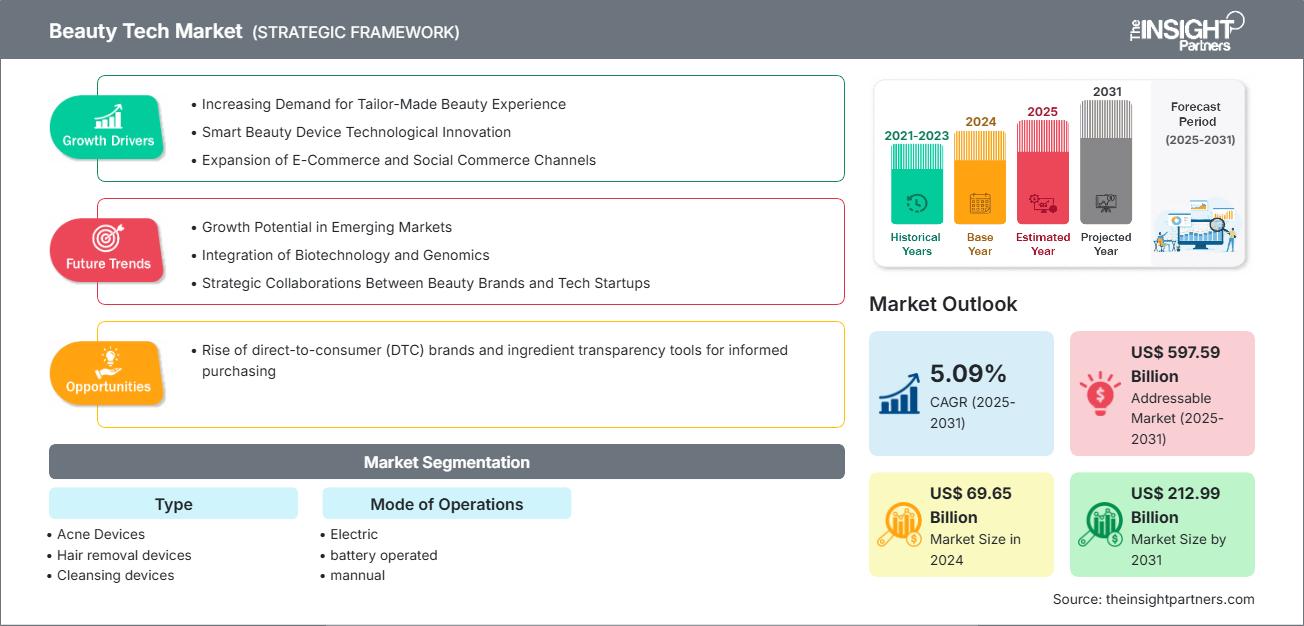
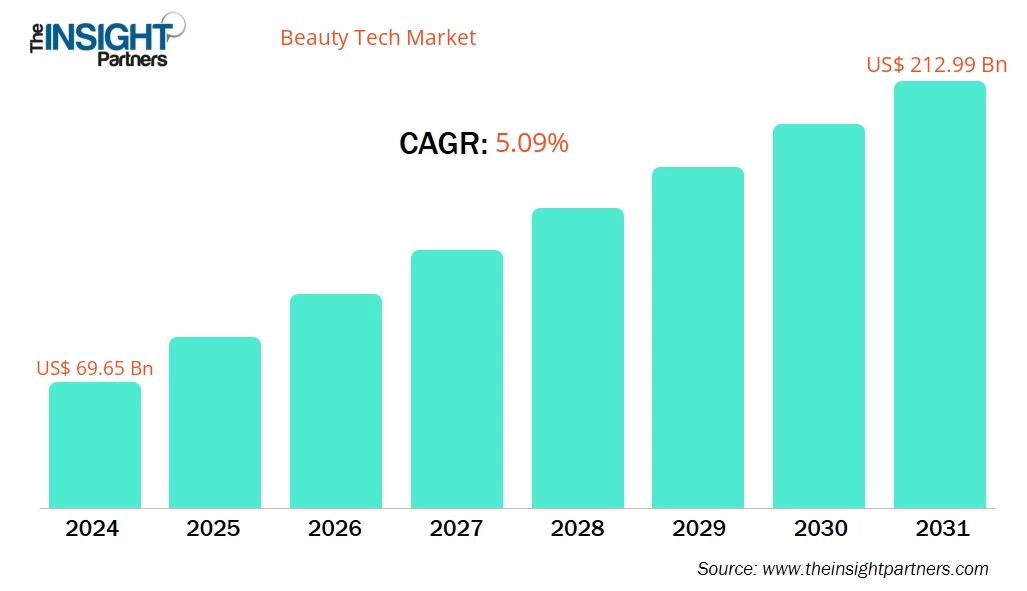
The beauty tech market size is projected to reach US$ 212.99 billion by 2031 from US$ 69.65 billion in 2024. The market is expected to register a CAGR of 5.09% during 2025–2031.
Beauty Tech Market Analysis
The beauty tech market is undergoing rapid transformation with the help of emerging technologies such as artificial intelligence, augmented reality, IoT, and biotechnology being infused into personal care. The industry is moving away from product-based thinking to developing immersive, experience-based solutions. Consumers now benefit from highly personalized offerings through smart devices, virtual consultations, and analytics-driven insights. Additionally, the growth of at-home beauty treatments, emphasis on sustainable and clean beauty, and the digitization of retail channels are redefining consumer expectations and influencing how brands design their strategies.
Beauty Tech Market Overview
Beauty technology is the process of using digital innovation in all areas of skincare, makeup, and personal grooming. It encompasses intelligent devices for skincare, virtual try-on technology for makeup, AI-based diagnostic platforms, and wearable beauty devices. They improve the overall experience of the user, enhance the efficacy of treatments, and enable very customized beauty regimens. Through data-driven, interactive use, beauty tech is revolutionizing how consumers interact with products, changing them from passive consumers to active, knowledgeable players in their beauty regimen.
Market Assessment and Insights
- Global market for Beauty Tech was valued at US$ 69.65 Billion in 2024
- Annual market size is expected to reach US$ 212.99 Billion by 2031
- Total addressable market (TAM) during 2025-2031 is projected to reach approximately US$ 597.59 Billion
- Market is anticipated to register a CAGR of 5.09% during the forecast period
- The United States represents a key market, supported by Increasing Demand for Tailor-Made Beauty Experience, Smart Beauty Device Technological Innovation, Expansion of E-Commerce and Social Commerce Channels, as well as evolving industry dynamics
- Market analysis covers North America, Europe, Asia-Pacific, South and Central America, Middle East and Africa, with growth evaluated across the forecast period
- Market opportunities such as Rise of direct-to-consumer (DTC) brands and ingredient transparency tools for informed purchasing are expected to influence market dynamics and addressable market
- Report profiles industry participants, including L'Oreal S.A., Estee Lauder Companies Inc., Procter & Gamble Co., Unilever PLC, Shiseido Co. Ltd., Coty Inc., Perfect Corp, Foreo AB, Skin Inc., Dyson Ltd., while analyzing competitive strategies and innovation developments
-
Source: The Insight Partners' analysis based on proprietary research, government publications, company annual reports, investor presentations, industry databases, and expert interviews.
● REPORT CUSTOMIZATION
Tailor This Report To Align With Your Specific Business Requirements
This report can be customized to align precisely with your business objectives, scope, and target markets. Customization options include tailored segmentation, geography, competitive analysis, and strategic insights to support informed decision-making.
Customize This Report →WHAT YOU CAN ADJUST
- ● Segmentations
- ● Geography
- ● Competitive Analysis
- ● Language Preferences
Beauty Tech Market: Strategic Insights
-
Get Top Key Market Trends of this report.This FREE sample will include data analysis, ranging from market trends to estimates and forecasts.
Beauty Tech Market Drivers and Opportunities
Market Drivers:
- Increasing Demand for Tailor-Made Beauty Experience: Today's consumers are looking for active skincare and cosmetic products specially formulated to respond to their own needs. Advanced AI algorithms currently analyze skin type, weather, lifestyle, and personal preference to give personalized product recommendations and beauty routines. Customization leads to increased customer satisfaction, enhanced product performance, and loyalty.
- Smart Beauty Device Technological Innovation: The introduction of Internet of Things (IoT)-based beauty devices has revolutionized home care rituals. Among these are LED therapy masks, artificial intelligence (AI) facial cleansing brushes, smart hair dryers, and skin sensors that now deliver outcomes equivalent to salon-style treatments. All these innovations provide ease, accuracy, and consistency, which is driving higher user take-up of high-tech beauty products.
- Expansion of E-Commerce and Social Commerce Channels: Online channels are changing how consumers shop and discover beauty products online. Augmented reality (AR) virtual try-ons, artificially intelligent (AI) skin analysis, and influencer-driven digital messaging are all spurring engagement and web sales. Virtual consultations and live-streaming experiences improve trust and interactivity, helping facilitate the adoption of beauty tech sooner rather than later.
Market Opportunities:
- Growth Potential in Emerging Markets: Asia-Pacific is projected to grow rapidly in the years ahead. Demand for AI-assisted beauty is expanding as more consumers within the region become digitally native and economic factors (e.g., rising disposable income and increased smartphone penetration) contribute. Emerging markets have opportunities for local apps to promote beauty services, region-specific formulations, and digital beauty services that meet varying consumer needs at scale.
- Integration of Biotechnology and Genomics: Advanced research in genetics, microbiome research, and biotechnology is enabling brands to produce skincare for the next generation. Products that are personalized, lab-grown, cruelty-free, and biomimetic will be more commonplace. These technologies enable beauty businesses to marry scientific precision with consumer personalization, creating new opportunities for differentiation and high-margin products.
- Strategic Collaborations Between Beauty Brands and Tech Startups: Partnerships are accelerating the co-creation of innovative solutions. Programs such as L'Oréal's Big Bang Innovation Initiative and other incubators bring together technology startups and established brands to develop AI-powered devices, smart formulations, and interactive platforms. Such collaborations drive faster market adoption and continuous technological evolution in the beauty sector.
Beauty Tech Market Report Segmentation Analysis
The beauty tech market share is analyzed across various segments to provide a clearer understanding of its structure, growth potential, and emerging trends. Below is the standard segmentation approach used in most industry reports:
By Technology:
- Artificial Intelligence (AI): AI acquires a leading role in the beauty tech landscape with a 34% market share by 2024. AI powers diagnostic tools, personalized skin care recommendations, and virtual assistants to guide users on choosing and using products.
- Augmented Reality (AR): AR creates virtual try-ons and "immersive" shopping experiences with the consumer, allowing them to picture products before purchase.
- Wearable Technology: This segment includes smart mirrors, skin sensors, and connected beauty tools that track skin health and deliver targeted treatments.
By Product Category:
- Skincare Devices: Encompasses acne treatment devices, cleansing brushes, rejuvenation devices, and anti-ageing technologies.
- Hair Care Devices: Consists of intelligent dryers, LED therapy devices, and hair growth helmets that are meant to enhance scalp health and hair density.
- Cosmetics: Includes intelligent makeup applicators, voice-activated assistants, and virtual try-on sites that improve cosmetic application and choice.
By End-Use Industry:
- Individual Consumers
- Beauty Salons and Spas
- Retail Stores
Each segment has distinct needs for personalization, device functionality, and integration with digital platforms.
By Delivery Mode:
- Direct Sales
- Retail
- Online
Online channels are rapidly gaining traction due to the rise of e-commerce, influencer marketing, and virtual consultations.
By Geography:
- North America
- Europe
- Asia Pacific
- Latin America
- Middle East & Africa
The beauty tech market in the Asia Pacific is expected to witness the fastest growth during the forecast period, driven by mobile-first consumers, tech innovation, and youth-driven demand in countries such as China, South Korea, and India.
Beauty Tech Market Report Scope
| Report Attribute | Details |
|---|---|
| Market size in 2024 | US$ 69.65 Billion |
| Market Size by 2031 | US$ 212.99 Billion |
| Global CAGR (2025 - 2031) | 5.09% |
| Historical Data | 2021-2023 |
| Forecast period | 2025-2031 |
| Segments Covered |
By Type
|
| Regions and Countries Covered |
North America
|
| Market leaders and key company profiles |
|
Beauty Tech Market Players Density: Understanding Its Impact on Business Dynamics
The Beauty Tech Market is growing rapidly, driven by increasing end-user demand due to factors such as evolving consumer preferences, technological advancements, and greater awareness of the product's benefits. As demand rises, businesses are expanding their offerings, innovating to meet consumer needs, and capitalizing on emerging trends, which further fuels market growth.
Beauty Tech Market Share Analysis by Geography
Asia Pacific is expected to grow fastest in the coming years. Emerging markets in Latin America, the Middle East, and Africa also have many untapped opportunities for beauty tech providers to expand. The beauty tech market shows a different growth trajectory in each region due to factors such as digital adoption, consumer behavior, regulatory frameworks, and innovation ecosystems.
Below is a summary of market share and trends by region:
1. North America
- Market Share: Largest region with 38% in 2024.
- Key Drivers:
- Adoption of AI and AR in skincare and makeup
- Influencer marketing and social commerce
- Rising demand for clean and sustainable beauty products
- Trends: Rise of direct-to-consumer (DTC) brands and ingredient transparency tools for informed purchasing.
2. Europe
- Market Share: Strong growth due to the luxury brand presence.
- Key Drivers:
- AR-powered virtual consultations
- Stringent sustainability regulations
- High consumer preference for premium products
- Trends: Collaborations between tech startups and heritage beauty houses, and immersive retail experiences.
3. Asia Pacific
- Market Share: Fastest-growing region driven by tech-savvy consumers.
- Key Drivers:
- Widespread use of smartphone beauty apps
- The incorporation of wearable skincare devices. There is a demand for hyper-personalized beauty routines
- Trends: Robotics in skincare, live-stream shopping, and youth-driven product innovation.
4. Latin America
- Market Share: Emerging market with rising tech adoption.
- Key Drivers:
- Rapid e-commerce growth
- Strong influencer culture shaping beauty trends
- Expanding middle-class consumer base
- Trends: Affordable smart beauty devices and localized tech solutions tailored to regional needs.
5. Middle East and Africa
- Market Share: Developing market with high potential.
- Key Drivers:
- Urbanizing and higher disposable income
- Increased focus on wellness and self-care
- Enhancing digital infrastructure
- Trends: Beauty platforms optimized for mobile and AR-based retail experiences among younger consumers.
Beauty Tech Market Players Density: Understanding Its Impact on Business Dynamics
High Market Density and Competition
Competition is intensifying due to the presence of major vendors such as L'Oréal S.A., Estée Lauder Companies Inc., and Procter & Gamble Co. Regional and niche players like Perfect Corp and Skin Inc. also contribute to the crowded market landscape. This competitive environment pushes vendors to differentiate through:
- Personalization and diagnostics for skincare, haircare and makeup routines using AI
- Virtual try-ons using Augmented Reality to increase digital shopping experiences and reduce product returns
- Eco-friendly beauty and clean beauty innovation to support sustainability-minded consumer values
- Smart device integration and IoT connectivity to provide real-time skin analysis and treatment management
Opportunities and Strategic Moves
- Collaborate with research institutions and technology startups to accelerate both product creation and the advancement of artificial intelligence.
- Expand into new market opportunities for beauty tech services and products within the local context.
- Invest in hybrid retail models that use technology via e-commerce, social commerce, and physical in-store experiences.
- Leverage Artificial Intelligence and Machine Learning to create predictive analytics, personalized marketing, and supply chain optimization.
Major Companies Operating in the Beauty Tech Market
- L'Oréal S.A.
- Estée Lauder Companies Inc.
- Procter & Gamble Co.
- Unilever PLC
- Shiseido Co. Ltd.
- Coty Inc.
- Perfect Corp
- Foreo AB
- Skin Inc.
- Dyson Ltd.
Disclaimer: The companies listed above are not ranked in any particular order.
Beauty Tech Market News and Recent Developments
- L'Oréal S.A. acquired Kering's beauty unit for $4.7 billion, securing long-term licenses for Gucci and other prestige brands. The company also launched its €20 million "Act for Dermatology" initiative to expand global access to skin health solutions.
- Estée Lauder Companies Inc. opened a Global Fragrance Atelier in Paris to drive next-gen perfume innovation and debuted on Amazon Mexico's Premium Beauty store. The company also honored female scientists at the 2025 Inspiring Women in Science Awards.
- Procter & Gamble Co. announced a quarterly dividend payment of $1.0568 per share and confirmed its board leadership team during the annual meeting. The company is also making investments in sustainable packaging and employee well-being in its ESG strategy.
- Unilever PLC sold its Kate Somerville skincare brand and announced plans to spin off its Ice Cream division. The company is leveraging AI to enhance consumer engagement and drive premium brand growth.
- Shiseido Co. Ltd. won top honors at the IFSCC Congress for microbiome and age spot research, and its luxury restaurant L'OSIER retained three Michelin stars for the eighth consecutive year.
Beauty Tech Market Report Coverage and Deliverables
The "Beauty Tech Market Size and Forecast (2025–2031)" report provides a detailed analysis of the market covering the following areas:
- Beauty Tech Market size and forecast at global, regional, and country levels for all the key market segments covered under the scope
- Beauty Tech Market trends, as well as market dynamics such as drivers, restraints, and key opportunities
- Detailed PEST and SWOT analysis
- Beauty Tech Market analysis covering key market trends, global and regional framework, major players, regulations, and recent market developments
- Industry landscape and competition analysis covering market concentration, heat map analysis, prominent players, and recent developments in the Beauty Tech Market
- Detailed company profiles
Frequently Asked Questions

- Comprehensive Market Sizing and Forecast Analysis
- Detailed Segmentation Analysis
- In-Depth Market Dynamics Assessment
- Regional and Country-Level Insights
- Competitive Landscape and Company Benchmarking
- Strategic Business Intelligence
Recent Reports
Testimonials

The Insight Partners' SCADA System Market report is comprehensive, with valuable insights on current trends and future forecasts. The team was highly professional, responsive, and supportive throughout. We are very satisfied and highly recommend their services.
RAN KEDEM Partner, Reali Technologies LTDs
I requested a report on a very specific software market and the team produced the report in a few days. The information was very relevant and well presented. I then requested some changes and additions to the report. The team was again very responsive and I got the final report in less than a week.
JEAN-HERVE JENN Chairman, Future Analytica
We worked with The Insight Partners for an important market study and forecast. They gave us clear insights into opportunities and risks, which helped shape our plans. Their research was easy to use and based on solid data. It helped us make smart, confident decisions. We highly recommend them.
PIYUSH NAGPAL Sr. Vice President, High Beam Global
The Insight Partners delivered insightful, well-structured market research with strong domain expertise. Their team was professional and responsive throughout. The user-friendly website made accessing industry reports seamless. We highly recommend them for reliable, high-quality research services
YUKIHIKO ADACHI CEO, Deep Blue, LLC.
This is the first time I have purchased a market report from The Insight Partners.While I was unsure at first, I visited their web site and felt more comfortable to take the risk and purchase a market report.I am completely satisfied with the quality of the report and customer service. I had several questions and comments with the initial report, but after a couple of dialogs over email with their analyst I believe I have a report that I can use as input to our strategic planning process.Thank you so much for taking the extra time and making this a positive experience.I will definitely recommend your service to others and you will be my first call when we need further market data.
JOHN SUZUKI President and Chief Executive Officer, Board Director, BK Technologies
I wish to appreciate your support and the professionalism you displayed in the course of attending to my request for information regarding to infectious disease IVD market in Nigeria. I appreciate your patience, your guidance, and the fact that you were willing to offer a discount, which eventually made it possible for us to close a deal. I look forward to engaging The Insight Partners in the future, all thanks to the impression you have created in me as a result of this first encounter.
DR CHIJIOKE ONYIA MANAGING DIRECTOR, PineCrest Healthcare Ltd.Reason to Buy
- Informed Decision-Making
- Understanding Market Dynamics
- Competitive Analysis
- Identifying Emerging Markets
- Customer Insights
- Market Forecasts
- Risk Mitigation
- Boosting Operational Efficiency
- Strategic Planning
- Investment Justification
- Tracking Industry Innovations
- Aligning with Regulatory Trends





 Get Free Sample for