
AI In Software Development Market Share, Growth & Forecast by 2034
Coverage: By Application (Code Generation & Auto-completion, Automated Testing, Bug Detection, Performance Optimization, Project Management & Planning), Technology (Machine Learning, Natural Language Processing, Generative AI, Computer Vision), Deployment (Cloud, On Premises, Hybrid), End User (Healthcare, Finance, Retail, Manufacturing, IT & Telecommunications, and Other Industries), and Geography (North America, Europe, Asia Pacific, the Middle East and Africa, and South and Central America)
- Status : Upcoming
- Report Code : TIPRE00043092
- Category : Technology, Media and Telecommunications
- No. of Pages : 150
- Available Report Formats :


- Last update date : August 12, 2026


2025 Market Size
US$ 690 Mn
Base year value
2034 Forecast
US$ 14,512 Mn
Projected by 2034
CAGR 2026-2034
39.6 %
Growth rate
Addressable Market
US$ 46,546.37 Mn
(2026-2034)
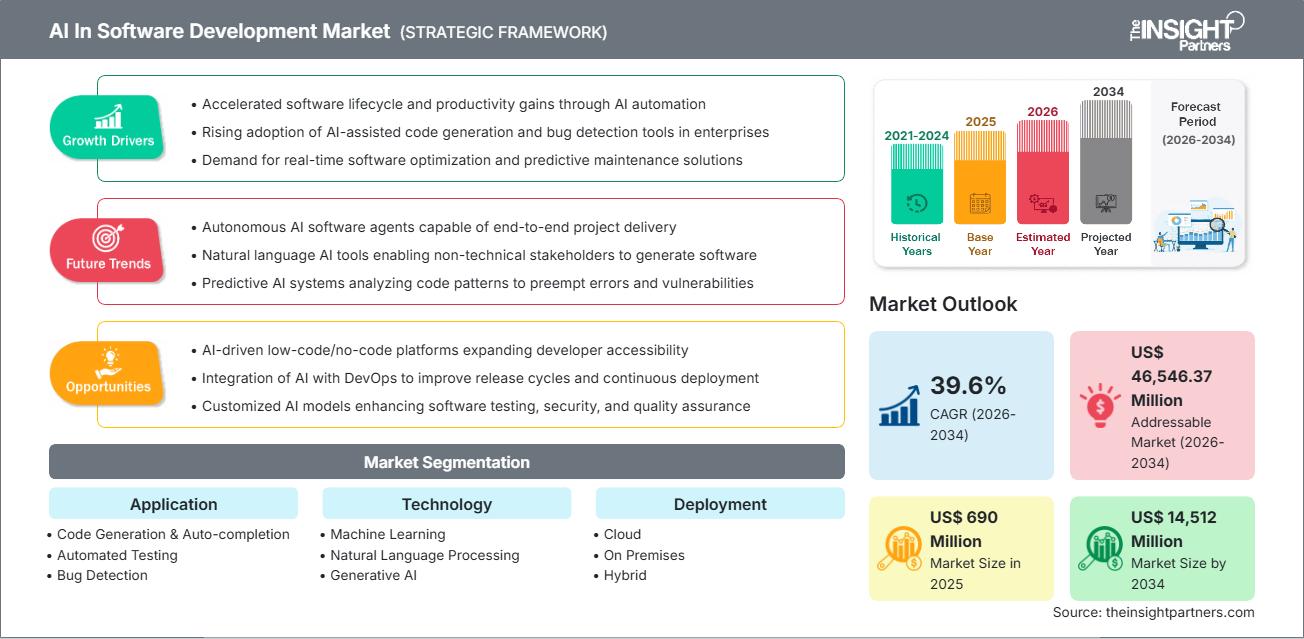
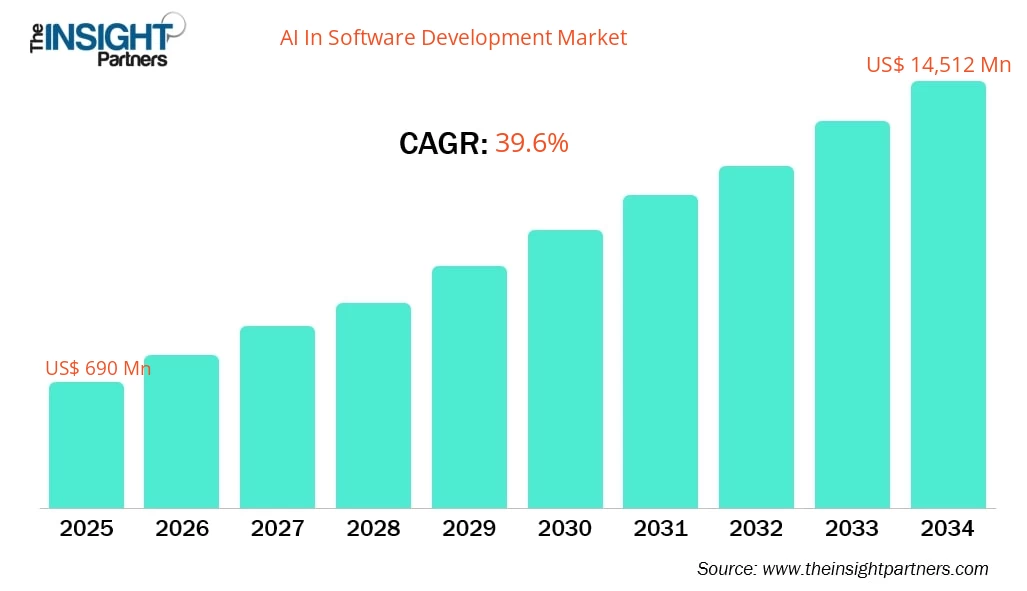
The AI in software development market is projected to grow from US$ 690 Million in 2025 to US$ 14,512 Million by 2034, recording a CAGR of 39.6% during 2026–2034. The market is moving from developer assistance toward embedded software lifecycle automation, where code generation, testing, debugging, project planning, and optimization are increasingly supported by machine learning, natural language processing, and generative AI models.
North America remains the most mature regional base for AI in software development market size expansion, supported by enterprise cloud adoption, DevOps modernization, venture investment, and concentration of platform providers. Validated external benchmarks indicate North America held about 42.1% of the market in 2024, supporting a 2025 modeled share range of 41–43% and a 2026–2034 CAGR range of 37–40%.
AI In Software Development Market Assessment and Insights
- North America: Accounted for an estimated 41–43% share in 2025 and is expected to grow at a CAGR of 37–40% during 2026–2034, led by cloud-native engineering, AI coding assistants, and agentic DevOps adoption.
- US: Represented 82–85% of North America in 2025 and is projected to expand at a CAGR of 38–41%, supported by hyperscaler platforms and enterprise software spending.
- Europe: Held an estimated 23–25% share in 2025 and is expected to grow at a CAGR of 35–38%, with the UK, Germany, and France leading regulated enterprise adoption.
- Asia Pacific: Captured an estimated 25–27% share in 2025 and is projected to grow at a CAGR of 42–45%, led by China, India, Japan, South Korea, and Australia.
- Largest Segment: Code Generation and Auto-completion held an estimated 31–33% market share in 2025 and is expected to grow at a CAGR of 38–41% during 2026–2034.
- High Growth Segment: Automated Testing held an estimated 18–20% share in 2025 and is forecast to grow at a CAGR of 43–46%, as QA automation becomes integral to AI-enabled delivery pipelines.
- Key companies analyzed in detail: Microsoft Corporation, International Business Machines Corporation, OpenAI OpCo, LLC, NVIDIA Corporation, Alphabet Inc., Amazon Web Services, Inc., Accenture plc, DataRobot, Inc., InData Labs, DataToBiz, and Neoteric.
Source: The Insight Partners' analysis based on proprietary research, government publications, company annual reports, investor presentations, industry databases, and expert interviews.
The AI in software development market report has evolved from autocomplete tools into broader engineering intelligence platforms. Earlier adoption centered on code snippets and syntax correction, while current deployments cover pull-request generation, automated test creation, defect detection, documentation, and release orchestration. Market growth is now linked to how effectively enterprises integrate AI into DevOps governance, developer experience, and secure software supply chains.
Forward momentum is expected to strengthen across emerging digital economies as cloud access, developer talent pools, and software outsourcing ecosystems expand. Enterprises are also prioritizing private and hybrid deployment to protect intellectual property while using generative AI for repetitive engineering work. These factors create a wider commercialization runway for vendors offering secure, auditable, and workflow-integrated AI development platforms.
AI In Software Development Market Report Scope
| Report Attribute | Details |
|---|---|
| Market size in 2025 | US$ 690 Million |
| Market Size by 2034 | US$ 14,512 Million |
| Global CAGR (2026 - 2034) | 39.6% |
| Historical Data | 2021-2024 |
| Forecast period | 2026-2034 |
AI In Software Development Market Analysis
Demand is being driven by software complexity, shortened release cycles, and persistent pressure to improve developer productivity. Enterprises increasingly use AI to translate natural language requirements into code, detect defects earlier, and prioritize testing. The AI in software development market growth trajectory is also supported by cloud-based development environments, model APIs, and enterprise repositories that provide contextual data for intelligent engineering tools.
The value chain includes model developers, cloud providers, integrated development environment vendors, DevOps platform providers, system integrators, and enterprise software teams. Microsoft Corporation, Alphabet Inc., Amazon Web Services, Inc., International Business Machines Corporation, OpenAI OpCo, LLC, NVIDIA Corporation, and Accenture plc are strengthening platform depth, while specialists such as DataRobot, Inc., InData Labs, DataToBiz, and Neoteric support implementation and domain customization.
● REPORT CUSTOMIZATION
Tailor This Report To Align With Your Specific Business Requirements
This report can be customized to align precisely with your business objectives, scope, and target markets. Customization options include tailored segmentation, geography, competitive analysis, and strategic insights to support informed decision-making.
Customize This Report →WHAT YOU CAN ADJUST
- ● Segmentations
- ● Geography
- ● Competitive Analysis
- ● Language Preferences
AI In Software Development Market: Strategic Insights
Regional Insights
North America AI in software development market
North America is estimated to hold 41–43% AI in software development market share in 2025, supported by a dense base of cloud providers, developer platforms, cybersecurity vendors, and enterprise software buyers. The region benefits from early adoption of AI coding assistants, advanced CI/CD practices, and strong investment in secure software automation.
The region is projected to grow at a CAGR of 37–40% during 2026–2034. Enterprises are moving from individual productivity tools toward managed AI engineering workflows with governance, repository controls, and audit trails. This shift supports demand for AI-enabled code review, test generation, performance optimization, and project planning capabilities.
U.S. AI in software development Market
The US represented an estimated 82–85% of North America in 2025 and is expected to grow at a CAGR of 38–41% during 2026–2034. Its leadership reflects the presence of major platform providers, large software engineering workforces, and rapid enterprise pilots of generative AI across development workflows.
Adoption is strongest in cloud software, financial services, healthcare technology, and IT services. Companies are applying AI to reduce development backlogs, improve test coverage, modernize legacy code, and support regulated deployment processes. Agentic coding and secure repository integration are becoming key purchase criteria.
Europe AI in software development Market
Europe held an estimated 23–25% share in 2025 and is forecast to grow at a CAGR of 35–38% through 2034. The UK leads early enterprise deployment, while Germany emphasizes industrial software, embedded systems, and compliance-heavy engineering environments. France, Italy, and Spain are expanding adoption through digital transformation programs.
European buyers prioritize explainability, data protection, and vendor accountability. This creates demand for hybrid and on-premises deployment models, especially in finance, manufacturing, telecommunications, and public-sector software. Regional growth is also supported by cloud migration and modernization of legacy applications.
APAC AI in software development Market
APAC accounted for an estimated 25–27% share in 2025 and is projected to grow at a CAGR of 42–45% during 2026–2034. China, India, Japan, South Korea, and Australia are leading adoption as enterprises scale cloud-native applications and developer productivity programs.
India’s software services base, Japan’s modernization needs, South Korea’s electronics ecosystem, and China’s platform economy support fast uptake. The region’s growth is reinforced by digital public infrastructure, AI policy support, and rising demand for automated testing and code quality management.
Middle East & Africa AI in software development Market
Middle East and Africa is expected to record a CAGR of 34–37% during 2026–2034, led by Saudi Arabia, the UAE, South Africa, and broader digital infrastructure modernization. Demand is rising as governments, energy companies, banks, and telecom operators expand software-led transformation programs.
Cloud adoption, smart city initiatives, and enterprise automation projects are creating opportunities for AI-assisted development. Buyers in the region typically prioritize secure deployment, system integration, and support for multilingual or domain-specific software engineering requirements.
Segmentation Analysis
Application
Application is expected to grow at a CAGR of 39–42% during 2026–2034. The AI in software development market scope across applications is expanding as enterprises combine code generation, automated testing, bug detection, performance optimization, and project planning into unified delivery pipelines.
- Code Generation and Auto-completion lead adoption as developers use AI to accelerate boilerplate coding, API integration, documentation, and refactoring while maintaining human review for architecture and security.
- Automated Testing is gaining strategic importance as enterprises use AI to generate unit tests, regression cases, and risk-based validation workflows across complex application portfolios.
- Bug Detection supports earlier defect identification by analyzing code patterns, dependency risks, and historical issue data before errors reach production environments.
- Performance Optimization helps engineering teams identify inefficient queries, memory bottlenecks, latency issues, and infrastructure misalignment across cloud-native applications.
- Project Management and Planning uses AI to summarize requirements, estimate tasks, identify sprint risks, and improve alignment between product, engineering, and delivery teams.
Technology
Technology is expected to grow at a CAGR of 38–41% during 2026–2034. Machine learning, natural language processing, generative AI, and computer vision collectively support intelligent coding, contextual search, repository analysis, and software lifecycle automation.
- Machine Learning remains foundational for pattern recognition, defect prediction, code recommendation, anomaly detection, and workflow optimization across engineering environments.
- Natural Language Processing enables requirement interpretation, documentation generation, conversational coding, ticket summarization, and developer knowledge retrieval.
- Generative AI is central to code synthesis, test creation, refactoring, documentation, and agentic development tasks that require contextual reasoning.
- Computer Vision supports niche but growing use cases such as UI validation, design-to-code conversion, visual defect detection, and screenshot-based bug interpretation.
Deployment
Deployment is expected to grow at a CAGR of 37–40% during 2026–2034. Cloud remains dominant due to scalability and model access, while on-premises and hybrid deployments address intellectual property, regulatory, and repository security concerns.
- Cloud supports rapid adoption through managed AI services, integrated development tools, scalable inference, and continuous model upgrades.
- On Premises is preferred by organizations handling sensitive source code, regulated workloads, sovereign data requirements, or restricted development environments.
- Hybrid is gaining traction as enterprises combine cloud model access with private repositories, governance layers, and secure runtime controls.
End User
End User is expected to grow at a CAGR of 40–43% during 2026–2034. Adoption spans healthcare, finance, retail, manufacturing, IT and telecommunications, and other industries that need faster software delivery with improved reliability.
- Healthcare uses AI-assisted development to modernize patient platforms, improve interoperability, and accelerate compliant software releases.
- Finance applies AI tools to legacy modernization, secure coding, regulatory reporting systems, and high-volume digital banking applications.
- Retail focuses on e-commerce personalization, inventory applications, customer analytics, and rapid feature delivery across omnichannel platforms.
- Manufacturing adopts AI development tools for industrial software, connected products, predictive maintenance systems, and operational applications.
- IT and Telecommunications remain a core adopter due to large developer teams, cloud-native platforms, network automation, and continuous software delivery needs.
Opportunity Snapshot
| Application | Revenue Contribution | Trend Tag | Adoption Stage |
| Code Generation and Auto-completion | High | Code Copilots | Mature |
| Automated Testing | High | Test Automation | Scaling |
| Bug Detection | Medium | Defect Intelligence | Scaling |
| Performance Optimization | Medium | Runtime Tuning | Emerging |
| Project Management and Planning | Medium | Sprint Intelligence | Emerging |
AI In Software Development Market Growth Drivers and Impact Analysis
Enterprise Need for Faster and Safer Software Delivery
Enterprises have to develop and deliver digital products at an increasing speed while maintaining quality and security. This issue can be solved by using AI-empowered development tools, which will help accelerate the process of writing code, testing, defect identification, and documentation. This approach works especially well for large companies with complex repositories and engineering teams because even small productivity improvements yield significant results.
Integration of Generative AI into Developer Workflows
Generative AI technology is no longer an experiment but part of the standard toolkit for software development workflows. The fact that artificial intelligence tools are integrated into IDEs, version control systems, CI/CD pipelines, and cloud platforms allows developers to request code, test cases, documentation, and even refactoring directly within their standard working environment.
Rising Importance of AI-Enabled Quality Assurance
Software quality is now emerging as a strategic priority because digital services play a vital role in revenue generation, compliance, and customer satisfaction. Using AI-based testing and bug detection enhances quality by discovering edge cases, scripting tests, and evaluating high-risk changes. This process helps reduce manual efforts in testing and enables rapid release cycles.
AI In Software Development Market Future Trends
Agentic Software Engineering Workflows
AI in software development market trends are pointing to agentic systems capable of understanding problems, creating branches, generating code, submitting pull requests, and responding to reviews. GitHub made an agentic code-generation system, Copilot, available as an enterprise-grade Offering that demonstrates how self-service development tasks are being integrated into repository processes. Human approval, policy controls, and session logs will remain essential as adoption scales.
Private AI Development Environments
Private or hybrid AI development environments will increasingly be required by enterprises to safeguard source code, customer data, and architecture. Secure access to models, repositories, governance, and deployment options is likely to be the key area where vendors would vie for supremacy. The above trend will be particularly significant for banks, healthcare companies, defense contractors, telecom companies, and industrial software companies.
AI In Software Development Market Opportunities
AI-Assisted Legacy Modernization
Larger companies use old code that is very expensive to upgrade and document. AI technology can be used to analyze this old code, write down the documentation, suggest refactoring, and help migrate to new architectures. AI in the software development market forecasts show potential for AI implementation in industries where legacy systems remain mission-critical, such as banking, insurance, government organizations, manufacturing, and telecom.
Vertical-Specific Engineering Assistants
Vendors have an opportunity to deliver differentiated value by providing domain-specific AI engineering assistants. Such AI assistants could be designed to include coding standards, compliance, data models, and testing templates specific to health care, finance, retail, and manufacturing. This will be especially relevant where generic coding platforms require adaptation to meet enterprise needs.
Frequently Asked Questions

- Comprehensive Market Sizing and Forecast Analysis
- Detailed Segmentation Analysis
- In-Depth Market Dynamics Assessment
- Regional and Country-Level Insights
- Competitive Landscape and Company Benchmarking
- Strategic Business Intelligence
Recent Reports
Testimonials

The Insight Partners' SCADA System Market report is comprehensive, with valuable insights on current trends and future forecasts. The team was highly professional, responsive, and supportive throughout. We are very satisfied and highly recommend their services.
RAN KEDEM Partner, Reali Technologies LTDs
I requested a report on a very specific software market and the team produced the report in a few days. The information was very relevant and well presented. I then requested some changes and additions to the report. The team was again very responsive and I got the final report in less than a week.
JEAN-HERVE JENN Chairman, Future Analytica
We worked with The Insight Partners for an important market study and forecast. They gave us clear insights into opportunities and risks, which helped shape our plans. Their research was easy to use and based on solid data. It helped us make smart, confident decisions. We highly recommend them.
PIYUSH NAGPAL Sr. Vice President, High Beam Global
The Insight Partners delivered insightful, well-structured market research with strong domain expertise. Their team was professional and responsive throughout. The user-friendly website made accessing industry reports seamless. We highly recommend them for reliable, high-quality research services
YUKIHIKO ADACHI CEO, Deep Blue, LLC.
This is the first time I have purchased a market report from The Insight Partners.While I was unsure at first, I visited their web site and felt more comfortable to take the risk and purchase a market report.I am completely satisfied with the quality of the report and customer service. I had several questions and comments with the initial report, but after a couple of dialogs over email with their analyst I believe I have a report that I can use as input to our strategic planning process.Thank you so much for taking the extra time and making this a positive experience.I will definitely recommend your service to others and you will be my first call when we need further market data.
JOHN SUZUKI President and Chief Executive Officer, Board Director, BK Technologies
I wish to appreciate your support and the professionalism you displayed in the course of attending to my request for information regarding to infectious disease IVD market in Nigeria. I appreciate your patience, your guidance, and the fact that you were willing to offer a discount, which eventually made it possible for us to close a deal. I look forward to engaging The Insight Partners in the future, all thanks to the impression you have created in me as a result of this first encounter.
DR CHIJIOKE ONYIA MANAGING DIRECTOR, PineCrest Healthcare Ltd.Reason to Buy
- Informed Decision-Making
- Understanding Market Dynamics
- Competitive Analysis
- Identifying Emerging Markets
- Customer Insights
- Market Forecasts
- Risk Mitigation
- Boosting Operational Efficiency
- Strategic Planning
- Investment Justification
- Tracking Industry Innovations
- Aligning with Regulatory Trends





 Get Free Sample for