
Bentonite Market Size, Growth & Demand by 2034
Coverage: By Product (Sodium Bentonite, Calcium Bentonite, Sulphur Bentonite, Others); End-Use Industry (Pharmaceuticals, Cosmetics, Construction, Food and Beverages, Others) , and Geography (North America, Europe, Asia Pacific, and South and Central America)
- Status : Data Released
- Report Code : TIPRE00012621
- Category : Chemicals and Materials
- No. of Pages : 150
- Available Report Formats :


- Last update date : August 27, 2026


2025 Market Size
US$ 2.72 Bn
Base year value
2034 Forecast
US$ 3.63 Bn
Projected by 2034
CAGR 2026-2034
3.66 %
Growth rate
Addressable Market
US$ 29.43 Bn
(2026-2034)
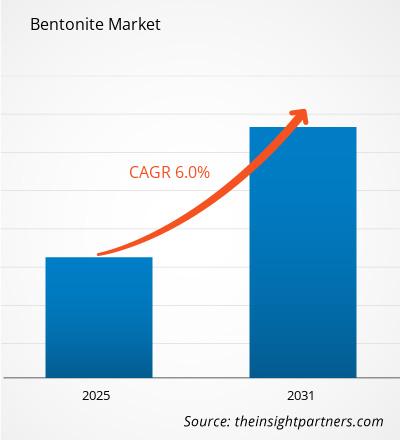
The Bentonite market is projected to increase from US$ 2.72 Billion in 2025 to US$ 3.63 Billion by 2034, registering a CAGR of 3.66% from 2026 to 2034. Demand spans drilling fluids, construction engineering, foundry binders, agriculture, cosmetics, pharmaceuticals, paints and coatings, pulp and paper, and environmental applications. Bentonite is valued for its swelling, binding, adsorption, rheological, and sealing properties across industrial and consumer applications.
North America remains an established production and consumption center, supported by drilling fluids, foundry operations, civil engineering, absorbents, and iron ore processing. The regional Bentonite market size is supported by established mineral reserves, processing infrastructure, and diversified industrial demand. Regional growth is expected at approximately 3.2–3.7% CAGR during 2026–2034, with infrastructure and energy activity providing structural support.
Bentonite Market Assessment and Insights
- North America: North America is expected to represent a 24–28% share in 2025 and grow at a 3.2–3.7% CAGR between 2026 and 2034, supported by drilling fluids, absorbents, foundry applications, infrastructure construction, and established mineral-processing capacity.
- U.S.: The U.S. is expected to account for 68–72% of North America in 2025 and expand at a 3.1–3.6% CAGR between 2026–2034, led by drilling mud, absorbents, foundry applications, and construction.
- Europe: Europe is estimated at a 20–24% share in 2025 and is projected to grow at a 3.0–3.5% CAGR between 2026 and 2034, with Germany, Italy, France, Spain, and the UK supporting construction, foundry, cosmetics, coatings, and industrial applications.
- Asia Pacific: Asia Pacific is estimated at a 31–35% share in 2025 and is projected to grow at a 4.0–4.6% CAGR between 2026 and 2034, led by China, India, Japan, South Korea, and Australia across construction, foundry, agriculture, and drilling.
- Largest Segment: Sodium Bentonite holds approximately 58–62% market share in 2025 and is expected to grow at a 3.8–4.3% CAGR between 2026 and 2034, reflecting strong swelling, sealing, and rheological performance.
- High Growth Segment: Oil and Gas is estimated at 18–22% market share in 2025 and is projected to register a 4.4–5.0% CAGR between 2026 and 2034, supported by drilling-fluid requirements.
- Key companies analyzed in detail: Alfa Aesar, Ashapura Minechem Limited, Bentonite Performance Minerals LLC, Black Hills Bentonite LLC, CB Minerals Holdings Ltd., Clariant AG, Kunimine Industries Co., Ltd., Minerals Technologies Inc., Wyo-Ben, Inc., and Imerys SA.
Source: The Insight Partners' analysis based on proprietary research, government publications, company annual reports, investor presentations, industry databases, and expert interviews.
The Bentonite Market has transitioned from bulk clay sales to application-specific clays with particle size, swelling ability, viscosity, filtration properties, and adsorption characteristics being controllable. Suppliers are able to incorporate selective mining, activation, grinding, drying, blending, and laboratory analysis to meet consumer needs. Such capabilities allow supplying distinct clay products for drilling muds, foundry binders, pelletizing, construction sealing, paper manufacturing, cosmetic ingredients, and environmental cleanup.
Future demand in the Bentonite Market will be dictated by developing Asian manufacturing hubs, infrastructure spending, energy industry, and special formulation needs. Spending is directed towards increased processing flexibility, better logistics, mine rehabilitation, and consistency in quality. Attention of regulations to the issues of protecting groundwater, industrial emissions, land reclamation, and purity of products will affect operations. Producers with diversified mineral deposits and downstream processing capabilities will find themselves better positioned to deal with mineralogical diversity and logistics challenges.
Bentonite Market Report Scope
| Report Attribute | Details |
|---|---|
| Market size in 2025 | US$ 2.72 Billion |
| Market Size by 2034 | US$ 3.63 Billion |
| Global CAGR (2026 - 2034) | 3.66% |
| Historical Data | 2021-2024 |
| Forecast period | 2026-2034 |
Bentonite Market Analysis
Demand for Bentonite Market development is associated with sectors that need swelling, adsorption, binding, suspension, or sealing characteristics. In drilling fluids, sodium types are especially valuable since hydration enhances viscosity and helps stabilize the borehole. Construction applications range from slurry walls, piling, tunneling, waterproofing to geotechnical barriers. The foundry sector utilizes bentonite as the bonding agent for molds, whereas agriculture, cosmetics, pharmaceuticals, coating, and paper sectors offer more applications.
The supply chain in the Bentonite Market starts with deposit exploration and mining, followed by benefaction, drying, milling, activation, blending, packing, and distribution. The mineralogical composition of the deposits defines the swelling capacity, cation exchange capability, viscosity, filterability, and contamination levels. The transportation charges are still high due to the weight of mineral products. Manufacturers having deposits and mills near the region have an advantage when addressing the local industry clients who demand regular deliveries and specific technical characteristics.
Competitive positioning in the Bentonite Market is based on mineral resources, technology of processing, applications experience, geographic presence, and client qualifications. Minerals Technologies Inc. is known for its specialty minerals platform, while Clariant AG covers adsorbents and additives. Ashapura Minechem Limited unites mining, processing, research, and distribution activities, while Wyo-Ben, Inc., Black Hills Bentonite LLC, and Bentonite Performance Minerals LLC have already taken up industrial positions. Kunimine Industries Co., Ltd. and Imerys SA add strength to global competition.
Growing focus of strategic investment is on processing efficiency, product specialization, technical support, and regional supply security rather than capacity increase. Producers look for closer cooperation with drilling, foundry, construction, environmental, agricultural, and specialty formulations clients. According to the above Bentonite Market analysis, it becomes clear that competition will be developing in terms of the quality of minerals and specific specifications for applications. Producers with diversified applications can decrease dependency on cyclic sectors.
● REPORT CUSTOMIZATION
Tailor This Report To Align With Your Specific Business Requirements
This report can be customized to align precisely with your business objectives, scope, and target markets. Customization options include tailored segmentation, geography, competitive analysis, and strategic insights to support informed decision-making.
Customize This Report →WHAT YOU CAN ADJUST
- ● Segmentations
- ● Geography
- ● Competitive Analysis
- ● Language Preferences
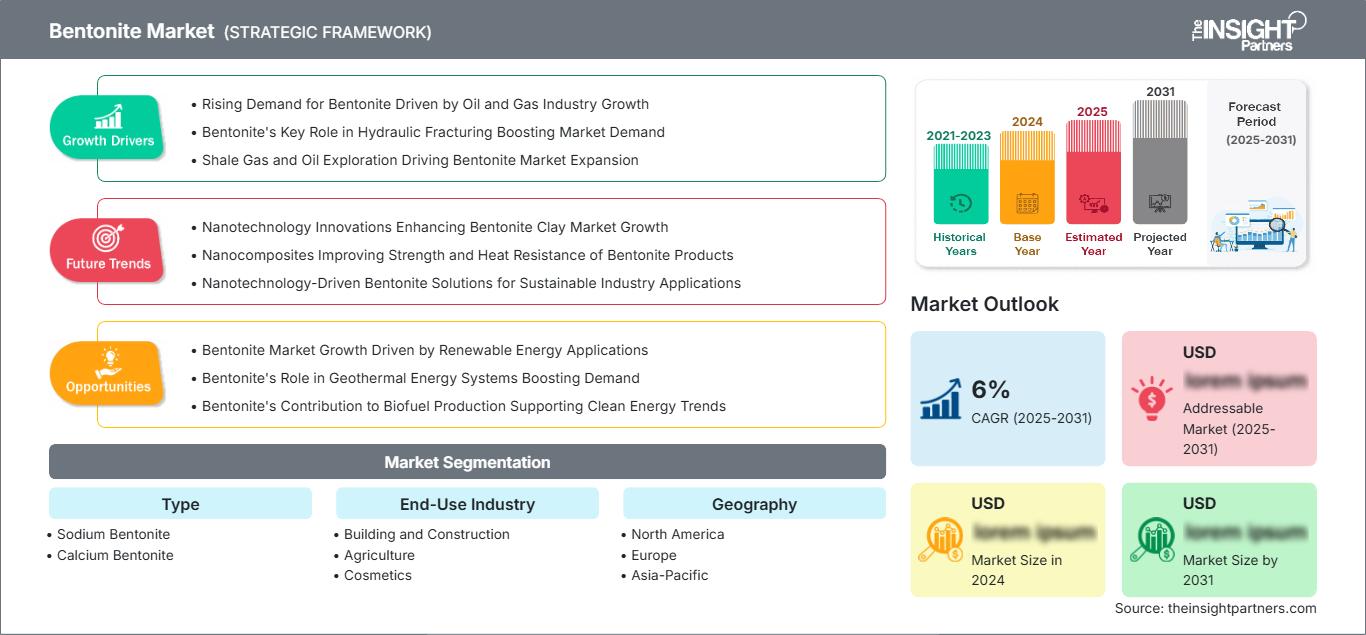
Bentonite Market: Strategic Insights
Regional Insights
North America Bentonite Market
North America is estimated to hold 24–28% Bentonite Market share in 2025, with regional growth projected at a 3.2–3.7% CAGR through 2034. The U.S. has the largest share of demand since Bentonite is used as drilling mud, absorbent, foundry sand binding agent, pellets, and in construction.
Canada and Mexico complement the regional ecosystem through their role in the trade of minerals and industrial use. Energy, infrastructure, metallurgy, foundry production, and environmental engineering contribute to the diversification of demand. Mine efficiency, costs of transportation, environmental regulations, water management, and reclamation also play an important role in determining supply economics.
U.S. Bentonite Market
The U.S. represents approximately 68–72% of North America in 2025 and is projected to expand at a 3.1–3.6% CAGR. Domestic production was approximately 4.10 million metric tons in 2025, while exports reached an estimated 640,000 tons. Pet-waste absorbents and drilling mud represented major domestic uses, demonstrating the market's diversified application base.
Trends in application are moving towards grades that have properties such as controllable viscosity, swelling, filtration, particle size and activation. Some of the companies that take part in the local supply chain include Minerals Technologies Inc., Wyo-Ben, Inc., Black Hills Bentonite LLC and Bentonite Performance Minerals LLC. Application areas that help to diversify demand include infrastructure projects, drilling needs, foundry sand production, absorbents and environmental cleanup.
Europe Bentonite Market
Europe is estimated to have a 20–24% share in 2025 and is projected to grow at a 3.0–3.5% CAGR. Germany is an example of an important industrial market, whereas France, Italy, Spain, and UK offer demands from the construction industry, foundries, cosmetics, coating industry, agricultural uses, and specialized mineral applications. Purchases within Europe have increasingly become focused on quality, compliance, technical data, and environmental performance.
The United Kingdom retains demand in construction engineering, specialized formulations, drilling uses, and consumer use. Germany has a strong demand in foundries, construction, coatings, and industrial processing thanks to its manufacturing sector. France and Italy contribute with cosmetics, construction, foundry, and industrial uses, while Spain has benefited from construction, ceramic uses, agriculture, and mineral processing. Germany continues to be the top country in terms of demand modeled.
APAC Bentonite Market
APAC is estimated to account for a 31–35% share in 2025 and is projected to grow at a 4.0–4.6% CAGR. China leads regional demand, followed by India, Japan, South Korea, and Australia. Construction, steel, foundry, agriculture, drilling, and infrastructure investment create a broad consumption base.
China remains the largest APAC market, while India is strengthening its mining, processing, and export capabilities. Japan and South Korea support specialty industrial applications, and Australia contributes through mining and resource-sector activity. Infrastructure programs, manufacturing expansion, resource development, and agricultural productivity policies reinforce regional demand for sodium and calcium grades.
Middle East & Africa Bentonite Market
The Middle East and Africa demand is projected to grow at a 3.4–3.9% CAGR. Saudi Arabia is at the front of the market regionally with the help of drilling, oil and gas, infrastructural development, and construction. UAE helps through their energy services and construction. South Africa offers support in mining, foundry, agriculture, and industrial applications.
Other markets in MEA region are relatively smaller yet still gain from investments in infrastructure, mineral processing, drilling operations, and agriculture. Local deposits, import needs, intensity of drilling operations, and processing capabilities determine the demand. Investment in energy is the best regional demand foundation, while construction, environmental engineering, and industrial applications add more to consumption.
Segmentation Analysis
Type
The Bentonite Market scope across type categories reflects differences in mineral chemistry, hydration behavior, and end-use requirements. Sodium grades lead because of their high swelling capacity and viscosity, which support drilling, sealing, construction, and foundry applications. The Type segment is projected to grow at a 3.8–4.3% CAGR from 2026–2034, supported by performance-sensitive industrial uses.
- Sodium Bentonite: Sodium Bentonite holds the leading position because strong hydration and swelling enable borehole stabilization, waterproofing, pellet binding, and sealing. Demand remains closely connected with drilling and infrastructure activity.
- Calcium Bentonite: Calcium Bentonite supports adsorption, clarification, agricultural, cosmetic, and specialty industrial applications. Lower swelling characteristics make mineral chemistry, processing, and application-specific formulation important purchasing considerations.
End-Use Industry
End-use industries determine grade selection, processing requirements, quality specifications, and purchasing priorities. The End-Use Industry segment is projected to grow at a 3.6–4.1% CAGR from 2026–2034, with oil and gas, construction, agriculture, and foundry applications providing substantial recurring consumption.
- Building and Construction: Bentonite supports waterproofing systems, slurry walls, piling, tunneling, and geotechnical barriers. Demand depends on infrastructure investment and the adoption of engineered sealing materials.
- Agriculture: Agricultural formulations use Bentonite for soil conditioning, nutrient carriers, moisture management, and selected feed-related applications. Cation exchange and absorption properties support formulation flexibility.
- Cosmetics: Cosmetics use finely processed Bentonite for masks, cleansers, texture modification, adsorption, and formulation stabilization. Demand depends on purity, particle size, sensory properties, and compatibility.
- Pharmaceuticals: Pharmaceutical applications require controlled mineral quality and stringent impurity specifications. Bentonite can function as an adsorbent, excipient, or formulation component where validated performance is required.
- Paints and Coatings: Bentonite contributes rheology control, suspension, thickening, and pigment stabilization. Formulators select grades according to dispersion behavior and compatibility with waterborne or solvent-based systems.
- Pulp and Paper: Bentonite supports retention, drainage, formation, and process efficiency. Demand is concentrated in grades engineered for interaction with fibers, fillers, polymers, and process chemicals.
- Oil and Gas: Oil and gas remain major applications because sodium Bentonite forms viscous drilling fluids that assist borehole stability, cuttings suspension, and filtration control.
- Foundry: Foundries use Bentonite as a bonding agent in molding sands. Selection depends on green compression strength, thermal durability, permeability, moisture control, and casting-line requirements.
Opportunity Snapshot
| End-Use Industry | Revenue Contribution | Trend Tag | Adoption Stage |
| Building and Construction | High | Waterproof Barriers | Scaling |
| Agriculture | Medium | Soil Conditioning | Scaling |
| Cosmetics | Medium | Clay Formulations | Mature |
| Pharmaceuticals | Low | Excipient Purity | Emerging |
| Paints and Coatings | Medium | Rheology Control | Scaling |
| Pulp and Paper | Medium | Drainage Aid | Mature |
| Oil and Gas | High | Drilling Fluids | Mature |
| Foundry | High | Sand Binding | Mature |
Bentonite Market Growth Drivers and Impact Analysis
Expansion of drilling and geotechnical applications
Demand for oil and gas drilling continues to be a structural one due to the role played by sodium Bentonite in delivering viscosity, filtration control, cuttings suspension, and borehole stabilization. Fluids used in horizontal and directional drilling must have rheological properties in spite of varying temperatures, pressures, and salt concentration. Other construction projects include the use of Bentonite in the construction of diaphragm walls, tunneling, piling, waterproofing, and geotechnical seals. This ensures the creation of structural demand for the material. For suppliers having constant swelling properties and technical service provision, specification applications will arise. Increased drilling operations in North America, the Middle East, and certain emerging markets could then affect the volume of processed minerals and regional buying patterns.
Rising use in iron ore pelletization and foundry processes
Steel production and metal casting are other important demand sources since Bentonite serves as a binder in the manufacture of iron ore pellets and sand molds. A reliable binder is essential in ensuring that the iron ore pellets remain strong even during handling and subsequent processing, while consistent green strength and thermal stability are important considerations in foundry. Growth in steelmaking capability in Asia and upgrading in the foundry industry contribute to repeat mineral demand. Automation in casting increases the significance of particle size, moisture content, and activation characteristics consistency. This means that suppliers will have to invest in processing and specialized grades of Bentonite for various applications. This makes the technical significance of Bentonite in the steel and foundry value chain very important.
Broader adoption in environmental and agricultural applications
Applications in environmental engineering and agriculture arise due to the fact that Bentonite is characterized by swelling, adsorption and cation-exchange abilities. Applications in environmental engineering may involve the utilization of mineral barriers for the purposes of containment, remediation, landfill protection and groundwater management, while applications in agriculture may cover soil conditioning, nutrient carrier functions and moisture management. The growing focus on the protection of groundwater and contamination control may help boost the demand for engineered mineral barriers for relevant projects. Agricultural users appreciate the mineral functionality wherever it is justified by economics and the local soil conditions. The applications are less exposed to drilling cycles in comparison with energy sector demand, which contributes to supplier diversification.
Bentonite Market Future Trends
Greater emphasis on engineered and application-specific grades
The Bentonite Market trends will be characterized more by engineered grades than bulk mineral sales. Producers will optimize properties such as swelling characteristics, rheology, particle size distribution, filtration efficiency, adsorption and formulation chemistry compatibility. Process digitalization and lab testing may help to control batch variability from the stage of mine selection to packaging. Product grading will gain more importance in drilling, pharmaceuticals, cosmetics, environmental remediation, and construction system applications, where incorrect specifications may result in increased operational costs. Technical service departments may be expanded to assist customers in optimizing their formulations and processes. Such a transition will make the competitive advantage depend not only on the mineral resource ownership but also on mineral characterization, processing know-how, application knowledge, quality control, and customer qualification.
Integration of resource efficiency and mine rehabilitation practices
Environmental performance is expected to become more closely integrated with Bentonite extraction and processing decisions. Producers are likely to strengthen mine planning, land restoration, water management, energy efficiency, dust control, and process optimization. Clariant's 2025 reporting describes biodiversity impacts associated with Bentonite mining and identifies the need to evaluate land-use effects across its mining locations. The direction indicates greater operational attention to restoration and environmental controls. Customers in regulated markets are also likely to place greater weight on traceability and environmental documentation. Processing facilities may adopt energy-saving drying systems, improved material recovery, and tighter resource monitoring. These changes can reduce operational losses while strengthening compliance and improving qualification for customers with documented environmental procurement requirements.
Bentonite Market Opportunities
Capacity expansion in high-value processed mineral grades
Bentonite Market Forecasts indicate increasing opportunities for processed grades serving drilling, environmental remediation, construction, cosmetics, and specialty formulations. Producers can increase value realization through selective mining, activation, micronization, controlled drying, blending, and technical testing. Regional processing investments can also reduce transportation exposure while supporting application-specific product development. Ashapura Minechem Limited reported starting production from two new Bentonite mines in Kutch in 2025 and expected distribution of approximately 300,000 tons annually. The company also described value-added applications across oil and gas, foundry, environmental solutions, pet litter, and animal feed. This development demonstrates how mine expansion can be combined with downstream product specialization. Similar strategies can be applied in resource-rich markets where domestic processing can support regional customers and export-oriented supply.
Development of Bentonite-based environmental remediation products
Environmental remediation represents a specialized opportunity because Bentonite can function as an engineered adsorbent or sealing component in water and soil treatment systems. PFAS remediation is one developing application area. Minerals Technologies Inc., through CETCO, participated in a U.S. Environmental Protection Agency roundtable in May 2026 focused on PFAS destruction and remediation and highlighted its Bentonite-based FLUORO-SORB adsorbent. Continued regulatory attention to persistent contaminants could expand demand for mineral-based containment and adsorption technologies. Suppliers that combine Bentonite with engineered formulations, geosynthetic systems, or treatment media can address higher-value environmental projects beyond conventional bulk mineral markets. Such opportunities depend on demonstrated removal performance, regulatory acceptance, project economics, and the ability to integrate mineral products into established remediation systems.
Recent Developments
- May 2025: Bureau of Land Management (BLM) — Greasewood Creek Bentonite Mine Approved in Wyoming: The BLM approved the Greasewood Creek bentonite mine near Medicine Bow in Albany County, Wyoming. The approval allows Wyo Silver, LLC to extract bentonite from approximately 648 acres of federal mineral estate over a 10-year period. The project is subject to Wyoming environmental requirements, including backfilling, contouring, topsoil redistribution, and revegetation after mining. The development supports additional domestic bentonite production capacity in Wyoming, one of the world's major bentonite-producing regions.
- February 2026: Amarak Chemicals FZC — 60,000-Tonne Sulfur Bentonite Facility Begins Operations in Dubai: Amarak Chemicals FZC, an associate company of the Aries Group, commenced operations at a fully automated 60,000 metric ton per year sulfur manufacturing facility in Jebel Ali Free Zone, Dubai. The facility produces sulfur bentonite and value-added sulfur products for agricultural applications. Its location within Jafza provides access to integrated logistics infrastructure and supports exports to international markets, strengthening regional manufacturing and distribution of sulfur-based agricultural inputs.
Frequently Asked Questions

- Comprehensive Market Sizing and Forecast Analysis
- Detailed Segmentation Analysis
- In-Depth Market Dynamics Assessment
- Regional and Country-Level Insights
- Competitive Landscape and Company Benchmarking
- Strategic Business Intelligence
Recent Reports
Testimonials

The Insight Partners' SCADA System Market report is comprehensive, with valuable insights on current trends and future forecasts. The team was highly professional, responsive, and supportive throughout. We are very satisfied and highly recommend their services.
RAN KEDEM Partner, Reali Technologies LTDs
I requested a report on a very specific software market and the team produced the report in a few days. The information was very relevant and well presented. I then requested some changes and additions to the report. The team was again very responsive and I got the final report in less than a week.
JEAN-HERVE JENN Chairman, Future Analytica
We worked with The Insight Partners for an important market study and forecast. They gave us clear insights into opportunities and risks, which helped shape our plans. Their research was easy to use and based on solid data. It helped us make smart, confident decisions. We highly recommend them.
PIYUSH NAGPAL Sr. Vice President, High Beam Global
The Insight Partners delivered insightful, well-structured market research with strong domain expertise. Their team was professional and responsive throughout. The user-friendly website made accessing industry reports seamless. We highly recommend them for reliable, high-quality research services
YUKIHIKO ADACHI CEO, Deep Blue, LLC.
This is the first time I have purchased a market report from The Insight Partners.While I was unsure at first, I visited their web site and felt more comfortable to take the risk and purchase a market report.I am completely satisfied with the quality of the report and customer service. I had several questions and comments with the initial report, but after a couple of dialogs over email with their analyst I believe I have a report that I can use as input to our strategic planning process.Thank you so much for taking the extra time and making this a positive experience.I will definitely recommend your service to others and you will be my first call when we need further market data.
JOHN SUZUKI President and Chief Executive Officer, Board Director, BK Technologies
I wish to appreciate your support and the professionalism you displayed in the course of attending to my request for information regarding to infectious disease IVD market in Nigeria. I appreciate your patience, your guidance, and the fact that you were willing to offer a discount, which eventually made it possible for us to close a deal. I look forward to engaging The Insight Partners in the future, all thanks to the impression you have created in me as a result of this first encounter.
DR CHIJIOKE ONYIA MANAGING DIRECTOR, PineCrest Healthcare Ltd.Reason to Buy
- Informed Decision-Making
- Understanding Market Dynamics
- Competitive Analysis
- Identifying Emerging Markets
- Customer Insights
- Market Forecasts
- Risk Mitigation
- Boosting Operational Efficiency
- Strategic Planning
- Investment Justification
- Tracking Industry Innovations
- Aligning with Regulatory Trends





 Get Free Sample for