
Bio Alcohol Market Size, Demand & Growth by 2034
Coverage: By Type (Biobutanol, Bioethanol, Biomethanol, Butanediol); Application (Medical, Power Generation, Transportation, Others); Source(Bio-Waste, Grains, Sugarcane, Others) , and Geography (North America, Europe, Asia Pacific, and South and Central America)
- Status : Data Released
- Report Code : TIPRE00007835
- Category : Chemicals and Materials
- No. of Pages : 150
- Available Report Formats :


- Last update date : August 27, 2026


2025 Market Size
US$ 74.75 Bn
Base year value
2034 Forecast
US$ 140.58 Bn
Projected by 2034
CAGR 2026-2034
7.27 %
Growth rate
Addressable Market
US$ 971.29 Bn
(2026-2034)
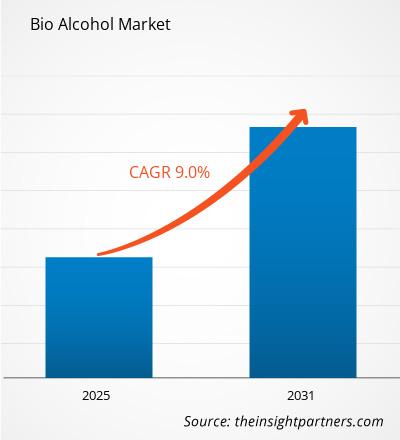
The Bio Alcohol market size is US$ 74.75 Billion in 2025 and is projected to reach US$ 140.58 Billion by 2034, registering a CAGR of 7.27% during 2026–2034. Demand is increasingly shaped by transportation decarbonization, renewable-content mandates, feedstock diversification, and development of bio-based chemical intermediates. Bio Alcohol represents a broad renewable-carbon platform spanning fuel ethanol, biobutanol, biomethanol, biopropanol, and biobutanediol.
North America is positioned for sustained expansion as renewable fuel standards, low-carbon fuel programs, corn-based ethanol infrastructure, and emerging alcohol-to-jet pathways support consumption. The regional Bio Alcohol Market size is also influenced by established fermentation capacity, agricultural feedstock availability, carbon-intensity reduction initiatives, and investment in low-carbon ethanol facilities integrated with carbon capture.
Bio Alcohol Market Assessment and Insights
- North America: North America is expected to account for a 35–39% share in 2025 and expand at a 5.9–6.8% CAGR during 2026–2034, supported by established ethanol infrastructure, renewable fuel policies, and low-carbon production investments.
- U.S.: The U.S. is estimated to represent 28–32% of the global market in 2025, expanding at a 5.8–6.7% CAGR through 2034 as ethanol production and low-carbon fuel applications broaden.
- Europe: Europe is projected to hold a 20–24% share in 2025 and grow at a 6.4–7.3% CAGR, with Germany, France, Italy, Spain, and the UK supporting renewable fuel adoption and bio-based chemical demand.
- Asia Pacific: Asia Pacific is estimated at 27–31% in 2025 and is expected to grow at a 7.8–8.7% CAGR, led by China, India, Japan, and South Korea through blending mandates and industrial bio-based chemical development.
- Largest Segment: Bioethanol is estimated to command a 68–73% market share in 2025 and expand at a 6.8–7.6% CAGR, reflecting its established transportation-fuel role.
- High Growth Segment: Bio-waste is positioned for accelerated adoption, with an estimated 15–19% share in 2025 and a 9.0–10.0% CAGR as waste-derived pathways improve carbon performance.
- Key companies analyzed in detail: BASF SE, Cargill, Incorporated, Mitsubishi Chemical Corporation, Raízen S.A., Genomatica, Inc., Godavari Biorefineries Limited, Gevo, Inc., Green Plains Inc., POET, LLC.
Source: The Insight Partners' analysis based on proprietary research, government publications, company annual reports, investor presentations, industry databases, and expert interviews.
The Bio Alcohol Market share is increasingly influenced by the transition from conventional first-generation feedstocks toward lower-carbon pathways. Efficiencies in fermentation, distillation, dehydration, carbon sequestration, and waste-to-fuel processes are revolutionizing the economics of production. Legacy corn and sugarcane-based plants will maintain their scale advantages, whereas new build projects will increasingly focus on cellulosic materials, agriwaste, and biorefineries that can generate fuels, chemicals, power, and coproducts from the same raw material input.
For the outlook period, investment is predicted to flow into regions where there is access to biomass resources alongside blending policies and export routes. India, Brazil, Southeast Asia, and parts of North America are areas with good prospects for capacity growth, whereas Europe favors lower life-cycle emissions with its regulatory requirements. Technology providers are developing alcohol-to-jet pathways, offering another use for ethanol and other bio-alcohol intermediates beyond road transport fuels.
Bio Alcohol Market Report Scope
| Report Attribute | Details |
|---|---|
| Market size in 2025 | US$ 74.75 Billion |
| Market Size by 2034 | US$ 140.58 Billion |
| Global CAGR (2026 - 2034) | 7.27% |
| Historical Data | 2021-2024 |
| Forecast period | 2026-2034 |
Bio Alcohol Market Analysis
Bio Alcohol Market growth is supported by renewable fuel mandates, petroleum displacement objectives, and demand for lower-carbon chemical feedstocks. Value chain starts from raw materials like sugar, starch, cellulosic residues, or organic wastes, then moves ahead towards pretreatment, fermentation or catalysis, purification, blending, distribution, and conversion in end uses. In addition to the main feedstock, other coproducts, including distillers' grains, CO2, corn oil, electricity, and renewable chemicals, are now being marketed. The price of the feedstocks is a big variable in the supply side, specifically, corn and sugarcane-based processes.
The economics of production differ significantly across geographies due to varying availability of feedstocks, energy costs, carbon credits systems, logistics, and blending. An integrated approach will help in lowering the vulnerability to commodity price changes through the generation of different revenue streams. Technologies based on waste require better collection and pretreatment mechanisms; however, these technologies can enhance carbon performance and also provide better access to premium low-carbon markets.
The Bio Alcohol Market analysis indicates a competitive structure combining large commodity producers, integrated chemical companies, technology developers, and specialist renewable-fuel businesses. Chemical industry competencies are provided by BASF SE and Mitsubishi Chemical Corporation. Agricultural resources and processes are covered by Cargill, Incorporated, Raízen S.A., Green Plains Inc., and POET, LLC. Specialization of Gevo, Inc. lies in low-carbon ethanol, carbon management, and alcohol-to-jet technologies.
Competitive positioning increasingly hinges upon scale of production, carbon content, reliability of feedstock supply, and opportunities for obtaining long-term offtake contracts. Godavari Biorefineries Limited brings exposure to India's sugar cane-based ecosystem. Biotechnology-driven chemical production is the specialization of Genomatica, Inc. There are also investments in process integration, carbon capturing, advanced fermentation and renewable chemicals. Acquisitions, strategic alliances, technology licensing, and capacity expansion will thus continue to play their role.
● REPORT CUSTOMIZATION
Tailor This Report To Align With Your Specific Business Requirements
This report can be customized to align precisely with your business objectives, scope, and target markets. Customization options include tailored segmentation, geography, competitive analysis, and strategic insights to support informed decision-making.
Customize This Report →WHAT YOU CAN ADJUST
- ● Segmentations
- ● Geography
- ● Competitive Analysis
- ● Language Preferences
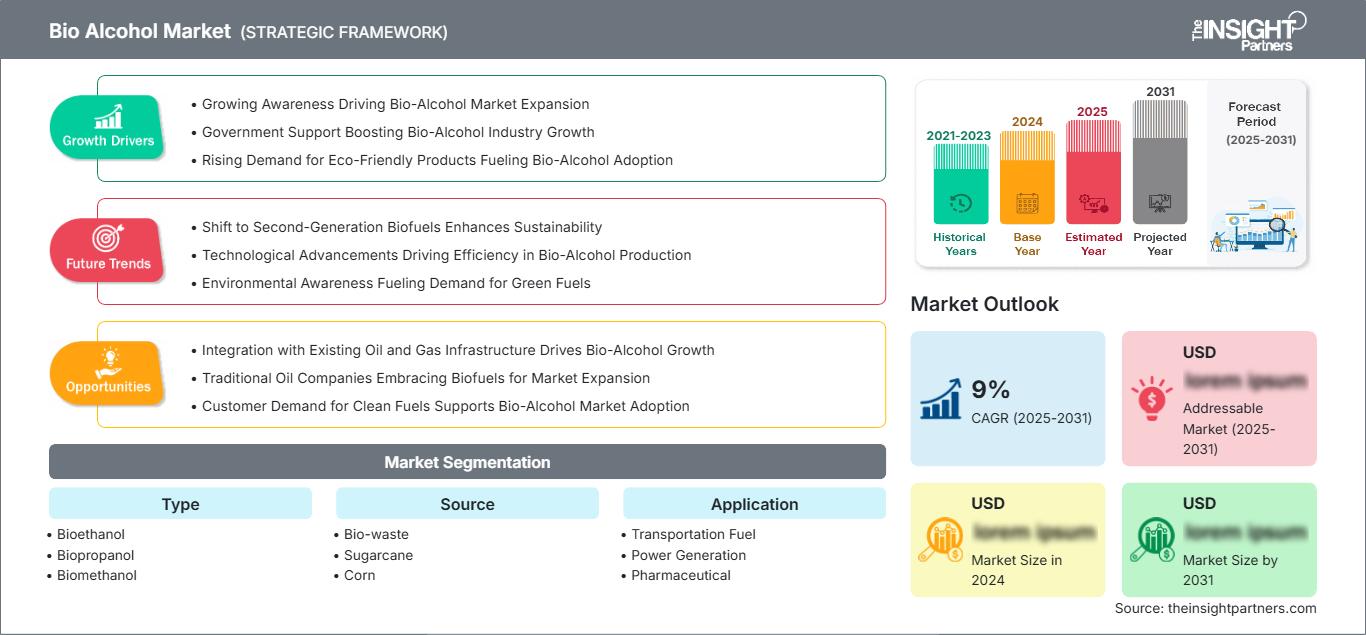
Bio Alcohol Market: Strategic Insights
Regional Insights
North America Bio Alcohol Market
North America Bio Alcohol Market is estimated to hold a 35–39% share in 2025 and register a 5.9–6.8% CAGR through 2034. The United States' role in regional business is due to its vast corn availability, well-established ethanol facilities, blending market and logistics capabilities. Canada's involvement comes via renewable fuel regulations and increased focus on lower-carbon transportation fuels. Regional players are looking at carbon capture, waste feedstocks, and renewable chemicals to improve economics.
There are also investments that link the traditional ethanol business with the emerging low-carbon opportunities. Alcohol-to-jet routes will increase demand for ethanol, and carbon capture will decrease lifecycle emissions and improve access to low-carbon credits. Consequently, agricultural cooperatives, ethanol producers, chemical firms, and technology suppliers are forming ecosystems, and feedstock availability and regulatory certainty become key drivers of utilization and investment.
U.S. Bio Alcohol Market
The U.S. represents approximately 79–83% of North America's Bio Alcohol Market and about 28–32% globally in 2025. It is projected to expand at a 5.8–6.7% CAGR through 2034. Corn-based ethanol remains the dominant production pathway, supported by extensive farming infrastructure and established blending channels. Companies including POET, LLC, Green Plains Inc., Cargill, Incorporated, and Gevo, Inc. are positioned across different parts of the value chain.
Future demand will be more related to the use of low-carbon fuels than conventional gasoline blends. There is investment in carbon-capturing technologies, natural gas from renewables, low-carbon ethanol, and alcohol to jet fuel processes. Governmental policies at the federal and state levels still have a great impact on the economy due to fuel standards and carbon credits. Agricultural raw materials availability, existing railroads, and substantial fuel consumption make the U.S. structurally advantaged in producing.
Europe Bio Alcohol Market
Europe is estimated to account for a 20–24% share of the Bio Alcohol Market in 2025 and expand at a 6.4–7.3% CAGR. Demand is generated by the UK and Germany, while France, Italy and Spain contribute through policies related to renewable transportation, industrial processing and well-developed chemical industries in Europe. European demand becomes more and more interested in technologies and processes that prove the reduction of greenhouse gas emissions in the life cycle and sustainable feedstock sourcing.
The UK works hard on the development of low-carbon transport measures, favoring renewable fuels and advanced feedstock technologies. Germany pays attention to renewable energy and lowering of transport emissions, thus increasing demand for sustainable fuels. The advantage of France lies in agricultural feedstock availability and the existing biofuels production industry. Italy and Spain also offer additional opportunities due to renewable transportation policies, agricultural residues and increased interest in advanced biofuels.
APAC Bio Alcohol Market
APAC is estimated to represent 27–31% of global Bio Alcohol Market demand in 2025 and is expected to grow at a 7.8–8.7% CAGR. China leads regional industrial activity, while India is expanding ethanol blending rapidly. Japan and South Korea emphasize advanced bio-based chemicals and lower-carbon fuels, while Australia provides agricultural residues and renewable-energy integration opportunities.
Policy support is a major regional catalyst. India achieved a 20% ethanol blending level during ESY 2025–26, while expanding domestic production capacity. China is developing renewable fuel and biochemical capabilities, and Japan and South Korea are investing in low-carbon industrial pathways. Regional producers increasingly evaluate agricultural waste and non-food feedstocks to reduce exposure to food-versus-fuel concerns and improve lifecycle emissions.
Middle East & Africa Bio Alcohol Market
The Middle East & Africa Bio Alcohol Market remains smaller than the leading regions but offers a developing opportunity base, with a projected 5.5–6.5% CAGR. Saudi Arabia and the UAE are evaluating renewable fuels alongside broader energy diversification, while South Africa has agricultural residues and established chemical-processing capabilities.
The region's energy infrastructure provides a foundation for future bio-based fuel integration. Saudi Arabia and the UAE possess strong logistics and petrochemical networks that can support downstream bio-based chemicals, while South Africa provides agricultural feedstock opportunities. Other MEA markets may develop smaller decentralized projects using municipal waste, molasses, crop residues, and industrial byproducts where collection economics are favorable.
Segmentation Analysis
Type
The Type segment is expected to expand at a 6.9–7.7% CAGR during 2026–2034. Bioethanol remains the dominant product because of its established use in transportation fuel, while biobutanol, biomethanol, biopropanol, and biobutanediol provide higher-value opportunities in chemicals, coatings, specialty fuels, and industrial applications. Technology maturity and production economics will determine the pace of diversification.
- Bioethanol: Remains the principal product because blending infrastructure, established fermentation technology, and government mandates support large-volume transportation applications across North America, Brazil, India, and Europe.
- Biopropanol: Serves emerging opportunities in solvents, chemicals, and specialty formulations, with development focused on biological conversion pathways capable of improving feedstock flexibility and reducing fossil-derived chemical dependence.
- Biomethanol: Provides opportunities for renewable marine fuels, chemicals, and energy applications. Demand is increasingly linked to carbon-intensity targets and the availability of sustainable biomass or waste-based production routes.
- Biobutanol: Offers attractive fuel and chemical characteristics, including higher energy density and broader blending potential. Commercial adoption depends on fermentation productivity, separation costs, and competitive feedstock economics.
- Biobutanediol: Represents an emerging bio-based chemical intermediate with potential applications in polymers, coatings, and specialty materials. Its strategic importance is linked to replacing fossil-derived chemical building blocks.
Source
The Source segment is projected to grow at a 7.3–8.1% CAGR through 2034. Sugarcane and corn remain commercially important because of established supply chains, while bio-waste is gaining strategic importance as producers seek lower-carbon feedstocks. Source diversification can reduce dependence on individual agricultural commodities and improve resilience against seasonal supply fluctuations.
- Bio-waste: Includes agricultural residues, municipal organic waste, and industrial byproducts. Its importance is rising as producers seek lower-carbon pathways and improved utilization of resources that would otherwise require disposal or low-value treatment.
- Sugarcane: Provides an established feedstock for ethanol production, particularly in Brazil and other tropical agricultural economies. High sugar content and integrated milling operations support efficient conversion and coproduct generation.
- Corn: Remains strategically important in North America because of extensive cultivation, established grain logistics, and mature dry-mill and wet-mill infrastructure. Its economics remain sensitive to crop prices and competing food and feed uses.
Application
The Application segment is expected to register a 7.0–7.8% CAGR. Transportation fuel remains the largest outlet because blending mandates support large-volume consumption, while pharmaceutical, coatings, cosmetics, and power applications diversify demand. The Bio Alcohol Market scope, therefore, extends beyond fuel markets into industries where renewable carbon can replace petroleum-derived intermediates.
- Transportation Fuel: Represents the largest application base because ethanol and other alcohols can be blended with gasoline or converted into advanced fuels. Regulatory mandates and carbon-reduction programs remain central demand drivers.
- Power Generation: Provides an additional outlet where bio-alcohols can support distributed energy systems or integrated biorefineries. Adoption depends on conversion efficiency, local fuel economics, and competition from other renewable technologies.
- Pharmaceutical: Uses high-purity alcohols as solvents, intermediates, and formulation components. Demand is supported by pharmaceutical manufacturing, quality requirements, and increasing interest in renewable sourcing for chemical inputs.
- Paints and Coatings: Bio-based alcohols can serve as solvents and chemical intermediates. Adoption is influenced by formulation performance, regulatory requirements, volatile-organic-compound considerations, and the availability of competitively priced renewable feedstocks.
- Cosmetics and Personal Care: Demand is supported by formulations seeking renewable or naturally derived ingredients. Product qualification, purity, odor characteristics, and compatibility with existing formulations determine commercial adoption.
Opportunity Snapshot
| Application | Revenue Contribution | Trend Tag | Adoption Stage |
| Transportation Fuel | High | Fuel Blending | Mature |
| Power Generation | Medium | Distributed Energy | Scaling |
| Pharmaceutical | Medium | Renewable Solvents | Scaling |
| Paints and Coatings | Medium | Bio Solvents | Scaling |
| Cosmetics and Personal Care | Low | Clean Formulation | Emerging |
Bio Alcohol Market Growth Drivers and Impact Analysis
Expansion of ethanol blending mandates and renewable fuel programs
The continued importance of government blending policies is due to the fact that they generate a predictable demand for domestic renewable alcohol fuels. India has achieved a 20% ethanol blending target during ESY 2025-26, whereas the U.S. and Brazil already have an established market for ethanol based on regulation. The government programs lower dependency on the capricious demand by consumers and make producers' intentions to build additional production capacity more visible. They stimulate investments in storage, distribution, blending facilities, and feedstock procurement. As the government blending targets increase or become stricter, producers will be able to operate at higher capacities and gain from economies of scale. Nevertheless, profitability depends on many factors such as feedstock costs, fuel compatibility with existing vehicles, and regulatory policies.
Growing use of lower-carbon feedstocks and waste-based pathways
Biomass waste is emerging as a strategic resource that could help in reducing the carbon footprint in the lifecycle without increasing land requirement in agriculture. Agricultural residues, organic wastes from municipalities, and industrial by-products serve as alternate sources of carbon with new possibilities of generating revenues in waste management ecosystems. Technological progress in pretreatments, enzyme conversion, fermentation, and catalytic processes makes such options more technically viable. Producers can also combine carbon capture with a low-carbon-intensity ethanol production process. Such an approach would help in enhancing market entry into high-end fuels and other incentives associated with carbon. This strategy would be commercially viable depending on factors like the availability of feedstock at a high density, the cost of pre-processing, yield levels, and the local logistics.
Integration of bio-alcohol production with higher-value downstream markets
Increasingly, producers are looking to expand their activities outside traditional fuel markets through the transformation of alcohols into sustainable aviation fuel, renewable chemicals, solvents, polymers, and specialty intermediates. Such a strategy will enable improved utilization of assets and a decreased reliance on a single market for the end product. The importance of ethanol-to-jet technology lies in its ability to help the producer gain access to the aviation fuel markets from its ethanol infrastructure. Gevo, Inc. is developing ethanol-to-jet and ethanol-to-olefin technologies. The economic impact is an expanded target market for the producer with access to a stable supply of alcohol raw materials. In the long run, a plant that can operate on fuel and chemicals could be more resilient to fluctuations in commodity prices and regulation.
Bio Alcohol Market Future Trends
Bio Alcohol trends toward advanced feedstock flexibility
Future Bio Alcohol Market trends will increasingly center on low-carbon feedstocks, advanced fermentation, cellulosic conversion, carbon-intensity reduction, and integration with sustainable aviation fuel pathways. The next phase of development will involve increasing focus on flexible feedstock utilization instead of using just one crop. It is anticipated that producers will use a combination of corn, sugarcane bagasse, agricultural residues, and industrial wastes wherever possible. Flexible feedstocks will ensure stable output in case of a shortage of commodities and will be more environmentally friendly. New pretreatment and fermentation techniques will allow more heterogeneous feedstocks to go into the commercial conversion process. Another benefit of the new approach will be its compliance with circular economy requirements, as waste materials will now become fuel and chemical feedstocks. The new production paradigm will come closer to multiproduct biorefineries instead of a simple ethanol plant.
Expansion of alcohol-to-jet and renewable chemical pathways
It is likely that alcohol-to-jet and alcohol-to-chemical routes will be more attractive going forward due to the increased value streams available to bioalcohol producers through new routes for renewable alcohols. Aviation fuel usage can take up very large quantities of ethanol, while also increasing demands other than those for gasoline blending. In parallel, ethanol-to-olefins processes can create renewable raw materials for plastic resins, coatings, solvents, and specialty chemicals. This may add value in situations where transportation fuel markets are hindered by either policy or price issues. Through technology licensing and strategic alliances, such projects will become easier to execute, allowing producers to use their fermentative production facilities in combination with downstream process technology.
Bio Alcohol Market Opportunities
Development of integrated waste-to-alcohol biorefineries
Construction of integrated waste to alcohol plants can generate opportunities for regions rich in agricultural biomass, food processing waste, and municipal biogenic organic materials. Integrated waste to alcohol plants can integrate processes such as preprocessing, fermentation, purification, carbon handling, and coproduct recovery under one process system. This approach will enhance efficiency and reduce the costs of material disposal, along with reduced lifecycle emissions. Developers should target regions with an established transportation network, availability of renewable power and fuel or chemical buyers downstream. Collaborations with farmers, municipalities, food processors, and industries will help in securing feedstocks. Projects may also leverage economies of low-carbon fuels due to their differentiated lifecycle emissions policies. In the future, technology advancements may allow modular plants to be commercially attractive in regions that do not have high feedstock density for central processing plants.
Expansion into renewable chemicals and sustainable aviation fuel
The Bio Alcohol Market Forecasts point toward opportunities created by diversification into sustainable aviation fuel and renewable chemical intermediates. Investors can target projects that connect established ethanol assets with downstream conversion technologies, allowing existing feedstock and fermentation infrastructure to serve higher-value markets. The approach can reduce dependence on gasoline blending while creating exposure to aviation and specialty chemical demand. Strategic opportunities include ethanol-to-jet conversion, ethanol-to-olefins, renewable solvents, and bio-based polymer intermediates. Successful projects will require technology validation, certification, long-term offtake agreements, and access to low-carbon feedstocks. Producers with integrated carbon management may have an additional advantage because lower lifecycle emissions can strengthen market positioning and support eligibility under evolving environmental incentive frameworks.
Recent Developments
- March 2025: MayMaan Research unveiled its AquaStroke engine, designed to operate on a fuel mixture containing 70% water and 30% ethanol/methanol. The technology targets power-generation applications, including data centers, EV charging infrastructure, off-grid systems, and backup power. MayMaan also stated that it was pursuing licensing agreements with manufacturers and distributors in Europe and the U.S.
- August 2025: Conestoga Energy Holdings, LLC acquired SAFFiRE Renewables, LLC, gaining its intellectual property, related technologies, proposed pilot facility, and key personnel. The acquisition provides access to NREL-developed Deacetylation and Mechanical Refining technology for converting corn stover into ultra-low-carbon ethanol, supporting future sustainable aviation fuel and low-carbon biofuel production. Frequently Asked Questions
Frequently Asked Questions

- Comprehensive Market Sizing and Forecast Analysis
- Detailed Segmentation Analysis
- In-Depth Market Dynamics Assessment
- Regional and Country-Level Insights
- Competitive Landscape and Company Benchmarking
- Strategic Business Intelligence
Recent Reports
Testimonials

The Insight Partners' SCADA System Market report is comprehensive, with valuable insights on current trends and future forecasts. The team was highly professional, responsive, and supportive throughout. We are very satisfied and highly recommend their services.
RAN KEDEM Partner, Reali Technologies LTDs
I requested a report on a very specific software market and the team produced the report in a few days. The information was very relevant and well presented. I then requested some changes and additions to the report. The team was again very responsive and I got the final report in less than a week.
JEAN-HERVE JENN Chairman, Future Analytica
We worked with The Insight Partners for an important market study and forecast. They gave us clear insights into opportunities and risks, which helped shape our plans. Their research was easy to use and based on solid data. It helped us make smart, confident decisions. We highly recommend them.
PIYUSH NAGPAL Sr. Vice President, High Beam Global
The Insight Partners delivered insightful, well-structured market research with strong domain expertise. Their team was professional and responsive throughout. The user-friendly website made accessing industry reports seamless. We highly recommend them for reliable, high-quality research services
YUKIHIKO ADACHI CEO, Deep Blue, LLC.
This is the first time I have purchased a market report from The Insight Partners.While I was unsure at first, I visited their web site and felt more comfortable to take the risk and purchase a market report.I am completely satisfied with the quality of the report and customer service. I had several questions and comments with the initial report, but after a couple of dialogs over email with their analyst I believe I have a report that I can use as input to our strategic planning process.Thank you so much for taking the extra time and making this a positive experience.I will definitely recommend your service to others and you will be my first call when we need further market data.
JOHN SUZUKI President and Chief Executive Officer, Board Director, BK Technologies
I wish to appreciate your support and the professionalism you displayed in the course of attending to my request for information regarding to infectious disease IVD market in Nigeria. I appreciate your patience, your guidance, and the fact that you were willing to offer a discount, which eventually made it possible for us to close a deal. I look forward to engaging The Insight Partners in the future, all thanks to the impression you have created in me as a result of this first encounter.
DR CHIJIOKE ONYIA MANAGING DIRECTOR, PineCrest Healthcare Ltd.Reason to Buy
- Informed Decision-Making
- Understanding Market Dynamics
- Competitive Analysis
- Identifying Emerging Markets
- Customer Insights
- Market Forecasts
- Risk Mitigation
- Boosting Operational Efficiency
- Strategic Planning
- Investment Justification
- Tracking Industry Innovations
- Aligning with Regulatory Trends





 Get Free Sample for