
Bioabsorbable Implants Market Demand, Size & Forecast by 2034
Coverage: By Material Type (Metallic, Polymer); Application (Orthopedic, Cardiovascular, Others); End User (Hospitals, Ambulatory Surgical Centers, Others), and Geography (North America, Europe, Asia Pacific, and South and Central America)
- Status : Data Released
- Report Code : TIPRE00020834
- Category : Life Sciences
- No. of Pages : 150
- Available Report Formats :


- Last update date : November 05, 2026


2025 Market Size
US$ 7.01 Bn
Base year value
2034 Forecast
US$ 18.42 Bn
Projected by 2034
CAGR 2026-2034
11.34 %
Growth rate
Addressable Market
US$ 112.15 Bn
(2026-2034)
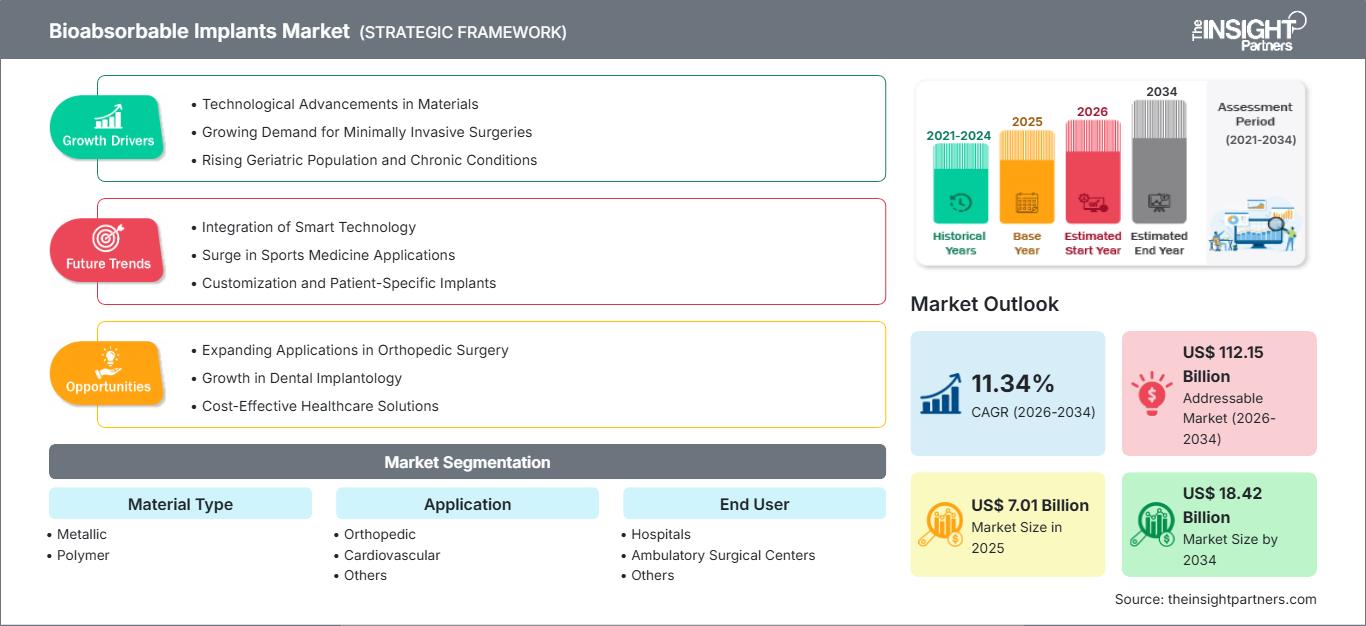
The bioabsorbable implants market was valued at US$ 7.01 Billion in 2025 and is expected to reach US$ 18.42 Billion by 2034, registering a CAGR of 11.34% during 2026–2034. Growth is supported by demand for temporary fixation, avoidance of implant-removal procedures, advances in biodegradable polymers and magnesium alloys, and broader adoption of minimally invasive interventions. Clinical interest is strengthening where implants can provide temporary structural support and progressively resorb after healing.
Across North America, the bioabsorbable implants market size is projected to expand at approximately ~11% CAGR through 2034. The region benefits from high orthopedic and cardiovascular procedure volumes, established reimbursement pathways, active clinical research, and early adoption of advanced biomaterials. Greater use of outpatient surgery and increasing evaluation of leave-nothing-behind technologies are encouraging manufacturers to develop implants with improved radial strength, controlled degradation, biocompatibility, and procedure-specific delivery systems.
Bioabsorbable Implants Market Assessment and Insights
Regional Outlook
- North America: ~38% of the global market in 2025 | ~11% CAGR through 2034. Market position: North America leads through advanced surgical infrastructure, substantial orthopedic and cardiovascular intervention volumes, established clinical research networks, and comparatively early adoption of resorbable biomaterial platforms.
- US: ~87% of North American market revenue in 2025 | ~11% CAGR through 2034. Market position: The US anchors regional demand through major medical-device manufacturers, high utilization of minimally invasive surgery, active regulatory evaluation, and broad hospital and ambulatory surgical capacity.
- Europe: ~30% of the global market in 2025 | ~11% CAGR through 2034. Market position: Europe represents a mature development and commercialization base, with Germany leading within Europe and the UK, France, Italy, and Spain supporting orthopedic and cardiovascular adoption.
- Asia Pacific: ~24% of the global market in 2025 | ~14% CAGR through 2034. Market position: Asia Pacific is the fastest-growing region as local manufacturing, surgical access, and regulatory approvals expand. China leads within Asia Pacific, while Japan, South Korea, India, and Australia support wider clinical uptake.
Segment Outlook
- Application: ~46% Share in 2025 | ~11% CAGR through 2034. Market position: Application leads because implant design, material selection, degradation timing, mechanical strength, and clinical evidence are determined primarily by anatomical site and procedural requirements.
- Material Type: ~32% Share in 2025 | ~13% CAGR through 2034. Market position: Material Type has the highest growth outlook as magnesium alloys, refined polymers, composite structures, and advanced coatings improve strength retention, degradation control, deliverability, and biological performance.
Competitive Coverage
Meril Life Sciences Pvt. Ltd., Medtronic plc, Smith+Nephew plc, Stryker Corporation, KLS Martin Group, BIOTRONIK SE & Co. KG, Syntellix AG, Q3 Medical Devices Limited, JW Medical Systems Ltd., OrbusNeich Medical Group Holdings Limited
Methodology
The Insight Partners follows Data Collection & Secondary Research, Primary Research, Data Analysis, and Data Triangulation & Final Review to validate market estimates and insights.
Source: The Insight Partners' analysis based on proprietary research, government publications, company annual reports, investor presentations, industry databases, and expert interviews.
Bioabsorbable implant technologies have progressed from relatively thick devices made of polymers, which have varied resorption characteristics, to thinner, stronger, and more indication-specific devices. Manufacturers in the bioabsorbable implants market are optimizing materials including polymer, molecular weight, crystallinity, alloy, coating, and process parameters to ensure mechanical strength maintenance during the healing process. The manufacturing process demands exact controls of degradation, sterility, shelf life, particulates, and precision in dimensioning. Magnesium platforms have expanded the field of research away from traditional polymers, whereas advances in molding, extruding, machining, and additive manufacturing facilitate the development of more complex geometries of implants.
Over the coming decade, commercial success is anticipated to spread into Asia Pacific and some emerging healthcare systems due to growing experience, local manufacturing, and regulatory ability. Focus on investments will be on gathering clinical data over a long period of time, material science, delivery, training of physicians, and indications for use. Regulators will monitor the mechanical performance, degradation products, inflammation reaction, and post-market results. Companies that manage to match resorption properties with biological healing and procedures performed by physicians should be in a better position.
Bioabsorbable Implants Market Report Scope
| Report Attribute | Details |
|---|---|
| Market size in 2025 | US$ 7.01 Billion |
| Market Size by 2034 | US$ 18.42 Billion |
| Global CAGR (2026 - 2034) | 11.34% |
| Historical Data | 2021-2024 |
| Forecast period | 2026-2034 |
Bioabsorbable Implants Market Analysis
The growth of the bioabsorbable implants market is driven by a demand for reducing any complications and associated costs arising due to permanent devices. The value chain includes polymers and alloys production, components production, coating, sterilization, packaging, validation, distribution, implantation, and post-market monitoring. The greatest demands are for products which allow temporary structure creation and healing without leaving any permanent materials.
The favorable supply situation will be provided by those companies which manage to control material purity, degradation rate, mechanical retention ability, and production processes. In addition, surgeons need reliable equipment for the implant insertion process which depends on insertion torque, accuracy of insertion, lesions preparation, and fixation methods. Therefore, success of the product cannot depend only on the implant but also on other aspects.
The bioabsorbable implants market report highlights the competition between diversified medical-device companies and niche players with expertise in degradable materials. Medtronic plc, Smith+Nephew plc, and Stryker Corporation leverage existing clinical relationships and synergies in the surgical portfolio. Meril Life Sciences Pvt. Ltd., BIOTRONIK SE & Co. KG, Syntellix AG, Q3 Medical Devices Limited, JW Medical Systems Ltd., and OrbusNeich Medical Group Holdings Limited add their expertise in cardiovascular or biodegradable solutions.
Key areas of investment encompass magnesium alloys, thin polymer scaffolds, bioactive surfaces, drug delivery, customization to the anatomy, and research activities. KLS Martin Group participates in the ecosystem of maxillofacial and reconstructive surgeries, and existing manufacturers can add absorbable technologies to their product lines. A successful strategy is more about finding indications when temporary implants have advantages over permanent implants rather than replacing all implants universally.
● REPORT CUSTOMIZATION
Tailor This Report To Align With Your Specific Business Requirements
This report can be customized to align precisely with your business objectives, scope, and target markets. Customization options include tailored segmentation, geography, competitive analysis, and strategic insights to support informed decision-making.
Customize This Report →WHAT YOU CAN ADJUST
- ● Segmentations
- ● Geography
- ● Competitive Analysis
- ● Language Preferences
Bioabsorbable Implants Market: Strategic Insights
Regional Insights
North America bioabsorbable implants market
North America comprised ~38% share of worldwide revenue in 2025 and is anticipated to achieve ~11% CAGR until 2034. The bioabsorbable implants market share is an indication of the presence of well-established infrastructure for orthopedics, cardiovascular, sports medicine, reconstructive, and ambulatory surgery applications. Clinical trials, regulatory submission, reimbursement analysis, medical education, and post-marketing evidence generation are all facilitated by the region’s environment.
While hospitals continue to play an important role in the performance of cardiovascular and orthopedic surgeries, the involvement of ambulatory surgery centers in selected fixation and sports medicine surgeries is on the rise. In Canada, there is a contribution in the form of specialist hospitals and research institutes. For Mexico, a growth potential is evident due to investments in healthcare and local production. Adoption of bioabsorbable implants is contingent upon clinical comparison, predictable degradation, familiarity with procedure, and total cost of treatment.
U.S. bioabsorbable implants market
The USA accounted for roughly ~87% of revenue from North America in 2025 and is projected to grow at ~11% CAGR to 2034. Its domination of North America is driven by high volumes of procedures, development of medical devices, clinical research networks in universities, and evaluation pathways for new implants. The demand is associated with procedures in traumatology, sports medicine, orthopedics, cardiovascular surgery, and reconstruction surgeries.
The Medtronic plc, Smith+Nephew plc, Stryker Corporation, Meril Life Sciences Pvt. Ltd., and other specialized vendors operate in all relevant clinical segments. US buyers consider the acquisition cost along with the proof of mechanical stability, reduced secondary revision, shorter follow-up, and compatibility with minimally-invasive techniques. The cardiovascular segment is particularly evidence-based due to early experience with scaffold that drew much attention to struts size, lesion choice, technique of implantation, thrombosis, and long-term outcome. Orthopedic segment is relatively procedure-driven and depends on the confidence of surgeons in fixation.
Europe bioabsorbable implants market
Europe captured around ~30% of the bioabsorbable implants market share in 2025 and will grow at a CAGR of ~11% till 2034. The region has established infrastructure for medical device manufacturing along with biomaterial technology, clinical trials network, and health care system that focuses on clinical efficacy and total life cycle cost analysis.
Germany is the key country in Europe owing to its engineering expertise, orthopedic specialty centers, and developers that focus on magnesium implants. The UK provides well-established infrastructure for cardiovascular and orthopedic research studies but procurement involves evidence of comparative value. France provides structure procurement through hospitals along with interventional treatment. Italy provides high proficiency procedures in both orthopedic and cardiology segments, whereas Spain provides growth via regional hospitals and sports medicine centers.
Europe’s technology platform is further strengthened by Syntellix AG, BIOTRONIK SE & Co. KG, KLS Martin Group, and Q3 Medical Devices Limited. The regional need is further augmented by the availability of commercialization avenues where implant technologies can gain experience in different countries. Nevertheless, there is the challenge of dealing with different requirements for reimbursement, tenders, distribution, and training in each country. Sustainable growth will be seen when companies provide evidence of controlled resorption while maintaining functionality after a longer period.
APAC bioabsorbable implants market
Asia Pacific accounted for approximately ~24% of worldwide revenue in 2025 and is projected to post the fastest regional CAGR of ~14% through 2034. China is the leading country in Asia Pacific, supported by increasing hospital capacity, medical-device localization, orthopedic demand, and policy support for domestic innovation.
Japan can provide highly advanced clinical practice and strict quality standards, while South Korea is characterized by its biomaterials research along with its sophisticated healthcare system. India has much to offer due to the growth of private hospitals and companies, such as Meril Life Sciences Pvt. Ltd. Australia can be regarded as having an advanced adoption environment especially when it comes to advanced surgeries.
Middle East & Africa bioabsorbable implants market
The Middle East & Africa market is expected to grow at approximately ~9% CAGR through 2034. Saudi Arabia is the leading country in the Middle East & Africa, supported by healthcare infrastructure investment, specialist hospital development, and procurement of advanced surgical technologies. The UAE contributes through premium hospitals, medical tourism, and access to internationally developed devices.
South Africa is an example of relatively mature clinical base in Sub-Saharan Africa, whereas the Rest of MEA is limited by issues of variable reimbursement, specialist availability, distribution and operating theatre capabilities. Resilience of energy is important for the preservation of sterilized instruments as well as functioning of hospitals, but unlike biological products, implants themselves have relatively simple logistical needs.
Segmentation Analysis
Material Type
The bioabsorbable implants market scope by Material Type covers degradable platforms designed to retain sufficient strength during healing and subsequently break down into biocompatible products. Selection is influenced by mechanical load, anatomical environment, degradation period, imaging requirements, and manufacturing feasibility. Metallic implants are projected to expand at approximately ~13% CAGR during 2026–2034 as magnesium technology advances and developers pursue stronger temporary fixation with biologically compatible transformation.
- Metallic: Magnesium-based platforms provide metal-like initial handling and mechanical support while gradually resorbing. Development focuses on controlling corrosion, hydrogen evolution, alloy purity, coatings, strength retention, and replacement by native tissue.
- Polymer: Resorbable polymers offer adjustable degradation profiles and established use in screws, pins, anchors, scaffolds, and soft-tissue devices. Performance depends on molecular structure, crystallinity, geometry, processing, and local biological conditions.
Application
Application in the bioabsorbable implants market determines implant configuration, load-bearing requirements, degradation timing, delivery approach, and evidence expectations. The segment is important because successful performance in one anatomical environment does not automatically translate to another. Cardiovascular applications are forecast to register approximately ~12% CAGR through 2034 as thinner scaffolds, magnesium platforms, improved coatings, and more disciplined implantation protocols renew interest in temporary vessel support.
- Orthopedic: Absorbable screws, pins, plates, and anchors support fracture fixation, osteotomy, ligament reconstruction, and extremity procedures. Their clinical value is strongest where permanent hardware may become prominent or require elective removal.
- Cardiovascular: Resorbable vascular scaffolds provide temporary vessel support before degradation. Adoption depends on deliverability, radial strength, strut thickness, drug-release performance, lesion selection, deployment accuracy, and long-term safety evidence.
- Others: Additional uses include biliary, pancreatic, maxillofacial, reconstructive, and soft-tissue applications. Commercial potential varies according to anatomy, required support duration, migration risk, regulatory classification, and availability of conventional alternatives.
End User
End User dynamics in the bioabsorbable implants market reflect differences in case complexity, infrastructure, reimbursement, procurement authority, and postoperative care. Hospitals maintain the broadest access to multidisciplinary expertise and advanced imaging, while outpatient facilities prioritize predictable workflows and rapid recovery. Ambulatory Surgical Centers are projected to expand at approximately ~13% CAGR through 2034 as suitable orthopedic and minimally invasive procedures move into lower-cost care settings with standardized instruments and defined patient-selection criteria.
- Hospitals: Hospitals manage complex cardiovascular, trauma, reconstructive, and multidisciplinary cases. Purchasing decisions often require formal clinical review, regulatory documentation, physician training, technical support, and evidence of comparative outcomes.
- Ambulatory Surgical Centers: These facilities emphasize procedure efficiency, compact instrumentation, predictable inventory, and limited postoperative burden. Absorbable fixation can support outpatient economics when clinical indications and reimbursement are well established.
- Others: Specialist clinics, research institutions, and focused treatment centers contribute selective demand. Their adoption depends on procedural capability, referral volumes, clinical-study participation, and access to trained surgeons and supporting technologies.
Opportunity Snapshot
| Application | Revenue Contribution | Trend Tag | Adoption Stage |
| Orthopedic | High | Temporary Fixation | Mature |
| Cardiovascular | High | Vessel Restoration | Scaling |
| Others | Medium | Ductal Support | Emerging |
Bioabsorbable Implants Market Growth Drivers and Impact Analysis
Reduced Need for Secondary Implant-Removal Procedures
Permanent implants can require removal when they cause pain, soft-tissue irritation, growth-related concerns, or interference with adjacent structures. A bioabsorbable device is designed to provide support during healing and disappear once that function is no longer required. This mechanism can reduce exposure to an additional operation, anesthesia, facility utilization, and recovery time. The benefit is particularly relevant in extremity, sports medicine, pediatric-oriented, and maxillofacial procedures where hardware prominence can become clinically important. Market impact depends on manufacturers proving that resorption is predictable and does not create premature strength loss, inflammatory response, or harmful degradation products. Evidence demonstrating fewer downstream interventions can strengthen reimbursement and hospital procurement decisions.
Advances in Degradable Polymers and Magnesium Alloys
Materials development is improving the balance between initial strength, flexibility, biological compatibility, and controlled degradation. Polymer platforms can be engineered through molecular composition, reinforcement, geometry, and coatings, while magnesium alloys provide higher initial strength for selected orthopedic and vascular applications. Advances in extrusion, precision machining, surface modification, and sterilization are also improving manufacturing reproducibility. These developments expand the set of procedures that can be addressed without permanent hardware. Market impact will be greatest where material performance is linked to a defined healing timeline and supported by clinical outcomes. Manufacturers must still manage shelf stability, degradation variability, particulate generation, corrosion control, and scale-up consistency before broader adoption becomes feasible.
Expansion of Minimally Invasive and Outpatient Procedures
Healthcare providers are shifting suitable interventions toward minimally invasive and outpatient pathways to reduce hospitalization and improve resource utilization. Bioabsorbable implants can support this transition when they simplify follow-up and reduce the likelihood of planned removal. Headless screws, anchors, vascular scaffolds, and biodegradable ductal devices are increasingly designed for delivery through compact instruments or catheter-based systems. Real-world impact depends on procedural efficiency because longer operating times or complex deployment can offset downstream benefits. Suppliers that provide standardized kits, intuitive delivery systems, training, and reliable inventory can improve adoption within ambulatory environments. Clear patient-selection criteria and reimbursement alignment will remain necessary to convert technical suitability into routine utilization.
Bioabsorbable Implants Market Future Trends
Convergence of Structural Support and Biological Function
The bioabsorbable implants market trends indicate a transition from passive degradation toward implants that actively support tissue regeneration. Future products may incorporate osteoconductive surfaces, controlled drug release, biologically responsive coatings, or degradation products that facilitate favorable remodeling. Material selection will increasingly consider how the implant interacts with cells and tissues throughout its lifecycle rather than only its initial mechanical performance. This shift could create differentiated platforms for bone healing, vascular restoration, infection management, and soft-tissue repair. Development programs will require integrated mechanical, chemical, and biological testing because added functionality introduces more complex regulatory claims. Companies connecting biomaterial science with measurable clinical outcomes should establish stronger differentiation.
Patient-Specific Design and Precision Manufacturing
Advanced imaging, computational modeling, and additive manufacturing could enable implants with geometry, porosity, strength, and degradation behavior tailored to specific anatomical requirements. Patient-specific bioabsorbable devices may be particularly relevant in craniomaxillofacial reconstruction, complex trauma, and pediatric procedures where standard dimensions create compromises. Precision manufacturing may also support internal lattice structures that preserve mechanical performance while reducing material volume. Commercialization will require validated design controls, repeatable production, sterilization compatibility, and efficient regulatory pathways for customized devices. Rather than replacing standardized inventory, patient-specific products are likely to emerge first in complex, high-value cases where anatomical fit and avoidance of later removal create meaningful clinical advantages.
Bioabsorbable Implants Market Opportunities
Magnesium-Based Orthopedic Fixation in High-Value Procedures
Magnesium implants provide an investment opportunity where polymer strength is insufficient and permanent titanium or steel creates a meaningful removal burden. Foot and ankle, hand and wrist, sports medicine, osteotomy, and maxillofacial procedures offer targeted entry points. Companies can invest in alloy optimization, corrosion-controlling surfaces, procedure-specific screws, plates, instruments, and surgeon education. Commercial programs should focus on indications with clear healing timelines and measurable downstream benefits rather than broad substitution claims. Partnerships with specialist centers can generate comparative evidence on fixation, remodeling, imaging, complications, and removal avoidance. Local manufacturing and regulatory partnerships may also improve access in Asia Pacific markets with expanding orthopedic capacity.
Next-Generation Cardiovascular Scaffolds and Delivery Systems
The bioabsorbable implants market Forecasts indicate renewed opportunity for cardiovascular platforms that address limitations associated with first-generation polymer scaffolds. Development priorities include thinner struts, stronger magnesium alloys, improved deliverability, controlled drug release, enhanced radiopacity, and predictable resorption. Companies should pair product innovation with imaging-guided deployment protocols, physician training, and long-term registries. Commercial opportunity is most credible in carefully selected lesions and patient populations where temporary scaffolding offers an advantage over permanent stents or balloon-only treatment. Investment decisions should account for lengthy clinical development, demanding regulatory evidence, and competition from established drug-eluting stents. Successful platforms could nevertheless access substantial interventional networks through differentiated leave-nothing-behind treatment pathways.
Recent Developments
- October 2026: Teleflex Incorporated, the US FDA granted Breakthrough Device Designation to the Freesolve resorbable magnesium scaffold for percutaneous coronary intervention. The platform uses a proprietary magnesium alloy and bioabsorbable coating to provide temporary vessel support. Teleflex is evaluating the scaffold in the BIOMAG-III pivotal trial as part of its US development strategy.
- January 2026: Syntellix AG reported continued commercial progress in China following the 2025 market launch of its MAGNEZIX bioabsorbable magnesium implant products. Initial shipments had been delivered, provincial product-listing activities were progressing, and its local partner had expanded infrastructure dedicated to distribution and market development.
- March 2025: Becton, Dickinson and Company announced treatment of the first patient in the STANCE investigational device exemption trial evaluating the bioabsorbable GalaFLEX LITE scaffold in breast implant revision surgery. The poly-4-hydroxybutyrate scaffold is being studied for reducing recurrence of capsular contracture and implant malposition.
Frequently Asked Questions

- Comprehensive Market Sizing and Forecast Analysis
- Detailed Segmentation Analysis
- In-Depth Market Dynamics Assessment
- Regional and Country-Level Insights
- Competitive Landscape and Company Benchmarking
- Strategic Business Intelligence
Recent Reports
Testimonials

The Insight Partners provided valuable market intelligence that supported our global go-to-market strategy. Their team was professional, responsive, and attentive to our feedback, providing thoughtful analysis and helpful methodological clarifications throughout the project.
Junmo Kim Chief Financial Officer (CFO), Enertech Co., Ltd.
The Insight Partners' SCADA System Market report is comprehensive, with valuable insights on current trends and future forecasts. The team was highly professional, responsive, and supportive throughout. We are very satisfied and highly recommend their services.
RAN KEDEM Partner, Reali Technologies LTDs
I requested a report on a very specific software market and the team produced the report in a few days. The information was very relevant and well presented. I then requested some changes and additions to the report. The team was again very responsive and I got the final report in less than a week.
JEAN-HERVE JENN Chairman, Future Analytica
We worked with The Insight Partners for an important market study and forecast. They gave us clear insights into opportunities and risks, which helped shape our plans. Their research was easy to use and based on solid data. It helped us make smart, confident decisions. We highly recommend them.
PIYUSH NAGPAL Sr. Vice President, High Beam Global
The Insight Partners delivered insightful, well-structured market research with strong domain expertise. Their team was professional and responsive throughout. The user-friendly website made accessing industry reports seamless. We highly recommend them for reliable, high-quality research services
YUKIHIKO ADACHI CEO, Deep Blue, LLC.
This is the first time I have purchased a market report from The Insight Partners.While I was unsure at first, I visited their web site and felt more comfortable to take the risk and purchase a market report.I am completely satisfied with the quality of the report and customer service. I had several questions and comments with the initial report, but after a couple of dialogs over email with their analyst I believe I have a report that I can use as input to our strategic planning process.Thank you so much for taking the extra time and making this a positive experience.I will definitely recommend your service to others and you will be my first call when we need further market data.
JOHN SUZUKI President and Chief Executive Officer, Board Director, BK Technologies
I wish to appreciate your support and the professionalism you displayed in the course of attending to my request for information regarding to infectious disease IVD market in Nigeria. I appreciate your patience, your guidance, and the fact that you were willing to offer a discount, which eventually made it possible for us to close a deal. I look forward to engaging The Insight Partners in the future, all thanks to the impression you have created in me as a result of this first encounter.
DR CHIJIOKE ONYIA MANAGING DIRECTOR, PineCrest Healthcare Ltd.Reason to Buy
- Informed Decision-Making
- Understanding Market Dynamics
- Competitive Analysis
- Identifying Emerging Markets
- Customer Insights
- Market Forecasts
- Risk Mitigation
- Boosting Operational Efficiency
- Strategic Planning
- Investment Justification
- Tracking Industry Innovations
- Aligning with Regulatory Trends





 Get Free Sample for