
Bioadhesives Market Size, Demand & Growth by 2034
Coverage: by Type (Plant Based and Animal Based), End Use (Paper & Packaging, Construction, Woodworking, Personal Care, Medical, and Others), , and by Geography (North America, Europe, Asia Pacific, and South and Central America)
- Status : Data Released
- Report Code : TIPRE00007698
- Category : Chemicals and Materials
- No. of Pages : 150
- Available Report Formats :


- Last update date : August 28, 2026


2025 Market Size
US$ 11.01 Bn
Base year value
2034 Forecast
US$ 22.40 Bn
Projected by 2034
CAGR 2026-2034
8.22 %
Growth rate
Addressable Market
US$ 150.16 Bn
(2026-2034)
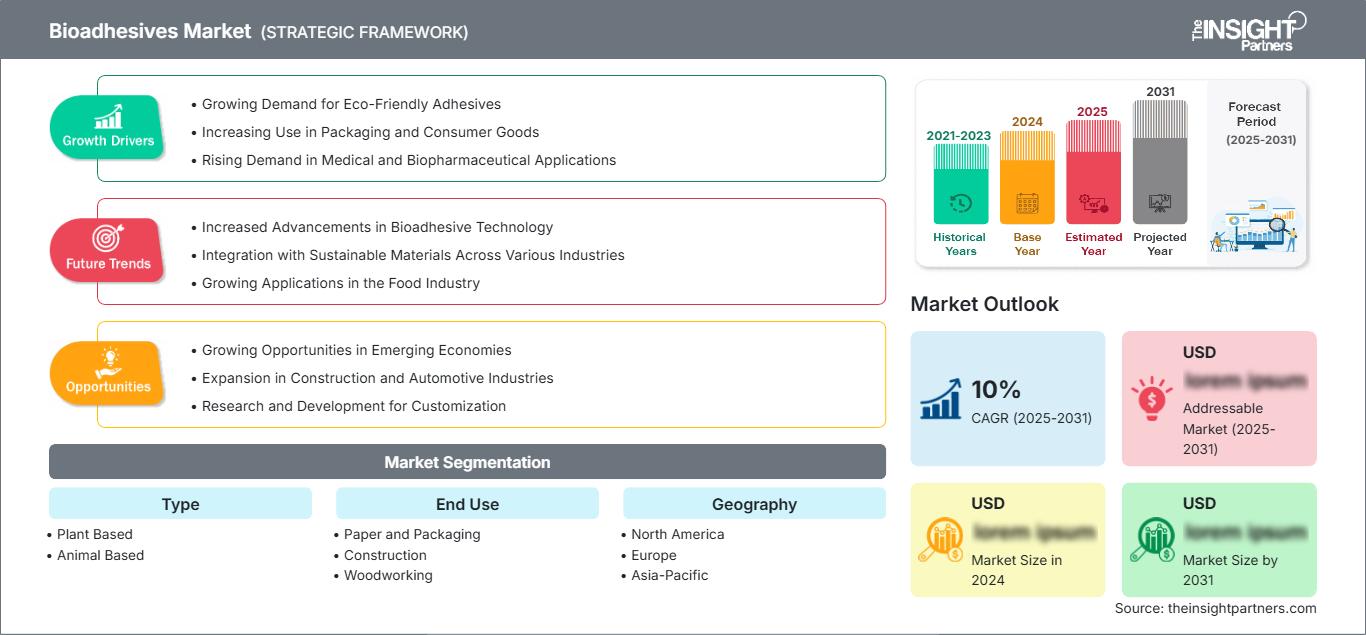
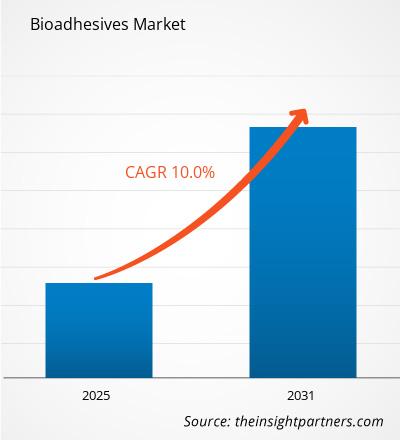
The Bioadhesives market is valued at US$ 11.01 Billion in 2025 and is projected to reach US$ 22.40 Billion by 2034, registering a CAGR of 8.22% during 2026–2034. Demand is supported by increasing substitution of petroleum-derived bonding systems with renewable formulations across paper and packaging, construction, woodworking, personal care, and medical applications. Advances in formulation chemistry are improving bond strength, moisture resistance, processing efficiency, and substrate compatibility.
The Bioadhesives Market size outlook across North America is supported by established adhesive manufacturing, extensive packaging conversion, engineered-wood production, healthcare applications, and sustainability-oriented procurement. The regional market is expected to expand at approximately 7.6–8.4% CAGR during 2026–2034, supported by renewable-material qualification, lower-emission manufacturing, and growing demand for adhesives compatible with recyclable and fiber-based substrates.
Bioadhesives Market Assessment and Insights
- North America: North America held approximately 33% share in 2025 and is estimated to expand at a 7.6–8.4% CAGR between 2026 and 2034, supported by packaging, healthcare, construction, and established sustainable-material infrastructure.
- U.S.: The U.S. represented approximately 66–68% of North American demand in 2025, with growth estimated at 7.4–8.2% CAGR during 2026–2034, supported by packaging, medical, and personal-care applications.
- Europe: Europe accounted for approximately 31% share in 2025 and is projected to grow at a 7.8–8.6% CAGR during 2026–2034, with Germany, the UK, France, Italy, and Spain supporting regional demand.
- Asia Pacific: Asia Pacific represented approximately 26% share in 2025 and is forecast to register a 9.0–9.8% CAGR during 2026–2034, led by China, Japan, South Korea, India, and Australia.
- Largest Segment: Plant-based accounted for approximately 71–72% market share in 2025, with an estimated 7.8–8.6% CAGR during 2026–2034, supported by packaging, paper, and woodworking applications.
- High Growth Segment: Animal-based represented approximately 28–29% market share in 2025 and is projected to grow at 9.3–10.0% CAGR during 2026–2034, supported by specialized medical and industrial applications.
- Key companies analyzed in detail: Arkema S.A., DuPont de Nemours, Inc., EcoSynthetix Inc., Emsland Group, H.B. Fuller Company, Henkel AG & Co. KGaA, Jowat SE, Permabond LLC, Sealock Ltd., Solenis LLC.
Source: The Insight Partners' analysis based on proprietary research, government publications, company annual reports, investor presentations, industry databases, and expert interviews.
The industry will move away from standard starch, protein, cellulose, and natural polymer materials toward engineered renewable formulations, which provide better rheology, wet strength, heat resistance, and processing properties. The manufacturers are increasingly blending biological feedstocks and traditional adhesive solutions to overcome qualification challenges. In the product development phase, the emphasis is placed on renewability, recyclable packaging compatibility, reduced processing temperatures, and carbon footprint reduction.
Future growth will most likely be achieved where renewable solutions can bring environmental and operational advantages at once. The converters of packaging materials, producers of engineered wood, developers of personal care products, and medical products are increasingly considering material footprints during supplier qualification. Europe will stay influential in circularity and regulations, while the Asia Pacific will produce considerable incremental demand due to industrialization, packaging conversion, and local specialty material production.
Bioadhesives Market Report Scope
| Report Attribute | Details |
|---|---|
| Market size in 2025 | US$ 11.01 Billion |
| Market Size by 2034 | US$ 22.40 Billion |
| Global CAGR (2026 - 2034) | 8.22% |
| Historical Data | 2021-2024 |
| Forecast period | 2026-2034 |
Bioadhesives Market Analysis
Bioadhesives Market growth path is driven by the need for renewable adhesives, where companies are looking for less fossil resources dependency, sustainability advantages, or compatibility with recyclable substrates. Value chain consists of agricultural and forestry raw materials providers, biochemical producers, polymer producers, adhesive manufacturers, converters, distributors, and end users. Demand for paper and packaging is high, whereas demand from medical and personal care industries requires additional qualifications.
Raw material availability is still an issue as starch, cellulose, soy, lignin, gelatin, and other biological raw materials are subject to agriculture production, processing infrastructure, and regional logistics issues. Diversification of raw materials and formulation helps manufacturers overcome variability issues. Certification of renewable inputs and mass balance system allow raw material suppliers to produce lower carbon products via current infrastructure, without changes in customer equipment.
Technical performance is becoming more important for competitive positioning than renewable content only. Henkel AG & Co. KGaA, H.B. Fuller Company, Arkema S.A., and Jowat SE compete using wide application portfolio, technical services, formulation expertise, and global manufacturing capabilities. EcoSynthetix Inc. differentiates based on the use of renewable biopolymer technologies for the wood composite, pulp and tissue, and personal care applications.
Investments are being made in renewable feedstock, formulation optimization, application testing, certification, and production decarbonization. EcoSynthetix reported net sales of US$20.8 million in FY2025, an increase by 12% compared to 2024, volume increase related to wood composites, pulp and tissue applications. The expansion of the company's renewable-materials programs and sustainability metrics indicates a trend towards competitiveness through verified environmental performance along with adhesion functionality.
According to the Bioadhesives Market analysis, competitive advantages will be increasingly achieved by formulation performance, supply security, application engineering, and sustainability documentation. Diversified companies can rely on global manufacturing capabilities and technical services networks, while specialized producers can differentiate through their bio-based polymer technologies and applications.
● REPORT CUSTOMIZATION
Tailor This Report To Align With Your Specific Business Requirements
This report can be customized to align precisely with your business objectives, scope, and target markets. Customization options include tailored segmentation, geography, competitive analysis, and strategic insights to support informed decision-making.
Customize This Report →WHAT YOU CAN ADJUST
- ● Segmentations
- ● Geography
- ● Competitive Analysis
- ● Language Preferences
Bioadhesives Market: Strategic Insights
Regional Insights
North America Bioadhesives Market
North America represented approximately 33% of the Bioadhesives Market share in 2025 and is projected to expand at a 7.6–8.4% CAGR through 2034. The United States is the primary demand center, while Canada adds through its forestry industry, renewable chemicals, packaging, and engineered wood segments. This market is helped by having existing adhesive suppliers as well as customers who factor in renewable content and performance in their procurement process.
Packaging and paper conversion are among the main applications as bio-based adhesives can help with fiber-containing substrates and recycle-friendly products. Woodworking and construction can be other applications, while medical products will need more biocompatibility. Research capacity and existing facilities in the specialty chemical segment help with formulation development.
U.S. Bioadhesives Market
The U.S. accounted for approximately 66–68% of North American demand in 2025 and is expected to grow at a 7.4–8.2% CAGR through 2034. Packaging, paper conversion, engineered wood, personal care, and medical applications will drive the market. Technical platforms from existing adhesive companies and renewable polymer experts will help qualify customers for trials and formulations.
Market demand is now becoming more and more driven by sustainable requirements, renewable material sourcing, and circular packaging goals. EcoSynthetix Inc. has been steadily increasing its commercial business in wood composites, pulp/tissue, and personal care applications to illustrate application-specific properties that enable replacement. Larger adhesive companies will supplement these technologies.
Europe Bioadhesives Market
Europe accounted for approximately 31% share in 2025 and is forecast to expand at a 7.8–8.6% CAGR through 2034. Germany is the largest national market, whereas the UK, France, Italy, and Spain participate via packaging, woodworking, construction, and manufacture of consumer goods. Recycling and sustainable materials needs are key regional demand drivers.
UK market is driven by packaging sustainability goals and demands of retailers, which push converters to assess adhesives for recycling capabilities and compatibility with substrates. Germany enjoys its strong industrial adhesives market as well as engineered wood production. France and Italy contribute significantly to packaging, furniture, and construction markets, whereas Spain participates in food packaging, woodworking, and sustainable manufacturing.
APAC Bioadhesives Market
APAC represented approximately 26% share in 2025 and is projected to achieve a 9.0–9.8% CAGR through 2034, making it the fastest-growing major region. China dominates regional demand followed by Japan, South Korea, India, and Australia. Opportunities in packaging, construction, consumer goods manufacture, and healthcare manufacture are possible.
China has an advantage due to its extensive manufacturing and packaging industries, whereas Japan and South Korea have a focus on high performance materials. India has its support from packaging growth and industrialization, and Australia has its contribution from sustainable packaging and construction. The development of policy programs, business sustainability goals, and manufacturing capacities is pushing towards more consideration of renewables.
Middle East & Africa Bioadhesives Market
Middle East & Africa remains a developing market, with demand concentrated in packaging, construction, woodworking, and personal care. Saudi Arabia and the UAE provide investment capacity for advanced manufacturing and infrastructure, while South Africa has an established packaging and forestry-linked industrial base. Regional growth is estimated at 7.0–8.0% CAGR through 2034.
Both Saudi Arabia and UAE are forming industrial ecosystems which would enable them to utilize sustainable materials in industries other than those of energy. South Africa has the advantage of paper, wood, and consumer goods manufacturing. However, the Rest of MEA is fragmented with technology, feedstocks, customers' needs, and suppliers' competitive ability playing a critical role in adoption of sustainable materials.
Segmentation Analysis
Type influences feedstock characteristics, formulation performance, processing requirements, and application suitability. Plant-based remains the dominant category, with an estimated 7.8–8.6% CAGR during 2026–2034, while animal-based is projected to expand at 9.3–10.0% CAGR. Plant-derived systems benefit from broad packaging and woodworking use, whereas animal-derived technologies retain importance in specialized applications.
- Plant-Based: Starch, cellulose, soy, lignin, and related feedstocks support high-volume applications where renewable content, low emissions, and compatibility with paper-based substrates are important procurement criteria.
- Animal-based: Protein-derived systems such as gelatin, collagen, and casein provide strong bonding characteristics and specialized functionality, supporting medical, woodworking, and selected packaging applications.
End Use determines qualification requirements, purchasing economics, and required performance characteristics. The Bioadhesives Market scope extends across paper and packaging, construction, woodworking, personal care, and medical applications. Paper and packaging provide the broadest commercial base, while medical applications offer specialized opportunities where biocompatibility, controlled adhesion, and safety requirements support higher-value formulation development.
- Paper and Packaging: High-volume carton, corrugated, labeling, and converting applications provide recurring adhesive consumption and increasingly favor renewable-content systems compatible with recycling processes.
- Construction: Engineered wood and building-material applications require reliable structural performance, durability, moisture resistance, and low-emission characteristics over extended service periods.
- Woodworking: Furniture, panels, and engineered timber applications increasingly evaluate renewable binders that preserve machining efficiency, bond strength, durability, and finished-product quality.
- Personal Care: Bio-based polymers and binders are gaining attention where natural positioning, renewable content, sensory performance, and ingredient transparency influence formulation and product-development decisions.
- Medical: Medical adhesives require stringent biocompatibility, sterilization compatibility, controlled adhesion, flexibility, and safety performance, resulting in longer qualification cycles and specialized product-development requirements.
Opportunity Snapshot
| End Use | Revenue Contribution | Trend Tag | Adoption Stage |
|---|---|---|---|
| Paper and Packaging | High | Fiber Packaging | Mature |
| Construction | Medium | Timber Bonding | Scaling |
| Woodworking | Medium | Bio Binders | Scaling |
| Personal Care | Medium | Natural Polymers | Scaling |
| Medical | Low | Tissue Bonding | Emerging |
Bioadhesives Market Growth Drivers and Impact Analysis
Expansion of Sustainable Paper and Packaging Formats
The transition toward recyclable, fiber-based, and lower-carbon packaging is increasing the strategic importance of renewable adhesive technologies. There is a need for adhesive systems that can handle high production volumes in order to meet requirements in corrugated board, carton, label, and food packaging applications made from paper products. Bio-based adhesives could help where the right tack, drying properties, and suitability to substrates are provided by starch, cellulose, or other types of chemistry. Packaging companies are starting to evaluate adhesive systems within the context of overall sustainability of the packaging product and not merely as individual consumables. This would lead to different supplier selection criteria that favor renewability, recyclability, food contact approval, and efficient production.
Advancement of High-Performance Bio-Based Formulations
Formulation development is reducing the performance gap between renewable and conventional adhesive systems. Improved wet strength, temperature resistance, rheology, cure kinetics, and compatibility with fast production-line machinery are some advantages offered by newer technologies. These advantages apply especially to wood manufacturing and construction in which failure of bond could influence the performance of the final product. Increasing use of renewable materials is possible either by using biomass directly or by mass balance techniques without changing the existing manufacturing processes. The lower need for change could motivate customers to try out the products as they do not need to change their entire line for making improvements environmentally.
Growing Demand for Lower-Emission and Renewable Manufacturing
Industrial buyers are incorporating carbon reduction, renewable sourcing, and emissions performance into procurement decisions. Adhesives affect product-level environmental performance through feedstocks, manufacturing energy, solvent content, and end-of-life characteristics. Suppliers are responding through bio-based raw materials, lower-temperature processing, renewable electricity, and certified renewable-content systems. Henkel's 2026 collaboration with Sekab targets the replacement of conventional ethyl acetate with a bio-based alternative through a drop-in approach for industrial adhesive production. Such initiatives can reduce switching barriers and encourage customers to evaluate renewable systems without compromising established production requirements. These developments are reinforcing the commercial relevance of sustainability as a measurable procurement criterion.
Bioadhesives Market Future Trends
Shift Toward Certified and Traceable Renewable Feedstocks
Bioadhesives Market trends are increasingly moving toward certified and traceable renewable feedstocks rather than relying on bio-based content claims alone. Buyers are expected to request stronger chain-of-custody documentation, certification, lifecycle information, and evidence supporting environmental claims. Mass-balance systems should remain relevant because they allow renewable inputs to enter established chemical value chains without requiring complete infrastructure replacement. Direct plant-derived formulations will retain importance where biodegradability and natural-material positioning are central to product specifications. Suppliers capable of demonstrating consistent feedstock quality, reliable sourcing, and transparent carbon accounting should gain an advantage during customer qualification. This trend is expected to influence procurement standards across packaging, woodworking, construction, personal care, and specialty applications.
Convergence of Renewable Content and Process Efficiency
The next generation of formulations is expected to combine renewable content with measurable processing advantages such as lower application temperatures, faster setting, reduced adhesive consumption, or improved production-line efficiency. This changes the commercial proposition from environmental compliance toward total operating value. Packaging producers can benefit when an adhesive simultaneously reduces fossil-resource dependence and energy requirements during application. Similar benefits may support engineered-wood and furniture manufacturers seeking shorter cycle times without compromising bond performance. Product developers are therefore likely to prioritize multifunctional formulations rather than simply maximizing renewable content. Commercial adoption should increasingly depend on demonstrated cost, performance, and lifecycle benefits under actual manufacturing conditions rather than on sustainability claims considered independently.
Bioadhesives Market Opportunities
Expansion of Medical and Specialty Bonding Applications
Medical and specialty bonding applications provide an attractive opportunity because stringent performance requirements can support specialized formulation economics. Tissue adhesives, wound-care systems, medical-device assembly, transdermal products, and controlled-release technologies require combinations of adhesion, biocompatibility, flexibility, sterilization tolerance, and controlled degradation. Bio-derived proteins, polysaccharides, and biomimetic materials provide platforms for addressing these requirements. Suppliers can capture value by developing application-specific technologies rather than competing directly with commodity packaging adhesives. Partnerships with medical-device manufacturers, research institutions, and formulation specialists can support validation and shorten development cycles. The opportunity lies in combining renewable chemistry with functionality that provides clear technical differentiation, particularly where conventional commodity adhesives cannot easily satisfy increasingly stringent safety or performance specifications.
Regional Manufacturing and Feedstock Integration in APAC
APAC offers opportunities to develop localized bioadhesive supply chains around agricultural, forestry, and industrial feedstocks. China, India, Japan, South Korea, and Southeast Asia provide large packaging, construction, woodworking, and personal-care manufacturing bases, creating opportunities for regional formulation and application centers. Local production can reduce logistics exposure and improve responsiveness to converter requirements while enabling formulations to be adapted to regional substrates and operating conditions. Partnerships with starch, cellulose, agricultural-processing, and specialty-chemical producers can improve feedstock security and cost management. Manufacturers establishing technical-service capabilities near major converting clusters can accelerate qualification by supporting application trials, production troubleshooting, and performance validation before customers undertake broader substitution.
Recent Developments
- April 2025: Chemyunion introduced Hidrahair® Seal SE MB, a fermented biotechnological ingredient with bioadhesive properties for immediate and long-lasting split-end repair. Testing showed that the technology sealed up to 97% of split ends immediately and maintained 83% of repair after 48 hours, demonstrating the expansion of bioadhesive technologies into high-value personal-care applications.
- May 2026: Dublin City University and industry partners advanced OsStic™, a phosphoserine and alpha-tricalcium phosphate-based bone bioadhesive, toward a first-in-human clinical investigation for tibial plateau fractures at Leeds University Teaching Hospital. The development strengthens the medical application pipeline for bioadhesives, particularly in fracture fixation, bone repair, and biomimetic orthopedic technologies.
Frequently Asked Questions

- Comprehensive Market Sizing and Forecast Analysis
- Detailed Segmentation Analysis
- In-Depth Market Dynamics Assessment
- Regional and Country-Level Insights
- Competitive Landscape and Company Benchmarking
- Strategic Business Intelligence
Recent Reports
Testimonials

The Insight Partners' SCADA System Market report is comprehensive, with valuable insights on current trends and future forecasts. The team was highly professional, responsive, and supportive throughout. We are very satisfied and highly recommend their services.
RAN KEDEM Partner, Reali Technologies LTDs
I requested a report on a very specific software market and the team produced the report in a few days. The information was very relevant and well presented. I then requested some changes and additions to the report. The team was again very responsive and I got the final report in less than a week.
JEAN-HERVE JENN Chairman, Future Analytica
We worked with The Insight Partners for an important market study and forecast. They gave us clear insights into opportunities and risks, which helped shape our plans. Their research was easy to use and based on solid data. It helped us make smart, confident decisions. We highly recommend them.
PIYUSH NAGPAL Sr. Vice President, High Beam Global
The Insight Partners delivered insightful, well-structured market research with strong domain expertise. Their team was professional and responsive throughout. The user-friendly website made accessing industry reports seamless. We highly recommend them for reliable, high-quality research services
YUKIHIKO ADACHI CEO, Deep Blue, LLC.
This is the first time I have purchased a market report from The Insight Partners.While I was unsure at first, I visited their web site and felt more comfortable to take the risk and purchase a market report.I am completely satisfied with the quality of the report and customer service. I had several questions and comments with the initial report, but after a couple of dialogs over email with their analyst I believe I have a report that I can use as input to our strategic planning process.Thank you so much for taking the extra time and making this a positive experience.I will definitely recommend your service to others and you will be my first call when we need further market data.
JOHN SUZUKI President and Chief Executive Officer, Board Director, BK Technologies
I wish to appreciate your support and the professionalism you displayed in the course of attending to my request for information regarding to infectious disease IVD market in Nigeria. I appreciate your patience, your guidance, and the fact that you were willing to offer a discount, which eventually made it possible for us to close a deal. I look forward to engaging The Insight Partners in the future, all thanks to the impression you have created in me as a result of this first encounter.
DR CHIJIOKE ONYIA MANAGING DIRECTOR, PineCrest Healthcare Ltd.Reason to Buy
- Informed Decision-Making
- Understanding Market Dynamics
- Competitive Analysis
- Identifying Emerging Markets
- Customer Insights
- Market Forecasts
- Risk Mitigation
- Boosting Operational Efficiency
- Strategic Planning
- Investment Justification
- Tracking Industry Innovations
- Aligning with Regulatory Trends





 Get Free Sample for