
Biomedical Refrigerators Market Share, Size & Demand by 2034
Coverage: by Type (Blood Bank Refrigerators, Pharmacy Refrigerators, Laboratory Refrigerators, Ultra-low-Temperature Freezers, Other); End User (Hospitals and Clinics, Diagnostic Labs, Blood Banks, Research and Academic institutes) , and Geography (North America, Europe, Asia Pacific, and South and Central America)
- Status : Data Released
- Report Code : TIPRE00008762
- Category : Life Sciences
- No. of Pages : 150
- Available Report Formats :


- Last update date : November 05, 2026


2025 Market Size
US$ 4.28 Bn
Base year value
2034 Forecast
US$ 7.97 Bn
Projected by 2034
CAGR 2026-2034
7.15 %
Growth rate
Addressable Market
US$ 55.28 Bn
(2026-2034)
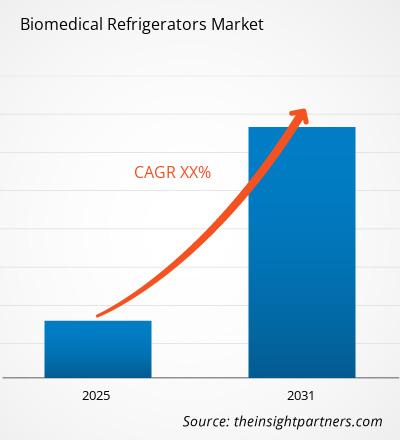
The biomedical refrigerators market was valued at US$ 4.28 Billion in 2025 and is projected to reach US$ 7.97 Billion by 2034, registering a CAGR of 7.15% during 2026–2034. Growth is supported by expanding biobanking, vaccine distribution, blood-component management, specialty pharmaceutical storage, and life-science research. Replacement of domestic appliances with purpose-built medical refrigeration is also improving temperature stability, traceability, and sample protection.
Across North America, the biomedical refrigerators market size is expected to expand at a CAGR of ~7% through 2034. The region benefits from extensive hospital and laboratory infrastructure, high-value biologic inventories, developed blood-bank networks, and stringent storage protocols. Demand increasingly favors purpose-built units with digital data logging, remote alarms, rapid temperature recovery, access controls, energy-efficient refrigeration, and integration with facility monitoring systems.
Biomedical Refrigerators Market Assessment and Insights
Regional Outlook
- North America: ~38% of the global biomedical refrigerators market share in 2025 | ~7% CAGR through 2034. Market position: North America leads through extensive healthcare infrastructure, regulated vaccine storage, established blood-bank networks, advanced biobanking, and strong demand for purpose-built pharmacy, laboratory, and ultra-low-temperature refrigeration.
- US: ~87% of North American market revenue in 2025 | ~7% CAGR through 2034. Market position: The US anchors regional demand through large hospital networks, biomedical research, pharmaceutical distribution, clinical laboratories, regulatory storage guidance, and replacement of general-purpose units with medical-grade equipment.
- Europe: ~29% of the global market in 2025 | ~6% CAGR through 2034. Market position: Europe is a mature market supported by regulated blood services, pharmaceutical research, and biobanking, with Germany leading regional demand and the UK and France maintaining strong laboratory infrastructure.
- Asia Pacific: ~25% of the global market in 2025 | ~10% CAGR through 2034. Market position: Asia Pacific is the fastest-growing region as China, Japan, India, South Korea, and Australia expand hospitals, vaccine programs, clinical research, blood services, and domestic equipment manufacturing.
Segment Outlook
- Type: ~56% Share in 2025 | ~7% CAGR through 2034. Market position: Type is the largest main segment because healthcare and research facilities require differentiated equipment for blood, medicines, reagents, biological samples, vaccines, and materials stored under ultra-low-temperature conditions.
- End User: ~44% Share in 2025 | ~8% CAGR through 2034. Market position: End User has the stronger growth outlook as diagnostic laboratories, biobanks, research institutes, hospitals, and blood centers increase storage capacity and replace aging refrigeration infrastructure.
Competitive Coverage
Thermo Fisher Scientific Inc., PHC Holdings Corporation, Liebherr-Hausgeräte GmbH, Helmer Scientific Inc., B Medical Systems S.à r.l., Follett Products, LLC, Arctiko A/S, Migali Industries Inc., Aegis Scientific, Inc., Qingdao Haier Biomedical Co., Ltd., Terumo Blood and Cell Technologies
Methodology
The Insight Partners follows Data Collection & Secondary Research, Primary Research, Data Analysis, and Data Triangulation & Final Review to validate market estimates and insights.
Source: The Insight Partners' analysis based on proprietary research, government publications, company annual reports, investor presentations, industry databases, and expert interviews.
Biomedical refrigeration has moved from mechanically-controlled cold cabinets to system-specific solutions with computer-based controls, accurate sensors, digital records, remote alerts, and adaptive compressors. Ultra-low-temperature systems incorporate hydrocarbons, better insulation, variable speed cooling, and compartmentalized storage to conserve energy and reduce exposure time during retrieval. The manufacturers are also networking the equipment with inventory systems, RFID identification, access control, and building monitoring systems, thus making the refrigeration technology more than mere storage but an integral part of the laboratory or clinical workflow.
For 2034, the investments in the biomedical refrigerators market shall be in networked cold storage, low-GWP refrigerants, automated biostorage systems, emergency power planning, and appropriate equipment for decentralization of healthcare services. Asia Pacific would receive the bulk of manufacturing and deployment investments as their research capacities and hospitals grow. Health programs would continue to create demand for freeze-proof vaccine refrigerators while the biopharmaceutical companies would need ultra-low-temperature systems that can provide accurate temperature records and validated recovery performance.
Biomedical Refrigerators Market Report Scope
| Report Attribute | Details |
|---|---|
| Market size in 2025 | US$ 4.28 Billion |
| Market Size by 2034 | US$ 7.97 Billion |
| Global CAGR (2026 - 2034) | 7.15% |
| Historical Data | 2021-2024 |
| Forecast period | 2026-2034 |
Biomedical Refrigerators Market Analysis
The expansion of the biomedical refrigeration equipment market comes from the rising quantity and value of temperature-dependent vaccines, blood products, biologics, clinical specimens, reagents, and research samples. A temperature excursion may reduce the effectiveness of a product, render an experiment invalid, postpone treatment, or necessitate sample replacement. The importance of temperature stability, alarm systems, and temperature control records outweighs that of the initial cost of equipment.
The supply chain in the biomedical refrigerators market includes compressor and insulation suppliers, refrigerator manufacturers, temperature monitoring system developers, distribution partners, service providers, hospitals, laboratories, biobanks, pharmacies, and research institutions. Refrigerator procurement will depend on the required temperature range, usable volume, door-opening recovery time, electrical robustness, sample organization, heat generation, sound level, and access for service. Service coverage is commercially vital since equipment failure could jeopardize valuable biological material.
Biomedical refrigerators market research reveals competitive positioning of diversified manufacturers of laboratory equipment and medical refrigeration solutions. Thermo Fisher Scientific Inc. and PHC Holdings Corporation provide diverse laboratory storage systems, whereas Helmer Scientific Inc., B Medical Systems S.à r.l., and Follett Products, LLC provide medical refrigerators for clinical, pharmacy, blood bank, and vaccine storage applications. Qingdao Haier Biomedical Co., Ltd. provides combination of refrigeration and connected sample management system solutions.
Capital in biomedical refrigerators market is flowing towards energy-efficient compressors, natural refrigerants, automation, remote monitoring, and modular storage solutions. Competitors in the market include Liebherr-Hausgeräte GmbH, Arctiko A/S, Migali Industries Inc., and Aegis Scientific, Inc. that compete by means of differentiated capacity and configuration solutions. Terumo Blood and Cell Technologies serve broader blood management solution providers. Strategic positioning of companies is based on product performance, response, connectivity, lifecycle cost, and compliance support.
● REPORT CUSTOMIZATION
Tailor This Report To Align With Your Specific Business Requirements
This report can be customized to align precisely with your business objectives, scope, and target markets. Customization options include tailored segmentation, geography, competitive analysis, and strategic insights to support informed decision-making.
Customize This Report →WHAT YOU CAN ADJUST
- ● Segmentations
- ● Geography
- ● Competitive Analysis
- ● Language Preferences
Biomedical Refrigerators Market: Strategic Insights
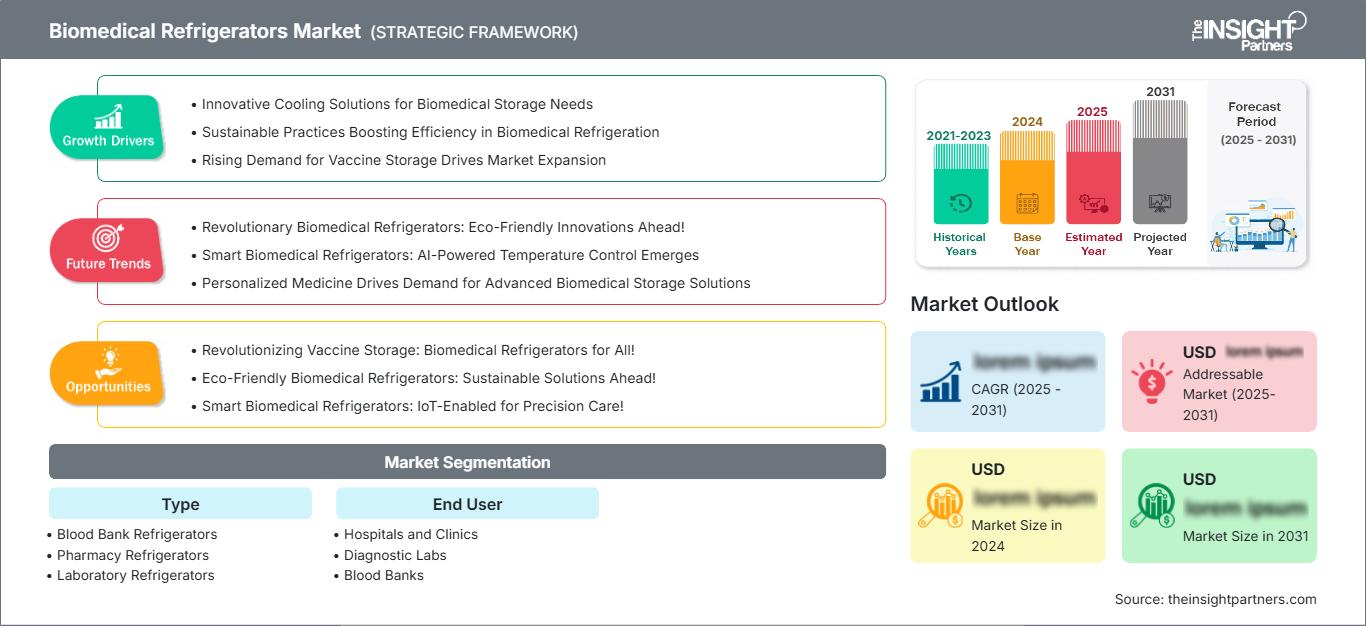
Regional Insights
North America biomedical refrigerators market
North America accounted for ~38% of global biomedical refrigerators market in 2025 and is projected to register a CAGR of ~7% through 2034. Market share for biomedical refrigerators shows large-scale hospital, pharmacy, clinical laboratory, blood bank, biobank, and pharmaceutical facilities. Replacement purchases will be considerable since more and more healthcare organizations tend to equip their facilities with standardized refrigerators to minimize fluctuations in temperatures, facilitate maintenance procedures, and monitor performance.
Equipment purchase trends shift towards purpose-designed devices that feature continuous temperature recording, calibrated probes, alarm systems, access control, and proper excursion handling. Canada makes its contribution via hospital laboratories, vaccination programs, blood supply, and research activities, while the USA continues to act as the main business region. Storage guidelines and high values of biologicals support the necessity of medical-grade devices.
U.S. biomedical refrigerators market
The US represented ~87% of North American revenue in 2025 and is expected to expand at a CAGR of ~7% through 2034. The demand for such systems is facilitated by the presence of extensive health networks, specialty pharmacies, vaccine producers, universities conducting research, blood banks, diagnostic laboratories, and biopharmaceutical firms. Storage facilities have come to increasingly depend on constant digital monitoring, standard procedures, contingency plans, and specialized storage units suited for different temperature levels.
Some of the companies that are significantly exposed to this market in terms of operations and/or business include Thermo Fisher Scientific Inc., Helmer Scientific Inc., Follett Products, LLC, Migali Industries Inc., Aegis Scientific, Inc., and Terumo Blood and Cell Technologies. Buyers are increasingly taking into consideration fleet standardization, service reaction time, energy efficiency, integration with alarms, noise, heat dissipation, and total cost of ownership.
Europe biomedical refrigerators market
Europe held ~29% of worldwide revenue in 2025 and is forecast to grow at a CAGR of ~6% through 2034. This region has developed hospital systems, regulated pharmaceutical storage, national blood services, clinical research, vaccine distribution and biobanks in place. Procurement takes into consideration energy efficiency and refrigerant impact in addition to temperature uniformity, recovery capability, alarm capability and documentation.
Germany is the leader among European countries due to its pharmaceutical industry, laboratory infrastructure, manufacturing of medical equipment, and hospital infrastructure. The UK relies on clinical research, blood services, biomedical laboratories and centralized healthcare procurement. France has an advantage thanks to its hospital modernization, vaccines, diagnostics and pharmaceutical research. Italy and Spain contribute to increasing demands through blood centers, regional hospitals, universities and molecular laboratories.
Equipment that uses higher-impact refrigerants will be replaced gradually by European buyers who will opt for more efficient equipment with natural refrigerants, better insulation and adaptive cooling. Liebherr-Hausgeräte GmbH, PHC Holdings Corporation, B Medical Systems S.à r.l., Arctiko A/S and other vendors are meeting this trend. Growth will depend on replacement cycles, laboratory investments, biobanking and increasing value of refrigerated and frozen inventories.
APAC biomedical refrigerators market
Asia Pacific generated ~25% of global revenue in 2025 and is projected to record a CAGR of ~10% through 2034, making it the fastest-growing region. China is the leading country in Asia Pacific through hospital scale, biomedical research, domestic equipment production, vaccine manufacturing, and biobank development. Japan contributes mature clinical and pharmaceutical infrastructure.
India is expanding immunization, diagnostic laboratories, blood services, and pharmaceutical research, while South Korea supports biotechnology and advanced hospital systems. Australia contributes regulated biobanking and academic research. Manufacturing localization, digital healthcare investment, and laboratory modernization are supporting adoption, although service coverage and power reliability vary across markets.
Middle East & Africa biomedical refrigerators market
The Middle East & Africa market is expected to expand at a CAGR of ~6% through 2034. Saudi Arabia is positioned as the leading country in the Middle East & Africa through hospital development, laboratory localization, blood services, and pharmaceutical investment. The UAE operates as a medical-services, distribution, and specialized laboratory hub.
South Africa maintains comparatively developed blood-bank, diagnostic, academic, and vaccine infrastructure. Across the Rest of MEA, unreliable electricity, service limitations, and long logistics routes shape equipment selection. Solar direct-drive systems, extended holdover performance, remote monitoring, and robust operation under high ambient temperatures can improve suitability for decentralized facilities. WHO equipment standards emphasize temperature control, freeze prevention, and context-specific technology selection.
Segmentation Analysis
Type
Type is the largest main segment because storage temperature, recovery requirements, sample value, and regulatory conditions differ materially among healthcare inventories. The biomedical refrigerators market scope includes purpose-built refrigeration and freezing systems used for clinical products, laboratory materials, blood components, and biological samples. Ultra-low-Temperature Freezers are projected to expand at a CAGR of ~9% during 2026–2034 as biobanking, genomic research, advanced therapies, and long-term specimen storage increase.
- Blood Bank Refrigerators: Blood-bank systems maintain tightly controlled conditions for whole blood and red-cell components. Buyers prioritize temperature uniformity, calibrated monitoring, rapid recovery, access control, alarm redundancy, inventory visibility, and compatibility with transfusion-service procedures.
- Pharmacy Refrigerators: Pharmacy units store vaccines, specialty medicines, biologics, and compounded preparations. Purpose-built airflow, adjustable shelving, digital logs, door alarms, and stable recovery help reduce product loss and support standardized medication-management practices.
- Laboratory Refrigerators: Laboratory refrigerators protect reagents, controls, specimens, culture media, and research materials. Demand spans diagnostic laboratories, universities, pharmaceutical facilities, and clinical research sites requiring configurable storage and reliable daily access.
- Ultra-low-Temperature Freezers: Ultra-low-temperature equipment supports preservation of cells, tissues, nucleic acids, proteins, vaccines, and long-term research collections. Performance factors include recovery speed, energy consumption, insulation, sample organization, monitoring, and backup planning.
End User
End User has the higher-growth main-segment profile because facilities are expanding capacity while replacing fragmented or domestic-grade equipment with application-specific systems. Purchasing patterns depend on inventory value, testing volume, regulatory exposure, access frequency, and available technical support. Research and Academic institutes are expected to register a CAGR of ~8% during 2026–2034 as biobanks, translational research, genomics, and cell-based studies generate larger sample collections.
- Hospitals and Clinics: Hospitals and clinics require refrigeration for vaccines, medicines, blood components, specimens, and clinical supplies. Fleet standardization, alarm escalation, service response, workflow access, and integration with pharmacy or facility systems guide purchasing.
- Diagnostic Labs: Diagnostic laboratories store specimens, reagents, calibrators, and quality controls under defined conditions. Equipment reliability directly influences testing continuity, analytical validity, turnaround performance, and the cost of replacing compromised laboratory materials.
- Blood Banks: Blood banks require specialized storage connected to component handling, traceability, quality systems, and emergency availability. Reliable refrigeration supports blood integrity while alarm, access, and record controls help manage operational and regulatory risk.
- Research and Academic institutes: Research institutions store irreplaceable biological samples, cell lines, tissues, proteins, and genomic materials. Purchases emphasize capacity, sample organization, monitoring, energy efficiency, and protection against failures that could invalidate long-running studies.
Opportunity Snapshot
| End User | Revenue Contribution | Trend Tag | Adoption Stage |
| Hospitals and Clinics | High | Fleet Standardization | Mature |
| Diagnostic Labs | High | Reagent Protection | Scaling |
| Blood Banks | Medium | Traceable Storage | Mature |
| Research and Academic institutes | High | Biobank Expansion | Scaling |
Biomedical Refrigerators Market Growth Drivers and Impact Analysis
Expansion of Biobanking and Life-Science Research
Biobanks and research laboratories are storing increasing volumes of cells, tissues, nucleic acids, proteins, and longitudinal clinical specimens. These materials may be irreplaceable and can represent years of collection, consent management, and experimental investment. Growth in genomics, proteomics, regenerative medicine, and advanced therapy development therefore increases demand for reliable refrigerated and ultra-low-temperature storage. The commercial impact includes larger-capacity units, redundant cooling, compartmented inventory, remote monitoring, and service contracts. Laboratories are also evaluating energy use because large freezer fleets increase electricity consumption and facility heat load. Vendors that combine sample protection with lower operating cost can address both scientific and sustainability objectives.
Rising Storage Requirements for Biologics and Specialty Medicines
Biologics, vaccines, monoclonal antibodies, and specialty medicines can be sensitive to temperature excursions and may carry substantial replacement costs. Hospitals and pharmacies are consequently replacing general-purpose units with purpose-built systems offering controlled airflow, uniform temperature, continuous records, and alarm escalation. The impact extends beyond equipment purchases to validation, monitoring, staff training, and backup planning. Integrated health networks increasingly seek standardized models across locations to simplify maintenance and operating procedures. Equipment suppliers that provide fleet-management tools, preventive service, qualification support, and rapid replacement capability can secure broader network contracts rather than isolated unit sales.
Modernization of Blood and Vaccine Cold-Chain Infrastructure
Blood services and immunization programs depend on reliable refrigeration across centralized stores, hospitals, clinics, and remote facilities. Equipment failure can lead to inventory loss, interrupted treatment, or reduced vaccine potency. Public health investment therefore supports replacement of domestic appliances with purpose-built refrigerators, solar direct-drive systems, freeze-protected designs, and electronic monitoring. The market impact is strongest in regions expanding vaccine access or modernizing rural health infrastructure. Procurement decisions must consider ambient temperature, electricity reliability, usable capacity, holdover time, service availability, and total ownership cost. WHO guidance specifically distinguishes medical cold-chain equipment from domestic refrigeration and promotes performance-based selection.
Biomedical Refrigerators Market Future Trends
Connected Refrigeration Becomes the Default Architecture
Biomedical refrigerators market trends increasingly include cloud-connected monitoring, RFID inventory, automated access records, predictive maintenance, and centralized alarm management. Connected systems can link sample identity, storage location, temperature history, and user activity, reduce manual reconciliation and supporting chain-of-custody documentation. Through 2034, hospitals and biopharmaceutical facilities are expected to integrate refrigeration data with laboratory, pharmacy, and quality-management platforms. Cybersecurity, software validation, connectivity resilience, and data ownership will become procurement considerations alongside cooling performance. Haier Biomedical’s automated and RFID-supported storage solutions illustrate the movement toward an integrated infrastructure model rather than stand-alone equipment.
Natural Refrigerants and Adaptive Cooling Gain Adoption
Manufacturers will increasingly use hydrocarbon refrigerants, high-efficiency insulation, variable-capacity compressors, and adaptive control to reduce electricity use and environmental impact. These technologies can also lower heat output and noise, which matter in laboratories and medication areas. Procurement teams will evaluate lifecycle energy consumption alongside purchase price, particularly when replacing large equipment fleets. Adoption will be strongest where efficiency upgrades preserve temperature recovery and uniformity under frequent door openings. Suppliers must provide performance evidence across ambient conditions and loading patterns because energy savings cannot compromise stored-product protection.
Biomedical Refrigerators Market Opportunities
Automated Ultra-Low-Temperature Biostorage
Biomedical refrigerators market Forecasts indicate growing investment potential in automated ultra-low-temperature platforms for pharmaceutical development, biobanks, genomics, and clinical research. Automation can reduce open-door exposure, manual searches, sample-location errors, and staff time spent managing large collections. Developers should combine robotic retrieval, RFID or barcode identification, validated temperature control, and interoperable inventory software. Commercial opportunities extend to retrofit modules, facility design, data integration, and long-term service. Customers will require evidence that automation improves traceability and preserves recovery performance without creating a single operational point of failure.
Resilient Refrigeration for Emerging Healthcare Networks
Healthcare expansion in Asia Pacific, the Middle East, and Africa creates opportunities for equipment designed around unstable power, high ambient temperatures, limited service access, and distributed facilities. Manufacturers can invest in solar direct-drive units, extended holdover systems, voltage protection, remote diagnostics, and standardized spare-parts programs. Regional assembly and technician training can lower downtime and improve procurement competitiveness. Success requires matching equipment to local operating conditions rather than offering simplified versions of products developed for stable urban laboratories. WHO selection tools reinforce the importance of capacity, freeze protection, operating time, voltage regulation, and monitoring features.
Recent Developments
- September 2026: Qingdao Haier Biomedical Co., Ltd. showcased an automated -80°C storage platform and Smart RFID ultra-low-temperature solution at ISPE Singapore. The technologies connect physical samples with digital records, track location and movement, and support mixed sample formats across research, quality-control, warehousing, and biopharmaceutical workflows.
- August 2026: Helmer Scientific Inc. highlighted its GX Solutions portfolio of medical-grade refrigerators, freezers, and ultra-low-temperature systems. The equipment emphasizes temperature uniformity, rapid recovery, natural hydrocarbon refrigerants, reduced heat output, quieter operation, and variable-capacity cooling for clinical, pharmacy, laboratory, and biological storage environments.
- January 2026: Thermo Fisher Scientific Inc. TSX Universal Series was identified among current-generation ultra-low-temperature systems using adaptive variable-speed compression, natural refrigerants, and configurable operating modes. The platform is positioned for biobanks, pharmaceutical research, and laboratories requiring temperature recovery, sustainability, and protection of high-value samples.
Frequently Asked Questions

- Comprehensive Market Sizing and Forecast Analysis
- Detailed Segmentation Analysis
- In-Depth Market Dynamics Assessment
- Regional and Country-Level Insights
- Competitive Landscape and Company Benchmarking
- Strategic Business Intelligence
Recent Reports
Testimonials

The Insight Partners provided valuable market intelligence that supported our global go-to-market strategy. Their team was professional, responsive, and attentive to our feedback, providing thoughtful analysis and helpful methodological clarifications throughout the project.
Junmo Kim Chief Financial Officer (CFO), Enertech Co., Ltd.
The Insight Partners' SCADA System Market report is comprehensive, with valuable insights on current trends and future forecasts. The team was highly professional, responsive, and supportive throughout. We are very satisfied and highly recommend their services.
RAN KEDEM Partner, Reali Technologies LTDs
I requested a report on a very specific software market and the team produced the report in a few days. The information was very relevant and well presented. I then requested some changes and additions to the report. The team was again very responsive and I got the final report in less than a week.
JEAN-HERVE JENN Chairman, Future Analytica
We worked with The Insight Partners for an important market study and forecast. They gave us clear insights into opportunities and risks, which helped shape our plans. Their research was easy to use and based on solid data. It helped us make smart, confident decisions. We highly recommend them.
PIYUSH NAGPAL Sr. Vice President, High Beam Global
The Insight Partners delivered insightful, well-structured market research with strong domain expertise. Their team was professional and responsive throughout. The user-friendly website made accessing industry reports seamless. We highly recommend them for reliable, high-quality research services
YUKIHIKO ADACHI CEO, Deep Blue, LLC.
This is the first time I have purchased a market report from The Insight Partners.While I was unsure at first, I visited their web site and felt more comfortable to take the risk and purchase a market report.I am completely satisfied with the quality of the report and customer service. I had several questions and comments with the initial report, but after a couple of dialogs over email with their analyst I believe I have a report that I can use as input to our strategic planning process.Thank you so much for taking the extra time and making this a positive experience.I will definitely recommend your service to others and you will be my first call when we need further market data.
JOHN SUZUKI President and Chief Executive Officer, Board Director, BK Technologies
I wish to appreciate your support and the professionalism you displayed in the course of attending to my request for information regarding to infectious disease IVD market in Nigeria. I appreciate your patience, your guidance, and the fact that you were willing to offer a discount, which eventually made it possible for us to close a deal. I look forward to engaging The Insight Partners in the future, all thanks to the impression you have created in me as a result of this first encounter.
DR CHIJIOKE ONYIA MANAGING DIRECTOR, PineCrest Healthcare Ltd.Reason to Buy
- Informed Decision-Making
- Understanding Market Dynamics
- Competitive Analysis
- Identifying Emerging Markets
- Customer Insights
- Market Forecasts
- Risk Mitigation
- Boosting Operational Efficiency
- Strategic Planning
- Investment Justification
- Tracking Industry Innovations
- Aligning with Regulatory Trends





 Get Free Sample for