
Bismuth Iron Garnet Materials Market Trends and Opportunities by 2034
Coverage: By Product (Sputtering Targets, Evaporation Materials, and Others) and Application (Magneto-Optical Devices, Research and Development, Spintronics, and Others)
- Status : Published
- Report Code : TIPRE00043880
- Category : Chemicals and Materials
- No. of Pages : 229
- Available Report Formats :


- Last update date : September 02, 2026


2025 Market Size
US$ 1.59 Mn
Base year value
2034 Forecast
US$ 3.76 Mn
Projected by 2034
CAGR 2026-2034
10.0 %
Growth rate
Addressable Market
US$ 23.75 Mn
(2026-2034)
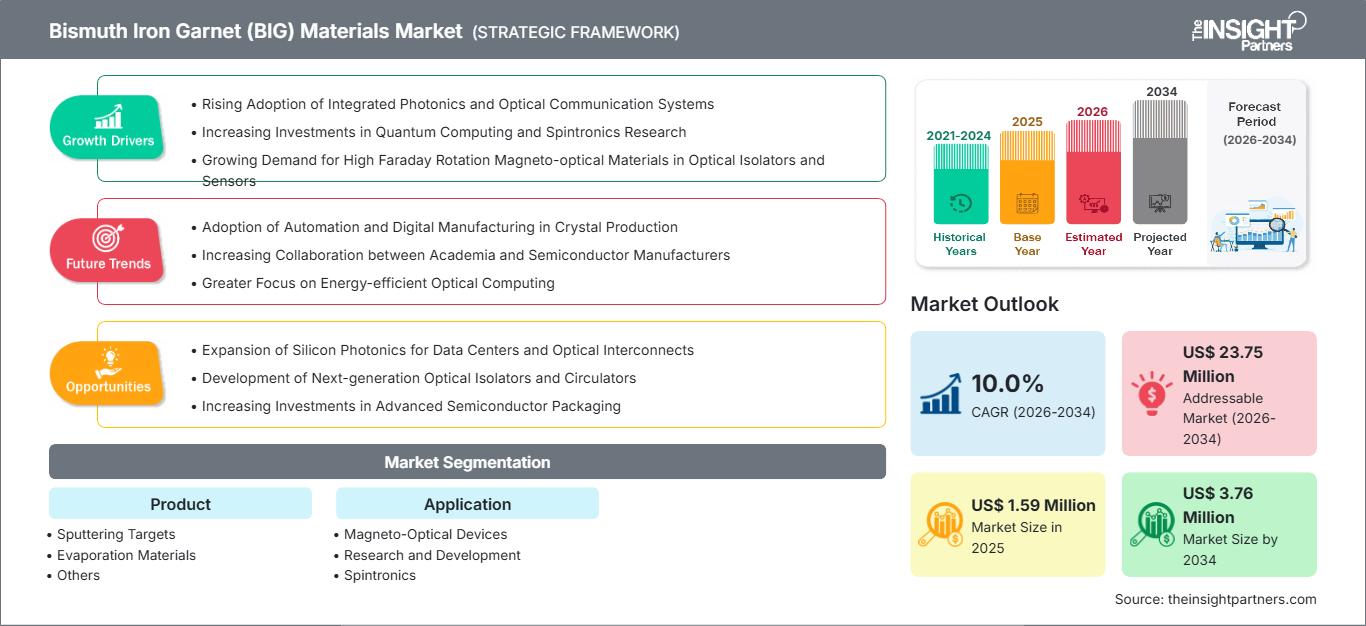
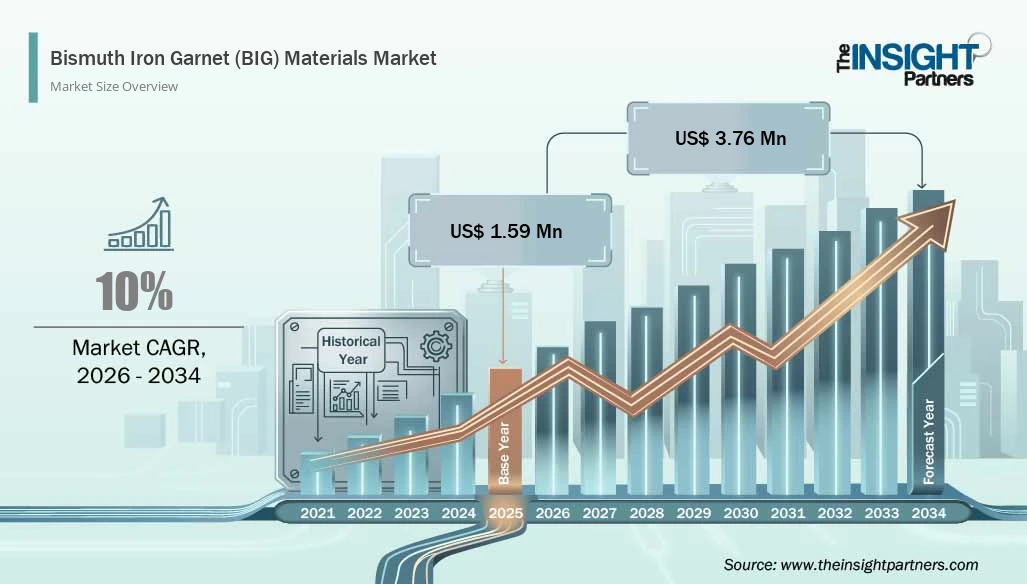
The Bismuth Iron Garnet (BIG) Materials market was valued at US$ 1.59 million in 2025 and is projected to reach US$ 3.76 million by 2034, expanding at a CAGR of 10.0% during 2026–2034. Research institutes and semiconductor value chains are well on the way to sustainable industry growth, with increasing research activity in magnetic thin films, steadily rising commercialization of magneto-optical devices, and ongoing investments in advanced materials synthesis. Bismuth Iron Garnet (BIG) Materials market is a new specialty material for advanced photonics, magneto-optical, and spintronic applications.
Ongoing investments in photonics research and semiconductor innovation continue to strengthen the North American ecosystem, contributing significantly to the growth of the Market. The region is expected to register a CAGR of 8.9–10.5% during 2026–2034, supported by government-funded quantum technology initiatives, increasing adoption of magnetic thin-film materials, and collaborations among universities, national laboratories, and advanced material manufacturers focused on next-generation optoelectronic applications.
Bismuth Iron Garnet (BIG) Materials Market Assessment and Insights
- North America: North America accounted for 27.12% share in 2025 and is projected to expand at a CAGR of 10.5% during 2026–2034. Strong research funding, semiconductor innovation, and established advanced material supply chains continue to support demand for high-purity BIG materials and strengthen the Market.
- U.S.: The U.S. represented 89.32% of the North American market in 2025 and is anticipated to grow at a CAGR of 10.5% during 2026–2034, supported by national photonics programs, defense research, and investments in quantum technologies.
- Europe: Europe held 15.88% share in 2025 and is forecast to grow at a CAGR of 9.7% during 2026–2034. Germany, the UK, and France lead regional demand through advanced materials research, precision manufacturing, and collaborative semiconductor initiatives supporting Market growth.
- Asia Pacific: Asia Pacific accounted for 48.25% share in 2025 and is projected to register the fastest regional CAGR of 10.0% during 2026–2034. China, Japan, South Korea, and India continue expanding investments in photonics manufacturing, magnetic materials, and semiconductor fabrication capabilities, creating favorable conditions for the Market.
- Largest Segment: Magneto-Optical Devices accounted for 52.33% of the market share in 2025 and is expected to expand at a 10.1% CAGR during 2026–2034, supported by increasing deployment in optical communication and sensing technologies.
- High Growth Segment: Research and Development accounted for 28.09% market share in 2025 and is projected to register the highest CAGR of 10.4% during 2026–2034, driven by increasing investments in advanced magnetic materials research, photonics innovation, quantum technology programs, and thin-film deposition studies across academic institutions, government laboratories, and industrial R&D centers.
- Key companies analyzed in detail: Kurt J. Lesker Company, Tinsan Materials, American Elements Inc., AEM Deposition, Stanford Advanced Materials, Infinita Materials LLC, Edgetech Industries LLC, NANOCHEMAZONE, Thin Film Materials, QS Advanced Materials Inc., and ATT Advanced Elemental Materials Co., Ltd.
Source: The Insight Partners' analysis based on proprietary research, government publications, company annual reports, investor presentations, industry databases, and expert interviews.
Rapid progress in magnetic oxide engineering and thin-film deposition technologies has changed the Market from a mostly research-focused area into a specialized commercial materials segment. Improved crystal growth methods, higher purity standards, and better control over sputtering target production have improved production consistency. These advancements support the development of integrated photonic devices, optical isolators, and sensing technologies. Material suppliers are increasingly refining manufacturing processes to meet the strict demands of semiconductor and research applications, which helps maintain Bismuth Iron Garnet (BIG) Materials Market growth across the global value chain.
Future industry growth is likely to benefit from rising investments in quantum technologies, silicon photonics, and advanced semiconductor packaging. Government-supported research in North America, Europe, and the Asia Pacific continues to promote the commercialization of functional magnetic materials. Collaborations among universities, national laboratories, and specialty materials manufacturers accelerate innovation. Expanding production capabilities for high-performance deposition materials and the growing use of magneto-optical components in new electronics applications are expected to create positive long-term conditions for the Bismuth Iron Garnet (BIG) Materials market.
Bismuth Iron Garnet (BIG) Materials Market Report Scope
| Report Attribute | Details |
|---|---|
| Market size in 2025 | US$ 1.59 Million |
| Market Size by 2034 | US$ 3.76 Million |
| Global CAGR (2026 - 2034) | 10.0% |
| Historical Data | 2021-2024 |
| Forecast period | 2026-2034 |
Bismuth Iron Garnet (BIG) Materials Market Analysis
The growing demand for high-performance magnetic thin films in photonics, optical communication, and quantum technology is driving growth in the Market. Increasing investments in semiconductor research and functional materials motivate manufacturers to improve the quality, purity, and structural consistency of deposition. The rising use of sputtering technologies, along with a greater focus on integrated photonic circuits and precision optical sensing, is expanding commercial opportunities for BIG materials beyond laboratory settings.
The market value chain includes specialty oxide powder synthesis, crystal engineering, sputtering target fabrication, evaporation material processing, thin-film deposition, and integration into electronic and photonic devices. Continuous quality checks, material characterization, and process improvement are crucial for achieving reliable magnetic and optical performance. Enhanced collaboration between research institutions and commercial suppliers also fosters technology transfer and accelerates product qualification for industrial use.
Competitive intensity within the Bismuth Iron Garnet (BIG) Materials Market analysis landscape remains moderate, with participants emphasizing product purity, customized deposition materials, and technical support rather than large-scale manufacturing volume. Companies, including Kurt J. Lesker Company, American Elements Inc., Stanford Advanced Materials, AEM Deposition, and Thin Film Materials, continue expanding specialized material portfolios, while suppliers such as Infinita Materials LLC, QS Advanced Materials Inc., ATT Advanced Elemental Materials Co., Ltd., Tinsan Materials, Edgetech Industries LLC, and NANOCHEMAZONE focus on customized research-grade and industrial-grade solutions for universities, laboratories, and semiconductor manufacturers.
Strategic investments are increasingly directed at advanced ceramic processing, precision machining, and high-purity material synthesis to boost product reliability and manufacturing efficiency. Material producers are strengthening their global distribution networks while partnering with academic institutions and technology developers to speed up the commercialization of next-generation magneto-optical and spintronic devices. These efforts improve supplier competitiveness, diversify application opportunities, and support the long-term growth potential of Market.
● REPORT CUSTOMIZATION
Tailor This Report To Align With Your Specific Business Requirements
This report can be customized to align precisely with your business objectives, scope, and target markets. Customization options include tailored segmentation, geography, competitive analysis, and strategic insights to support informed decision-making.
Customize This Report →WHAT YOU CAN ADJUST
- ● Segmentations
- ● Geography
- ● Competitive Analysis
- ● Language Preferences
Bismuth Iron Garnet (BIG) Materials Market: Strategic Insights
Regional Insights
North America Bismuth Iron Garnet (BIG) Materials Market
North America held 27.12% of the Bismuth Iron Garnet (BIG) Materials Market share in 2025. The market is expected to grow at 10.5% annually from 2026 to 2034. It benefits from solid research facilities, steady federal funding for photonics and quantum technologies, and strong semiconductor manufacturing skills. Universities, national laboratories, and defense organizations are increasing their investments in magneto-optical materials for applications such as optical isolation, sensing, and integrated photonic systems. These advantages boost the demand for high-purity sputtering targets and evaporation materials.
Manufacturers also gain from a well-established network of suppliers for thin-film deposition equipment, specialty ceramic processors, and material distributors. The growing use of optical communication technologies, along with more partnerships between research institutions and private companies, fosters product innovation and technology transfer. Ongoing investments in precision material engineering and semiconductor research should maintain regional demand. They also urge suppliers to develop custom BIG materials with improved magnetic, optical, and structural performance for new industrial and scientific applications. These factors are expected to sustain investment and create favorable conditions for the Market throughout the forecast period.
U.S. Bismuth Iron Garnet (BIG) Materials Market
The United States accounted for 89.32% of the North American market in 2025 and is projected to grow at a 10.5% CAGR from 2026 to 2034. The country retains its leadership through significant investments in semiconductor research, quantum information science, and photonics programs. Federal programs that promote domestic semiconductor manufacturing and research infrastructure continue to drive demand for functional magnetic materials used in high-precision thin-film applications. Active participation from research universities and national laboratories also bolsters commercialization efforts. Growing demand from semiconductor, photonics, and defense-related research applications is expected to strengthen further strengthen the Market in the country.
Companies like Kurt J. Lesker Company, American Elements Inc., AEM Deposition, and Stanford Advanced Materials enhance the availability of domestic materials and provide better technical support for research institutions and industrial users. Demand is growing for magneto-optical devices, optical communication systems, and spintronic research. Increased collaboration between equipment makers, specialty material suppliers, and academic institutions fosters innovation, improves the quality of deposition materials, and aids the development of next-generation magnetic oxide technologies.
Europe Bismuth Iron Garnet (BIG) Materials Market
Europe made up 15.88% of the global market in 2025 and is expected to grow at a CAGR of 9.7% from 2026 to 2034. Germany is still the top regional market due to its strong semiconductor equipment industry, robust materials research ecosystem, and ongoing investments in photonic manufacturing technologies. Government-supported innovation programs and partnerships between manufacturers and academic institutions continue to advance the commercialization of functional magnetic materials.
The United Kingdom holds a strong position by investing in quantum technologies, photonics innovation centers, and university-led materials science research. France, Italy, and Spain contribute by expanding semiconductor research, optical engineering, and nanotechnology development programs. European Union initiatives that promote semiconductor independence and improved manufacturing capabilities encourage research into magneto-optical materials. Collaborative projects among research institutes and industrial organizations help accelerate the development of high-performance deposition materials for new electronic and photonic applications. Such initiatives are expected to create additional opportunities for suppliers operating in the Market.
APAC Bismuth Iron Garnet (BIG) Materials Market
Asia Pacific accounted for 48.25% of the global market in 2025 and is projected to have the highest regional growth rate, at 10.0%, from 2026 to 2034. China is at the forefront of regional production and research funding. Japan and South Korea remain strong players due to their semiconductor manufacturing and magnetic materials development. Rising investments in advanced electronics and photonics are expected to further expand the Market across the region.
India is growing its research capabilities with government-backed semiconductor programs. Meanwhile, Australia contributes through university-led materials science projects and expertise in advanced mineral processing. Increased investments in photonics manufacturing, precision electronics, and magnetic oxide research are boosting regional demand and expanding the Bismuth Iron Garnet (BIG) Materials Market Scope across industrial and scientific uses.
Middle East & Africa Bismuth Iron Garnet (BIG) Materials Market
The Middle East and Africa market is expected to grow at a rate of 4.90% from 2026 to 2034. This growth will be driven by increased investments in scientific research and improved manufacturing capabilities. Saudi Arabia and the United Arab Emirates are enhancing technology research through national innovation strategies. Meanwhile, South Africa is actively pursuing materials science research at universities and specialized research institutes.
The shift toward diversification beyond traditional energy industries is promoting investment in electronics research, nanotechnology, and semiconductor capabilities. Although the regional market is still smaller than those in North America, Europe, and Asia-Pacific, growing academic collaborations, technology transfer efforts, and infrastructure development should support the gradual adoption of advanced magnetic materials in research labs and specialized industrial applications. These developments are gradually improving the regional Market landscape and creating opportunities for specialty material suppliers.
Segmentation Analysis
Product
The Product segment is expected to expand at a significant CAGR during 2026–2034. Product innovation is key to the market. End users need high-purity deposition materials with consistent composition and magnetic performance. Ongoing improvements in powder processing, ceramic sintering, and precision machining support reliable thin-film deposition for photonics, semiconductor research, and magneto-optical applications. Manufacturers are developing more customized product grades to meet changing research and industrial needs. This expands the market across various functional material applications.
- Sputtering Targets: These products account for a large share of commercial demand. They produce uniform thin films with controlled magnetic and optical properties for semiconductor, photonic, and magneto-optical device manufacturing.
- Evaporation Materials: Demand continues to rise in laboratory research and specialized thin-film deposition processes. These processes require precise material composition, high purity, and reliable evaporation characteristics for advanced electronic and optical applications.
Application
The Application segment is projected to grow at a significant CAGR during 2026–2034. Expanding the commercial use of photonic technologies, increasing investment in spin-based electronics, and ongoing improvements in precision optical systems drive a variety of applications. This area benefits from closer cooperation between research institutions and industrial manufacturers, which speeds up technology validation and adoption in new high-performance electronic and magnetic device markets. These developments are expected to reinforce the Market outlook throughout the forecast period.
- Magneto-Optical Devices: This application shows the largest commercial demand, driven by the rising use in optical isolators, sensors, communication systems, and laser-based technologies that require stable magnetic and optical properties.
- Research and Development: Universities, government labs, and industrial research centers are increasingly acquiring high-purity BIG materials for experimental studies of magnetic oxides, thin-film characterization, and the development of next-generation photonic components.
- Spintronics: The growing interest in low-power computing, magnetic random-access memory, and quantum information technologies continues to boost demand for BIG materials in experimental spin-based electronic devices and in advanced research on magnetic materials.
Opportunity Snapshot
| Application | Revenue Contribution | Trend Tag | Adoption Stage |
|---|---|---|---|
| Magneto-Optical Devices | High | Optical Isolation | Mature |
| Research and Development | Medium | Thin Films | Scaling |
| Spintronics | Medium | Quantum Memory | Emerging |
| Others | Low | Specialty Research | Emerging |
Bismuth Iron Garnet (BIG) Materials Market Growth Drivers and Impact Analysis
Expansion of Photonics and Integrated Optical Communication Technologies
The growing use of optical communication infrastructure and integrated photonic devices is driving higher demand for high-quality magnetic thin-film materials. Bismuth Iron Garnet has excellent magneto-optical properties, making it ideal for optical isolators, circulators, and precision sensing applications in communication systems. Ongoing investments in silicon photonics by semiconductor companies and research institutions have increased the need for high-purity sputtering targets and evaporation materials with reliable magnetic performance. Government-supported photonics initiatives in North America, Europe, and the Asia-Pacific region are accelerating the commercialization of advanced optical technologies. As a result, material suppliers are expanding their manufacturing capabilities, improving deposition quality, and developing custom products that meet stricter industrial and research standards. These developments strengthen long-term demand in both commercial manufacturing and scientific research settings, supporting Bismuth Iron Garnet (BIG) Materials Market growth.
Rising Investment in Quantum Computing and Spin-Based Electronics
The growing interest in quantum computing, spintronics, and next-generation memory technologies is creating significant opportunities for functional magnetic materials. Research organizations and semiconductor companies are investing in materials that can support effective spin manipulation, low-power information processing, and advanced magnetic sensing. Bismuth Iron Garnet remains in the spotlight due to its strong magnetic and optical properties, which support the experimental development of new spin-based devices. Public funding for quantum technologies in major economies has boosted collaboration between universities, national laboratories, and specialty material manufacturers. As prototype devices move toward commercial validation, suppliers are focused on improving material purity, crystal quality, and deposition consistency. This effort enables wider use in advanced electronics, quantum research, and high-performance computing applications, strengthening the long-term Bismuth Iron Garnet (BIG) Materials Market Forecast.
Advancements in High-Purity Thin-Film Deposition Materials
Ongoing improvements in ceramic processing, crystal engineering, powder synthesis, and precision machining have greatly enhanced the quality of deposition materials for advanced magnetic oxide films. Manufacturers are increasingly focusing on high-density sputtering targets, controlled grain structures, and superior chemical purity to enhance thin-film uniformity and device performance. These technological advances reduce process variability and boost manufacturing efficiency for semiconductor production and photonic component creation. Growing partnerships between deposition equipment manufacturers and material suppliers also help optimize thin-film processes for research and industrial use. As quality standards become stricter in advanced electronics fields, producers that can provide consistent, application-specific BIG materials are likely to improve their competitive position and support the ongoing growth of market.
Bismuth Iron Garnet (BIG) Materials Market Future Trends
Growing Adoption of Magneto-Optical Materials in Integrated Photonics
Bismuth Iron Garnet (BIG) Materials Market Trends show a growing use of magneto-optical materials in integrated photonics. Optical communication systems are becoming more compact and energy efficient. Bismuth Iron Garnet is attracting attention for its strong Faraday rotation, optical transparency, and suitability for thin-film deposition techniques. Researchers are increasingly adding magnetic oxide films to compact photonic devices to improve signal isolation and optical performance. As silicon photonics moves toward wider commercialization, manufacturers are investing in deposition technologies capable of producing highly uniform films with consistent magnetic properties. Ongoing cooperation among semiconductor companies, research institutions, and specialty material suppliers is likely to boost innovation and support the broader use of BIG materials.
Increasing Commercialization of Spintronic and Quantum Device Technologies
Rapid advances in spin-based computing and quantum information processing may change the demand for magnetic materials. Research is increasingly targeting efficient materials for spin transport, magnetic memory, and low-power electronic designs. Bismuth Iron Garnet is becoming a promising option for experimental spintronic structures due to its favorable magnetic qualities and compatibility with advanced thin-film production methods. Growing investments in quantum technology programs across major economies are fostering closer partnerships between academia and industry. As prototype devices transition to commercial applications, the need for high-purity deposition materials is expected to increase, creating new opportunities for manufacturers specializing in advanced magnetic oxide materials and supporting the expansion of the Market.
Bismuth Iron Garnet (BIG) Materials Market Opportunities
Expanding Supply Partnerships with Semiconductor and Photonics Manufacturers
The increasing focus on semiconductor self-sufficiency and photonics manufacturing offers significant opportunities for suppliers of specialty deposition materials. Manufacturers that can provide application-specific sputtering targets and evaporation materials with high purity and consistent performance are well-positioned to build long-lasting commercial partnerships. Rising investments in wafer fabrication, photonic integrated circuits, and precision optical components need reliable material supply chains that meet strict technical specifications. Companies that increase production capacity, improve process control, and offer customized material engineering services can enhance customer loyalty and support the commercialization of next-generation electronic and optical technologies. These trends are expected to create appealing investment opportunities over the forecast period and support Bismuth Iron Garnet (BIG) Materials Market Forecasts for long-term growth.
Development of Customized Materials for Advanced Research Applications
The growing demand from universities, government labs, and industrial research organizations gives manufacturers a chance to broaden their specialty materials offerings. Researchers need customized compositions, controlled microstructures, and specific deposition materials for experimental studies in magneto-optics, quantum computing, and spintronics. Suppliers that invest in flexible manufacturing, advanced characterization, and collaborative research programs can meet these evolving needs more effectively. Long-term partnerships with academic institutions and technology developers also help accelerate the validation of new materials and support their commercialization. These strategic moves allow producers to tap into higher-value research markets, build technological expertise, and create competitive advantages in the global Market.
Recent Developments
- June 2026: Kurt J. Lesker Company announced a US$10 million expansion of its Jefferson Hills, Pennsylvania, headquarters to strengthen advanced manufacturing, thin-film deposition technologies, and semiconductor research capabilities. The project, developed in partnership with Penn State University, is expected to enhance innovation in vacuum technologies and specialty deposition materials used in semiconductor, photonics, and magneto-optical applications, supporting the supply chain for advanced functional materials.
- June 2026: Researchers from Tohoku University and Kyocera Corporation developed a silicon-compatible nanocomposite magnetic garnet film with approximately four times higher magneto-optical performance than conventional polycrystalline garnet films. The breakthrough enables direct integration of high-performance garnet materials onto silicon substrates, advancing on-chip optical isolators, integrated photonics, and next-generation optical communication devices that rely on magneto-optical materials such as bismuth iron garnets.
Frequently Asked Questions

- Comprehensive Market Sizing and Forecast Analysis
- Detailed Segmentation Analysis
- In-Depth Market Dynamics Assessment
- Regional and Country-Level Insights
- Competitive Landscape and Company Benchmarking
- Strategic Business Intelligence
Recent Reports
Testimonials

The Insight Partners provided valuable market intelligence that supported our global go-to-market strategy. Their team was professional, responsive, and attentive to our feedback, providing thoughtful analysis and helpful methodological clarifications throughout the project.
Junmo Kim Chief Financial Officer (CFO), Enertech Co., Ltd.
The Insight Partners' SCADA System Market report is comprehensive, with valuable insights on current trends and future forecasts. The team was highly professional, responsive, and supportive throughout. We are very satisfied and highly recommend their services.
RAN KEDEM Partner, Reali Technologies LTDs
I requested a report on a very specific software market and the team produced the report in a few days. The information was very relevant and well presented. I then requested some changes and additions to the report. The team was again very responsive and I got the final report in less than a week.
JEAN-HERVE JENN Chairman, Future Analytica
We worked with The Insight Partners for an important market study and forecast. They gave us clear insights into opportunities and risks, which helped shape our plans. Their research was easy to use and based on solid data. It helped us make smart, confident decisions. We highly recommend them.
PIYUSH NAGPAL Sr. Vice President, High Beam Global
The Insight Partners delivered insightful, well-structured market research with strong domain expertise. Their team was professional and responsive throughout. The user-friendly website made accessing industry reports seamless. We highly recommend them for reliable, high-quality research services
YUKIHIKO ADACHI CEO, Deep Blue, LLC.
This is the first time I have purchased a market report from The Insight Partners.While I was unsure at first, I visited their web site and felt more comfortable to take the risk and purchase a market report.I am completely satisfied with the quality of the report and customer service. I had several questions and comments with the initial report, but after a couple of dialogs over email with their analyst I believe I have a report that I can use as input to our strategic planning process.Thank you so much for taking the extra time and making this a positive experience.I will definitely recommend your service to others and you will be my first call when we need further market data.
JOHN SUZUKI President and Chief Executive Officer, Board Director, BK Technologies
I wish to appreciate your support and the professionalism you displayed in the course of attending to my request for information regarding to infectious disease IVD market in Nigeria. I appreciate your patience, your guidance, and the fact that you were willing to offer a discount, which eventually made it possible for us to close a deal. I look forward to engaging The Insight Partners in the future, all thanks to the impression you have created in me as a result of this first encounter.
DR CHIJIOKE ONYIA MANAGING DIRECTOR, PineCrest Healthcare Ltd.Reason to Buy
- Informed Decision-Making
- Understanding Market Dynamics
- Competitive Analysis
- Identifying Emerging Markets
- Customer Insights
- Market Forecasts
- Risk Mitigation
- Boosting Operational Efficiency
- Strategic Planning
- Investment Justification
- Tracking Industry Innovations
- Aligning with Regulatory Trends





 Get Free Sample for