
Substituted Gadolinium Gallium Garnet (SGGG) Materials Market Growth, Demand and Outlook to 2034
Coverage: By Product (Single Crystal Substrate and Wafer) and Application (Magneto-Optical Devices, Research and Development, Spintronics, and Others)
- Status : Published
- Report Code : TIPRE00043881
- Category : Chemicals and Materials
- No. of Pages : 235
- Available Report Formats :


- Last update date : September 02, 2026


2025 Market Size
US$ 5.19 Mn
Base year value
2034 Forecast
US$ 11.66 Mn
Projected by 2034
CAGR 2026-2034
9.4 %
Growth rate
Addressable Market
US$ 75.18 Mn
(2026-2034)
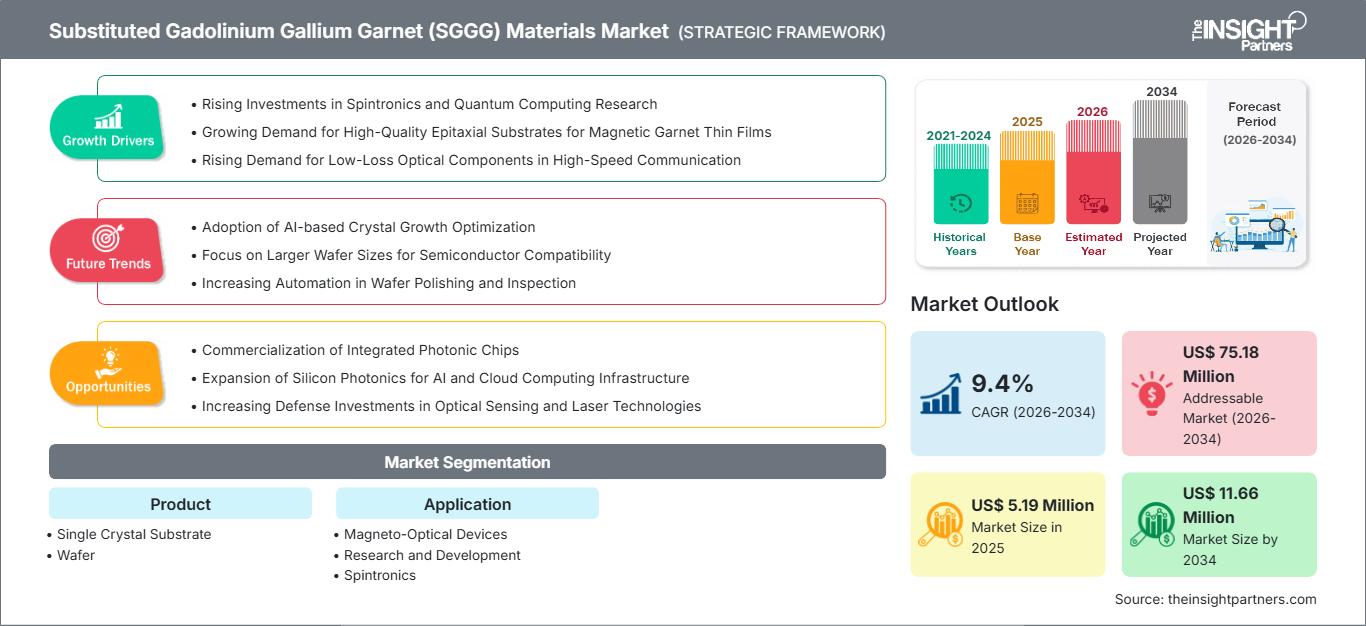
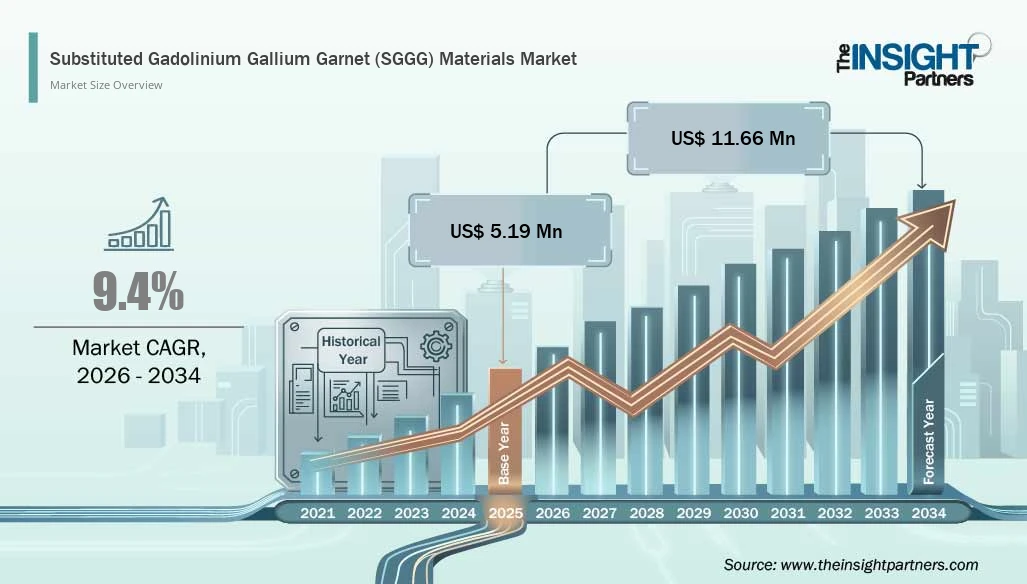
The Substituted Gadolinium Gallium Garnet (SGGG) Materials market was valued at US$ 5.19 million in 2025 and is expected to reach US$ 11.66 million by 2034, with a compound annual growth rate (CAGR) of 9.4% from 2026 to 2034. The market is seeing increased adoption due to the growing use of SGGG substrates in magneto-optical devices, spintronic research, and photonic applications. The rising demand for engineered crystalline materials for next-generation electronic and optical technologies is driving market growth in research and industrial uses. The market is also supported by growing demand for specialized substrates with controlled magnetic and optical properties.
The North America market is influenced by more investments in photonics research, semiconductor innovation, and materials development. This regional market is expected to grow at an estimated CAGR of 8.2% to 9.8% from 2026 to 2034. Growth is supported by a strong research infrastructure, government technology programs, and more use of precision substrates in optical isolation systems, magnetic devices, and experimental spintronic platforms. The market in North America is expected to benefit from continued investments in advanced electronic and optical technologies.
Substituted Gadolinium Gallium Garnet (SGGG) Materials Market Assessment and Insights
- North America had an estimated 29.94% share in 2025 and is expected to grow at a CAGR of 9.8% from 2026 to 2034. The region benefits from strong photonics research, semiconductor projects, and rising demand for specialized crystalline substrates. These factors strengthen the market across research and technology applications.
- The U.S. made up about 91.56% of the market in 2025 and is projected to expand at a CAGR of 9.9% from 2026 to 2034. Research labs, tech companies, and a growing interest in applications of magnetic and optical devices drive growth. The market in the U.S. is further supported by advanced materials research and semiconductor development.
- Europe held nearly 24.82% of the market in 2025 and is forecast to see a CAGR of 9.1% from 2026 to 2034. Germany, the UK, France, and Italy continue to play key roles due to their strengths in photonics research, precision manufacturing, and materials development. These capabilities create favorable conditions for the market in Europe.
- Asia Pacific captured around 37.64% of the market in 2025 and is predicted to achieve a CAGR of 9.5% from 2026 to 2034. China, Japan, South Korea, and India are driving growth with semiconductor investments, optical component production, and research efforts. The expanding electronics ecosystem is creating additional opportunities for the market across the region.
- The largest segment, Wafer, accounted for about 64.57% of the market share in 2025 and is projected to grow at a CAGR of 9.2% from 2026 to 2034 due to its compatibility with scalable device fabrication and substrate processing. Wafer adoption remains a key driver of the market.
- The high growth segment, Research and Development, represented nearly 19.37% of the market share in 2025 and is expected to have a CAGR of 9.7% from 2026 to 2034 due to increasing investments in advanced materials research, photonics innovation, and experimental studies in magnetic, optical, and electronic applications. Research programs continue to expand the addressable market.
- Key companies analyzed include SurfaceNet GmbH, Luxium Solutions, Hangzhou Shalom Electro-optics Technology Co., Ltd., ANHUI CRYSTRO CRYSTAL MATERIALS Co., Ltd., Jiaxing AOSITE Photonics Technology Co., Ltd., Sumitomo Metal Mining Co., Ltd., Stanford Advanced Materials, MTI Corp, KingwinOptics, and WALLSON INDUSTRIAL CO., LTD. These companies support the specialized supply landscape of the market.
Source: The Insight Partners' analysis based on proprietary research, government publications, company annual reports, investor presentations, industry databases, and expert interviews.
Changes in the development of Substituted Gadolinium Gallium Garnet (SGGG) Materials include enhancements in crystal growth, improvements in the production process of substrates, and increasing demand for materials in photonics and electronics. Suppliers have been improving crystal purity, maintaining dimensional stability, and enhancing crystal surface treatments to meet the special needs of specific applications. Improvements in optical systems and experimental computing devices are driving suppliers to provide dependable substrate solutions.
Substituted Gadolinium Gallium Garnet (SGGG) Materials are projected to see future growth due to the increasing investments in quantum studies, semiconductors, and optoelectronics. Emerging markets in the Asia Pacific region are set to support materials manufacturing, while North America and Europe will contribute through research collaborations. Local technology advancements and improvements in the supply chain of materials will define future investments.
Substituted Gadolinium Gallium Garnet (SGGG) Materials Market Report Scope
| Report Attribute | Details |
|---|---|
| Market size in 2025 | US$ 5.19 Million |
| Market Size by 2034 | US$ 11.66 Million |
| Global CAGR (2026 - 2034) | 9.4% |
| Historical Data | 2021-2024 |
| Forecast period | 2026-2034 |
Substituted Gadolinium Gallium Garnet (SGGG) Materials Market Analysis
The Substituted Gadolinium Gallium Garnet (SGGG) Materials Market growth is supported by increasing demand for specialized substrates used in magneto-optical systems, spintronic research platforms, and advanced photonic components. The market consists of crystal manufacturers, substrate processors, optical device developers, research institutions, and semiconductor technology companies. As the need for defect-free crystals, precise dimensions, and specific application features grows, manufacturers are working to improve production capabilities and material consistency.
The supply of the product is concentrated around expert producers who can grow garnet crystals and develop advanced techniques for processing them. Firms strive to increase productivity, minimize defect rates, and design specific types of substrates that satisfy their customers’ needs. Collaboration between firms producing materials and research institutions also promotes innovation in optical and electronic applications. The development of more complicated technologies in the future will probably increase the need for such crystalline materials. These dynamics continue to influence the competitive structure of the market.
Advances in techniques for growing, polishing, and inspecting crystals increase the availability of SGGG substrates. Producers improve their facilities to meet the demands of applications that require the material’s magnetic and optical stability. Development-oriented demand continues to affect the market; scientific centers use various substrates in their experiments with innovative devices. Improvements in these capabilities are expected to support the market over the forecast period.
The Substituted Gadolinium Gallium Garnet (SGGG) Materials Market analysis highlights a specialized competitive environment in which companies compete on material quality, customization capabilities, technical expertise, and application support. SurfaceNet GmbH, Luxium Solutions, Hangzhou Shalom Electro-optics Technology Co., Ltd., and ANHUI CRYSTRO CRYSTAL MATERIALS Co., Ltd. are positioned as important suppliers supporting optical and research applications. Their strategies focus on improving substrate quality and meeting specialized customer requirements.
Investments in manufacturing capabilities and partnerships with research organizations also sway competitive positioning. Sumitomo Metal Mining Co Ltd, Stanford Advanced Materials, MTI Corp, KingwinOptics, Jiaxing AOSITE Photonics Technology Co Ltd, and WALLSON INDUSTRIAL CO LIMITED play significant roles by providing specialized materials, optical solutions, and global distribution. Companies are increasingly expanding their product lines, enhancing technical services, and supporting emerging applications such as spintronics and advanced photonics. Partnerships between suppliers and technology developers are expected to be crucial for the future growth of the market.
● REPORT CUSTOMIZATION
Tailor This Report To Align With Your Specific Business Requirements
This report can be customized to align precisely with your business objectives, scope, and target markets. Customization options include tailored segmentation, geography, competitive analysis, and strategic insights to support informed decision-making.
Customize This Report →WHAT YOU CAN ADJUST
- ● Segmentations
- ● Geography
- ● Competitive Analysis
- ● Language Preferences
Substituted Gadolinium Gallium Garnet (SGGG) Materials Market: Strategic Insights
Regional Insights
North America Substituted Gadolinium Gallium Garnet (SGGG) Materials Market
North America Substituted Gadolinium Gallium Garnet (SGGG) Materials market share accounted for approximately 29.94 in 2025 and is expected to expand at a CAGR range of 9.8% during 2026–2034. The regional market benefits from strong semiconductor research, a well-established photonics infrastructure, and increasing investments in high-performance materials. The US is the main contributor due to its robust ecosystem of research laboratories, universities, and tech companies.
Demand across North America comes from applications in magneto-optical devices, experimental spintronic structures, and optical communication components. The presence of specialized material suppliers and research-focused organizations promotes innovation in substrate quality and processing technologies. Government initiatives supporting semiconductor progress and manufacturing are creating more opportunities for suppliers of crystalline materials. Canada also plays a role through academic research and emerging technology programs focused on photonics and materials science, supporting the Substituted Gadolinium Gallium Garnet (SGGG) Materials market.
U.S. Substituted Gadolinium Gallium Garnet (SGGG) Materials Market
The U.S. accounted for approximately 91.56% of North America’s share in 2025 and is projected to register a CAGR of 9.9% during 2026–2034. The country’s leadership relies on strong research capabilities, semiconductor innovation, and growing development of optical and magnetic technologies. Universities, national laboratories, and technology companies continue to explore applications of substrates.
Companies like Stanford Advanced Materials and MTI Corp help increase material availability and support research efforts. Demand is rising from photonics developers, semiconductor researchers, and organizations studying magnetic device designs. The U.S. market is also shaped by a growing interest in domestic supply chains for specialty materials. Ongoing investment in next-generation electronics, quantum research, and high-performance computing is likely to keep demand for specialized garnet substrates high, supporting the market.
Europe Substituted Gadolinium Gallium Garnet (SGGG) Materials Market
Europe Market share reached approximately 24.82% in 2025 and is forecast to grow at a CAGR range of 9.1% during 2026–2034. Germany is a leading market because of its strong precision engineering sector, optical technology capabilities, and research ecosystem. The region has established scientific institutions and industrial users that focus on photonics and electronic materials.
The UK contributes through academic research and photonics innovation programs. The development of optical devices and the study of advanced materials drive demand. Germany holds a strong position thanks to its industrial research and manufacturing expertise. France, Italy, and Spain are creating opportunities through university collaborations, technology initiatives, and specialized research programs. European investments in semiconductor resilience, scientific infrastructure, and manufacturing are expected to support long-term use of specialized crystalline substrates and the market.
APAC Substituted Gadolinium Gallium Garnet (SGGG) Materials Market
APAC Substituted Gadolinium Gallium Garnet (SGGG) Materials share accounted for approximately 37.64% in 2025 and is projected to achieve a CAGR range of 9.5% during 2026–2034. China leads regional demand because of its growing crystal manufacturing and optical component production.
Japan and South Korea help market development with semiconductor research and electronics applications. India and Australia are contributing by increasing scientific research activities. Industrial growth, electronics manufacturing policies, and rising investments in new materials are driving regional growth and creating favorable conditions for the market.
Middle East & Africa Substituted Gadolinium Gallium Garnet (SGGG) Materials Market
The Middle East & Africa are an emerging region for, with expected growth at a CAGR range of 8.7% during 2026–2034. Saudi Arabia and the UAE are boosting investments in technology infrastructure, research capabilities, and economic diversification programs.
South Africa contributes through academic research and scientific institutions, while the rest of the MEA market is still developing. Regional opportunities depend on technology modernization, telecommunications expansion, and investments in industrial capabilities. An increasing focus on innovation-driven economic development may slowly lead to greater use of specialized optical and electronic materials, creating opportunities for the market.
Segmentation Analysis
Product
The Substituted Gadolinium Gallium Garnet (SGGG) Materials Market scope covers Single Crystal Substrate and Wafer products, with the product segment expected to grow at a significant CAGR during 2026–2034. Increasing demand for high-quality crystalline structures in optical devices, semiconductor research, and experimental electronics is driving product adoption. Manufacturers are working to improve substrate uniformity, surface quality, and production efficiency to meet application needs.
- Single Crystal Substrate: Single Crystal Substrate products are commonly used where superior crystalline quality and magnetic properties are essential. These substrates support precision applications in optical components, laboratory research, and specialized electronic development. Such requirements contribute to the expansion of the market
- Wafer: Wafer products represent a large demand category because they are suitable for scalable fabrication processes. Their standardized format aids in device manufacturing, testing, and integration into photonic and electronic systems.
Application
The application segment of Substituted Gadolinium Gallium Garnet (SGGG) Materials is expected to register a significant CAGR during 2026–2034. Adoption of magneto-optical devices, research programs, and spintronic development is increasing due to the material’s useful magnetic and optical properties. Increased investment in computing and photonic technologies is enabling greater exploration of applications.
- Magneto-Optical Devices: Magneto-optical devices are important because there is a demand for materials that support optical isolation and magnetic control functions. SGGG substrates are used in developing advanced communication and photonic components.
- Research and Development: Research and development activities keep creating demand through academic studies, experimental electronics, and material testing programs. Institutions use SGGG substrates to study magnetic, optical, and electronic properties. Increasing research expenditure is therefore supporting the market.
- Spintronics: Spintronics applications are becoming more valuable due to research in low-power computing and magnetic memory technologies. SGGG substrates help in building experimental structures focused on spin-dependent phenomena and future electronic designs. These developments are expected to expand the application potential of the market.
Opportunity Snapshot
| Application | Revenue Contribution (High/Medium/Low) | Trend Tag | Adoption Stage |
|---|---|---|---|
| Magneto-Optical Devices | High | Optical Isolation | Scaling |
| Research and Development | Medium | Material Research | Mature |
| Spintronics | Medium | Magnetic Memory | Emerging |
| Others | Low | Specialty Uses | Emerging |
Substituted Gadolinium Gallium Garnet (SGGG) Materials Market Growth Drivers and Impact Analysis
Rising Adoption of Magneto-Optical Technologies
The growing demand for magneto-optic technologies necessitates the development of high-quality crystalline substrates for optical communications and signal processing. Materials such as substituted Gadolinium Gallium Garnet (SGGG) possess appropriate optical and magnetic properties for efficient device development. As optical networks and advanced photonic devices develop, there appears to be a need to enhance the quality, consistency, and specialization of the substrates used. This tendency affects not only end-users, but the whole supply chain, including manufacturers of crystal substrates, developers of photonic devices, and research organizations. The growing demand for optical isolation solutions provides many new business opportunities for companies that can offer high-quality substrates and strengthens the market.
Expansion of Spintronics Research and Magnetic Computing Applications
The growing interest in spintronics and magnetic computing is boosting the demand for specialized substrates that support experimental device designs. Researchers are exploring spin-based technologies to develop energy-efficient computing solutions, improved memory systems, and alternative electronic setups. Substituted Gadolinium Gallium Garnet (SGGG) materials are increasingly studied in research settings because of their magnetic properties and compatibility with current research. Universities, laboratories, and tech developers are investing in materials that enable the examination of spin interactions and magnetic phenomena. This trend is prompting suppliers to enhance customization and provide crystal solutions tailored to specific applications. Ongoing advancements in spin-based electronics may increase the significance of SGGG substrates in new semiconductor and computing environments, benefiting the market.
Increasing Investments in Advanced Materials and Semiconductor Research
The growth of research in new materials and semiconductor innovation programs is increasing demand for specialized crystalline substrates. Substituted Gadolinium Gallium Garnet (SGGG) materials are catching the eye of researchers involved in photonics, quantum technologies, and next-generation electronic devices. More investments in high-performance computing and advanced manufacturing are leading organizations to seek serial platforms with better improvements. This trend shows up in material development, wafer processing, and device research efforts. Suppliers are working to improve crystal growth techniques, reduce defects, and enhance product reliability to meet changing needs. As technology developers look for alternatives for future electronic designs, advanced garnet substrates will likely remain important in research-focused applications, supporting continued expansion of the market.
Substituted Gadolinium Gallium Garnet (SGGG) Materials Market Future Trends
Growing Integration into Quantum and Advanced Photonics Research
Substituted Gadolinium Gallium Garnet (SGGG) Materials Market trends indicate increasing exploration of these substrates in quantum technology research and advanced photonic systems. Researchers are studying specialized crystalline platforms that enable optical control, magnetic interactions, and new computing concepts. As quantum communication, sensing technologies, and photonic processing expand, material suppliers are working to improve purity, consistency, and customization options. Future developments will likely focus on better crystal quality, optimized substrate structures, and improved compatibility with modern manufacturing methods. Collaboration among universities, labs, and technology firms may also impact innovation. As quantum and photonic technologies transition from experimental phases to real-world applications, the need for reliable, precisely engineered crystalline materials may increase.
Development of Customized Substrate Solutions for Emerging Applications
Customization will be an important trend as developers require specific substrate features for optical and electronic uses. Material suppliers are focusing on creating SGGG solutions with tailored dimensions, surface properties, and performance traits. The future of market development will depend on manufacturers’ ability to meet specific needs through flexible production methods and technical partnerships. Improvements in crystal growth, polishing methods, and quality monitoring systems are expected to increase reliability. This trend is especially significant in research-driven areas where material specifications impact device performance. Companies that offer customized solutions and support emerging technology developers are likely to strengthen their market position as application complexity increases. This trend is expected to create additional opportunities in the market.
Substituted Gadolinium Gallium Garnet (SGGG) Materials Market Opportunities
Expansion of Spintronic Device Development Programs
The growing interest in spintronic device development presents opportunities for suppliers to support researchers and tech companies in developing future electronic designs. New memory systems and low-power computing ideas need materials that can control magnetic interactions. Companies that make high-quality crystalline substrates can benefit from partnering with semiconductor researchers, universities, and tech developers. Expanding collaborative research programs could accelerate the commercialization of SGGG-based applications. Suppliers with solid technical skills, the ability to customize, and consistent production quality can meet changing market needs. As the demand for energy-efficient computing solutions rises, investing in advanced substrate manufacturing can open new opportunities in research-driven tech environments and strengthen the market.
Strengthening Global Photonics Research Partnerships
Rising global investments in photonics research create opportunities for companies supplying specialized crystalline materials. Research institutions and industry developers are exploring advanced optical systems, communication technologies, and magnetic devices that require precise substrate solutions. Manufacturers can create more opportunities by forming partnerships with labs, universities, and tech organizations focused on next-generation photonic development. The growing focus on advanced electronics, semiconductor innovation, and funding for scientific research may help increase the use of specialized materials. Companies focusing on reliable supply chains, technical assistance, and customized product development can improve their competitive position. Substituted Gadolinium Gallium Garnet (SGGG) Materials Market Forecasts indicate that future opportunities will be influenced by increasing investments in photonics, spintronics research, and advanced material development programs across major technology markets.
Recent Developments
- June 2026: Kurt J. Lesker Company announced a US$10 million expansion of its Jefferson Hills, Pennsylvania, headquarters to strengthen advanced manufacturing, thin-film deposition technologies, and semiconductor research capabilities. The project, developed in partnership with Penn State University, is expected to enhance innovation in vacuum technologies and specialty deposition materials used in semiconductor, photonics, and magneto-optical applications, supporting the supply chain for advanced functional materials.
- June 2026: Researchers from Tohoku University and Kyocera Corporation developed a silicon-compatible nanocomposite magnetic garnet film with approximately four times higher magneto-optical performance than conventional polycrystalline garnet films. The breakthrough enables direct integration of high-performance garnet materials onto silicon substrates, advancing on-chip optical isolators, integrated photonics, and next-generation optical communication devices that rely on magneto-optical materials such as bismuth iron garnets.
Frequently Asked Questions

- Comprehensive Market Sizing and Forecast Analysis
- Detailed Segmentation Analysis
- In-Depth Market Dynamics Assessment
- Regional and Country-Level Insights
- Competitive Landscape and Company Benchmarking
- Strategic Business Intelligence
Recent Reports
Testimonials

The Insight Partners provided valuable market intelligence that supported our global go-to-market strategy. Their team was professional, responsive, and attentive to our feedback, providing thoughtful analysis and helpful methodological clarifications throughout the project.
Junmo Kim Chief Financial Officer (CFO), Enertech Co., Ltd.
The Insight Partners' SCADA System Market report is comprehensive, with valuable insights on current trends and future forecasts. The team was highly professional, responsive, and supportive throughout. We are very satisfied and highly recommend their services.
RAN KEDEM Partner, Reali Technologies LTDs
I requested a report on a very specific software market and the team produced the report in a few days. The information was very relevant and well presented. I then requested some changes and additions to the report. The team was again very responsive and I got the final report in less than a week.
JEAN-HERVE JENN Chairman, Future Analytica
We worked with The Insight Partners for an important market study and forecast. They gave us clear insights into opportunities and risks, which helped shape our plans. Their research was easy to use and based on solid data. It helped us make smart, confident decisions. We highly recommend them.
PIYUSH NAGPAL Sr. Vice President, High Beam Global
The Insight Partners delivered insightful, well-structured market research with strong domain expertise. Their team was professional and responsive throughout. The user-friendly website made accessing industry reports seamless. We highly recommend them for reliable, high-quality research services
YUKIHIKO ADACHI CEO, Deep Blue, LLC.
This is the first time I have purchased a market report from The Insight Partners.While I was unsure at first, I visited their web site and felt more comfortable to take the risk and purchase a market report.I am completely satisfied with the quality of the report and customer service. I had several questions and comments with the initial report, but after a couple of dialogs over email with their analyst I believe I have a report that I can use as input to our strategic planning process.Thank you so much for taking the extra time and making this a positive experience.I will definitely recommend your service to others and you will be my first call when we need further market data.
JOHN SUZUKI President and Chief Executive Officer, Board Director, BK Technologies
I wish to appreciate your support and the professionalism you displayed in the course of attending to my request for information regarding to infectious disease IVD market in Nigeria. I appreciate your patience, your guidance, and the fact that you were willing to offer a discount, which eventually made it possible for us to close a deal. I look forward to engaging The Insight Partners in the future, all thanks to the impression you have created in me as a result of this first encounter.
DR CHIJIOKE ONYIA MANAGING DIRECTOR, PineCrest Healthcare Ltd.Reason to Buy
- Informed Decision-Making
- Understanding Market Dynamics
- Competitive Analysis
- Identifying Emerging Markets
- Customer Insights
- Market Forecasts
- Risk Mitigation
- Boosting Operational Efficiency
- Strategic Planning
- Investment Justification
- Tracking Industry Innovations
- Aligning with Regulatory Trends





 Get Free Sample for