
Blood Collection Tubes Market Demand, Share & Growth by 2034
Blood Collection Tubes Market Size and Forecasts (2021–2034), Global and Regional Share, Trends, and Growth Opportunity Analysis Report Coverage : by Tube Type (EDTA Tubes, Serum Separator Tubes, Heparin Tubes, Blood Culture Tubes, Other Specialized Tubes); Application (Clinical Diagnostics, Blood Banks, Research Laboratories, Forensic Laboratories); End-User (Hospitals, Diagnostic Laboratories, Blood Banks); and Geography (North America, Europe, Asia Pacific, and South and Central America)
- Status : Data Released
- Report Code : TIPRE00040015
- Category : Life Sciences
- No. of Pages : 150
- Available Report Formats :


- Last update date : August 17, 2026


2025 Market Size
US$ 5.5 Bn
Base year value
2034 Forecast
US$ 8.91 Bn
Projected by 2034
CAGR 2026-2034
6.22 %
Growth rate
Addressable Market
US$ 67.75 Bn
(2026-2034)
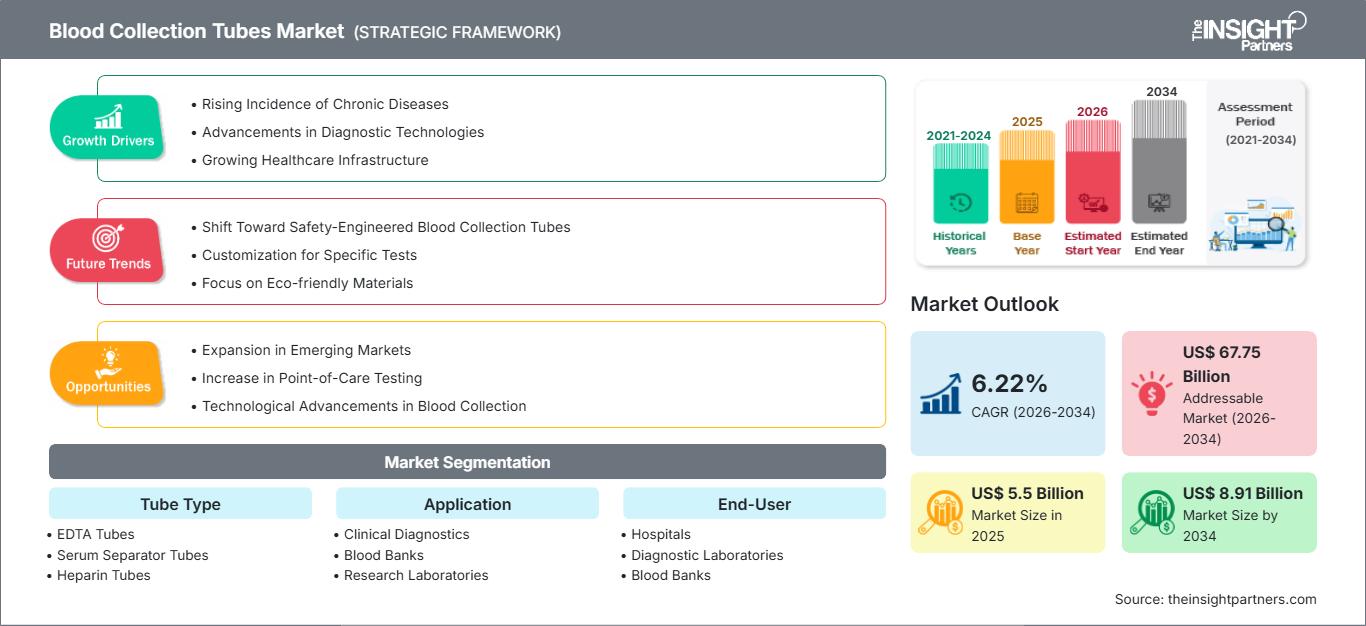
The Blood Collection Tubes Market size is expected to grow from US$ 5.5 Billion in 2025 to US$ 8.91 Billion by 2034, at a CAGR of 6.22% from 2026 to 2034. Growth will be driven by increasing diagnostic tests, laboratory automation, chronic disease monitoring, blood banking activities, and standardization of pre-analytical processes in hospitals, diagnostic laboratories, research laboratories, and blood banks.
In North America, structural support exists in terms of well-equipped laboratories, high testing intensity, and strict requirements regarding specimen quality. The Blood Collection Tubes Market outlook for size shows that a modeled CAGR of 5.7-6.3% will be witnessed through 2034, backed by automation and use of specialized collection tubes in molecular, hematology, oncology, and clinical chemistry studies.
Blood Collection Tubes Market Assessment and Insights
- North America: North America is expected to maintain a leading position, supported by mature laboratory networks and high diagnostic intensity, with a modeled 2025 share of 31–35% and CAGR of 5.7–6.3% between 2026–2034.
- US: The US accounts for 80–84% of North American Blood Collection Tubes Market share in 2025 and is projected to grow at 5.6–6.2% CAGR between 2026–2034, supported by advanced diagnostics and decentralized testing.
- Europe: Europe is estimated at 25–29% share in 2025, growing at 5.9–6.5% CAGR between 2026–2034. Germany, the UK, France, Italy, and Spain support regional demand through established laboratory and hospital systems.
- Asia Pacific: Asia Pacific represents an estimated 23–27% share in 2025 and is modeled to grow at 7.2–8.0% CAGR between 2026–2034, led by China, Japan, India, South Korea, and Australia.
- Largest Segment: Serum Separator Tubes hold a modeled 30–34% market share in 2025 and are expected to grow at 6.1–6.7% CAGR between 2026–2034.
- High Growth Segment: Research Laboratories represent 15–19% in 2025 and are modeled to expand at 7.5–8.3% CAGR between 2026–2034, driven by translational and molecular research.
- Key companies analyzed in detail: Becton, Dickinson and Company (BD), Thermo Fisher Scientific, Inc., Cardinal Health, Inc., Sekisui Diagnostics, Greiner Bio-One International GmbH, Merck KGaA, Labcorp, Bio-Rad Laboratories, Inc., Cochlear Limited, SARSTEDT AG & Co. KG.
Source: The Insight Partners' analysis based on proprietary research, government publications, company annual reports, investor presentations, industry databases, and expert interviews.
Blood Collection Tubes Market has progressed from evacuated tubes that were all standard towards application specific tubes which incorporate the factors like specimen stability, additive efficacy, safety, and laboratory automation. The manufacturing process has focused on precise molding, vacuum attributes, high-quality polymers, caps, and additives. The introduction of gel separator, low volume tubes, and specialized tubes has helped in widening the range of the product portfolio for labs to obtain reproducibility and less pre-analytical error.
The Blood Collection Tubes Market trends indicate that investments would be made into the development of products that work well with automated sample handling, decentralized diagnostics, molecular diagnostics, and lower volume collection. With the healthcare system emerging in Asia-Pacific region, the manufacturers who have validation in their production process, reliable supply chain, and tube configuration would get more traction.
Blood Collection Tubes Market Report Scope
| Report Attribute | Details |
|---|---|
| Market size in 2025 | US$ 5.5 Billion |
| Market Size by 2034 | US$ 8.91 Billion |
| Global CAGR (2026 - 2034) | 6.22% |
| Historical Data | 2021-2024 |
| Forecast period | 2026-2034 |
Blood Collection Tubes Market Analysis
The Blood Collection Tubes market is closely tied to diagnostic test volume, as the process involves the proper collection, preservation, transport, and processing of biological specimens. The demand follows a supply chain consisting of polymer, glass, additives, separator gel, closure, labeling, vacuum, molding, sterilization, packaging, distribution, laboratories, hospitals, and blood banks. Supply chain economics depend on resins, production yield, additives, and quality control.
Hospitals and diagnostic laboratories are focused on using tubes with a reduced number of redraws and compatibility with the centrifuge, analyzer, transportation, and laboratory information processing processes. EDTA and heparin tubes continue to be indispensable in hematology and plasma tests. Serum separator tubes facilitate mass chemistry and immunoassay processing. Blood culture and specialty tubes are used for microbiology, molecular diagnostics, trace element analysis, and other types of testing.
Positioning through competition is increasingly driven by portfolio diversity beyond just tube capability. Becton, Dickinson and Company (BD) offers collection systems in combination with safety-related components, and Greiner Bio-One International GmbH focuses on integrated pre-analytical processes. SARSTEDT AG & Co. KG gains through diversified tube designs and automation. Strategic positioning for Cardinal Health, Inc. and Thermo Fisher Scientific, Inc. is driven through their lab distribution capabilities and related product lines.
Further strategic positioning involves investments into process integration, specialized additives, small sample volumes, and manufacturing capacity. Sekisui Diagnostics has expertise in raw materials for blood collection tubes, while Merck KGaA and Bio-Rad Laboratories, Inc. operate in laboratory and research environments. Labcorp has significant experience in diagnostics and laboratories, and Cochlear Limited has minimal relevance in blood collection tubes but is included due to its presence in the list provided.
● REPORT CUSTOMIZATION
Tailor This Report To Align With Your Specific Business Requirements
This report can be customized to align precisely with your business objectives, scope, and target markets. Customization options include tailored segmentation, geography, competitive analysis, and strategic insights to support informed decision-making.
Customize This Report →WHAT YOU CAN ADJUST
- ● Segmentations
- ● Geography
- ● Competitive Analysis
- ● Language Preferences
Blood Collection Tubes Market: Strategic Insights
Regional Insights
North America Blood Collection Tubes Market
It is predicted that North America will contribute towards generating 31–35% of global revenues in 2025 with a projected CAGR of 5.7–6.3% during the period till 2034. North America stands out with advanced hospitals, central & independent laboratories, high diagnostic usage, and procurement guidelines in place. The US is the key market for the region, whereas Canada makes its contribution with public healthcare organizations and increasing laboratory infrastructure.
There is a strong demand for uniform pre-analytical products, safety-based collection methods, and tubes that can work with automated analyzers. The need for molecular diagnostics, cancer diagnosis, chronic condition monitoring, and blood banking drives the demand. Also, there are stringent product qualification criteria and laboratory procedures in place that make the switching costs relatively high, benefiting the existing manufacturers while providing opportunities for niche tubes.
U.S. Blood Collection Tubes Market
The US accounts for about 80% – 84% of North America revenue in 2025 and is projected to expand at a CAGR of 5.6% to 6.2% up to 2034. The demand in the country is driven by high laboratory throughput, testing in hospitals, outpatient testing, blood banking, and research. Major suppliers in the market are Becton, Dickinson and Company (BD), Cardinal Health, Inc., Thermo Fisher Scientific, Inc., and others.
Increasing application trends include the use of standardized collection systems used in clinical chemistry, hematology, molecular diagnostic, oncology testing, and decentralized sampling. In addition, the laboratory automation in the US market is due to the uniform tube dimensions, closure performance, barcoding, and specimen quality. Reduction in unnecessary blood loss in pediatric and low-volume collection formats is yet another differentiator in the products being supplied in the market.
Europe Blood Collection Tubes Market
Europe is forecast at 25-29% market share in 2025 and expected to grow at 5.9-6.5% CAGR during 2034. Germany is the largest country in the region, followed by the UK, France, Italy, and Spain. The well-developed infrastructure, quality standards, and established laboratories ensure steady demand for repeatable tube usage.
The UK and Germany have developed pathology ecosystems, where the focus of demand is standardization of pre-analytics, lab automation, and tracking of specimens. Additionally, Germany enjoys developed medical technology manufacturing base and existing suppliers. France, Italy, and Spain assist regional development through hospital modernization, preventative diagnostics, and laboratories consolidation. In Europe, environmental aspects and effective material utilization play an important role in procurement processes without diminishing the significance of specimen integrity.
APAC Blood Collection Tubes Market
APAC generates around 23-27% of revenue by 2025 and is expected to grow at 7.2-8.0% CAGR till 2034, thereby becoming the fastest growing large geography. The top countries are China, Japan, India, South Korea, and Australia. Capacity growth would be aided by the growth of industries and investment in healthcare.
China and India offer a good potential in terms of volume due to growing diagnostic chains, whereas quality and automation are the priorities for Japan and South Korea. Australia sustains demand owing to well-developed healthcare system. Investment into lab facilities, growth of diagnostics in private sector, and screening of chronic diseases provide an attractive environment for standardized collection products.
Middle East & Africa Blood Collection Tubes Market
Demand in the Middle East and Africa is forecast at 4.8%-5.8% CAGR to 2034, led by the market in Saudi Arabia, followed by the UAE and South Africa. Hospital upgrading, development of private laboratories, and investments in diagnostic equipment create a demand for ongoing use of routine and specialty test tubes.
In Saudi Arabia and the UAE, there are health care infrastructure projects and procurement centralization; whereas South Africa boasts a well-developed laboratory infrastructure in the region. Other MEA countries have less coherent structures, where access and distribution drive demand. Energy and infrastructure investments help boost healthcare capacity indirectly, thanks to hospital upgrading, logistics, and laboratory connectivity; however, there is greater procurement sensitivity than in developed countries.
Segmentation Analysis
Tube Type
The Tube Type segment is expected to expand at 6.0–6.6% CAGR from 2026–2034. Product selection depends on specimen chemistry, analyte stability, laboratory workflow, and analyzer compatibility. Serum separator formats remain prominent in routine diagnostics, while EDTA, heparin, culture, and specialized tubes support increasingly diverse clinical and research protocols. The Blood Collection Tubes Market scope therefore broadens as testing menus become more specialized.
- EDTA Tubes: EDTA tubes remain essential for hematology and molecular applications because anticoagulation preserves cellular characteristics. Their established protocols and compatibility with automated analyzers support consistent recurring laboratory consumption.
- Serum Separator Tubes: Serum separator tubes support high-volume chemistry and immunoassay workflows. Separator gels simplify serum recovery, reduce handling steps, and improve compatibility with automated laboratory processes.
- Heparin Tubes: Heparin tubes are widely used when plasma is preferred for rapid clinical chemistry and related testing. Their role remains important where shortened processing cycles improve laboratory turnaround.
- Blood Culture Tubes: Blood culture tubes serve microbiology workflows requiring controlled specimen conditions. Demand is linked to bloodstream infection diagnosis, hospital microbiology capacity, and protocols requiring reliable contamination control.
- Other Specialized Tubes: Specialized tubes address molecular, trace-element, glucose, pediatric, and research applications. Their strategic importance rises as laboratories adopt assays requiring controlled additives, smaller volumes, or specialized specimen preservation.
Application
The Application segment is projected to grow at 6.3–7.0% CAGR from 2026–2034. Clinical Diagnostics remains the largest use area because routine testing generates recurring specimen volumes. Research Laboratories are expected to post faster expansion as precision medicine, biobanking, translational research, and molecular workflows require controlled specimen collection and preservation.
- Clinical Diagnostics: Clinical diagnostics provides the broadest recurring demand base, covering chemistry, hematology, immunology, microbiology, and molecular testing across hospitals and independent laboratories.
- Blood Banks: Blood banks require standardized collection products for donor testing, component processing, infectious disease screening, and compatibility workflows, making reliability and traceability central procurement considerations.
- Research Laboratories: Research laboratories increasingly use application-specific tubes for biomarker discovery, genomics, proteomics, biobanking, and translational studies where sample integrity directly affects reproducibility.
- Forensic Laboratories: Forensic laboratories require specialized collection and preservation approaches for evidentiary specimens. Demand is supported by DNA analysis, toxicology, and standardized chain-of-custody procedures.
End-User
The End-User segment is forecast to grow at 6.1–6.8% CAGR from 2026–2034. Hospitals remain major purchasers because of broad testing menus and high patient throughput, while diagnostic laboratories increasingly consolidate purchasing around standardized platforms. Blood banks maintain specialized demand, particularly for donor screening and transfusion-related testing.
- Hospitals: Hospitals generate diverse collection requirements across emergency, inpatient, outpatient, surgery, oncology, and intensive-care workflows, supporting broad tube portfolios and recurring replenishment.
- Diagnostic Laboratories: Diagnostic laboratories prioritize consistent tube specifications, analyzer compatibility, automation readiness, and supply continuity because high testing volumes amplify the operational impact of collection errors.
- Blood Banks: Blood banks require dependable collection and testing systems supporting donor management, infectious disease screening, compatibility testing, and component processing under controlled procedures.
Opportunity Snapshot
| Segment Name | Revenue Contribution (High/Medium/Low) | Trend Tag | Adoption Stage |
|---|---|---|---|
| Hospitals | High | Automation Ready | Mature |
| Diagnostic Laboratories | High | Workflow Automation | Mature |
| Blood Banks | Medium | Donor Screening | Mature |
Blood Collection Tubes Market Growth Drivers and Impact Analysis
Rising Diagnostic Testing Intensity
Intensifying testing activity is one of the key drivers, since blood samples continue to be at the core of chemistry, hematology, immunology, molecular diagnostics, and disease management activities. Noncommunicable diseases are said to constitute the majority of deaths worldwide, thus highlighting the need for continuous screening and disease management activities. Higher frequency of tests increases recurrent usage of the tubes within hospitals and laboratories. This effect is more pronounced where laboratories consolidate high-throughput testing and streamline sample collection practices. Suppliers can capitalize on the situation by tailoring their tube lines to leading analyzer systems, developing specialty formats, and ensuring availability of supplies. Increasingly procurement departments take into consideration not only the cost per unit, but also the risk of redraws, sample quality, compatibility with workflows, and overall test costs.
Expansion of Automated Laboratory Workflows
Laboratory automation is changing tube requirements by making dimensional consistency, labeling, closure performance, barcode readability, and predictable centrifugation behavior increasingly important. Automation makes for less manual intervention but makes for a more impactful compatibility issue since one non-compatible tube specification can stop the entire process chain. Such a trend makes validation of the tube system's compatibility highly valuable. Suppliers of tubes who integrate their products with the automation equipment, transport and workflow systems would be able to develop a closer relationship with their accounts. The importance of this trend goes further than just hospitals as diagnostic laboratories become more centralized in their efforts. With automation becoming more widespread, tube manufacturers will have to work harder to ensure precise manufacturing and application-specific documentation.
Growth of Molecular and Specialized Testing
The growth of molecular diagnostics, oncology testing, biobanking, genomics, and translational research will increase the demand for specialized collection devices. Specific analyte testing can demand certain types of anticoagulants, stabilizers, gel properties, low volume designs, or even specimen preservation. Hence, the market opportunities for these products are shifting from high volume standard tubes towards collection devices that are formulated to meet the needs of a specific testing platform. Specialized tubes become more strategically relevant as laboratories will not switch to different products without validation once they affect the results of the testing process. Hence, research organizations and advanced diagnostic laboratories represent an appealing customer base for companies that are trying to create differentiated products. Another trend that emerges on the supplier side is a growing demand for technical support and product validation from customers.
Blood Collection Tubes Market Future Trends
Smaller-Volume Collection and Patient-Centric Sampling
Future product development is likely to place greater emphasis on smaller-volume collection, particularly for pediatric, geriatric, intensive-care, decentralized, and repeat-testing populations. Reduced specimen volume can support patient-centered care while lowering unnecessary blood loss during frequent testing. This trend will encourage manufacturers to redesign tube dimensions, additive concentrations, separator systems, and closure mechanisms while maintaining compatibility with existing analytical platforms. Capillary and minimally invasive collection approaches may increasingly complement conventional venous workflows rather than replace them. Suppliers will also need to validate specimen stability across transport conditions and testing delays. Over time, smaller-volume products could become more strategically important where healthcare systems emphasize resource efficiency, shorter hospital stays, and personalized monitoring. The strongest opportunities are likely to arise from products combining low volume, automation compatibility, and validated analytical performance.
Digital Traceability Across the Specimen Journey
Digital traceability is likely to become a stronger design consideration as laboratories seek end-to-end visibility from collection through analysis and storage. Future tubes may increasingly incorporate advanced labeling, machine-readable identifiers, and compatibility with automated tracking systems. These capabilities can reduce identification errors, support chain-of-custody requirements, and improve inventory management. Integration with laboratory information systems may also enable more precise monitoring of collection times, transport conditions, processing status, and specimen location. Manufacturers therefore have an opportunity to differentiate through data-enabled tube ecosystems rather than physical containers alone. Adoption will depend on interoperability, cybersecurity, workflow economics, and regulatory acceptance. In high-throughput laboratories, the value proposition will be strongest when digital identification reduces manual handling while simultaneously improving specimen traceability, inventory accuracy, and operational visibility.
Blood Collection Tubes Market Opportunities
Localized Manufacturing in High-Growth Healthcare Systems
Manufacturers can pursue capacity expansion and localized production in high-growth healthcare systems where diagnostic volumes are rising and supply continuity is strategically important. India, China, Southeast Asia, and selected Middle Eastern markets offer opportunities for regional manufacturing, contract production, distribution partnerships, and localized packaging. Such investments can reduce logistics exposure, improve response times, and strengthen participation in public and private procurement programs. Successful localization requires more than manufacturing capacity because suppliers must address regulatory approvals, additive sourcing, quality systems, technical support, and consistent product specifications. Partnerships with established laboratories and healthcare networks can accelerate qualification. The Blood Collection Tubes Market Forecast indicates that higher-growth regions can support differentiated investment strategies, particularly where local production is paired with automation-compatible products and specialized formats serving molecular diagnostics and chronic disease monitoring.
Specialized Tubes for Precision Diagnostics and Research
A second opportunity lies in developing specialized tubes designed around precision diagnostics, biobanking, liquid biopsy, and advanced research workflows. These applications require controlled specimen conditions, creating opportunities for products that stabilize analytes, reduce pre-analytical variability, or enable smaller sample volumes. Manufacturers can pursue collaboration models with diagnostic companies, academic laboratories, and research institutions to validate new tube chemistries before broader commercialization. Investment should prioritize evidence generation because adoption depends heavily on demonstrating compatibility with established analytical protocols. Suppliers can also build premium portfolios around application-specific requirements rather than competing solely on high-volume commodity formats. The opportunity is particularly relevant for companies with capabilities in polymers, separator gels, additives, precision molding, and laboratory workflow integration. Strong technical documentation can further support qualification and reduce customer switching barriers.
Recent Developments
- March 2025: Becton, Dickinson and Company (BD) and Babson Diagnostics announced studies showing that several drops of fingertip blood collected using the BD MiniDraw Capillary Blood Collection System could produce testing accuracy comparable to higher-volume draws. The development supports decentralized blood testing and illustrates continuing movement toward smaller-volume collection workflows.
- March 2025: Greiner Bio-One International GmbH highlighted circularity initiatives for medical devices and discussed development work examining how blood collection tubes can participate in more sustainable material systems. The initiative reflects growing attention to resource efficiency and environmental considerations within specimen-collection manufacturing and laboratory workflows.
- September 2025: SARSTEDT AG & Co. KG presented S-Monovette, Tempus1800, and HSS workflow solutions at the IBMS Congress, emphasizing pre-analytical reliability, automated sample handling, high-speed transport, and sample-quality improvements. The company also highlighted sustainability initiatives connected with its collection systems and laboratory workflow portfolio.
Frequently Asked Questions

- Comprehensive Market Sizing and Forecast Analysis
- Detailed Segmentation Analysis
- In-Depth Market Dynamics Assessment
- Regional and Country-Level Insights
- Competitive Landscape and Company Benchmarking
- Strategic Business Intelligence
Recent Reports
Testimonials

The Insight Partners' SCADA System Market report is comprehensive, with valuable insights on current trends and future forecasts. The team was highly professional, responsive, and supportive throughout. We are very satisfied and highly recommend their services.
RAN KEDEM Partner, Reali Technologies LTDs
I requested a report on a very specific software market and the team produced the report in a few days. The information was very relevant and well presented. I then requested some changes and additions to the report. The team was again very responsive and I got the final report in less than a week.
JEAN-HERVE JENN Chairman, Future Analytica
We worked with The Insight Partners for an important market study and forecast. They gave us clear insights into opportunities and risks, which helped shape our plans. Their research was easy to use and based on solid data. It helped us make smart, confident decisions. We highly recommend them.
PIYUSH NAGPAL Sr. Vice President, High Beam Global
The Insight Partners delivered insightful, well-structured market research with strong domain expertise. Their team was professional and responsive throughout. The user-friendly website made accessing industry reports seamless. We highly recommend them for reliable, high-quality research services
YUKIHIKO ADACHI CEO, Deep Blue, LLC.
This is the first time I have purchased a market report from The Insight Partners.While I was unsure at first, I visited their web site and felt more comfortable to take the risk and purchase a market report.I am completely satisfied with the quality of the report and customer service. I had several questions and comments with the initial report, but after a couple of dialogs over email with their analyst I believe I have a report that I can use as input to our strategic planning process.Thank you so much for taking the extra time and making this a positive experience.I will definitely recommend your service to others and you will be my first call when we need further market data.
JOHN SUZUKI President and Chief Executive Officer, Board Director, BK Technologies
I wish to appreciate your support and the professionalism you displayed in the course of attending to my request for information regarding to infectious disease IVD market in Nigeria. I appreciate your patience, your guidance, and the fact that you were willing to offer a discount, which eventually made it possible for us to close a deal. I look forward to engaging The Insight Partners in the future, all thanks to the impression you have created in me as a result of this first encounter.
DR CHIJIOKE ONYIA MANAGING DIRECTOR, PineCrest Healthcare Ltd.Reason to Buy
- Informed Decision-Making
- Understanding Market Dynamics
- Competitive Analysis
- Identifying Emerging Markets
- Customer Insights
- Market Forecasts
- Risk Mitigation
- Boosting Operational Efficiency
- Strategic Planning
- Investment Justification
- Tracking Industry Innovations
- Aligning with Regulatory Trends





 Get Free Sample for