
Blood Lancet Market Demand, Trends & Forecast by 2034
Blood Lancet Market Size and Forecasts (2021–2034), Global and Regional Share, Trends, and Growth Opportunity Analysis Report Coverage : by Product Type (Safety Lancet, Homecare Lancet); End User (Hospitals, Blood Banks, Home Care); and Geography (North America, Europe, Asia Pacific, and South and Central America)
- Status : Data Released
- Report Code : TIPRE00040779
- Category : Life Sciences
- No. of Pages : 150
- Available Report Formats :


- Last update date : July 29, 2026


2025 Market Size
US$ 2.31 Bn
Base year value
2034 Forecast
US$ 5.37 Bn
Projected by 2034
CAGR 2026-2034
9.83 %
Growth rate
Addressable Market
US$ 34.21 Bn
(2026-2034)
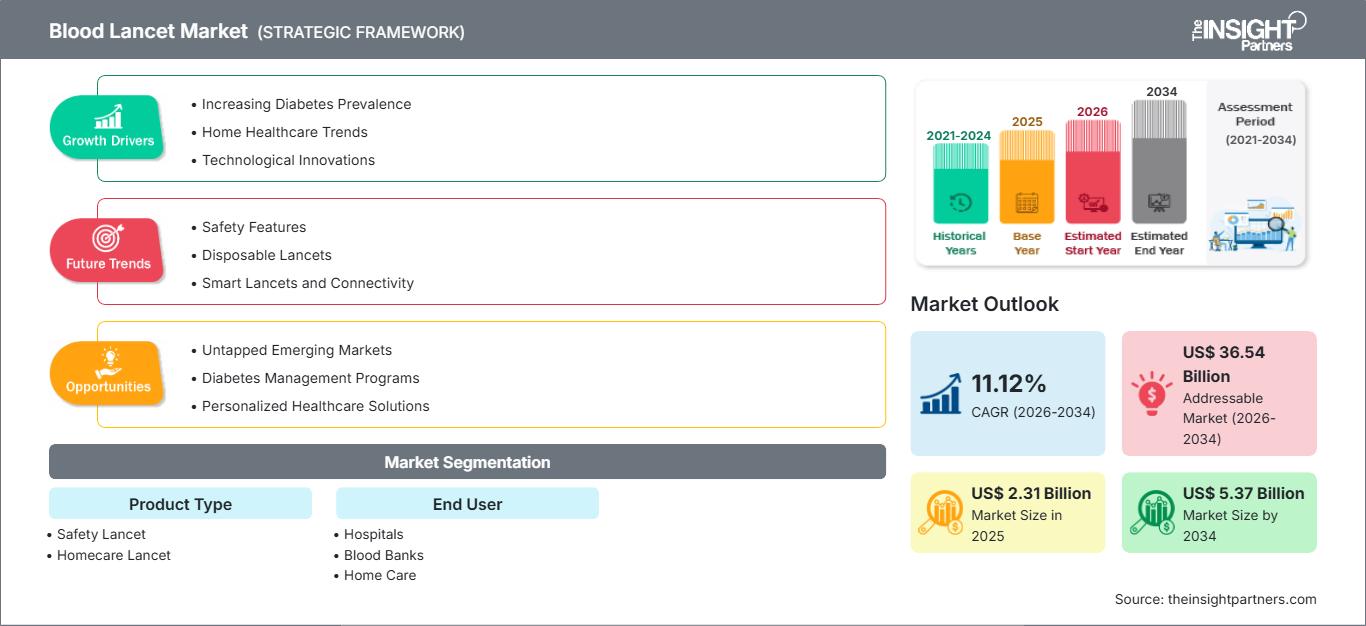
The Blood Lancet market was valued at US$ 2.31 billion in 2025 and is expected to reach US$ 5.37 billion by 2034; it is estimated to record a CAGR of 9.83% during 2026-2034.
Blood Lancet Market Assessment and Insights
- North America held 34–37% share in 2025 and is projected to grow at a CAGR between 9.8–10.6% during 2026–2034, driven by diabetes testing volume, strong safety-device adoption, and institutional purchasing discipline.
- US accounted for 78–82% of North America in 2025 and is expected to expand at a CAGR between 9.6–10.4% during 2026–2034, supported by high self-testing penetration and clinical safety mandates.
- Europe represented 24–27% share in 2025 and is projected to grow at a CAGR between 8.8–9.6% during 2026–2034, with Germany, the UK, France, Italy, and Spain leading regulated demand.
- Asia Pacific captured 25–28% share in 2025 and is expected to grow at a CAGR between 12.4–13.6% during 2026–2034, led by China, India, Japan, South Korea, and Australia.
- Largest Segment Safety Lancet held 62–66% market share in 2025 and is projected to grow at a CAGR between 10.6–11.4% during 2026–2034 due to hospital safety compliance.
- High Growth Segment Home Care held 18–22% market share in 2025 and is projected to grow at a CAGR between 13.0–14.2% during 2026–2034 as self-monitoring expands.
- Key companies analyzed in detail: F. Hoffmann-La Roche Ltd, Becton, Dickinson and Company, Abbott Laboratories, Terumo Corporation, LifeScan, Inc., Medtronic plc, Nipro Corporation, ARKRAY, Inc., Greiner Bio-One International GmbH, Owen Mumford Ltd.
Source: The Insight Partners' analysis based on proprietary research, government publications, company annual reports, investor presentations, industry databases, and expert interviews.
Blood Lancet market technology evolution spans from the initial use of manual needles to retractable, depth-controlled, pressure-controlled and drum-based devices that minimize exposure to the needle. The production environment is increasingly influenced by automation in molding, sterilization, and packaging due to the high volume and the need for sterility in these devices. Manufacturers have to balance between incorporating hospital grade safety characteristics into devices intended for the consumer market and distributing these devices through retailers.
During the forecast period, there will be an increased demand for this product among the new emerging population with diabetes, decentralized diagnosis and prevention screenings. Regulatory winds will favor the adoption of single-use and safety engineering for medical environments while funding will be directed towards ergonomic lancets for improved patient compliance in home use environments. Local manufacture in Asia and sterilization agreements will lower landed costs especially where there is lack of reimbursement.
Blood Lancet Market Report Scope
| Report Attribute | Details |
|---|---|
| Market size in 2025 | US$ 2.31 Billion |
| Market Size by 2034 | US$ 5.37 Billion |
| Global CAGR (2026 - 2034) | 9.83% |
| Historical Data | 2021-2024 |
| Forecast period | 2026-2034 |
Blood Lancet Market Analysis
Market development for blood lancet is due to increased incidence rate of capillary blood testing for diabetes, anemia test, neonatal test, and infectious diseases. WHO and IDF statistics show that the prevalence of diabetes has been increasing worldwide, thereby driving the need for sterile and painless sampling devices. Safety lancets are required in hospitals as well as repeat buying through retail pharmacies and online portals for diabetic patients doing self-monitoring.
Value chain consists of resin suppliers, stainless steel needle processers, assembly workers in cleanrooms, sterilization firms, distributors, hospitals, pharmacies, and at home consumers. The supply factors will include resin cost, ethylene oxide sterilization capacity, and import regulations from different regions. This industry is strong due to being inexpensive consumable products. However, poor quality may cause product recalls.
Blood lancet market dynamics are characterized by a competitive environment that revolves around factors such as comfort, safety, costs per unit, and channel penetration. Notably, F. Hoffmann-La Roche Ltd and LifeScan, Inc. retain their presence through the ecosystem of glucose monitors while Becton, Dickinson and Company, Owen Mumford Ltd, and Greiner Bio-One International GmbH focus on safety and sampling processes in institutions.
Market investments focus on automated assembly, needle grinding, improved retraction systems, and bundled diabetes management products. Abbott Laboratories and Medtronic plc impact the landscape of connected care despite being complementary to lancets. Terumo Corporation, Nipro Corporation, and ARKRAY, Inc. build regional presence through their network of medical devices and diagnostics.
● REPORT CUSTOMIZATION
Tailor This Report To Align With Your Specific Business Requirements
This report can be customized to align precisely with your business objectives, scope, and target markets. Customization options include tailored segmentation, geography, competitive analysis, and strategic insights to support informed decision-making.
Customize This Report →WHAT YOU CAN ADJUST
- ● Segmentations
- ● Geography
- ● Competitive Analysis
- ● Language Preferences
Blood Lancet Market: Strategic Insights
Regional Insights
North America Blood Lancet Market
North America held 34–37% share in 2025 and is projected to grow at a CAGR of 9.8–10.6% during 2026–2034. The Blood Lancet Market share in this region is supported by high diagnostic spending, broad diabetes screening, and strong use of safety-engineered sharps in hospitals. OSHA-driven needlestick prevention practices and hospital infection control policies continue to favor retractable lancets.
Demands would be supported by chronic disease management services from pharmacies, mail order diabetes products, and home glucose test. In this region, the infrastructure is developed for reimbursement, however, prices are still sensitive among customers due to frequent replacement of lancets. Hence, the differentiating factors for suppliers would include pain alleviation, ease of packaging, safety certification, and product availability.
U.S. Blood Lancet Market
In 2025, the U.S. contributed 78-82% of North America and is predicted to grow at CAGR of 9.6-10.4% from 2026-2034. Driving demand will include extensive use of point-of-care testing, higher diabetes prevalence, and robust institutional purchase of safety lancets. Distributors and group purchasing organizations influence prices, specifications, and suppliers in hospitals and clinics.
There are companies present in the segment and some of them include Becton, Dickinson and Company, Abbott Laboratories, Roche Diabetes Care, LifeScan, Inc., and Owen Mumford Ltd which operate in the diabetes and sample-collection segments. Application trend includes self-monitoring of blood glucose, wellness testing, blood donation testing, and bedside testing. In the U.S. segment, products that make the use easy are rewarded.
Europe Blood Lancet Market
In Europe, the market share was estimated at 24–27%, with a CAGR forecast for the period of 2026-2034 of 8.8–9.6%. In the UK, there are advantages of structured diabetes reviews, community pharmacies involvement, as well as public procurement biased towards compliance with safety requirements. Growth is consistent, as primary care networks recommend regular testing and the standardization of blood sampling procedures.
Leading positions belong to Germany because of high-level outpatient diagnostics, developed infrastructure for diabetes treatment, and high demands on medical devices quality. Hospitals and laboratories tend to prefer lancets which proved their efficacy in occupational exposure reduction. Retail segment supports home-based self-testing among the elderly. France, Italy, and Spain make their contribution by increased chronic diseases screenings, prevention programs, and substitution of conventional lancets with safe disposable versions.
APAC Blood Lancet Market
APAC accounted for 25–28% market share in 2025 and is expected to exhibit a CAGR of 12.4-13.6% during 2026-2034. China is the market leader, backed by high volume of diabetes testing, development of hospitals, and manufacture of devices in-country. The focus in Japan and South Korea is on high quality home diagnostic products.
India and Australia bring their own dynamics. The contribution of India comes from diagnostics, retail pharmacies and noncommunicable disease testing in the country. Meanwhile, Australia has better adoption rates of standardized home and clinical diagnostic products. Industrial factors include mold making facilities, low cost assembly, and encouragement for the manufacture of devices in-country.
Middle East & Africa Blood Lancet Market
Middle East and Africa is projected to expand at a CAGR of 10.5-11.6% for 2026-2034. The leading markets are Saudi Arabia and the UAE due to high prevalence of diabetes cases, increase in private hospital facilities, and improvements in preventive healthcare programs that improve access to testing. The main areas of demand include urban hospitals, laboratories, and pharmacies.
The demand from Sub-Saharan Africa comes from South Africa through private diagnostics and blood banks, and chronic disease management programs. The rest of Middle East and Africa continues to exhibit heterogeneity due to large differences in budget allocation, distribution, and rural testing capabilities. Public sector revenues from energy resources in Gulf countries indirectly support investments in healthcare infrastructure.
Segmentation Analysis
Product Type
Product Type is projected to grow at a CAGR of 10.8–11.6% during 2026–2034. The Blood Lancet Market scope across this segment is shaped by institutional safety requirements and home-use convenience. Product innovation focuses on retractable needles, finer gauges, consistent puncture depth, and ergonomic activation. Manufacturers must balance comfort and safety features with unit economics because large-volume procurement still prioritizes dependable, cost-effective supply.
- Safety Lancet holds the strongest position because hospitals, clinics, and blood banks need single-use, self-retracting products that reduce accidental needle exposure and support infection prevention protocols.
- Homecare Lancet demand is rising as diabetes patients perform frequent self-monitoring, requiring devices that are comfortable, easy to load, compatible with meters, and suitable for repeat household use.
End User
End User is projected to grow at a CAGR of 11.4–12.2% during 2026–2034. Demand varies by setting, with hospitals prioritizing safety compliance, blood banks focusing on rapid donor screening, and home care emphasizing comfort and affordability. Procurement decisions increasingly consider training simplicity, disposal practices, product availability, and compatibility with broader diabetes or diagnostic workflows.
- Hospitals remain core institutional buyers because lancets are used in bedside glucose checks, neonatal sampling, emergency triage, and routine point-of-care diagnostics.
- Blood Banks rely on dependable, sterile lancets for hemoglobin checks and donor screening, making product consistency, rapid activation, and low contamination risk strategically important.
- Home Care is gaining strategic importance as chronic disease management shifts toward patient-led monitoring, subscription supplies, and broader use of compact diabetes testing kits.
Opportunity Snapshot
Market Opportunity Snapshot
| End User | Revenue Contribution | Trend Tag | Adoption Stage |
| Hospitals | High | Safety Compliance | Mature |
| Blood Banks | Medium | Donor Screening | Scaling |
| Home Care | High | Self Testing | Scaling |
Blood Lancet Market Growth Drivers and Impact Analysis
Rising Diabetes Burden and Routine Capillary Testing
Diabetes prevalence is the strongest volume driver because blood glucose monitoring depends on repeated capillary sampling. IDF estimates indicate hundreds of millions of adults live with diabetes globally, and undiagnosed cases remain substantial, supporting screening-led demand. This creates a recurring consumable model rather than one-time equipment sales. The impact is visible across pharmacies, clinics, and home care channels, where lancets are purchased alongside meters and strips. Suppliers that offer comfortable puncture, reliable sterility, and broad compatibility can improve adherence while reducing patient discomfort. As governments expand noncommunicable disease screening, even low-cost lancets become strategically important for early detection.
Needlestick Prevention and Clinical Safety Regulations
Clinical buyers increasingly prefer safety lancets because needlestick injuries expose healthcare workers to bloodborne pathogens and create reporting, treatment, and liability costs. Safety-engineered devices with automatic needle retraction reduce post-use exposure and simplify disposal practices. Hospitals, laboratories, and blood banks therefore evaluate lancets not only on price but also on compliance, training requirements, and occupational safety outcomes. The impact is strongest in regulated markets where procurement teams require documented performance and sterility validation. This driver supports premiumization within institutional channels and encourages manufacturers to differentiate through activation control, shielded needles, and consistent puncture depth.
Expansion of Decentralized and Home-Based Diagnostics
Healthcare systems are moving routine monitoring closer to patients to reduce clinic burden and support earlier intervention. This shift increases demand for lancets used in home glucose monitoring, community health checks, pharmacy screening, and portable point-of-care testing. The market impact is broader channel diversification, with pharmacies, online platforms, and subscription models becoming more important. Home users value low pain, intuitive handling, and small packaging, while providers require dependable results from capillary samples. Manufacturers that design devices for both supervised and self-administered testing can address chronic care, preventive screening, and remote monitoring programs without relying only on hospital procurement cycles.
Blood Lancet Market Future Trends
Lower-Pain Sampling and Patient-Centered Device Design
Blood Lancet Market trends are moving toward lower-pain puncture, improved grip design, and controlled depth settings that support frequent testing without discouraging adherence. Future products are expected to use finer needles, vibration-reducing mechanisms, and simplified activation to reduce anxiety among elderly users, children, and new diabetes patients. Design will matter more as home care expands and patients compare devices through retail and online channels. Manufacturers that validate comfort claims through structured usability evidence can gain stronger shelf positioning and build loyalty around diabetes care ecosystems.
Bundled Diabetes Management and Digital Supply Models
Lancets are expected to become more integrated into bundled diabetes management offerings that include meters, strips, digital coaching, and automated replenishment. This trend does not digitize the lancet itself, but it changes how products are purchased and retained. Subscription models can stabilize demand, reduce stockouts, and support better adherence by ensuring patients receive supplies on schedule. Suppliers with strong partnerships across pharmacies, payers, and device platforms will be better positioned to convert consumable demand into predictable recurring revenue streams.
Blood Lancet Market Opportunities
Localized Manufacturing in High-Demand Emerging Markets
Emerging markets offer strong investment potential because diabetes prevalence is rising while access to affordable testing supplies remains uneven. Blood Lancet Market Forecasts indicate stronger momentum where domestic production policies, hospital expansion, and retail pharmacy growth converge. Localized molding, assembly, and sterilization can reduce import dependence, shorten lead times, and improve tender competitiveness. Companies entering India, China, Southeast Asia, and Gulf markets should prioritize regulatory registration, distributor depth, and product formats suited to both public procurement and out-of-pocket retail buyers.
Safety Lancet Upgrades in Blood Banks and Hospitals
A clear opportunity exists in replacing conventional or partially protected lancets with fully retractable safety designs across hospitals and blood banks. Buyers in these settings need rapid sampling, predictable blood volume, and minimized exposure risk during high-throughput workflows. Vendors can strengthen adoption by offering evidence-based training, disposal compatibility, and procurement packs aligned with department-level usage. This opportunity is attractive because safety upgrades can justify better margins than commodity home lancets while supporting institutional goals around worker protection and infection prevention.
Recent Developments
- May 2026: Abbott Laboratories secured CE Mark for its dual glucose-ketone sensing technology for people with diabetes, strengthening its position in connected metabolic monitoring and reinforcing demand for complementary capillary sampling supplies used in confirmation testing, patient education, and transitional care settings.
- April 2025: F. Hoffmann-La Roche Ltd expanded Accu-Chek patient affordability support in the US by including FastClix and Softclix lancets in its prescription discount program, improving access to bundled blood glucose monitoring supplies for eligible self-testing users.
- February 2025: Becton, Dickinson and Company announced plans to separate its Biosciences and Diagnostic Solutions business, allowing the future medtech organization to focus capital allocation on core medical device categories, operational efficiency, and portfolio priorities relevant to safety-engineered consumables.
Frequently Asked Questions

- Comprehensive Market Sizing and Forecast Analysis
- Detailed Segmentation Analysis
- In-Depth Market Dynamics Assessment
- Regional and Country-Level Insights
- Competitive Landscape and Company Benchmarking
- Strategic Business Intelligence
Recent Reports
Testimonials

The Insight Partners provided valuable market intelligence that supported our global go-to-market strategy. Their team was professional, responsive, and attentive to our feedback, providing thoughtful analysis and helpful methodological clarifications throughout the project.
Junmo Kim Chief Financial Officer (CFO), Enertech Co., Ltd.
The Insight Partners' SCADA System Market report is comprehensive, with valuable insights on current trends and future forecasts. The team was highly professional, responsive, and supportive throughout. We are very satisfied and highly recommend their services.
RAN KEDEM Partner, Reali Technologies LTDs
I requested a report on a very specific software market and the team produced the report in a few days. The information was very relevant and well presented. I then requested some changes and additions to the report. The team was again very responsive and I got the final report in less than a week.
JEAN-HERVE JENN Chairman, Future Analytica
We worked with The Insight Partners for an important market study and forecast. They gave us clear insights into opportunities and risks, which helped shape our plans. Their research was easy to use and based on solid data. It helped us make smart, confident decisions. We highly recommend them.
PIYUSH NAGPAL Sr. Vice President, High Beam Global
The Insight Partners delivered insightful, well-structured market research with strong domain expertise. Their team was professional and responsive throughout. The user-friendly website made accessing industry reports seamless. We highly recommend them for reliable, high-quality research services
YUKIHIKO ADACHI CEO, Deep Blue, LLC.
This is the first time I have purchased a market report from The Insight Partners.While I was unsure at first, I visited their web site and felt more comfortable to take the risk and purchase a market report.I am completely satisfied with the quality of the report and customer service. I had several questions and comments with the initial report, but after a couple of dialogs over email with their analyst I believe I have a report that I can use as input to our strategic planning process.Thank you so much for taking the extra time and making this a positive experience.I will definitely recommend your service to others and you will be my first call when we need further market data.
JOHN SUZUKI President and Chief Executive Officer, Board Director, BK Technologies
I wish to appreciate your support and the professionalism you displayed in the course of attending to my request for information regarding to infectious disease IVD market in Nigeria. I appreciate your patience, your guidance, and the fact that you were willing to offer a discount, which eventually made it possible for us to close a deal. I look forward to engaging The Insight Partners in the future, all thanks to the impression you have created in me as a result of this first encounter.
DR CHIJIOKE ONYIA MANAGING DIRECTOR, PineCrest Healthcare Ltd.Reason to Buy
- Informed Decision-Making
- Understanding Market Dynamics
- Competitive Analysis
- Identifying Emerging Markets
- Customer Insights
- Market Forecasts
- Risk Mitigation
- Boosting Operational Efficiency
- Strategic Planning
- Investment Justification
- Tracking Industry Innovations
- Aligning with Regulatory Trends





 Get Free Sample for