
Blood Pressure Test Market Growth, Share & Trends by 2034
Coverage: By Product (Sphygmomanometers, Blood Pressure Transducers, Instrument and Accessories, Others); Indication (Hypertension, Coronary Heart Disease, Others); End-User (Hospitals and Clinics, Diagnostic Centres, Homecare settings, Others); , and Geography (North America, Europe, Asia Pacific, and South and Central America)
- Status : Data Released
- Report Code : TIPRE00020477
- Category : Life Sciences
- No. of Pages : 150
- Available Report Formats :


- Last update date : July 30, 2026


2025 Market Size
US$ 2.06 Bn
Base year value
2034 Forecast
US$ 6.5 Bn
Projected by 2034
CAGR 2026-2034
13.60 %
Growth rate
Addressable Market
US$ 37.01 Bn
(2026-2034)
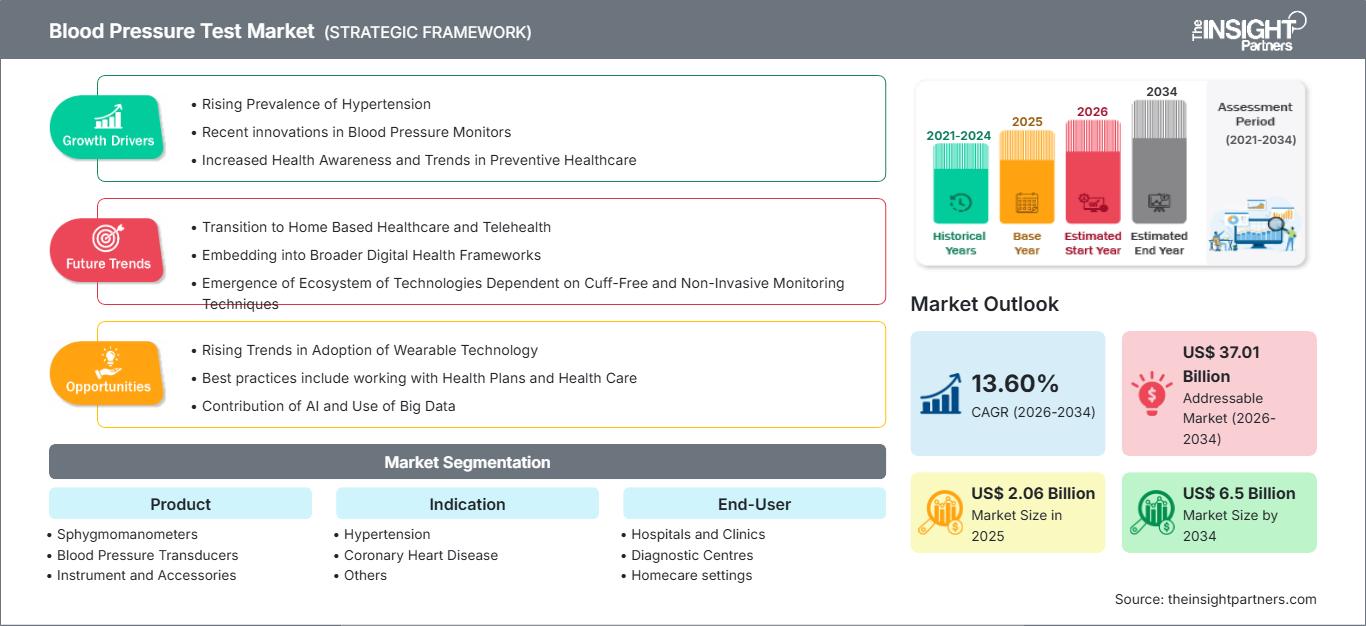
The Blood Pressure Test Market size is expected to rise from US$ 2.06 Billion in 2025 to reach US$ 6.5 billion by 2034, marking a CAGR of 13.60% during the period from 2026–2034. The factors driving growth include the rising incidence of hypertension tests, cardiovascular risk assessment, and increased usage of automated blood pressure test devices in hospitals, diagnostic centers, and home-based facilities.
North America continues to be one of the structurally advanced revenue markets. The factors fueling growth of the Blood Pressure Test Market size include chronic disease detection, payer-driven home monitoring, and connected care. It is projected to register a CAGR of 12.8% – 13.4% during 2026-2034 driven by high diagnosis levels, physician-led self-measurement, and availability of validated upper arm monitors.
Blood Pressure Test Market Assessment and Insights
- North America held 38–41% share in 2025 and is projected to grow at a CAGR of 12.8–13.4% between 2026–2034, supported by remote monitoring reimbursement, hypertension management protocols, and connected device penetration.
- US accounted for 82–86% of North America in 2025 and is expected to grow at a CAGR of 12.6–13.2% between 2026–2034, driven by primary care screening and home measurement.
- Europe represented 24–27% share in 2025 and is forecast to grow at a CAGR of 12.0–12.6% between 2026–2034, with Germany, the UK, and France leading adoption.
- Asia Pacific captured 22–25% share in 2025 and is expected to grow at a CAGR of 15.2–15.9% between 2026–2034, led by China, Japan, India, and South Korea.
- Largest Segment: Sphygmomanometers held 41–45% market share in 2025 and are expected to grow at a CAGR of 12.4–13.0% between 2026–2034 due to wide clinical and home use.
- High Growth Segment: Homecare settings held 20–24% market share in 2025 and are projected to grow at a CAGR of 15.6–16.4% between 2026–2034 as self-monitoring scales.
- Key companies analyzed in detail: OMRON Healthcare Co., Ltd., SunTech Medical, Inc., SPENGLER SAS, Koninklijke Philips N.V., SCHILLER AG, Spacelabs Healthcare LLC, American Diagnostic Corporation, Bosch + Sohn GmbH u. Co. KG, Withings SA, Welch Allyn, Inc., A&D Company Limited, GE HealthCare Technologies Inc., Microlife Corporation, Nihon Seimitsu Sokki Co., Ltd., Panasonic Holdings Corporation, Jiangsu Yuyue Medical Equipment & Supply Co., Ltd., Rossmax International Ltd., FKA Distributing Co., LLC, Guangdong Sejoy Electronics & Instruments Co., Ltd., Shenzhen Kingyield Technology Co., Ltd., and Andon Health Co., Ltd.
Source: The Insight Partners' analysis based on proprietary research, government publications, company annual reports, investor presentations, industry databases, and expert interviews.
The development of technology in the Blood Pressure Test Market is driving the movement from mercury devices to an ecosystem that is automated, validated for use in clinics, and connectivity-ready. Hospitals are continuing to standardize cuffs, transducers, and monitors, while manufacturers of home devices are improving their products with features such as larger screens, arrhythmia warnings, Bluetooth capabilities, and assistance with fitting the cuff.
In addition to the above, the production trends of the market include localization of cuffs manufacturing, protection of components supply, and algorithms implementation that helps avoid movement-related measurement errors. Over the forecast period, the adoption will increase in the geographies due to more developed hypertension management program in the region, use of ambulatory measurement, and cardiovascular risk assessment in primary care.
Blood Pressure Test Market Report Scope
| Report Attribute | Details |
|---|---|
| Market size in 2025 | US$ 2.06 Billion |
| Market Size by 2034 | US$ 6.5 Billion |
| Global CAGR (2026 - 2034) | 13.60% |
| Historical Data | 2021-2024 |
| Forecast period | 2026-2034 |
Blood Pressure Test Market Analysis
The growth path of demand in the Blood Pressure Testing Equipment market is driven by the growing clinical burden of hypertension, coronary heart disease, stroke prevention, and renal-risk monitoring. According to WHO statistics, the prevalence of hypertension is one in three adults around the world, which leads to the regular testing requirement rather than the one-time acquisition of the device.
The supply chain includes sensor suppliers, cuff makers, equipment assembly plants, medical software providers, distributors, and hospitals. Supply chain dynamics are determined by the pressure sensor, rubber bladder, textiles, semiconductors, and regulatory documents. The purchasing process focuses on the validation criteria, ability of data transmission, cuff sizes, longevity, and compatibility with EHRs.
High competitive intensity persists as the market report indicates some overlap among companies that manufacture consumer health products and those that produce clinical-grade products. OMRON Healthcare Co., Ltd, Withings SA, Microlife Corporation, and A&D Company Limited concentrate on home monitoring, whereas GE HealthCare Technologies Inc, Koninklijke Philips N.V, Spacelabs Healthcare LLC, and SunTech Medical, Inc. target clinical process flow.
Strategic positioning has shifted from pressure reading to cardiovascular monitoring. Investments have been made into AFib detection, remote patient monitoring, ambulatory testing, and resistance to cuff supply shortages. The pricing strategy still reflects product differentiation as premium connected monitors battle for convenience and data quality, while basic monitors fight through accessibility and cost-effectiveness.
● REPORT CUSTOMIZATION
Tailor This Report To Align With Your Specific Business Requirements
This report can be customized to align precisely with your business objectives, scope, and target markets. Customization options include tailored segmentation, geography, competitive analysis, and strategic insights to support informed decision-making.
Customize This Report →WHAT YOU CAN ADJUST
- ● Segmentations
- ● Geography
- ● Competitive Analysis
- ● Language Preferences
Blood Pressure Test Market: Strategic Insights
Regional Insights
North America Blood Pressure Test Market
North America accounted for 38-41% Blood Pressure Test Market share in 2025 and is expected to register a CAGR of 12.8-13.4% during 2026-2034. Favorable factors for the region include high rates of hypertension diagnosis, cardiac guidelines, pharmacy-based screening, and remote monitoring programs. Most demand comes from validated upper arm monitors, clinical quality cuffs, and accessories for hospital monitoring.
In addition, procurement drivers such as chronic disease management and value-based payments encourage healthcare teams to monitor blood pressure outside episodic consultations. Device replacements are ongoing due to the capabilities of connected devices to store patient data. Supply reliability has become a priority due to the shortage of cuffs, leading hospitals to diversify suppliers and prefer companies with robust North American support.
U.S. Blood Pressure Test Market
The U.S. accounted for 82-86% of North America in 2025 and is expected to register growth at CAGR of 12.6-13.2% over 2026-2034. High prevalence rate of hypertension in U.S. adults (as per CDC), close to 50%, ensures steady demand for regular measurements. In hospitals, primary care practices, and even in home monitoring systems, preference is being given to products that minimize user errors and increase clinician's access to the readings.
High company presence in consumer, clinical and OEM segments. Devices by OMRON Healthcare Co., Ltd., Welch Allyn, Inc., GE HealthCare Technologies Inc., SunTech Medical, Inc., American Diagnostic Corporation, and Withings SA cater to applications ranging from home monitoring to ambulatory measurement, emergency departments, and perioperative use. Preference is shifting from basic measuring to connected measurement, adherence reminders and arrhythmia detection.
Europe Blood Pressure Test Market
Europe held a 24–27% market share in 2025 and will grow at a CAGR of 12.0–12.6% between 2026 and 2034. Germany leads the region due to wide availability of primary care services, good availability of medical equipment, and frequent usage of approved home monitors. Bosch + Sohn GmbH u. Co. KG, SPENGLER SAS, SCHILLER AG, and Koninklijke Philips N.V. increase regional competitiveness.
The UK market benefits from community BP screenings, pharmaceutical store-based BP measurements, and NHS prioritizing the need to identify early stages of heart disease risks. Doctors encourage the usage of home measurements to detect white coat and masked hypertension more accurately. The growth of digital channels increases demand for Bluetooth-connected monitors and cuffs for repeat self-measurements.
The contribution from France, Italy, and Spain comes from aging populations, cardiology follow-ups, and better availability of automated monitors in the retail segment. France sees consistent adoption of connected devices for home health care, whereas Italy and Spain rely on clinic monitoring and pharmacies. Pricing pressures reduce regional demand, but accuracy and validation keep premium devices safe.
APAC Blood Pressure Test Market
APAC held 22–25% share in 2025 and is forecast to grow at a CAGR of 15.2–15.9% during 2026–2034. China is the leading country, supported by hospital expansion, large hypertensive populations, and domestic manufacturers such as Jiangsu Yuyue Medical Equipment & Supply Co., Ltd. and Andon Health Co., Ltd.
The other nations of interest contribute their own unique factors that drive growth. Japan boasts of being familiar with home monitoring procedures because of companies such as OMRON Healthcare Co., Ltd and Nihon Seimitsu Sokki Co., Ltd. India is growing in terms of screenings in private clinics and pharmacies. South Korea takes advantage of the adoption of connected care.
Middle East & Africa Blood Pressure Test Market
Middle East & Africa is expected to grow at a CAGR of 10.8–11.6% during 2026–2034, with Saudi Arabia as the leading country. Demand is supported by hospital infrastructure, diabetes and obesity screening, and government investment in preventive healthcare. The UAE also shows higher uptake of imported connected monitors.
South Africa leads sub-Saharan demand through private hospitals, diagnostic centres, and pharmacy retail channels. Rest of MEA remains price-sensitive, but urban clinics are increasing procurement of automated devices. Energy-linked fiscal capacity in Gulf countries supports hospital modernization, while broader infrastructure gaps limit rapid adoption in lower-income healthcare systems.
Segmentation Analysis
Product
Product is expected to register a CAGR of 12.8–13.5% during 2026–2034. The Blood Pressure Test Market scope across product categories is widening as healthcare providers balance manual reliability, automated convenience, and invasive monitoring needs. Demand is shifting toward clinically validated automated devices, replacement cuffs, and accessories that improve repeatability across hospital, diagnostic, and home environments.
- Sphygmomanometers remain strategically important because they serve hospitals, clinics, pharmacies, and households, with automated upper-arm models gaining preference over mercury and manual formats.
- Blood Pressure Transducers are critical in intensive care, anesthesia, and operating rooms, where invasive arterial pressure monitoring supports high-acuity decision-making and continuous hemodynamic assessment.
- Instrument and Accessories include cuffs, tubes, connectors, valves, and mounting tools, making the category essential for replacement demand, infection control, and device interoperability.
Indication
Indication is projected to grow at a CAGR of 13.0–13.7% between 2026–2034. Hypertension remains the largest clinical use case, while coronary heart disease increases the need for regular pressure tracking in risk stratification and follow-up. Screening frequency is rising because blood pressure is a low-cost marker linked to cardiovascular, renal, endocrine, and metabolic disease pathways.
- Hypertension drives recurring measurement across primary care, community screening, pharmacies, and home settings, creating sustained demand for validated devices and patient-friendly monitoring workflows.
- Coronary Heart Disease supports use of accurate blood pressure readings in cardiology clinics, rehabilitation programs, medication titration, and follow-up after acute cardiovascular events.
End-User
End-User is forecast to grow at a CAGR of 14.0–14.8% during 2026–2034. Hospitals and clinics remain central buyers, but homecare settings are expanding fastest as care pathways move beyond facility visits. Diagnostic centres and pharmacies are gaining relevance as blood pressure testing becomes a routine entry point for broader cardiovascular and metabolic risk assessment.
- Hospitals and Clinics account for high-volume clinical use because blood pressure measurement is embedded in triage, inpatient monitoring, outpatient visits, anesthesia, and chronic disease management.
- Diagnostic Centres use automated monitors and accessories for standardized screening, pre-procedure assessment, cardiovascular risk panels, and referral-based evaluations.
- Homecare settings are gaining strategic relevance as patients, caregivers, and clinicians rely on self-measured readings for treatment adherence, teleconsultation, and longitudinal hypertension control.
Opportunity Snapshot
| Segment Name | Revenue Contribution | Trend Tag | Adoption Stage |
| Hospitals and Clinics | High | Workflow Accuracy | Mature |
| Diagnostic Centres | Medium | Preventive Screening | Scaling |
| Homecare settings | High | Connected Monitoring | Scaling |
| Others | Low | Community Access | Emerging |
Blood Pressure Test Market Growth Drivers and Impact Analysis
Rising Hypertension Burden and Earlier Screening
The strongest sustainable factor is the growing number of people who need their blood pressure checked repeatedly. Hypertension is silent in many cases, thus making blood pressure measurement the key way to diagnose the condition and adjust treatment. Thus, there is a consistent demand for cuffs, validated monitors, and even connected devices that can be used for blood pressure measurement at home and allow for longitudinal monitoring. Since there is a growing focus on the importance of early intervention, blood pressure testing is integrated into the monitoring and management of other conditions such as diabetes, kidney disease, obesity, and cardiovascular diseases.
Shift Toward Home-Based and Remote Patient Monitoring
Home monitoring is becoming a mainstream extension of clinical care because single in-office readings often fail to capture white-coat or masked hypertension. Connected devices allow patients to share readings, identify trends, and support medication adjustments between appointments. The effect on the Blood Pressure Test Market is a shift from basic devices toward guided, app-enabled monitors with memory storage, alerts, and clinician dashboards. Manufacturers that simplify cuff positioning, improve readability, and automate data transfer are better positioned to capture demand from older adults, chronic care programs, and telehealth-enabled primary care networks.
<h3> Clinical Standardization and Supply Chain Resilience
Hospitals increasingly treat blood pressure measurement as a quality-critical workflow rather than a commodity purchase. Standardized cuff sizes, validated algorithms, infection-control compatibility, and device integration can reduce measurement variability and operational delays. Supply chain resilience has become equally important because shortages in cuffs or accessories can disrupt routine monitoring. This driver supports multi-year procurement agreements, vendor qualification, and investment in local or diversified manufacturing. The market impact is stronger demand for trusted clinical brands, accessory availability, and devices that align with international validation protocols and hospital interoperability requirements.
Blood Pressure Test Market Future Trends
AI-Assisted Cardiovascular Signal Interpretation
A major Blood Pressure Test Market trend is the integration of blood pressure measurement with rhythm analysis, risk alerts, and guided interpretation. Future devices will increasingly identify irregular pulses, flag possible atrial fibrillation, and contextualize readings using history, posture, medication timing, and symptoms. This will move the category from measurement hardware toward preventive cardiovascular intelligence. Adoption will be strongest where clinicians can receive structured data instead of isolated readings. The trend also supports premium pricing for devices that reduce false readings, improve adherence, and deliver clinically usable signals across home and outpatient environments.
Validated Devices Designed for Aging Users
Future growth will depend on simplifying the measurement experience for older adults and patients with limited digital literacy. Larger displays, step-by-step prompts, cuff-fit detection, audible guidance, and automatic retesting will become standard differentiators. Manufacturers will also expand multi-size cuffs to improve accuracy across body types. This trend matters because usability directly affects reading quality and monitoring adherence. Devices that combine clinical validation with intuitive design will be preferred by remote care programs, home health agencies, and family caregivers managing chronic cardiovascular risk at scale.
Blood Pressure Test Market Opportunities
Remote Monitoring Programs in Primary Care
Primary care networks can create scalable opportunities by bundling validated monitors, patient education, and clinician review workflows. Blood Pressure Test Market Forecasts point to stronger investment in homecare settings where payers, providers, and patients benefit from fewer avoidable visits and better treatment titration. Vendors can differentiate by offering device fleets, replacement cuffs, training materials, technical support, and dashboard integrations. The opportunity is especially strong in the U.S., Japan, Germany, and urban China, where chronic care capacity is under pressure and connected health infrastructure is already developing.
Emerging Market Channel Expansion
Manufacturers have a significant opportunity to expand through pharmacies, diagnostic chains, e-commerce, and public screening initiatives in India, Southeast Asia, Latin America, and parts of the Middle East. Success will require affordable validated monitors, durable cuffs, local-language instructions, and serviceable accessories. Partnerships with distributors and telehealth platforms can accelerate adoption where hospital access is uneven. Companies that balance price with clinical reliability can capture first-time device buyers and repeat accessory sales. This opportunity also supports public-health goals by improving hypertension awareness and follow-up outside tertiary hospitals.
Recent Developments
- April 2026: OMRON Healthcare Co., Ltd. and UCSF launched an atrial fibrillation trial designed to study early detection through home blood pressure monitoring, supporting the company’s strategy to combine routine blood pressure checks with cardiovascular risk identification and remote patient engagement.
- October 2025: Withings SA introduced BPM Vision, a home blood pressure monitor with integrated ECG capability, a large color screen, guided measurement prompts, and support for atrial fibrillation detection, strengthening its connected cardiovascular monitoring portfolio for consumer and clinical-adjacent use.
- May 2025: Baxter Healthcare Corporation reported that Welch Allyn FlexiPort disposable blood pressure cuffs were no longer on allocation effective May 12, 2025, following capacity expansion that included new U.S. production equipment to improve supply continuity.
Frequently Asked Questions

- Comprehensive Market Sizing and Forecast Analysis
- Detailed Segmentation Analysis
- In-Depth Market Dynamics Assessment
- Regional and Country-Level Insights
- Competitive Landscape and Company Benchmarking
- Strategic Business Intelligence
Recent Reports
Testimonials

The Insight Partners' SCADA System Market report is comprehensive, with valuable insights on current trends and future forecasts. The team was highly professional, responsive, and supportive throughout. We are very satisfied and highly recommend their services.
RAN KEDEM Partner, Reali Technologies LTDs
I requested a report on a very specific software market and the team produced the report in a few days. The information was very relevant and well presented. I then requested some changes and additions to the report. The team was again very responsive and I got the final report in less than a week.
JEAN-HERVE JENN Chairman, Future Analytica
We worked with The Insight Partners for an important market study and forecast. They gave us clear insights into opportunities and risks, which helped shape our plans. Their research was easy to use and based on solid data. It helped us make smart, confident decisions. We highly recommend them.
PIYUSH NAGPAL Sr. Vice President, High Beam Global
The Insight Partners delivered insightful, well-structured market research with strong domain expertise. Their team was professional and responsive throughout. The user-friendly website made accessing industry reports seamless. We highly recommend them for reliable, high-quality research services
YUKIHIKO ADACHI CEO, Deep Blue, LLC.
This is the first time I have purchased a market report from The Insight Partners.While I was unsure at first, I visited their web site and felt more comfortable to take the risk and purchase a market report.I am completely satisfied with the quality of the report and customer service. I had several questions and comments with the initial report, but after a couple of dialogs over email with their analyst I believe I have a report that I can use as input to our strategic planning process.Thank you so much for taking the extra time and making this a positive experience.I will definitely recommend your service to others and you will be my first call when we need further market data.
JOHN SUZUKI President and Chief Executive Officer, Board Director, BK Technologies
I wish to appreciate your support and the professionalism you displayed in the course of attending to my request for information regarding to infectious disease IVD market in Nigeria. I appreciate your patience, your guidance, and the fact that you were willing to offer a discount, which eventually made it possible for us to close a deal. I look forward to engaging The Insight Partners in the future, all thanks to the impression you have created in me as a result of this first encounter.
DR CHIJIOKE ONYIA MANAGING DIRECTOR, PineCrest Healthcare Ltd.Reason to Buy
- Informed Decision-Making
- Understanding Market Dynamics
- Competitive Analysis
- Identifying Emerging Markets
- Customer Insights
- Market Forecasts
- Risk Mitigation
- Boosting Operational Efficiency
- Strategic Planning
- Investment Justification
- Tracking Industry Innovations
- Aligning with Regulatory Trends





 Get Free Sample for