
Body Protection Equipment Market Trends, Share & Demand by 2034
Coverage: By Product (Laboratory Coats, Coveralls, Full Body Suits, Surgical Gowns, Vests and Jackets, Aprons); Application (Hand & Leg Protection, Fall Protection, Protective Clothing, Respiratory Protection, and others), and Geography (North America, Europe, Asia Pacific, and South and Central America)
- Status : Data Released
- Report Code : TIPRE00005177
- Category : Life Sciences
- No. of Pages : 150
- Available Report Formats :


- Last update date : July 29, 2026


2025 Market Size
US$ 3.54 Bn
Base year value
2034 Forecast
US$ 5.49 Bn
Projected by 2034
CAGR 2026-2034
5.01 %
Growth rate
Addressable Market
US$ 41.01 Bn
(2026-2034)
The global Body Protection Equipment Market size is forecasted to expand from US$ 3.54 Billion in 2025 to US$ 5.49 Billion by 2034, growing at a CAGR of 5.01% between 2026 and 2034. The Body Protection Equipment market demonstrates strong demand for protective clothing products designed to mitigate chemical, biological, thermal, particulate, and mechanical risks faced by workers.
In the North American region, the emphasis for the buyers will shift from compliance-based purchases of protective clothing products to risk-appropriate, fit-tested, and reusable protective clothing systems. In the region, the Body Protection Equipment Market is driven by stricter workplace safety policies, reshoring of high-tech manufacturing, and increased spending by health care and laboratory users. Demand growth in the North American region will be seen in the CAGR of 4.6–5.2%.
Body Protection Equipment Market Assessment and Insights
- North America accounted for 32–35% share in 2025 and is growing at a CAGR between 2026–2034 of 4.6–5.2%, supported by OSHA enforcement, healthcare preparedness, and high replacement demand across manufacturing and construction.
- US represented 78–82% of North America share in 2025 and is expanding at a CAGR between 2026–2034 of 4.5–5.1%, led by industrial safety audits and healthcare PPE standardization.
- Europe held 25–28% share in 2025 and is growing at a CAGR between 2026–2034 of 4.2–4.8%, with Germany, the UK, France, Italy, and Spain leading demand through regulated industrial and healthcare procurement.
- Asia Pacific captured 27–30% share in 2025 and is advancing at a CAGR between 2026–2034 of 5.7–6.4%, driven by China, Japan, South Korea, India, and Australia.
- Largest Segment Protective Clothing held 45–49% market share in 2025, growing at a CAGR range of 4.8–5.4%, reflecting broad use in industrial, healthcare, and contamination-control environments.
- High Growth Segment Fall Protection held 14–17% market share in 2025, growing at a CAGR range of 6.0–6.7%, supported by construction safety mandates and infrastructure activity.
- Key companies analyzed in detail: 3M Company, Alpha Pro Tech, Ltd., Ansell Limited, Cintas Corporation, DuPont de Nemours, Inc., Honeywell International Inc., Kimberly-Clark Professional, Lakeland Industries, Inc., Radians, Inc., uvex group, MSA Safety Incorporated, and Sioen Industries NV.
Source: The Insight Partners' analysis based on proprietary research, government publications, company annual reports, investor presentations, industry databases, and expert interviews.
Technological innovation has consistently impacted the Body Protection Equipment Market, where consumers look for clothing which not only has superior protection but is breathable, durable, and employee-compliant. Moving from coveralls to nonwovens, coated materials, high-visibility clothing, and chemical resistant laminated clothes has added more value differentiation. There are changes occurring in the dynamics of manufacturing, where regionalization of inventories, cutting and sealing automation, and supplier qualification are helping avoid potential disruptions in healthcare and industrial PPE markets.
In terms of future trends, procurement is going to be affected by new industrial clusters developing in the Asia-Pacific region, energy investments being made in the Middle East, and regulatory tailwinds regarding traceability, fit, and sustainable disposal in Europe and North America. Projects in public infrastructure, semiconductor fabrication, pharmaceuticals, and renewable energy are likely to broaden specifications. There is a possibility of creating opportunity for higher-value products, particularly when the employer considers total cost of ownership instead of per-unit price.
Body Protection Equipment Market Report Scope
| Report Attribute | Details |
|---|---|
| Market size in 2025 | US$ 3.54 Billion |
| Market Size by 2034 | US$ 5.49 Billion |
| Global CAGR (2026 - 2034) | 5.01% |
| Historical Data | 2021-2024 |
| Forecast period | 2026-2034 |
Body Protection Equipment Market Analysis
The growth drivers of the Body Protection Equipment Market comprise the need to minimize recordable injuries, keep the workers safe from multi-hazard environment, and address documented PPE requirements. The highest demand is seen where the employers have to deal with hazards such as chemical splash, dust, pathogens, flame, arc, visibility, and falls at once. The supply chain comprises raw material suppliers, fabric converters, garment manufacturers, test labs, distributors, rental services, and end users who increasingly seek evidence-based products.
The supply chain continues to be driven by volatile raw materials, reliance on polyethylene and special coatings, and need for certified manufacturing facilities. Increasingly, large purchasers are seeking to enter into framework agreements in order to ensure continuity, standards, and consistent sizing. The estimates of International Labour Organization regarding almost 3 million work-related deaths each year and 395 million non-fatal injuries support the safety motivation behind the repeated demand.
Market Positioning is becoming less about the number of products available and more about application know-how. DuPont de Nemours focuses on advanced protective textiles, while Ansell Limited is diversifying its cleanroom and industrial PPE offerings, while 3M Company takes into account the correlation between apparel choices and comprehensive safety programs. Cintas Corporation has the advantage of being involved in rental and managed service business, while Lakeland Industries, Inc. and Sioen Industries NV cater to technical protective apparel applications.
Current investments target breathable chemical apparel, hi-vis workwear, compliance management solutions, and recycling services for non-hazardous PPE. Honeywell International Inc., uvex group, MSA Safety Incorporated, Radians, Inc., Alpha Pro Tech, Ltd., and Kimberly-Clark Professional will need to stand out through ergonomics, accessibility, and conformity documentation. The strategic success may include certified products, training and strong regional distribution.
● REPORT CUSTOMIZATION
Tailor This Report To Align With Your Specific Business Requirements
This report can be customized to align precisely with your business objectives, scope, and target markets. Customization options include tailored segmentation, geography, competitive analysis, and strategic insights to support informed decision-making.
Customize This Report →WHAT YOU CAN ADJUST
- ● Segmentations
- ● Geography
- ● Competitive Analysis
- ● Language Preferences
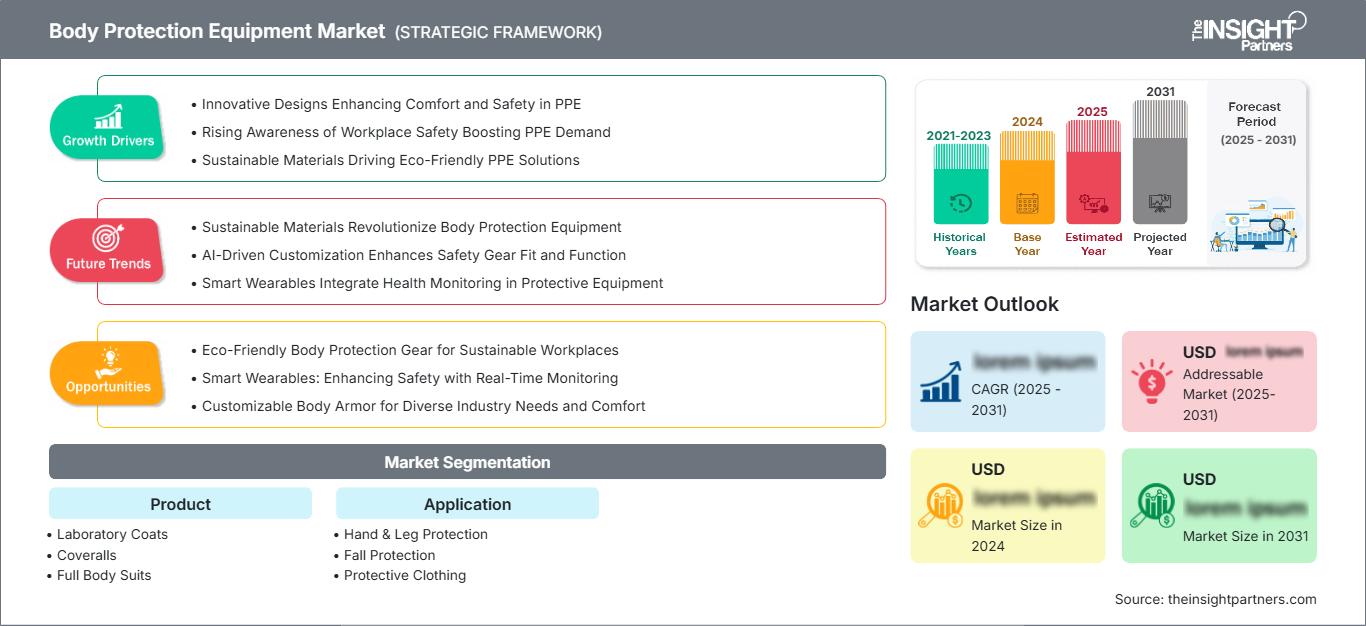
Body Protection Equipment Market: Strategic Insights
Regional Insights
North America Body Protection Equipment Market
North America accounted for 32-35% Body Protection Equipment Market share in 2025 and is projected to register a CAGR between 4.6-5.2% during 2026-2034. Growth drivers include OSHA regulations, healthcare preparedness planning, oil and gas maintenance, utilities, and construction industries. The 2025 maximum OSHA penalty of US$ 16,550 for serious violations ensures compliance-led purchases in the market.
Other advantages include an organized distribution channel, managed uniform program, and extensive use of fit-specific body protection equipment in construction and healthcare industries. Employers are substituting traditional disposable work clothes for those which provide resistance to chemicals, visibility, comfort, and proven performance. Evaluation criteria include supplier dependability, worker preference, and waste management, thus driving premiumization in the market.
U.S. Body Protection Equipment Market
The U.S. had the market share of 78–82% of North America and is estimated to grow at a rate of 4.5–5.1% CAGR from 2026–2034. The 2025 PPE rule of OSHA related to the use of proper fit for construction workers made it imperative to focus on sizes, fit for female workers, and job-specific requirements.
Presence of companies in this region is widespread, with companies such as 3M Company, DuPont de Nemours, Inc., Cintas Corporation, Honeywell International Inc., MSA Safety Incorporated, Radians, Inc., and Lakeland Industries, Inc. serving the nation-wide customers. Demand in terms of applications is high in protective clothing, fall protection, and adjacent body protection of respiratory protection in laboratory, utility, construction, and emergency response sectors.
Europe Body Protection Equipment Market
Europe accounted for 25–28% share in 2025 and is projected to grow at a CAGR range of 4.2–4.8% during 2026–2034. Regulation (EU) 2016/425 requires PPE design, manufacture, and conformity procedures that support consistent product quality across member states. Germany remains the leading country because of chemical, automotive, machinery, and advanced manufacturing exposure.
The UK shows steady replacement demand from healthcare, utilities, and construction, with procurement teams emphasizing CE or UKCA conformity, garment compatibility, and supplier service levels. Germany leads technical garment usage, especially for chemical splash, high-visibility, and industrial maintenance needs. France, Italy, and Spain contribute through pharmaceuticals, food processing, infrastructure, and energy projects, while buyers increasingly prefer breathable, reusable, and recyclable apparel formats.
APAC Body Protection Equipment Market
The APAC region had a market share of 27-30% in 2025 and is expected to see a CAGR of 5.7-6.4% between 2026-2034. China dominates the region due to its manufacturing size, chemicals, electronics, and public infrastructure. The Japanese and Korean countries have increased demands for high specifications from electronics, cleanrooms, and advanced materials.
The countries of India and Australia contribute with constructions, mining, energy, and stringent workplace safety regulations. The focus of policies in terms of industrial accidents, manufacturing, and healthcare preparedness has resulted in greater use of PPE clothes that meet the certification standards.
Middle East & Africa Body Protection Equipment Market
The Middle East & Africa is projected to expand at a CAGR range of 4.9–5.6% during 2026–2034. Saudi Arabia is the leading country, supported by energy, petrochemicals, industrial cities, and giga-project construction. The UAE adds demand from infrastructure, aviation, logistics, and healthcare investment.
South Africa remains important for mining, utilities, manufacturing, and emergency services, while the rest of MEA shows selective adoption linked to oil and gas maintenance and public works. Harsh climates increase the need for breathable protective clothing, high-visibility garments, and fall protection systems that improve worker compliance during long outdoor shifts.
Segmentation Analysis
Product
Product is projected to grow at a CAGR range of 4.9–5.5% during 2026–2034, supported by constant replacement cycles and specialization by hazard class. The Body Protection Equipment Market scope across products is widening as users demand garments that combine protection, mobility, thermal comfort, and regulatory documentation. Manufacturers are differentiating through fabric technology, seam construction, size inclusivity, and contamination-control packaging.
- Laboratory Coats serve laboratories, diagnostics, universities, and pharmaceutical environments where splash protection, clean appearance, and routine replacement support compliance and professional safety protocols.
- Coveralls remain central to industrial, construction, and maintenance applications because they offer full-torso coverage, disposable formats, and compatibility with gloves, boots, and respiratory equipment.
- Full Body Suits address high-risk chemical, biological, and cleanroom settings where sealed construction, barrier integrity, and contamination control are critical to worker and process protection.
- Surgical Gowns are essential in healthcare and procedural environments, with demand shaped by infection control, fluid resistance, comfort, and consistent availability during caseload fluctuations.
- Vests and Jackets support visibility and weather protection in construction, logistics, utilities, and roadwork, making them strategically important for outdoor and mobile workforces.
- Aprons are used in food processing, laboratories, healthcare, and chemical handling where localized splash protection, ease of removal, and affordability support frequent use.
Application
Application is projected to grow at a CAGR range of 5.0–5.6% during 2026–2034 as employers map PPE spending to task-level risk assessments. Demand is moving beyond minimum compliance toward integrated protection programs that reduce downtime and standardize worker behavior. Protective clothing remains the broadest application, while fall protection is gaining momentum from infrastructure and height-work regulations.
- Hand & Leg Protection supports welding, chemical handling, metalworking, healthcare, and industrial maintenance where extremity exposure often determines injury severity and productivity loss.
- Fall Protection is strategically important in construction, utilities, telecom, and oil and gas, where height-related incidents drive investment in harness-compatible apparel and training.
- Protective Clothing holds the largest application position because it addresses chemical, biological, particulate, visibility, and general industrial risks across multiple end-use sectors.
- Respiratory Protection is closely tied to body protection strategies when workers operate in contaminated, dusty, chemical, or infectious environments requiring coordinated PPE compatibility.
Opportunity Snapshot
| Segment Name | Revenue Contribution | Trend Tag | Adoption Stage |
| Hand & Leg Protection | Medium | Extremity Safety | Mature |
| Fall Protection | High | Height Safety | Scaling |
| Protective Clothing | High | Barrier Apparel | Mature |
| Respiratory Protection | Medium | Integrated PPE | Scaling |
Body Protection Equipment Market Growth Drivers and Impact Analysis
Stricter Safety Enforcement and Higher Compliance Costs
Rising enforcement intensity is encouraging employers to move from reactive PPE buying to documented protection programs. In the U.S., 2025 OSHA penalties reached US$ 16,550 per serious violation and US$ 165,514 per willful or repeated violation, making non-compliance financially material for contractors and industrial operators. Similar regulatory pressure in Europe under Regulation (EU) 2016/425 increases demand for certified garments and traceable supply. The market impact is strongest in construction, chemicals, utilities, healthcare, and manufacturing, where audits require evidence that garments match the hazard. This supports higher-value products, fit-specific purchasing, and long-term supply contracts.
Expansion of Healthcare, Cleanroom, and Laboratory Use Cases
Healthcare systems, life sciences manufacturing, diagnostics, and cleanroom operations are expanding demand for protective gowns, laboratory coats, coveralls, and controlled-environment suits. The impact is not limited to infection control, as semiconductor, battery, pharmaceutical, and biotechnology facilities also require apparel that protects both workers and processes. Buyers in these settings typically prioritize lint control, sterilization compatibility, fluid resistance, and packaging integrity. As cleanroom and laboratory spending increases in North America, Europe, and Asia Pacific, suppliers with validated materials and contamination-control expertise gain an advantage. This driver raises average selling prices and supports recurring replenishment demand.
Industrial Projects Requiring Multi-Hazard Protection
Large industrial projects increasingly expose workers to combined risks, including chemical splash, abrasive particles, heat, visibility hazards, fall risks, and respiratory contaminants. Energy, infrastructure, mining, and heavy manufacturing customers are therefore specifying apparel that works as part of a coordinated PPE system. The impact is visible in demand for high-visibility jackets, chemical coveralls, flame-resistant garments, harness-compatible clothing, and breathable full-body suits. Employers are also standardizing product lists across sites to simplify training and reduce incorrect PPE selection. This creates opportunities for suppliers that can provide technical guidance, certifications, logistics, and multi-category portfolios.
Body Protection Equipment Market Future Trends
Comfort-Science Apparel Shaping Product Specifications
Body Protection Equipment Market trends will increasingly reflect the science of wearer comfort, including breathability, heat dissipation, ergonomic fit, and reduced fatigue during long shifts. DuPont’s 2025 Tyvek APX launch highlights how suppliers are positioning advanced protective fabrics around worker well-being without reducing barrier performance. Future specifications will likely incorporate physiological testing, wear trials, and heat-stress considerations, especially in construction, utilities, chemicals, and emerging-market infrastructure. As employers link PPE compliance to actual wear time, garments that improve comfort while maintaining certification will command stronger pricing and preferred-supplier status.
Circular PPE Programs and Waste Visibility
Future procurement will place greater emphasis on end-of-life recovery, particularly for non-hazardous PPE waste generated by laboratories, cleanrooms, healthcare, and industrial manufacturing. Ansell’s integration of The RightCycle Program after acquiring Kimberly-Clark’s PPE business demonstrates how sustainability services are becoming part of protective apparel value propositions. Over the forecast period, buyers will ask suppliers to document material composition, recycling pathways, and disposal costs. This trend will not replace safety performance, but it will influence tender scoring and vendor retention among multinational accounts with environmental reporting obligations.
Body Protection Equipment Market Opportunities
Managed PPE Services for Large Industrial Employers
Large employers need consistent garment availability, correct sizing, compliance records, laundering, inspection, and replacement across multiple sites. This creates an opportunity for managed PPE platforms that bundle apparel supply with inventory tracking, worker issue records, fit verification, and renewal schedules. Body Protection Equipment Market Forecasts indicate stronger adoption among utilities, infrastructure contractors, manufacturing groups, and healthcare networks seeking lower administrative burden. Service providers can differentiate by combining certified products, digital portals, training materials, and waste programs. The investment case is strongest where fragmented purchasing leads to higher stockouts, inconsistent protection, and weak audit documentation.
Localized Production for Strategic Supply Assurance
Supply chain resilience remains a major opportunity because emergency demand spikes and shipping disruptions can quickly expose reliance on distant suppliers. Regionalized production, fabric conversion, and final garment assembly can improve lead times for healthcare, government, and critical infrastructure buyers. Companies that invest in dual sourcing, automated cutting, sealed-seam capacity, and validated quality systems can win contracts where continuity is a procurement requirement. Local production also supports customization for climate, sizing, language labeling, and national standards. This opportunity is especially relevant in North America, Europe, India, and the Gulf economies.
Recent Developments
- November 2025: DuPont de Nemours, Inc. introduced Tyvek APX, a disposable chemical garment fabric designed to improve breathability while maintaining protection and durability, at A+A 2025 in Düsseldorf. The company stated that the fabric was supported by independent physiological evaluation by Empa and developed to address heat build-up in demanding protective apparel use cases.
- October 2025: 3M Company presented new personal safety innovations at A+A 2025, including integrated PPE solutions focused on comfort, compatibility, communication, and worker compliance. The showcase included fall protection, respiratory protection, welding protection, and hearing communication systems, reflecting the company’s strategy to connect body protection decisions with broader workplace safety programs.
- March 2025: Ansell Limited expanded its portfolio to include Kimtech, KleenGuard, and RightCycle brands across North America and Europe following the acquisition of Kimberly-Clark’s PPE business. The commercial milestone strengthened Ansell’s position in laboratories, cleanrooms, and industrial manufacturing, while adding sustainable disposal and contamination-control service capabilities.
Frequently Asked Questions

- Comprehensive Market Sizing and Forecast Analysis
- Detailed Segmentation Analysis
- In-Depth Market Dynamics Assessment
- Regional and Country-Level Insights
- Competitive Landscape and Company Benchmarking
- Strategic Business Intelligence
Recent Reports
Testimonials

The Insight Partners' SCADA System Market report is comprehensive, with valuable insights on current trends and future forecasts. The team was highly professional, responsive, and supportive throughout. We are very satisfied and highly recommend their services.
RAN KEDEM Partner, Reali Technologies LTDs
I requested a report on a very specific software market and the team produced the report in a few days. The information was very relevant and well presented. I then requested some changes and additions to the report. The team was again very responsive and I got the final report in less than a week.
JEAN-HERVE JENN Chairman, Future Analytica
We worked with The Insight Partners for an important market study and forecast. They gave us clear insights into opportunities and risks, which helped shape our plans. Their research was easy to use and based on solid data. It helped us make smart, confident decisions. We highly recommend them.
PIYUSH NAGPAL Sr. Vice President, High Beam Global
The Insight Partners delivered insightful, well-structured market research with strong domain expertise. Their team was professional and responsive throughout. The user-friendly website made accessing industry reports seamless. We highly recommend them for reliable, high-quality research services
YUKIHIKO ADACHI CEO, Deep Blue, LLC.
This is the first time I have purchased a market report from The Insight Partners.While I was unsure at first, I visited their web site and felt more comfortable to take the risk and purchase a market report.I am completely satisfied with the quality of the report and customer service. I had several questions and comments with the initial report, but after a couple of dialogs over email with their analyst I believe I have a report that I can use as input to our strategic planning process.Thank you so much for taking the extra time and making this a positive experience.I will definitely recommend your service to others and you will be my first call when we need further market data.
JOHN SUZUKI President and Chief Executive Officer, Board Director, BK Technologies
I wish to appreciate your support and the professionalism you displayed in the course of attending to my request for information regarding to infectious disease IVD market in Nigeria. I appreciate your patience, your guidance, and the fact that you were willing to offer a discount, which eventually made it possible for us to close a deal. I look forward to engaging The Insight Partners in the future, all thanks to the impression you have created in me as a result of this first encounter.
DR CHIJIOKE ONYIA MANAGING DIRECTOR, PineCrest Healthcare Ltd.Reason to Buy
- Informed Decision-Making
- Understanding Market Dynamics
- Competitive Analysis
- Identifying Emerging Markets
- Customer Insights
- Market Forecasts
- Risk Mitigation
- Boosting Operational Efficiency
- Strategic Planning
- Investment Justification
- Tracking Industry Innovations
- Aligning with Regulatory Trends





 Get Free Sample for