
Bottle and CSD Grade PET Market Size, Growth & Demand by 2034
Coverage: By Grade (High, Medium, and Low), By Application [Food (Condiments and Sauces, Edible Oils, and Dairy Products) and Beverage (Carbonated Drinks, Alcoholic Beverages, Juices, and Bottled Water], and Geography (North America, Europe, Asia Pacific, the Middle East and Africa, and South and Central America)
- Status : Published
- Report Code : TIPRE00044080
- Category : Chemicals and Materials
- No. of Pages : 261
- Available Report Formats :


- Last update date : September 07, 2026


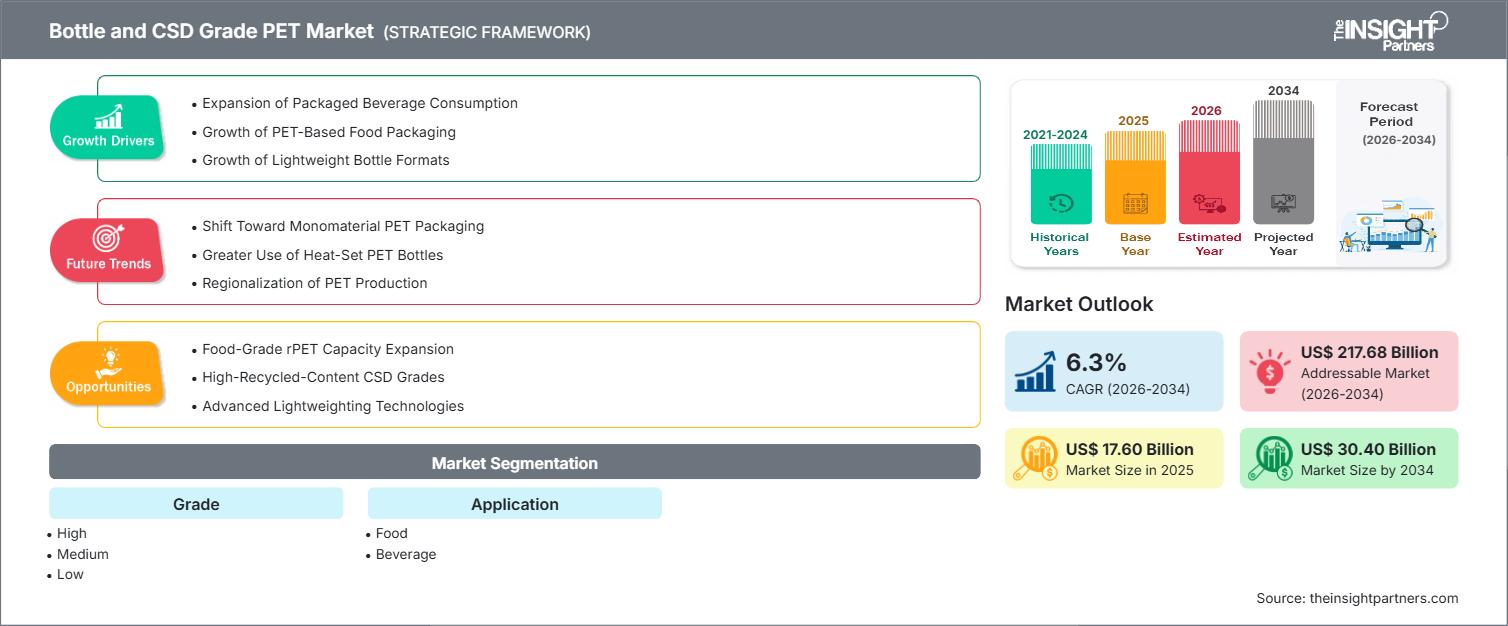
2025 Market Size
US$ 17.60 Bn
Base year value
2034 Forecast
US$ 30.40 Bn
Projected by 2034
CAGR 2026-2034
6.3 %
Growth rate
Addressable Market
US$ 217.68 Bn
(2026-2034)
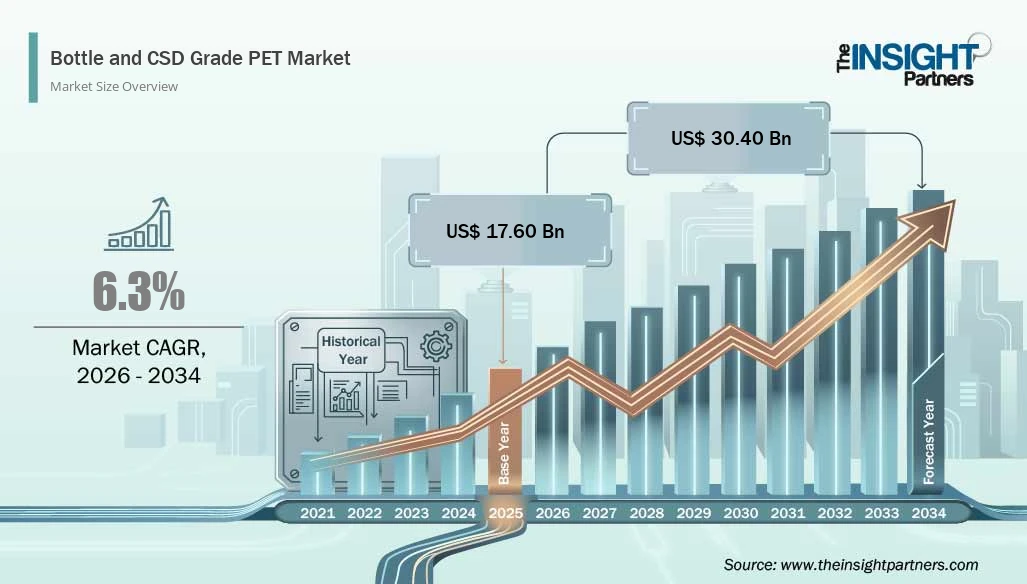
The bottle and CSD grade PET market was valued at US$ 17.60 billion in 2025 and is projected to reach US$ 30.40 billion by 2034, expanding at a CAGR of 6.3% from 2026 to 2034. Growth is being fueled by the increasing consumption of packaged beverages and food products, where PET remains the preferred packaging material due to its durability, clarity, lightweight nature, and cost efficiency. Rising demand for bottled water, carbonated soft drinks, juices, edible oils, dairy products, condiments, and sauces continues to strengthen PET resin consumption globally. In addition, evolving industry priorities, including bottle lightweighting, enhanced packaging convenience, improved recyclability, and expanding beverage distribution networks, are reshaping resin procurement and manufacturing strategies. As brand owners and regulators place greater emphasis on sustainability, the integration of recycled PET (rPET) and circular packaging solutions is becoming a key factor influencing future market growth and competitive differentiation.
The bottle and CSD grade PET market in North America is structurally mature yet still expanding, thanks to existing beverage bottling facilities, demand for packaging made with recycled content, and a shift away from heavier packaging formats. This regional outlook is being strengthened by investments in recycling systems, in the development of lighter bottle designs, and in the use of recycled PET that complies with food-contact requirements. These factors ensure the growth of the bottle and CSD grade PET market.
Bottle and CSD Grade PET Market Assessment and Insights
- North America: The region is expected to represent a 21–25% share in 2025 and grow at a CAGR of 4.8–5.5% during 2026–2034, supported by beverage packaging replacement, recycling infrastructure, and established converter networks.
- US: The US is estimated to account for 78–83% of North American demand in 2025 and expand at a 4.6–5.3% CAGR during 2026–2034, led by beverage and food packaging.
- Europe: Europe is projected to hold 18–22% share in 2025 and grow at a 4.9–5.6% CAGR through 2034, with Germany, Italy, France, the UK, and Spain supporting demand through beverage packaging and circularity initiatives.
- Asia Pacific: Asia Pacific is estimated at a 44–48% share in 2025 and is expected to grow at a 7.0–7.8% CAGR through 2034, led by China, India, Japan, South Korea, and Southeast Asian beverage markets.
- Largest Segment: Beverage application is estimated at 68–72% market share in 2025, with a 6.5–7.1% CAGR during 2026–2034, reflecting extensive PET use in water and carbonated beverages.
- High Growth Segment: High-grade PET is estimated at 32–36% market share in 2025 and is expected to grow at a 6.8–7.5% CAGR through 2034 as quality and recycled-content requirements increase.
- Key companies analyzed in detail: Mohinani Group; Indorama Ventures Public Company Limited; Indorama Corporation; Alpek, S.A.B. de C.V.; Zhejiang Wankai New Materials Co., Ltd.; Jiangsu Sanfangxiang Group Co., Ltd.; China Resources Chemical Materials Technology Co., Ltd.; LOTTE Chemical CORPORATION; Reliance Industries Limited; Nan Ya Plastics Corporation; JB Ecotex Limited; Henan Fengbai Industrial Co., Ltd.; Plastipak Holdings, Inc.; TLD Vietnam Company Limited; and Chiripal Poly Films Limited.
Source: The Insight Partners' analysis based on proprietary research, government publications, company annual reports, investor presentations, industry databases, and expert interviews.
There has been a growing trend in the bottle and CSD grade PET market towards large, PET integrated plants that can manage polymer quality, energy consumption, and feedstock use. When it comes to producing bottles, special attention is given to intrinsic viscosity, acetaldehyde levels, color, crystallization behavior, and processability, and newer production methods are increasingly likely to incorporate recycled materials alongside design-for-recycling factors. At the same time, resin producers are adjusting their product specifications to meet the demands of high-speed preform and bottle conversion processes.
The future situation is being influenced by capacity optimization, further investments in recycling, and geographic diversification. In the emerging beverage markets of South and Southeast Asia, Africa, and certain areas of Latin America, there are opportunities for new resin and preform capacity, whereas in more developed markets, there is a growing emphasis on using recycled content and reducing weight. As a result of regulatory pressure on packaging waste, the demand for the bottle and CSD grade PET market is growing rapidly.
Bottle and CSD Grade PET Market Report Scope
| Report Attribute | Details |
|---|---|
| Market size in 2025 | US$ 17.60 Billion |
| Market Size by 2034 | US$ 30.40 Billion |
| Global CAGR (2026 - 2034) | 6.3% |
| Historical Data | 2021-2024 |
| Forecast period | 2026-2034 |
Bottle and CSD Grade PET Market Analysis
The bottle and CSD grade PET market is closely linked to beverage consumption, packaging substitution, and the efficiency of resin conversion. The value chain includes suppliers of PTA and MEG, manufacturers of PET resin, producers of preforms, bottle converters, beverage companies, retailers, consumers, collection networks, and recyclers. The availability of feedstock and energy costs affect the resin's economics, while the bottle design determines material intensity and conversion requirements.
Demand is especially affected by bottled water, carbonated drinks, juices, and other ready-to-drink products. PET provides a mix of lightweight, transparency, mechanical strength, and good transport efficiency, which enables its wide use in the beverage sector. As for the supply side, producers are increasingly inclined to balance virgin resin production with the use of recycled PET, thereby strengthening connections among resin manufacturing, collection, sorting, washing, and food-grade recycling.
The position a company takes in competition is determined by the locations of its manufacturing facilities, the efficiency of its polymerization processes, the consistency of its products, its ability to recycle materials, and its relationships with customers. Indorama Ventures Public Company Limited and Indorama Corporation have broad exposure to both polyester and recycling, whereas Alpek, S.A.B. de C.V. has a considerable presence in the Americas in PET. Zhejiang Wankai New Materials Co., Ltd. specializes in PET resin for packaging, including water and carbonated soft drinks.
Other participants are adopting different regional strategies. For example, Jiangsu Sanfangxiang Group Co., Ltd. carries out polyester production together with the manufacture of bottle-grade resin, and China Resources Chemical Materials Technology Co., Ltd. and LOTTE Chemical CORPORATION are involved in large-scale polyester and petrochemical value chains. Reliance Industries Limited, Nan Ya Plastics Corporation, Mohinani Group, Plastipak Holdings, Inc., and the regional specialists compete through their capacity, downstream relationships, recycled-content solutions, and application-specific grades.
● REPORT CUSTOMIZATION
Tailor This Report To Align With Your Specific Business Requirements
This report can be customized to align precisely with your business objectives, scope, and target markets. Customization options include tailored segmentation, geography, competitive analysis, and strategic insights to support informed decision-making.
Customize This Report →WHAT YOU CAN ADJUST
- ● Segmentations
- ● Geography
- ● Competitive Analysis
- ● Language Preferences
Bottle and CSD Grade PET Market: Strategic Insights
Regional Insights
North America Bottle and CSD Grade PET Market
In 2025, North America is expected to make up 21–25% of the bottle and CSD grade PET market and is projected to grow at a compound annual growth rate of 4.8–5.5% through 2034. Because of the mature beverage packaging systems, the widespread use of PET bottles, and well-established food packaging supply chains, there is a solid demand. The United States is the leading market in the region, with Canada and Mexico contributing via beverage production and cross-border supply chains. The practice of using lighter materials continues as packaging converters look to improve material efficiency without sacrificing bottle performance.
As a result, recycling has become an increasingly important element of regional purchasing strategies, as beverage producers and packaging companies aim to increase the amount of recycled content incorporated. The availability and price of recycled feedstock are affected by the ability to collect, sort, and wash, as well as by food-grade recycling capacity. Resin producers, therefore, base their competition on consistency, logistics, compatibility with recycled content, and the level of technical support they provide. They also invest in production efficiency and flexible product ranges that meet the needs of both conventional and circular packaging.
US Bottle and CSD Grade PET Market
In 2025, the United States accounts for about 78 to 83 percent of demand in North America and is anticipated to grow at a compound annual growth rate of 4.6 to 5.3 percent through 2034. The big beverage bottlers, food processors, retailers, and packaging converters generate varied demand for PET in products such as bottled water, carbonated drinks, juices, edible oils, and sauces. Both domestic producers and foreign suppliers compete on the basis of supply reliability and the availability of grades suited to specific applications.
There is a growing trend in applications towards lightweight bottles, materials with recycled content, and improved recyclability. Companies such as Alpek, S.A.B. de C.V., and Plastipak Holdings, Inc. are involved in the regional PET ecosystem, and converters are increasingly assessing resin taking into account processing efficiency, bottle performance, the amount of recycled content, and the assurance of a continuous supply. Strategic procurement remains important to ensuring a steady supply of packaging for beverage and food applications.
Europe Bottle and CSD Grade PET Market
Europe's share is expected to be between 18 and 22 percent in 2025 and is forecast to grow at a compound annual growth rate of 4.9 to 5.6 percent through to 2034. Germany continues to be a leading market, thanks to its advanced beverage packaging and recycling systems. The UK, France, Italy, and Spain also play a role because of their well-established food and beverage industries. Circular packaging requirements are still an important competitive factor.
Germany has a well-developed system for collecting and recycling PET, which encourages beverage producers to make greater use of recycled material and to improve their bottle design. The country also supports specialized capabilities for packaging conversion and recycling, leading to demand for a consistent food-grade resin.
The United Kingdom, France, Italy, and Spain have well-developed beverage markets and are placing greater emphasis on packaging circularity. Demand varies by beverage type and the state of the recycling infrastructure, and manufacturers are increasingly inclined to assess resin suppliers by the consistency of quality, the availability of recycled content, logistics, and compliance with regulatory requirements. The regional compound annual growth rate remains within the mentioned European range, with Germany maintaining its leading position.
APAC Bottle and CSD Grade PET Market
The bottle and CSD grade PET market in APAC is expected to have a market share of 44–48% by 2025 and will grow at a compound annual growth rate of 7.0–7.8% through to 2034, thus becoming the largest regional market. China continues to be the leading force, with India, Japan, South Korea, and Australia contributing through investments in beverage manufacturing, food packaging, and recycling.
Industrial expansion increased urban consumption, the development of modern retail, and the localization of packaging all help to meet demand. China takes advantage of its extensive polyester infrastructure, while India sees packaged beverage consumption rising, together with growing recycling activities. Japan and South Korea stress advanced packaging and resource efficiency, whereas Australia is placing increasing emphasis on collection and the integration of recycled content.
Middle East & Africa Bottle and CSD Grade PET Market Market
Demand in the Middle East and Africa of the bottle and CSD grade PET market is backed by consumption of beverages, the use of food packaging, infrastructure development, and investment in manufacturing. Important market areas in the Gulf are Saudi Arabia and the UAE, and South Africa offers a major packaging base for the region. The region is anticipated to grow at a 5.7–6.5% compound annual growth rate through 2034, with Saudi Arabia being the leader in terms of regional investment.
In the Gulf, the availability of energy and the integration with petrochemicals help to make the production of resins economically viable, and at the same time, improvements to the infrastructure enhance the distribution of packaged products. Although recycling capacity is still underdeveloped in a number of markets, this presents opportunities for investments in collection, sorting, and conversion. Regional suppliers can thus take advantage of access to integrated feedstocks and the increasing demand for beverage packaging.
Segmentation Analysis
Grade
Grade classification reflects differences in resin performance, processing requirements, application specifications, and quality control. The grade segment is expected to grow at a 6.1–6.7% CAGR during 2026–2034. Higher-grade materials benefit from beverage packaging requirements involving clarity, mechanical strength, controlled acetaldehyde, and consistent preform processing.
- High: High-grade PET serves demanding beverage and food packaging applications requiring controlled polymer properties and consistent conversion. Its strategic importance is increasing as converters prioritize process stability, bottle performance, and compatibility with recycled-content strategies.
- Medium: Medium-grade PET addresses applications balancing performance and cost, including selected food and beverage packaging formats. Demand is supported by broad converter compatibility and manufacturers seeking economical resin without sacrificing core bottle functionality.
- Low: Low-grade PET serves applications where stringent optical or processing specifications are less critical. Its position is influenced by cost-sensitive packaging requirements and regional manufacturing economics, particularly where product specifications permit wider material tolerance.
Application
Application demand is driven by beverage packaging and selected food packaging uses. The application segment is expected to expand at a 6.4–7.0% CAGR during 2026–2034, with beverage packaging maintaining the stronger demand base because PET is extensively used for portable liquid products.
- Food: Food packaging provides diversified demand through condiments, edible oils, and dairy products. PET's transparency, lightweight construction, and resistance to breakage support use where product visibility, handling efficiency, and shelf distribution are important.
- Condiments and Sauces: PET bottles provide convenient dispensing, visibility, and handling for sauces and condiments. Demand is supported by packaged-food distribution and the shift toward lightweight containers suitable for retail and foodservice channels.
- Edible Oils: PET is widely suited to edible-oil bottles because of its clarity, lightweight structure, and resistance to breakage. Packaging producers emphasize bottle design, processability, and efficient transportation when selecting resin.
- Dairy Products: PET supports selected dairy packaging formats requiring robust, lightweight containers. Adoption depends on product compatibility, processing requirements, barrier expectations, and the ability of converters to maintain packaging integrity through distribution.
- Beverage: Beverage packaging represents the largest application area, supported by bottled water, carbonated drinks, juices, and alcoholic beverages. PET's portability, strength, transparency, and processing efficiency sustain demand across high-volume bottling operations.
- Carbonated Drinks: CSD bottles require PET with controlled molecular characteristics and adequate pressure resistance. Resin selection emphasizes carbonation retention, stress-crack resistance, clarity, and stable performance during high-speed filling and distribution.
- Alcoholic Beverages: PET is used selectively for alcoholic beverage packaging where lightweighting, break resistance, and transport efficiency provide advantages. Adoption varies by product formulation, packaging format, regulatory requirements, and brand positioning.
- Juices: PET supports juice packaging through lightweight construction and transparent presentation. Demand is influenced by filling technology, shelf-life requirements, product acidity, package design, and consumer preference for convenient ready-to-drink formats.
- Bottled Water: Bottled water remains a core PET application because the material combines low weight, transparency, impact resistance, and scalable preform production. Lightweighting and recycled-content integration increasingly influence procurement decisions.
Opportunity Snapshot
| Application | Revenue Contribution (High/Medium/Low) | Trend Tag (MAX 2 words) | Adoption Stage |
|---|---|---|---|
| Food | Medium | Lightweight Packs | Scaling |
| Condiments and Sauces | Low | Easy Dispensing | Scaling |
| Edible Oils | Medium | Lightweight Bottles | Mature |
| Dairy Products | Low | Rigid Convenience | Scaling |
| Beverage | High | Portable Packaging | Mature |
| Carbonated Drinks | High | CO2 Retention | Mature |
| Alcoholic Beverages | Low | Break Resistance | Scaling |
| Juices | Medium | RTD Packaging | Scaling |
| Bottled Water | High | Bottle Lightweighting | Mature |
Bottle and CSD Grade PET Market Growth Drivers and Impact Analysis
Expansion of Packaged Beverage Consumption
The increasing preference for packaged beverages drives higher consumption of PET resin, as producers need containers that are both lightweight and scalable for use in the retail, foodservice, travel, and convenience sectors. Demand for preforms and bottles for bottled water, carbonated drinks, juices, and functional beverages is continuously generated. PET's suitability for use with high-throughput molding and filling systems also enhances its standing. The effects on the market go beyond the volume of resin, as packaging producers must continually improve the weight, shape, wall thickness, and compatibility of closures. As the range of beverages grows, resin suppliers offering a variety of application grades can meet a wider range of customer needs. This factor also increases demand in developing markets where the availability of packaged beverages is expanding via modern retail and regional bottling networks.
Lightweighting and Packaging Efficiency
Lightweighting is altering how PET is produced, as manufacturers are now seeking to use less material without compromising mechanical performance, carbonation retention, handling properties, or the product's shelf appeal. Advances in preform design, injection molding, stretch-blow molding, and polymer control enable packaging producers to reduce excessive material use. This increased efficiency can reduce transport needs and enhance the production economics for large bottling operations. In response, resin suppliers are expected to develop grades that maintain manufacturing stability as bottles are made lighter. Lightweighting also gives converters a competitive edge by enabling them to optimize bottle shape and processing conditions. Its impact is felt across all areas, including bottled water, carbonated drinks, juices, edible oils, and other applications where packaging weight significantly contributes to logistics and manufacturing costs.
Expansion of PET Recycling Infrastructure
Recycling infrastructure is now a key driver of strategy, as packaging producers, beverage companies, and resin manufacturers all seek better access to post-consumer feedstock. The amount of recycled PET available for use in demanding packaging applications depends on the processes involved in collection, sorting, washing, producing flakes, and producing food-grade pellets. By increasing the level of integration between resin producers and recyclers, it's possible to improve feedstock security while maintaining the consistent quality of recycled content. This development is affecting investment choices, as companies are increasingly treating virgin and recycled PET as closely linked material streams rather than as two separate markets. Furthermore, expanding recycling capacity can help strengthen regional supply chains by reducing the need for imported recycled feedstock. For bottle manufacturers, greater availability of recycled resin offers opportunities to meet circular packaging requirements while still using their existing PET conversion technologies.
Bottle and CSD Grade PET Market Future Trends
Higher Integration of Recycled and Virgin PET Streams
Packaging companies are likely to begin combining their plans for using recycled and virgin PET to secure consistent material quality and achieve greater circularity. Instead of viewing recycled PET as a separate specialist ingredient, manufacturers are expected to optimize the mixtures, purification methods, polymer characteristics, and their quality-control systems for wider use in packaging. More advanced sorting and washing technologies can enhance the consistency of the feedstock, and food-grade recycling processes can broaden the range of applications for recycled material. Procurement teams might start assessing suppliers based on both the reliability of virgin resin and the availability of recycled content. This integrated strategy could affect long-term capacity planning, contract arrangements, and relationships among regions. Companies that have access to collection networks, recycling facilities, and knowledge of polymerization are well-positioned to manage the flow of materials more efficiently.
Application-Specific PET Formulation and Processing
Future product development is expected to focus increasingly on application-specific PET grades rather than standardized resin specifications alone. Beverage converters are seeking materials that support lightweight bottles, improved carbonation retention, lower acetaldehyde formation, higher recycled content, and stable processing across modern equipment. Resin producers can respond through tighter polymer-property control, optimized catalysts, improved solid-state processing, and specialized formulations. Digital process monitoring may further improve consistency by identifying deviations in polymer quality before they affect preform or bottle production. These developments are likely to strengthen technical collaboration between resin producers and converters. The resulting market structure may favor suppliers capable of combining large-scale production with application engineering, quality assurance, and rapid adaptation to changing bottle designs.
Bottle and CSD Grade PET Market Opportunities
Regional Recycling and Circular PET Capacity
Investment opportunities are emerging in regions where beverage consumption is expanding faster than formal PET collection and recycling infrastructure. Developers can target integrated facilities covering collection partnerships, sorting, washing, flake processing, and food-grade recycled resin production. Such investments can create localized feedstock sources for beverage packaging producers while reducing dependence on long-distance material transportation. Partnerships among resin manufacturers, beverage companies, waste-management operators, and packaging converters can improve collection economics and secure long-term material offtake. India, Southeast Asia, the Middle East, Africa, and Latin America present particularly relevant strategic opportunities because expanding beverage packaging demand can support both virgin and recycled PET requirements. Regional infrastructure development can therefore become a source of competitive differentiation for material suppliers.
Advanced Resin Solutions for Lightweight Bottles
Specialized resin development provides another opportunity as converters seek lighter bottles without sacrificing mechanical strength, carbonation retention, clarity, or processing efficiency. Suppliers can invest in polymer formulations, intrinsic-viscosity control, acetaldehyde management, and preform optimization to support thinner packaging structures. Technical collaboration with beverage companies and converters can accelerate the qualification of new grades and improve alignment between resin characteristics and bottle geometry. Opportunities also exist for grades designed around higher recycled-content incorporation, where material consistency can become more challenging than with conventional virgin resin. Companies that are able to provide application engineering alongside resin supply can strengthen customer retention and expand into premium packaging programs. Such solutions can create differentiated value without requiring fundamental changes to established PET conversion equipment.
Recent Developments
- In August 2026, Indorama Ventures Public Company Limited announced a strategic partnership through Indovida, Indorama Ventures' packaging business segment, with Suntory Holdings Limited, Suntory PepsiCo Beverage (Thailand) Co., Ltd., and Iwatani Corporation, to bring commercial-scale circular PET packaging to Thailand. The collaboration further strengthens Indorama Ventures' downstream packaging platform while expanding its leadership in circular packaging solutions.
- In August 2026, China Resources Chemical Innovative Materials officially commenced construction of its PETG Phase II project. The project expands the company's specialty polyester capacity and supports the development of PETG materials for applications including packaging and other downstream markets.
Frequently Asked Questions

- Comprehensive Market Sizing and Forecast Analysis
- Detailed Segmentation Analysis
- In-Depth Market Dynamics Assessment
- Regional and Country-Level Insights
- Competitive Landscape and Company Benchmarking
- Strategic Business Intelligence
Recent Reports
Testimonials

The Insight Partners provided valuable market intelligence that supported our global go-to-market strategy. Their team was professional, responsive, and attentive to our feedback, providing thoughtful analysis and helpful methodological clarifications throughout the project.
Junmo Kim Chief Financial Officer (CFO), Enertech Co., Ltd.
The Insight Partners' SCADA System Market report is comprehensive, with valuable insights on current trends and future forecasts. The team was highly professional, responsive, and supportive throughout. We are very satisfied and highly recommend their services.
RAN KEDEM Partner, Reali Technologies LTDs
I requested a report on a very specific software market and the team produced the report in a few days. The information was very relevant and well presented. I then requested some changes and additions to the report. The team was again very responsive and I got the final report in less than a week.
JEAN-HERVE JENN Chairman, Future Analytica
We worked with The Insight Partners for an important market study and forecast. They gave us clear insights into opportunities and risks, which helped shape our plans. Their research was easy to use and based on solid data. It helped us make smart, confident decisions. We highly recommend them.
PIYUSH NAGPAL Sr. Vice President, High Beam Global
The Insight Partners delivered insightful, well-structured market research with strong domain expertise. Their team was professional and responsive throughout. The user-friendly website made accessing industry reports seamless. We highly recommend them for reliable, high-quality research services
YUKIHIKO ADACHI CEO, Deep Blue, LLC.
This is the first time I have purchased a market report from The Insight Partners.While I was unsure at first, I visited their web site and felt more comfortable to take the risk and purchase a market report.I am completely satisfied with the quality of the report and customer service. I had several questions and comments with the initial report, but after a couple of dialogs over email with their analyst I believe I have a report that I can use as input to our strategic planning process.Thank you so much for taking the extra time and making this a positive experience.I will definitely recommend your service to others and you will be my first call when we need further market data.
JOHN SUZUKI President and Chief Executive Officer, Board Director, BK Technologies
I wish to appreciate your support and the professionalism you displayed in the course of attending to my request for information regarding to infectious disease IVD market in Nigeria. I appreciate your patience, your guidance, and the fact that you were willing to offer a discount, which eventually made it possible for us to close a deal. I look forward to engaging The Insight Partners in the future, all thanks to the impression you have created in me as a result of this first encounter.
DR CHIJIOKE ONYIA MANAGING DIRECTOR, PineCrest Healthcare Ltd.Reason to Buy
- Informed Decision-Making
- Understanding Market Dynamics
- Competitive Analysis
- Identifying Emerging Markets
- Customer Insights
- Market Forecasts
- Risk Mitigation
- Boosting Operational Efficiency
- Strategic Planning
- Investment Justification
- Tracking Industry Innovations
- Aligning with Regulatory Trends





 Get Free Sample for