
Polyethylene Rotational Molding Market Demand & Forecast 2034
Coverage: By Material (LDPE [Conventional LDPE, Metallocene LDPE], LLDPE [Conventional LLDPE, Metallocene LLDPE (mLLDPE)], HDPE [Conventional HDPE, Metallocene HDPE (mHDPE)], and Others), Application (Water Tanks [LDPE, LLDPE, HDPE, Others], Chemical Storage Tanks [LDPE, LLDPE, HDPE, Others], Fuel Tanks [LDPE, LLDPE, HDPE, Others], Septic Tanks [LDPE, LLDPE, HDPE, Others], Pallets and Crates [LDPE, LLDPE, HDPE, Others], Automotive Components [LDPE, LLDPE, HDPE, Others], Sporting Goods [LDPE, LLDPE, HDPE, Others], Marine [LDPE, LLDPE, HDPE, Others], Planters and Seedling Trays [LDPE, LLDPE, HDPE, Others], and Others), End Use (Automotive, Chemicals, Oil and Gas, Marine, Agriculture, Consumer Goods, Food and Beverages, Construction, and Others), and Geography (North America, Europe, Asia Pacific, the Middle East and Africa, and South and Central America)
- Status : Published
- Report Code : TIPRE00044089
- Category : Chemicals and Materials
- No. of Pages : 861
- Available Report Formats :


- Last update date : October 06, 2026


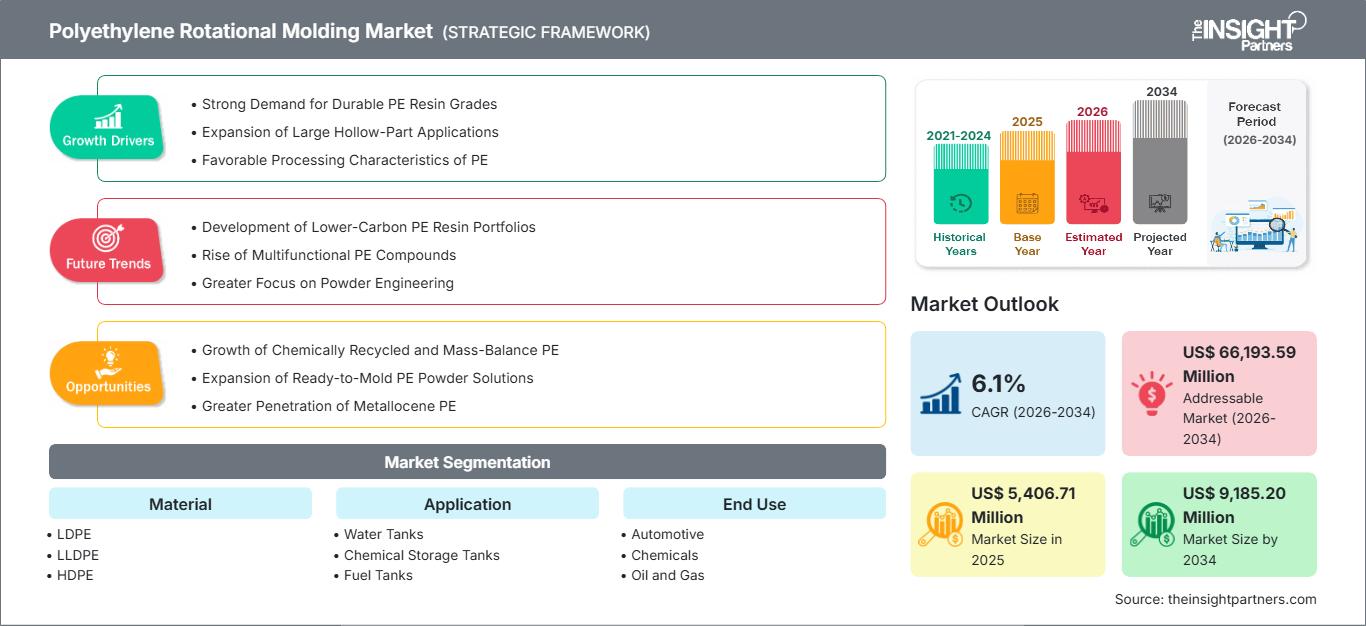
2025 Market Size
US$ 5,406.71 Mn
Base year value
2034 Forecast
US$ 9,185.20 Mn
Projected by 2034
CAGR 2026-2034
6.1 %
Growth rate
Addressable Market
US$ 66,193.59 Mn
(2026-2034)
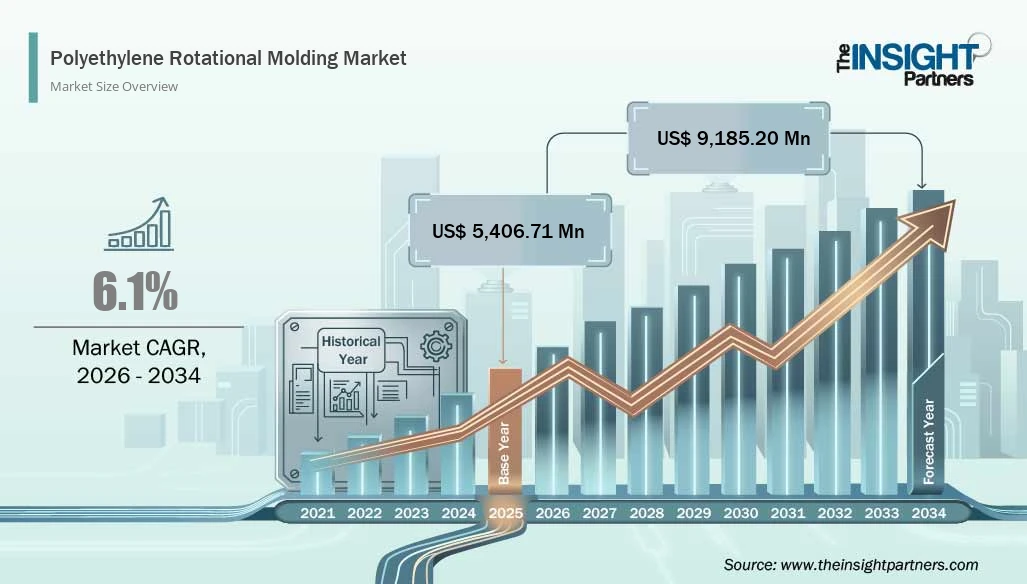
The Polyethylene Rotational Molding Market reached US$ 5,406.71 million in 2025 and is projected to reach US$ 9,185.20 million by 2034, expanding at a CAGR of 6.1% during 2026–2034. The market covers polyethylene materials used in rotational molding, including LDPE, LLDPE, HDPE, and Others, across tanks, containers, automotive components, marine products, sporting goods, agricultural products, and other molded applications.
The Polyethylene Rotational Molding Market size is supported by established demand in North America, where rotationally molded polyethylene products serve water storage, industrial containment, automotive, recreational, and material-handling applications. North America is expected to expand at ~5% CAGR through 2034, supported by replacement demand, established processing capacity, continued use of durable polyethylene products, and increasing requirements for lightweight and corrosion-resistant components.
Polyethylene Rotational Molding Market Assessment and Insights
Regional Outlook
- North America: ~34% of the global market in 2025 | ~5% CAGR through 2034. Market position: North America maintains a leading position because of mature rotational molding capacity, extensive industrial and recreational applications, established polyethylene supply chains, and sustained replacement demand for tanks, containers, automotive parts, and durable outdoor products.
- US: ~82% of North American market revenue in 2025 | ~5% CAGR through 2034. Market position: The US represents the principal North American demand center, supported by broad use of polyethylene tanks, industrial containers, marine products, recreational equipment, and automotive components, together with a well-developed resin and molding ecosystem.
- Europe: ~24% of the global market in 2025 | ~4% CAGR through 2034. Market position: Europe is a mature market with strong demand for engineered tanks, agricultural products, marine equipment, and industrial components. Germany represents the leading country in Europe, supported by advanced manufacturing and high-value industrial applications.
- Asia Pacific: ~32% of the global market in 2025 | ~8% CAGR through 2034. Market position: Asia Pacific is the fastest-growing region, supported by water-storage requirements, agricultural expansion, industrialization, infrastructure investment, and expanding polyethylene processing capacity. China represents the leading country in Asia Pacific by market scale.
Segment Outlook
- LLDPE: ~55% Share in 2025 | ~6% CAGR through 2034. Market position: LLDPE remains central to rotational molding because its toughness, flexibility, environmental stress crack resistance, processability, and suitability for large seamless products support broad adoption in tanks, containers, agricultural equipment, and recreational applications.
- Automotive: ~7% Share in 2025 | ~8% CAGR through 2034. Market position: Automotive represents a high-growth end-use segment as manufacturers seek lightweight, corrosion-resistant, impact-resistant, and geometrically flexible components. Polyethylene rotational molding also enables consolidation of components and economical production of specialized vehicle parts.
Competitive Coverage
ExxonMobil Corporation, Dow Inc., LyondellBasell Industries N.V., Reliance Industries Limited, Chevron Phillips Chemical Company LLC, Braskem S.A., Shell plc, Borouge International Limited, SCG Chemicals Public Company Limited, PTT Global Chemical Public Company Limited, Integrated Polymer Solutions, Brilsol, GRAFE GmbH & Co. KG, Matrix Polymers Limited, HPCL Mittal Energy Limited
Methodology
The Insight Partners follows Data Collection & Secondary Research, Primary Research, Data Analysis, and Data Triangulation & Final Review to validate market estimates and insights.
Source: The Insight Partners' analysis based on proprietary research, government publications, company annual reports, investor presentations, industry databases, and expert interviews.
Polyethylene Rotational Molding Market has changed over time from tanks and containers of simple design to engineering products that require specific wall thickness, impact resistance, UV stability, chemical resistance, and better aesthetics. The reason why polyethylene is still used most frequently is that it can be processed into powder form, melts evenly on the surface of the mold, and combines toughness with resistance to environmental stress cracking. Today, more and more LLDPE and HDPE grades have optimal comonomer structure, stabilization packages, and processing characteristics.
Future trends will become more focused on new production sites, especially in Asia-Pacific and other parts of the world where hollow articles are needed for water storage, agricultural operations, infrastructure, and industrial logistics. Resin manufacturers also give more consideration to the possibility of using recycled content, down gauging, processability, and special grades. The regulatory focus on product durability, recyclability, chemical containment, and environmental performance encourages molders to choose materials considering total life cycle of the product, not only its initial price.
Polyethylene Rotational Molding Market Report Scope
| Report Attribute | Details |
|---|---|
| Market size in 2025 | US$ 5,406.71 Million |
| Market Size by 2034 | US$ 9,185.20 Million |
| Global CAGR (2026 - 2034) | 6.1% |
| Historical Data | 2021-2024 |
| Forecast period | 2026-2034 |
Polyethylene Rotational Molding Market Analysis
The demand for this product occurs on items that require smooth construction, good corrosion resistance, low tooling cost, and flexibility in design. Applications include water tanks, chemical storage tanks, fuel tanks, septic systems, pallets, crates, marine products, and recreational products. Value chains include the manufacture of ethylene based polyethylene, resin formulation, stabilization, pelletizing or powerizing, grinding, color compounding, rotational molding, finishing, assembling, and distribution. Therefore, material providers have an influence on the performance of products by their melt flow, density, impact properties, environmental stress crack resistance, UV stabilization, and powder particle size distribution.
The supply of this product occurs through factors such as availability of polyethylene, local resin economics, energy cost, processing capabilities of powder and transportation cost. The rotational molding technology is suited to low and medium volume productions due to lower tooling costs compared to pressure molding techniques; and large items can be made without complicated structural tooling. Hence there is fragmentation in the downstream industry where there are competing resin providers, powder providers, molders, compounders and product makers.
The competition mentioned in the Polyethylene Rotational Molding Market Report is affected by integrated polymer manufacturers as well as specialist materials suppliers. ExxonMobil Corporation, Dow Inc., LyondellBasell Industries N.V., Reliance Industries Limited, Chevron Phillips Chemical Company LLC, Braskem S.A., and Shell plc take part in the competition via polyethylene product lines and polymer technology expertise. Additionally, Borouge International Limited, SCG Chemicals Public Company Limited, and PTT Global Chemical Public Company Limited enhance the regional presence in the supply chain, and Integrated Polymer Solutions, Brilsol, GRAFE GmbH & Co. KG, Matrix Polymers Limited, and HPCL Mittal Energy Limited contribute specialist and regional expertise.
More and more investments go into the improvement of resin properties, specialty powders, color systems, recyclability, and specialized grades, rather than just capacity increase. For instance, Dow has RESILITY portfolio focused on impact performance, UV resistance, processibility, and sustainability, whereas LyondellBasell offers HDPE and LLDPE grades and specialty rotomolding powders. Such competition situation prompts manufacturers to differentiate themselves in terms of processing window, material consistency, technical service, and ability to provide customized products.
● REPORT CUSTOMIZATION
Tailor This Report To Align With Your Specific Business Requirements
This report can be customized to align precisely with your business objectives, scope, and target markets. Customization options include tailored segmentation, geography, competitive analysis, and strategic insights to support informed decision-making.
Customize This Report →WHAT YOU CAN ADJUST
- ● Segmentations
- ● Geography
- ● Competitive Analysis
- ● Language Preferences
Polyethylene Rotational Molding Market: Strategic Insights
Regional Insights
North America Polyethylene Rotational Molding Market
The Polyethylene Rotational Molding Market was estimated to hold ~34% share of the market in North America in 2025 and will continue to grow at ~5% CAGR up to 2034. The region offers well-established ecosystem of rotational molding products including industrial tanks, waste handling and handling solutions, marine products, recreational items, agricultural goods, and auto parts. The US is the key market here, benefiting from abundance of polyethylene resins and downstream molding operations.
Demand is supplemented by replacing metals and other rigid materials due to better performance offered by non-corrosive nature, light weight, and greater design flexibility. Canada participates in the market through industrial, agricultural, water management, and recreational applications, and Mexico through production facilities associated with automotive, industrial, and consumer goods supply chains. Increasingly, North American suppliers pay attention to such product features as UV resistance, impact strength, stress crack resistance, and processability.
U.S. Polyethylene Rotational Molding Market
The US accounted for approximately 82% of the North American rotational molding market share in 2025 and is anticipated to witness ~5% CAGR till 2034. This is due to the range of applications catered to by rotational molding technology including water tanks, chemical tanks, fuel tanks, marine products, recreational products, waste tanks, pallets, crates, and industrial products. Presence of a significant number of processors and resin suppliers ensures local availability of resins.
Automotive weight reduction, infrastructure, agriculture, and industrial containment need also impact US market growth. Key players supplying polyethylene-based resins catering to needs of rotational molding include ExxonMobil Corporation, Dow Inc., and Chevron Phillips Chemical Company LLC. Processors have been addressing application specific product design needs. Resin efficiency, better UV performance, recyclability, and lower scrap content are the key aspects dominating the market. This ensures ongoing development of new materials without losing out on demand for traditional LLDPE and HDPE grades.
Europe Polyethylene Rotational Molding Market
Europe constituted ~24% of the Polyethylene Rotational Molding Market share in 2025 and is expected to witness growth at a CAGR of ~4% through 2034. Europe offers an amalgamation of mature facilities for rotational molding along with high demand for agricultural equipment, water management products, industrial storage solutions, marine products, automotive components, and consumer goods. Germany is the major market within Europe, owing to its highly advanced industrial sector, automobile industry, engineering capabilities, and plastics processing sector.
Demand in the UK exists for water management, agricultural equipment, industrial equipment, and specialty molded products. Applications in agriculture, construction-based products, tanks, materials handling, marine, and consumer goods exist in France and Italy. Spain is driven by applications in agriculture, water storage, infrastructure, and outdoor products.
The production of materials is becoming more and more associated with environmental performance and product durability. In Europe, suppliers are developing UV resistant materials as well as material grades which will be compatible with recycling. At the same time, molders are looking for materials with better dimension stability, surface finish, and processability. Regulations on chemical substances, waste, recyclability, and product safety also emphasize the importance of traceable materials and material specification.
APAC Polyethylene Rotational Molding Market
Asia Pacific accounted for ~32% of the global market in 2025 and is expected to record ~8% CAGR through 2034, making it the fastest-growing region. China is the leading country in Asia Pacific, supported by its large manufacturing base, resin production capacity, construction activity, agricultural demand, and extensive use of water and industrial storage products. India is also expanding as urbanization and water-management requirements stimulate tank and infrastructure applications.
Contributions from Japan, South Korea, and Australia will be realized through high-end uses of these products in industrial, automobile, marine, and agricultural sectors. Local availability of polyethylene and increased molding capacity in the region will enable efficient production. Structural growth drivers include infrastructure development and increasing demand for robust water containers, especially in emerging economies. Growth in availability of metallocene and special polyethylene grades will allow for more product diversification.
Middle East & Africa Polyethylene Rotational Molding Market
The Middle East & Africa region is projected to expand at ~6% CAGR through 2034. Saudi Arabia represents a leading country in the Middle East & Africa region where evidence supports strong demand, supported by petrochemical integration, industrial investment, water infrastructure, agriculture, and large-scale construction activity. The UAE also contributes through infrastructure, logistics, construction, and industrial storage applications.
South Africa has established demand across agriculture, mining-related applications, water storage, industrial containment, and consumer products. Across the rest of the region, polyethylene tanks and containers are particularly relevant where water storage, chemical containment, and agricultural infrastructure require corrosion-resistant and durable products. Proximity to petrochemical production in Gulf economies can support resin availability, while infrastructure programs and water-management requirements create downstream opportunities for rotationally molded polyethylene products.
Segmentation Analysis
Material
The Material segment in the Polyethylene Rotational Molding Market is projected to expand at ~6% CAGR through 2034. Polyethylene grades dominate because they combine processability with impact strength, chemical resistance, weatherability, and suitability for large seamless products. LLDPE is widely used for tanks and durable molded products, while HDPE supports applications requiring greater stiffness. LDPE and specialized grades serve selected flexible or application-specific requirements.
- LDPE: Conventional LDPE provides flexibility and processability for selected molded products, while metallocene LDPE can improve mechanical performance and processing characteristics. Its strategic role is concentrated in applications requiring greater flexibility rather than maximum structural stiffness.
- LLDPE: Conventional LLDPE is widely adopted for tanks, containers, recreational products, and agricultural equipment because of its toughness and environmental stress crack resistance. Metallocene LLDPE provides enhanced property control for demanding applications requiring improved impact, stiffness, and downgauging potential.
- HDPE: Conventional HDPE supports products requiring higher stiffness, chemical resistance, and load-bearing performance. Metallocene HDPE provides additional opportunities for demanding rotationally molded components where impact strength and controlled processing characteristics are important.
Application
The Application segment in the Polyethylene Rotational Molding Market is expected to grow at ~6% CAGR through 2034. Tanks remain central to polyethylene rotational molding because seamless construction reduces leakage risks and polyethylene provides chemical and environmental resistance. Non-tank applications are expanding through material handling, automotive, marine, recreational, agricultural, and consumer products requiring complex shapes and durable performance.
- Water Tanks: Water storage remains a fundamental rotational molding application, particularly where corrosion resistance, lightweight construction, and long outdoor service are required. Polyethylene tanks can be manufactured in large seamless structures and adapted to residential, agricultural, commercial, and industrial water-management requirements.
- Chemical Storage Tanks: Chemical tanks benefit from polyethylene's chemical resistance and seamless construction. Resin selection depends on the stored chemical, temperature, wall thickness, UV exposure, and environmental stress crack requirements, making technical material specification important.
- Fuel Tanks: Fuel tanks require carefully engineered polyethylene structures and, for certain fuels, barrier solutions. Automotive and equipment applications emphasize impact performance, permeation control, dimensional stability, and resistance to temperature cycling.
- Septic Tanks: Septic tanks benefit from lightweight construction, corrosion resistance, and reduced installation complexity. Demand is associated with decentralized wastewater systems, rural infrastructure, residential development, and replacement of heavier traditional containment materials.
- Pallets and Crates: Rotomolded pallets and crates provide durability, impact resistance, and reusable service characteristics. Applications span industrial logistics, agriculture, material handling, and outdoor environments where resistance to moisture and repeated handling is valuable.
- Automotive Components: Rotational molding enables lightweight hollow components and complex geometries for selected vehicle applications. Adoption is supported by component consolidation, corrosion resistance, design flexibility, and the ability to manufacture relatively specialized parts economically.
- Sporting Goods: Kayaks, recreational equipment, coolers, playground products, and other sporting goods benefit from impact resistance and weatherability. Material formulation and color stability are increasingly important as products face repeated outdoor exposure.
- Marine: Marine applications use polyethylene for buoyant, impact-resistant, and corrosion-resistant products. Watercraft components, tanks, floating products, and related equipment benefit from seamless construction and resistance to moisture and harsh environments.
- Planters and Seedling Trays: Agricultural and horticultural products use rotational molding where durability, weather resistance, and repeated handling are important. Demand is supported by controlled-environment agriculture, nurseries, landscaping, and commercial cultivation.
End Use
The End Use segment in the Polyethylene Rotational Molding Market is forecast to expand at ~6% CAGR through 2034. Demand spans automotive, chemicals, oil and gas, marine, agriculture, consumer goods, food and beverages, and construction. Adoption depends on the performance requirements of each industry, with chemical resistance, impact strength, UV stability, hygiene, lightweighting, and design flexibility influencing material selection.
- Automotive: Automotive applications prioritize lightweighting, durability, impact resistance, corrosion resistance, and component integration. Rotational molding is particularly suitable for specialized hollow components and parts requiring complex geometries.
- Chemicals: Chemical industries use polyethylene tanks and containers where resistance to selected corrosive substances and reliable containment are required. Product specification must account for chemical compatibility, temperature, concentration, and service conditions.
- Oil and Gas: Oil and gas applications include storage, containment, buoyancy, and specialized equipment. Material selection emphasizes chemical resistance, toughness, outdoor durability, and compatibility with operating environments.
- Marine: Marine users value corrosion resistance, buoyancy, impact performance, and weatherability. Polyethylene rotational molding supports tanks, watercraft components, floating equipment, and recreational marine products.
- Agriculture: Agriculture is a major application environment for water tanks, chemical containers, equipment components, and storage products. Demand is linked to irrigation, water conservation, farm mechanization, and durable outdoor equipment.
- Consumer Goods: Consumer products include recreational equipment, household products, planters, storage products, and outdoor goods. Design flexibility and relatively economical tooling support product customization.
- Food and Beverages: Food-related applications require appropriate material specifications, cleanliness, impact resistance, and regulatory compatibility. Rotationally molded polyethylene can serve selected storage and handling applications where product-contact requirements are met.
- Construction: Construction applications include water storage, material handling, barriers, equipment components, and site products. Demand benefits from lightweight installation, corrosion resistance, and the ability to manufacture large or complex structures.
Opportunity Snapshot
| Application | Revenue Contribution | Trend Tag | Adoption Stage |
| Water Tanks | High | Water Storage | Mature |
| Chemical Storage Tanks | High | Chemical Containment | Mature |
| Fuel Tanks | Medium | Barrier Performance | Scaling |
| Septic Tanks | Medium | Wastewater Systems | Scaling |
| Pallets and Crates | Medium | Reusable Logistics | Mature |
| Automotive Components | Medium | Lightweight Components | Scaling |
| Sporting Goods | Medium | Outdoor Recreation | Mature |
| Marine | Medium | Marine Durability | Scaling |
| Planters and Seedling Trays | Low | Horticulture Expansion | Scaling |
| Others | Low | Custom Products | Emerging |
Polyethylene Rotational Molding Market Growth Drivers and Impact Analysis
Increasing Demand for Durable Water and Chemical Storage Products
Water and chemical storage remains one of the strongest structural demand foundations for polyethylene rotational molding. Polyethylene provides corrosion resistance, impact performance, and seamless construction, making it suitable for tanks exposed to moisture, chemicals, and outdoor conditions. The Association of Rotational Molders identifies tanks as a major rotational molding application, particularly in developing markets where water storage can represent a significant portion of local demand. Expanding water-management infrastructure, agricultural irrigation, decentralized wastewater systems, and industrial chemical handling therefore create recurring opportunities for molded polyethylene products. The impact extends across resin suppliers, powder processors, molders, fittings suppliers, and distributors, increasing demand for application-specific grades with controlled melt flow, UV stabilization, stiffness, and environmental stress crack resistance.
Lightweighting and Component Consolidation in Industrial Products
Manufacturers are increasingly evaluating polyethylene rotational molding as an alternative for selected metal, fiberglass, and multi-piece plastic components. The process can produce large hollow structures with molded-in features and relatively low tooling requirements, allowing designers to combine functions within a single component. Automotive, marine, agriculture, material handling, and construction equipment can therefore benefit from weight reduction, corrosion resistance, and simplified assembly. The market impact is strongest where component volumes are moderate or product designs require customization. Resin producers are responding with grades that improve impact performance, stiffness, flexibility, weather resistance, and processing latitude. As buyers place greater emphasis on total manufacturing cost and product durability, the ability to consolidate components can strengthen the commercial case for rotationally molded polyethylene.
Expansion of Specialty Polyethylene Grades and Processing Technologies
Material innovation is broadening the range of products that can be manufactured through rotational molding. Conventional LLDPE and HDPE remain important, but metallocene grades, specialty powders, stabilized compounds, and application-specific formulations allow processors to target more demanding performance requirements. Improvements in melt flow, powder particle distribution, environmental stress crack resistance, UV stability, and impact performance can support thinner walls, better surface quality, shorter cycles, or longer service life. These improvements affect the market by increasing the addressable range of products rather than relying only on higher unit volumes. Suppliers with technical service capabilities can also influence resin selection during product development, creating closer relationships with molders and OEMs and increasing switching costs once a qualified grade becomes embedded in a product design.
Polyethylene Rotational Molding Market Future Trends
Greater Integration of Recycled and Circular Polyethylene Feedstocks
Polyethylene rotational molding is likely to see greater integration of recycled feedstocks where performance specifications and processing consistency permit their use. The trend is moving beyond simple recycled-content claims toward controlled incorporation of regrind, optimized stabilization packages, and material systems designed around repeated processing. Dow highlights recyclability, regrind incorporation, downgauging, and long product life as relevant sustainability characteristics for rotomolding resins, while European material suppliers are increasingly emphasizing UV-stabilized recycled solutions. The resulting shift could change procurement criteria, with molders evaluating feedstock consistency, contamination control, color management, mechanical-property retention, and regulatory suitability alongside price. Suppliers capable of providing reliable recycled-compatible formulations may gain additional opportunities as customers seek lower material footprints without compromising product durability.
Advanced Resin Design for Thin-Wall and High-Performance Products
Future Polyethylene Rotational Molding Market trends are likely to emphasize resin structures that allow manufacturers to reduce wall thickness while maintaining impact strength, stiffness, and long-term durability. Metallocene technology and optimized comonomer systems can provide tighter control over mechanical and processing characteristics, supporting more sophisticated product designs. Improved UV stabilization and environmental stress crack resistance can also extend outdoor service life, particularly for tanks, marine products, agricultural equipment, and recreational goods. The commercial implication is a gradual movement from commodity resin selection toward performance-based specifications. Molders and OEMs may increasingly evaluate material efficiency, cycle-time performance, surface quality, and lifetime performance together, encouraging suppliers to compete through application engineering rather than resin price alone.
Polyethylene Rotational Molding Market Opportunities
Localized Production of Water and Wastewater Management Products
Investment opportunities in the Polyethylene Rotational Molding Market Forecast exist in regional manufacturing capacity for water tanks, septic tanks, wastewater components, and associated products, particularly in markets where infrastructure expansion and decentralized water management are increasing. Rotational molding is suited to these products because tooling can accommodate different capacities and geometries without the high-pressure requirements of alternative processes. Investors and processors can strengthen economics by locating production near end users, reducing transportation costs for bulky finished products and enabling customized configurations. Opportunities extend beyond resin supply into powder preparation, mold fabrication, fittings, assembly, and distribution. Regions with expanding agricultural activity and water-storage requirements can support integrated production platforms serving multiple applications rather than relying on a single product category.
Application-Specific Polyethylene Compounds for Automotive and Industrial Components
The automotive and industrial sectors offer opportunities for suppliers that can develop polyethylene grades around defined component requirements rather than generic rotational molding specifications. Potential areas include fuel systems, protective structures, housings, reservoirs, marine components, and equipment parts requiring impact resistance, low-temperature performance, chemical resistance, or controlled flexibility. Strategic investment can focus on material formulation, simulation, prototype development, powder processing, and technical support. Close collaboration between resin producers, molders, Tier suppliers, and OEM engineering teams can shorten qualification cycles and create recurring demand once a grade is specified. This approach also enables suppliers to move toward higher-value applications where material performance, product reliability, and engineering support are more important than commodity resin pricing.
Recent Developments
- September 2026: Reliance Industries revised domestic polyethylene prices effective September 15, 2026, following recent increases across HDPE, LLDPE, and LDPE grades.
- August 2026: ExxonMobil Signature Polymers introduced Exceed Tough m 4536UV12, a metallocene-based polyethylene resin for demanding rotational molding applications.
- July 2026: LyondellBasell reported significantly higher Q2 2026 margins as Middle East supply disruptions tightened global polyethylene markets.
Frequently Asked Questions

- Comprehensive Market Sizing and Forecast Analysis
- Detailed Segmentation Analysis
- In-Depth Market Dynamics Assessment
- Regional and Country-Level Insights
- Competitive Landscape and Company Benchmarking
- Strategic Business Intelligence
Recent Reports
Testimonials

The Insight Partners' SCADA System Market report is comprehensive, with valuable insights on current trends and future forecasts. The team was highly professional, responsive, and supportive throughout. We are very satisfied and highly recommend their services.
RAN KEDEM Partner, Reali Technologies LTDs
I requested a report on a very specific software market and the team produced the report in a few days. The information was very relevant and well presented. I then requested some changes and additions to the report. The team was again very responsive and I got the final report in less than a week.
JEAN-HERVE JENN Chairman, Future Analytica
We worked with The Insight Partners for an important market study and forecast. They gave us clear insights into opportunities and risks, which helped shape our plans. Their research was easy to use and based on solid data. It helped us make smart, confident decisions. We highly recommend them.
PIYUSH NAGPAL Sr. Vice President, High Beam Global
The Insight Partners delivered insightful, well-structured market research with strong domain expertise. Their team was professional and responsive throughout. The user-friendly website made accessing industry reports seamless. We highly recommend them for reliable, high-quality research services
YUKIHIKO ADACHI CEO, Deep Blue, LLC.
This is the first time I have purchased a market report from The Insight Partners.While I was unsure at first, I visited their web site and felt more comfortable to take the risk and purchase a market report.I am completely satisfied with the quality of the report and customer service. I had several questions and comments with the initial report, but after a couple of dialogs over email with their analyst I believe I have a report that I can use as input to our strategic planning process.Thank you so much for taking the extra time and making this a positive experience.I will definitely recommend your service to others and you will be my first call when we need further market data.
JOHN SUZUKI President and Chief Executive Officer, Board Director, BK Technologies
I wish to appreciate your support and the professionalism you displayed in the course of attending to my request for information regarding to infectious disease IVD market in Nigeria. I appreciate your patience, your guidance, and the fact that you were willing to offer a discount, which eventually made it possible for us to close a deal. I look forward to engaging The Insight Partners in the future, all thanks to the impression you have created in me as a result of this first encounter.
DR CHIJIOKE ONYIA MANAGING DIRECTOR, PineCrest Healthcare Ltd.Reason to Buy
- Informed Decision-Making
- Understanding Market Dynamics
- Competitive Analysis
- Identifying Emerging Markets
- Customer Insights
- Market Forecasts
- Risk Mitigation
- Boosting Operational Efficiency
- Strategic Planning
- Investment Justification
- Tracking Industry Innovations
- Aligning with Regulatory Trends





 Get Free Sample for