
Non-Cross-Linked Heat-Resistance PVC for Automotive Wire and Cable Market Size & Forecast by 2034
Coverage: By Engine Type (Internal Combustion Engine and Electric), By Vehicle Type (Passenger Cars, Light Commercial Vehicles, Heavy Commercial Vehicles, and Others), and Geography
- Status : Published
- Report Code : TIPRE00043882
- Category : Chemicals and Materials
- No. of Pages : 272
- Available Report Formats :


- Last update date : September 10, 2026


2025 Market Size
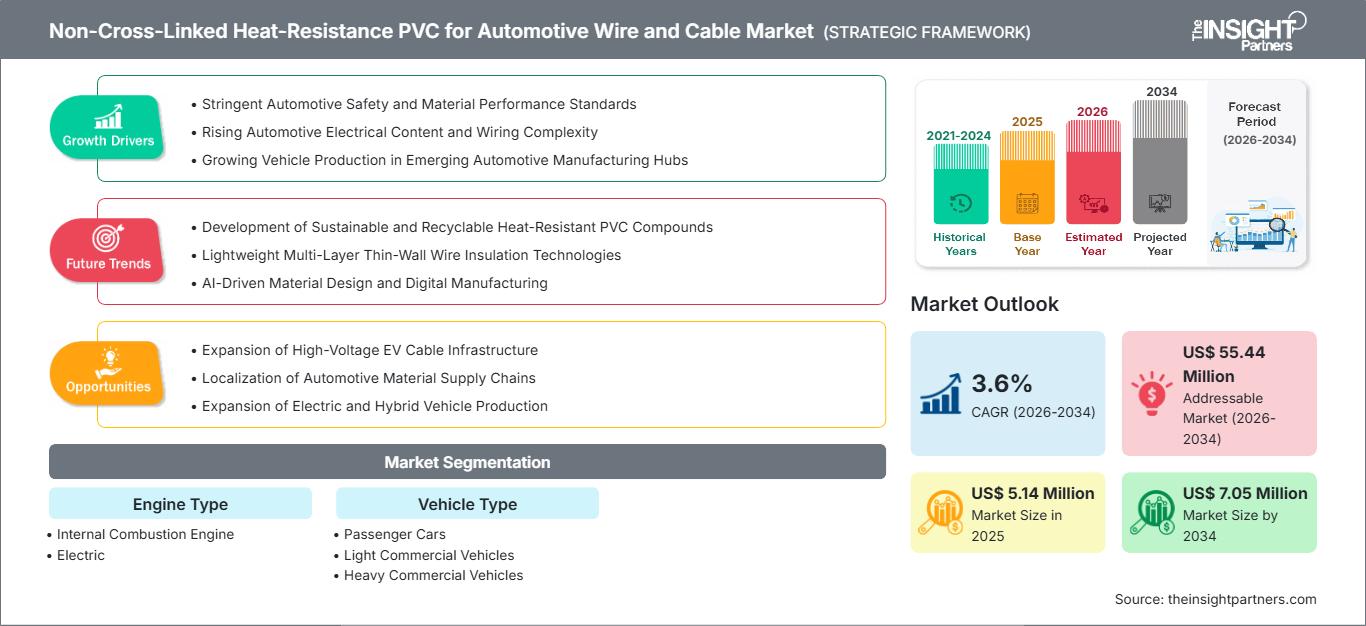
US$ 5.14 Mn
Base year value
2034 Forecast
US$ 7.05 Mn
Projected by 2034
CAGR 2026-2034
3.6 %
Growth rate
Addressable Market
US$ 55.44 Mn
(2026-2034)
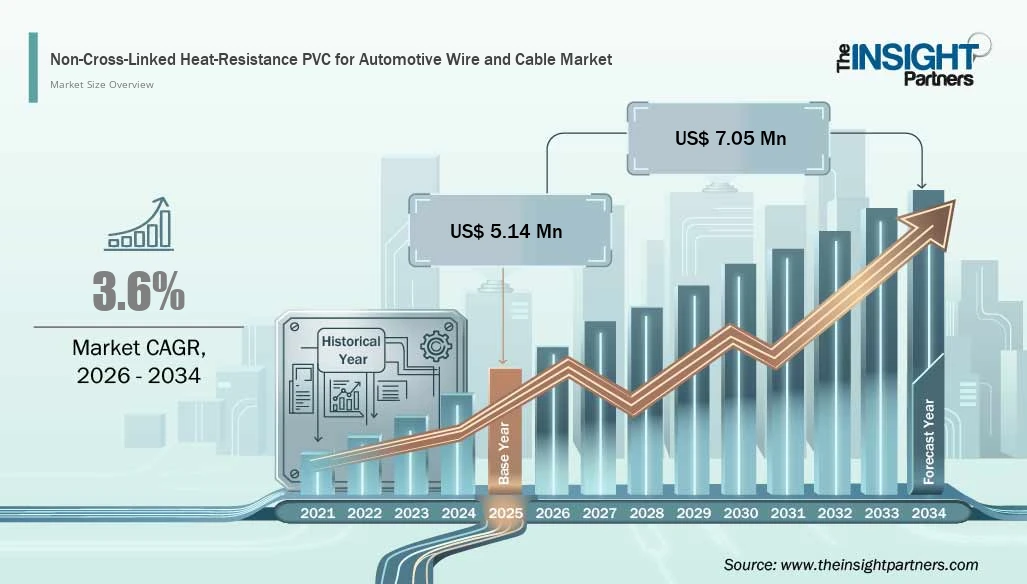
The Non-Cross-Linked Heat-Resistance PVC used in automotive wire and cable was worth US$ 5.14 Million in 2025 and is expected to amount to 7.05 Million by 2034, thus achieving a CAGR of 3.6% between 2026 and 2034. This market is being propelled by the growing demand for high-temperature insulation materials in automotive electrical systems, the increasing trend towards vehicle electrification, and the requirement for durable wire and cable solutions that can meet the strict performance requirements of the automotive industry.
North America is anticipated to experience steady growth over the forecast period, thanks to its automotive manufacturing operations, the increasing uptake of advanced electrical architectures, and the rising demand for reliable insulation materials in both passenger and commercial vehicles. The market in this region is expected to grow at a compound annual growth rate (CAGR) between 3.2% and 3.8% from 2026 through 2034, a trend driven by vehicle safety regulations and the amount of investment in next-generation mobility technologies.
Non-Cross-Linked Heat-Resistance PVC for Automotive Wire and Cable Market Assessment and Insights
- North America: North America accounted for a significant share of the market in 2025, supported by automotive production, advanced wire harness requirements, and the adoption of heat-resistant insulation materials. The region held a 25–30% share in 2025 and is projected to grow at a 3.2–3.8% CAGR during 2026–2034.
- US: The US market benefits from established automotive manufacturing capabilities and demand for high-performance electrical components. The country represented 75–80% of North America's share in 2025 and is expected to expand at a 3.3–3.9% CAGR between 2026 and 2034.
- Europe: Europe remains a key market due to stringent automotive safety standards and strong vehicle manufacturing bases in Germany, France, Italy, and the UK. The region held a 28–33% share in 2025 and is estimated to register a 3.0–3.6% CAGR during 2026–2034.
- Asia Pacific: Asia Pacific represents a major growth region due to automotive production volumes in China, Japan, South Korea, and India. The region accounted for a 30–35% share in 2025 and is expected to record a 3.8–4.4% CAGR during 2026–2034.
- Largest Segment: Internal Combustion Engine segment maintained the leading position with a 60–65% market share in 2025, supported by extensive vehicle parc and established wire harness applications, growing at a 2.8–3.4% CAGR during 2026–2034.
- High Growth Segment: Electric segment is expected to witness higher adoption due to electrification trends and thermal management requirements, accounting for a 35–40% share in 2025 and growing at a 4.5–5.2% CAGR during 2026–2034.
- Key companies analyzed in detail: Westlake Corporation, Takkar Polychem Private Limited, Konnark Polymer Private Limited, Manner Polymers, Renk Granul, Wiscom Co., Ltd., Shakun Polymers Private Limited, Mexichem Specialty Compounds, Ltd., Bansal Polyplast Pvt Ltd, and Cabopol.
Source: The Insight Partners' analysis based on proprietary research, government publications, company annual reports, investor presentations, industry databases, and expert interviews.
The industry concerned with automotive wire and cable has become more focused on insulation materials that offer thermal resistance, electrical stability, and processing efficiency. In order to meet the requirements of today's vehicle electrical systems, manufacturers are creating special PVC compounds that have better performance when subjected to heat, are more flame-resistant, and have improved mechanical durability. The shift towards more advanced harness designs, smaller wiring layouts, and higher operating temperatures has increased the demand for specially engineered PVC formulations. At the same time, greater collaboration between producers of PVC compounds and automotive suppliers has led to the development of solutions tailored to specific applications in order to satisfy the performance specifications of the original equipment manufacturers.
The extent to which the market expands will be determined by the level of investment in electric mobility, in regional car manufacturing, and in more rigorous material compliance standards. New automotive centers in the Asia Pacific and Latin America areas are anticipated to produce further demand opportunities as local manufacturers improve their abilities in producing vehicle components. Ongoing innovation in polymer additives, formulation technologies, and the development of sustainable materials is likely to help promote long-term acceptance in a number of vehicle categories.
Non-Cross-Linked Heat-Resistance PVC for Automotive Wire and Cable Market Report Scope
| Report Attribute | Details |
|---|---|
| Market size in 2025 | US$ 5.14 Million |
| Market Size by 2034 | US$ 7.05 Million |
| Global CAGR (2026 - 2034) | 3.6% |
| Historical Data | 2021-2024 |
| Forecast period | 2026-2034 |
Non-Cross-Linked Heat-Resistance PVC for Automotive Wire and Cable Market Analysis
Growth in the market for non-cross-linked heat-resistant PVC used in automotive wire and cable is due to the increasing electrical content of vehicles, the growing demand for high-temperature insulation systems, and the greater integration of automotive electronics. This market ecosystem comprises PVC resin suppliers, manufacturers of additives, compound producers, wire and cable manufacturers, automotive tier suppliers, and vehicle original equipment manufacturers. Competitiveness throughout the value chain is affected by the availability of raw materials, formulation know-how, and adherence to automotive specifications. Compound manufacturers concentrate on balancing thermal performance, flexibility, flame resistance, and cost efficiency in order to meet the changing requirements of vehicles.
Motor vehicle wire harness manufacturers are now more and more using heat-resistant PVC materials in situations where high temperatures are encountered, such as in the engine bay, in systems related to the battery, and in intricate electrical assemblies. The conditions affecting supply are shaped by the availability of polymer raw materials, the level of manufacturing capacity in different regions, and the technological skills of the companies that produce the compounds. Because of the increasing demand for reliable electrical insulation, suppliers have been expanding their range of specialized products and forming stronger partnerships with makers of automotive components.
The market analysis for Non-Cross-Linked Heat-Resistance PVC used in automotive wire and cable shows that the situation is moderately competitive, with global compound manufacturers as well as specialized regional suppliers being present. Companies like Westlake Corporation, Takkar Polychem Private Limited, Konnark Polymer Private Limited, and Manner Polymers are concentrating on the development of custom PVC formulations for use in automotive wire. Meanwhile, other companies such as Renk Granul, Wiscom Co., Ltd., Shakun Polymers Private Limited, Mexichem Specialty Compounds, Ltd., Bansal Polyplast Pvt Ltd, and Cabopol are consolidating their market positions by means of product development and offering solutions tailored to their customers.
The investment strategies in the industry focus on boosting production efficiency, improving material performance, and keeping up with the trend towards automotive electrification. Manufacturers are now making more compounds that have better thermal endurance, lower emissions, and are compatible with the changing automotive standards. The way in which companies position themselves is based on their technical capabilities, geographic coverage, customer relationships, and their ability to maintain a high level of quality for demanding automotive applications.
● REPORT CUSTOMIZATION
Tailor This Report To Align With Your Specific Business Requirements
This report can be customized to align precisely with your business objectives, scope, and target markets. Customization options include tailored segmentation, geography, competitive analysis, and strategic insights to support informed decision-making.
Customize This Report →WHAT YOU CAN ADJUST
- ● Segmentations
- ● Geography
- ● Competitive Analysis
- ● Language Preferences
Non-Cross-Linked Heat-Resistance PVC for Automotive Wire and Cable Market: Strategic Insights
Regional Insights
North America Non-Cross-Linked Heat-Resistance PVC for Automotive Wire and Cable Market
North America has a well-developed automotive market, thanks to the presence of established vehicle manufacturing, the widespread adoption of advanced electrical systems, and stringent automotive safety regulations. In 2025, the region had a market share ranging from 25% to 30% and is anticipated to show a compound annual growth rate of 3.2% to 3.8% between 2026 and 2034. The demand in this area is mainly due to the greater integration of electronic components, the growing trend towards vehicle electrification, and the substitution of traditional insulation materials with high-performance alternatives.
U.S. Non-Cross-Linked Heat-Resistance PVC for Automotive Wire and Cable Market
The United States is still the main contributor because of the size of its automotive production, the large number of vehicles in its fleet, and the fact that it has global automotive suppliers. Manufacturers are now placing greater emphasis on heat-resistant PVC compounds for use in situations where durability at high temperatures is required. Growth is being supported by funding going into the manufacture of electric vehicles, battery systems, and advanced wiring systems. Automotive component suppliers are working with compound producers in order to meet the changing requirements of the OEMs concerning thermal stability, flame resistance, and long-term electrical reliability.
In 2025, the United States held about 75 to 80% of the North American market share and is expected to grow at a compound annual growth rate of 3.3 to 3.9% between 2026 and 2034. The market is supported by its strong abilities in automotive manufacturing, the growing adoption of electric vehicles, and the demand for reliable wire insulation systems in both the passenger and commercial vehicle areas.
Europe Non-Cross-Linked Heat-Resistance PVC for Automotive Wire and Cable Market
In 2025, Europe had a market share ranging from 28 to 33% and is expected to grow at a compound annual growth rate of 3.0 to 3.6% between 2026 and 2034, thanks to its strong capabilities in automotive manufacturing and the strict vehicle safety regulations. Germany is still the leading market because of its well-established automotive industry and the wide range of suppliers it has. Support for the UK market comes from investments in electric mobility, automotive electrification, and lightweight vehicle technologies, which in turn raises the demand for durable insulation materials.
Germany is still promoting regional consumption by producing premium vehicles and developing advanced components. Nowadays, automotive suppliers are turning to specialized PVC compounds in order to meet the performance requirements of modern vehicle platforms. France, Italy, and Spain also make a significant contribution through their existing vehicle manufacturing plants and their expanding initiatives in the production of electric vehicles. European manufacturers are placing a strong emphasis on material compliance, sustainability improvements, and efficient production processes, which in turn supports the ongoing demand for heat-resistant insulation solutions for automotive wire and cable.
APAC Non-Cross-Linked Heat-Resistance PVC for Automotive Wire and Cable Market
In 2025, the Asia Pacific region had a market share ranging from 30 to 35% and is expected to grow at a compound annual growth rate of 3.8 to 4.4% between 2026 and 2034, which will make it one of the fastest-growing areas. China is the main driver of demand in the region as a result of its big automotive production base and the swift uptake of electric vehicles.
Japan, South Korea, India, and Australia are likewise helping the market to grow by expanding their automotive manufacturing and by increasing the complexity of their electrical systems. Measures taken by governments to promote the uptake of electric vehicles, the production of components locally, and the development of automotive technology are enhancing the demand for advanced insulation materials. Moreover, the availability of regional compound manufacturers and the expanding network of suppliers is aiding the expansion of the market.
Middle East & Africa Non-Cross-Linked Heat-Resistance PVC for Automotive Wire and Cable Market
In the Middle East and Africa area, growth is expected to be gradual, thanks to automotive imports, developments in infrastructure, and the increasing number of vehicles being owned. Saudi Arabia is the foremost market because of the investments it is making in its automotive sector and its economic diversification plans, whereas the UAE enjoys demand for commercial vehicles and its advanced mobility projects.
The contribution comes via South Africa's existing automotive assembly industry and its export-oriented manufacturing plants. Growth in the region is being driven by rising demand for durable electrical components that are capable of functioning in difficult environmental conditions. Opportunities are expected to arise for suppliers of specialized wire and cable insulation materials as a result of investments in industrial infrastructure and automotive localization initiatives.
Segmentation Analysis
Engine Type
The Engine Type segment includes Internal Combustion Engine and Electric vehicles. This segment is influenced by changing vehicle production patterns, increasing electrification, and evolving requirements for high-temperature electrical insulation. The segment is expected to register a 3.2–4.0% CAGR during 2026–2034 as automotive manufacturers require reliable materials for diverse powertrain configurations.
- Internal Combustion Engine: Internal combustion engine vehicles remain a significant application area due to the large installed vehicle base and extensive wire harness usage. Demand is supported by requirements for insulation materials capable of performing in engine compartments and other high-temperature environments.
- Electric: Electric vehicles are gaining importance due to increasing EV adoption and higher electrical system complexity. Heat-resistant PVC compounds are used in applications requiring thermal durability, electrical protection, and reliability across battery-related and auxiliary wiring systems.
Vehicle Type
The Vehicle Type segment covers Passenger Cars, Light Commercial Vehicles, Heavy Commercial Vehicles, and Others. The segment is influenced by vehicle production volumes, electrical content growth, and increasing adoption of advanced wiring systems. The segment is projected to achieve a 3.4–4.2% CAGR during 2026–2034 due to expanding automotive applications.
- Passenger Cars: Passenger cars represent a major demand category due to high production volumes and increasing integration of electronic systems. Manufacturers are adopting advanced insulation materials to support safety, comfort features, and vehicle electrification.
- Light Commercial Vehicles: Light commercial vehicles require durable wiring solutions due to frequent usage and demanding operating conditions. Heat-resistant PVC compounds support reliability in delivery vehicles, vans, and fleet applications.
- Heavy Commercial Vehicles: Heavy commercial vehicles demand robust insulation materials due to extended operating cycles, higher electrical loads, and harsh environments. Durable wire systems help improve vehicle reliability and reduce maintenance requirements.
Opportunity Snapshot
| Vehicle Type | Revenue Contribution (High/Medium/Low) | Trend Tag | Adoption Stage |
|---|---|---|---|
| Passenger Cars | High | EV Wiring | Scaling |
| Light Commercial Vehicles | Medium | Fleet Electrification | Scaling |
| Heavy Commercial Vehicles | Medium | Thermal Durability | Emerging |
| Others | Low | Specialty Vehicles | Emerging |
Non-Cross-Linked Heat-Resistance PVC for Automotive Wire and Cable Market Growth Drivers and Impact Analysis
Rising Vehicle Electrification and Increasing Electrical System Complexity
The rapid shift towards the use of electric and hybrid vehicles is leading to greater demand for insulation materials that can cope with higher electrical loads and elevated operating temperatures. In order to connect the battery, power distribution units, charging systems, and electronic control components, EV platforms need more advanced wiring systems. Non-cross-linked heat-resistant PVC compounds offer manufacturers a balance of thermal stability, flexibility, and processing efficiency. Since automotive designs are relying more and more on electronic systems, suppliers are putting money into improving their PVC formulations in order to meet the changing performance requirements. The fact that EV production plants are expanding in the Asia Pacific region, in Europe, and in North America is expected to generate further demand for specialized automotive cable insulation materials. This change is prompting compound manufacturers to create application-specific solutions that help to ensure vehicle safety, durability, and long-term operational reliability.
Increasing Adoption of Advanced Automotive Safety and Performance Standards
The strict automotive safety regulations and the requirements regarding material performance are having an effect on the choice of insulation materials for vehicle wiring systems. Both OEMs and tier suppliers need compounds that show they can resist heat aging, the spread of flame, abrasion, chemicals, and mechanical stress when subjected to harsh operating conditions. Meeting international automotive standards as well as the specifications set by the manufacturers has now become a major factor in the material qualification process. This situation is prompting suppliers to enhance the formulations of their PVC compounds by using advanced additive technologies and by improving the polymer blends. Since vehicles are becoming equipped with an increasing number of sensors, electronic modules, and high-power components, the demand for reliable insulation materials is growing all the time. These requirements are therefore leading to wider acceptance among automotive wire harness manufacturers who are looking for materials that are cost-effective and have consistent performance characteristics.
Expansion of Automotive Manufacturing in Emerging Economies
The growing capacity for car production in developing countries is opening up new opportunities for companies that supply heat-resistant PVC compounds. In places such as China, India, and the Southeast Asian markets, vehicle manufacturing capabilities are being expanded along with greater localization of automotive component supply chains. This is leading to increased demand in the region for special wire and cable materials used in passenger cars, commercial vehicles, and electric mobility systems. Automotive suppliers locally are now looking for reliable insulation solutions that satisfy international quality standards and, at the same time, support efficient manufacturing processes. Since there are more investments being made in vehicle assembly plants, in facilities for manufacturing components, and in EV ecosystems, the demand for advanced polymer materials is rising. As the automotive infrastructure in emerging markets continues to develop, those suppliers who have the ability to produce regionally and who possess expertise in custom formulations are in a position to take advantage of the rising need for such materials.
Non-Cross-Linked Heat-Resistance PVC for Automotive Wire and Cable Market Future Trends
Development of Sustainable and Low-Emission PVC Compound Solutions
Future advances in automotive insulation materials are likely to concentrate on enhancing sustainability, with a focus on lowering their environmental impact, improving their recyclability, and refining their additive systems. Manufacturers are investigating PVC compound technologies that will retain both their heat resistance and mechanical performance while at the same time meeting the changing environmental requirements of automotive original equipment manufacturers. The growing emphasis on circular economy practices is prompting suppliers to examine the incorporation of recycled content, the use of resource-efficient manufacturing processes, and better management of the material's entire lifecycle. Since automotive companies are setting more ambitious sustainability targets, material suppliers are expected to launch advanced formulations that achieve both performance and environmental goals. Such developments could affect procurement strategies throughout the automotive supply chain and lead to a demand for innovative insulation materials designed for next-generation vehicle platforms.
Integration of Smart Manufacturing Technologies in Compound Production
The adoption of automation, digital monitoring, and advanced process control technologies is expected to transform PVC compound manufacturing. Producers are increasingly using data-driven approaches to improve formulation consistency, production efficiency, and quality control. Smart manufacturing systems enable better monitoring of extrusion processes, additive dispersion, and material performance parameters. These capabilities allow suppliers to meet increasingly precise automotive specifications while reducing production variability. As automotive wire and cable manufacturers demand higher reliability and customized material solutions, digital manufacturing practices will become an important competitive factor. Companies investing in advanced production technologies are likely to strengthen their ability to deliver specialized compounds for evolving automotive applications.
Non-Cross-Linked Heat-Resistance PVC for Automotive Wire and Cable Market Opportunities
Rising Demand from Electric Vehicle Wiring Applications
The increasing deployment of electric vehicles presents a significant opportunity for manufacturers of heat-resistant PVC compounds. EV platforms require extensive wiring networks capable of supporting higher electrical loads, thermal exposure, and complex electronic architectures. Suppliers can capture new opportunities by developing specialized formulations optimized for battery systems, charging components, and auxiliary electrical applications. Growing EV manufacturing investments across major automotive markets are encouraging collaboration between compound producers, wire manufacturers, and vehicle OEMs. Companies with strong technical capabilities and application-focused product development strategies can benefit from the expanding demand for advanced insulation materials. The opportunity is further strengthened by increasing requirements for lightweight, reliable, and cost-efficient wiring solutions in future vehicle designs.
Expansion of Localized Automotive Supply Chains
Increasing localization of automotive component manufacturing in emerging markets is creating opportunities for regional PVC compound suppliers. Governments and automotive manufacturers are encouraging domestic production of vehicle components to strengthen supply chain resilience and reduce dependency on imports. This trend is supporting investments in polymer compounding facilities, technical development centres, and regional distribution networks. Companies capable of providing consistent-quality materials, customized formulations, and responsive technical support can strengthen their position within automotive supply ecosystems. Expansion of manufacturing capacity across Asia Pacific and other developing regions is expected to increase demand for specialized insulation materials. Strategic partnerships with wire harness producers and automotive suppliers will remain important for capturing opportunities arising from localized automotive production initiatives.
Recent Developments
- January 14, 2025: Teknor Apex expanded its sustainable wire and cable compound portfolio through the launch of Cycle-Tek PVC compounds containing recycled content. The new formulations were designed for flexible cable applications, supporting manufacturers seeking materials with improved sustainability characteristics while maintaining required flexibility, durability, and electrical performance.
- June 15, 2026: Westlake Corporation announced today that its German subsidiary, Westlake Vinnolit GmbH & Co. KG, has completed the previously announced acquisition of a polyvinyl chloride and vinyl chloride monomer production site located in Wilhelmshaven, Germany (the "Wilhelmshaven plant"). The Wilhelmshaven plant, which was previously in insolvency administration, has the capacity to produce 380,000 metric tons of PVC per year.
Frequently Asked Questions

- Comprehensive Market Sizing and Forecast Analysis
- Detailed Segmentation Analysis
- In-Depth Market Dynamics Assessment
- Regional and Country-Level Insights
- Competitive Landscape and Company Benchmarking
- Strategic Business Intelligence
Recent Reports
Testimonials

The Insight Partners provided valuable market intelligence that supported our global go-to-market strategy. Their team was professional, responsive, and attentive to our feedback, providing thoughtful analysis and helpful methodological clarifications throughout the project.
Junmo Kim Chief Financial Officer (CFO), Enertech Co., Ltd.
The Insight Partners' SCADA System Market report is comprehensive, with valuable insights on current trends and future forecasts. The team was highly professional, responsive, and supportive throughout. We are very satisfied and highly recommend their services.
RAN KEDEM Partner, Reali Technologies LTDs
I requested a report on a very specific software market and the team produced the report in a few days. The information was very relevant and well presented. I then requested some changes and additions to the report. The team was again very responsive and I got the final report in less than a week.
JEAN-HERVE JENN Chairman, Future Analytica
We worked with The Insight Partners for an important market study and forecast. They gave us clear insights into opportunities and risks, which helped shape our plans. Their research was easy to use and based on solid data. It helped us make smart, confident decisions. We highly recommend them.
PIYUSH NAGPAL Sr. Vice President, High Beam Global
The Insight Partners delivered insightful, well-structured market research with strong domain expertise. Their team was professional and responsive throughout. The user-friendly website made accessing industry reports seamless. We highly recommend them for reliable, high-quality research services
YUKIHIKO ADACHI CEO, Deep Blue, LLC.
This is the first time I have purchased a market report from The Insight Partners.While I was unsure at first, I visited their web site and felt more comfortable to take the risk and purchase a market report.I am completely satisfied with the quality of the report and customer service. I had several questions and comments with the initial report, but after a couple of dialogs over email with their analyst I believe I have a report that I can use as input to our strategic planning process.Thank you so much for taking the extra time and making this a positive experience.I will definitely recommend your service to others and you will be my first call when we need further market data.
JOHN SUZUKI President and Chief Executive Officer, Board Director, BK Technologies
I wish to appreciate your support and the professionalism you displayed in the course of attending to my request for information regarding to infectious disease IVD market in Nigeria. I appreciate your patience, your guidance, and the fact that you were willing to offer a discount, which eventually made it possible for us to close a deal. I look forward to engaging The Insight Partners in the future, all thanks to the impression you have created in me as a result of this first encounter.
DR CHIJIOKE ONYIA MANAGING DIRECTOR, PineCrest Healthcare Ltd.Reason to Buy
- Informed Decision-Making
- Understanding Market Dynamics
- Competitive Analysis
- Identifying Emerging Markets
- Customer Insights
- Market Forecasts
- Risk Mitigation
- Boosting Operational Efficiency
- Strategic Planning
- Investment Justification
- Tracking Industry Innovations
- Aligning with Regulatory Trends





 Get Free Sample for