
Polyethylene Masterbatch Market Trends & Growth Forecast 2034
Coverage: By Type (Black Masterbatch, White, Color, Additive, Fillers, and Other Types), Polymer Type (HDPE, LDPE, LLDPE, and Other Polymers), End-use Industry (Building and Construction [Pipes and Fittings, Geomembrane Pond Liners, and Others], Automotive [Interior and Exterior], Flexible Packaging [UHT Milk Films, Courier Bags, Trash Liners, FIBC Liners (Conductive), Stretch Films, and Others], Agriculture Films [Mulch Films, Drip Pipes or Laterals, Silage Films, and Others], and Others), Process (Extrusion, Injection Molding, Blow Molding, Rotational Molding, and Others), and Geography (North America, Europe, Asia Pacific, the Middle East and Africa, and South and Central America)
- Status : Published
- Report Code : TIPRE00044085
- Category : Chemicals and Materials
- No. of Pages : 653
- Available Report Formats :


- Last update date : October 08, 2026


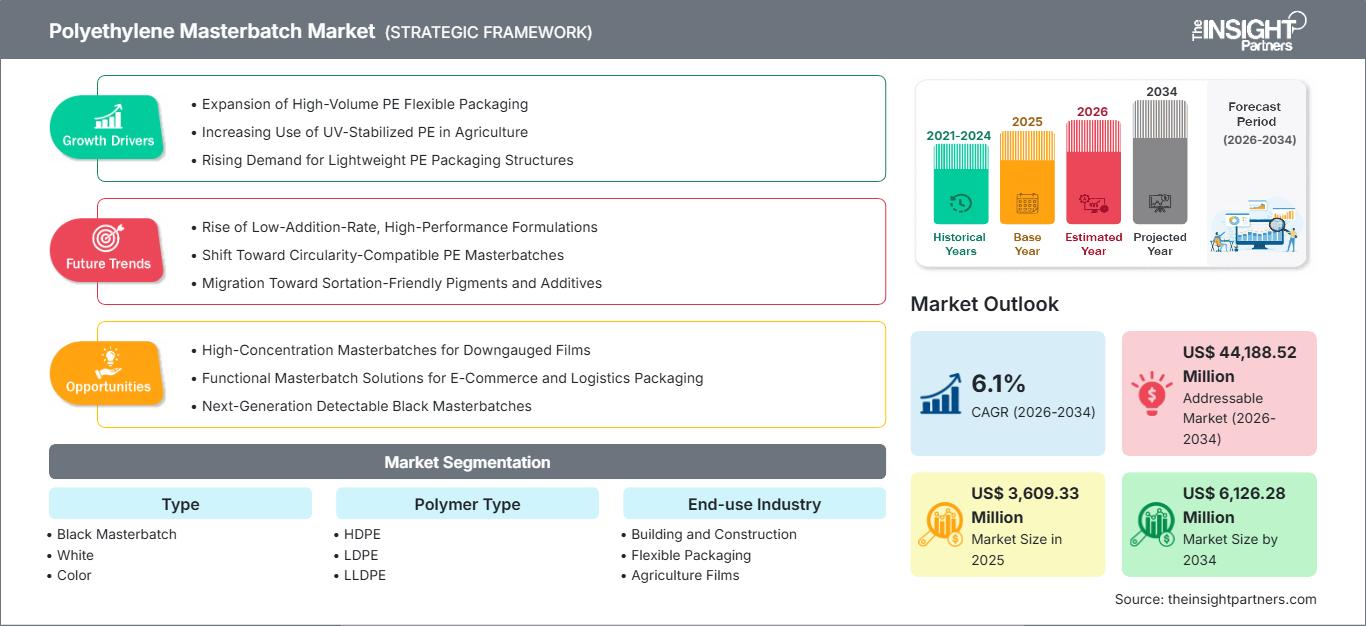
2025 Market Size
US$ 3,609.33 Mn
Base year value
2034 Forecast
US$ 6,126.28 Mn
Projected by 2034
CAGR 2026-2034
6.1 %
Growth rate
Addressable Market
US$ 44,188.52 Mn
(2026-2034)
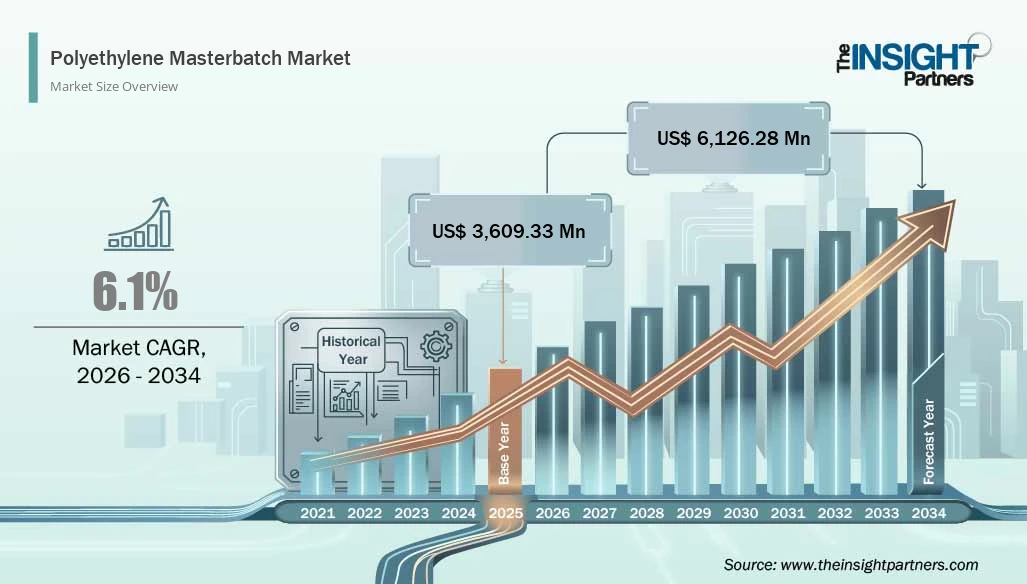
The Polyethylene Masterbatch Market was valued at US$ 3,609.33 million in 2025 and is projected to reach US$ 6,126.28 million by 2034, registering a CAGR of 6.1% during 2026–2034. The market covers black, white, color, additive, filler, and other masterbatches formulated for polyethylene polymers and used across construction, automotive, flexible packaging, agriculture films, and other applications. Demand is influenced by polymer processing efficiency, product differentiation, durability requirements, recyclability, and the increasing use of functional additives in polyethylene products.
North America is supported by established polyethylene processing capacity, advanced packaging conversion, infrastructure replacement, and increasing demand for recycled-content-compatible masterbatch formulations. The regional Polyethylene Masterbatch Market Size is expected to expand at a ~5% CAGR through 2034, supported by demand for durable polyethylene products, sophisticated color and additive systems, and formulation solutions compatible with recycled feedstocks. Packaging, construction piping, agricultural applications, and automotive components remain important consumption areas across the region.
Polyethylene Masterbatch Market Assessment and Insights
Regional Outlook
- North America: ~23% of the global market in 2025 | ~5% CAGR through 2034. Market position: North America represents a mature demand center supported by established polyethylene conversion, packaging production, infrastructure applications, and technically demanding automotive and industrial products. Recycled-content adoption is strengthening demand for specialized formulations.
- US: ~83% of North American market revenue in 2025 | ~5% CAGR through 2034. Market position: The US represents the largest country market in North America, supported by extensive packaging conversion, construction applications, agricultural films, and automotive plastics. Supplier capabilities increasingly emphasize sustainable colorants, recycled polymers, and functional additives.
- Europe: ~24% of the global market in 2025 | ~5% CAGR through 2034. Market position: Europe is a mature regional market, with Germany representing the leading country in Europe. Packaging circularity, recycled polymer utilization, automotive manufacturing, infrastructure applications, and tighter sustainability requirements support continued demand for higher-performance polyethylene masterbatch formulations.
- Asia Pacific: ~42% of the global market in 2025 | ~7% CAGR through 2034. Market position: Asia Pacific is the largest regional market and the fastest-growing major region, supported by large polyethylene conversion capacity, packaging expansion, agricultural films, construction activity, and increasing localization of masterbatch production across China, India, Japan, and South Korea.
Segment Outlook
- Black Masterbatch: ~30% Share in 2025 | ~6% CAGR through 2034. Market position: Black masterbatch leads the type structure because polyethylene pipes, agricultural products, packaging, automotive components, geomembranes, and industrial products require opacity, UV protection, consistent coloration, and weathering performance.
- Flexible Packaging: ~34% Share in 2025 | ~7% CAGR through 2034. Market position: Flexible packaging has the highest growth outlook among major end-use categories as polyethylene film structures expand across food, retail, logistics, and industrial packaging while mono-material designs and recyclable structures increase demand for specialized additives and color systems.
Competitive Coverage
Avient Corporation, Ampacet Corporation, Cabot Corporation, LyondellBasell Industries N.V., Plastika Kritis S.A., Penn Color, Inc., Americhem, Inc., FRILVAM S.p.A., Hubron International Ltd., Plastiblends India Ltd., ALOK Masterbatches Pvt. Ltd., RTP Company, Mitsui Chemicals, Inc., Perfect Colourants and Plastics Pvt. Ltd., Dow Inc.
Methodology
The Insight Partners follows Data Collection & Secondary Research, Primary Research, Data Analysis, and Data Triangulation & Final Review to validate market estimates and insights.
Source: The Insight Partners' analysis based on proprietary research, government publications, company annual reports, investor presentations, industry databases, and expert interviews.
Polyethylene Masterbatch Market have developed into multifunctional materials impacting processability, performance, recyclability, durability, and aesthetics rather than color masterbatches alone. The growing use of polyethylene in films, piping, agricultural goods, packaging materials, molded parts, and industrial applications has led to new formulation demands. There is increasing development of concentrates compatible with polyethylene carriers such as HDPE, LDPE, and LLDPE as well as additive technology that covers UV stability, antistatic property, slip, antiblock, processability, and recycled resin variations. With increasing use of polyethylene packaging that consists of one material, there is need for additives that maintain film properties and recyclability.
Investment in the future will be focused on sustainable pigments, recycling polymers-compatible concentrates, PFAS-free processing agents, and masterbatches suitable for closed-loop material flows. New manufacturing centers are likely to emerge in Asia Pacific as processing capacity for polyethylene grows and local converters desire to shorten their supply chain. Regulation of packaging waste and recycled content will motivate producers to formulate concentrates that are capable of maintaining their optical and mechanical characteristics when recycled polymers are incorporated. The future will be favorable for suppliers possessing formulation skills, application labs, regional manufacturing, and access to special pigments and additives.
Polyethylene Masterbatch Market Report Scope
| Report Attribute | Details |
|---|---|
| Market size in 2025 | US$ 3,609.33 Million |
| Market Size by 2034 | US$ 6,126.28 Million |
| Global CAGR (2026 - 2034) | 6.1% |
| Historical Data | 2021-2024 |
| Forecast period | 2026-2034 |
Polyethylene Masterbatch Market Analysis
Demand for masterbatch is strongly linked with polyethylene use in film extrusion, pipe making, molding, agricultural films, and packaging. Masterbatch manufacturers are intermediaries that lie between pigment and additive makers and polyethylene processors; they provide converters with concentrates ready for dose preparation. The value chain thus is influenced by pigment quality, compatibility of additives, carriers used, dispersion process, compounding, and technical assistance provided by suppliers to converters. The importance of consistency of dispersion is especially significant in the cases when converters demand stable color, lower dosage, high-quality surface, and good processing.
The supply situation is affected by polyethylene resin supply, the cost of pigments and additives, energy cost, local production capacity, and converters' qualification period. Converters can be qualified if a supplier possesses wide range of formulas applicable to different grades of polyethylene and different techniques of its processing. Recycling feedstocks increase the formulation complexity since impurities, color inconsistency, moisture content, and melt flow properties of the material may change the masterbatch performance.
The competitive scenario in the Polyethylene Masterbatch Market Report encompasses diversified material suppliers and specialized masterbatch providers. In the former group lie Ampacet Corporation, Avient Corporation, Cabot Corporation, LyondellBasell Industries N.V., and Dow Inc., which possess extensive material know-how along with a broad customer base, whereas Plastika Kritis S.A., Hubron International Ltd., Penn Color, Inc., Americhem, Inc., and Plastiblends India Ltd. represent specialized masterbatch providers with expertise in color and additive concentrates. Other competitors in the segment include FRILVAM S.p.A., ALOK Masterbatches Pvt. Ltd., RTP Company, Mitsui Chemicals, Inc., and Perfect Colourants and Plastics Pvt. Ltd.
Strategic investments are being made in circular products, application-based concentrates, sustainable pigments, and process technologies that support recycled polyethylene. The circular black masterbatch product line-up from Cabot is an example of the strategic focus on recycled carbon and polyethylene feedstock, while Avient has emphasized non-PFAS additives and recycled material-based solutions. Ampacet is making forays into sustainable colors including natural black pigments. The emphasis is a clear indication that differentiation from the competition is moving towards performance, regulation compliance, and sustainability.
● REPORT CUSTOMIZATION
Tailor This Report To Align With Your Specific Business Requirements
This report can be customized to align precisely with your business objectives, scope, and target markets. Customization options include tailored segmentation, geography, competitive analysis, and strategic insights to support informed decision-making.
Customize This Report →WHAT YOU CAN ADJUST
- ● Segmentations
- ● Geography
- ● Competitive Analysis
- ● Language Preferences
Polyethylene Masterbatch Market: Strategic Insights
Regional Insights
North America Polyethylene Masterbatch Market
North America continues to be a developed market with robust conversion capacity of polyethylene along with varied demand from end use industries. The region is forecasted to experience a ~5% CAGR till 2034. Flexible packaging constitutes one of the key consumer applications, whereas pipe applications, geomembrane, agri-films, auto components, and industrial products contribute additional demand. The US contributes ~83% share to the North American market revenues in 2025 owing to its greater plastics processing base and extensive customer base.
The region’s market is also evolving with demand for recycled content and the need for converters to ensure performance while processing recycled polyethylene. Black masterbatch plays a crucial role in pipes, infrastructure goods, agri-products, and molding applications, while additive concentrates are used in films and durability applications. Technical support in the region allows suppliers to better address their customer needs and varied nature of raw materials. Mexico and Canada act as complimentary manufacturing and application regions, especially in the segments of automotive, packaging, agriculture, and infrastructure plastics.
U.S. Polyethylene Masterbatch Market
US constitutes about ~83% of the revenue generated from North America in 2025 and is estimated to witness a ~5% CAGR up to 2034. Market presence is driven by the country's extensive polyethylene processing environment which encompasses flexible packaging, pipe extrusion, agricultural films, consumer goods, automotive parts, and industrial uses. Mature converting industry presence creates an opportunity for demand generation for bulk color concentrates and speciality additive formulations.
Competition in the Polyethylene Masterbatch Market is largely focused on recyclable content, circular black masterbatch, and sustainable color technology. Ampacet Corporation, Avient Corporation, Cabot Corporation, Penn Color, Inc., and Americhem, Inc. cater to processor needs in color and additive segments. Demands are driven by the ability of processors to process recycled resins, where moisture content, color variability, and melt-flow characteristics necessitate the need for customized formulation. Automobiles and infrastructure use of products requires properties like UV stability, weathering resistance, and opacity and durability.
Europe Polyethylene Masterbatch Market
Europe represented ~24% of the global Polyethylene Masterbatch Market Share in 2025 and is expected to record a ~5% CAGR through 2034. Germany is the leading country in Europe, supported by its large industrial manufacturing base, automotive production, packaging conversion, and established plastics processing ecosystem. The UK contributes through packaging, construction, and industrial plastics demand, while France and Italy have significant packaging, agricultural, consumer, and manufacturing applications. Spain adds demand from packaging, agriculture, construction, and film production.
The demands of European customers are increasingly driven by material efficiency and circularity goals. Polyethylene processors need masterbatches that are suitable for use with recyclable raw materials and mono-material constructions. Thus, additives that enable processing, surface treatment, UV resistance, and film performance are still highly relevant. Plastika Kritis S.A. produces masterbatches for agricultural films, packaging, pipes, fittings, and other polyethylene end uses, while Hubron International Ltd. operates a wide speciality portfolio in the field of colors and additives.
The advanced regulation in Europe favors material producers who can demonstrate the features of their products in terms of composition, performance, and sustainability. It thus provides good prospects for technically differentiated products rather than commodity concentrates. Automotive, flexible packaging, construction materials, and agricultural films are likely to be important markets.
APAC Polyethylene Masterbatch Market
Asia Pacific accounted for ~42% of the global Polyethylene Masterbatch Market in 2025 and is expected to grow at a ~7% CAGR through 2034, making it the fastest-growing major region. China is the leading country in Asia Pacific, supported by extensive plastics conversion and large packaging, construction, agriculture, and industrial manufacturing bases. Japan and South Korea contribute through technically advanced automotive, electronics, packaging, and industrial plastics applications.
India and Australia add demand from packaging, agriculture, infrastructure, and construction. Regional growth is supported by manufacturing localization, expanding polyethylene processing capacity, urbanization, agricultural film consumption, and increasing emphasis on material efficiency. Supplier investments in regional production and technical centers can reduce lead times and enable formulations tailored to local resin grades, processing equipment, and end-use requirements.
Middle East & Africa Polyethylene Masterbatch Market
Middle East & Africa grows off of a smaller base of installations and is projected to see a ~6% CAGR out to 2034. Both Saudi Arabia and the UAE will see growth due to their robust petrochemical integration and access to polyethylene feedstocks, while South Africa offers a plastics conversion industry. Applications include packaging, agricultural, pipes, construction materials, and industry.
The energy and petrochemical industry within the region can create a supply of polymer locally as well as promote plastics manufacturing down the line. Saudi Arabia is the leading country in the Middle East & Africa for which there is evidence for a more pronounced polyethylene-linked industrial ecosystem. UAE demand will be bolstered by packaging, infrastructure, and manufacturing demand, while South Africa's diverse converter industry will drive masterbatch demand. Agricultural films and irrigation polyethylene goods offer other applications where color control and UV stabilization will extend product service life.
Segmentation Analysis
Type
Type is a central segmentation dimension because polyethylene processors require different combinations of coloration, opacity, functionality, and cost optimization. The type segment in the Polyethylene Masterbatch Market is expected to register a ~6% CAGR through 2034. Black and white concentrates support high-volume applications, while additive and filler formulations increasingly address processing efficiency, durability, and recycled-material variability.
- Black Masterbatch: Black concentrates serve pipes, geomembranes, agricultural films, automotive parts, industrial products, and molded components. Their strategic importance comes from the combination of coloration, opacity, UV protection, and durability required in outdoor and performance-oriented polyethylene applications.
- White Masterbatch: White concentrates are widely used where opacity, brightness, and visual consistency are required. Packaging films, agricultural products, pipes, and consumer products create recurring demand, while titanium dioxide efficiency and dispersion quality remain important formulation considerations.
- Color: Color masterbatches allow converters to achieve repeatable shades without handling pigments individually. Demand is linked to branding, product differentiation, consumer aesthetics, and consistent appearance across polyethylene films and molded products.
- Additive: Additive masterbatches improve functional characteristics such as UV stability, slip, antiblocking, antistatic behavior, and processing. Their strategic importance is increasing as polyethylene products are expected to combine performance, efficiency, and longer service life.
- Fillers: Filler masterbatches are used to modify cost, stiffness, processing characteristics, and material properties. Their relevance is strongest in applications where formulation economics and controlled physical properties are important.
Polymer Type
Polymer Type segment in the Polyethylene Masterbatch Market reflects compatibility between masterbatch carriers and polyethylene grades used by converters. This segment is expected to register a ~6% CAGR through 2034. Formulation compatibility affects dispersion, processing behavior, dosage efficiency, and final product properties across film, pipe, molded, and agricultural applications.
- HDPE: HDPE-compatible masterbatches support pipes, containers, geomembranes, industrial products, and molded components. Consistent dispersion and resistance to outdoor exposure are particularly important where products face mechanical and environmental stresses.
- LDPE: LDPE formulations are important in flexible films and packaging because the carrier must disperse effectively while maintaining film processing and surface properties. Demand follows flexible packaging and film-conversion activity.
- LLDPE: LLDPE-compatible concentrates are significant in films requiring flexibility, toughness, puncture resistance, and controlled processing. Agricultural and flexible packaging applications provide an important demand base.
End-use Industry
End-use Industry is expected to register a ~6% CAGR through 2034 as polyethylene remains widely deployed across packaging, infrastructure, automotive, and agriculture. Flexible packaging represents the largest major application category, while agriculture and construction provide additional opportunities for functional formulations.
- Building and Construction: Polyethylene masterbatches support pipes, fittings, geomembranes, and other construction products where UV stability, durability, identification, and long service life are important.
- Automotive: Automotive applications require consistent color, weatherability, lightweighting support, and compatibility with recycled materials. Interior and exterior components create different performance requirements for appearance and durability.
- Flexible Packaging: Flexible packaging uses masterbatches in films, liners, bags, and specialized structures. Demand is increasingly shaped by mono-material polyethylene packaging, recyclability, film performance, and consistent visual quality.
- Agriculture Films: Agricultural films require UV stabilization, controlled coloration, durability, and reliable processing. Mulch films, drip pipes or laterals, and silage films create application-specific requirements linked to crop protection and outdoor exposure.
Process
Process is expected to register a ~6% CAGR through 2034 because masterbatch performance must remain consistent across different polymer conversion technologies. Extrusion remains fundamental to polyethylene films and pipes, while molding processes support durable and industrial products.
- Extrusion: Extrusion is strategically important because it covers films, pipes, sheets, profiles, and other continuous polyethylene products. Masterbatch dispersion and processing stability directly influence surface quality, productivity, and product consistency.
- Injection Molding: Injection molding applications require precise dispersion, repeatable color, and controlled processing. Durable goods, automotive components, and consumer products provide recurring demand for specialized polyethylene-compatible concentrates.
- Blow Molding: Blow molding uses masterbatches for containers, films, and hollow products where uniform coloration and process stability are important. Product appearance and wall consistency influence formulation selection.
- Rotational Molding: Rotational molding requires good dispersion and heat stability because material is processed within a mold through controlled heating and rotation. Large molded products create demand for durable, consistent masterbatch systems.
Opportunity Snapshot
| End-use Industry | Revenue Contribution | Trend Tag | Adoption Stage |
| Building and Construction | High | Infrastructure Pipes | Mature |
| Automotive | Medium | Lightweight Parts | Scaling |
| Flexible Packaging | High | Mono-Material Films | Scaling |
| Agriculture Films | Medium | UV-Stable Films | Scaling |
| Others | Low | Specialty Plastics | Emerging |
Polyethylene Masterbatch Market Growth Drivers and Impact Analysis
Expansion of Recyclable Polyethylene Packaging Structures
The transition toward recyclable and mono-material packaging is creating demand for masterbatches that maintain film performance while remaining compatible with polyethylene recycling streams. Oriented polyethylene films can replace multilayer structures that contain non-polyethylene substrates, increasing the importance of slip, antiblock, antistatic, antifog, and processing additives that work within PE-based structures. Masterbatch suppliers therefore have an opportunity to move beyond basic coloration and provide formulation packages optimized for recyclability, downgauging, sealing, and optical performance. This driver can increase the value of technical support because converters must balance sustainability targets against processing productivity and finished-film properties. Suppliers that can demonstrate consistent performance with recycled and virgin polyethylene can strengthen converter qualification and deepen customer relationships.
Rising Demand for Durable Infrastructure and Agricultural Products
Polyethylene pipes, geomembranes, irrigation products, agricultural films, and related outdoor applications require protection against UV exposure, weathering, oxidation, and mechanical degradation. These requirements increase the functional content of masterbatch formulations and create recurring demand for stabilized concentrates. Agricultural applications are particularly relevant where mulch films, drip irrigation systems, and silage products operate under prolonged outdoor exposure. Infrastructure products similarly require consistent pigmentation and long service life for applications such as water, drainage, telecommunications, and industrial piping. The commercial impact extends beyond basic volume growth because processors increasingly select masterbatches based on dosage efficiency, dispersion, compliance, and expected service performance. This supports higher-value additive and black masterbatch formulations.
Increasing Use of Sustainable and Recycled Feedstocks
Growing use of recycled polyethylene introduces variability in color, contamination, moisture, melt flow, and processing behavior. Masterbatch formulations can compensate for some of these variations by improving opacity, color consistency, processing stability, and functional performance. Circular black masterbatches are particularly relevant because black pigmentation can mask variation while also supporting demanding applications. The move toward recycled content is consequently expanding the technical role of masterbatch suppliers within the plastics value chain. Suppliers that combine recycled carriers, recovered pigments or carbon sources, and application-specific formulation expertise can address both sustainability and performance requirements. This creates opportunities for differentiated products with traceable recycled content and documented environmental attributes rather than commodity concentrates based solely on pigment loading.
Polyethylene Masterbatch Market Future Trends
Bio-Derived Pigments and Lower-Impact Color Systems
Future product development in the Polyethylene Masterbatch Market is likely to place greater emphasis on colorants derived from renewable or recovered sources. Naturally derived pigments can provide an alternative pathway to conventional petroleum-derived colorants where performance requirements permit substitution. Ampacet's development of Natura Jet demonstrates the direction of innovation toward bio-derived black pigmentation compatible with multiple polymers and injection-molding applications. Similar approaches could expand into polyethylene films, molded goods, agricultural products, and packaging as formulation technologies improve. The key commercial issue will be maintaining color strength, dispersion, weatherability, and processing stability while reducing environmental impact. Suppliers able to qualify renewable or recovered colorants against demanding polyethylene applications could create differentiated product families and support converters responding to sustainability requirements.
Masterbatches Designed for Variable Recycled Polyethylene
As recycled polyethylene becomes more widely incorporated into finished products, masterbatch formulations are likely to become increasingly adaptive to variable feedstock characteristics. Future products may combine coloration, odor management, stabilization, processing support, and optical correction within multifunctional concentrates. This approach can reduce the need for converters to manage several separate additives while improving process consistency. Application-specific formulations will become particularly relevant for recycled flexible packaging, molded automotive products, construction components, and agricultural plastics. Digital formulation support and improved testing methods can further help converters predict color and processing outcomes when resin composition changes. The Polyethylene Masterbatch Market trend should shift supplier competition toward formulation intelligence, material characterization, and documented performance rather than simply production capacity.
Polyethylene Masterbatch Market Opportunities
Localized Production in High-Growth Polyethylene Processing Hubs
Asia Pacific provides opportunities for localized masterbatch manufacturing because polyethylene conversion is distributed across packaging, agriculture, infrastructure, automotive, and industrial applications. Regional production can shorten delivery times, reduce logistics exposure, and allow suppliers to tailor formulations to locally available HDPE, LDPE, and LLDPE grades. India and Southeast Asia are particularly relevant for agricultural films, flexible packaging, pipes, and consumer products, while China, Japan, and South Korea provide broader technical and industrial applications. Investment opportunities include application laboratories, small-batch customization, recycling-compatible formulations, and regional technical centers. Companies that combine local manufacturing with global formulation standards can improve responsiveness while maintaining consistency across multinational customer programs.
Premium Functional Concentrates for Circular Plastics
The shift toward recycled and recyclable polyethylene in the Polyethylene Masterbatch Market Forecast creates an opportunity for premium multifunctional masterbatches that solve several processing and performance challenges simultaneously. Suppliers can develop concentrates that combine color correction, UV stabilization, processing assistance, odor management, and compatibility with recycled feedstocks. Such products can address the variability that otherwise limits recycled resin utilization in demanding applications. Commercial opportunities are strongest where converters face strict appearance, durability, or regulatory requirements and therefore require documented formulation performance. Strategic partnerships between masterbatch producers, resin suppliers, recyclers, packaging converters, and brand owners can accelerate qualification. Investment in testing, traceability, and application-specific formulation libraries can help suppliers capture higher-value positions within circular polyethylene supply chains.
Recent Developments
- June 2026: Americhem announced the launch of its Laser Marking Solutions platform, a portfolio of masterbatches and engineered compounds designed to enhance laser marking performance across a wide range of polymer systems. Developed to help OEMs meet growing traceability, compliance and product identification requirements, the platform delivers durable, machine-readable markings for applications in healthcare, transportation, building and construction, electronics and industrial markets.
- February 2026: Avient showcased a broad portfolio of generic masterbatch pellets for color and performance applications at PLASTINDIA 2026. The company presented these alongside pre-colored thermoplastics and specialty polymer solutions, highlighting its continued focus on expanding masterbatch and polymer coloration technologies for diverse processing applications.
- January 2026: Americhem announced five healthcare polymer technologies for Pharmapack and MD&M West 2026, addressing PFAS reduction, traceability, sterilization durability, regulatory compliance, and fluid repellency. The portfolio includes PFAS-free compounds, laser-marking thermoplastics, transparent alloys, ColorRx masterbatch, and nDryve additive technologies.
Frequently Asked Questions

- Comprehensive Market Sizing and Forecast Analysis
- Detailed Segmentation Analysis
- In-Depth Market Dynamics Assessment
- Regional and Country-Level Insights
- Competitive Landscape and Company Benchmarking
- Strategic Business Intelligence
Recent Reports
Testimonials

The Insight Partners' SCADA System Market report is comprehensive, with valuable insights on current trends and future forecasts. The team was highly professional, responsive, and supportive throughout. We are very satisfied and highly recommend their services.
RAN KEDEM Partner, Reali Technologies LTDs
I requested a report on a very specific software market and the team produced the report in a few days. The information was very relevant and well presented. I then requested some changes and additions to the report. The team was again very responsive and I got the final report in less than a week.
JEAN-HERVE JENN Chairman, Future Analytica
We worked with The Insight Partners for an important market study and forecast. They gave us clear insights into opportunities and risks, which helped shape our plans. Their research was easy to use and based on solid data. It helped us make smart, confident decisions. We highly recommend them.
PIYUSH NAGPAL Sr. Vice President, High Beam Global
The Insight Partners delivered insightful, well-structured market research with strong domain expertise. Their team was professional and responsive throughout. The user-friendly website made accessing industry reports seamless. We highly recommend them for reliable, high-quality research services
YUKIHIKO ADACHI CEO, Deep Blue, LLC.
This is the first time I have purchased a market report from The Insight Partners.While I was unsure at first, I visited their web site and felt more comfortable to take the risk and purchase a market report.I am completely satisfied with the quality of the report and customer service. I had several questions and comments with the initial report, but after a couple of dialogs over email with their analyst I believe I have a report that I can use as input to our strategic planning process.Thank you so much for taking the extra time and making this a positive experience.I will definitely recommend your service to others and you will be my first call when we need further market data.
JOHN SUZUKI President and Chief Executive Officer, Board Director, BK Technologies
I wish to appreciate your support and the professionalism you displayed in the course of attending to my request for information regarding to infectious disease IVD market in Nigeria. I appreciate your patience, your guidance, and the fact that you were willing to offer a discount, which eventually made it possible for us to close a deal. I look forward to engaging The Insight Partners in the future, all thanks to the impression you have created in me as a result of this first encounter.
DR CHIJIOKE ONYIA MANAGING DIRECTOR, PineCrest Healthcare Ltd.Reason to Buy
- Informed Decision-Making
- Understanding Market Dynamics
- Competitive Analysis
- Identifying Emerging Markets
- Customer Insights
- Market Forecasts
- Risk Mitigation
- Boosting Operational Efficiency
- Strategic Planning
- Investment Justification
- Tracking Industry Innovations
- Aligning with Regulatory Trends





 Get Free Sample for