
Cross-Linked Polyethylene (XLPE) Materials for Automotive Wire and Cable Market Size & Growth by 2034
Coverage: By Engine Type (Internal Combustion Engine and Electric), By Vehicle Type (Passenger Cars, Light Commercial Vehicles, Heavy Commercial Vehicles, and Others), and Geography (North America, Europe, Asia Pacific, the Middle East and Africa, and South and Central America)
- Status : Published
- Report Code : TIPRE00043883
- Category : Chemicals and Materials
- No. of Pages : 278
- Available Report Formats :


- Last update date : September 10, 2026


2025 Market Size
US$ 244.45 Mn
Base year value
2034 Forecast
US$ 521.76 Mn
Projected by 2034
CAGR 2026-2034
8.8 %
Growth rate
Addressable Market
US$ 3,434.20 Mn
(2026-2034)
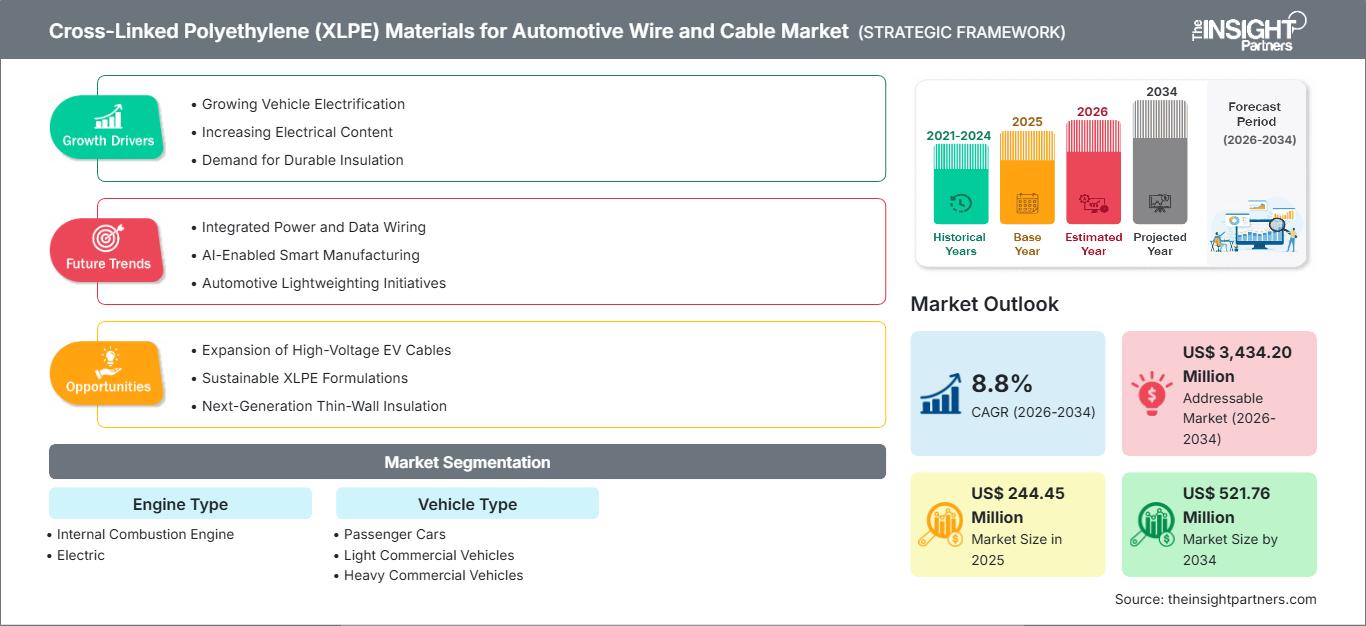
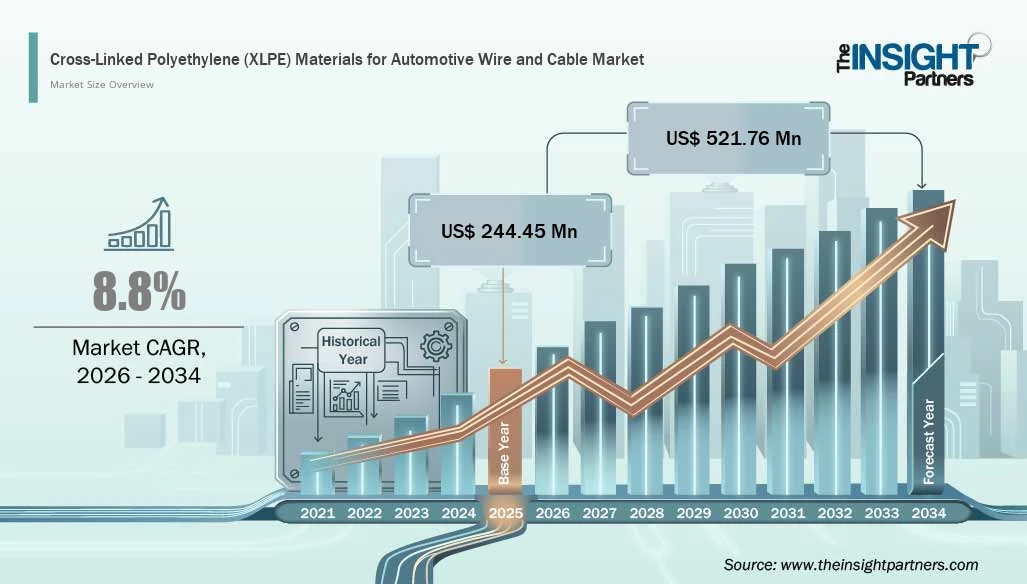
The Cross-Linked Polyethylene (XLPE) materials used in automotive wire and cable was worth US$ 244.45 million in 2025 and is expected to rise to US$ 521.76 million by 2034, reflecting a compound annual growth rate (CAGR) of 8.8% between 2026 and 2034. This growth is due to the trend towards electrification, the increasing amount of electrical equipment in each vehicle, and the demand for insulation materials that can retain their thermal, mechanical, and electrical performance in the more compact automotive wiring arrangements.
North America is expected to stay an important market, thanks to vehicle electrification, the greater adoption of hybrid and battery-electric platforms, and the strict automotive performance requirements. The market in the region is projected to grow at a compound annual growth rate of 8.0 to 9.0% between 2026 and 2034. This demand is especially driven by the rising need for high-voltage wiring, the development of advanced driver-assistance systems, and the ongoing progress in domestic automotive manufacturing and battery supply chains.
Cross-Linked Polyethylene (XLPE) Materials for Automotive Wire and Cable Market Assessment and Insights
- North America: North America is estimated to account for a 24–28% share in 2025 and expand at a CAGR of 8.0–9.0% between 2026 and 2034, supported by EV production, hybrid vehicles, and high-voltage electrical architectures.
- US: The US represents approximately 78–82% of North America's 2025 demand and is expected to grow at a CAGR of 8.1–9.1% between 2026 and 2034 as electrified platforms increase.
- Europe: Europe holds an estimated 21–25% share in 2025 and is projected to grow at a CAGR of 7.7–8.7%, with Germany, France, Italy, and the UK supporting demand through vehicle electrification and advanced automotive manufacturing.
- Asia Pacific: Asia Pacific represents approximately 42–47% of the 2025 market and is expected to expand at a CAGR of 9.2–10.2%, led by China, Japan, South Korea, and India.
- Largest Segment: Electric engine applications represent an estimated 58–64% market share in 2025 and are expected to grow at a CAGR of 10.0–11.0% through 2034.
- High Growth Segment: Light Commercial Vehicles represent approximately 12–16% share in 2025 and are expected to expand at a CAGR of 9.5–10.5% during 2026–2034.
- Key companies analyzed in detail: Westlake Corporation; Takkar Polychem Private Limited; Cabopol; Borouge International; Electric Cable Compounds, Inc.; GuangDong Advanced Thermoplastic Polymer Technology Co., Ltd.; ANGREEN; Wiscom Co., Ltd.; Hebei Sunua Advanced Material Co., Ltd.; and SACO AEI Polymers.
Source: The Insight Partners' analysis based on proprietary research, government publications, company annual reports, investor presentations, industry databases, and expert interviews.
The cross-linked polyethylene (XLPE) used in automotive wire and cable has shifted from standard insulation requirements towards more advanced formulations that provide higher operating temperatures, smaller bending radii, better chemical resistance, and improved electrical reliability. This change is due to vehicle electrification, since the wiring linked to batteries, inverters, motors, and charging systems has to meet greater thermal and voltage demands than does conventional low-voltage wiring. In order to stand out, material suppliers are focusing on accurate control of their formulations, achieving uniform cross-linking, ensuring flame retardance, and improving their processing characteristics.
The growth of the market will be influenced by developments in Asian automotive manufacturing, by the establishment of regional electric vehicle supply chains, and by greater investment in specialized compounding facilities. It is essential to comply with automotive standards such as ISO 6722 and SAE specifications for materials to be approved. Original equipment manufacturers are prioritizing weight reduction, durability, and electrical safety, a trend that is increasing demand for advanced XLPE grades in both the passenger and commercial vehicle sectors.
Cross-Linked Polyethylene (XLPE) Materials for Automotive Wire and Cable Market Report Scope
| Report Attribute | Details |
|---|---|
| Market size in 2025 | US$ 244.45 Million |
| Market Size by 2034 | US$ 521.76 Million |
| Global CAGR (2026 - 2034) | 8.8% |
| Historical Data | 2021-2024 |
| Forecast period | 2026-2034 |
Cross-Linked Polyethylene (XLPE) Materials for Automotive Wire and Cable Market Analysis
The growth of Cross-Linked Polyethylene (XLPE) materials used in automotive wire and cable is mainly due to vehicle electrification. Since both battery-electric and hybrid vehicles need insulation that can withstand high temperatures for their power and control circuits, the demand for advanced XLPE compounds has increased. The value chain includes suppliers of polyethylene and additives, compounders, wire and cable manufacturers, harness assemblers, Tier-1 suppliers, and the automotive original equipment manufacturers. The supply conditions are affected by the availability of resin, cross-linking technologies, additive systems, the duration of the qualification process, and the manufacturing capacity in various regions.
It is essential for XLPE compounds to provide a balance of dielectric strength, flexibility, resistance to abrasion, performance during thermal aging, chemical resistance, and processability. In the automotive industry, manufacturers place a priority on stable extrusion and uniform wall thickness since variations in dimensions affect both electrical and mechanical reliability. The qualification processes in the automotive sector can be lengthy and thus delay commercialization, which in turn favors suppliers who have expertise in formulation, a solid testing infrastructure, and already existing partnerships with harness manufacturers.
The market comprises several polymer producers, regional compounders, and specialists who make wire and cable materials. Westlake Corporation and Borouge International have a wide range of polymer products, whereas Electric Cable Compounds, Inc. focuses on crosslinkable automotive compounds. GuangDong Advanced Thermoplastic Polymer Technology Co., Ltd. and ANGREEN strengthen the supply side in Asia. SACO AEI Polymers stands out through special compounding and custom formulations.
The strategy involved in market positioning is now turning towards formulations that are tailored to specific applications, going beyond the provision of standard polyethylene. Various suppliers are producing grades designed for use in high-temperature primary wire, battery cables, high-voltage systems, and complex vehicle structures. Takkar Polychem Private Limited, Cabopol, Wiscom Co., Ltd., and Hebei Sunua Advanced Material Co., Ltd. play a role in the competition within their regions. There is still fragmentation in the market between materials specialists and integrated polymer companies.
● REPORT CUSTOMIZATION
Tailor This Report To Align With Your Specific Business Requirements
This report can be customized to align precisely with your business objectives, scope, and target markets. Customization options include tailored segmentation, geography, competitive analysis, and strategic insights to support informed decision-making.
Customize This Report →WHAT YOU CAN ADJUST
- ● Segmentations
- ● Geography
- ● Competitive Analysis
- ● Language Preferences
Cross-Linked Polyethylene (XLPE) Materials for Automotive Wire and Cable Market: Strategic Insights
Regional Insights
North America Cross-Linked Polyethylene (XLPE) Materials for Automotive Wire and Cable Market
In 2025, North America is expected to make up 24–28% of the global market, with a compound annual growth rate (CAGR) of 8.0–9.0% anticipated over the period up to 2034. Demand within the region is led by the United States, due to the rapid advancement of vehicle electrification, the growing adoption of hybrid powertrains, the expansion of battery manufacturing, and the rise in the amount of electrical content in each vehicle. As a result, automotive suppliers are restructuring their harness systems to suit higher-voltage architectures, thereby raising the need for insulation materials that have improved thermal and mechanical properties.
Mexico is supporting regional growth by means of its existing automotive manufacturing capabilities and its integration with the production networks of the United States. Canada supports this market growth by increasing demand through its continued investment in the production of vehicles and batteries. While adoption is still mainly focused on passenger vehicles, the gradual electrification of commercial fleets is driving greater demand for reliable high-voltage wiring solutions. Material qualification is still controlled by the original equipment manufacturer (OEM) and by the specifications of the Tier-1 suppliers, which underlines the importance of technical consistency as a key factor in procurement.
US Cross-Linked Polyethylene (XLPE) Materials for Automotive Wire and Cable Market
The United States is projected to represent 78% to 82% of North American demand in 2025, with a compound annual growth rate (CAGR) of 8.1% to 9.1% forecast through 2034. Growth in domestic automotive manufacturing, increased battery investments, and the ongoing shift toward electrification are driving higher demand for high-temperature insulation and high-voltage cable systems. Key suppliers, including Westlake Corporation and Electric Cable Compounds, Inc., operate within the broader polymer and wire materials value chain.
Demand spans passenger cars, pickups, SUVs, and commercial vehicles, with electric vehicle (EV) platforms generating the highest requirements for battery and powertrain wiring. The adoption of advanced driver-assistance systems (ADAS), connectivity features, and electronic control systems is increasing wiring complexity in both conventional and electrified vehicles. As a result, compound suppliers must provide application-specific performance solutions instead of standardized insulation formulations.
Europe Cross-Linked Polyethylene (XLPE) Materials for Automotive Wire and Cable Market
Europe is projected to account for 21% to 25% of the market in 2025 and is expected to register a CAGR of 7.7% to 8.7% from 2026 to 2034. Germany leads the regional market, supported by a robust OEM and Tier-1 supplier base that drives demand for advanced insulation solutions. France, Italy, Spain, and the UK follow as key markets, each contributing through established automotive manufacturing networks. The region's vehicle electrification policies continue to strengthen long-term demand for high-voltage wiring materials.
The UK sustains market demand through premium vehicle manufacturing and ongoing technology development. Germany benefits from large-scale passenger vehicle production and continued investment in electric vehicle platforms. France and Italy contribute through established OEM and component supplier networks, while Spain remains a key location for high-volume vehicle assembly. Across the region, suppliers are prioritizing low-weight, durable, and thermally stable materials that align with evolving electrical architectures and meet European qualification standards.
APAC Cross-Linked Polyethylene (XLPE) Materials for Automotive Wire and Cable Market
Asia Pacific is projected to account for 42% to 47% of global demand in 2025, with a forecasted compound annual growth rate (CAGR) of 9.2% to 10.2%. China leads the region, followed by Japan, South Korea, India, and Australia. High automotive production volumes and accelerated electric vehicle (EV) adoption position Asia Pacific as a primary driver of material demand.
China's electric vehicle manufacturing ecosystem delivers the largest production volumes in the region. Japan and South Korea contribute through advanced automotive and battery technology capabilities. India is increasing its vehicle and component manufacturing capacity, while Australia maintains a comparatively smaller market share. Regional industrial policies, development of localized supply chains, and sustained investment in electrified mobility continue to drive demand for high-performance insulation materials.
Middle East & Africa Cross-Linked Polyethylene (XLPE) Materials for Automotive Wire and Cable Market
Middle East and Africa accounts for a comparatively modest share of global automotive demand; however, the region is projected to register a compound annual growth rate (CAGR) of 7.0% to 8.0% through 2034. Saudi Arabia and the United Arab Emirates are advancing automotive and mobility sector investments, while South Africa continues to serve as the primary established vehicle manufacturing hub in the region.
Key demand drivers in the region include infrastructure development, expansion of vehicle assembly operations, growth in commercial transportation, and the ongoing transition toward electrification. Saudi Arabia's relevance is increasing due to industrial diversification strategies, while the United Arab Emirates prioritizes the development of advanced mobility infrastructure. South Africa maintains its position as the leading exporter of vehicles within the region. Other Middle East and Africa markets remain largely reliant on imported vehicles and automotive components.
Segmentation Analysis
Engine Type
- The Engine Type segment is expected to register a CAGR of 8.8% to 9.8% from 2026 to 2034. The scope of the Cross-Linked Polyethylene (XLPE) Materials for Automotive Wire and Cable Market is shaped by the distinct insulation requirements of conventional and electrified powertrains. Electrified platforms necessitate enhanced thermal stability, voltage resistance, and operational reliability across battery and motor circuits.
- Internal Combustion Engine: Conventional vehicles maintain consistent demand for high-temperature primary wire, especially in engine compartments and auxiliary electrical systems. XLPE offers superior thermal and chemical resistance in applications where traditional thermoplastic insulation is insufficient under elevated operating conditions.
- Electric: Electric vehicles require advanced insulation solutions for battery connections, inverter systems, motors, charging circuits, and high-voltage harnesses. The segment holds strategic significance as electrification drives higher electrical loading and imposes more stringent thermal and mechanical performance requirements.
Vehicle Type
- The Vehicle Type segment is projected to register a CAGR of 8.7% to 9.7% from 2026 to 2034. Passenger vehicles constitute the primary volume driver, supported by sustained production levels. The electrification of commercial fleets is increasing demand for advanced cable materials with enhanced durability. Formulation requirements vary by application due to differences in duty cycles, available packaging space, voltage systems, and thermal exposure profiles.
- Passenger Cars: Passenger cars account for the largest share of demand, driven by high global production volumes and rising electrical content per vehicle. The adoption of electrification, advanced driver-assistance systems (ADAS), connectivity features, and battery integration is increasing both the quantity and performance requirements of insulated wiring systems.
- Light Commercial Vehicles: The electrification of delivery fleets and urban transport is elevating the significance of light commercial vehicles. These vehicles require robust battery, charging, and power distribution wiring systems engineered to withstand frequent thermal and mechanical stresses associated with intensive operating cycles.
- Heavy Commercial Vehicles: Heavy commercial vehicles, including trucks and buses, require cable systems with high durability due to continuous operation under demanding load and environmental conditions. The electrification of heavy-duty platforms is increasing the need for insulation materials that offer superior mechanical strength and high-temperature resistance.
- Others: This category includes specialized mobility platforms and selected off-road vehicles. Demand is limited and highly application-specific, with material selection governed by operating environment, electrical system architecture, packaging constraints, and manufacturer qualification standards.
Opportunity Snapshot
| Vehicle Type | Revenue Contribution | Trend Tag | Adoption Stage |
|---|---|---|---|
| Passenger Cars | High | EV Wiring | Scaling |
| Light Commercial Vehicles | Medium | Fleet Electrification | Scaling |
| Heavy Commercial Vehicles | Medium | High Voltage | Emerging |
| Others | Low | Specialized Mobility | Emerging |
Cross-Linked Polyethylene (XLPE) Materials for Automotive Wire and Cable Market Growth Drivers and Impact Analysis
Growing Vehicle Electrification
The transition from internal combustion engines to hybrid and battery-electric vehicles is redefining the performance criteria for automotive insulation. Electric powertrains require stable electrical insulation for batteries, inverters, motors, charging systems, and high-voltage distribution circuits, all operating under elevated thermal and mechanical stress. This evolution in wiring architecture expands the application scope for XLPE compounds beyond traditional primary wire uses. Automotive suppliers are prioritizing cable diameter reduction, optimized routing, and weight minimization, driving demand for materials that deliver consistent performance in compact designs. The introduction of dedicated EV platforms and commercial electric vehicles is broadening qualification requirements across multiple voltage classes and cable configurations. These structural changes are increasing demand for specialized crosslinkable polyethylene formulations and enabling higher-value applications within the automotive wire and cable sector.
Increasing Electrical Content per Vehicle
Modern vehicles integrate a significantly higher number of electronic functions, including advanced driver assistance systems, infotainment, sensors, electronic control units, connectivity modules, power management, and zonal electrical architectures. This trend increases circuit density and elevates requirements for insulation uniformity, flexibility, thermal stability, and environmental protection. Internal combustion engine vehicles are also contributing to rising demand for advanced wire materials due to expanded electrical content. The proliferation of electronic systems results in more constrained packaging, necessitating thinner and more robust insulation solutions. XLPE compounds meet these requirements through precise cross-linking and customized additive packages. As automotive architectures shift toward centralization and software-defined platforms, material suppliers are increasingly involved in design qualification processes with wire manufacturers and Tier-1 suppliers, reinforcing demand for differentiated, high-performance formulations.
Higher Thermal and Mechanical Performance Requirements
Automotive cables must withstand exposure to heat, vibration, oils, coolants, abrasion, humidity, and continuous mechanical movement. The adoption of electrified powertrains increases these demands, as high-current circuits generate higher thermal loads and are often positioned near batteries, motors, and power electronics. The cross-linked structure of XLPE delivers dimensional and thermal stability, supporting its use in high-performance insulation applications. Manufacturers are advancing formulations to achieve an optimal balance of temperature resistance, flexibility, processability, flame retardancy, and chemical durability. Compliance with automotive standards is critical, as insulation failure can compromise electrical safety and system reliability. These stringent performance requirements elevate the technical standards for suppliers and drive increased collaboration among compound manufacturers, cable producers, harness manufacturers, and OEM engineering teams.
Cross-Linked Polyethylene (XLPE) Materials for Automotive Wire and Cable Market Future Trends
Transition Toward Higher-Voltage and More Integrated Wiring Systems
The Cross-Linked Polyethylene (XLPE) materials market for automotive wire and cable is being driven by the adoption of higher-voltage electrical architectures and integrated power distribution systems. Emerging vehicle platforms are incorporating high-voltage battery systems and zonal architectures, which reduce wiring length and consolidate electrical functions. These developments increase requirements for insulation reliability, thermal stability, electromagnetic compatibility, flexibility, and compact cable design. Material suppliers are responding by developing grades tailored to specific voltage and temperature profiles, moving away from general-purpose formulations. The growth of commercial electric vehicles, particularly in trucks and buses, is accelerating demand for wiring solutions that can withstand sustained electrical loads. As a result, qualification programs are placing greater emphasis on material performance in the context of complete cable and harness systems.
Greater Emphasis on Lightweight and Processing-Efficient Materials
Automotive manufacturers are prioritizing reductions in wiring-system weight while maintaining electrical safety and durability. Material innovation is focusing on thinner insulation, enhanced extrusion consistency, and formulations that retain mechanical integrity after extended thermal exposure. Integration of cross-linking technology with automated cable manufacturing is advancing dimensional control and production efficiency. As global vehicle platforms become more standardized, suppliers with the capability to deliver consistent material performance across multiple production sites are gaining strategic importance. Sustainability is also influencing resin selection, additive systems, manufacturing energy consumption, and end-of-life management. These trends are driving compound developers to balance performance gains with processing efficiency and lifecycle impact.
Cross-Linked Polyethylene (XLPE) Materials for Automotive Wire and Cable Market Opportunities
Expansion of Specialized Materials for Commercial EV Platforms
The electrification of commercial vehicles is driving demand for advanced insulation compounds tailored to the operational requirements of buses, delivery vehicles, trucks, and other high-utilization platforms. These vehicles are subject to extended duty cycles and heightened exposure to vibration, thermal variation, mechanical stress, and challenging environmental conditions compared to passenger vehicles. Material suppliers are positioned to address stringent requirements for high-voltage battery cables, power distribution systems, charging interfaces, and motor connections through the development of application-specific formulations. The ongoing transition of urban delivery fleets and public transportation to electric powertrains further supports this trend. Material developers with expertise in high-temperature, flame-resistant, chemical-resistant, and mechanically robust compounds are increasingly participating in multi-platform qualification programs. As a result, the Cross-Linked Polyethylene (XLPE) materials market for automotive wire and cable is expected to see increased commercial relevance for specialized high-performance grades.
Regionalization of Automotive Compound Manufacturing
Automotive manufacturers are prioritizing resilient regional supply chains for critical materials, creating opportunities for compound producers to establish or expand production capacity near vehicle and cable manufacturing hubs. Localized manufacturing reduces logistics risk, accelerates qualification-to-production timelines, and enables formulation adjustments to meet regional OEM requirements. Asia Pacific remains a key region due to its concentration of automotive, battery, cable, and polymer production. North America and Europe are also experiencing increased investment in reshoring, localized electric vehicle manufacturing, and supplier diversification. Strategic investments are directed toward compounding lines, laboratory testing, application development, and technical service infrastructure. Companies that integrate regional manufacturing with robust quality management systems can enhance their participation in long-term automotive supply programs and reduce reliance on extended global supply networks.
Recent Developments
- In April 2025, Angreen and a large Indian company officially signed an agency cooperation agreement for silicone rubber materials and other polymer materials. This important cooperation will provide a solid fulcrum for Angreen to further expand its overseas market and deepen its regional layout. The two parties will jointly promote the widespread application of high-performance polymer materials in the Indian market and inject new momentum into the local manufacturing industry.
- In January 2026, SACO AEI Polymers opened a new plant that will supply the Latin American region with a range of products, including cross-linked polyethylene (XLPE) compounds. The multi-million-dollar, state-of-the-art facility is a 184,500 sq. ft. manufacturing facility in Ramos Arizpe, Mexico.
Frequently Asked Questions

- Comprehensive Market Sizing and Forecast Analysis
- Detailed Segmentation Analysis
- In-Depth Market Dynamics Assessment
- Regional and Country-Level Insights
- Competitive Landscape and Company Benchmarking
- Strategic Business Intelligence
Recent Reports
Testimonials

The Insight Partners provided valuable market intelligence that supported our global go-to-market strategy. Their team was professional, responsive, and attentive to our feedback, providing thoughtful analysis and helpful methodological clarifications throughout the project.
Junmo Kim Chief Financial Officer (CFO), Enertech Co., Ltd.
The Insight Partners' SCADA System Market report is comprehensive, with valuable insights on current trends and future forecasts. The team was highly professional, responsive, and supportive throughout. We are very satisfied and highly recommend their services.
RAN KEDEM Partner, Reali Technologies LTDs
I requested a report on a very specific software market and the team produced the report in a few days. The information was very relevant and well presented. I then requested some changes and additions to the report. The team was again very responsive and I got the final report in less than a week.
JEAN-HERVE JENN Chairman, Future Analytica
We worked with The Insight Partners for an important market study and forecast. They gave us clear insights into opportunities and risks, which helped shape our plans. Their research was easy to use and based on solid data. It helped us make smart, confident decisions. We highly recommend them.
PIYUSH NAGPAL Sr. Vice President, High Beam Global
The Insight Partners delivered insightful, well-structured market research with strong domain expertise. Their team was professional and responsive throughout. The user-friendly website made accessing industry reports seamless. We highly recommend them for reliable, high-quality research services
YUKIHIKO ADACHI CEO, Deep Blue, LLC.
This is the first time I have purchased a market report from The Insight Partners.While I was unsure at first, I visited their web site and felt more comfortable to take the risk and purchase a market report.I am completely satisfied with the quality of the report and customer service. I had several questions and comments with the initial report, but after a couple of dialogs over email with their analyst I believe I have a report that I can use as input to our strategic planning process.Thank you so much for taking the extra time and making this a positive experience.I will definitely recommend your service to others and you will be my first call when we need further market data.
JOHN SUZUKI President and Chief Executive Officer, Board Director, BK Technologies
I wish to appreciate your support and the professionalism you displayed in the course of attending to my request for information regarding to infectious disease IVD market in Nigeria. I appreciate your patience, your guidance, and the fact that you were willing to offer a discount, which eventually made it possible for us to close a deal. I look forward to engaging The Insight Partners in the future, all thanks to the impression you have created in me as a result of this first encounter.
DR CHIJIOKE ONYIA MANAGING DIRECTOR, PineCrest Healthcare Ltd.Reason to Buy
- Informed Decision-Making
- Understanding Market Dynamics
- Competitive Analysis
- Identifying Emerging Markets
- Customer Insights
- Market Forecasts
- Risk Mitigation
- Boosting Operational Efficiency
- Strategic Planning
- Investment Justification
- Tracking Industry Innovations
- Aligning with Regulatory Trends





 Get Free Sample for