
Bowman Lacrimal Probe Market Growth, Share & Trends by 2034
Coverage: By Type (Stainless Steel, Silver); End User (Hospitals, Surgery Centres, Others) , and Geography (North America, Europe, Asia Pacific, and South and Central America)
- Status : Data Released
- Report Code : TIPRE00008661
- Category : Life Sciences
- No. of Pages : 150
- Available Report Formats :


- Last update date : August 05, 2026


2025 Market Size
US$ 1.33 Mn
Base year value
2034 Forecast
US$ 2.8 Mn
Projected by 2034
CAGR 2026-2034
8.65 %
Growth rate
Addressable Market
US$ 18.54 Mn
(2026-2034)
The Bowman Lacrimal Probe Market size was worth US$ 1.33 Million in 2025 and is expected to grow to US$ 2.88 Million by 2034 at a CAGR of 8.65% between 2026 and 2034. The growth can be attributed to the consistent use of lacrimal probing devices in ophthalmology, oculoplastics procedures, and nasolacrimal duct obstruction treatment in pediatric patients where reusable probes continue to form an essential part of the surgical trays.
North America will continue to act as a significant demand hub for the market owing to the availability of ambulatory surgeries for ophthalmology, well-established reimbursement options, and availability of specialty oculoplastic procedures. The Bowman Lacrimal Probe Market size in North America is forecasted to gain traction on account of CAGR ranging between 8.1% to 8.7% during 2026 and 2034.
Bowman Lacrimal Probe Market Assessment and Insights
- North America: The region accounted for 37–41% share in 2025 and is expected to grow at a CAGR of 8.1–8.7% between 2026–2034, supported by high procedural access, pediatric ophthalmology capacity, and established ASC infrastructure.
- US: The U.S. represented 78–82% of North America in 2025 and is projected to expand at a CAGR of 8.2–8.8% between 2026–2034, led by hospital outpatient and ophthalmic ASC utilization.
- Europe: Europe held 25–29% share in 2025 and is forecast to grow at a CAGR of 7.6–8.2% between 2026–2034, with Germany, the UK, and France leading demand through specialist eye-care networks.
- Asia Pacific: Asia Pacific captured 22–26% share in 2025 and is expected to grow at a CAGR of 9.2–9.8% between 2026–2034, led by China, India, Japan, South Korea, and Australia.
- Largest Segment: Stainless steel held 69–73% market share in 2025 and is expected to grow at a CAGR of 8.2–8.8% during 2026–2034, reflecting durability, sterilization compatibility, and broad hospital purchasing acceptance.
- High Growth Segment: Surgery centres held 31–35% share in 2025 and are expected to grow at a CAGR of 9.0–9.6% during 2026–2034, supported by ophthalmic outpatient migration.
- Key companies analyzed in detail: Sklar Corporation, Integra LifeSciences Corporation, BR Surgical, LLC, Accurate Surgical & Scientific Instruments Corporation, Wexler Surgical, Inc., Accutome Inc., Microtrack Surgicals, Novo Surgical Inc., Rumex International Co., Katena Products Inc.
Source: The Insight Partners' analysis based on proprietary research, government publications, company annual reports, investor presentations, industry databases, and expert interviews.
Material standardization, atraumatic ends, standardized sizes, and improved finish are areas in which the market has experienced instrument evolution as opposed to design innovation. Instruments in the market are largely produced by surgical instrument makers, using stainless steel and silver alloy varieties. With rising sterilization requirements in hospitals, manufacturers are competing based on their ability to offer tray systems, a wide selection, repairs, and reliable distribution.
During the forecast period, there will be an increase in adoption in new ophthalmology centers as pediatric eye screenings become more common. Investments will be directed towards specialty centers, instrument substitution schemes, and regional distribution deals. There will be an increased focus from regulators on device traceability, safety of materials, and sterilization documentation.
Bowman Lacrimal Probe Market Report Scope
| Report Attribute | Details |
|---|---|
| Market size in 2025 | US$ 1.33 Million |
| Market Size by 2034 | US$ 2.8 Million |
| Global CAGR (2026 - 2034) | 8.65% |
| Historical Data | 2021-2024 |
| Forecast period | 2026-2034 |
Bowman Lacrimal Probe Market Analysis
Bowman Lacrimal Probe Market demand is very much related to the diagnosis of the nasolacrimal duct obstruction, lacrimal duct probing, and complementary procedures in pediatric and adult ophthalmology. As per WHO’s report, at least 2.2 billion individuals worldwide suffer from impaired near or distant vision, hence, making it an important public health need for eye care infrastructure growth.
Supply factors include reusable probe cost economics, procurement cycles, and sterilization compatibility. Hospitals usually standardize on stainless steel probes since they fit well into the central sterile processing processes and allow multiple turns per procedure. Ophthalmic surgery centers go for complete ophthalmic instrument sets, which makes it easier for vendors with comprehensive portfolios and rapid replacement capabilities to have an edge over others.
The Bowman Lacrimal Probe Market report shows a fragmented competition where the depth of the catalog as well as distribution network is more important than brand marketing. Sklar Corporation, Integra LifeSciences Corporation, Novo Surgical Inc., and Katena Products Inc. compete through their platform for surgical instruments, whereas Rumex International Co., Wexler Surgical, Inc., BR Surgical, LLC, and Accurate Surgical & Scientific Instruments Corporation compete on the basis of specialty and precision instruments.
Strategic positioning is becoming more linked to documentation, surgeon preference, and regional availability. Accutome Inc. and Microtrack Surgicals compete by virtue of their focus on ophthalmic products. As procurement becomes streamlined, companies that offer repair and sterilization instructions, a wide range of ophthalmic products, and a friendly ordering process for ASCs can withstand the competition better in the market.
● REPORT CUSTOMIZATION
Tailor This Report To Align With Your Specific Business Requirements
This report can be customized to align precisely with your business objectives, scope, and target markets. Customization options include tailored segmentation, geography, competitive analysis, and strategic insights to support informed decision-making.
Customize This Report →WHAT YOU CAN ADJUST
- ● Segmentations
- ● Geography
- ● Competitive Analysis
- ● Language Preferences
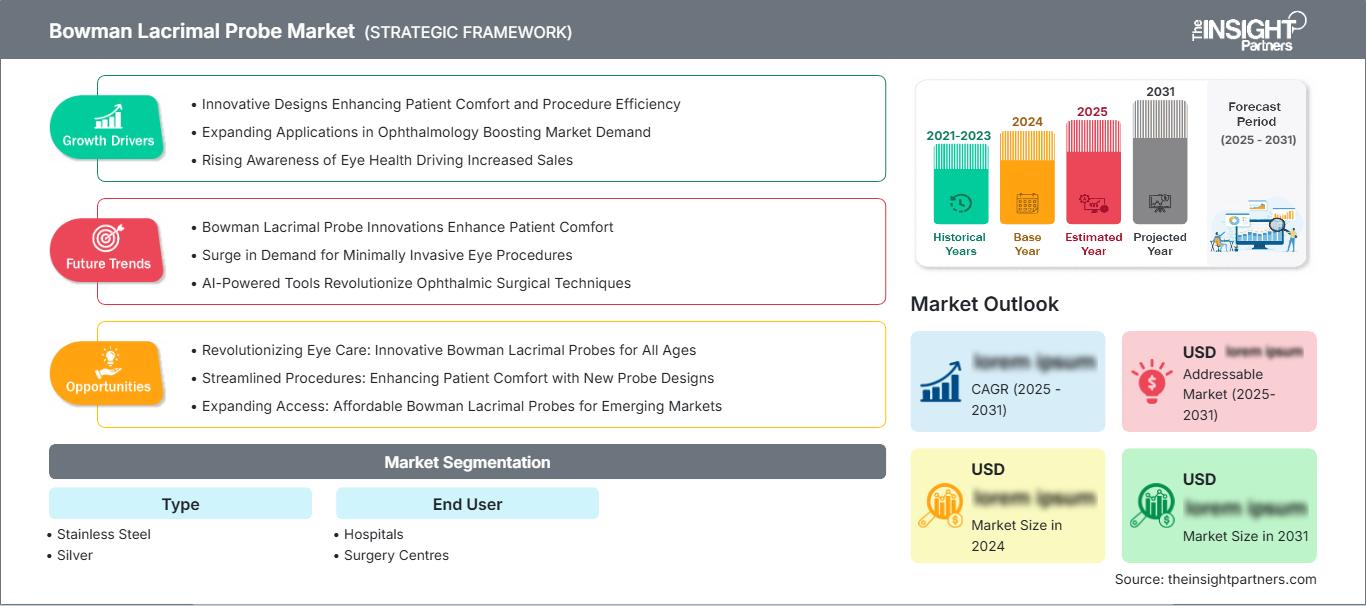
Bowman Lacrimal Probe Market: Strategic Insights
Regional Insights
North America Bowman Lacrimal Probe Market
North America held 37–41% of the Bowman Lacrimal Probe Market share in 2025 and is projected to grow at a CAGR of 8.1–8.7% during 2026–2034. The region benefits from well-developed pediatric ophthalmology pathways, high surgical instrument compliance standards, and broad access to oculoplastic specialists. Demand is reinforced by outpatient eye-care migration, with ASCRS-linked reporting indicating that many anterior segment surgeons use ambulatory or outpatient surgical settings.
Market in the region also gets support through purchasing practices of the hospitals that replace their reusable ophthalmic devices based on tip integrity, checking for any corrosion and sterilization potential. Competitive positioning becomes possible due to size capability, material traceability, and delivery network capability. Sklar Corporation, Integra LifeSciences Corporation, Wexler Surgical Inc., Novo Surgical Inc., and Katena Products Inc. gain visibility in U.S. market channels..
U.S. Bowman Lacrimal Probe Market
The United States was estimated to account for 78-82% of North America in 2025 and anticipated to grow at a CAGR of 8.2-8.8% through 2026-2034 due to its dominant position based on well-developed provider network of ophthalmologists, pediatric referral network, and significant number of ambulatory surgery centers. EyeWorld reported ASCRS Clinical Survey 2025 that found that 49% of survey respondents did surgery in ASCs, proving migration of procedures into specialty ambulatory centers.
The company portfolio is diverse with such players as Sklar Corporation, Integra LifeSciences Corporation, Wexler Surgical, Inc., Novo Surgical Inc., and Katena Products Inc. supplying reusable surgical instruments for hospitals, physician-owned facilities and specialty distributors. The application trend is related to stainless steel probes in standardized lacrimal trays, whereas silver probes are still selectively used depending on surgeon's preferences, feel, or tradition.
Europe Bowman Lacrimal Probe Market
Europe accounts for 25% - 29% market share in 2025 and expected to register a CAGR of 7.6% - 8.2% during 2026-2034. Germany dominates in Europe owing to presence of well-established ophthalmic surgery capabilities, good-quality instruments procurement practices, and preference for reusable devices. The UK is a contributor due to eye-care facilities under NHS program and private outpatient centers where there is requirement of reliable instruments for oculoplastics.
The demand from Germany is driven by stringent surgical instrument manufacturing capabilities, specialized clinics, and strong hospital purchasing policies. France, Italy, and Spain contribute to the growth on the back of cataract and ophthalmic surgery capabilities, pediatric eye care consultations, and instrument procurement. The buyers in Europe usually look for CE-certified instruments, corrosion-resistant, and long-lived instruments, which make stainless-steel Bowman probes popular in hospitals.
APAC Bowman Lacrimal Probe Market
In 2025, APAC occupied 22-26% market share and is estimated to record a CAGR of 9.2-9.8% during 2026-2034, thereby emerging as the fastest-growing region. The growing number of tertiary hospitals, ophthalmology specialty centers, and increased pediatric screening are key drivers of regional growth from China. Japan, South Korea, India, and Australia contribute to growth by means of procedural standardization and high volume of eye care.
The policy initiatives aimed at reduction in avoidable blindness and the public hospital investment continue to expand the capacity of ophthalmology services. The high patient population and the presence of private eye care chains in India ensure that procurement takes place on volume basis, whereas Japan and Australia focus on the sale of premium reusable products.
Middle East & Africa Bowman Lacrimal Probe Market
The Middle East & Africa market is expected to grow at a CAGR of 7.1–7.7% during 2026–2034, led by Saudi Arabia and the UAE. Hospital infrastructure investment, specialist ophthalmology clinics, and medical tourism initiatives support demand for precision reusable instruments. South Africa remains the main sub-Saharan market due to comparatively stronger private healthcare and specialist surgery capacity.
The Gulf region’s fiscal investments in energy are resulting in increased access to specialty surgical procedures such as ophthalmology and pediatrics. The demand for the rest of MEA is quite inconsistent due to inconsistent budgets for procuring goods, availability of trained professionals, and sterilization facilities. Distributors who provide training, repair services, and low-cost stainless steel products would do well in this market.
Segmentation Analysis
Type
The Type segment is expected to grow at a CAGR of 8.3–8.9% during 2026–2034. Bowman Lacrimal Probe Market scope by type is defined by material preference, sterilization durability, and surgeon familiarity. Stainless steel dominates because it offers strength, corrosion resistance, and repeat use, while silver probes serve selective procedural preferences where flexibility, tactile feel, or legacy clinical practice supports continued demand.
- Stainless Steel: Stainless steel probes hold the strongest market position due to durability, reusable economics, and compatibility with hospital sterilization workflows. Their strategic importance lies in standard tray adoption across pediatric and adult ophthalmology.
- Silver: Silver probes serve a smaller but clinically relevant demand base where surgeons value material feel and procedural tradition. Demand is selective, often linked to specialist preference and premium instrument procurement.
End User
The End User segment is expected to grow at a CAGR of 8.6–9.2% during 2026–2034. Hospitals remain the primary users due to pediatric referrals, emergency ophthalmology access, and multidisciplinary capability. Surgery centres are gaining relevance as ophthalmic procedures shift to outpatient environments that favor efficient trays, faster turnover, and direct procurement of specialty reusable instruments.
- Hospitals: Hospitals remain the core demand base because they manage complex pediatric and adult lacrimal cases. Broad sterilization departments and standardized procurement make them essential for recurring replacement purchases.
- Surgery Centres: Surgery centres are strategically important as ophthalmology shifts toward outpatient care. They emphasize compact instrument sets, predictable availability, efficient sterilization cycles, and vendor responsiveness.
Opportunity Snapshot
| Segment Name | Revenue Contribution | Trend Tag | Adoption Stage |
| Hospitals | High | Sterile Trays | Mature |
| Surgery Centres | Medium | Outpatient Shift | Scaling |
Bowman Lacrimal Probe Market Growth Drivers and Impact Analysis
Expansion of pediatric ophthalmology referrals
Pediatric nasolacrimal duct obstruction remains a recurring clinical pathway for ophthalmologists, creating stable procedural demand for probing instruments. Early diagnosis, parental awareness, and specialist referral networks are improving case identification in many developed and emerging markets. The impact is strongest in hospitals and children’s eye-care units, where probes are included in standardized lacrimal procedure trays. As pediatric ophthalmology capacity expands, demand shifts from occasional replacement buying to structured instrument lifecycle management. This benefits supplier offering consistent sizing, smooth finish quality, and reliable availability. Pediatric use also supports premium positioning because atraumatic design and predictable handling are central to clinician confidence during delicate duct procedures.
Migration of ophthalmic procedures to outpatient settings
Ophthalmic care is increasingly moving toward ambulatory and specialty surgery settings, supported by efficiency, patient convenience, and focused clinical workflows. This transition affects instrument purchasing because surgery centres often build dedicated procedure trays rather than relying on large hospital inventories. ASCRS-linked reporting on cataract and anterior segment practice settings indicates growing relevance of ASCs and office-based suites, strengthening demand for compact reusable ophthalmic instrument portfolios. The market impact is a broader buyer base and faster replacement cycles, especially when instruments are processed frequently. Vendors that provide surgery centre-ready ordering systems, repair support, and consistent product documentation can convert procedural migration into durable revenue opportunities across the market.
Preference for reusable stainless-steel instruments
Reusable stainless-steel probes remain favoured because they combine durability, sterilization compatibility, and predictable handling at a low per-procedure cost. Hospitals and surgery centres face pressure to balance infection-control standards with procurement efficiency, making long-life instruments attractive when quality is consistent. Stainless steel also aligns with existing central sterile processing infrastructure and reduces dependence on procedure-specific disposable supply chains. The market impact is sustained replacement demand rather than rapid obsolescence. Suppliers with validated materials, polished atraumatic tips, corrosion resistance, and broad ophthalmic catalogs are positioned to capture repeat orders. This driver particularly supports established instrument makers serving standardized ophthalmology trays.
Bowman Lacrimal Probe Market Future Trends
Greater standardization of lacrimal procedure trays
Bowman Lacrimal Probe Market trends point toward greater tray standardization as hospitals and surgery centres tighten sterilization protocols and reduce procedural variability. Procurement teams are expected to prefer complete lacrimal and ophthalmic minor procedure sets with documented material specifications, traceable SKUs, and repeatable instrument performance. Standardization will also support staff training, reduce intraoperative delays, and simplify inventory audits. This trend should benefit suppliers that offer complementary dilators, cannulas, hooks, and probes within a single ophthalmic portfolio. Over time, purchasing decisions may shift from single-product replacement toward bundled procedural set management.
Rising importance of service-backed instrument procurement
Instrument buyers are increasingly evaluating suppliers on lifecycle support, not only unit price. Repair access, replacement speed, catalog transparency, and sterilization guidance are becoming important purchasing criteria for specialty ophthalmic tools. This trend is expected to strengthen as outpatient centres operate with leaner inventories and limited tolerance for instrument downtime. Manufacturers that support maintenance programs, easy reordering, and clear handling instructions can improve customer retention. The trend also favors established companies with distributor networks and quality documentation, while smaller suppliers may need partnerships to compete effectively beyond price.
Bowman Lacrimal Probe Market Opportunities
Outpatient ophthalmology procurement programs
Surgery centres create a focused investment opportunity because they require reliable, compact instrument sets for predictable procedural throughput. Bowman Lacrimal Probe Market Forecasts indicate that outpatient growth will expand direct purchasing by specialty centers seeking durable probes, dilators, and supporting lacrimal tools. Suppliers can act by developing ASC-specific bundles, automated replenishment programs, and service agreements that reduce instrument downtime. The highest returns are likely where vendors combine competitive pricing with clinical familiarity and fast delivery. This opportunity is distinct from hospital replacement demand because purchasing cycles are shorter and surgeon influence is often stronger.
Distributor-led expansion in emerging eye-care markets
Emerging geographies offer growth potential where public and private eye-care investment is expanding but direct manufacturer presence remains limited. Companies can scale by working with ophthalmic distributors that understand tender requirements, surgeon preferences, and sterilization infrastructure. The opportunity is strongest in India, Southeast Asia, Gulf countries, and parts of Africa where specialist eye-care capacity is rising. Product education, repair support, and bundled ophthalmic trays can help overcome trust barriers. Suppliers that balance affordability with quality documentation may capture early loyalty before procurement systems consolidate around preferred instrument brands.
Recent Developments
- August 2025: Sklar Corporation donated 17 pallets of surgical instruments to Project AnimalAid, its largest reported gifts-in-kind instrument donation to the organization. The donation included reusable medical instruments intended to support animal health partners across multiple regions and reflected the company’s broader emphasis on instrument reuse, sustainability, and medical outreach.
- May 2025: Wexler Surgical, Inc. showcased its latest surgical innovations at AATS 2025, including TAVR removal scissors, curved VATS Lambert-Kay clamps, and SWICKER fluid-control products. The update reinforced the company’s continued positioning in specialty surgical instrumentation and its focus on surgeon-facing innovation for complex procedural environments.
- February 2025: Rumex International Co. highlighted 2025 ophthalmic instrument innovations through partner communications, including microsurgical forceps with improved ergonomics, advanced cutting precision, and coating enhancements intended to improve durability and reduce tissue adhesion. The development supported the company’s positioning in reusable ophthalmic instruments.
Frequently Asked Questions

- Comprehensive Market Sizing and Forecast Analysis
- Detailed Segmentation Analysis
- In-Depth Market Dynamics Assessment
- Regional and Country-Level Insights
- Competitive Landscape and Company Benchmarking
- Strategic Business Intelligence
Recent Reports
Testimonials

The Insight Partners' SCADA System Market report is comprehensive, with valuable insights on current trends and future forecasts. The team was highly professional, responsive, and supportive throughout. We are very satisfied and highly recommend their services.
RAN KEDEM Partner, Reali Technologies LTDs
I requested a report on a very specific software market and the team produced the report in a few days. The information was very relevant and well presented. I then requested some changes and additions to the report. The team was again very responsive and I got the final report in less than a week.
JEAN-HERVE JENN Chairman, Future Analytica
We worked with The Insight Partners for an important market study and forecast. They gave us clear insights into opportunities and risks, which helped shape our plans. Their research was easy to use and based on solid data. It helped us make smart, confident decisions. We highly recommend them.
PIYUSH NAGPAL Sr. Vice President, High Beam Global
The Insight Partners delivered insightful, well-structured market research with strong domain expertise. Their team was professional and responsive throughout. The user-friendly website made accessing industry reports seamless. We highly recommend them for reliable, high-quality research services
YUKIHIKO ADACHI CEO, Deep Blue, LLC.
This is the first time I have purchased a market report from The Insight Partners.While I was unsure at first, I visited their web site and felt more comfortable to take the risk and purchase a market report.I am completely satisfied with the quality of the report and customer service. I had several questions and comments with the initial report, but after a couple of dialogs over email with their analyst I believe I have a report that I can use as input to our strategic planning process.Thank you so much for taking the extra time and making this a positive experience.I will definitely recommend your service to others and you will be my first call when we need further market data.
JOHN SUZUKI President and Chief Executive Officer, Board Director, BK Technologies
I wish to appreciate your support and the professionalism you displayed in the course of attending to my request for information regarding to infectious disease IVD market in Nigeria. I appreciate your patience, your guidance, and the fact that you were willing to offer a discount, which eventually made it possible for us to close a deal. I look forward to engaging The Insight Partners in the future, all thanks to the impression you have created in me as a result of this first encounter.
DR CHIJIOKE ONYIA MANAGING DIRECTOR, PineCrest Healthcare Ltd.Reason to Buy
- Informed Decision-Making
- Understanding Market Dynamics
- Competitive Analysis
- Identifying Emerging Markets
- Customer Insights
- Market Forecasts
- Risk Mitigation
- Boosting Operational Efficiency
- Strategic Planning
- Investment Justification
- Tracking Industry Innovations
- Aligning with Regulatory Trends





 Get Free Sample for