
Breast Localization Wire Market Size, Share & Demand by 2034
Coverage: By Product Type (Double Barb Breast Localization Wire, Single Barb Breast Localization Wire); Application (Hospital, Research Institutions) , and Geography (North America, Europe, Asia Pacific, and South and Central America)
- Status : Data Released
- Report Code : TIPRE00018493
- Category : Life Sciences
- No. of Pages : 150
- Available Report Formats :


- Last update date : August 06, 2026


2025 Market Size
US$ 494.36 Mn
Base year value
2034 Forecast
US$ 886.5 Mn
Projected by 2034
CAGR 2026-2034
6.70 %
Growth rate
Addressable Market
US$ 6,239.92 Mn
(2026-2034)
The Breast Localization Wire Market is expected to increase from US$ 494.36 Million in 2025 to US$ 886.5 Million by 2034, posting a CAGR of 6.70% during 2026-2034. This growth is attributed to the ongoing usage of breast wire localization in breast-conserving surgery, the ongoing diagnosis of non-palpable lesions via screening, and the cost-effectiveness of breast wires in hospitals that maintain a close link between the operating room process and radiology work.
North America continues to remain the procedure hub, as the size of the Breast Localization Wire Market size is aided by advanced breast imaging infrastructure, one-day biopsy-to-surgery routes, and the availability of reimbursement. The region is expected to grow at a CAGR of 5.9 – 6.5% during 2026-2034, due to high screening rates, accredited mammography networks, and hospitals' tendency towards breast localization devices despite rising wire-free trend.
Breast Localization Wire Market Assessment and Insights
- North America held 39–42% share in 2025 and is growing at a CAGR of 6.4–6.8% during 2026–2034, supported by breast cancer reconstruction demand, surgeon density, and structured device surveillance.
- US represented 84–87% of North America in 2025 and is growing at a CAGR of 6.5–6.9% during 2026–2034, led by augmentation and reconstruction procedures.
- Europe held 24–27% share in 2025 and is growing at a CAGR of 6.1–6.5% during 2026–2034, with Germany, France, the UK, Italy, and Spain leading adoption.
- Asia Pacific accounted for 22–25% share in 2025 and is growing at a CAGR of 8.1–8.6% during 2026–2034, driven by China, Japan, South Korea, India, and Australia.
- Largest Segment Silicone held 82–86% market share in 2025, with a CAGR of 6.9–7.3% during 2026–2034 due to natural feel and cohesive gel performance.
- High Growth Segment Cosmetic Surgery held 63–67% market share in 2025, with a CAGR of 7.4–7.9% during 2026–2034 as premium private procedures expand.
- Key companies analyzed in detail: Allergan Aesthetics, Mentor Worldwide LLC, GC Aesthetics plc, Sientra, Inc., POLYTECH Health & Aesthetics GmbH, Ideal Implant Incorporated, Silimed, Groupe Sebbin SAS, Guangzhou Wanhe Plastic Materials Co., Ltd., HANSBIOMED CO., LTD., Establishment Labs Holdings Inc., Tiger Aesthetics Medical, LLC
Source: The Insight Partners' analysis based on proprietary research, government publications, company annual reports, investor presentations, industry databases, and expert interviews.
From merely the placement of a hook-wire to specific designs based on procedures, greater visibility of needles, and ergonomic deployment handles is how clinical adoption has evolved. Advances in barb design, more acute cannulas, centimeter marks, and MRI-compatible line of devices persist amidst the backdrop of sterile and single use manufacture processes. Manufacture challenges are determined by sources of nitinol and stainless steel wire, wire forming methods, package validation, and procurement by hospitals that focus on availability over platform change.
For the future, the trend of moving the procedures to ambulatory breast centers and multidisciplinary cancer centers will result in accessibility in selected geographies. The tailwinds brought about by the development of regulation including quality mammogram standards, breast density laws, and national screening programs will ensure that wire localization continues to be a key technology in areas where cost considerations preclude a move to wireless.
Breast Localization Wire Market Report Scope
| Report Attribute | Details |
|---|---|
| Market size in 2025 | US$ 494.36 Million |
| Market Size by 2034 | US$ 886.5 Million |
| Global CAGR (2026 - 2034) | 6.70% |
| Historical Data | 2021-2024 |
| Forecast period | 2026-2034 |
Breast Localization Wire Market Analysis
Cancer authorities worldwide diagnose breast cancer as the most common form of cancer among women, thus ensuring steady lesion localization volume even in developed and emerging health care systems. The value chain includes wire producers, sterile packaging companies, imaging facilities, breast surgeons, distributors, group buying organizations, and hospital tender committees.
Supply conditions are strong because wires are relatively cheaper and more procedure familiar devices than seed, radar, and magnetic localization solutions. Hospitals continue to employ them where same day radiology placement and surgical removal is possible. But manufacturers have to cope with profit pressure due to tendering, stricter regulation documentation, traceability needs, and demands for reliable anchorage without migration possibilities.
Breast Localization Wire Market report shows that the market has a fairly fragmented competitive structure. Companies such as Becton, Dickinson and Company and Cook Medical Incorporated leverage their wide interventional product lines. Whereas companies such as SOMATEX Medical Technologies GmbH, Mammotome, Inc., PAJUNK GmbH Medizintechnologie, and IZI Medical Products, LLC engage in competition through their special breast care products, training, and specific products for each modality.
Compatibility with ultrasound guided, stereotactic mammography guided, and MRI guided procedures has become a key consideration for strategic positioning. Companies including Argon Medical Devices, Inc., Medline Industries, LP, CP Medical, Inc., and Genesis Health System enter the market through procurement, distribution, clinical use, and specialty supply. Competitiveness of Hologic, Inc. with its wide breast intervention product line, including wireless localization, compels wire manufacturers to focus on cost-effectiveness.
● REPORT CUSTOMIZATION
Tailor This Report To Align With Your Specific Business Requirements
This report can be customized to align precisely with your business objectives, scope, and target markets. Customization options include tailored segmentation, geography, competitive analysis, and strategic insights to support informed decision-making.
Customize This Report →WHAT YOU CAN ADJUST
- ● Segmentations
- ● Geography
- ● Competitive Analysis
- ● Language Preferences
Breast Localization Wire Market: Strategic Insights
Regional Insights
North America Breast Localization Wire Market
The North American region occupied 39–42% market share in 2025 and is predicted to record a CAGR of 5.9–6.5% from 2026 to 2034. The Breast Localization Wire Market share in the region continues to be driven by high usage of mammography, specialized breast surgery services, and image-guided localization before performing lumpectomy procedures. The FDA guidelines for mammography and quality imaging networks help ensure standardized detection processes, ensuring procedure volumes at hospitals and breast care facilities.
The demand is focused on institutions that are able to facilitate radiological placement and surgery on the same day. Even though wireless localization is becoming popular, wires continue to make sense as they are familiar, affordable, and compatible with existing imaging facilities. Purchasing groups continue to maintain dual sourcing for the sake of scheduling flexibility, surgeon preference, and payer considerations.
U.S. Breast Localization Wire Market
The US was responsible for 78-82% share of North America in 2025, and it is expected to register a CAGR of 6.0-6.6% over 2026-2034. The demand will be driven by a large percentage of breast cancer screenings, availability of breast imaging equipment and institutional standards of biopsy and oncological surgery. Localization products used to be standardized by large hospital groups due to differences in training and delay in the procedure.
The presence of companies is high as Becton, Dickinson and Company, Cook Medical Incorporated, Mammotome, Inc., Argon Medical Devices, Inc., Medline Industries, LP, and IZI Medical Products, LLC continue to have access to markets via direct sales, distribution or catalog procurement. The application trends favor hospitals for complex and image-guided localization, while research institutions focus on accuracy of wire placement, decrease in number of re-excisions and timing of the procedures.
Europe Breast Localization Wire Market
Europe accounted for 25-28% of the market share in 2025 and is anticipated to grow at a CAGR of 5.4-6.0% from 2026 to 2034, with Germany being a prominent procedural market. UK is driven by systematic breast screening and cancer pathway approach which ensures demand for accurate localization equipment in NHS and private breast centers.
Germany has strong presence of breast centers, surgical oncology knowledge base, and medical technologies expertise. Procedure standardization, radiology-surgery interaction, and preference for high-quality localization wires which are ideal for ultrasounds, mammograms, and MRIs are some of the factors supporting adoption. SOMATEX Medical Technologies GmbH and PAJUNK GmbH Medizintechnologie further enhance regional specialty.
France, Italy, and Spain contribute through national screening programs, breast conservation procedures, and hospital buying environment. High incidences identified through screening program in France, regional oncology networks in Italy, and public hospitals buying environment in Spain support adoption. Cost control keeps localization wires competitive against wireless systems.
APAC Breast Localization Wire Market
APAC will account for 21%–24% market share in 2025 and will experience growth at a CAGR of 7.4%–8.2% from 2026 to 2034. China will be the biggest growth contributor owing to increased access to screening programs, development in oncological centers, and image-guided breast interventions. Japan, South Korea, India, and Australia will add to demand owing to technologically sophisticated imaging facilities, private hospitals, and breast conserving surgeries.
The policy drivers are cancer screening programs, hospital upgrade, and training of radiologists in localization procedures. Industrial drivers are also important because of increased accessibility of imported sterile wires and biopsy consumables in regional distributors. Cost sensitivity is high in favor of wire localization due to need of reliable device without substantial capital expenditures.
Middle East & Africa Breast Localization Wire Market
The Middle East & Africa is expected to register a CAGR of 5.8–6.4% between 2026 and 2034, with Saudi Arabia being the major driving force in regional demand. Breast imaging in the specialty oncology centers is being implemented in hospitals in UAE, while South Africa is the most mature sub-Saharan market in terms of breast diagnostics. The growth in Rest of MEA is gradual due to the uneven availability of screening services.
Investments in healthcare infrastructure will stimulate demand for reliable and affordable localization devices. The growth will be stimulated in the Gulf countries due to the energy-funded expansion of hospitals, the development of oncology centers, and the popularity of medical tourism in UAE.
Segmentation Analysis
Product Type
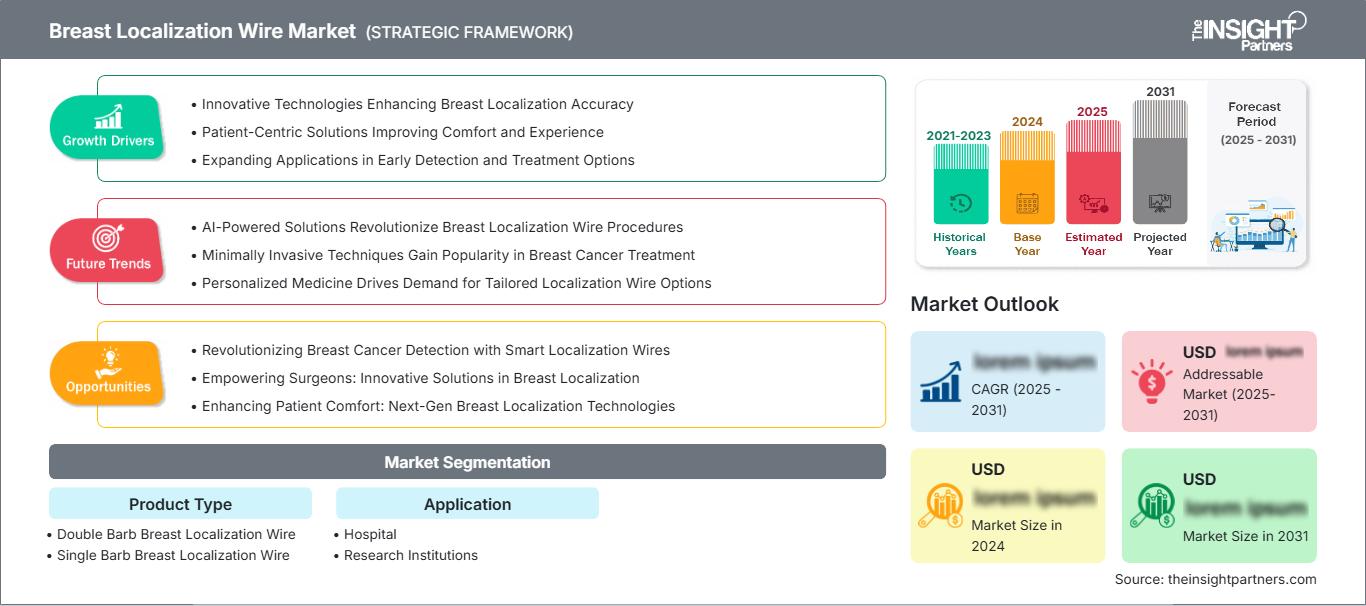
The Product Type segment is projected to grow at a CAGR of 6.4–7.0% during 2026–2034. The Breast Localization Wire Market scope across product formats is defined by anchoring strength, lesion depth, imaging modality, and surgeon preference. Hospitals often carry more than one wire configuration to address dense breast tissue, superficial lesions, and procedural positioning requirements while minimizing needle repositioning.
- Double Barb Breast Localization Wire: This sub-segment leads adoption because dual anchoring improves positional stability during patient transfer and surgical preparation, making it strategically important for hospitals managing high breast-conserving surgery volumes.
- Single Barb Breast Localization Wire: Demand remains steady where clinicians prefer simpler deployment, narrower tissue engagement, or cost-effective localization for straightforward non-palpable lesions under ultrasound or mammography guidance.
Application
The Application segment is forecast to grow at a CAGR of 6.5–7.1% during 2026–2034. Hospitals dominate usage because localization is closely linked to diagnostic imaging, operating room timing, pathology coordination, and multidisciplinary cancer care. Research institutions are increasingly relevant as localization studies compare wire placement accuracy, specimen margin outcomes, and workflow alternatives.
- Hospital: Hospitals represent the primary demand base due to integrated radiology and surgical teams, high procedure throughput, established procurement channels, and responsibility for breast-conserving surgery pathways.
- Research Institutions: Research institutions create strategic value by testing localization techniques, comparing outcomes with wire-free systems, and generating evidence that influences procurement decisions in academic hospitals.
Opportunity Snapshot
| Application | Revenue Contribution | Trend Tag | Adoption Stage |
| Hospital | High | Surgical Workflow | Mature |
| Research Institutions | Medium | Margin Studies | Scaling |
Breast Localization Wire Market Growth Drivers and Impact Analysis
Screening-Led Detection of Non-Palpable Breast Lesions
Expanded mammography, ultrasound, and MRI screening continues to identify smaller lesions that require preoperative localization before breast-conserving surgery. This trend directly supports wire usage because many suspicious abnormalities are not palpable during surgery and require radiologic marking. The commercial impact is strongest in hospitals with accredited imaging networks and multidisciplinary tumor boards, where standardized lesion workup creates recurring product demand. As developing markets increase screening coverage, a larger share of patients will enter surgical pathways earlier, raising the need for affordable localization. Wire systems are positioned well because they require limited capital investment, use familiar procedural steps, and fit existing radiology suites without major workflow redesign.
Cost Pressure Favouring Familiar Localization Technologies
Healthcare systems are under sustained pressure to improve cancer care access without increasing procedure costs unnecessarily. Wire localization remains attractive because the device cost is generally lower than wireless seed, radar, or magnetic systems, and most radiology teams already understand placement protocols. This affects purchasing behaviour in public hospitals, community cancer centers, and price-sensitive private facilities. The market impact is visible in dual-technology strategies, where advanced centers adopt wireless options for selected cases but maintain wires for routine procedures. Suppliers that offer reliable inventory, multiple needle lengths, MRI-compatible options, and training support can defend share while hospitals balance clinical flexibility with budget discipline.
Integration with Established Breast Surgery Workflows
Wire localization benefits from deep integration into existing breast surgery workflows, including preoperative imaging, surgeon orientation, specimen radiography, and pathology margin assessment. This embedded role reduces adoption barriers compared with newer platforms that require console purchases, seed tracking policies, or radiation source management. Hospitals value predictable workflow because localization delays can disrupt operating room utilization and patient scheduling. The practical impact is steady demand for wires that deploy smoothly, remain visible under imaging, and maintain position during transfer. Manufacturers that improve handle ergonomics, cannula sharpness, and anchoring reliability can support incremental clinical gains without forcing hospitals to redesign their procedural pathway.
Breast Localization Wire Market Future Trends
Hybrid Localization Protocols
The next phase of Breast Localization Wire Market trends will include hybrid protocols where hospitals select wire, magnetic, radar, or seed approaches according to lesion type, scheduling complexity, and payer coverage. Wires are unlikely to disappear from high-volume breast units because they remain practical for same-day surgery and straightforward lesions. Instead, protocols will become more segmented, with wireless systems used for cases requiring scheduling flexibility and wires retained for cost-sensitive or immediate procedures. This trend will push suppliers to position wires as part of a broader procedural toolkit rather than as a standalone legacy product, emphasizing reliability, training, and compatibility.
Procedure-Specific Wire Design Optimization
Future product innovation will focus on procedure-specific improvements rather than radical redesign. Manufacturers are expected to enhance anchoring geometry, tactile feedback, ultrasound visibility, MRI compatibility, and handle usability for single-handed deployment. Hospitals will also prefer packaging that reduces setup time and supports sterile field efficiency. These refinements can reduce placement revisions, improve surgeon confidence, and strengthen procurement justification even when wireless alternatives receive attention. Over the forecast period, incremental design differentiation will become important because tender committees increasingly compare not only price, but also usability, complication risk, training burden, and availability across multiple lesion localization scenarios.
Breast Localization Wire Market Opportunities
Expansion in Ambulatory Breast Centers
Ambulatory breast centers present a practical opportunity for suppliers that can support high-throughput imaging and same-day surgical referrals. Breast Localization Wire Market Forecasts indicate that outpatient settings will increasingly handle diagnostic workups, biopsy follow-ups, and selected localization procedures as hospitals shift care away from inpatient infrastructure. Vendors can act by offering compact product portfolios, radiologist training modules, and distributor programs that reduce stockouts across satellite centers. The opportunity is strongest in the US, Europe, Australia, and selected APAC metros, where breast units seek lower-cost tools that preserve clinical familiarity while improving procedure scheduling and patient convenience.
Evidence Partnerships with Academic Hospitals
Academic hospitals and research institutions offer an opportunity to generate stronger comparative evidence around wire localization outcomes. Suppliers can collaborate on studies measuring margin status, localization accuracy, patient flow, imaging time, and re-excision rates across lesion types. This approach is especially useful as procurement committees request data before purchasing or retaining device lines. Partnerships should focus on real-world registries, surgeon-radiologist feedback loops, and protocol optimization rather than promotional trials. Companies that support evidence generation can improve credibility, defend conventional wire use where appropriate, and identify product improvements that differentiate future offerings in competitive tenders.
Recent Developments
- May 2026: Cairn Surgical, Inc. reported pivotal trial results for its Breast Cancer Locator System, comparing the investigational system with conventional wire localization in 418 patients across 23 centers. The trial reported a 32% reduction in positive margin rate and a 34% reduction in re-excision rate, adding competitive evidence around alternatives to conventional wire-based approaches.
- February 2026: Mammotome, Inc. launched the Mammotome Prima MR Dual Vacuum-Assisted Breast Biopsy System, described as an in-room MRI breast biopsy platform positioned at the patient’s side. Although focused on biopsy rather than wire placement, it strengthens Mammotome’s breast intervention portfolio and supports procedural ecosystems that feed localization decisions.
- January 2026: Becton, Dickinson and Company received FDA 510(k) clearance for the EnCor EnCompass Breast Biopsy and Tissue Removal System, a multi-modality platform for breast disease diagnosis. The system supports stereotactic, ultrasound, and MRI-guided workflows, strengthening BD’s breast health portfolio adjacent to localization procedures.
Frequently Asked Questions

- Comprehensive Market Sizing and Forecast Analysis
- Detailed Segmentation Analysis
- In-Depth Market Dynamics Assessment
- Regional and Country-Level Insights
- Competitive Landscape and Company Benchmarking
- Strategic Business Intelligence
Recent Reports
Testimonials

The Insight Partners' SCADA System Market report is comprehensive, with valuable insights on current trends and future forecasts. The team was highly professional, responsive, and supportive throughout. We are very satisfied and highly recommend their services.
RAN KEDEM Partner, Reali Technologies LTDs
I requested a report on a very specific software market and the team produced the report in a few days. The information was very relevant and well presented. I then requested some changes and additions to the report. The team was again very responsive and I got the final report in less than a week.
JEAN-HERVE JENN Chairman, Future Analytica
We worked with The Insight Partners for an important market study and forecast. They gave us clear insights into opportunities and risks, which helped shape our plans. Their research was easy to use and based on solid data. It helped us make smart, confident decisions. We highly recommend them.
PIYUSH NAGPAL Sr. Vice President, High Beam Global
The Insight Partners delivered insightful, well-structured market research with strong domain expertise. Their team was professional and responsive throughout. The user-friendly website made accessing industry reports seamless. We highly recommend them for reliable, high-quality research services
YUKIHIKO ADACHI CEO, Deep Blue, LLC.
This is the first time I have purchased a market report from The Insight Partners.While I was unsure at first, I visited their web site and felt more comfortable to take the risk and purchase a market report.I am completely satisfied with the quality of the report and customer service. I had several questions and comments with the initial report, but after a couple of dialogs over email with their analyst I believe I have a report that I can use as input to our strategic planning process.Thank you so much for taking the extra time and making this a positive experience.I will definitely recommend your service to others and you will be my first call when we need further market data.
JOHN SUZUKI President and Chief Executive Officer, Board Director, BK Technologies
I wish to appreciate your support and the professionalism you displayed in the course of attending to my request for information regarding to infectious disease IVD market in Nigeria. I appreciate your patience, your guidance, and the fact that you were willing to offer a discount, which eventually made it possible for us to close a deal. I look forward to engaging The Insight Partners in the future, all thanks to the impression you have created in me as a result of this first encounter.
DR CHIJIOKE ONYIA MANAGING DIRECTOR, PineCrest Healthcare Ltd.Reason to Buy
- Informed Decision-Making
- Understanding Market Dynamics
- Competitive Analysis
- Identifying Emerging Markets
- Customer Insights
- Market Forecasts
- Risk Mitigation
- Boosting Operational Efficiency
- Strategic Planning
- Investment Justification
- Tracking Industry Innovations
- Aligning with Regulatory Trends





 Get Free Sample for