
Breast Retractors Market Size, Trends & Growth Opportunities by 2034
Breast Retractors Market Size and Forecasts (2021 - 2034), Global and Regional Share, Trends, and Growth Opportunity Analysis Report Coverage : by Type (Handheld, Self-retaining); Usage (Reusable, Disposable); Application (Mastectomy, Breast Reconstruction, Breast Augmentation, Lumpectomy); End Use (Hospitals, Clinics); and Geography (North America, Europe, Asia Pacific, and South and Central America)
- Status : Data Released
- Report Code : TIPRE00039953
- Category : Life Sciences
- No. of Pages : 150
- Available Report Formats :


- Last update date : August 13, 2026


2025 Market Size
US$ 412.88 Mn
Base year value
2034 Forecast
US$ 631.75 Mn
Projected by 2034
CAGR 2026-2034
4.84 %
Growth rate
Addressable Market
US$ 4,741.66 Mn
(2026-2034)
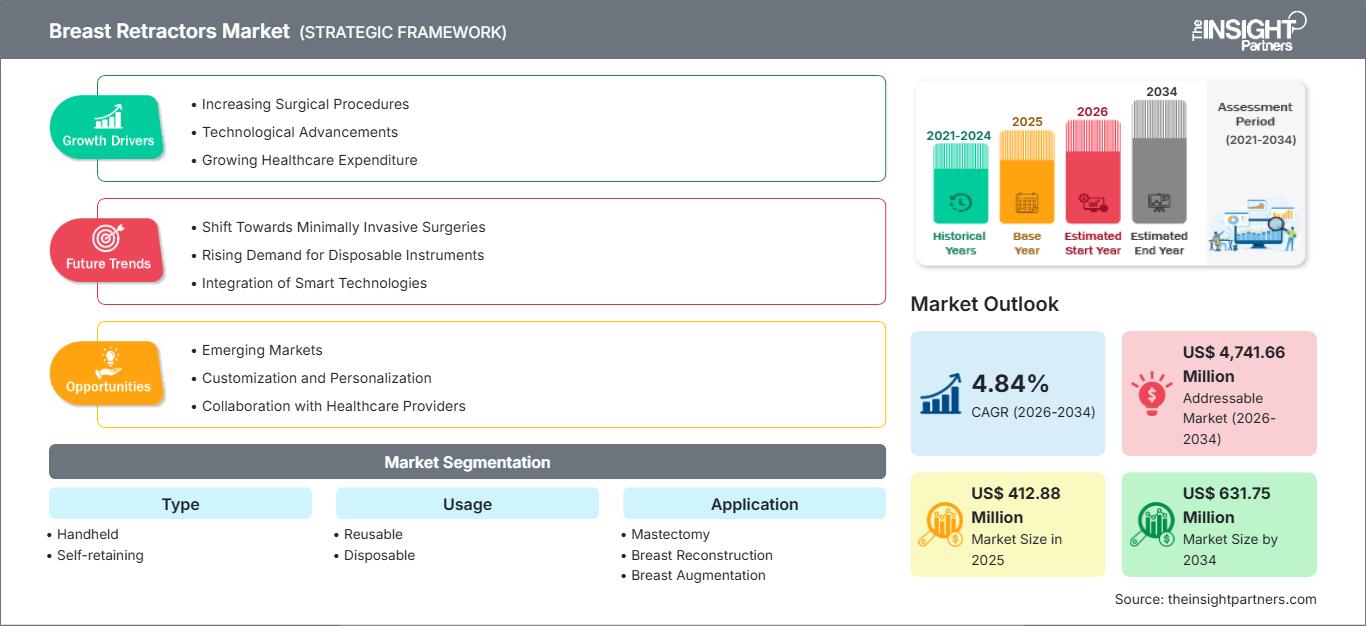
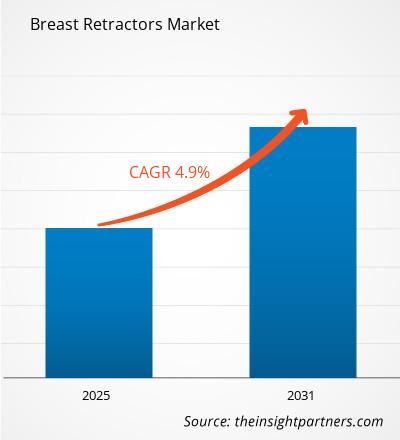
The Breast Retractors Market size is expected to increase from US$ 412.88 Million in 2025 to US$ 631.75 Million by 2034 at a CAGR of 4.84% during the period 2026-2034. This growth is due to consistent use of retractors for breast reconstruction, mastectomy, lumpectomy, cosmetic breast surgery, and revision of breast implants, in which controlled exposure of tissues is essential.
In North America, the procedural concentration in specialized breast surgery centers is driving the market towards a CAGR of 4.4%-4.8% until 2034. The size of the Breast Retractors Market in this region is fueled by well-established reimbursement programs, increased rates of reconstructions following surgeries for cancer, and quick uptake of single-use illuminated retractors in out-patient operating rooms due to their low risk of infection and fast turnover rate.
Breast Retractors Market Assessment and Insights
- North America held 39–42% share in 2025 and is expected to grow at a CAGR of 4.4–4.8% during 2026–2034, led by high breast reconstruction volumes, strong hospital purchasing, and established device distribution.
- US accounted for 78–82% of North America in 2025 and is projected to expand at a CAGR of 4.3–4.7% during 2026–2034, supported by specialty surgical centers.
- Europe represented 27–30% share in 2025 and is forecast to grow at a CAGR of 4.5–4.9% during 2026–2034, with Germany, the UK, and France leading adoption.
- Asia Pacific captured 20–23% share in 2025 and is expected to grow at a CAGR of 5.6–6.1% during 2026–2034, led by China, Japan, South Korea, India, and Australia.
- Largest Segment: Reusable retractors accounted for an estimated 64–69% market share in 2025 and are projected to register a 4.1–4.7% CAGR during 2026–2034, supported by established hospital sterilization workflows.
- High Growth Segment: Disposable retractors represented approximately 31–36% market share in 2025 and are expected to register a 5.8–6.6% CAGR during 2026–2034, supported by infection-control requirements and procedure-ready configurations.
- Key companies analyzed in detail: Medtronic plc, Johnson & Johnson, Stryker Corporation, B. Braun SE, Boston Scientific Corporation, CONMED Corporation, Zimmer Biomet Holdings, Inc., Integra LifeSciences Holdings Corporation, KLS Martin Group, and Medi-Globe Technologies GmbH.
Source: The Insight Partners' analysis based on proprietary research, government publications, company annual reports, investor presentations, industry databases, and expert interviews.
Instrument design has evolved from rudimentary exposure devices made from stainless steel to retraction systems incorporating ergonomically designed handles, flexible blades, radiolucent material, and illumination. More manufacturers are now developing products to match the specific demands of procedures in breast oncology and reconstruction surgery. Hospitals continue to strike a balance between optimizing reusable fleets and adopting disposable instruments, especially when sterilization capability, turnover times, and tracking affect their purchasing decisions.
During the forecast period, the emergence of new centers for surgery in Asia Pacific and some Middle Eastern countries will impact the direction of investment by instrument makers. Increased focus on reprocessing validation, OR safety, and proper labeling of disposables has been instrumental in the differentiation of products. Total Cost of Ownership analysis by purchasing departments has forced manufacturers to offer durable and efficient solutions.
Breast Retractors Market Report Scope
| Report Attribute | Details |
|---|---|
| Market size in 2025 | US$ 412.88 Million |
| Market Size by 2034 | US$ 631.75 Million |
| Global CAGR (2026 - 2034) | 4.84% |
| Historical Data | 2021-2024 |
| Forecast period | 2026-2034 |
Breast Retractors Market Analysis
Factors driving Breast Retractors Market growth are increasing breast cancer diagnosis rate, increase in breast-conserving surgery, and awareness about reconstruction. Surgeons need consistent visibility of deep pockets, implant planes, axillary approaches, and flap manipulation. Demand will be high wherever multidisciplinary breast centers are engaged in oncological and reconstructive surgery in a joint effort, thus creating repeat procurements of handheld and self-retaining instruments.
The value chain consists of steel manufacturers, polymer components manufacturers, LED modules, sterilization packaging providers, distributors, and central sterile services of hospitals. The supply chain is evolving through localization of stock levels, expansion of sterile disposable kits, and standardization of blade configuration options. Group purchasing organizations impact pricing in established markets, whereas distributor-led training matters in emerging geographies.
Breast Retractors Market analysis reflects moderate consolidation within the industry in terms of competition between big medical technology firms and surgical instruments manufacturers. Medtronic plc derives an advantage from illumination of access products, whereas Johnson & Johnson and Stryker Corporation rely on their extensive operating theater presence. B. Braun SE, Integra LifeSciences Holdings Corporation, and KLS Martin Group sustain their position with help of reusable surgical products and physician recognition.
Investments are now directed to visualization, ergonomic designs of procedures, and sterility pack efficiency rather than the growth of metal instrument business. Boston Scientific Corporation, CONMED Corporation, Zimmer Biomet Holdings, Inc., and Medi-Globe Technologies GmbH are engaged in breast retractor industry with help of adjacent surgical access, specialized instruments, and distribution channels.
● REPORT CUSTOMIZATION
Tailor This Report To Align With Your Specific Business Requirements
This report can be customized to align precisely with your business objectives, scope, and target markets. Customization options include tailored segmentation, geography, competitive analysis, and strategic insights to support informed decision-making.
Customize This Report →WHAT YOU CAN ADJUST
- ● Segmentations
- ● Geography
- ● Competitive Analysis
- ● Language Preferences
Breast Retractors Market: Strategic Insights
Regional Insights
North America Breast Retractors Market
North America held 39–42% share in 2025 and is projected to grow at a CAGR of 4.4–4.8% during 2026–2034. The region benefits from high procedure volumes in breast oncology, implant-based reconstruction, and cosmetic surgery. Its Breast Retractors Market share is supported by advanced operating-room infrastructure, surgeon preference for dedicated access instruments, and purchasing patterns that favor premium products with clinical workflow advantages.
Hospitals and ambulatory surgery centers continue to adopt disposable and illuminated retractors where small incisions limit visibility. Reusable devices remain strong in academic centers and integrated delivery networks with robust sterilization capacity. Supplier differentiation depends on compatibility with reconstructive techniques, blade interchangeability, surgeon training, and procurement evidence showing reduced setup time or improved cavity illumination.
U.S. Breast Retractors Market
In 2025, the United States accounted for 78–82% of North America and is expected to show CAGR of 4.3–4.7% during 2026-2034. The demand for the device is linked to the breast cancer treatment pathway, outpatient reconstruction, and elective aesthetic surgeries. Hospital chains prefer standardized instrument trays while private surgery centers prefer disposable retractors for reduced reprocessing efforts.
Market players include a range of companies such as Medtronic plc, Johnson & Johnson, Stryker Corporation, Integra LifeSciences Holdings Corporation, and B. Braun SE. Application-wise, nipple-sparing mastectomy, skin-sparing mastectomy, implant exchange, and hidden scar techniques are being practiced. Surgeons appreciate good lighting, tissue protection, and visibility for deep pocket in complicated reconstructive processes.
Europe Breast Retractors Market
Europe held a market share of 27-30% in 2025 and is expected to experience growth of CAGR 4.5-4.9% between 2026 and 2034. In Europe, Germany is the market leader due to its rich legacy in manufacturing surgical instruments, existing breast centers, and advanced sterilization protocols.
Germany benefits from domestic expertise in high-end precision surgical instrument engineering and well-defined purchasing practices in hospitals. Buyers are focused on product longevity and reusability, traceability, and compliance with European standards for reprocessing.
In the UK, the demand is driven by national healthcare pathway programs for cancer patients and reconstruction procedures in private hospitals. The French, Italian, and Spanish countries together drive regional demand due to the breast cancer surgery networks, aesthetic practices in private hospitals, and operating room modernization.
France focuses on standardized cancer pathways, Italy is known for the large involvement of private plastic surgeons, and Spain is developing day surgery services. In these countries, suppliers will be competing through surgeon preferences, tender prices, and instrument support.
APAC Breast Retractors Market
The APAC region accounted for 20-23% share in 2025 and is forecasted to witness a CAGR of 5.6-6.1% in 2026-2034. China is considered the key contributor due to increasing investment in hospitals, expansion in oncology facilities, and high breast screening activity. Countries like Japan and South Korea provide value addition via advanced techniques of reconstructive and cosmetic surgeries.
India and Australia bring in their own growth avenues. While India receives demand contribution from private multispecialty hospitals and cancer treatment facilities, Australia has the benefit of structured breast care programs and surgical training. Increased procurement confidence due to the supportive policies on cancer detection, hospital facilities, and quality systems of medical devices is anticipated.
Middle East & Africa Breast Retractors Market
Growth in the Middle East and Africa region is forecasted to register a CAGR of 3.9–4.3% during 2026-2034. Saudi Arabia is leading, backed by healthcare investments and establishment of specialty hospitals. UAE will see a rise in surgical center investments and medical tourism, whereas South Africa drives the demand with tertiary care.
Further, energy-related investments by the government in public hospitals will lead to growth through hospital renovations, which will contribute indirectly to specialized surgical instrument demand. However, other MEA regions will lag because of budget issues and insufficient capacity for reconstruction. Growth is dependent on educating distributors and surgeons, along with availability of reusable instruments and selective use of disposables.
Segmentation Analysis
Type
Type segmentation covers handheld and self-retaining retractors and is projected to register a 4.5–5.1% CAGR during 2026–2034. The Breast Retractors Market scope across this category is evolving as surgeons balance direct manual control with the need for stable, hands-free exposure. Handheld systems remain important where frequent repositioning is required, while self-retaining designs support consistent tissue separation and can reduce dependence on manual retraction during longer procedures.
- Handheld: Handheld retractors provide surgeons or assistants with direct control over tissue positioning and retraction pressure, supporting breast augmentation, lumpectomy, reconstruction, and procedures where exposure requirements change during different operative stages.
- Self-retaining: Self-retaining retractors maintain tissue separation without continuous manual holding, making them strategically important for procedures requiring stable exposure, deeper operative access, consistent visualization, and efficient use of operating-room personnel.
Usage
Usage segmentation includes reusable and disposable retractors and is projected to register a 4.6–5.2% CAGR during 2026–2034. Reusable devices retain a strong position in hospitals with centralized sterilization infrastructure and high procedure volumes, while disposable systems address requirements for procedure readiness and elimination of reprocessing between patients. FDA device records confirm that reusable retractors commonly require sterilization before use, supporting continued investment in validated reprocessing workflows.
- Reusable: Reusable retractors remain economically attractive for high-volume hospitals capable of managing cleaning, inspection, sterilization, and instrument tracking, enabling repeated utilization while supporting standardized surgical sets across breast procedures.
- Disposable: Disposable retractors are gaining strategic relevance where hospitals prioritize procedure-ready instruments, simplified workflow, and integrated functionality. Single-use platforms can incorporate illumination and interchangeable blades without requiring capital equipment or subsequent reprocessing.
Application
Application segmentation is projected to register a 4.7–5.3% CAGR during 2026–2034, reflecting demand spanning cancer treatment, reconstruction, aesthetic surgery, and breast-conserving procedures. Retraction requirements differ according to incision geometry, depth, tissue preservation, and surgical objective. Product configurations therefore increasingly address specific procedural needs rather than functioning solely as general surgical instruments. Medtronic's lighted retractor, for example, is intended for breast, plastic, and reconstructive procedures.
- Mastectomy: Mastectomy creates sustained demand for controlled surgical exposure, particularly during skin-sparing and nipple-sparing procedures where visualization of deeper tissue planes and careful manipulation around preserved tissue are operational priorities.
- Breast Reconstruction: Reconstruction requires dependable access during implant-based and other reconstructive workflows, creating demand for retractors offering suitable blade geometry, deep-pocket visualization, ergonomic handling, and compatibility with complex multi-stage surgical procedures.
- Breast Augmentation: Augmentation procedures favor instruments that facilitate controlled creation and visualization of implant pockets. Specialized retractors can support tissue manipulation while enabling surgeons to access confined operative spaces through comparatively limited incisions.
- Lumpectomy: Lumpectomy requires localized exposure while preserving surrounding breast tissue, supporting demand for retractors that provide precise access to the operative field without unnecessarily enlarging incisions or interfering with tissue-conserving surgical techniques.
End Use
End Use segmentation comprises hospitals and clinics and is projected to register a 4.5–5.1% CAGR during 2026–2034. Hospitals account for broad demand because mastectomy and complex reconstruction require oncology, anesthesia, pathology, and postoperative infrastructure. Clinics contribute particularly through selected plastic and aesthetic procedures. Procurement decisions increasingly evaluate instrument lifecycle cost, reprocessing requirements, surgeon preference, procedure frequency, and compatibility with existing surgical instrument inventories.
- Hospitals: Hospitals constitute the principal institutional demand base, particularly for oncologic surgery and reconstruction. Higher procedural throughput supports extensive reusable inventories while simultaneously creating opportunities for disposable systems in selected procedures.
- Clinics: Specialized surgical and plastic surgery clinics generate demand from augmentation, revision, and selected reconstructive procedures, emphasizing compact instrument inventories, procedure efficiency, ergonomic designs, predictable availability, and simplified instrument-management workflows.
Opportunity Snapshot
| Application | Revenue Contribution | Trend Tag | Adoption Stage |
|---|---|---|---|
| Mastectomy | High | Tissue Sparing | Mature |
| Breast Reconstruction | High | Pocket Access | Scaling |
| Breast Augmentation | Medium | Aesthetic Access | Mature |
| Lumpectomy | Medium | Tissue Conservation | Scaling |
Breast Retractors Market Growth Drivers and Impact Analysis
Rising Breast Cancer Surgery and Reconstruction Volumes
Breast cancer remains one of the most procedure-intensive oncology areas, and surgical access tools are required across biopsy escalation, breast conserving surgery, mastectomy, reconstruction, and revision care. Earlier diagnosis increases the pool of patients eligible for lumpectomy and tissue-sparing procedures, where controlled exposure is critical. Reconstruction after mastectomy also requires retractors that support precise pocket creation and implant or flap placement. The market impact is strongest in countries with organized screening, multidisciplinary tumor boards, and insurance coverage for reconstruction. As surgical teams adopt smaller incisions and hidden-scar approaches, demand shifts toward retractor designs that improve deep-pocket visibility without excessive tissue trauma.
Operating-Room Efficiency and Sterilization Workflow Pressure
Hospital organizations are facing challenges when trying to increase procedure flow through infection control processes. Retractors have a role to play here in that reusable trays need to be washed, checked, sterilized, and stored, while disposables help cut down on the burden of central sterile processing. Organizations facing staffing shortages and large numbers of outpatients procedures are increasingly looking at price versus the costs involved in the process of reprocessing. This factor does not mean that there is no demand for reusable trays, but rather promotes mixed purchasing practices where high-volume academic hospitals continue using reusable trays, and ASCs prefer disposables.
Adoption of Illuminated and Procedure-Specific Access Tools
Smaller incisions, deep cavities, implant pockets, and reconstructive planes create visualization challenges that conventional lighting does not always resolve. Illuminated retractors address this clinical need by bringing light closer to the surgical field, reducing dependence on external angles and assistant positioning. Procedure-specific blades also help surgeons adapt exposure to nipple-sparing mastectomy, skin-sparing mastectomy, and implant revision. Market impact is visible in premium pricing, product differentiation, and surgeon preference formation. Vendors that combine ergonomic design, low-heat illumination, reliable blade exchange, and sterile convenience are better positioned to win contracts in specialized breast surgery programs.
Breast Retractors Market Future Trends
Shift Toward Integrated Visualization Access
The leading Breast Retractors Market trends point toward retractors becoming visualization-enabled access platforms rather than passive exposure instruments. Future devices are likely to combine low-temperature LED lighting, improved lens geometry, smoke-resistant surfaces, and blade designs suited to deep breast pockets. This will support smaller incisions and more cosmetically sensitive procedures. Hospitals will evaluate these products based on clinical utility, setup simplicity, and compatibility with outpatient workflows. Vendors able to demonstrate measurable visibility improvement and dependable sterility will gain advantage, especially in reconstructive centers where exposure quality affects operative precision and surgeon confidence.
Customization Around Site-of-Care Economics
Product strategies will increasingly reflect the economic differences between hospitals, ambulatory surgery centers, and specialty plastic surgery clinics. Large hospitals will continue demanding reusable systems with validated reprocessing instructions, instrument tracking, and long service life. Ambulatory centers will favor compact disposable kits that reduce storage, cleaning, and scheduling complexity. Suppliers may therefore develop parallel product lines with similar clinical geometry but different usage models. This trend will push companies to provide total cost evidence, not only unit pricing, and to support procurement teams with data on turnover time, waste, maintenance, and procedural reliability.
Breast Retractors Market Opportunities
Disposable Illuminated Retractors for Ambulatory Surgery Centers
Ambulatory breast surgery is expanding as anesthesia protocols, imaging localization, and postoperative care pathways improve. This creates a clear opportunity for suppliers offering sterile, single-use illuminated retractors tailored to lumpectomy, reconstruction, and revision procedures. Breast Retractors Market Forecasts indicate that adoption can accelerate where centers prioritize rapid room turnover and avoid capital-lighting constraints. Commercial success will depend on targeted surgeon education, procedure-specific blade kits, and pricing models that reflect avoided reprocessing costs. Companies should focus on outpatient networks, plastic surgery groups, and breast centers with measurable volumes and standardized clinical pathways.
Reusable Premium Systems for Integrated Breast Centers
Integrated cancer hospitals and reconstructive centers remain attractive targets for premium reusable retractors. These facilities value durable instruments, consistent tray configuration, and long-term cost control. Suppliers can differentiate through ergonomic handles, atraumatic blade edges, modular self-retaining configurations, and validated cleaning instructions. The opportunity is strongest where hospitals centralize breast oncology and plastic surgery in high-volume programs. Vendors should support clinical champions with training, instrument audits, and lifecycle replacement planning. This approach helps protect recurring demand while reducing price-only competition in tenders, particularly in Europe, Japan, Australia, and advanced U.S. hospital networks.
Recent Developments
- July 2026: Johnson & Johnson received U.S. FDA market authorization for its OTTAVA robotic surgical system, a table-integrated soft tissue robotics platform authorized for multiple upper abdominal general surgery procedures. Although not breast-specific, the authorization strengthens Johnson & Johnson’s broader surgical ecosystem and signals continued investment in operating-room technologies that may influence future access and visualization strategies.
- November 2025: Integra LifeSciences Holdings Corporation received FDA 510(k) clearance for expanded use of the CUSA Clarity Ultrasonic Surgical Aspirator System in cardiac surgeries. The clearance broadened the company’s advanced surgical technology portfolio and reinforced its position in precision surgical solutions used across specialties, including plastic, reconstructive, thoracic, orthopedic, and gynecological procedures.
- September 2025: B. Braun SE completed the full acquisition of True Digital Surgery, a specialist in digital robotic-assisted 3D surgical microscopy. The transaction strengthened Aesculap’s digital surgical visualization capabilities and supported B. Braun’s strategy to expand advanced surgical platforms that improve ergonomics, visualization, and procedural precision across complex operating-room environments.
Frequently Asked Questions

- Comprehensive Market Sizing and Forecast Analysis
- Detailed Segmentation Analysis
- In-Depth Market Dynamics Assessment
- Regional and Country-Level Insights
- Competitive Landscape and Company Benchmarking
- Strategic Business Intelligence
Recent Reports
Testimonials

The Insight Partners provided valuable market intelligence that supported our global go-to-market strategy. Their team was professional, responsive, and attentive to our feedback, providing thoughtful analysis and helpful methodological clarifications throughout the project.
Junmo Kim Chief Financial Officer (CFO), Enertech Co., Ltd.
The Insight Partners' SCADA System Market report is comprehensive, with valuable insights on current trends and future forecasts. The team was highly professional, responsive, and supportive throughout. We are very satisfied and highly recommend their services.
RAN KEDEM Partner, Reali Technologies LTDs
I requested a report on a very specific software market and the team produced the report in a few days. The information was very relevant and well presented. I then requested some changes and additions to the report. The team was again very responsive and I got the final report in less than a week.
JEAN-HERVE JENN Chairman, Future Analytica
We worked with The Insight Partners for an important market study and forecast. They gave us clear insights into opportunities and risks, which helped shape our plans. Their research was easy to use and based on solid data. It helped us make smart, confident decisions. We highly recommend them.
PIYUSH NAGPAL Sr. Vice President, High Beam Global
The Insight Partners delivered insightful, well-structured market research with strong domain expertise. Their team was professional and responsive throughout. The user-friendly website made accessing industry reports seamless. We highly recommend them for reliable, high-quality research services
YUKIHIKO ADACHI CEO, Deep Blue, LLC.
This is the first time I have purchased a market report from The Insight Partners.While I was unsure at first, I visited their web site and felt more comfortable to take the risk and purchase a market report.I am completely satisfied with the quality of the report and customer service. I had several questions and comments with the initial report, but after a couple of dialogs over email with their analyst I believe I have a report that I can use as input to our strategic planning process.Thank you so much for taking the extra time and making this a positive experience.I will definitely recommend your service to others and you will be my first call when we need further market data.
JOHN SUZUKI President and Chief Executive Officer, Board Director, BK Technologies
I wish to appreciate your support and the professionalism you displayed in the course of attending to my request for information regarding to infectious disease IVD market in Nigeria. I appreciate your patience, your guidance, and the fact that you were willing to offer a discount, which eventually made it possible for us to close a deal. I look forward to engaging The Insight Partners in the future, all thanks to the impression you have created in me as a result of this first encounter.
DR CHIJIOKE ONYIA MANAGING DIRECTOR, PineCrest Healthcare Ltd.Reason to Buy
- Informed Decision-Making
- Understanding Market Dynamics
- Competitive Analysis
- Identifying Emerging Markets
- Customer Insights
- Market Forecasts
- Risk Mitigation
- Boosting Operational Efficiency
- Strategic Planning
- Investment Justification
- Tracking Industry Innovations
- Aligning with Regulatory Trends





 Get Free Sample for