
Breathalyzers Market Size, Share & Trends by 2034
Coverage: by Technology ( Fuel Cell Testers, Semiconductor Oxide-Based Testers, Spectrophotometer Testers ); Application ( Alcohol Detection, Drug abuse Detection, Medical Applications ); End User ( Hospitals, Security Agencies, Private sector, Rehabilitation Centers, Others ), and Geography (North America, Europe, Asia Pacific, and South and Central America)
- Status : Data Released
- Report Code : TIPRE00007624
- Category : Life Sciences
- No. of Pages : 150
- Available Report Formats :


- Last update date : August 10, 2026


2025 Market Size
US$ 3.64 Bn
Base year value
2034 Forecast
US$ 13.81 Bn
Projected by 2034
CAGR 2026-2034
15.98 %
Growth rate
Addressable Market
US$ 73.89 Bn
(2026-2034)
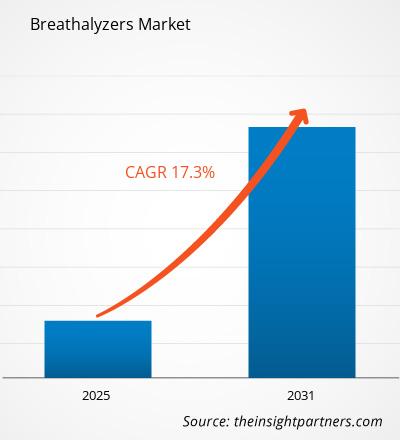
The Breathalyzers Market size is predicted to grow from US$ 3.64 Billion in 2025 to US$ 13.81 Billion in 2034 at a CAGR of 15.98%. The factors driving the growth include the increased use of breathalyzers for detecting alcohol abuse, drug abuse, and medical screening among others. This is boosted by enhanced sensor precision, device portability, and digital connectivity in testing processes.
North America continues to be a key source of revenue due to efforts by public safety authorities, occupational health departments, logistics companies and rehabilitation centers to increase testing procedures. North America will continue to experience growth due to the forecasted CAGR range of 14.5-16.0% in 2026-2034 fueled by efforts to enforce impaired driving laws, improve workplace compliance and use of fuel cell testers.
Breathalyzers Market Assessment and Insights
- North America accounted for 34–38% share in 2025 and is expected to grow at a CAGR between 2026–2034 of 14.5–16.0%, supported by DUI enforcement, DOT-style workplace testing, clinical monitoring, and connected device procurement.
- US represented 78–82% of North America in 2025 and is projected to grow at a CAGR between 2026–2034 of 14.2–15.8%, led by law enforcement, workplace, and court-monitored sobriety programs.
- Europe held 26–30% share in 2025 and is forecast to grow at a CAGR between 2026–2034 of 14.0–15.5%, with Germany, the UK, France, Italy, and Spain leading procurement.
- Asia Pacific captured 22–26% share in 2025 and is expected to grow at a CAGR between 2026–2034 of 17.5–19.5%, led by China, Japan, India, Australia, and South Korea.
- Largest Segment Fuel Cell Testers held 48–52% market share in 2025 and is expected to record a CAGR range of 15.0–16.5% during 2026–2034 due to accuracy-led adoption.
- High Growth Segment Drug abuse Detection held 16–20% market share in 2025 and is projected to grow at a CAGR range of 18.5–20.5% during 2026–2034.
- Key companies analyzed in detail: AlcoHAWK, Alcolizer Technology Pty Ltd, Abbott Laboratories, KHN Solutions Inc. (BACtrack), Breathalyzer.net, Drägerwerk AG & Co. KGaA, Intoximeters, Inc., Lifeloc Technologies, Inc., Lion Laboratories Limited, Quest Products, Inc.
Source: The Insight Partners' analysis based on proprietary research, government publications, company annual reports, investor presentations, industry databases, and expert interviews.
The Migration of Technology includes a shift from inexpensive semiconductor sensors to fuel cell tests and hybrid technologies, which provide fast recovery, higher selectivity and audit-proof performance. The production process in the industry is changing due to integration of Bluetooth capability, mobile applications, robust housing, automated calibration systems, multilingual interface and secure processes. All these improvements enhance the adoption rate of the devices by police stations, industries, airports, rehab facilities and hospitals that require repeated screening.
In future, the demand will depend on the modernization of infrastructure, recovery of aviation sector, road safety campaigns and tightened work-place risks control. New geographies in Asia Pacific and Middle East will increase the number of purchases due to increasing traffic intensity and sensitive industries there. The market will also get benefits from substance-use surveillance. The breathalyzers manufacturers will be actively developing breathalyzer technologies of drug detection, remote monitoring systems and access-control screening in mining, logistics, oil and gas and transportation industries.
Breathalyzers Market Report Scope
| Report Attribute | Details |
|---|---|
| Market size in 2025 | US$ 3.64 Billion |
| Market Size by 2034 | US$ 13.81 Billion |
| Global CAGR (2026 - 2034) | 15.98% |
| Historical Data | 2021-2024 |
| Forecast period | 2026-2034 |
Breathalyzers Market Analysis
Breathalyzers Market growth is based on enforcement pressure, occupational safety, and medical accountability. Driving under the influence of alcohol continues to be a pressing concern, and employers in industries like transportation, construction, energy, and manufacturing need quick screening for minimizing exposure to incidents. Hospitals and addiction treatment facilities create additional demand by employing breath tests in emergencies, in cases of abstinence monitoring, and for measuring compliance. The network comprises manufacturers of sensors, providers of calibration gases, developers of software, testing services providers, law enforcement distributors, and occupational health organizations.
Supply is advantageous for the vendors who have control over the sensor quality, calibration frequency, and data accuracy. The fuel cell technology is used in professional products due to reduced risk of false positives and the ability to apply in the context of evidential and semi-evidential testing. However, semiconductor oxide-based tests are used in consumer and basic level workplace testing in spite of its low cost, while spectrophotometer tests are used in stationary locations.
The market analysis for Breathalyzers reveals an industry divided among global safety-technology corporations and specific alcohol testing manufacturers. Companies like Drägerwerk AG & Co. KGaA, Intoximeters, Inc., Lifeloc Technologies, Inc., and Lion Laboratories Limited continue to hold sway in professional and law enforcement domains, whereas KHN Solutions Inc. (BACtrack), AlcoHAWK, and Breathalyzer.net have enhanced consumer access and remote monitoring capabilities. Other key players are Alcolizer Technology Pty Ltd and Quest Products, Inc.
Current investment trends are geared towards hardware solutions that can connect, calibrate automatically, manage evidence, and conduct multi-analyte breath tests. The medical diagnostics prowess of Abbott Laboratories comes through in its diversified test offerings, whereas breathalyzer experts differentiate themselves with approvals, training, and durability of devices. Positioning is now dependent on certification capability, connectivity with case management software, and the capability of working with public institutions, safety-sensitive employers, and private treatment facilities without affecting accuracy.
● REPORT CUSTOMIZATION
Tailor This Report To Align With Your Specific Business Requirements
This report can be customized to align precisely with your business objectives, scope, and target markets. Customization options include tailored segmentation, geography, competitive analysis, and strategic insights to support informed decision-making.
Customize This Report →WHAT YOU CAN ADJUST
- ● Segmentations
- ● Geography
- ● Competitive Analysis
- ● Language Preferences
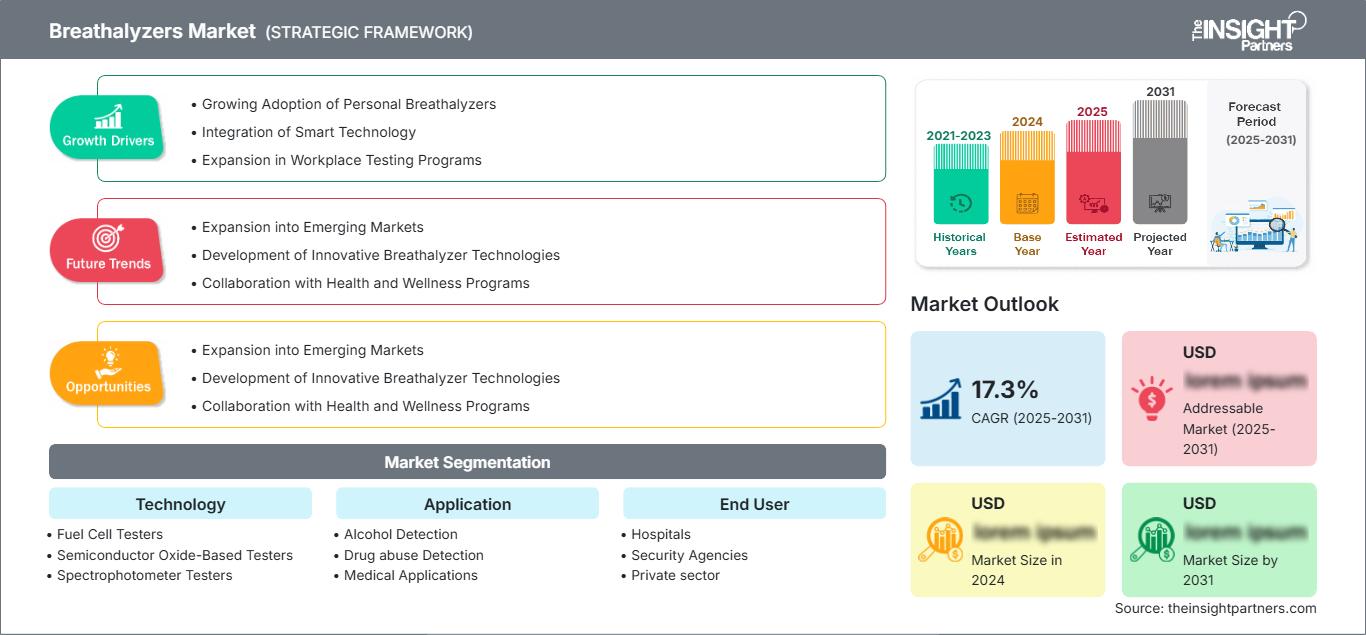
Breathalyzers Market: Strategic Insights
Regional Insights
North America Breathalyzers Market
The North America region had a market share of 34-38% in 2025, and the Breathalyzers Market share in this region is forecasted to increase at a CAGR range of 14.5-16.0% from 2026 to 2034. This market share of the North America region is driven by matured DUI enforcement policies, workforce alcohol screening, probation, and private rehabilitation.
There are also demand drivers for the market in this region due to aviation and logistics industries, oil and gas industry, and construction sector that needs pre-shift and post-incident audits of individuals. Connected breathalyzers are becoming increasingly popular with courts and treatment centers because of the time stamps, video checks, and GPS tracking capabilities that minimize compliance issues.
U.S. Breathalyzers Market
In 2025, the U.S. constituted 78-82% of North America, with an estimated growth rate of CAGR 14.2-15.8% between 2026-2034. Demand is centered on applications within police departments, highway patrol departments, DOT-compliant workplace programs, substance abuse treatments centers, and family court monitoring. Professional breathalyzer test kits by manufacturers such as Intoximeters, Inc., Drägerwerk AG & Co. KGaA, Lifeloc Technologies, Inc., and KHN Solutions Inc. (BACtrack) are well-known in the distribution channel.
Growing applications include portable fuel cell breathalyzers, remote alcohol monitoring systems, and reporting software solutions. For private businesses, post-accident and reasonable suspicion tests are the dominant types, and rehabilitation centers use repeated breathalyzer tests to encourage recovery. However, consumer breathalyzers still play an important role in the market; nevertheless, institutional procurement relies more on defensibility, support, calibration, and data security.
Europe Breathalyzers Market
The Europe market held 26-30% market share in 2025 and is expected to register a CAGR between 14.0-15.5% from 2026-2034. Germany holds the dominant position in the region due to traffic safety measures, industrial safety, and alcohol tests with high accuracy. The UK market is driven by workplace tests, security checks at events, procurement by law enforcement and rehabilitation centers.
In France, Italy, and Spain, adoption is constant due to increased use in road safety, transport, and private security for random tests. The French market is benefited by preventative road safety measures and professional alcohol testing services, while the Italian and Spanish markets are fueled by tourism and hospitality. Selection of breath alcohol tester devices include fuel cell type devices with certifications and multilingual screens.
APAC Breathalyzers Market
Market share of APAC region stood at 22–26% in 2025 and will have a CAGR in the range of 17.5–19.5% from 2026–2034. China dominates the regional market due to modernization of road safety, workforce screening in industries, and investments in public security. Japan and South Korea emphasize precision and compliance, whereas India's rapid urbanization and Australia's mining and transportation sectors require frequent testing.
Some policy factors include enhanced punishment for drunk driving, airport safety, and accident prevention in workplaces. Industrial buyers are moving towards more advanced connected handheld devices and access control-linked breath testing devices. Local distributors are critical as calibration facilities and localization play a major role in buying.
Middle East & Africa Breathalyzers Market
MEA is forecasted to experience an average CAGR between 13.5% and 15.0% from 2026 to 2034 driven by the UAE and Saudi Arabia markets. The drivers include demands generated from aviation airports, energy projects, construction sites, and security screening. South Africa will be contributing to the region through its enforcement of road safety, mining activities, and workplaces drug testing programs.
Growth will be generated from infrastructure development where institutional use cases will develop especially where there are large contractors needing to have pre-entry screening and incident control. There will be variability in the adoption levels within RoMEA due to variation in the budgets for procurement, consistency of enforcement, and calibration services.
Segmentation Analysis
Technology
The technology segment is expected to grow at a CAGR range of 15.2–16.8% during 2026–2034. The Breathalyzers Market scope across technology is expanding as buyers prioritize sensor selectivity, calibration reliability, digital connectivity, and defensible records. Professional users favor devices with fuel cell architecture, while lower-cost semiconductor platforms retain demand in entry-level screening and personal-use categories.
- Fuel Cell Testers: Fuel cell testers lead professional adoption because they offer alcohol-specific measurement, stable repeatability, and suitability for law enforcement, workplace testing, rehabilitation monitoring, and high-frequency institutional use.
- Semiconductor Oxide-Based Testers: Semiconductor oxide-based testers serve budget-sensitive and consumer applications where affordability and compact design matter, though professional buyers remain cautious about selectivity under demanding field conditions.
- Spectrophotometer Testers: Spectrophotometer testers maintain strategic relevance in fixed forensic or evidential environments where controlled settings, documented processes, and high analytical reliability support formal alcohol measurement.
Application
The application segment is expected to grow at a CAGR range of 15.5–17.2% during 2026–2034. Alcohol detection remains the largest use case, but drug abuse detection is becoming strategically important as agencies and employers seek rapid, less invasive screening. Medical applications are also expanding in emergency care, liver disease monitoring, detoxification support, and treatment compliance.
- Alcohol Detection: Alcohol detection dominates routine procurement because it is embedded in traffic enforcement, workplace programs, event security, correctional monitoring, and private sobriety management.
- Drug abuse Detection: Drug abuse Detection is the fastest-moving application as public safety agencies and employers seek breath-based workflows that reduce reliance on slower or more invasive sample collection.
- Medical Applications: Medical applications are growing as hospitals and clinics use breath testing for triage support, addiction treatment monitoring, metabolic assessment, and recurring patient compliance checks.
End User
The end user segment is expected to grow at a CAGR range of 14.8–16.5% during 2026–2034. Adoption differs by setting, with security agencies emphasizing evidential quality, hospitals prioritizing patient workflow, and private-sector buyers focusing on incident prevention. Rehabilitation centers create recurring demand for verified testing, especially where remote monitoring supports supervision outside facility walls.
- Hospitals: Hospitals use breath testing for emergency assessment, intoxication screening, treatment planning, and patient monitoring where rapid results can improve clinical workflow and decision speed.
- Security Agencies: Security agencies require rugged, portable, and legally defensible devices for roadside checks, public venues, transport hubs, correctional facilities, and institutional screening programs.
- Private sector: Private sector adoption is rising among logistics, mining, construction, aviation services, manufacturing, and energy companies seeking auditable alcohol policies and lower operational risk.
- Rehabilitation Centers: Rehabilitation centers rely on recurring breath checks to verify abstinence, support treatment compliance, document progress, and enable remote supervision for outpatient recovery programs.
Opportunity Snapshot
| Segment Name | Revenue Contribution | Trend Tag | Adoption Stage |
| Hospitals | Medium | Clinical Triage | Scaling |
| Security Agencies | High | Roadside Enforcement | Mature |
| Private sector | High | Workplace Screening | Scaling |
| Rehabilitation Centers | Medium | Remote Monitoring | Scaling |
| Others | Low | Event Access | Emerging |
Breathalyzers Market Growth Drivers and Impact Analysis
Stricter Road Safety Enforcement
The aspect of road safety enforcement still constitutes a vital driver for demand since impaired driving results in avoidable deaths, medical costs, legal costs, and increased insurance risk. There are rising efforts by governments to implement more roadside inspections, sobriety checkpoints, and deterrence efforts, thereby directly supporting the procurement of handheld fuel cell testers and evidentiary testing kits. The effect is most profound in instances where there is a need for high speed, robustness, and reliable documentation of testing results by law enforcement organizations. Suppliers of tested devices, consumables, calibration services, and training of officers can earn continuous revenue streams beyond the sale of devices. The increasing density of traffic in growing urban centers adds value to the Market.
Workplace Safety and Compliance Programs
Alcohol testing by safety-sensitive employers is becoming more prevalent since alcoholism could lead to interruptions in the operation, injuries, and litigation or compliance risks. Transport, mining, aviation services, construction, oil and gas, and warehousing companies are gradually transitioning into pre-shift, random, post-incident, and return-to-work testing. The buying influence here is clear, as customers seek breathalyzers that minimize time lost, streamline the process, and connect with other control or HR systems. This results in greater allocation of resources being spent on testing ecosystems rather than less expensive standalone devices. Breathalyzers Market vendors with robust hardware, reporting, calibration capabilities, and training achieve better retention rates especially among multi-location companies.
Expansion of Rehabilitation and Remote Monitoring
Increased demand will be seen from rehabilitation centers, courts, probation, and family monitoring systems for alcohol verification services. Breathalyzers that connect to smartphones may record BrAC results, time stamps, identity verifications, and locations. Thus, remote monitoring is possible without the need for physical clinics. The effect on the market will be a shift in services offered from one-off tests to recurring compliance services. Fuel cells, tamper-proof mouthpieces, smartphone apps, subscription-based websites, and other technologies are expected to see increased demand. Remote monitoring makes it easier to provide services in rural or underserved areas where visits to clinics are challenging.
Breathalyzers Market Future Trends
Connected Testing Ecosystems
Connected platforms will define Breathalyzers Market trends as buyers seek integrated workflows instead of standalone readings. Future devices will increasingly pair with mobile applications, cloud dashboards, digital printers, evidence systems, and access-control platforms. This evolution will support automated policy enforcement, faster reporting, and stronger auditability across workplaces, courts, and agencies. Artificial intelligence may improve anomaly detection by identifying missed tests, suspicious patterns, or device misuse. The strategic shift will favor suppliers that can combine sensor accuracy with cybersecurity, interoperability, and data governance. Hardware margins may compress, but software-enabled services can expand customer lifetime value and strengthen competitive differentiation.
Multi-Analyte Breath Screening
Breath testing is moving beyond alcohol toward rapid screening for drugs, biomarkers, and health indicators. The next phase will focus on portable platforms that detect cannabis, opioids, or other substances without relying solely on urine, blood, or saliva collection. Technical hurdles remain, including sensitivity, environmental interference, and validation against legal standards. However, demand from employers, police, and clinicians is strong because breath samples are fast, noninvasive, and operationally convenient. Companies with expertise in sensors, microfluidics, spectroscopy, and data analytics may create differentiated platforms. Successful validation could expand the addressable market substantially and reposition breathalyzers as broader safety and health tools.
Breathalyzers Market Opportunities
Institutional Fleet Replacement
A major opportunity lies in replacing aging breath testing fleets with connected, fuel cell-based systems. Many law enforcement agencies, transport operators, and industrial users still operate devices that meet basic needs but lack modern data transfer, multilingual prompts, high-capacity storage, or automated calibration support. Breathalyzers Market Forecasts indicate that replacement cycles will accelerate as buyers seek traceability and lower service downtime. Suppliers should target multi-year contracts bundling hardware, mouthpieces, calibration, training, and software rather than selling devices alone. This approach can improve revenue visibility, deepen customer relationships, and reduce competitive switching where compliance documentation is mission critical.
Access-Control Integrated Screening
Integrating breath testing with site access systems creates an actionable opportunity for high-risk workplaces. Mining sites, refineries, logistics depots, airports, and construction projects can automate pass-or-deny decisions before workers enter controlled areas. This reduces supervisor burden, improves consistency, and creates a clear audit trail for safety investigations. Suppliers can partner with security-system integrators, occupational health providers, and enterprise software vendors to deliver turnkey solutions. The opportunity is strongest in regions where infrastructure investment and workforce mobility are rising. Vendors that provide reliable passive or active testing, durable enclosures, and rapid service support can convert safety policies into recurring operational demand.
Recent Developments
- March 2026: Lifeloc Technologies, Inc. reported 2025 revenue growth to US$ 9.027 million and highlighted continued market penetration of its L-series LX9 and LT7 devices, citing smartphone pairing, wider temperature range, local-language customization, and AS 3547:2019 certification as factors supporting professional adoption.
- April 2025: Drägerwerk AG & Co. KGaA launched the Alcotest 7000 for law enforcement, DOT compliance, and workplace safety screening. The device combines mouthpiece and funnel-based testing, Bluetooth connectivity, a color display, and storage for up to 10,000 results, improving field mobility and documentation.
- February 2025: Alcolizer Technology Pty Ltd promoted its LE5 law enforcement breathalyser platform with AS 3547:2019 certification, electrochemical fuel cell technology, Bluetooth printing, multiple testing modes, and data download capability, strengthening its positioning in police, industrial, and high-frequency workplace testing environments.
Frequently Asked Questions

- Comprehensive Market Sizing and Forecast Analysis
- Detailed Segmentation Analysis
- In-Depth Market Dynamics Assessment
- Regional and Country-Level Insights
- Competitive Landscape and Company Benchmarking
- Strategic Business Intelligence
Recent Reports
Testimonials

The Insight Partners' SCADA System Market report is comprehensive, with valuable insights on current trends and future forecasts. The team was highly professional, responsive, and supportive throughout. We are very satisfied and highly recommend their services.
RAN KEDEM Partner, Reali Technologies LTDs
I requested a report on a very specific software market and the team produced the report in a few days. The information was very relevant and well presented. I then requested some changes and additions to the report. The team was again very responsive and I got the final report in less than a week.
JEAN-HERVE JENN Chairman, Future Analytica
We worked with The Insight Partners for an important market study and forecast. They gave us clear insights into opportunities and risks, which helped shape our plans. Their research was easy to use and based on solid data. It helped us make smart, confident decisions. We highly recommend them.
PIYUSH NAGPAL Sr. Vice President, High Beam Global
The Insight Partners delivered insightful, well-structured market research with strong domain expertise. Their team was professional and responsive throughout. The user-friendly website made accessing industry reports seamless. We highly recommend them for reliable, high-quality research services
YUKIHIKO ADACHI CEO, Deep Blue, LLC.
This is the first time I have purchased a market report from The Insight Partners.While I was unsure at first, I visited their web site and felt more comfortable to take the risk and purchase a market report.I am completely satisfied with the quality of the report and customer service. I had several questions and comments with the initial report, but after a couple of dialogs over email with their analyst I believe I have a report that I can use as input to our strategic planning process.Thank you so much for taking the extra time and making this a positive experience.I will definitely recommend your service to others and you will be my first call when we need further market data.
JOHN SUZUKI President and Chief Executive Officer, Board Director, BK Technologies
I wish to appreciate your support and the professionalism you displayed in the course of attending to my request for information regarding to infectious disease IVD market in Nigeria. I appreciate your patience, your guidance, and the fact that you were willing to offer a discount, which eventually made it possible for us to close a deal. I look forward to engaging The Insight Partners in the future, all thanks to the impression you have created in me as a result of this first encounter.
DR CHIJIOKE ONYIA MANAGING DIRECTOR, PineCrest Healthcare Ltd.Reason to Buy
- Informed Decision-Making
- Understanding Market Dynamics
- Competitive Analysis
- Identifying Emerging Markets
- Customer Insights
- Market Forecasts
- Risk Mitigation
- Boosting Operational Efficiency
- Strategic Planning
- Investment Justification
- Tracking Industry Innovations
- Aligning with Regulatory Trends





 Get Free Sample for