
Bunsen Burner Market Growth, Trends & Demand by 2034
Coverage: By Product (Standard Burners, Safety Burners); Fuel Source (Natural Gas Burners, LPG Burners, Hybrid Burners); End-User (Academic Institutes, Research Institutes, Clinical Laboratories), and Geography (North America, Europe, Asia Pacific, and South and Central America)
- Status : Data Released
- Report Code : TIPRE00017792
- Category : Life Sciences
- No. of Pages : 150
- Available Report Formats :


- Last update date : August 12, 2026


2025 Market Size
US$ 141.59 Mn
Base year value
2034 Forecast
US$ 227.03 Mn
Projected by 2034
CAGR 2026-2034
5.39 %
Growth rate
Addressable Market
US$ 1,672.07 Mn
(2026-2034)
The Bunsen Burner Market was valued at US$ 141.59 Million in 2025 and is projected to reach US$ 227.03 Million by 2034, expanding at a CAGR of 5.39% during 2026–2034. Demand continues to be firmly rooted in academic laboratories, clinical testing labs, and research institutions where controlled flame heating, sterilization, and combustion activities still demand small, reliable, and low maintenance burner equipment.
North America is a mature but robust demand hub with the Bunsen Burner Market size bolstered by the cyclic replacement of laboratory equipment, safety standards on college campuses, and consistent purchases made for the life sciences, chemistry, and medical training purposes. The region is forecast to register a CAGR of 4.9 to 5.4% for the period 2026–2034.
Bunsen Burner Market Assessment and Insights
- North America held 34–36% share in 2025 and is expected to grow at a CAGR range of 4.9–5.4% during 2026–2034, supported by high laboratory density, replacement-led demand, and institutional safety compliance.
- US accounted for 76–79% of North America in 2025 and is projected to grow at a CAGR range of 4.8–5.3% during 2026–2034, driven by university labs and clinical facilities.
- Europe represented 27–29% share in 2025 and is forecast to grow at a CAGR range of 4.6–5.1% during 2026–2034, with Germany, the UK, and France leading demand.
- Asia Pacific captured 24–26% share in 2025 and is projected to grow at a CAGR range of 6.0–6.6% during 2026–2034, led by China, India, Japan, South Korea, and Australia.
- Largest Segment Standard Burners held 58–62% market share in 2025 and is expected to grow at a CAGR range of 4.7–5.2% during 2026–2034.
- High Growth Segment Safety Burners held 38–42% share in 2025 and is forecast to grow at a CAGR range of 6.0–6.7% during 2026–2034.
- Key companies analyzed in detail: Humboldt Mfg. Co., Hospital Equipment Mfg. Co., R & L Enterprises Ltd., Braun & Company Ltd., Carl Friedrich Usbeck KG, Daigger Scientific Inc., Sigma-Aldrich Co. LLC, INTEGRA Biosciences AG, Dentalfarm Srl, Paul Marienfeld GmbH & Co. KG, Eisco Scientific LLC, and Cole-Parmer Instrument Company, LLC.
Source: The Insight Partners' analysis based on proprietary research, government publications, company annual reports, investor presentations, industry databases, and expert interviews.
Design features in laboratory burner models have evolved greatly from the basic tubular combustion device to more sophisticated burners featuring improved flame stability, anti-skid base, adjustable gas flow, and ability to work with natural gas/LPG. Manufacturing dynamics in the segment are rather fragmented since burners are inexpensive, durable products that are usually purchased through distributors of laboratory equipment and not as capital equipment. The main differentiation among burner manufacturers is based on material quality, standards (DIN/CE), combustion efficiency, and supplementary accessories such as hose, regulators, igniters, and flame stabilizers.
Future growth potential is associated with growth in infrastructure in educational institutions, increase in healthcare laboratories, as well as laboratory renovations due to safety concerns. Regulatory aspects addressing biosafety, ventilation, and proper gas handling would promote burners featuring reliable inlet connections and ignition system. Growth in procurement is expected in Asia Pacific and certain Middle Eastern countries due to the development of university, diagnostics, and scientific laboratories facilities.
Bunsen Burner Market Report Scope
| Report Attribute | Details |
|---|---|
| Market size in 2025 | US$ 141.59 Million |
| Market Size by 2034 | US$ 227.03 Million |
| Global CAGR (2026 - 2034) | 5.39% |
| Historical Data | 2021-2024 |
| Forecast period | 2026-2034 |
Bunsen Burner Market Analysis
Market Development Profile for Bunsen Burner Market development is characterized by consistent usage in the lab rather than through technological innovations. The burners are currently used to provide heat, sterilize, manipulate glassware, and illustrate the process of combustion in academic chemistry, microbiology, dental material science, and clinic preparations departments. Biosafety guidelines from WHO in biomedical laboratories focus on risk assessment and safety, thus creating need for safe use of flames and bench controls.
Participants in the value chain include metals, manufacture of burners, distribution of laboratory equipment, institutional purchasers, and end users. The stability of supply is ensured due to manufacturing being based on brass, aluminum, zinc alloy, stainless steel, and mechanical parts, but no electronic parts. Compatibility of the sources of gas is one of the factors that affects purchasing decision, especially in the case of centralization of the pipeline of natural gas or LPG cylinders.
Bunsen Burner Market Report competitive positioning is based on breadth of catalogue, distribution, and safety. Humboldt Mfg. Co. stresses made-in-America burners featuring die-cast zinc bases and various gases, while Carl Friedrich Usbeck KG provides DIN compliant natural gas, bottle gas, and all-gas laboratory burners.
Strategies for increasing availability are adopted by Eisco Scientific LLC, Sigma-Aldrich Co. LLC, Daigger Scientific Inc., and Cole-Parmer Instrument Company, LLC. INTEGRA Biosciences AG had been concentrating on safety burners under FIREBOY series that ensured flame detection, overheating, and multi-gas features but, unfortunately, FIREBOY has been discontinued from 2022 onwards.
● REPORT CUSTOMIZATION
Tailor This Report To Align With Your Specific Business Requirements
This report can be customized to align precisely with your business objectives, scope, and target markets. Customization options include tailored segmentation, geography, competitive analysis, and strategic insights to support informed decision-making.
Customize This Report →WHAT YOU CAN ADJUST
- ● Segmentations
- ● Geography
- ● Competitive Analysis
- ● Language Preferences
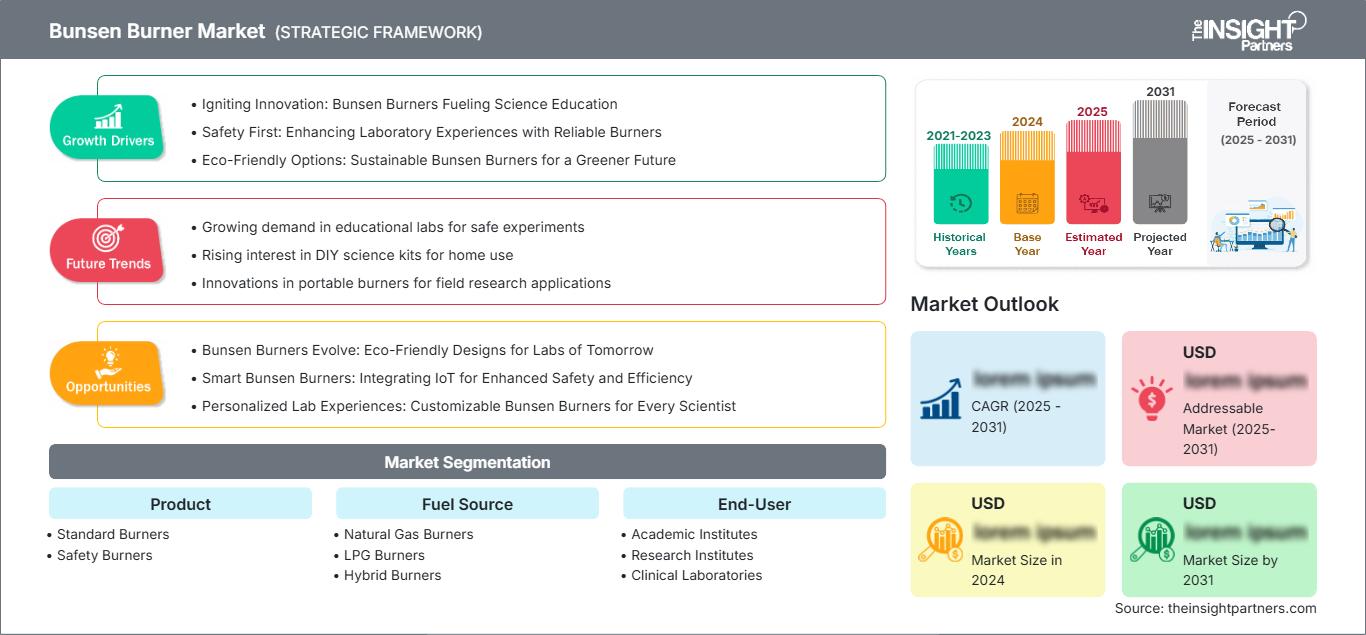
Bunsen Burner Market: Strategic Insights
Regional Insights
North America Bunsen Burner Market
Share of North America was 34-36% in 2025 and is forecast to grow at a CAGR of 4.9-5.4% between 2026-2034. North America’s market share in the Bunsen Burner is due to the presence of many school, university, healthcare, and industrial laboratories. The demand is driven by factors such as stability of the base, secure gas connection, flexibility in adjustment of the flame and suitability with existing gas facilities.
There are well-established laboratory supply chains and periodic purchase of laboratory instruments by educational districts, community colleges, research centers and hospital laboratories. Safety considerations in product selection have become relevant as laboratories re-evaluate the use of open flames in view of biosafety, ventilation and risk management practices. Natural gas burners account for fixed laboratory applications and LPG burners find use in mobile applications.
U.S. Bunsen Burner Market
United States comprised 76%-79% of the geographical region of North America in 2025 and is anticipated to experience a CAGR in the range of 4.8%-5.3% during the period 2026-2034. Demand for this segment is driven by higher rates of laboratory equipment replacement in various organizations such as academia laboratories, clinical laboratories, biotechnology training laboratories, and industrial testing laboratories. Adoption of product will be inclined towards standard burners that have robust bases, flame stabilizers, and tubing accessories.
Companies presence is wide through distributors such as Fisher Scientific, Sigma-Aldrich, Cole-Parmer, and specialists. Humboldt Mfg. Co. continues to play a role in the domestic laboratory burner market whereas Eisco products continue to gain visibility through educational segments. Application areas include sterilization, demonstration, micro-method analysis, and heating applications using open flame rather than electric flames.
Europe Bunsen Burner Market
Europe constituted 27-29% of market share in 2025 and is expected to witness a compound annual growth rate (CAGR) in the range of 4.6%-5.1% from 2026 to 2034. Germany leads the region with high demand supported by its production base of laboratory equipment, technical education system, and regulatory product norms. Carl Friedrich Usbeck KG helps boost demand in Germany through burner lines and all-gas systems conforming to DIN norms.
UK continues to have stable demand via universities, school labs, medical testing labs, and contract research organizations. Demand is driven by safety audit of facilities, gas line testing, and lab refurbishments. France, Italy, and Spain drive moderate demand in Europe through educational reform, healthcare lab investment, and burner product distribution.
APAC Bunsen Burner Market
Share of Asia Pacific stood at 24-26% in 2025 and is forecast to register a CAGR of 6.0-6.6% in 2026-2034. Leading country of this region is China due to development of science education resources, research grants and industrial testing labs. Replacement demand for quality research infrastructure is fueled in Japan and South Korea.
Growth in India and Australia will be driven by lab upgrades, diagnostics equipment increase, and STEM education. The region is characterized by lower cost of burners production, distributor imports and wide use of LPG fueling systems in institutions without permanent gas infrastructure. OECD and World Bank R&D statistics prove research intensity in Japan, South Korea, Australia and other developed countries of APAC.
Middle East & Africa Bunsen Burner Market
Middle East & Africa is expected to grow at a CAGR range of 4.3–4.8% during 2026–2034. Saudi Arabia is the leading country, supported by university expansion, healthcare infrastructure investment, and industrial laboratory development. The UAE follows through private education, medical testing, and applied science facilities.
The reason why South Africa continues to be the most established African market is its university system, health laboratories and mine testing needs. RoMEA demand will continue to be selective and mostly donor-driven for education and laboratory rehabilitation purposes. Gas supply, maintenance facilities, and budget will dictate the speed of adoption.
Segmentation Analysis
Product
Product is projected to grow at a CAGR range of 5.1–5.7% during 2026–2034. The Bunsen Burner Market scope within this segment includes traditional standard burners and increasingly preferred safety burners. Procurement decisions are influenced by flame stability, burner base design, ignition method, laboratory risk profile, and compatibility with institutional gas systems.
- Standard Burners remain the largest sub-segment because they offer low acquisition cost, simple maintenance, and suitability for routine heating, combustion, and classroom demonstrations across established academic and research laboratories.
- Safety Burners are gaining strategic relevance as laboratories adopt flame monitoring, overtemperature protection, anti-tip construction, hands-free operation, and controlled burn-time features to reduce operational risks around open flames.
Fuel Source
Fuel Source is expected to grow at a CAGR range of 5.0–5.6% during 2026–2034. Selection depends on installed infrastructure, gas availability, portability needs, and local safety rules. Natural gas remains preferred in permanent laboratories, while LPG and hybrid models support flexible teaching, field, and temporary laboratory setups.
- Natural Gas Burners lead fixed laboratory use because centralized gas lines provide consistent supply, lower per-use operating cost, and reliable flame output for repetitive teaching and research workflows.
- LPG Burners serve institutions without piped gas infrastructure and remain important in portable, rural, temporary, and field laboratory environments requiring controlled flame access.
- Hybrid Burners appeal to users seeking fuel flexibility, especially laboratories managing mixed infrastructure, backup requirements, or multi-location procurement across campuses and satellite facilities.
End-User
End-User is forecast to grow at a CAGR range of 5.2–5.8% during 2026–2034. Academic institutes dominate volume purchases, while research institutes and clinical laboratories drive demand for higher-quality, safer, and more consistent flame-control systems. Procurement is usually bundled with broader laboratory consumables and bench equipment.
- Academic Institutes represent the most consistent demand source because chemistry, biology, and materials science curricula require basic flame-heating demonstrations and recurring replacement of damaged or aged burners.
- Research Institutes prioritize stable flame performance, precision gas adjustment, durable construction, and compatibility with specialized laboratory workflows where burners support preparation, sterilization, and controlled heating.
- Clinical Laboratories purchase selectively, focusing on sterilization-related procedures, biosafety-aligned workflows, backup flame applications, and safer burner configurations where open flame use remains permitted.
Opportunity Snapshot
| End-User | Revenue Contribution | Trend Tag | Adoption Stage |
| Academic Institutes | High | STEM Labs | Mature |
| Research Institutes | Medium | Precision Flame | Scaling |
| Clinical Laboratories | Medium | Biosafety Bench | Scaling |
Bunsen Burner Market Growth Drivers and Impact Analysis
Expansion of STEM Education and Laboratory Infrastructure
Education systems continue to invest in practical science learning, increasing demand for low-cost and durable bench equipment. Burners remain essential in foundational chemistry and biology instruction because they enable visual demonstrations of combustion, heating, sterilization, and flame behavior. The impact is strongest in secondary schools, community colleges, private universities, and vocational programs that need standardized laboratory setups at scale. This driver supports repeat procurement rather than one-time capital spending because burners are frequently replaced due to wear, missing components, corrosion, or safety audits. Suppliers with broad distributor access and bundled laboratory kits are positioned to capture institutional demand.
Shift Toward Safer Flame Handling in Regulated Labs
Laboratories are increasingly assessing open-flame equipment through risk-based safety programs. This supports demand for burners with anti-tip bases, flame stabilizers, gas control valves, secure tubing connections, and automatic shutoff options. WHO biosafety guidance highlights risk assessment and control measures for laboratory practices, which strengthens the rationale for safer equipment selection in biomedical and clinical settings. The market impact is a gradual mix shift from basic units toward safety-enhanced burners. Manufacturers that document compliance, provide clear operating manuals, and support training-oriented procurement can improve acceptance among institutional buyers.
Stable Replacement Demand Across Installed Laboratory Bases
The installed base of burners across education, healthcare, research, dental, and industrial laboratories creates recurring replacement demand. Unlike high-value instruments, burners have long functional lives but are exposed to flame heat, gas flow, chemical vapors, and frequent handling. This creates steady purchasing cycles for bases, nozzles, hoses, regulators, igniters, and full burner replacements. Market impact is visible in distributor catalogs that maintain wide burner assortments across gas types and price points. Because procurement teams often purchase burners with other consumables, companies with strong channel partnerships can maintain stable revenue even when new laboratory construction slows.
Bunsen Burner Market Future Trends
Safety-Centric Burner Design
The most visible Bunsen Burner Market trends will involve safety-first designs that reduce gas leakage, flame instability, and accidental tipping. Buyers will increasingly compare burner bases, gas connectors, ignition control, and flame monitoring before selecting products. This trend will not eliminate standard burners, but it will influence classroom and clinical procurement specifications. Suppliers may add clearer safety documentation, bundled tubing, improved regulators, and training materials. The effect will be gradual because budget-constrained institutions still favor standard models, yet safety burners will capture share in newly refurbished laboratories and regulated biomedical spaces.
Fuel Flexibility and Portable Laboratory Use
Fuel flexibility will gain importance as institutions operate mixed laboratory environments across permanent buildings, temporary teaching rooms, mobile testing units, and field locations. Hybrid burners and LPG-compatible models will benefit where fixed natural gas lines are unavailable or costly to install. IEA gas market analysis shows supply security and price volatility remain relevant considerations for gas users, encouraging buyers to value adaptable equipment. Portable burner demand will also align with rural education, field science programs, and emergency laboratory preparedness, where compact flame equipment remains useful.
Bunsen Burner Market Opportunities
Distributor-Led Bundling for Educational Laboratories
Suppliers can expand by bundling burners with hoses, igniters, tripods, wire gauze, safety mats, and instructional materials for academic laboratory upgrades. This approach reduces procurement complexity for schools and colleges that often buy equipment in classroom sets. The Bunsen Burner Market Forecasts indicate that volume growth will be strongest where science infrastructure is expanding rather than fully mature. Manufacturers should target distributor catalogs, institutional framework contracts, and education procurement portals. Bundled solutions can also improve safety consistency because buyers receive compatible accessories instead of sourcing components from multiple vendors.
Premium Safety Burners for Clinical and Research Settings
Clinical and research laboratories present an opportunity for premium safety burners with flame monitoring, automatic shutoff, stable bases, and hands-free activation. These buyers are less price-sensitive than classrooms when burner use is tied to contamination control, biosafety protocols, or high-value workflows. Product positioning should emphasize risk reduction, ease of cleaning, compatibility with common gases, and documentation for internal safety audits. Manufacturers can also offer replacement parts and maintenance guidance because these environments value uptime and traceability. This opportunity is smaller in unit volume but stronger in value contribution.
Recent Developments
- June 2026: Sigma-Aldrich Co. LLC listed Eisco Labs Tirrill Bunsen Burner with gas flow control, flame stabilizer, and air-flow adjustment for natural gas users, with availability shown for June 16, 2026. The listing highlighted a cast iron extended base, natural gas suitability, 800–1200 BTU range, and approximately 1500°C maximum temperature.
- June 2026: Eisco Scientific LLC showcased its NextGen Bunsen Burner line with expanded anti-tip bases, spaced feet for stand compatibility, and carry handles for safer movement of hot burners. The product collection reinforces the company’s focus on education-oriented burner safety and liquid propane or natural gas configurations.
- 2026: Humboldt Mfg. Co. promoted its 2026 catalog and continued to feature laboratory Bunsen burners with nickel-plated die-cast zinc bases, aluminum mixing tubes, serrated gas inlet connections, and flame stabilizer options. The catalog positioning supports replacement demand across education and general laboratory supply channels.
Frequently Asked Questions

- Comprehensive Market Sizing and Forecast Analysis
- Detailed Segmentation Analysis
- In-Depth Market Dynamics Assessment
- Regional and Country-Level Insights
- Competitive Landscape and Company Benchmarking
- Strategic Business Intelligence
Recent Reports
Testimonials

The Insight Partners' SCADA System Market report is comprehensive, with valuable insights on current trends and future forecasts. The team was highly professional, responsive, and supportive throughout. We are very satisfied and highly recommend their services.
RAN KEDEM Partner, Reali Technologies LTDs
I requested a report on a very specific software market and the team produced the report in a few days. The information was very relevant and well presented. I then requested some changes and additions to the report. The team was again very responsive and I got the final report in less than a week.
JEAN-HERVE JENN Chairman, Future Analytica
We worked with The Insight Partners for an important market study and forecast. They gave us clear insights into opportunities and risks, which helped shape our plans. Their research was easy to use and based on solid data. It helped us make smart, confident decisions. We highly recommend them.
PIYUSH NAGPAL Sr. Vice President, High Beam Global
The Insight Partners delivered insightful, well-structured market research with strong domain expertise. Their team was professional and responsive throughout. The user-friendly website made accessing industry reports seamless. We highly recommend them for reliable, high-quality research services
YUKIHIKO ADACHI CEO, Deep Blue, LLC.
This is the first time I have purchased a market report from The Insight Partners.While I was unsure at first, I visited their web site and felt more comfortable to take the risk and purchase a market report.I am completely satisfied with the quality of the report and customer service. I had several questions and comments with the initial report, but after a couple of dialogs over email with their analyst I believe I have a report that I can use as input to our strategic planning process.Thank you so much for taking the extra time and making this a positive experience.I will definitely recommend your service to others and you will be my first call when we need further market data.
JOHN SUZUKI President and Chief Executive Officer, Board Director, BK Technologies
I wish to appreciate your support and the professionalism you displayed in the course of attending to my request for information regarding to infectious disease IVD market in Nigeria. I appreciate your patience, your guidance, and the fact that you were willing to offer a discount, which eventually made it possible for us to close a deal. I look forward to engaging The Insight Partners in the future, all thanks to the impression you have created in me as a result of this first encounter.
DR CHIJIOKE ONYIA MANAGING DIRECTOR, PineCrest Healthcare Ltd.Reason to Buy
- Informed Decision-Making
- Understanding Market Dynamics
- Competitive Analysis
- Identifying Emerging Markets
- Customer Insights
- Market Forecasts
- Risk Mitigation
- Boosting Operational Efficiency
- Strategic Planning
- Investment Justification
- Tracking Industry Innovations
- Aligning with Regulatory Trends





 Get Free Sample for