
C-Reactive Protein Rapid Test Market Growth, Demand & Size by 2034
Coverage: By Type (Immunoturbidimetric Assay, ELISA, Chemiluminescence Immunoassay (CLIA), Others); End User (Hospitals, Diagnostic Laboratories, Others), and Geography (North America, Europe, Asia Pacific, and South and Central America)
- Status : Data Released
- Report Code : TIPRE00021650
- Category : Life Sciences
- No. of Pages : 150
- Available Report Formats :


- Last update date : August 14, 2026


2025 Market Size
US$ 1,095.91 Mn
Base year value
2034 Forecast
US$ 1,898.00 Mn
Projected by 2034
CAGR 2026-2034
6.29 %
Growth rate
Addressable Market
US$ 13,547.30 Mn
(2026-2034)
The C-Reactive Protein Rapid Test Market is projected to grow from US$ 1,095.1 million in 2025 to US$ 1,898.00 Million by 2034, registering a CAGR of 6.29% during 2026–2034. Demand is being shaped by rapid inflammation screening, antibiotic stewardship programs, emergency care triage, and broader adoption of point-of-care diagnostics across hospitals and diagnostic laboratories.
Across North America, the C-Reactive Protein Rapid Test Market size is supported by mature laboratory networks, higher use of high-sensitivity inflammatory markers, and reimbursement-linked diagnostic pathways. The region is expected to expand at a CAGR range of 5.8–6.3% during 2026–2034, with adoption led by urgent care settings, hospital outpatient departments, and clinical chemistry platforms that support faster turnaround for infection and inflammatory disease assessment.
C-Reactive Protein Rapid Test Market Assessment and Insights
- North America accounted for 35–38% share in 2025 and is expected to grow at a CAGR range of 5.8–6.3% during 2026–2034, supported by rapid testing penetration, primary care stewardship, and hospital automation.
- US represented 82–86% of North America in 2025 and is expected to grow at a CAGR range of 5.9–6.4% during 2026–2034, led by decentralized diagnostics.
- Europe held 27–30% share in 2025 and is projected to grow at a CAGR range of 5.4–5.9% during 2026–2034, with Germany, the UK, France, Italy, and Spain leading adoption.
- Asia Pacific captured 22–25% share in 2025 and is forecast to grow at a CAGR range of 7.2–7.8% during 2026–2034, led by China, Japan, India, South Korea, and Australia.
- Largest Segment Immunoturbidimetric Assay held 54–58% market share in 2025 and is expected to grow at a CAGR range of 5.8–6.3% during 2026–2034.
- High Growth Segment Diagnostic Laboratories held 42–46% market share in 2025 and is expected to grow at a CAGR range of 6.6–7.2% during 2026–2034.
- Key companies analyzed in detail: HORIBA Ltd.; Thermo Fisher Scientific Inc.; F. Hoffmann-La Roche Ltd; Quest Diagnostics Incorporated; Abbott Laboratories; Siemens Healthineers AG; Danaher Corporation; QuidelOrtho Corporation; Laboratory Corporation of America Holdings; Merck KGaA; Bio-Techne Corporation; Abcam plc; Randox Laboratories Ltd.; LifeSpan BioSciences, Inc.; and Zoetis Inc.
Source: The Insight Partners' analysis based on proprietary research, government publications, company annual reports, investor presentations, industry databases, and expert interviews.
Use in clinical practice has moved from traditional confirmation of inflammation to a faster, decision-support testing scenario that takes place in ambulatory, ER, and lab settings. Immunoturbidimetric tests are still important, as they are compatible with automated chemistry analyzers and allow for fast test processing. Production trends are shifting towards smaller analyzers, compatibility with whole blood testing, capillary sampling, and stability of reagents. This trend corresponds with the growing importance of AMR problems, as according to the World Health Organization, resistant bacterial infections contributed to more than 4.7 million deaths worldwide in 2021.
Forthcoming growth can be seen in the Asia Pacific region, select healthcare centers in the Middle East, and under-served ambulatory centers in Europe. The development of diagnostic instruments that facilitate the reduction in antibiotic use is being encouraged by governments. Private laboratories are focusing on building comprehensive chemistry systems and developing rapid immunoassays menus. Growth in the market would come from the migration of CRP tests from clinical workflow to urgent care, pediatric triage, and chronic inflammation assessment.
C-Reactive Protein Rapid Test Market Report Scope
| Report Attribute | Details |
|---|---|
| Market size in 2025 | US$ 1,095.91 Million |
| Market Size by 2034 | US$ 1,898.00 Million |
| Global CAGR (2026 - 2034) | 6.29% |
| Historical Data | 2021-2024 |
| Forecast period | 2026-2034 |
C-Reactive Protein Rapid Test Market Analysis
The factors driving the growth of the C-Reactive Protein Rapid Test Market include the need to differentiate between the presence of bacterial complications and self-resolving inflammation conditions in the same clinic visit. The importance of primary care cannot be overstated as WHO observes that 80% to 90% of the use of antibiotics occurs at this level and there will therefore be an obvious place for CRP tests to be included in antibiotic stewardship workflows.
The players in this value chain are antibody and reagent manufacturers, analyzer providers, distributors, hospital laboratories, reference laboratories, and point-of-care users. The supply chain is being bolstered through ready-to-use liquid reagents, automation of calibration, and increased analyzer compatibilities. Nonetheless, laboratories perform lot stability studies, quality controls, sample type flexibility, and compatibility of the devices to laboratory information systems before widening their rapid CRP menu.
C-Reactive Protein Rapid Test Market Report reveals that the market is operating in a competitive environment with competition divided into diagnostics platform players and immunoassays players. Key competitors include F. Hoffmann-La Roche Ltd, Siemens Healthineers AG, Abbott Laboratories, HORIBA Ltd., and Danaher Corporation, which compete through their chemistry analyzers, point-of-care devices, and workflow systems, while Randox Laboratories Ltd and Bio-Techne Corporation have good product lines.
Positioning of the companies relies on the number of tests available in their menus, claims for capillary blood use, software capabilities, and compliance with IVDR and FDA regulations. Quest Diagnostics Incorporated and Laboratory Corporation of America Holdings play an important role in influencing the demand based on their capacity for reference testing, while Thermo Fisher Scientific Inc., Merck KGaA, Abcam plc, and LifeSpan BioSciences, Inc. are involved in assay and antibody development.
● REPORT CUSTOMIZATION
Tailor This Report To Align With Your Specific Business Requirements
This report can be customized to align precisely with your business objectives, scope, and target markets. Customization options include tailored segmentation, geography, competitive analysis, and strategic insights to support informed decision-making.
Customize This Report →WHAT YOU CAN ADJUST
- ● Segmentations
- ● Geography
- ● Competitive Analysis
- ● Language Preferences
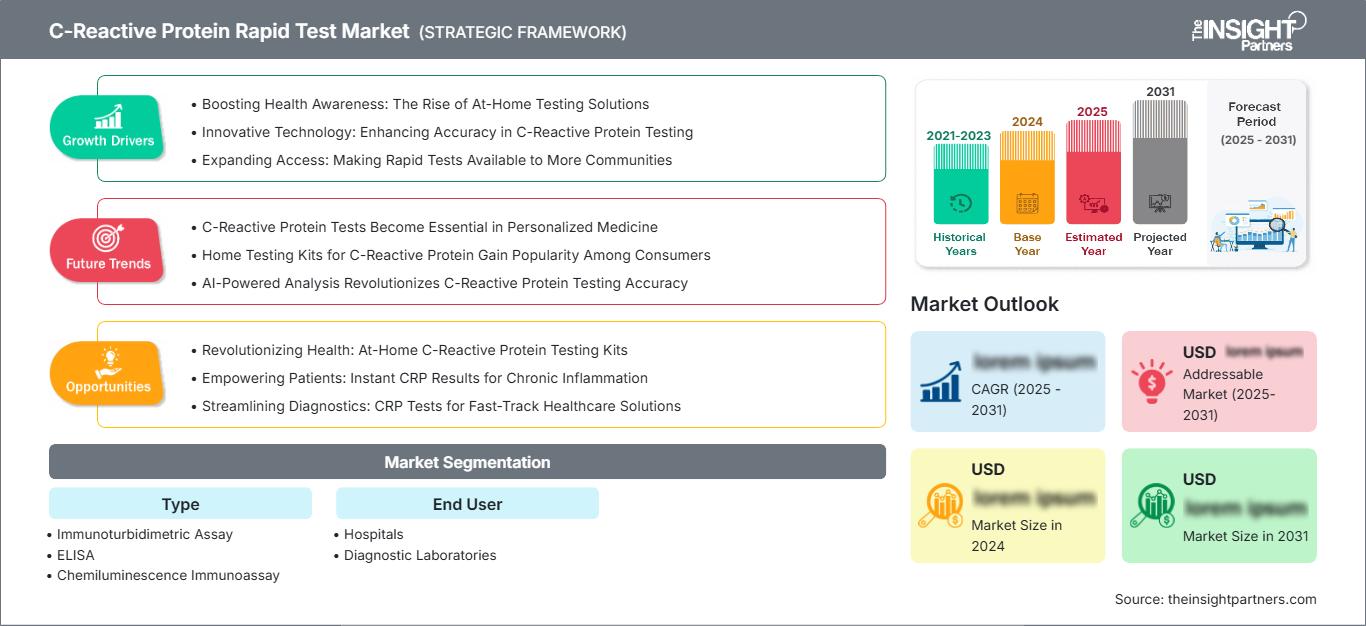
C-Reactive Protein Rapid Test Market: Strategic Insights
Regional Insights
North America C-Reactive Protein Rapid Test Market
North America held a market share of 35% - 38% in 2025 and is anticipated to expand at a CAGR between 5.8% - 6.3% during 2026 – 2034. C-Reactive Protein Rapid Test Market share will be driven by sophisticated hospital laboratories, urgent care facilities, and rising usage of inflammatory markers for the diagnosis of respiratory infections. U.S. and Canada-based healthcare organizations are increasingly adopting rapid tests to aid antimicrobial stewardship.
Factors influencing regional market include high rates of analyzer replacements, availability of clinical chemistry analyzers, and presence of well-defined laboratory reimbursement models. Manufacturers in the region include Abbott Laboratories, Siemens Healthineers AG, Danaher Corporation, Thermo Fisher Scientific Inc., and Quest Diagnostics Incorporated. Growth in the market will be restricted by high penetration levels, although decentralized testing and pediatric applications are expected to contribute to market expansion.
U.S. C-Reactive Protein Rapid Test Market
In 2025, the United States constituted 82–86% of North America and is projected to grow at a CAGR range of 5.9–6.4% between 2026 and 2034. Adoption is driven in hospitals, physician office laboratories, urgent care clinics, and big diagnostic chains. Rapid tests for CRP are becoming increasingly associated with testing for respiratory infections, evaluation of cardiovascular risks, inflammatory diseases, and use in antibiotic management.
Corporate presence still constitutes a significant competitive advantage. Abbott Laboratories provides point-of-care CRP test systems, Siemens Healthineers AG and Roche provide automation chemistry solutions, while Danaher Corporation takes part with clinical diagnostics instruments. Quest Diagnostics Incorporated and Laboratory Corporation of America Holdings will be responsible for volume standardization in reference networks. In the United States, there will be a preference for high throughput and integrated systems with quality control traceability.
Europe C-Reactive Protein Rapid Test Market
The region had a market share of 27–30% in 2025 and is projected to grow with a CAGR of 5.4–5.9% over 2026-2034. Germany is the prominent nation, backed up by robust outpatient diagnostic practices, hospital chemistry automation, and systematic infectious disease management. The UK will develop the adoption of selective CRP through antimicrobial resistance measures despite commissioning differences affecting broader primary care adoption.
Germany capitalizes on its well-developed laboratory medicine networks and high analyzer usage rates. Infection triage in hospitals, rheumatology monitoring, and cardiometabolic risk stratification drive the demand for this product in the nation. Instruments, reagents, and partnership programs of Siemens Healthineers AG, F. Hoffmann-La Roche Ltd, HORIBA Ltd., and Randox Laboratories Ltd. are significant.
Adoption in France, Italy, and Spain is expected to be stable because of hospital diagnostics upgrades and the fast growing demand for inflammatory markers tests. The stewardship approach and laboratory quality management programs represent France, the decentralized healthcare regional procurement represents Italy, and adoption within the ERs represents Spain. The choice of suppliers based on the IVDR will take into account only those able to demonstrate test assays performance.
APAC C-Reactive Protein Rapid Test Market
Asia Pacific held 22–25% market share in 2025 and expected to grow at a CAGR rate of 7.2–7.8% during 2026-2034. China is the largest market country due to growth in hospitals, high numbers of outpatient visits, and laboratory automation. Japan and South Korea focus on quality of analysis process of their instruments whereas India and Australia focus on development of rapid testing solutions in private laboratories and urgent care facilities.
The driving forces within the industrial setting are localized manufacturing and distribution of products and the increase in purchases of small-scale analysis machines. The policies favoring primary care development, infections treatment, and antimicrobial stewardship have helped improve clinical requirements. The growth of the Asia Pacific region is attributed to the diagnosis of chronic inflammatory conditions and the increase in CRP results quantification.
Middle East & Africa C-Reactive Protein Rapid Test Market
Middle East & Africa is projected to grow at a CAGR range of 6.0–6.6% during 2026–2034, with Saudi Arabia leading adoption. The UAE is investing in private hospitals and laboratory networks, while South Africa remains the most developed testing market in Sub-Saharan Africa. Rest of MEA growth is gradual but supported by infectious disease diagnostics.
The energy-related fiscal capacity of Gulf nations is fostering investments in healthcare facilities, hospital computerization, and private diagnostics. The importance of CRP rapid tests is being realized for emergency care, diagnosing respiratory diseases, and chronic diseases. The market will continue to grow based on the procurement budget, availability of reagents, lab technicians, and quality control.
Segmentation Analysis
Type
The Type segment is expected to grow at a CAGR range of 6.0–6.6% during 2026–2034. The C-Reactive Protein Rapid Test Market scope across assay technologies is shaped by throughput needs, sample type, analyzer compatibility, and sensitivity requirements. Automated chemistry platforms support routine volumes, while immunoassay formats address specialist testing environments where sensitivity, multiplexing potential, or research translation is important.
- Immunoturbidimetric Assay remains the dominant format because it integrates with clinical chemistry analyzers, supports predictable laboratory workflows, and enables quantitative CRP measurement across hospitals and diagnostic laboratories.
- ELISA retains strategic importance in research, validation, and specialized laboratory applications where batch testing, antibody specificity, and controlled assay conditions are prioritized over immediate turnaround.
- Chemiluminescence Immunoassay is gaining relevance for high-sensitivity testing, automated immunoassay platforms, and laboratories seeking broader inflammatory marker panels with improved analytical performance.
End User
The End User segment is expected to grow at a CAGR range of 6.3–6.9% during 2026–2034. Hospitals lead current utilization because CRP results support emergency triage, infection monitoring, postoperative assessment, and inpatient care. Diagnostic laboratories are expanding faster as outsourced testing, private lab chains, and automation investments increase the volume of standardized rapid inflammatory marker testing.
- Hospitals generate high utilization through emergency departments, inpatient monitoring, pediatric care, and multidisciplinary inflammatory disease assessment, making them central to rapid CRP adoption.
- Diagnostic Laboratories are the high growth channel as reference networks scale chemistry automation, standardize quality controls, and serve outpatient physicians requiring reliable quantitative results.
Opportunity Snapshot
| End User | Revenue Contribution | Trend Tag | Adoption Stage |
| Hospitals | High | Emergency Triage | Mature |
| Diagnostic Laboratories | Medium | Lab Automation | Scaling |
C-Reactive Protein Rapid Test Market Growth Drivers and Impact Analysis
Antimicrobial Stewardship Expands Clinical Utility
CRP rapid testing is increasingly used to support antibiotic prescribing decisions in respiratory and inflammatory presentations. The impact is strongest in primary care, urgencies, and pediatric settings where clinical symptoms alone may not sufficiently distinguish bacterial infection from viral or self-limiting illness. WHO has linked primary care prescribing behavior to antimicrobial resistance priorities, and rapid biomarkers fit directly into that intervention pathway. For suppliers, stewardship programs create demand for compact instruments, capillary sampling, simple cartridges, and clear interpretation thresholds. For providers, the value proposition is fewer unnecessary prescriptions, better patient communication, and faster escalation when inflammation is clinically significant.
Laboratory Automation Improves Test Economics
Automated chemistry systems are increasing the efficiency of CRP testing by reducing manual steps, supporting higher sample throughput, and improving traceability. Hospitals and diagnostic laboratories prefer platforms that combine ready-to-use reagents, stable calibration, quality controls, and digital connectivity. This driver has practical financial consequences because laboratories can absorb higher CRP volumes without proportionally increasing staffing. It also benefits manufacturers with broad analyzer installed bases, since assay expansion can occur through reagent menus rather than entirely new equipment purchases. Over the forecast period, automation is expected to reduce per-test operational friction and support wider inclusion of CRP in routine panels.
Chronic Inflammation Monitoring Broadens Demand
Clinical use is moving beyond acute infection into cardiovascular risk, autoimmune inflammation, postoperative monitoring, and chronic disease management. High-sensitivity and conventional CRP tests help clinicians assess inflammatory burden in longitudinal care, especially when combined with other biomarkers and clinical history. This creates recurring testing opportunities in hospitals and laboratories rather than one-time episodic use. Demand is also strengthened by aging populations and rising prevalence of chronic inflammatory conditions. The market impact is a wider customer base for assay suppliers, more diverse testing menus, and stronger justification for laboratories to maintain rapid, quantitative CRP capabilities across multiple departments.
C-Reactive Protein Rapid Test Market Future Trends
Integrated Biomarker Panels
The C-Reactive Protein Rapid Test Market trends are shifting toward multi-marker interpretation rather than isolated CRP readings. Future systems are expected to combine CRP with complete blood count parameters, procalcitonin, interleukins, or cardiovascular markers to improve diagnostic confidence. This trend will favor platforms capable of running multiple assays from low-volume samples and digitally presenting results in clinician-friendly formats. Integrated panels can reduce repeat visits, support emergency triage, and improve stewardship decisions. Suppliers that connect assays, software, and workflow analytics are likely to gain stronger differentiation than companies competing only on reagent price.
Capillary and Whole-Blood Testing
Capillary and whole-blood formats are expected to become more important as decentralized care expands. These methods reduce dependence on venipuncture, support pediatric and elderly patients, and allow testing in physician offices or urgent care settings. Siemens Healthineers’ 2026 launch of capillary testing claims on Atellica analyzers illustrates the direction of broader laboratory validation for less invasive collection workflows. Future adoption will depend on analytical reliability, quality control, training, and regulatory acceptance. As collection flexibility improves, CRP rapid testing can move closer to the patient while retaining laboratory-grade performance expectations.
C-Reactive Protein Rapid Test Market Opportunities
Diagnostic Laboratory Network Expansion
C-Reactive Protein Rapid Test Market Forecasts indicate a strong opportunity for suppliers targeting regional and national diagnostic laboratory networks. These buyers need scalable assays, instrument compatibility, consistent reagent supply, and strong service coverage. Investment should prioritize menu integration across chemistry and immunoassay platforms, as laboratories prefer vendors that reduce validation complexity. Companies can also build value through quality-control packages, middleware integration, and training support. In emerging markets, distributor partnerships and reagent availability will be decisive. The opportunity is commercially attractive because laboratory networks can convert standardized CRP testing into recurring, high-volume revenue streams.
Point-of-Care Deployment in Primary Care
Primary care remains underpenetrated in many countries despite its importance in antibiotic prescribing and early inflammation assessment. Suppliers can address this gap with compact analyzers, room-temperature reagent stability, cartridge-based workflows, and reimbursement evidence showing reduced unnecessary antibiotic use. Adoption will be strongest where physicians receive clinical guidance, communication tools, and quality assurance support. The opportunity is not limited to high-income countries, as low-cost CRP testing has been identified as feasible for antimicrobial resistance mitigation in lower-resource settings. Vendors that combine affordability with reliable quantification can unlock new outpatient demand.
Recent Developments
- March 2026: F. Hoffmann-La Roche Ltd received FDA 510(k) clearance for the cobas c 703 and cobas ISE neo analytical units, strengthening high-throughput laboratory infrastructure used for clinical chemistry menus, including inflammatory marker testing. The clearance supports laboratory efficiency, automation, and workflow capacity in environments that run broad diagnostic panels.
- January 2026: HORIBA Ltd. obtained CE IVDR certification for its Yumizen H500 CRP benchtop hematology analyzer, combining 5-part differential hematology with rapid whole-blood CRP measurement. The system uses 27 µL of venous or capillary blood and is designed for small laboratories and hospital testing settings that require fast infection and inflammation assessment.
- August 2025: Siemens Healthineers AG issued a follow-up field safety notice confirming resolution of incorrect software flagging for the Atellica CH Revised C-Reactive Protein assay through Atellica Solution Software version 1.30.0 and higher. The correction allowed laboratories to restore the original measuring interval after completing required calibration and system actions.
Frequently Asked Questions

- Comprehensive Market Sizing and Forecast Analysis
- Detailed Segmentation Analysis
- In-Depth Market Dynamics Assessment
- Regional and Country-Level Insights
- Competitive Landscape and Company Benchmarking
- Strategic Business Intelligence
Recent Reports
Testimonials

The Insight Partners' SCADA System Market report is comprehensive, with valuable insights on current trends and future forecasts. The team was highly professional, responsive, and supportive throughout. We are very satisfied and highly recommend their services.
RAN KEDEM Partner, Reali Technologies LTDs
I requested a report on a very specific software market and the team produced the report in a few days. The information was very relevant and well presented. I then requested some changes and additions to the report. The team was again very responsive and I got the final report in less than a week.
JEAN-HERVE JENN Chairman, Future Analytica
We worked with The Insight Partners for an important market study and forecast. They gave us clear insights into opportunities and risks, which helped shape our plans. Their research was easy to use and based on solid data. It helped us make smart, confident decisions. We highly recommend them.
PIYUSH NAGPAL Sr. Vice President, High Beam Global
The Insight Partners delivered insightful, well-structured market research with strong domain expertise. Their team was professional and responsive throughout. The user-friendly website made accessing industry reports seamless. We highly recommend them for reliable, high-quality research services
YUKIHIKO ADACHI CEO, Deep Blue, LLC.
This is the first time I have purchased a market report from The Insight Partners.While I was unsure at first, I visited their web site and felt more comfortable to take the risk and purchase a market report.I am completely satisfied with the quality of the report and customer service. I had several questions and comments with the initial report, but after a couple of dialogs over email with their analyst I believe I have a report that I can use as input to our strategic planning process.Thank you so much for taking the extra time and making this a positive experience.I will definitely recommend your service to others and you will be my first call when we need further market data.
JOHN SUZUKI President and Chief Executive Officer, Board Director, BK Technologies
I wish to appreciate your support and the professionalism you displayed in the course of attending to my request for information regarding to infectious disease IVD market in Nigeria. I appreciate your patience, your guidance, and the fact that you were willing to offer a discount, which eventually made it possible for us to close a deal. I look forward to engaging The Insight Partners in the future, all thanks to the impression you have created in me as a result of this first encounter.
DR CHIJIOKE ONYIA MANAGING DIRECTOR, PineCrest Healthcare Ltd.Reason to Buy
- Informed Decision-Making
- Understanding Market Dynamics
- Competitive Analysis
- Identifying Emerging Markets
- Customer Insights
- Market Forecasts
- Risk Mitigation
- Boosting Operational Efficiency
- Strategic Planning
- Investment Justification
- Tracking Industry Innovations
- Aligning with Regulatory Trends





 Get Free Sample for