
Calcium Channel Blocker Market Size, Trends & Growth by 2034
Coverage: By Drug Class (Dihydropyridine, Benzothizepine, Phenylalkylamine); Distribution Channel (Hospital Pharmacies, Retail Pharmacies, Others); and Geography , and Geography (North America, Europe, Asia Pacific, and South and Central America)
- Status : Data Released
- Report Code : TIPRE00020510
- Category : Life Sciences
- No. of Pages : 150
- Available Report Formats :


- Last update date : August 12, 2026


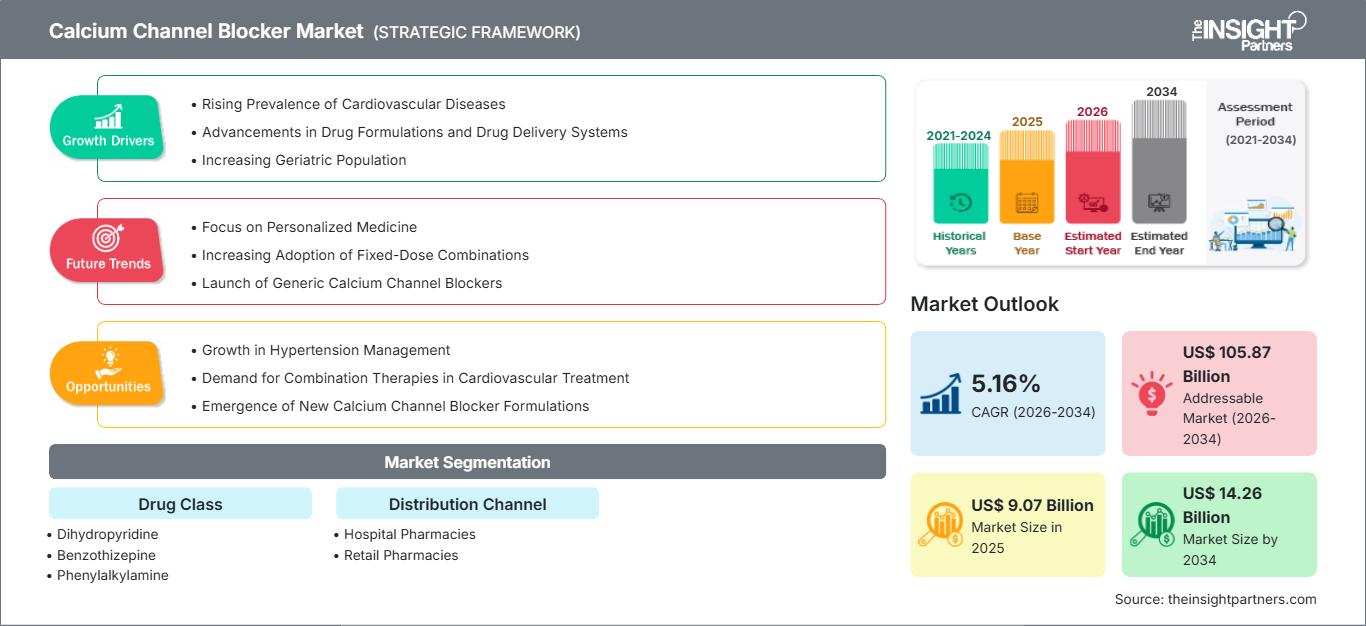
2025 Market Size
US$ 9.07 Bn
Base year value
2034 Forecast
US$ 14.26 Bn
Projected by 2034
CAGR 2026-2034
5.16 %
Growth rate
Addressable Market
US$ 105.87 Bn
(2026-2034)
The Calcium Channel Blocker Market is projected to grow from US$ 9.07 billion in 2025 to US$ 14.26 billion by 2034, expanding at a CAGR of 5.16% during 2026–2034. Demand is supported by sustained use in hypertension, angina, coronary artery disease, and selected rhythm-management settings, where calcium channel blockers remain established first-line or add-on therapies across primary care, cardiology, hospital, and retail pharmacy channels.
Across North America, the Calcium Channel Blocker Market size is expected to advance at an estimated CAGR range of 4.6–5.2% during 2026–2034, supported by high treated hypertension prevalence and continued prescribing of long-acting dihydropyridines. Nearly half of U.S. adults have hypertension, according to CDC data, reinforcing the region’s structural prescription base for antihypertensive medicines.
Calcium Channel Blocker Market Assessment and Insights
- North America accounts for 36–39% share in 2025 and is growing at a CAGR range of 4.6–5.2% during 2026–2034, supported by broad guideline use, chronic refills, and strong branded-generic substitution.
- US represents 82–86% of North America in 2025 and is growing at a CAGR range of 4.5–5.1% during 2026–2034, led by high diagnosis and retail refill volumes.
- Europe holds 24–27% share in 2025 and grows at a CAGR range of 4.1–4.8% during 2026–2034, with Germany, France, Italy, Spain, and the UK leading reimbursement-backed demand.
- Asia Pacific captures 21–24% share in 2025 and expands at a CAGR range of 6.0–6.8% during 2026–2034, led by China, Japan, India, South Korea, and Australia.
- Largest Segment: Dihydropyridine holds 68–72% market share in 2025 and grows at a CAGR range of 5.1–5.7% during 2026–2034, driven by amlodipine-centered prescribing.
- High Growth Segment: Hospital Pharmacies hold 34–38% market share in 2025 and grow at a CAGR range of 5.4–6.1% during 2026–2034, supported by inpatient cardiovascular stabilization.
- Key companies analyzed in detail: AbbVie Inc., Alvogen Inc., Arbor Pharmaceuticals, LLC, Bausch Health Companies Inc., Covis Pharma B.V., Exela Pharma Sciences, LLC, Novartis AG, Pfizer Inc., Silvergate Pharmaceuticals, Inc., Viatris Inc., Teva Pharmaceutical Industries Ltd., Brillian Pharma Inc., and Alembic Pharmaceuticals Limited.
Source: The Insight Partners' analysis based on proprietary research, government publications, company annual reports, investor presentations, industry databases, and expert interviews.
Calcium Channel Blocker Market has transformed from established immediate-release formulations to more sustained-release oral solids, extended-release capsules, fixed-dose combinations, and patient-convenient liquid or reconstituting products. The production trends have focused on robust bioequivalence, reliable API procurement, controlled-release beads, and distinct patient-friendly pediatric or dysphagia delivery. Generic competition has reduced cost per unit but prescription compliance keeps the market value alive through sustained use.
Market growth is now moving towards new geographies with hypertension diagnosis improvements, increased number of pharmacies, and wider availability of cardiovascular drugs through public health insurance schemes. Tailwinds in terms of regulations include the preference for essential drugs, local manufacturing, and improved pharmacovigilance expectations. According to WHO estimates, there were 1.4 billion adults with hypertension aged 30-79 years in 2024, with two-thirds residing in developing countries.
Calcium Channel Blocker Market Report Scope
| Report Attribute | Details |
|---|---|
| Market size in 2025 | US$ 9.07 Billion |
| Market Size by 2034 | US$ 14.26 Billion |
| Global CAGR (2026 - 2034) | 5.16% |
| Historical Data | 2021-2024 |
| Forecast period | 2026-2034 |
Calcium Channel Blocker Market Analysis
The market growth for calcium channel blocker depends on the chronic heart diseases, longer period of treatment, and the use along with ACE inhibitors, ARBs, beta-blockers, and diuretics. The dihydropyridine calcium channel blockers are very important owing to its property of using once a day along with its wide applications in uncomplicated hypertension. The non-dihydropyridines would remain very important for angina and rate control.
Supply factors still include generic high volume production, sustained release technology, and compliance with FDA standards for manufacturing. The industry includes API producers, finished product manufactures, wholesalers, group purchasing organizations, hospitals’ pharmacies, and popular retail chains. Amlodipine labeling from FDA still includes hypertension and coronary artery disease indications.
Calcium Channel Blocker Market report reflects a market characterized by large players protecting their established portfolio, while specialists compete on basis of convenience of dosage form, institutional supply, pediatrics focus, and reliability. Pfizer Inc. and Viatris Inc. continue to be related to the legacy of Norvasc, while Bausch Health Companies Inc. continues to hold diltiazem products, generics enter through competition based on costs.
There is no innovation-based investment in this market; companies are focusing on the lifecycle management of formulations, channel access, regulatory compliance, and delivery innovations for underserved patients. Approval of Sdamlo from Brillian Pharma Inc. and marketing collaboration of Pangea demonstrate continued innovation for established molecules.
● REPORT CUSTOMIZATION
Tailor This Report To Align With Your Specific Business Requirements
This report can be customized to align precisely with your business objectives, scope, and target markets. Customization options include tailored segmentation, geography, competitive analysis, and strategic insights to support informed decision-making.
Customize This Report →WHAT YOU CAN ADJUST
- ● Segmentations
- ● Geography
- ● Competitive Analysis
- ● Language Preferences
Calcium Channel Blocker Market: Strategic Insights
Regional Insights
North America Calcium Channel Blocker Market
The North America market for Calcium Channel Blockers commanded 36-39% market share in 2025 and will experience a growth rate between 4.6-5.2% CAGR over 2026-2034. There is large number of hypertensive diagnosed pool, chronic refills, integrative cardiology care pathway and usage of calcium channel blocker therapy as combined therapies in this region.
CDC states that 119.9 million adults are suffering from hypertension in US, resulting in high prescription flow. Canada and the US both have mature reimbursement system, with retail pharmacies playing key role in maintenance prescriptions. Hospitals play an important role in acute blood pressure management, angina assessment and post-discharge prescribing. Growth in North America region is moderate owing to generics penetration but there is high value owing to adherent formulations, brand loyalty and payer preference for affordable cardiovascular drugs.
U.S. Calcium Channel Blocker Market
U.S. constituted 82-86% share of North America in 2025 and is projected to grow at a CAGR range of 4.5-5.1% from 2026 to 2034. There will be higher demand owing to high levels of diagnoses, guidelines for using polytherapy, and greater coverage by pharmacies. 22.5% of adults with hypertension in the U.S. have their blood pressure under control.
The companies operating in the region include Pfizer Inc., Viatris Inc., Teva Pharmaceutical Industries Ltd., Bausch Health Companies Inc., Exela Pharma Sciences, LLC, and Brillian Pharma Inc. Application trends include once daily use of amlodipine, extended release diltiazem, and injections of verapamil in hospitals. Retail refills dominate the use of medication, whereas institutions cater to acute and specialized care needs.
Europe Calcium Channel Blocker Market
The share of Europe stood at 24-27% in 2025 and is expected to record growth at a CAGR between 4.1-4.8% in 2026-2034 with Germany emerging as the prominent country. The Calcium Channel Blocker receives benefits from the aging population, well-organized primary care, and reimbursement systems that favor generics. The WHO European region continues to be an important market for treating hypertension with improved prevention programs.
Prescribing in UK and Germany is driven by cost-effectiveness, long-term cardiovascular risk, and high usage of generics in primary care. Germany emerges as the leader by medicine volume and payer coverage while the UK emphasizes on protocol-based antihypertensive sequencing through national treatment guidelines and community pharmacies.
Stable demand arises in France, Italy, and Spain because of aging population, cardiology follow up, and public reimbursement programs. France benefits from sustained use of combination therapy, Italy has strong cardiology-based prescribing, and Spain has primary care-based chronic disease management. Growth continues to remain limited by reference pricing while adherence and combination therapy provides incremental value.
APAC Calcium Channel Blocker Market
Market APAC occupied 21-24% share in 2025 and is forecasted to grow in CAGR between 6.0% and 6.8% in 2026-2034; with Chinese demand leading the region. China and India have growing access to treatments, and Japan and South Korea demonstrate strong compliance in their mature healthcare systems. Australia offers steady supply through primary care prescriptions.
Drivers consist of local production of generics, purchasing of medicines in essential drug lists, urban screening programs, and growing insurance. WHO-related studies indicate an increase in the burden of the disease in the Western Pacific and South-East Asia, forming the basis of a large patient pool for the market growth.
Middle East & Africa Calcium Channel Blocker Market
Middle East & Africa is projected to expand at a CAGR range of 5.3–6.0% during 2026–2034, led by Saudi Arabia. Saudi Arabia and the UAE benefit from hospital infrastructure investment, noncommunicable disease programs, and greater insurance-backed access. South Africa anchors demand in the African subregion through public and private pharmacy channels.
Gulf healthcare spending is backed by energy-driven fiscal ability, whereas MEA growth is based on reliable procurement and affordability. The other MEA regions are fragmented; however, factors such as increased urbanization, presence of diabetes co-morbidity, and proliferation of pharmacies are helping in the diagnosis-treatment linkage of cardiovascular drugs.
Segmentation Analysis
Drug Class
The Drug Class segment is projected to grow at a CAGR range of 5.0–5.6% during 2026–2034. The Calcium Channel Blocker Market scope is defined by vascular selectivity, cardiac selectivity, dosing convenience, and compatibility with multidrug hypertension regimens. Dihydropyridines dominate routine hypertension care, while benzothiazepines and phenylalkylamines retain specialist relevance in angina and selected rhythm-related use.
- Dihydropyridine products dominate demand through once-daily prescribing, strong generic availability, and broad compatibility with ACE inhibitors, ARBs, and diuretics in hypertension management.
- Benzothizepine products, led by diltiazem formulations, remain strategically important in angina, hypertension, and selected rate-control pathways requiring clinician oversight.
- Phenylalkylamine products, represented principally by verapamil, serve defined cardiology use cases where rate effects, angina relief, or injectable hospital availability support demand.
Distribution Channel
The Distribution Channel segment is projected to grow at a CAGR range of 5.2–5.8% during 2026–2034. Retail pharmacies dominate chronic dispensing, but hospitals influence therapy initiation, switching, and acute cardiovascular protocols. Channel strategy increasingly depends on reliable inventory, payer contracts, electronic prescribing integration, and adherence support for patients managing lifelong antihypertensive therapy.
- Hospital Pharmacies support inpatient stabilization, specialist initiation, emergency cardiovascular use, and discharge prescriptions, making the channel strategically important despite smaller routine refill volumes.
- Retail Pharmacies capture chronic therapy refills, generic substitution, adherence counseling, and payer-directed dispensing, sustaining the largest volume contribution across mature and emerging markets.
Opportunity Snapshot
| Distribution Channel | Revenue Contribution | Trend Tag | Adoption Stage |
| Dihydropyridine | High | Once Daily | Mature |
| Benzothizepine | Medium | Extended Release | Mature |
| Phenylalkylamine | Low | Hospital Use | Scaling |
| Hospital Pharmacies | Medium | Acute Care | Scaling |
| Retail Pharmacies | High | Chronic Refill | Mature |
Calcium Channel Blocker Market Growth Drivers and Impact Analysis
Persistent Hypertension Burden and Lifelong Treatment Need
Hypertension still continues to dominate the demand side since many patients require continuous pharmacological intervention. Calcium channel blockers are commonly applied in cases where patients require vascular smooth muscle relaxation, once daily dosing schedule, or polytherapy with no metabolic impact. According to the World Health Organization factsheet for 2025, 1.4 billion adults aged between 30-79 years suffer from hypertension in 2024, and there is no control worldwide. This generates large numbers of potential patients who are either diagnosed or undiagnosed in terms of treatment opportunities especially in Asia, Africa, and some parts of Latin America.
Combination Therapy and Guideline-Based Prescribing
Clinical practice is gradually adopting the combination approach due to the fact that many patients fail to attain the recommended BP levels using a single drug. It has been established that calcium channel blockers work effectively with ARBs, ACE inhibitors, and diuretics thus enabling physicians to strike a balance in terms of effectiveness, side effects, and ease of administering doses. It enables the use of fixed dose combinations as well as prescribing amlodipine, diltiazem, and verapamil in their individual forms. FDA labeling continues to support the use of these drugs individually or in combination with other hypertension drugs and antianginals. This will result in repeated prescriptions across various settings, therapy adherence, and product life cycle management.
Access Expansion Through Generic and Retail Pharmacy Networks
Generic availability makes these drugs available and affordable in both public and private healthcare systems. Low cost per tablet makes it possible for these drugs to be incorporated into chronic disease programs, pharmacy benefit formulary lists and public tender lists. The pharmacies gain economies of scale through serving the drug refills in a monthly or even 90-day period, while the hospitals initiate the use of these drugs after certain cardiovascular events, uncontrolled hypertension, and chest pain assessments. According to estimates in the U.S., the total cost linked to high blood pressure was US$ 219 billion in 2019.
Calcium Channel Blocker Market Future Trends
Patient-Centric Formulations for Adherence Gaps
Calcium Channel Blocker Market trends are moving toward formulations that reduce administration barriers rather than replace established pharmacology. Reconstitutable oral solutions, alcohol-free liquids, smaller tablets, and extended-release systems can serve children, older adults, long-term care residents, and patients with swallowing difficulty. Brillian Pharma Inc.’s FDA-approved Sdamlo oral solution demonstrates this direction by adapting amlodipine for flexible dosing and easier administration. As payers focus on adherence and preventable cardiovascular events, manufacturers with differentiated delivery formats may secure access advantages. The trend will be strongest where retail, institutional, and home health channels can justify premium positioning through measurable persistence, lower wastage, and simplified medication management.
Quality-Led Supplier Selection in Mature Generics
The next phase of competition will place greater emphasis on manufacturing reliability, compliance history, and supply-chain redundancy. Cardiovascular generics are often low-margin, high-volume products, making interruptions costly for distributors, pharmacies, and hospitals. Regulatory scrutiny remains material, as shown by FDA actions involving manufacturing observations and CGMP expectations. Buyers are likely to favor suppliers with consistent release testing, validated controlled-release technologies, and diversified production networks. This trend could gradually separate commodity manufacturers from preferred vendors. The commercial result will not be broad price inflation, but stronger contracting power for manufacturers that combine affordability with dependable quality, documentation, and uninterrupted channel supply.
Calcium Channel Blocker Market Opportunities
Emerging Market Access and Localized Supply Partnerships
Calcium Channel Blocker Market Forecasts point to stronger incremental value in countries where diagnosis, insurance coverage, and pharmacy access are still expanding. Manufacturers can pursue tender participation, local packaging, technology transfer, and partnerships with domestic distributors to capture demand without heavy brand-building expenditure. China and India offer scale, while Gulf countries and Southeast Asia provide infrastructure-backed access. Winning strategies should prioritize essential medicine affordability, reliable inventory, and physician education around combination treatment pathways. Investment in localized supply can reduce import exposure, support public procurement eligibility, and improve channel trust. This opportunity is especially relevant for generic specialists seeking defensible volume growth beyond saturated U.S. and European markets.
Differentiated Mature Molecules for Special Populations
A second opportunity exists in repositioning mature calcium channel blockers for patients underserved by standard tablets. Pediatric patients, geriatric patients, dysphagia-affected adults, and long-term care residents often need formats that simplify dosing and reduce medication errors. Oral solutions, sprinkle-compatible forms, accurate low-dose options, and hospital-ready presentations can support value beyond commodity pricing. Commercial success requires evidence-based positioning, payer engagement, and coordination with pharmacies that serve institutional care. Companies with formulation science and lean commercialization platforms can build profitable niches even in generic-heavy categories. The opportunity is strongest when differentiated products solve measurable adherence, storage, preparation, or administration challenges in routine clinical workflows.
Recent Developments
- January 2026: Pangea Pharmaceuticals announced a strategic partnership with Brillian Pharma Inc. to commercialize Sdamlo, an alcohol-free, easy-to-administer amlodipine oral solution across approved strengths in the U.S. The agreement positions Brillian’s differentiated formulation for retail, institutional, home health, and long-term care channels.
- July 2025: Brillian Pharma Inc. received FDA approval for Sdamlo, amlodipine for oral solution, under NDA 219531. The product is approved for hypertension in adults and pediatric patients aged 6 years and older, and for coronary artery disease indications in adults.
- May 2025: Alembic Pharmaceuticals Limited received USFDA final approval for Amlodipine and Atorvastatin Tablets USP across multiple strengths. The product is therapeutically equivalent to Caduet and supports patients requiring both amlodipine and atorvastatin therapy.
Frequently Asked Questions

- Comprehensive Market Sizing and Forecast Analysis
- Detailed Segmentation Analysis
- In-Depth Market Dynamics Assessment
- Regional and Country-Level Insights
- Competitive Landscape and Company Benchmarking
- Strategic Business Intelligence
Recent Reports
Testimonials

The Insight Partners provided valuable market intelligence that supported our global go-to-market strategy. Their team was professional, responsive, and attentive to our feedback, providing thoughtful analysis and helpful methodological clarifications throughout the project.
Junmo Kim Chief Financial Officer (CFO), Enertech Co., Ltd.
The Insight Partners' SCADA System Market report is comprehensive, with valuable insights on current trends and future forecasts. The team was highly professional, responsive, and supportive throughout. We are very satisfied and highly recommend their services.
RAN KEDEM Partner, Reali Technologies LTDs
I requested a report on a very specific software market and the team produced the report in a few days. The information was very relevant and well presented. I then requested some changes and additions to the report. The team was again very responsive and I got the final report in less than a week.
JEAN-HERVE JENN Chairman, Future Analytica
We worked with The Insight Partners for an important market study and forecast. They gave us clear insights into opportunities and risks, which helped shape our plans. Their research was easy to use and based on solid data. It helped us make smart, confident decisions. We highly recommend them.
PIYUSH NAGPAL Sr. Vice President, High Beam Global
The Insight Partners delivered insightful, well-structured market research with strong domain expertise. Their team was professional and responsive throughout. The user-friendly website made accessing industry reports seamless. We highly recommend them for reliable, high-quality research services
YUKIHIKO ADACHI CEO, Deep Blue, LLC.
This is the first time I have purchased a market report from The Insight Partners.While I was unsure at first, I visited their web site and felt more comfortable to take the risk and purchase a market report.I am completely satisfied with the quality of the report and customer service. I had several questions and comments with the initial report, but after a couple of dialogs over email with their analyst I believe I have a report that I can use as input to our strategic planning process.Thank you so much for taking the extra time and making this a positive experience.I will definitely recommend your service to others and you will be my first call when we need further market data.
JOHN SUZUKI President and Chief Executive Officer, Board Director, BK Technologies
I wish to appreciate your support and the professionalism you displayed in the course of attending to my request for information regarding to infectious disease IVD market in Nigeria. I appreciate your patience, your guidance, and the fact that you were willing to offer a discount, which eventually made it possible for us to close a deal. I look forward to engaging The Insight Partners in the future, all thanks to the impression you have created in me as a result of this first encounter.
DR CHIJIOKE ONYIA MANAGING DIRECTOR, PineCrest Healthcare Ltd.Reason to Buy
- Informed Decision-Making
- Understanding Market Dynamics
- Competitive Analysis
- Identifying Emerging Markets
- Customer Insights
- Market Forecasts
- Risk Mitigation
- Boosting Operational Efficiency
- Strategic Planning
- Investment Justification
- Tracking Industry Innovations
- Aligning with Regulatory Trends





 Get Free Sample for