
Carboxytherapy Machine Market Share, Demand & Growth by 2034
Coverage: By Type (Portable, Table Top Devices); End-User (Hospitals, Clinics, Beauty Centers, Others), and Geography (North America, Europe, Asia Pacific, and South and Central America)
- Status : Data Released
- Report Code : TIPRE00014223
- Category : Life Sciences
- No. of Pages : 150
- Available Report Formats :


- Last update date : August 21, 2026


2025 Market Size
US$ 15.11 Bn
Base year value
2034 Forecast
US$ 32.01 Bn
Projected by 2034
CAGR 2026-2034
8.70 %
Growth rate
Addressable Market
US$ 211.19 Bn
(2026-2034)
The Carboxytherapy Machine Market is projected to grow from US$ 15.11 Billion in 2025 to US$ 32.01 Billion by 2034, registering a CAGR of 8.70% during 2026–2034. Demand is being shaped by the wider adoption of controlled carbon dioxide delivery systems across aesthetic medicine, dermatology, vascular support, scar management, and wellness-based skin rejuvenation procedures.
North America remains a high-value adoption center, with the Carboxytherapy Machine Market size supported by advanced med-spa networks, dermatology-led device purchasing, and consumer preference for minimally invasive treatments. The region is estimated to expand at a CAGR of 8.3–8.8% during 2026–2034, helped by protocol standardization, stronger physician-supervised aesthetics, and rising demand for non-surgical skin tightening.
Carboxytherapy Machine Market Assessment and Insights
- North America accounted for 36–39% share in 2025 and is expected to grow at a CAGR of 8.3–8.8% during 2026–2034, supported by high procedure density, clinic financing models, and strong disposable income.
- U.S. represented 76–80% of North America in 2025 and is projected to grow at a CAGR of 8.1–8.6% during 2026–2034, led by dermatology clinics and medical spas.
- Europe held 27–30% share in 2025 and is expected to grow at a CAGR of 7.9–8.4% during 2026–2034, with Italy, Germany, France, Spain, and the UK leading adoption.
- Asia Pacific captured 23–26% share in 2025 and is projected to grow at a CAGR of 9.4–10.1% during 2026–2034, driven by China, Japan, South Korea, India, and Australia.
- Largest Segment: Portable devices held 58–62% market share in 2025 and are expected to grow at a CAGR of 9.0–9.6% during 2026–2034 due to mobility and lower setup cost.
- High Growth Segment: Beauty centers held 22–25% market share in 2025 and are projected to grow at a CAGR of 9.5–10.2% during 2026–2034 as wellness aesthetics expands.
- Key companies analyzed in detail: Beijing Jontelaser Technology Co., Ltd., Dioxage, Acea Medica S.r.l. (DTA Medical), BFP Group SAS (AAMS), Unitronic Systems GmbH, Wavemed S.r.l., Ibramed Indústria Brasileira de Equipamentos Médicos Ltda., DermoEquipos S.A., BodyHT, and Lumisque Skincare Inc.
Source: The Insight Partners' analysis based on proprietary research, government publications, company annual reports, investor presentations, industry databases, and expert interviews.
The progression of device technology is advancing from simple gas insufflation to microprocessor-based administration, heated gas lines, electronic dosage, and pressure-sensing systems. The medical device directory, MedicalExpo, shows DTA Medical’s Carbo2 HPX with sensors for temperature, pressure, filtration, and CO2 supply, whereas Dioxage lists its features as heated gas, stepwise flow, pressure management, and dual gas delivery. This progress is making the treatment less painful and is helping in repeat treatments in clinics.
Moving forward, it appears that vendors will focus on new markets that have rapidly growing aesthetics clinics compared to purchasing cycles in hospitals. There will be an increased emphasis on training, clinical protocol validation, and CE, ISO 13485, and region-specific registration requirements for devices. As per ISAPS, around 38 million aesthetic treatments were performed in 2024, which includes 20.5 million non-surgical treatments.
Carboxytherapy Machine Market Report Scope
| Report Attribute | Details |
|---|---|
| Market size in 2025 | US$ 15.11 Billion |
| Market Size by 2034 | US$ 32.01 Billion |
| Global CAGR (2026 - 2034) | 8.70% |
| Historical Data | 2021-2024 |
| Forecast period | 2026-2034 |
Carboxytherapy Machine Market Analysis
The Carboxytherapy Machine Market growth is supported by demand for procedures that combine visible outcomes with limited recovery time. CO2 administration is used in aesthetic and dermatology settings for cellulite appearance, localized adiposity, stretch marks, scars, periorbital concerns, and skin laxity. WHO reported 2.5 billion overweight adults in 2022, including 890 million living with obesity, strengthening long-term interest in body contouring and supportive tissue therapies.
Supply dynamics are shaped by component availability, medical-grade gas regulation, sterile tubing, valves, touchscreens, sensors, and service support. Manufacturers able to combine software-guided protocols with disposable consumables can build recurring revenue beyond hardware. The Carboxytherapy Machine Market analysis indicates that training quality, local certification, and after-sales calibration increasingly determine repeat purchasing, especially among clinics with high daily patient throughput.
Competition is fragmented among European medical experts, China-based multi-technology aesthetic equipment manufacturers, and topical CO2 innovations. Beijing Jontelaser Technology Co., Ltd. specializes in aesthetic equipment exportation and OEM/ODM services, whereas Acea Medica S.r.l. (DTA Medical), BFP Group SAS (AAMS), Dioxage, and Unitronic Systems GmbH prioritize specialized therapy systems and accuracy.
Strategic positioning is moving away from mere affordability to credibility. Lumisque Skincare Inc. is working to apply carboxytherapy in professional topical CO2 applications, while Wavemed S.r.l., Ibramed Indústria Brasileira de Equipamentos Médicos Ltda., DermoEquipos S.A., and BodyHT offer regional accessibility. Manufacturers who keep records of procedures, disposables, safety alerts, and training programs will gain more leverage among distributors.
● REPORT CUSTOMIZATION
Tailor This Report To Align With Your Specific Business Requirements
This report can be customized to align precisely with your business objectives, scope, and target markets. Customization options include tailored segmentation, geography, competitive analysis, and strategic insights to support informed decision-making.
Customize This Report →WHAT YOU CAN ADJUST
- ● Segmentations
- ● Geography
- ● Competitive Analysis
- ● Language Preferences
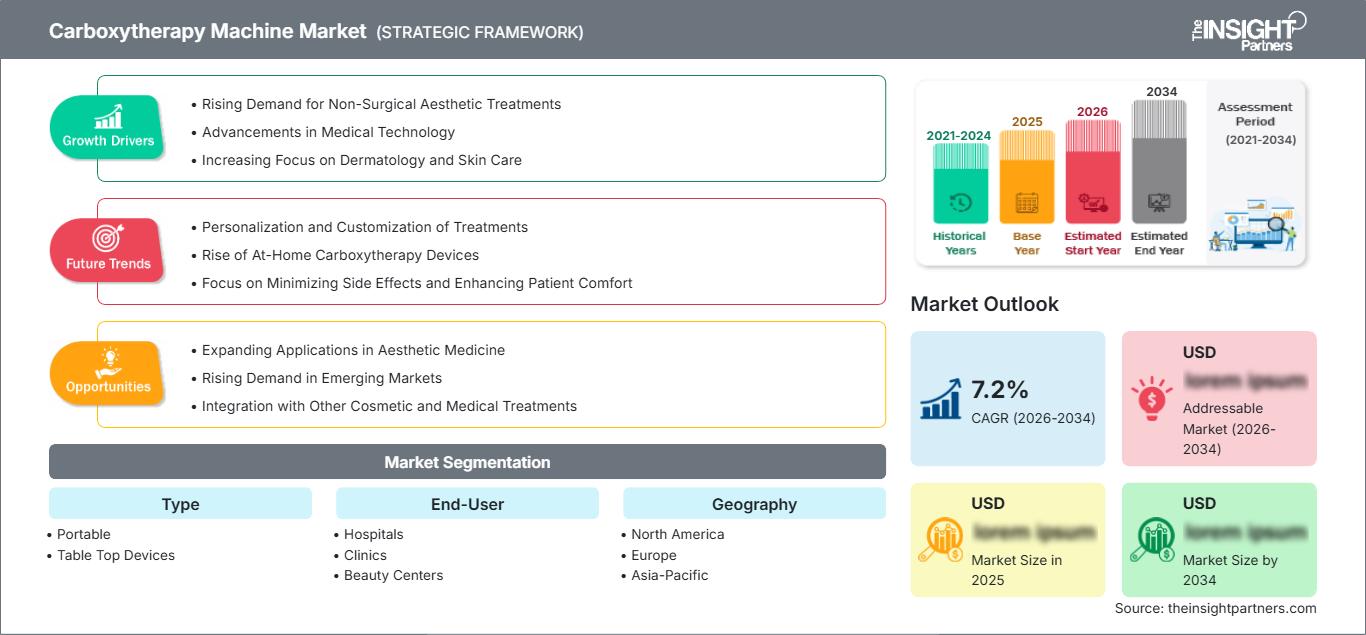
Carboxytherapy Machine Market: Strategic Insights
Regional Insights
North America Carboxytherapy Machine Market
North America accounted for 36–39% share in 2025 and is projected to grow at a CAGR of 8.3–8.8% during 2026–2034. The Carboxytherapy Machine Market share is supported by physician-led aesthetics, established med-spa chains, and broad acceptance of non-surgical skin and body procedures. ISAPS showed the U.S. performed over 6.1 million aesthetic procedures in 2024, indicating strong procedural infrastructure.
The demand is further fueled by the the consolidation of clinics and the leasing of equipment, which will remove barriers to acquiring equipment for smaller clinics. Safety of the equipment, its sterilization process, patient comfort, and the use of consumables are the main factors taken into consideration when purchasing medical devices in North America.
U.S. Carboxytherapy Machine Market
The U.S. represented 76–80% of the North America Carboxytherapy Machine Market in 2025 and is expected to grow at a CAGR of 8.1–8.6% during 2026–2034. Adoption is concentrated in dermatology practices, medical spas, plastic surgery adjunctive care, and wellness clinics that bundle CO2 procedures with skin tightening, injectables, laser resurfacing, and body contouring services.
Company presence is broad because distributors can serve multiple provider categories through training-led sales. U.S. customers show rising interest in low-discomfort treatments, topical CO2 masks, and post-procedure regeneration support. Lumisque Skincare Inc.’s CO2Lift positioning highlights sustained CO2 delivery and physician adoption, reflecting the local preference for treatments backed by clinical validation and practitioner education.
Europe Carboxytherapy Machine Market
Europe held 27–30% share in 2025 and is projected to grow at a CAGR of 7.9–8.4% during 2026–2034. Italy dominates due to the presence of some device manufacturers, such as Acea Medica S.r.l. (DTA Medical) and Wavemed S.r.l., which are embedded within an environment defined by aesthetic medicine education, phlebology, and dermatology.
The market in the United Kingdom is dominated by private aesthetic clinics and wellness spas that prefer devices that are easy to use, have simple protocols, are not demanding when it comes to maintenance, and also provide supplier training. The market in Germany focuses on medical devices compliance, safety validation, and engineering reliability, which favors controlled usage by dermatologists and rehabilitation specialists.
In France, Spain, and Italy, there is consistent adoption via beauty clinics and medical aesthetics congresses. AAMS identifies itself as a French manufacturer active in mesotherapy, carboxytherapy, and phototherapy across more than 50 countries, supporting Europe’s specialist supplier base. The Carboxytherapy Machine Market benefits from export-ready CE pathways and mature distributor networks.
APAC Carboxytherapy Machine Market
APAC accounted for 23–26% of the Carboxytherapy Machine Market share in 2025 and is projected to grow at a CAGR of 9.4–10.1% during 2026–2034, making it the fastest regional expansion zone. China leads in manufacturing scale, while Japan and South Korea add advanced aesthetic adoption and procedure innovation.
India and Australia are gaining traction through dermatology chains, beauty clinics, and medical tourism corridors. Beijing Jontelaser Technology Co., Ltd. highlights international certifications, OEM/ODM services, and distribution across more than 180 countries and regions, positioning Chinese suppliers to address cost-sensitive demand as regional clinics broaden device portfolios.
Middle East & Africa Carboxytherapy Machine Market
The Middle East & Africa segment is projected to grow at a CAGR of 7.6–8.2% during 2026–2034. Saudi Arabia and the UAE lead adoption through premium dermatology clinics, medical tourism, and beauty-focused urban investments, while South Africa supports demand through private healthcare and aesthetic medicine specialists.
Infrastructure investment in Gulf countries is improving access to advanced aesthetic technologies, although distributor training and certified servicing remain key bottlenecks. The rest of MEA adoption is selective, with demand concentrated in urban private clinics. Growth is likely to favor portable systems because they lower upfront investment and allow cross-location service deployment.
Segmentation Analysis
Type
The Type segment of the Carboxytherapy Machine Market is projected to expand at a CAGR of 8.5–9.1% during 2026–2034. The Carboxytherapy Machine Market scope across product formats is widening as clinics balance portability, treatment throughput, safety monitoring, and service cost. Portable systems suit decentralized aesthetics, while tabletop devices address higher-volume clinics that prioritize display interfaces, gas stability, and protocol repeatability.
- Portable devices lead demand because they require less floor space, support multi-room use, and help smaller clinics enter CO2 treatment services without heavy infrastructure commitment.
- Tabletop devices remain strategically important for physician-led facilities because they typically offer larger interfaces, more stable dosing controls, and stronger compatibility with standardized procedure protocols.
End-User
The End-User segment of the Carboxytherapy Machine Market is projected to expand at a CAGR of 8.6–9.2% during 2026–2034. Adoption varies by purchasing power, clinical supervision, and utilization intensity. Hospitals use devices selectively for medical or adjunctive applications, clinics drive procedural volume, and beauty centers expand access through wellness and aesthetic positioning.
- Hospitals adopt systems where CO2 therapy supports dermatology, vascular, or wound-related workflows, but purchasing is slower because committees require evidence, training, and clear clinical governance.
- Clinics represent the most stable installed base, as dermatology and aesthetic practices can integrate procedures into treatment bundles, schedule repeat visits, and maintain protocol consistency.
- Beauty Centers are the high-growth channel, supported by consumer interest in non-surgical skin quality improvement, lower treatment downtime, and packages combining CO2 therapy with facial or body services.
Opportunity Snapshot
| Segment Name | Revenue Contribution | Trend Tag | Adoption Stage |
| Hospitals | Medium | Adjunct Care | Scaling |
| Clinics | High | Protocol Bundles | Mature |
| Beauty Centers | High | Wellness Aesthetics | Scaling |
| Others | Low | Service Access | Emerging |
Carboxytherapy Machine Market Growth Drivers and Impact Analysis
Rising preference for minimally invasive aesthetic care
The primary demand driver for CO2 therapy lies in the change from procedure-based correction to an aesthetic process that is repetitive in nature and has low downtime. The ISAPS noted 20.5 million non-surgical aesthetic procedures in 2024, of which the non-surgical skin tightening was the most popular category, thus offering a procedural setting within which CO2 therapy can be marketed as a skin enhancement modality. This is beneficial for clinics because the procedures can be offered in bundles, including face, body, scar, and cellulite treatments. For the device providers, this is another driver for increasing demand for ergonomic systems with guidance on dosing and monitoring of pressure levels, as well as patient comfort.
Broader dermatology and skin repair applications
The clinical scope of use for this therapy is expanding from the aesthetics field into scars, stretch marks, microcirculation, skin recovery after the procedure and wound-related research. As noted in the 2025 Applied Sciences paper, carboxytherapy was referred to as a technique that promotes microcirculation, neoangiogenesis, and collagen formation, based on the scientific literature published from 2020 to 2025 for dermatological and aesthetic skin disorders. The case is also enhanced by the fact that there is a growing trend of combining CO2 therapy with lasers, peels, radiofrequency, or microneedling performed by physicians. It shows up in a market increase in demand for the equipment, delivering a controlled flow of warm gas.
Technology improvements reducing treatment discomfort
Treatment comfort has become crucial for adoption due to the need for tolerance from patients who have to undergo multiple sessions as part of the process in carboxytherapy. According to Dioxage, comfort is achieved through hot gas, progressive flow, pressure regulation, dosing, and micro-flow. According to DTA Medical, comfort can be achieved through their patented proportional valves that are controlled by the microprocessor. The practical effects include adherence of patients and confidence of doctors to recommend it. Comfort in engineering has the greatest impact on beauty clinics and high-volume clinics as they depend on word-of-mouth marketing, repeat purchase packages, and confidence of the staff.
Carboxytherapy Machine Market Future Trends
Evidence-led combination protocols
Carboxytherapy Machine Market trends will increasingly center on combined treatment pathways rather than standalone sessions. It is anticipated that clinics will combine CO2 administration with microneedling, chemical peeling, radiofrequency, laser resurfacing, or topical regeneration treatments to enhance results achieved from the treatment of scars, stretch marks, or procedures. According to the 2025 literature review on monotherapy and combined therapy treatments, there is evidence in favor of this trend through identifying numerous skin conditions being studied with the help of CO2 treatments. With the development of combinations, manufacturers will have to develop guidelines to control patients' expectations with the help of dosing protocols, training materials, and patient consent materials.
Shift toward connected training and protocol governance
Digital training, governance of protocols, and tracing of devices will become increasingly important in future procurements. Multisite clinics have to ensure that results do not vary among different groups of personnel. Hospitals and private practices will expect the equipment to be regularly maintained and have consumable usage tracked and undergo safety verification. For this reason, there is an increased demand for devices that have a user-friendly interface, built-in protocols, alarms, and sensors. Jontelaser’s focus on international certifications and quality management, as well as OEM/ODM services, demonstrates the supplier’s positioning related to regulatory compliance and global distribution. In the long term, devices may compete in remote education portals and clinical reference content.
Carboxytherapy Machine Market Opportunities
Expansion of clinic-led treatment packages in emerging cities
Carboxytherapy Machine Market Forecasts point to a meaningful opportunity in secondary and tier-two cities where clinics are expanding aesthetic menus but still need moderate-capex equipment. Portable systems can help providers test demand, run bundled skin and body packages, and move devices between rooms without major renovation. In APAC, rising middle-class wellness spending and social media-driven beauty awareness support adoption, especially in China, South Korea, India, and Southeast Asia. Suppliers should build localized training, distributor financing, and consumable availability into market entry plans. A durable opportunity exists for companies that can provide multilingual interfaces, compliance documentation, and service partnerships rather than only low upfront prices.
Professional topical CO2 and non-injection adjuncts
Non-injection and topical CO2 forms present complementary areas of opportunity for device makers, clinics, and cosmeceuticals. The CO2Lift technology by Lumisque Skincare Inc. is based on a new invention patented by them, which uses the continuous application of CO2 for more than one hour. This was backed up by positioning through research within the fields of medical and aesthetic care. This suggests that carboxytherapy has evolved to become a bigger area that encompasses device-based injection as well as post-device professional products. Device makers can take advantage of this development to develop care kits, after-care regimens, and a consumables revenue stream.
Recent Developments
- November 2025: Beijing Jontelaser Technology Co., Ltd. participated in ASIA HONG KONG 2025 at AsiaWorld-Expo and presented professional aesthetic and medical beauty equipment for skin rejuvenation, anti-aging, body contouring, hair removal, and energy-based treatments, strengthening its distributor and clinic partner network across Asia-Pacific and global markets.
- August 2025: Lumisque Skincare Inc. announced advancements in CO2Lift carboxytherapy technology, highlighting a patented lactone hydrolysis system designed to release CO2 steadily for more than one hour. The company positioned the system for professional medical and aesthetic care, including skin regeneration, barrier repair, wound healing, and physician-supervised post-procedure applications.
- July 2025: Acea Medica S.r.l. (DTA Medical) announced participation in the 27th International Congress of Aesthetic Medicine Agorà 2025, scheduled for October 09–11. The event supported visibility for its Made-in-Italy electromedical portfolio, including carboxytherapy systems used in aesthetic medicine, dermatology, and clinical wellness applications.
Frequently Asked Questions

- Comprehensive Market Sizing and Forecast Analysis
- Detailed Segmentation Analysis
- In-Depth Market Dynamics Assessment
- Regional and Country-Level Insights
- Competitive Landscape and Company Benchmarking
- Strategic Business Intelligence
Recent Reports
Testimonials

The Insight Partners' SCADA System Market report is comprehensive, with valuable insights on current trends and future forecasts. The team was highly professional, responsive, and supportive throughout. We are very satisfied and highly recommend their services.
RAN KEDEM Partner, Reali Technologies LTDs
I requested a report on a very specific software market and the team produced the report in a few days. The information was very relevant and well presented. I then requested some changes and additions to the report. The team was again very responsive and I got the final report in less than a week.
JEAN-HERVE JENN Chairman, Future Analytica
We worked with The Insight Partners for an important market study and forecast. They gave us clear insights into opportunities and risks, which helped shape our plans. Their research was easy to use and based on solid data. It helped us make smart, confident decisions. We highly recommend them.
PIYUSH NAGPAL Sr. Vice President, High Beam Global
The Insight Partners delivered insightful, well-structured market research with strong domain expertise. Their team was professional and responsive throughout. The user-friendly website made accessing industry reports seamless. We highly recommend them for reliable, high-quality research services
YUKIHIKO ADACHI CEO, Deep Blue, LLC.
This is the first time I have purchased a market report from The Insight Partners.While I was unsure at first, I visited their web site and felt more comfortable to take the risk and purchase a market report.I am completely satisfied with the quality of the report and customer service. I had several questions and comments with the initial report, but after a couple of dialogs over email with their analyst I believe I have a report that I can use as input to our strategic planning process.Thank you so much for taking the extra time and making this a positive experience.I will definitely recommend your service to others and you will be my first call when we need further market data.
JOHN SUZUKI President and Chief Executive Officer, Board Director, BK Technologies
I wish to appreciate your support and the professionalism you displayed in the course of attending to my request for information regarding to infectious disease IVD market in Nigeria. I appreciate your patience, your guidance, and the fact that you were willing to offer a discount, which eventually made it possible for us to close a deal. I look forward to engaging The Insight Partners in the future, all thanks to the impression you have created in me as a result of this first encounter.
DR CHIJIOKE ONYIA MANAGING DIRECTOR, PineCrest Healthcare Ltd.Reason to Buy
- Informed Decision-Making
- Understanding Market Dynamics
- Competitive Analysis
- Identifying Emerging Markets
- Customer Insights
- Market Forecasts
- Risk Mitigation
- Boosting Operational Efficiency
- Strategic Planning
- Investment Justification
- Tracking Industry Innovations
- Aligning with Regulatory Trends





 Get Free Sample for