
Cardiac Restoration Systems Market Growth, Size & Forecast by 2034
Coverage: By Product (Mitral Valve Restoration Systems, Left Ventricular Restoration Systems); Application (Percutaneous Ventricular Restoration, Surgical Ventricular Restoration); End User (Hospitals, Ambulatory Surgical Centers, Specialty Clinics), and Geography (North America, Europe, Asia Pacific, and South and Central America)
- Status : Data Released
- Report Code : TIPRE00005386
- Category : Life Sciences
- No. of Pages : 150
- Available Report Formats :


- Last update date : September 08, 2026


2025 Market Size
US$ 4.09 Bn
Base year value
2034 Forecast
US$ 7.91 Bn
Projected by 2034
CAGR 2026-2034
7.61 %
Growth rate
Addressable Market
US$ 54.07 Bn
(2026-2034)
The Cardiac Restoration Systems Market was valued at US$ 4.09 Billion in 2025 and is projected to reach US$ 7.91 Billion by 2034, registering a CAGR of 7.61% during 2026–2034. Expansion reflects growing clinical use of mitral valve restoration and ventricular remodeling technologies, broader adoption of percutaneous procedures, increasing structural heart disease prevalence, and continued investment in therapies for patients who remain symptomatic despite guideline-directed medical or conventional surgical treatment.
Within North America, the Cardiac Restoration Systems Market size is expected to expand at a CAGR of 7.2–7.8% during 2026–2034. Growth is supported by established structural heart programs, favorable adoption of transcatheter interventions, and a sizeable cardiovascular disease burden. In the US, 127.9 million adults had some form of cardiovascular disease during 2017–2020, sustaining demand for advanced restorative interventions and multidisciplinary heart teams.
Cardiac Restoration Systems Market Assessment and Insights
- North America: The region accounted for 38–42% of Cardiac Restoration Systems Market share in 2025 and is projected to register a CAGR of 7.2–7.8% during 2026–2034, supported by specialist centers, reimbursement coverage, and rapid uptake of catheter-based procedures.
- US: The country represented 84–88% of North American revenue in 2025 and is anticipated to grow at a CAGR of 7.3–7.9% through 2034.
- Europe: Europe held a 27–31% share in 2025 and is expected to expand at a CAGR of 6.8–7.4%, with Germany, the UK, France, Italy, and Spain supporting adoption.
- Asia Pacific: Asia Pacific accounted for 20–24% of revenue in 2025 and is forecast to record a CAGR of 8.5–9.2%, led by China, Japan, South Korea, India, and Australia.
- Largest Segment: Mitral valve restoration systems captured 62–66% market share in 2025 and are projected to register a CAGR of 7.3–7.9% during 2026–2034.
- High Growth Segment: Percutaneous ventricular restoration represented 54–58% market share in 2025 and is expected to expand at a CAGR of 8.2–8.9% during 2026–2034.
- Key companies analyzed in detail: Xeltis AG, Abbott Laboratories, BioVentrix, Inc., Artivion, Inc., Edwards Lifesciences Corporation, NeoChord, Inc., CardioKinetix, Inc., On-X Life Technologies, Inc., Valtech Cardio, Ltd., and LivaNova PLC.
Source: The Insight Partners' analysis based on proprietary research, government publications, company annual reports, investor presentations, industry databases, and expert interviews.
The Cardiac Restoration Systems Market forecast shows that the market has shifted away from traditional ventricular reconstruction and open mitral repair procedures toward imaging-guided repair, transcatheter valve replacement, micro-anchors and ventricular remodeling, and hybrid approaches. Manufacturers are developing delivery mechanisms, implant design, docking, and materials for anatomically challenging conditions along with reduction in procedural trauma. Commercial production considerations will increasingly center around precise components, tissue processing techniques, nitinol manufacture, catheter construction, and sterility of supplies. This trend reflects the requirement by physicians for reproducible implantation, reduced hospitalization duration, and pathways for patient management where open surgery is deemed inappropriate.
During the forecast period, commercial development will rely heavily on clinical proof of concept, specialist training, reimbursement, and entry into high-throughput cardiac centers. There is promising investment opportunity in the Asia Pacific region as the hospital environment improves and the number of structural heart centers expands. Left ventricular restoration will benefit from improved reimbursement practices in Europe, while transcatheter mitral therapy in the US will gain wider approvals. The regulatory windfalls will be evidence-based, favoring those companies able to integrate anatomic screening, procedure standardization, post-market monitoring, and measurable symptom reduction or ventricular function improvement.
Cardiac Restoration Systems Market Report Scope
| Report Attribute | Details |
|---|---|
| Market size in 2025 | US$ 4.09 Billion |
| Market Size by 2034 | US$ 7.91 Billion |
| Global CAGR (2026 - 2034) | 7.61% |
| Historical Data | 2021-2024 |
| Forecast period | 2026-2034 |
Cardiac Restoration Systems Market Analysis
The main growth drivers of the Cardiac Restoration Systems Market are growing incidence of structural heart diseases, heart failure following myocardial infarction, and less-invasive alternatives sought out. According to the estimates of the World Health Organization, cardiovascular diseases resulted in 19.8 million deaths in 2022 or 32% of total deaths.
The ecosystem includes biomaterials providers, precision implant producers, imaging vendors, clinical research organizations, regulatory agencies, distributors, hospitals and multi-disciplinary heart teams. The supply chain includes specialized nitinol, polyester covers, biologic tissues, catheter shafts, anchors, and sterile packages. The complexity of the production process and documentation of quality controls are the major barriers to entry, while training for procedures affects the utilization after installation. Therefore, hospitals will consider not only the cost of the device, but also compatibility with imaging tools, time spent in the operating room, management of complications and expected reduction in readmissions.
Cardiac Restoration Systems Market analysis reveals that there is competition in the market between diversified cardiovascular groups and specialists in cardiac restoration solutions. For instance, Abbott Laboratories and Edwards Lifesciences Corporation have comprehensive structural heart product lines and connections with hospitals. BioVentrix, Inc. develops solutions aimed at left ventricular remodeling, while Xeltis AG develops solutions for restorative cardiovascular implants. NeoChord, Inc. and Valtech Cardio, Ltd. offer unique mitral technologies, although their portfolios and stage of commercialization vary.
Currently, investments are being made into pivotal trials, transcatheter delivery, patient selection software and anatomically-challenging patient groups evidence. Abbott Laboratories' Tendyne and Edwards Lifesciences Corporation's SAPIEN M3 approvals demonstrate the role of regulatory differentiation in uncovering untreatable patients. BioVentrix is going to promote Revivent through its US clinical study and commercialization in Europe. Hence, competitive success will require not only excellent performance, but robust endpoints, implant durability, heart team usability, regulatory reimbursement readiness and establishment of referrals networks.
● REPORT CUSTOMIZATION
Tailor This Report To Align With Your Specific Business Requirements
This report can be customized to align precisely with your business objectives, scope, and target markets. Customization options include tailored segmentation, geography, competitive analysis, and strategic insights to support informed decision-making.
Customize This Report →WHAT YOU CAN ADJUST
- ● Segmentations
- ● Geography
- ● Competitive Analysis
- ● Language Preferences
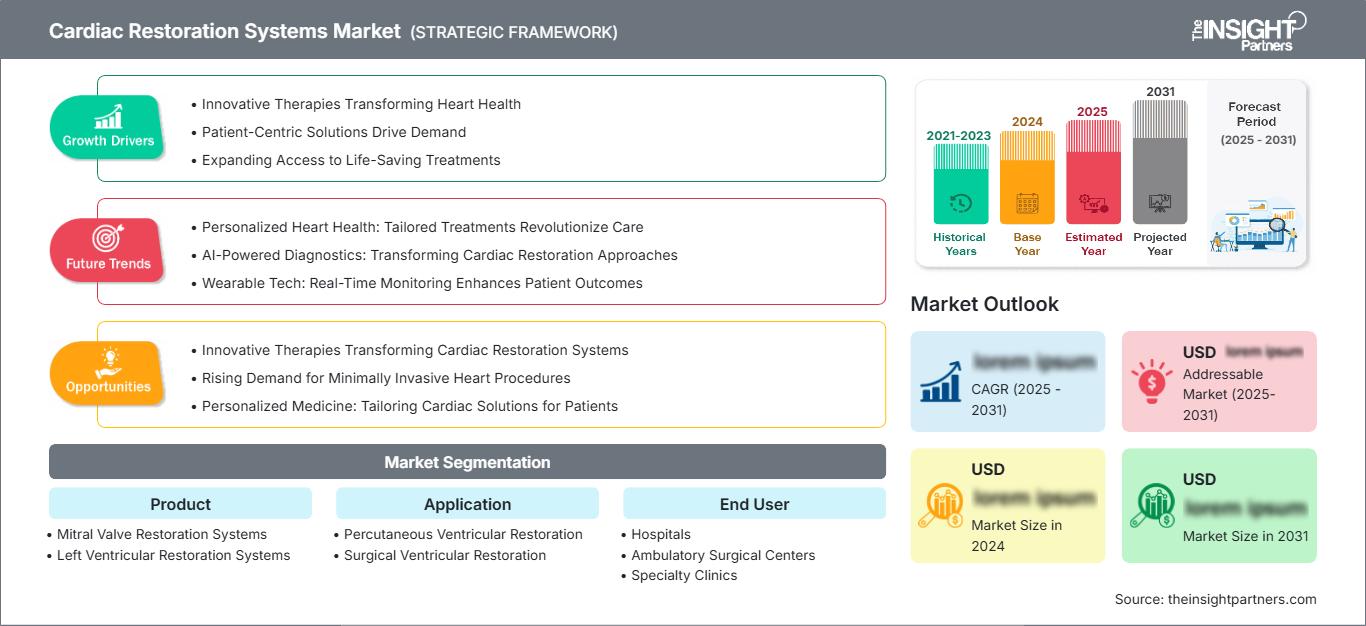
Cardiac Restoration Systems Market: Strategic Insights
Regional Insights
North America Cardiac Restoration Systems Market
North America held an estimated 38–42% Cardiac Restoration Systems Market share in 2025 and is projected to expand at a CAGR of 7.2–7.8% during 2026–2034. It is characterized by structured heart expertise, catheterization laboratories, advanced echocardiography, and fast adoption of regulated implants. The high cardiovascular spend will facilitate the analysis of therapeutic options which can help reduce readmissions and functional decline.
Commercialization increasingly targets frail patients, patients with ventricular dysfunction, mitral annular calcification, or various comorbidities who are not suitable for traditional surgeries. The area is helped by the presence of well-coordinated cardiology and cardiac surgery teams, ongoing pivotal trials, and physician training sponsored by manufacturers. Nevertheless, strict criteria for evidence, case selection, and payer coverage may prolong commercialization. Companies capable of demonstrating clinical benefit and reliable procedure results will be able to create referral pathways all across the United States and Canada.
U.S. Cardiac Restoration Systems Market
The US represented 84–88% of North American revenue in 2025 and is forecast to register a CAGR of 7.3–7.9% through 2034. Demands arise due to sophisticated structural heart centers, a high population suffering from cardiovascular diseases, and active participation in clinical trials. Some of the key players involved in mitral and ventricular restoration pathways include Abbott Laboratories, Edwards Lifesciences Corporation, and BioVentrix, Inc.
The application trends involve transcatheter and hybrid approaches for those patients that are not recommended for open-heart surgery. The recent FDA clearance of the Tendyne device by Abbott in May 2025 provided a solution for patients suffering from mitral annular calcification, whereas the SAPIEN M3 product clearance by Edwards Lifesciences in December 2025 was the first transseptal transcatheter approach of mitral valve replacement in the US market.
Europe Cardiac Restoration Systems Market
Europe accounted for an estimated 27–31% share in 2025 and is projected to grow at a CAGR of 6.8–7.4% through 2034. Germany leads due to its cardiac-center network, structured reimbursement process, and adoption of ventricular restoration. In the case of the UK, it enjoys specialized centers and health-technology assessment; however, procurement and referrals can influence adoption.
The advantage for Germany was increased by making 91 hospitals eligible to negotiate coverage for Revivent Therapy based on achieving NUB Status 1a for 2026. On the other hand, the UK has a potential for selective adoption of transcatheter mitral valve technologies in experienced centers with clinical governance and standardized heart team review.
France, Italy, and Spain contribute to growth with their aging populations, cardiovascular networks, and procedure experience. In the EU, in 2025, individuals 65 years old or older made up 22% of the total population. This emphasizes the need for long-term therapy for high-risk patients. However, market access varies depending on reimbursement policies and evidence criteria.
APAC Cardiac Restoration Systems Market
Asia Pacific held an estimated 20–24% share in 2025 and is projected to advance at a CAGR of 8.5–9.2% through 2034. Japan leads current regional adoption through mature cardiac infrastructure, specialist expertise, and an ageing population. China offers the largest scale opportunity, while South Korea and Australia provide advanced interventional capabilities.
India’s expansion is linked to private hospital investment and growing cardiac-care capacity. Regional policy emphasis on tertiary care, domestic device manufacturing, and specialist training supports diffusion. Affordability, reimbursement gaps, and uneven access outside major cities remain constraints.
Middle East & Africa Cardiac Restoration Systems Market
The Middle East and Africa segment is forecast to register a CAGR of 5.8–6.5% during 2026–2034. Saudi Arabia is the leading market, supported by tertiary hospital investment and health-system modernization. The UAE also attracts advanced cardiac procedures through specialist facilities and medical-travel flows.
South Africa anchors sub-Saharan adoption through established private cardiac centers. Across the rest of MEA, limited specialist availability and reimbursement restrict utilization. Oil-funded infrastructure programs in Gulf countries support equipment acquisition, but sustainable growth requires trained heart teams, referral systems, imaging capacity, and long-term clinical follow-up.
Segmentation Analysis
Product
Product is projected to expand at a CAGR of 7.2–7.8% during 2026–2034. The Cardiac Restoration Systems Market scope by product reflects two distinct therapeutic priorities: correcting mitral dysfunction and restoring inefficient ventricular geometry. Adoption depends on anatomy, surgical risk, imaging findings, physician expertise, and evidence of functional improvement. Product developers are emphasizing lower-profile delivery, predictable anchoring, durable materials, and compatibility with established structural heart workflows.
- Mitral Valve Restoration Systems: This category holds the leading position because mitral regurgitation affects broad patient groups and can be addressed through surgical repair, transcatheter edge-to-edge repair, chordal technologies, or valve replacement pathways.
- Left Ventricular Restoration Systems: Demand concentrates among patients with ischemic scarring, ventricular dilation, and reduced ejection fraction despite medical therapy, making clinical selection and imaging-based scar characterization strategically important.
Application
Application is anticipated to record a CAGR of 7.5–8.1% during 2026–2034. Clinical migration toward reduced surgical trauma supports percutaneous and hybrid techniques, while surgical ventricular restoration remains relevant for selected patients requiring direct anatomical correction. Application choice is determined by ventricular morphology, valve pathology, operative risk, prior interventions, and institutional expertise. Evidence comparing hospitalization, functional status, durability, and procedural complications will influence future treatment algorithms.
- Percutaneous Ventricular Restoration: This application benefits from demand for closed-chest or limited-access intervention, shorter recovery, and treatment of patients with elevated surgical risk, although procedural adoption requires advanced imaging and specialized operators.
- Surgical Ventricular Restoration: Surgical restoration maintains strategic importance for carefully selected patients with defined scar patterns or concurrent surgical needs, particularly where direct visualization permits extensive reshaping and associated valve or bypass procedures.
End User
End User is forecast to expand at a CAGR of 7.0–7.6% during 2026–2034. Utilization remains concentrated in institutions capable of multidisciplinary assessment, advanced imaging, anesthesia, cardiac surgery backup, and intensive post-procedure monitoring. Hospitals therefore dominate complex implantation. Ambulatory surgical centers may participate selectively as technologies and recovery protocols mature, while specialty clinics influence diagnosis, referral, imaging review, and longitudinal heart-failure management.
- Hospitals: Hospitals lead procedural volume because they combine catheter laboratories, operating rooms, intensive care, blood-bank support, imaging, and multidisciplinary teams required for managing complex structural and ventricular restoration cases.
- Ambulatory Surgical Centers: Adoption remains selective and procedure-dependent, with future relevance tied to device simplification, lower complication risk, predictable discharge protocols, reimbursement, and access to emergency cardiovascular support.
- Specialty Clinics: These facilities contribute through diagnosis, medication optimization, anatomical screening, referral coordination, and follow-up, making them important channels for identifying patients who remain symptomatic despite conventional therapy.
Opportunity Snapshot
| End User | Revenue Contribution (High/Medium/Low) | Trend Tag | Adoption Stage |
| Hospitals | High | Heart Teams | Mature |
| Ambulatory Surgical Centers | Low | Selective Migration | Emerging |
| Specialty Clinics | Medium | Referral Networks | Scaling |
Cardiac Restoration Systems Market Growth Drivers and Impact Analysis
Expanding Burden of Structural Heart Disease and Heart Failure
Cardiovascular disease remains the largest underlying demand driver because myocardial infarction, ischemic scarring, ventricular dilation, and valve dysfunction can produce progressive heart failure despite pharmacological management. According to WHO, 19.8 million people died of cardiovascular diseases in 2022, where heart attack and stroke accounted for 85% of the fatalities. The prevalence of more patients who survive with structural complications enhances the demand for procedures which can help restore the anatomical problem rather than only treating the symptom. Some of the benefits that restoration techniques provide include repairing mitral regurgitation, excluding dysfunctional scarred myocardium, or correcting the ventricular structure in some patients.
Clinical Shift Toward Less-Invasive Structural Interventions
Patients with advanced heart failure or mitral disease are frequently older, frail, or affected by comorbidities that increase open-surgery risk. Percutaneous and hybrid systems address this treatment gap by reducing sternotomy requirements, cardiopulmonary bypass exposure, or surgical dissection. The Bioventrix Revivent technique is described as mini-thoracotomy, off-pump surgery involving anchoring of scarred ventricle exclusion, whereas transcatheter mitral technologies involve catheter access for either repair or replacement of the mitral valve. Such a move increases the number of potential candidates for the therapy and decreases recovery time, but necessitates advanced imaging techniques and expertise in their use. The commercial success depends on cardiac centers, which have cardiology, surgical, imaging, and anesthesiology expertise.
Regulatory Approvals and Reimbursement Pathway Expansion
Regulatory and reimbursement breakthroughs translate clinical innovations into actionable demand. In 2025, the FDA cleared the Abbott Tendyne system for carefully selected patients with advanced mitral annular calcification and Edwards Lifesciences' SAPIEN M3 valve system for patients ineligible for surgical or edge-to-edge interventions. Also in Europe, BioVentrix won Germany's NUB Status 1a designation for 2026, allowing 91 hospitals to secure reimbursement for their Revivent Therapy. Such initiatives increase access, aid hospitals in their investments, and provide doctors with more options in anatomically challenging conditions. The effects will not be consistent since reimbursement conditions and requirements, evaluation criteria, and budget limits may differ. Still, successful regulatory clearance creates standards for clinical evidence, post-market studies, education, and economic evaluations that have to be fulfilled by future competitors.
Cardiac Restoration Systems Market Future Trends
Imaging-Guided Personalization and Digital Procedure Planning
Cardiac Restoration Systems Market trends will increasingly center on patient-specific planning using computed tomography, three-dimensional echocardiography, magnetic resonance imaging, and computational anatomical assessment. Such technology would allow the identification of scars, annulus size, leaflet morphology, ventricular anatomy, approach options, and potential obstructions prior to procedure. Device manufacturers will have the option to incorporate imaging guidelines with device selection and procedural simulation, allowing for a reduction of uncertainties with difficult anatomies. Image-based planning could also help ensure consistent selection criteria at different treatment facilities and enable review by experienced heart teams from remote locations. Eventually, structured imaging data could aid in patient recruitment in trials, prediction of procedural success, training of physicians, and reimbursement issues for payers.
Convergence of Repair, Replacement, and Ventricular Remodeling
Treatment approaches in the future will probably progress from treating individual valves or ventricles to comprehensive restoration of the mechanics of the heart. There can be synergy between mitral regurgitation and ventricular dilatation, movement of the papillary muscles, and weakening of contractility, thereby necessitating companies with product lines addressing all these aspects of disease progression. They may seek strategies such as sequential therapies, combination therapies, or compatible devices with common imaging and follow-up techniques. Such synergy may promote collaboration among valve device companies, ventricular restoration specialists, and companies providing planning and imaging software. Competition will no longer center on the effectiveness of individual devices but rather on lifelong disease management.
Cardiac Restoration Systems Market Opportunities
Establishing Referral Networks for Undertreated Patient Populations
A substantial commercial opportunity lies in converting diagnosed but untreated patients into appropriately evaluated candidates. Manufacturers and health systems can build referral pathways connecting heart-failure clinics, echocardiography laboratories, community cardiologists, and comprehensive structural heart centers. Investment should prioritize standardized screening criteria, secure image transfer, multidisciplinary case conferences, and patient-navigation services. These measures can reduce attrition between diagnosis and intervention, particularly among patients considered too high risk for conventional surgery. The Cardiac Restoration Systems Market can also benefit from education focused on post-infarction ventricular scarring and progressive mitral dysfunction. Successful networks would improve center utilization, shorten evaluation cycles, and generate real-world evidence across broader demographic and anatomical groups.
Localized Training and Evidence Generation in Emerging Markets
Asia Pacific and selected Gulf markets offer room for structured expansion through center-of-excellence partnerships rather than broad distributor-led launches. Companies should identify hospitals with cardiac surgery backup, advanced imaging, intensive care, and sufficient procedure volumes, then support proctoring and longitudinal outcome registries. Local evidence is particularly important where patient anatomy, referral timing, treatment costs, and reimbursement differ from Western trial settings. Joint programs with medical societies and public hospitals can strengthen physician confidence while demonstrating budget impact. Phased commercialization reduces execution risk by concentrating inventory, training, and technical support. It also provides a foundation for local manufacturing, regulatory submissions, and outcome-based reimbursement when procedural demand reaches sustainable levels.
Recent Developments
- March 2026: BioVentrix, Inc. announced that Germany’s Institute for the Hospital Remuneration System awarded Revivent Therapy NUB Status 1a for 2026. The designation enables 91 German hospitals to negotiate reimbursement for the therapy, supporting early European commercialization of the company’s less-invasive left ventricular restoration system for selected patients with ischemic heart failure.
- December 2025: Edwards Lifesciences Corporation received FDA approval for the SAPIEN M3 transcatheter mitral valve replacement system. The approval covers selected patients with symptomatic mitral regurgitation or mitral dysfunction associated with annular calcification who are unsuitable for surgery or transcatheter edge-to-edge repair, establishing the first FDA-approved transseptal mitral replacement therapy.
- May 2025: Abbott Laboratories received FDA approval for the Tendyne transcatheter mitral valve replacement system for patients with severe mitral annular calcification who are not candidates for open-heart surgery or successful MitraClip repair. The approval added a minimally invasive replacement option for a clinically complex population with constrained treatment alternatives.
Frequently Asked Questions

- Comprehensive Market Sizing and Forecast Analysis
- Detailed Segmentation Analysis
- In-Depth Market Dynamics Assessment
- Regional and Country-Level Insights
- Competitive Landscape and Company Benchmarking
- Strategic Business Intelligence
Recent Reports
Testimonials

The Insight Partners' SCADA System Market report is comprehensive, with valuable insights on current trends and future forecasts. The team was highly professional, responsive, and supportive throughout. We are very satisfied and highly recommend their services.
RAN KEDEM Partner, Reali Technologies LTDs
I requested a report on a very specific software market and the team produced the report in a few days. The information was very relevant and well presented. I then requested some changes and additions to the report. The team was again very responsive and I got the final report in less than a week.
JEAN-HERVE JENN Chairman, Future Analytica
We worked with The Insight Partners for an important market study and forecast. They gave us clear insights into opportunities and risks, which helped shape our plans. Their research was easy to use and based on solid data. It helped us make smart, confident decisions. We highly recommend them.
PIYUSH NAGPAL Sr. Vice President, High Beam Global
The Insight Partners delivered insightful, well-structured market research with strong domain expertise. Their team was professional and responsive throughout. The user-friendly website made accessing industry reports seamless. We highly recommend them for reliable, high-quality research services
YUKIHIKO ADACHI CEO, Deep Blue, LLC.
This is the first time I have purchased a market report from The Insight Partners.While I was unsure at first, I visited their web site and felt more comfortable to take the risk and purchase a market report.I am completely satisfied with the quality of the report and customer service. I had several questions and comments with the initial report, but after a couple of dialogs over email with their analyst I believe I have a report that I can use as input to our strategic planning process.Thank you so much for taking the extra time and making this a positive experience.I will definitely recommend your service to others and you will be my first call when we need further market data.
JOHN SUZUKI President and Chief Executive Officer, Board Director, BK Technologies
I wish to appreciate your support and the professionalism you displayed in the course of attending to my request for information regarding to infectious disease IVD market in Nigeria. I appreciate your patience, your guidance, and the fact that you were willing to offer a discount, which eventually made it possible for us to close a deal. I look forward to engaging The Insight Partners in the future, all thanks to the impression you have created in me as a result of this first encounter.
DR CHIJIOKE ONYIA MANAGING DIRECTOR, PineCrest Healthcare Ltd.Reason to Buy
- Informed Decision-Making
- Understanding Market Dynamics
- Competitive Analysis
- Identifying Emerging Markets
- Customer Insights
- Market Forecasts
- Risk Mitigation
- Boosting Operational Efficiency
- Strategic Planning
- Investment Justification
- Tracking Industry Innovations
- Aligning with Regulatory Trends





 Get Free Sample for