
Carpel tunnel Release System Market Demand, Size & Forecast by 2034
Carpel tunnel Release System Market Size and Forecasts (2021 - 2034), Global and Regional Share, Trends, and Growth Opportunity Analysis Report Coverage : by Product Type (Open Carpal Tunnel Release Systems and Endoscopic Carpal Tunnel Release Systems); End User (Hospitals, Ambulatory Surgical Centers, Other End Users); and Geography (North America, Europe, Asia Pacific, and South and Central America)
- Status : Data Released
- Report Code : TIPRE00040826
- Category : Life Sciences
- No. of Pages : 150
- Available Report Formats :


- Last update date : September 08, 2026


2025 Market Size
US$ 502.69 Mn
Base year value
2034 Forecast
US$ 825.17 Mn
Projected by 2034
CAGR 2026-2034
5.66 %
Growth rate
Addressable Market
US$ 6,018.31 Mn
(2026-2034)
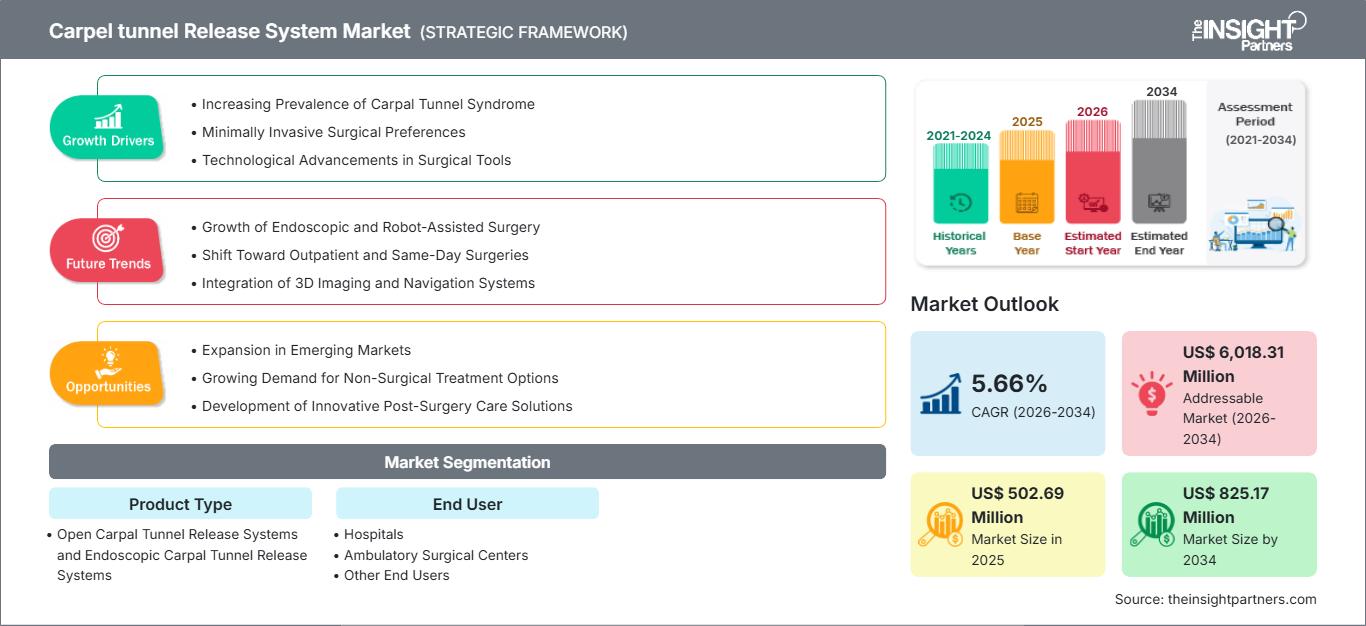
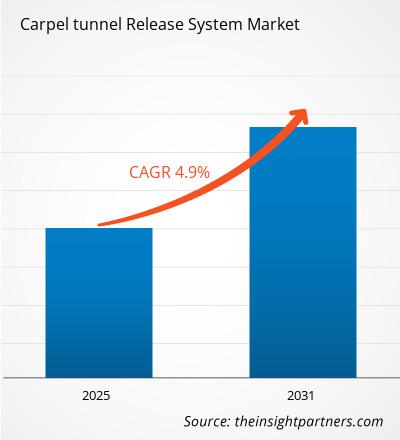
The Carpel Tunnel Release System Market was valued at US$ 502.69 Million in 2025 and is projected to reach US$ 825.17 Million by 2034. The industry is anticipated to record a CAGR of 5.66% during 2026-2034 owing to steady need for systems used to decompress the median nerve through open surgery as well as endoscopic releases.
North American Carpel Tunnel Release System Market Size is likely to experience growth at a CAGR of 5.2-5.8% during 2026-2034 due to availability of high procedures, proven reimbursement mechanisms, wide presence of hand surgery facilities, as well as increasing trend towards performing the treatment via outpatient facilities. Growth in use of compact visualization systems as well as disposable kits helps to conduct proper treatment through outpatient centers and office based facilities.
Carpel tunnel Release System Market Assessment and Insights
- North America: The region accounted for an estimated 33–36% share in 2025 and is projected to grow at a 5.2–5.8% CAGR between 2026–2034, supported by reimbursement coverage, surgeon training, high diagnosis rates, and outpatient procedure migration.
- US: The country represented approximately 86–89% of North American revenue in 2025 and is expected to register a 5.3–5.9% CAGR during 2026–2034, reflecting high surgical capacity and technology adoption.
- Europe: Europe held an estimated 25–28% share in 2025 and should expand at a 4.8–5.4% CAGR during 2026–2034. Germany, the UK, France, Italy, and Spain remain the principal markets.
- Asia Pacific: Asia Pacific captured approximately 23–26% share in 2025 and is projected to record a 6.4–7.1% CAGR during 2026–2034, led by China, Japan, South Korea, India, and Australia.
- Largest Segment: Open Carpal Tunnel Release Systems held an estimated 57–61% market share in 2025 and are expected to grow at a 4.5–5.1% CAGR during 2026–2034, supported by procedural familiarity.
- High Growth Segment: Endoscopic Carpal Tunnel Release Systems accounted for approximately 39–43% market share in 2025 and are projected to register a 6.7–7.4% CAGR during 2026–2034, reflecting outpatient adoption.
- Key companies analyzed in detail: AM Surgical, Inc.; Arthrex, Inc.; CONMED Corporation; Integra LifeSciences Holdings Corporation; Medical Designs, LLC; MicroAire Surgical Instruments, LLC; Smith & Nephew plc; Stryker Corporation; Trice Medical, Inc.; and SEG-WAY Orthopaedics, Inc.
Source: The Insight Partners' analysis based on proprietary research, government publications, company annual reports, investor presentations, industry databases, and expert interviews.
The development of surgical release technologies has evolved from conventional reusable open instruments to single-port endoscopy instruments, small visualization tools, disposable blades, and procedure specific guidance systems. The Carpel Tunnel Release System Market shows an increasing tendency towards differentiated production strategies, where reusable handpieces will ensure lower recurrent cost of acquisitions, while sterile single-use kits will eliminate the need for reprocessing and shorten the turnover time of the operating room. Portable imaging and chip-on-tip scopes will diminish the need for heavy endoscopy towers and make more places available for procedures.
Adoption of robotic technology is anticipated to rise within the Asia Pacific region and certain parts of the Middle East healthcare systems, thanks to advancements in surgical specialties, insurance coverage, and ambulatory care facilities. The manufacturing companies will be more concerned about distribution, training of doctors, and product designs that can be assembled in modules. However, the regulatory clearance of minimally invasive devices and prospective registries would boost purchasing confidence while budgetary constraints would restrict the adoption rate in the developing countries.
Carpel tunnel Release System Market Report Scope
| Report Attribute | Details |
|---|---|
| Market size in 2025 | US$ 502.69 Million |
| Market Size by 2034 | US$ 825.17 Million |
| Global CAGR (2026 - 2034) | 5.66% |
| Historical Data | 2021-2024 |
| Forecast period | 2026-2034 |
Carpel tunnel Release System Market Analysis
The Carpel Tunnel Release System market is fueled by carpal tunnel syndrome diagnoses, aging populations, obesity-related comorbidities, work-related hand strain, and increasing tendency to opt for surgery following failed conservative treatments. The syndrome could be seen in as much as 5% of the population, thus resulting in a wide-ranging clinical pathway starting from the diagnosis and nerve studies through the surgery and rehabilitation.
In this market, there are participants like instrument makers, component makers, sterilization services providers, distributors, hospitals, ASCs, hand surgeons, payers, and educational organizations. The procurement process becomes more about deciding whether to go for reusable systems or single-use systems. The committee members are concerned more about visualization, incision size, blade handling, compatibility with cameras, sterilization costs, and total cost per procedure than the cost of instruments only.
The Carpel Tunnel Release System Market Report shows a competitive scenario with competition existing between diversified surgical device companies and specialty upper extremity products. Arthrex, Inc. and MicroAire Surgical Instruments, LLC are competing based on existing endoscope platforms while Trice Medical, Inc. focuses on anatomy specific guides and disposable versions. CONMED Corporation, Stryker Corporation, Smith & Nephew plc, and Integra LifeSciences Holdings Corporation have the advantage of a wider hospital connection and operating room portfolio.
The current investments in this market lie in the development of portable visualization systems, sterile procedure kits, unique cutting techniques, clinical evidence, and surgical skills training programs. Competitive positioning involves leveraging the benefits of clinical superiority by adding value to the provider in the form of faster turnover, less reprocessing required, compatible with local anesthetics, and quicker recovery.
● REPORT CUSTOMIZATION
Tailor This Report To Align With Your Specific Business Requirements
This report can be customized to align precisely with your business objectives, scope, and target markets. Customization options include tailored segmentation, geography, competitive analysis, and strategic insights to support informed decision-making.
Customize This Report →WHAT YOU CAN ADJUST
- ● Segmentations
- ● Geography
- ● Competitive Analysis
- ● Language Preferences
Carpel tunnel Release System Market: Strategic Insights
Regional Insights
North America Carpel Tunnel Release System Market
North America represented an estimated 33–36% share in 2025 and is forecast to register a 5.2–5.8% CAGR during 2026–2034. The Carpel Tunnel Release System Market share reflects extensive hand-surgery networks, developed diagnostic pathways, established payer coverage, and rapid adoption of minimally invasive procedures. Published utilization evidence indicates that both open and endoscopic release volumes increased across the US during the decade through 2023.
Canadians’ contributions include publicly financed orthopedic care and enhanced day surgery facilities, whereas Americans drive innovation and adoption of the products. The growing use of regional purchasing has led to greater preference for kit systems, which decrease the complexity of preparation and allow for the use of local anesthetics. Pricing, the learning curve of the surgeons, and reimbursement differences in facilities may delay adoption, but further studies will shed light on this topic.
U.S. Carpel Tunnel Release System Market
US represented about 86%–89% of the North America market in 2025 and was anticipated to grow at a CAGR of 5.3%–5.9% during 2026–2034. The market dominance was driven by expertise in specialty, extensive ambulatory care facility network, well-established coding system for the procedure, and high representation of device manufacturers. Utilization patterns over a ten-year period of 215,115 patients indicated that the most utilized technique was open release and that use of endoscopic procedure was on the rise.
Companies such as Arthrex, Inc., MicroAire Surgical Instruments, LLC, Trice Medical, Inc., and AM Surgical, Inc. have been engaged in activities involving commercialization and education in the country. The trend towards the use of single portal release technique, sterilized disposable tools, and use of local anesthesia had developed. Registry data for 6 months of 2026 consisted of 887 patients and 1,082 hands.
Europe Carpel Tunnel Release System Market
The region accounted for 25-28% in 2025 and is anticipated to grow at a CAGR of 4.8-5.4% during 2026-2034. Germany leads among all the countries owing to high surgical infrastructure and continuous availability of specialists. The UK offers opportunities due to day-case pathways, though procurement constraints and waiting lists affect replacement cycles. The presence of ergonomic systems and reusability with known clinical use case is seen in both the nations.
France represents a combination of public hospital procurements along with well-established private surgical industry, whereas Italy and Spain show higher regional variability in accessibility and capital investments. In these countries, the adoption would be driven by reimbursement, surgeon preference, and proof that better quality endoscopy tools can ease the recovery process. Traceability of medical devices, sterilization, documentation, and sustainability of disposables are other considerations by the buyers in Europe.
The needs of the region would require compatibility with existing endoscopic tools, hence lowering capital costs. The open release procedure will remain crucial because of less instrument requirement and the presence of surgeons using the technique. The competitive edge will be achieved by way of training, distribution system, and availability of blade, cannulas, and sterile accessories.
APAC Carpel Tunnel Release System Market
The Asia Pacific market was projected to have a share of 23-26%, and its CAGR is projected to be between 6.4-7.1% in 2026-2034. The Japanese market leads the region with its advanced surgical infrastructure, while China has significant volume potential. South Korea and Australia provide assistance to adopt minimally invasive devices, while India profits from its growing private hospitals and day-care facilities.
Government initiatives to provide better surgical care and increase insurance cover will help the Carpel Tunnel Release System Market grow. However, growth will still depend on training of specialists and cost-effectiveness of the devices.
Middle East & Africa Carpel Tunnel Release System Market
The market is expected to grow at a 4.2-4.9% CAGR between 2026 and 2034. The growth is driven by hospital investment and specialization for Saudi Arabia and premium minimally invasive procedures for the UAE, whereas South Africa drives sub-Saharan region demand and the Rest of MEA relies on referral hospitals and importation of equipment and distributors' capabilities.
Healthcare infrastructure development generates procurement prospects; however, restricted insurance penetration and lack of hand surgery skills hinder the number of procedures. Portable systems can increase access in cases of insufficient endoscopy infrastructure and sterilization capabilities.
Segmentation Analysis
Product Type
Product Type is projected to expand at a 5.4–6.0% CAGR during 2026–2034. The Carpel Tunnel Release System Market scope covers open and endoscopic systems that differ in visualization, incision requirements, procedural workflow, capital intensity, and recurring consumable demand. Open platforms retain broad accessibility, while endoscopic systems gain adoption where providers prioritize smaller incisions, faster functional recovery, and outpatient efficiency.
- Open Carpal Tunnel Release Systems: These systems maintain the leading position because surgeons can directly visualize the ligament using familiar instruments, making the approach accessible across hospitals with varied technology budgets and case complexity.
- Endoscopic Carpal Tunnel Release Systems: Demand is rising as providers seek smaller incisions, reduced postoperative discomfort, and earlier return to normal activity, positioning visualization quality and surgeon training as central competitive factors.
End User
End User demand is expected to grow at a 5.3–5.9% CAGR during 2026–2034. Hospitals remain important for complex patients and cases requiring comprehensive anesthesia support. Ambulatory Surgical Centers are gaining strategic significance because standardized release procedures suit scheduled outpatient workflows, while compact equipment and sterile kits can reduce setup requirements. Other End Users contribute through selected specialty practices and office-based procedure environments.
- Hospitals: Hospitals remain the primary purchasers because they combine diagnostic services, specialist surgeons, anesthesia capability, and postoperative support, particularly for complex anatomy, severe neuropathy, comorbid patients, or conversion to open surgery.
- Ambulatory Surgical Centers: Centers increasingly favor streamlined endoscopic kits, compact visualization, predictable scheduling, and rapid turnover, making per-case consumable cost, training support, and reimbursement alignment decisive purchasing criteria.
Opportunity Snapshot
| End User | Revenue Contribution | Trend Tag | Adoption Stage |
| Hospitals | High | Complex Cases | Mature |
| Ambulatory Surgical Centers | High | Outpatient Shift | Scaling |
| Other End Users | Low | Office Procedures | Emerging |
Carpel tunnel Release System Market Growth Drivers and Impact Analysis
Increasing Diagnosed Burden of Median Nerve Compression
Carpal tunnel syndrome is recognized as the most common peripheral entrapment neuropathy and may affect up to 5% of the population. Aging, diabetes, obesity, repetitive occupational movement, and prolonged computer use sustain the pool of patients entering diagnostic and conservative-treatment pathways. When splinting, medication, injections, or activity modification fail, surgical decompression becomes an established option. Rising diagnosis does not translate automatically into device demand, but it enlarges the addressable procedural base. Manufacturers can capture this demand by supporting referral education, objective patient selection, and systems suited to different anatomical and facility requirements. The greatest commercial impact occurs where diagnosis, specialist access, reimbursement, and surgical capacity operate together.
Migration of Suitable Procedures to Ambulatory Settings
Carpal tunnel release is increasingly aligned with ambulatory care because suitable cases can be completed through small incisions, short procedural schedules, and local or regional anesthesia. Single-use instruments and portable visualization reduce dependence on large operating-room towers, while standardized kits can simplify preparation and inventory management. For facilities, the economic impact may include faster turnover and improved utilization of procedure rooms. For manufacturers, this shift creates demand for compact consoles, disposable cameras, sterile blades, and training programs tailored to smaller clinical teams. Adoption will depend on payer rules, credentialing, emergency protocols, and demonstrated outcomes. Systems designed around efficient workflows are therefore positioned to gain preference as health systems decentralize appropriate orthopedic procedures.
Expanding Clinical Evidence for Less Invasive Release
Prospective registries and comparative utilization studies are strengthening the evidence available to surgeons, payers, and procurement committees. The MISSION registry enrolled more than 1,300 patients across 33 US sites, while reported six-month findings covered 887 patients and 1,082 treated hands. Evidence on symptom improvement, functional recovery, patient satisfaction, anesthesia use, and return to activity can influence technology assessment beyond basic procedural success. Manufacturers that invest in post-market surveillance and independent publication can reduce uncertainty surrounding newer approaches. Clinical evidence is particularly important when facilities compare open, endoscopic, and ultrasound-guided workflows, because acquisition cost must be weighed against recovery, throughput, complications, and resource utilization.
Carpel tunnel Release System Market Future Trends
Single-Use Visualization and Integrated Procedure Kits
Carpel Tunnel Release System Market trends will increasingly favor integrated sterile kits that combine visualization, dilation, tissue preparation, and ligament-release components. Chip-on-tip cameras and portable monitors can reduce reliance on conventional towers, while preconfigured packs may simplify inventory and room setup. Product development will focus on image clarity, low-profile access, controlled blade deployment, and compatibility with local anesthesia workflows. Suppliers must also address the environmental burden of disposable components through material reduction, recyclable packaging, and lifecycle reporting. Purchasing decisions will therefore compare infection-control convenience and reprocessing savings against waste-management requirements, recurring consumable expense, and supply continuity.
Evidence-Guided Selection of Procedure and Care Setting
Treatment selection will become more data driven as registries capture patient-reported outcomes, recovery times, bilateral procedures, anesthesia choices, and site-of-service differences. Rather than replacing open release universally, emerging evidence should help clinicians identify patients suitable for endoscopic, office-based, or ultrasound-guided approaches. Manufacturers will integrate evidence generation into commercialization through multicenter registries, digital education, and standardized outcome reporting. Payers may use these datasets to refine coverage and prior-authorization policies. The long-term competitive advantage will shift toward platforms supported by reproducible outcomes across diverse surgeons and facilities, not solely devices offering smaller incisions or differentiated mechanical features.
Carpel tunnel Release System Market Opportunities
Build Ambulatory Conversion Programs Around Workflow Economics
Manufacturers can create value by offering ambulatory centers a complete conversion pathway rather than selling instruments independently. Programs should combine equipment assessment, procedural training, sterile inventory planning, reimbursement education, and post-adoption outcome tracking. The commercial target includes centers currently performing open release and facilities sending cases to hospital operating rooms because portable visualization is unavailable. Carpel Tunnel Release System Market Forecasts support investment in configurations that reduce setup complexity without limiting blade control or visualization. Vendors should document total cost per procedure, room turnover, reprocessing requirements, and capital utilization. Contract structures linking disposable commitments with equipment access may reduce initial financial barriers for qualified centers.
Expand Through Regional Training and Service Partnerships
Asia Pacific, the Middle East, and selected European markets offer room for structured expansion, but distribution alone will not ensure adoption. Companies should establish regional surgeon-training partnerships, multilingual technical resources, responsive repair services, and dependable consumable inventories. Modular product configurations can address hospitals with existing endoscopy towers while portable systems can serve facilities lacking advanced visualization infrastructure. Market entry should prioritize metropolitan hand-surgery centers that can become reference sites and training hubs. Local clinical evidence and health-economic documentation will be necessary where procurement committees require justification for premium devices. Partnerships with specialty societies and teaching hospitals can accelerate safe adoption while protecting brand credibility.
Recent Developments
- June 2026: Sonex Health, Inc. announced six-month outcomes from the MISSION registry covering 887 patients and 1,082 treated hands across 22 US sites. The reported findings showed rapid symptom and functional improvement following ultrasound-guided release, with 82.1% of procedures performed using local anesthesia and median return to normal activities reported at three days.
- August 2025: Arthrex, Inc. reported that its NanoScopic Release System received a bronze Edison Award in the Innovative Surgical Solutions category. The system combines a NanoNeedle Scope with the Centerline release device to support endoscopic carpal tunnel procedures while reducing dependence on conventional operating-room imaging equipment.
- January 2025: Trice Medical, Inc. published updated commercial materials for the Seg-WAY ECTR-d single-use system, highlighting an anatomy-specific disposable guide, portable angled visualization, local-anesthesia compatibility, and reduced setup requirements. The platform accommodates 2.3 mm disposable visualization and selected standard arthroscopes, supporting ambulatory and procedure-room workflows.
Frequently Asked Questions

- Comprehensive Market Sizing and Forecast Analysis
- Detailed Segmentation Analysis
- In-Depth Market Dynamics Assessment
- Regional and Country-Level Insights
- Competitive Landscape and Company Benchmarking
- Strategic Business Intelligence
Recent Reports
Testimonials

The Insight Partners' SCADA System Market report is comprehensive, with valuable insights on current trends and future forecasts. The team was highly professional, responsive, and supportive throughout. We are very satisfied and highly recommend their services.
RAN KEDEM Partner, Reali Technologies LTDs
I requested a report on a very specific software market and the team produced the report in a few days. The information was very relevant and well presented. I then requested some changes and additions to the report. The team was again very responsive and I got the final report in less than a week.
JEAN-HERVE JENN Chairman, Future Analytica
We worked with The Insight Partners for an important market study and forecast. They gave us clear insights into opportunities and risks, which helped shape our plans. Their research was easy to use and based on solid data. It helped us make smart, confident decisions. We highly recommend them.
PIYUSH NAGPAL Sr. Vice President, High Beam Global
The Insight Partners delivered insightful, well-structured market research with strong domain expertise. Their team was professional and responsive throughout. The user-friendly website made accessing industry reports seamless. We highly recommend them for reliable, high-quality research services
YUKIHIKO ADACHI CEO, Deep Blue, LLC.
This is the first time I have purchased a market report from The Insight Partners.While I was unsure at first, I visited their web site and felt more comfortable to take the risk and purchase a market report.I am completely satisfied with the quality of the report and customer service. I had several questions and comments with the initial report, but after a couple of dialogs over email with their analyst I believe I have a report that I can use as input to our strategic planning process.Thank you so much for taking the extra time and making this a positive experience.I will definitely recommend your service to others and you will be my first call when we need further market data.
JOHN SUZUKI President and Chief Executive Officer, Board Director, BK Technologies
I wish to appreciate your support and the professionalism you displayed in the course of attending to my request for information regarding to infectious disease IVD market in Nigeria. I appreciate your patience, your guidance, and the fact that you were willing to offer a discount, which eventually made it possible for us to close a deal. I look forward to engaging The Insight Partners in the future, all thanks to the impression you have created in me as a result of this first encounter.
DR CHIJIOKE ONYIA MANAGING DIRECTOR, PineCrest Healthcare Ltd.Reason to Buy
- Informed Decision-Making
- Understanding Market Dynamics
- Competitive Analysis
- Identifying Emerging Markets
- Customer Insights
- Market Forecasts
- Risk Mitigation
- Boosting Operational Efficiency
- Strategic Planning
- Investment Justification
- Tracking Industry Innovations
- Aligning with Regulatory Trends





 Get Free Sample for