
Ceramic Core Market Size, Share & Trends by 2034
Coverage: By Type (Alumina, Zicron, Silica); End User (Healthcare, Aerospace, Energy, Automotive, Others), and Geography (North America, Europe, Asia Pacific, and South and Central America)
- Status : Data Released
- Report Code : TIPRE00014011
- Category : Chemicals and Materials
- No. of Pages : 150
- Available Report Formats :


- Last update date : August 13, 2026


2025 Market Size
US$ 2.80 Bn
Base year value
2034 Forecast
US$ 4.43 Bn
Projected by 2034
CAGR 2026-2034
5.25 %
Growth rate
Addressable Market
US$ 32.83 Bn
(2026-2034)
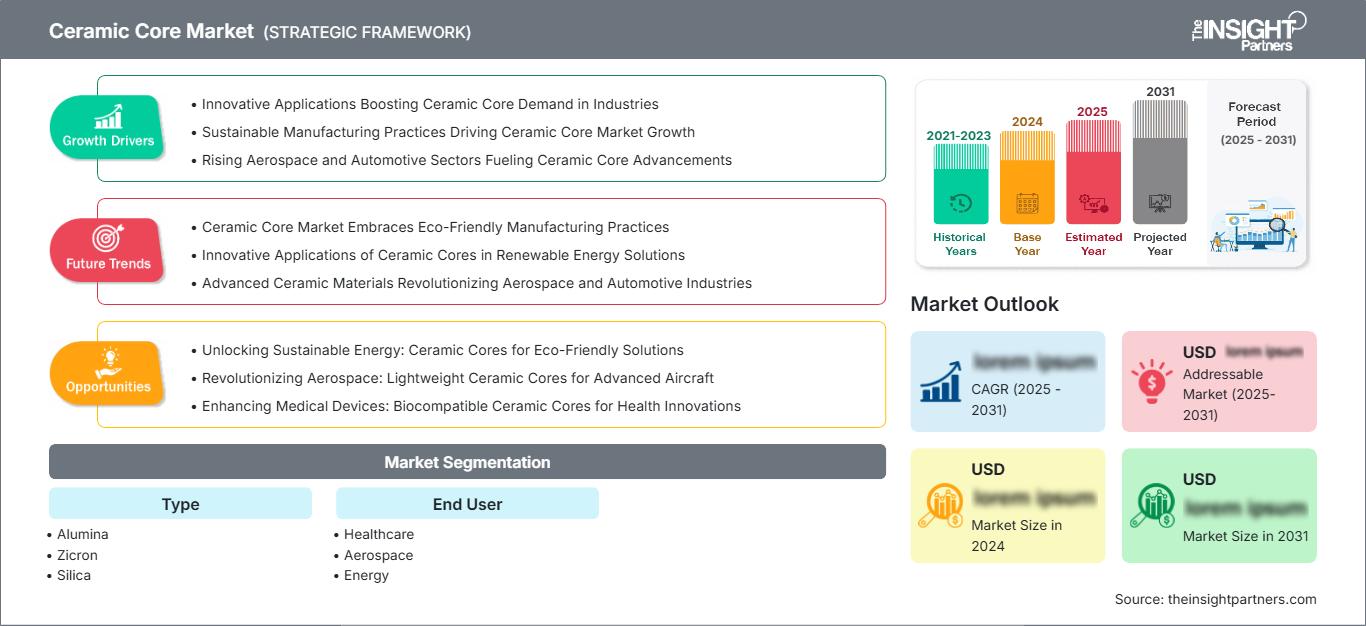
The Ceramic Core market was valued at US$ 2.80 Billion in 2025 and is projected to reach US$ 4.43 Billion by 2034, expanding at a CAGR of 5.25% during 2026–2034. The market is supported by rising demand for precision investment casting across aerospace, healthcare, energy, and automotive industries. Ceramic cores enable the production of intricate internal passages in high-performance metal components, particularly turbine blades and medical implants, where dimensional accuracy and thermal stability remain critical manufacturing requirements.
Across North America, manufacturers continue expanding investments in advanced casting technologies and lightweight component production to address increasing aerospace engine demand and industrial modernization. The Ceramic Core Market size in the region is supported by strong research capabilities, established investment casting infrastructure, and defense manufacturing programs. Growing adoption of next-generation gas turbines and additive manufacturing-assisted ceramic core production is expected to support a regional CAGR ranging between 5.0% and 5.6% throughout the forecast period.
Ceramic Core Market Assessment and Insights
- North America: The region benefits from strong aerospace manufacturing, advanced investment casting facilities, and increasing turbine engine production. Share in 2025: 34–38%. CAGR between 2026–2034: 5.0–5.6%.
- U.S.: High defense spending, aircraft engine manufacturing, and medical technology innovation support sustained demand. Share in 2025: 74–78% of North America. CAGR between 2026–2034: 5.1–5.7%.
- Europe: Germany, France, the UK, and Italy remain major manufacturing centers owing to aerospace supply chains and industrial engineering expertise. Share in 2025: 27–31%. CAGR between 2026–2034: 4.8–5.4%.
- Asia Pacific: China, Japan, South Korea, and India continue expanding investment casting capacity, aircraft manufacturing, and industrial turbine production. Share in 2025: 24–28%. CAGR between 2026–2034: 6.0–6.6%.
- Largest Segment: Aerospace represents the leading end-user segment due to widespread utilization of ceramic cores in turbine blade casting. Market share in 2025: 42–46%. CAGR between 2026–2034: 5.4–5.9%.
- High-Growth Segment: Zircon ceramic cores demonstrate accelerated adoption because of superior thermal shock resistance and dimensional stability for complex castings. Market share in 2025: 29–33%. CAGR between 2026–2034: 6.1–6.7%.
- Key companies analyzed in detail: Howmet Aerospace Inc., Avignon Ceramic SAS, CeramTec GmbH, CoorsTek, Inc., GF Precicast SA, Lanik s.r.o., Morgan Advanced Materials Limited, NORITAKE CO., LIMITED, PCC Airfoils, LLC, Vesuvius plc.
Source: The Insight Partners' analysis based on proprietary research, government publications, company annual reports, investor presentations, industry databases, and expert interviews.
Advancements in the field of ceramic material development, precision forming methods, and automation of investment casting technology have greatly improved manufacturing efficiency in all industry segments. More emphasis is being placed on the use of high-purity ceramic materials, close dimensional tolerances, and firing optimization for improving mechanical properties while lowering defect levels. All these developments have increased the use of Ceramic Core in gas turbine engines, aerospace propulsion systems, and medical devices where cooling passages and lightweight designs are crucial.
The growth of the Ceramic Core Market in the coming years will be aided by rising production in aircraft, energy infrastructure modernization, and industrial automation in developing countries. Defense manufacturing, clean energy generation, and advanced industrial materials through government funding are continuously motivating capacity additions in the sector. The digital manufacturing industry, with its simulation-based mold making and additive manufacturing-assisted tooling, will enhance manufacturing efficiency and development cycles in addition to creating more commercial prospects for the ceramic core providers in high-value engineering applications.
Ceramic Core Market Report Scope
| Report Attribute | Details |
|---|---|
| Market size in 2025 | US$ 2.80 Billion |
| Market Size by 2034 | US$ 4.43 Billion |
| Global CAGR (2026 - 2034) | 5.25% |
| Historical Data | 2021-2024 |
| Forecast period | 2026-2034 |
Ceramic Core Market Analysis
The Ceramic Core market growth is primarily supported by expanding demand for high-performance investment cast components in aerospace, energy, healthcare, and automotive industries. The manufacturers of aircraft engines have begun to demand the use of ceramic cores for creating turbine blades with intricate internal channels for enhancing fuel efficiency and operating temperatures. Higher demand for electricity has also fueled investments into gas turbines and high-end power generation machinery, leading to growth in the overall value chain. The raw materials suppliers, ceramic powder manufacturers, tools manufacturers, investment casting companies, and the original equipment manufacturers together make an integrated ecosystem with emphasis on quality assurance, precision, and consistency.
The dynamics of supply have continued to change as the manufacturers look to diversify their sources and develop regional manufacturing capabilities for better security. Automation in ceramic molding and precise firing techniques along with digitized quality inspections, have helped reduce variability in manufacturing and improve yield rates. Collaborations between the ceramic materials suppliers and the investment casting companies in aerospace are enabling innovations in robust and defect-free ceramic cores.
The Ceramic Core market analysis indicates that competition is centered on technological capabilities, manufacturing precision, product reliability, and long-term customer relationships rather than pricing alone. Leading participants, including Howmet Aerospace Inc., CeramTec GmbH, Morgan Advanced Materials Limited, CoorsTek, Inc., NORITAKE CO., LIMITED, and PCC Airfoils, LLC, continue investing in advanced ceramic formulations and process optimization to strengthen their positions in aerospace and industrial casting applications. Regional specialists such as Avignon Ceramic SAS, GF Precicast SA, Lanik s.r.o., and Vesuvius plc further enhance competition by supplying customized ceramic core solutions for specialized investment casting requirements.
Investment activity increasingly focuses on digital manufacturing, automation, advanced kiln technologies, and research into next-generation ceramic materials capable of withstanding higher casting temperatures. Companies are expanding technical partnerships with aircraft engine manufacturers, healthcare device producers, and industrial turbine suppliers to accelerate product development. At the same time, sustainability initiatives, including energy-efficient production processes, recycling of ceramic materials, and optimized resource utilization, are becoming important strategic differentiators that support long-term competitiveness across the global Ceramic Core industry.
● REPORT CUSTOMIZATION
Tailor This Report To Align With Your Specific Business Requirements
This report can be customized to align precisely with your business objectives, scope, and target markets. Customization options include tailored segmentation, geography, competitive analysis, and strategic insights to support informed decision-making.
Customize This Report →WHAT YOU CAN ADJUST
- ● Segmentations
- ● Geography
- ● Competitive Analysis
- ● Language Preferences
Ceramic Core Market: Strategic Insights
Regional Insights
North America Ceramic Core Market
North America accounted for 34–38% of the global Ceramic Core Market share in 2025 and is projected to register a CAGR of 5.0–5.6% during 2026–2034. The region benefits from mature aerospace manufacturing, advanced investment casting facilities, and continuous defense modernization programs. Strong demand for high-efficiency gas turbines and commercial aircraft engines continues to support the consumption of precision ceramic cores across the United States and Canada.
Manufacturers are increasingly investing in automated ceramic processing, digital inspection systems, and advanced material formulations to improve casting accuracy and production efficiency. Growing emphasis on lightweight aerospace components, industrial gas turbines, and next-generation medical devices further supports regional expansion. Stable raw material availability, skilled engineering capabilities, and collaboration between OEMs and casting suppliers continue to strengthen North America's competitive position within the global market.
U.S. Ceramic Core Market
The U.S. represented 74–78% of the North American market in 2025 and is expected to expand at a CAGR of 5.1–5.7% through 2034 in the Ceramic Core Market. The country's leadership is supported by a strong aerospace ecosystem, substantial defense spending, and the presence of globally recognized investment casting companies. Increasing production of aircraft engines and industrial turbines continues to generate consistent demand for high-performance ceramic core technologies.
Major manufacturers continue expanding research into advanced ceramic formulations capable of delivering improved dimensional stability and thermal resistance. Healthcare applications, including precision casting for orthopedic and surgical components, are also creating new demand opportunities. Strong collaboration among material suppliers, engine manufacturers, and research institutions supports technological innovation while maintaining the country's leadership in precision casting and advanced ceramic manufacturing.
Europe Ceramic Core Market
Europe accounted for 27–31% of the global market in 2025 and is forecast to grow at a CAGR of 4.8–5.4% during the study period in the Ceramic Core Market. Germany remains the leading national market because of its advanced engineering sector, industrial machinery production, and strong aerospace manufacturing base. Continuous investments in turbine technology and precision casting support long-term demand for high-performance ceramic core solutions.
The United Kingdom continues to strengthen its aerospace manufacturing capabilities through investments in aircraft engine development and advanced materials research. France maintains robust demand through commercial aviation programs and industrial gas turbine production, while Italy and Spain contribute through automotive engineering, industrial equipment manufacturing, and precision foundry operations. Collaboration across European aerospace supply chains supports innovation, manufacturing quality, and sustainable ceramic processing technologies.
APAC Ceramic Core Market
Asia Pacific represented 24–28% of global demand in 2025 and is anticipated to record the fastest regional CAGR of 6.0–6.6% during 2026–2034. China leads regional production, while Japan, South Korea, and India continue expanding investments in aerospace, industrial equipment, and advanced manufacturing technologies.
Government initiatives supporting domestic aircraft manufacturing, power generation infrastructure, and industrial modernization continue driving market expansion. Australia contributes through mining equipment and energy applications, while increasing the localization of investment casting production strengthens regional supply chains and technological capabilities.
Middle East & Africa Ceramic Core Market
The Middle East & Africa market is expected to expand at a CAGR of 4.5–5.1% during the forecast period. Saudi Arabia and the UAE continue investing in aerospace maintenance, industrial manufacturing, and energy infrastructure, creating steady demand for advanced ceramic casting solutions.
South Africa supports regional growth through mining equipment manufacturing and industrial engineering activities, while the rest of the region benefits from infrastructure development and energy sector investments. Increasing diversification beyond oil-based economies is expected to encourage wider adoption of precision ceramic components across multiple industrial applications.
Segmentation Analysis
Type
The Type segment defines the material characteristics that determine thermal stability, dimensional accuracy, and mechanical performance during investment casting. The Ceramic Core Market scope continues expanding as manufacturers develop advanced formulations capable of supporting increasingly complex turbine blade geometries and precision industrial components. The segment is projected to register a CAGR of 5.3–5.9% during 2026–2034, supported by continuous innovation in ceramic processing technologies.
- Alumina: Widely used because of its excellent mechanical strength, chemical stability, and cost efficiency. Alumina ceramic cores remain suitable for numerous aerospace, industrial, and automotive investment casting applications requiring consistent dimensional accuracy.
- Zircon: Preferred for high-temperature casting operations owing to superior thermal shock resistance and low thermal expansion. Demand continues to increase for advanced aerospace turbine components requiring complex cooling channel geometries and enhanced casting precision.
- Silica: Commonly utilized in precision investment casting because of its excellent mold compatibility, dimensional consistency, and ease of processing. Silica-based ceramic cores remain important for manufacturing intricate industrial components with stable production performance.
End User
The End User segment reflects the broad industrial adoption of ceramic cores across high-performance manufacturing sectors. Increasing demand for lightweight components, energy-efficient turbines, and precision medical products continues driving long-term consumption. The segment is expected to expand at a CAGR of 5.5–6.1% between 2026 and 2034 as advanced casting technologies become more widely adopted across industrial applications.
- Healthcare: Ceramic cores support precision casting of medical implants, orthopedic instruments, and surgical components requiring high-dimensional accuracy, biocompatible manufacturing processes, and reliable production quality for specialized healthcare applications.
- Aerospace: The largest end-user category utilizes ceramic cores for manufacturing turbine blades, vanes, combustion components, and other aircraft engine parts featuring intricate internal cooling channels and exceptional thermal performance requirements.
- Energy: Gas turbines, industrial power equipment, and advanced energy systems increasingly utilize ceramic cores to manufacture precision-engineered components capable of operating under elevated temperatures and demanding mechanical environments.
- Automotive: Automotive manufacturers employ ceramic cores in high-performance engine components, turbocharger systems, and prototype casting applications where lightweight design, improved efficiency, and precision manufacturing remain strategic priorities.
Opportunity Snapshot
| End User | Revenue Contribution | Trend Tag | Adoption Stage |
|---|---|---|---|
| Healthcare | Medium | Medical Casting | Scaling |
| Aerospace | High | Turbine Blades | Mature |
| Energy | High | Gas Turbines | Scaling |
| Automotive | Medium | Lightweight Engines | Emerging |
Ceramic Core Market Growth Drivers and Impact Analysis
Increasing Production of Advanced Aircraft Engines
The aerospace industry needs more and more efficient engines that should function in the conditions of increased operating temperatures, but lower fuel consumption and emissions. Ceramic cores are required for the production of blades and vanes with cooling passages, which are impossible to produce by traditional casting techniques. The recovery of commercial aviation, programs for modernizing defense capabilities, and increased deliveries of aircraft push the engine manufacturers to increase capacities in investment casting. On the other hand, new designs of turbofans and industrial gas turbines impose even higher requirements on ceramic cores in terms of dimensional accuracy and thermal resistance. All this drives the ceramic core suppliers to make investments into advanced materials, production, and inspection technologies, thus ensuring increased demand and production efficiency.
Expansion of Industrial Gas Turbine and Power Generation Projects
With the rise in consumption of electricity and the modernization of energy systems, there is an increased need for highly efficient gas turbines in developed and developing countries. The manufacture of turbine parts that can function efficiently at high temperatures calls for the use of ceramic cores. Power companies continue to make investments in combined cycle plants, distributed generation units, and flexible generation systems with the aim of enhancing efficiency and cutting down on emissions. Investments like these facilitate the production of more investment cast components and therefore prompt foundries and ceramic producers to increase production capacity.
Technological Advancements in Precision Investment Casting
Advances in investment casting technology are contributing towards increased accuracy in manufacturing, minimizing manufacturing defects, and creating even more intricate component designs. Digital modeling, robotic handling, additive manufacturing-based tooling, and ceramic material engineering technology have contributed immensely in improving the performance of ceramic cores. The ceramic cores are being designed in such a way that high purity levels are maintained so as to minimize cracking and to offer increased resistance against thermal shock. Such developments assist in minimizing production costs as well as increasing yield. With the demand for lightweight yet highly durable and engineered metal components in various industries, the demand for advanced ceramic core technology will increase.
Ceramic Core Market Future Trends
Integration of Additive Manufacturing in Ceramic Core Production
Additive manufacturing is transforming ceramic core production by enabling highly complex geometries, shorter development cycles, and improved dimensional precision. Three-dimensional printing technologies reduce tooling requirements while allowing manufacturers to rapidly prototype customized ceramic cores for aerospace and industrial applications. As digital manufacturing platforms mature, companies are integrating simulation software with additive production to optimize casting performance and reduce material waste. These advancements are expected to improve manufacturing flexibility, accelerate product innovation, and strengthen supply chain responsiveness. The Ceramic Core Market trends indicate that hybrid manufacturing, combining conventional processing with additive techniques, will become increasingly important for high-value precision casting applications.
Growing Adoption of Sustainable Ceramic Manufacturing Processes
Goals related to environmental protection and sustainability of the industry are compelling companies to enhance the efficiency of production while lowering their energy usage and waste generation. Manufacturers are adopting advanced technology for building energy-efficient kilns, reusable ceramic components, efficient firing cycles, and digital monitoring systems for quality control in order to reduce the impact of production on the environment. It can be expected that more attention will be paid to environmentally-friendly sources of ceramic raw materials and automation of the production processes to make the best use of resources without sacrificing the quality of the manufacturing process.
Ceramic Core Market Opportunities
Expansion of Aerospace Manufacturing Across Emerging Economies
Growing investments in domestic aerospace manufacturing across the Asia Pacific, the Middle East, and selected European countries are creating substantial opportunities for ceramic core manufacturers. Governments continue supporting aircraft production, maintenance facilities, and defense industrialization through favorable industrial policies and infrastructure development. These initiatives are increasing demand for locally manufactured investment-cast turbine components and advanced ceramic materials. Companies capable of establishing regional production facilities, technical support centers, and collaborative development programs with engine manufacturers can strengthen their competitive position while reducing supply chain risks. Ceramic Core Market Forecasts indicate that localization strategies, technology transfer partnerships, and capacity expansion projects will remain attractive investment priorities throughout the forecast period as aerospace production continues to diversify geographically.
Development of High-Performance Ceramic Materials for Next-Generation Turbines
Demand for higher operating temperatures, improved fuel efficiency, and longer service life is encouraging continuous innovation in ceramic material engineering. Manufacturers have opportunities to develop ceramic cores offering enhanced thermal shock resistance, lower shrinkage, improved dimensional accuracy, and superior mechanical strength. Research partnerships involving material suppliers, universities, aerospace OEMs, and precision foundries are accelerating the commercialization of advanced ceramic formulations for increasingly sophisticated turbine designs. Investment in digital process control, artificial intelligence-enabled quality inspection, and automated manufacturing technologies can further improve production efficiency while reducing defects. These advancements provide suppliers with opportunities to differentiate through technical performance, customized product development, and long-term strategic partnerships across aerospace, healthcare, energy, and automotive industries.
Recent Developments
- April 2026: Kyocera Corporation developed a multilayer ceramic core substrate for advanced AI semiconductors. The new substrate technology is designed to improve package integration, signal transmission performance, and thermal management for next-generation AI processors, supporting the increasing demand for high-performance semiconductor packaging solutions.
- December 2025: Kyocera Corporation entered a strategic partnership with Utility Global to expand production of the H2Gen® hydrogen generation technology. The collaboration aims to accelerate economic decarbonization of steel manufacturing by leveraging advanced ceramic materials and hydrogen production technologies, reinforcing Kyocera's presence in industrial ceramic applications.
- July 2025: Knowles Corporation introduced High-Q Ceramic Core Inductors for mission-critical RF applications. The product line offers high quality factor, high self-resonance frequency, and enhanced reliability for medical, defense, aerospace, and industrial systems, expanding the company's portfolio of advanced ceramic-based passive electronic components.
Frequently Asked Questions

- Comprehensive Market Sizing and Forecast Analysis
- Detailed Segmentation Analysis
- In-Depth Market Dynamics Assessment
- Regional and Country-Level Insights
- Competitive Landscape and Company Benchmarking
- Strategic Business Intelligence
Recent Reports
Testimonials

The Insight Partners provided valuable market intelligence that supported our global go-to-market strategy. Their team was professional, responsive, and attentive to our feedback, providing thoughtful analysis and helpful methodological clarifications throughout the project.
Junmo Kim Chief Financial Officer (CFO), Enertech Co., Ltd.
The Insight Partners' SCADA System Market report is comprehensive, with valuable insights on current trends and future forecasts. The team was highly professional, responsive, and supportive throughout. We are very satisfied and highly recommend their services.
RAN KEDEM Partner, Reali Technologies LTDs
I requested a report on a very specific software market and the team produced the report in a few days. The information was very relevant and well presented. I then requested some changes and additions to the report. The team was again very responsive and I got the final report in less than a week.
JEAN-HERVE JENN Chairman, Future Analytica
We worked with The Insight Partners for an important market study and forecast. They gave us clear insights into opportunities and risks, which helped shape our plans. Their research was easy to use and based on solid data. It helped us make smart, confident decisions. We highly recommend them.
PIYUSH NAGPAL Sr. Vice President, High Beam Global
The Insight Partners delivered insightful, well-structured market research with strong domain expertise. Their team was professional and responsive throughout. The user-friendly website made accessing industry reports seamless. We highly recommend them for reliable, high-quality research services
YUKIHIKO ADACHI CEO, Deep Blue, LLC.
This is the first time I have purchased a market report from The Insight Partners.While I was unsure at first, I visited their web site and felt more comfortable to take the risk and purchase a market report.I am completely satisfied with the quality of the report and customer service. I had several questions and comments with the initial report, but after a couple of dialogs over email with their analyst I believe I have a report that I can use as input to our strategic planning process.Thank you so much for taking the extra time and making this a positive experience.I will definitely recommend your service to others and you will be my first call when we need further market data.
JOHN SUZUKI President and Chief Executive Officer, Board Director, BK Technologies
I wish to appreciate your support and the professionalism you displayed in the course of attending to my request for information regarding to infectious disease IVD market in Nigeria. I appreciate your patience, your guidance, and the fact that you were willing to offer a discount, which eventually made it possible for us to close a deal. I look forward to engaging The Insight Partners in the future, all thanks to the impression you have created in me as a result of this first encounter.
DR CHIJIOKE ONYIA MANAGING DIRECTOR, PineCrest Healthcare Ltd.Reason to Buy
- Informed Decision-Making
- Understanding Market Dynamics
- Competitive Analysis
- Identifying Emerging Markets
- Customer Insights
- Market Forecasts
- Risk Mitigation
- Boosting Operational Efficiency
- Strategic Planning
- Investment Justification
- Tracking Industry Innovations
- Aligning with Regulatory Trends





 Get Free Sample for