
Charcoal Market Size, Share & Growth by 2034
Coverage: by Type (Lump Charcoal, Charcoal Briquettes, Japanese Charcoal, Sugar Charcoal); End-User (Households, Metallurgical Industry, Others) , and Geography (North America, Europe, Asia Pacific, and South and Central America)
- Status : Data Released
- Report Code : TIPRE00010367
- Category : Chemicals and Materials
- No. of Pages : 150
- Available Report Formats :


- Last update date : August 13, 2026


2025 Market Size
US$ 7.53 Bn
Base year value
2034 Forecast
US$ 11.08 Bn
Projected by 2034
CAGR 2026-2034
4.39 %
Growth rate
Addressable Market
US$ 84.53 Bn
(2026-2034)
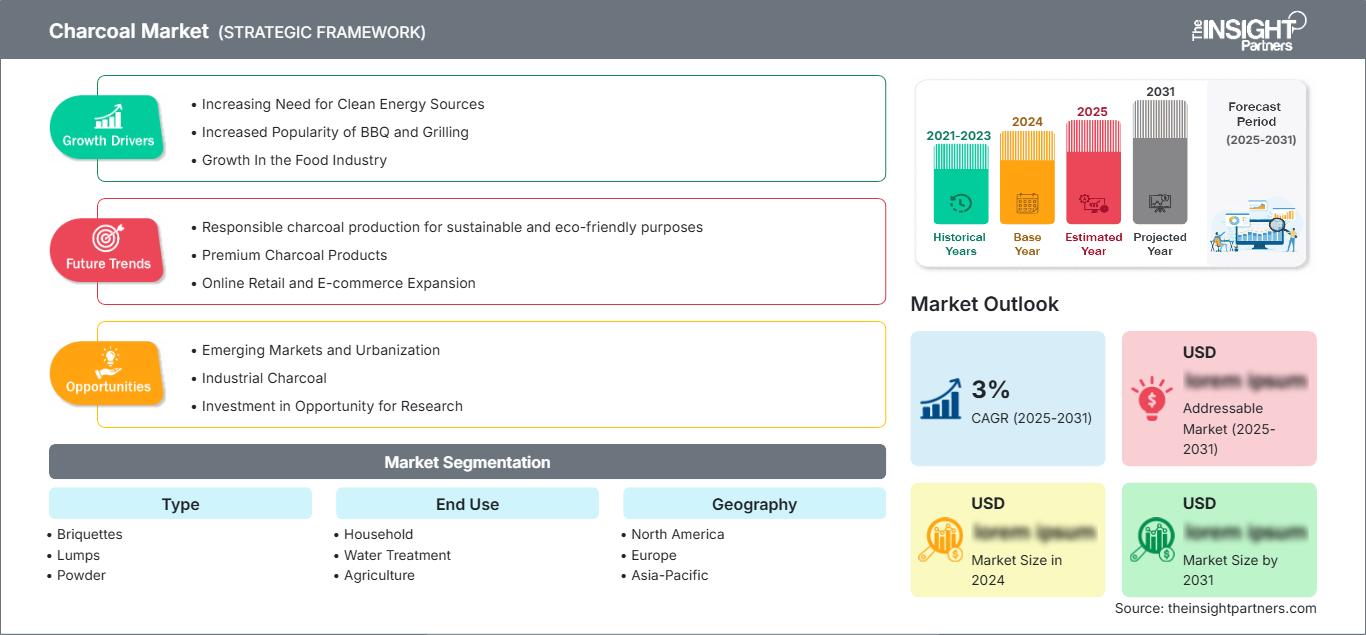
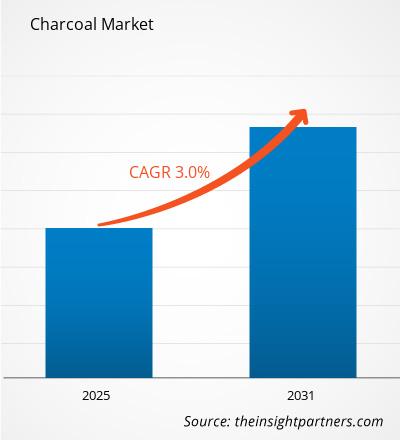
The Charcoal market was valued at US$ 7.53 Billion in 2025 and is projected to reach US$ 11.08 Billion by 2034, expanding at a CAGR of 4.39% during 2026–2034. The market continues to benefit from sustained demand across household cooking, metallurgical operations, industrial processing, and environmental applications. Growing emphasis on renewable carbon-based materials, increasing utilization in activated carbon production, and the expansion of industrial filtration technologies are reinforcing long-term demand across both developed and emerging economies.
Across North America, the Charcoal Market size is supported by strong consumer demand for outdoor grilling products, well-established retail distribution networks, and increasing adoption of premium hardwood charcoal. Environmental initiatives encouraging sustainably sourced biomass and rising investments in water purification technologies further strengthen regional demand. The regional market is projected to expand at a CAGR of 3.8%–4.4% during 2026–2034, supported by technological improvements in carbonization efficiency and product quality.
Charcoal Market Assessment and Insights
- North America: Accounted for a 31–33% Charcoal Market share in 2025 and is anticipated to expand at a CAGR of 3.8%–4.4% during 2026–2034, supported by robust grilling culture, advanced biomass processing technologies, and expanding demand from water treatment and industrial purification sectors.
- U.S.: Represented 79–82% of the North American market in 2025 and is projected to register a CAGR of 3.9%–4.5% during 2026–2034, driven by residential barbecue consumption, premium lump charcoal adoption, and commercial filtration applications.
- Europe: Held 24–26% share in 2025 and is expected to grow at a CAGR of 3.7%–4.3% during 2026–2034, led by Germany, the UK, France, Italy, and Poland, where sustainable biomass utilization and industrial decarbonization initiatives continue to support market expansion.
- Asia Pacific: Captured 29–31% Charcoal Market share in 2025 and is forecast to record a CAGR of 5.0%–5.6% during 2026–2034, driven by China, India, Japan, Indonesia, and South Korea through rising industrial consumption, urbanization, and increasing investments in biomass processing.
- Largest Segment: Household accounted for 39–42% market share in 2025 and is projected to expand at a CAGR of 3.9%–4.5% during 2026–2034, supported by consistent residential cooking demand and expanding outdoor recreation activities.
- High Growth Segment: Water Treatment represented 16–19% market share in 2025 and is expected to register a CAGR of 5.5%–6.1% during 2026–2034, driven by increasing investment in municipal water purification, industrial wastewater treatment, and activated carbon production.
- Key companies analyzed in detail: Kingsford Products Company LLC, Bricapar S.A.E., Duraflame, Inc., Gryfskand Sp. z o.o., Maurobera S.A., Mesjaya Abadi Sdn. Bhd., NAMCHAR (Pty) Ltd., Parker Charcoal Company, Royal Oak Enterprises, LLC, Sagar Charcoal and Firewood Depot.
Source: The Insight Partners' analysis based on proprietary research, government publications, company annual reports, investor presentations, industry databases, and expert interviews.
Improvements in biomass conversion technologies have greatly transformed the production processes within the global charcoal industry. The new carbonization technologies help in achieving higher conversion efficiencies, decreased particulate emissions, and increased uniformity in the process compared to traditional kilns. Manufacturers are making more use of waste biomass, forest residues, and agricultural wastes in their production process, thus increasing the efficiency of resources while helping in the realization of circular economy goals. These innovations will enhance production efficiency and enable manufacturers to comply with the rising environmental standards in the major consumption markets.
Future growth in the charcoal market is likely to be driven by rising investments in sustainable biomass value chains, improvements in responsible wood feedstock certification, and adoption of industrial products made from charcoal. Developing countries in the Asia Pacific region, Africa, and Latin America are continuously developing their production capacity because of their plentiful biomass resources and cost-effective manufacturing. At the same time, increasing sustainability standards and environmental initiatives among corporations are driving investments in cleaner production technologies and traceable sourcing practices around the globe.
Charcoal Market Report Scope
| Report Attribute | Details |
|---|---|
| Market size in 2025 | US$ 7.53 Billion |
| Market Size by 2034 | US$ 11.08 Billion |
| Global CAGR (2026 - 2034) | 4.39% |
| Historical Data | 2021-2024 |
| Forecast period | 2026-2034 |
Charcoal Market Analysis
Increasing industrial uses continue to drive demand for the Charcoal Market in both developing and developed countries. In addition to the use of charcoal in household cooking, there are other areas such as metallurgical uses, chemical processes, manufacture of activated carbon, and environmental management that require charcoal. Increased investment in water treatment facilities in cities, as well as increased need for industrial wastewater treatment, has increased the demand for quality charcoal feedstock. The growing popularity of renewable carbon feedstocks as a substitute for fossil feedstocks is an additional factor driving adoption in some industrial segments.
There is a trend whereby suppliers are utilizing various types of biomass from sustainably managed forests, plantation wood, coconut shells, bamboo, and agricultural wastes as feedstocks for the production of charcoal. The vertical integration of biomass suppliers, charcoal producers, logistics companies, and industrial customers is ensuring that the supply chain becomes more resilient and cost effective. Certification programs on responsible forestry practices are gaining weight among industrial consumers as procurement criteria, especially in North America and Europe.
As per a Detailed Analysis of the Charcoal Market, competition within the industry is still fairly fragmented, with existing global players operating in parallel with many local manufacturers providing goods for the domestic market. Some companies, such as Kingsford Products Company LLC and Royal Oak Enterprises, LLC, are continuously developing their retail distribution channels and high-end product lines, whereas others, like Gryfskand Sp. z o.o. and Maurobera S.A., concentrate on manufacturing for export purposes due to sustainable sourcing programs.
Investments in the Charcoal Market tend to be increasingly concentrated around production improvement projects, environmental-friendly technologies implementation, and securing biomass resources. Companies including Mesjaya Abadi Sdn. Bhd., NAMCHAR (Pty) Ltd., Parker Charcoal Company, Bricapar S.A.E., Duraflame, Inc., and Sagar Charcoal and Firewood Depot keep increasing their manufacturing capacity, and improving their supply chain management to provide certified raw materials. At the same time, investments in the value-added charcoal products sector, especially feedstock for activated carbon production and special industrial uses, are becoming more widespread.
● REPORT CUSTOMIZATION
Tailor This Report To Align With Your Specific Business Requirements
This report can be customized to align precisely with your business objectives, scope, and target markets. Customization options include tailored segmentation, geography, competitive analysis, and strategic insights to support informed decision-making.
Customize This Report →WHAT YOU CAN ADJUST
- ● Segmentations
- ● Geography
- ● Competitive Analysis
- ● Language Preferences
Charcoal Market: Strategic Insights
Regional Insights
North America Charcoal Market
In 2025, North America had a Charcoal Market share of 31-33%, which is expected to grow at a CAGR of 3.8%-4.4% over the forecast period (2026-2034). This is due to high domestic consumption, presence of established outdoor grilling tradition, and increased demand for activated carbon from industries for water and air treatment by municipalities. Investments in biomass usage and sustainable management of forests will aid in the future growth of the market and will encourage the adoption of innovative carbonization technologies.
Rising consumer preference for high-quality lump charcoal, natural briquettes, and sustainable products is expected to influence purchasing trends within North America. Foodservice providers, filtration companies, and metallurgic manufacturers are also increasing their purchase volumes in order to meet the rising production needs. Positive environmental policies that are promoting the use of renewable biomass along with innovations in low-emission production technologies are also expected to enhance competitiveness of the region in the coming years.
U.S. Charcoal Market
The U.S. held 79–82% of the market share of North America in 2025 and is expected to witness a CAGR of 3.9%–4.5% during the forecast period of 2026–2034. Active engagement of consumers in outdoor cooking, camping, and recreational grilling keeps up the steady residential demand, while growing demand persists for industrial applications in water treatment, chemical manufacturing, and metallurgy processes. Established distribution channels and availability of high-quality branded products add to the maturity of the market in the country.
Well-established production and distribution facilities of major manufacturers in the U.S. ensure efficient supply of charcoal throughout the country. Growing inclination towards hardwood lump charcoal and certified charcoal by residential consumers is driving the demand for charcoal. Industrial consumers are making investments in charcoal-based filtration media and activated carbon production. Improvement in biomass, packaging, and production technologies also help drive the competitive strength of the market.
Europe Charcoal Market
Europe had occupied a market share of 24-26% in 2025 and is expected to register a CAGR of 3.7%-4.3% from 2026 to 2034 due to increasing use of industrial biomass and regulation that are sustainability oriented. Germany is the dominant regional market for charcoal owing to its metallurgy activities, water treatment system in place, and certification of biomass used. The use of sustainable resources is motivating investments in efficient production of charcoal.
In the UK, demand for charcoal is steady with barbecue used in households, hospitality sector, and sustainable charcoal products used increasingly. Countries like France, Italy, and Spain together are contributing to regional demand through the food service industry, residential grilling, and industrial sector use of charcoal. Environmental consciousness, sustainable sourcing, and activated carbon production have boosted regional consumption.
APAC Charcoal Market
Asia Pacific region held a market share of 29%–31% of the global market in 2025 and expected to witness a CAGR of 5.0%–5.6% in the forecast period of 2026–2034, and is thus emerging as the fastest growing market region. China holds dominance over regional production and consumption of charcoal, while India is expected to increase both household and industrial demands.
Increasing industrialization, increasing water treatment infrastructure, and increasing use of biomass resources drive regional demand. The government support for renewable energy, efficient biomass management, and cleaner industrial production are some factors that promote investment in advanced carbonization processes, thereby ensuring dominance of the Asia Pacific region in global charcoal production and exports.
Middle East & Africa Charcoal Market
The Middle East & Africa market will experience a 4.6%–5.2% CAGR over 2026–2034 owing to the increase in consumption in households and industrial application of charcoal. South Africa still maintains its position as the highest producer because of high availability of forest materials and efficient export capabilities, while Saudi Arabia and UAE have continued experiencing increased demand for hospitality, commercial food service, and water treatment.
Growth in infrastructure, increase in population, and investments in wastewater treatment plants have been attributed to the increase in the consumption of charcoal in the region. Manufacturing oriented towards export especially in Southern Africa coupled with better management of biomass resources has been anticipated to promote sustainable development of the market.
Segmentation Analysis
Type
The Type segment defines product selection according to application requirements, combustion performance, and processing characteristics. The segment is projected to grow at a CAGR of 4.2%–4.8% during 2026–2034. Expanding industrial utilization, consumer preference for premium fuels, and increasing demand for processed charcoal products across filtration, metallurgy, and household cooking continue to support product diversification. The Charcoal Market scope continues expanding as manufacturers introduce higher-performance products tailored to residential and industrial applications.
- Briquettes – Manufactured from compressed charcoal fines and biomass binders, briquettes offer consistent combustion, extended burning duration, and uniform heat output. They remain widely preferred for household grilling, commercial cooking, and food service applications because of affordability and ease of handling.
- Lumps – Lump charcoal is produced directly from hardwood and delivers rapid ignition, high combustion temperatures, and minimal ash generation. Premium outdoor cooking, restaurants, and professional grilling applications increasingly favor lump charcoal due to its natural composition and enhanced flavor characteristics.
- Powder – Charcoal powder serves as an important raw material for activated carbon production, chemical processing, pharmaceuticals, cosmetics, pigments, and specialty industrial applications. Rising investment in purification technologies continues to support stable demand for high-quality powdered charcoal.
End Use
The End Use segment is anticipated to register a CAGR of 4.4%–5.0% during 2026–2034, supported by expanding applications across residential, industrial, environmental, and metallurgical sectors. Diversified consumption patterns reduce dependence on any single industry while increasing opportunities for manufacturers to develop specialized charcoal grades for distinct operational requirements and sustainability objectives.
- Household – Household consumption represents the largest end-use category, driven by residential cooking, outdoor grilling, camping, and recreational activities. Demand remains stable across developed economies while increasing disposable income supports premium charcoal product adoption in emerging markets.
- Water Treatment – Water treatment applications continue expanding as charcoal serves as a critical precursor for activated carbon used in municipal drinking water purification, industrial wastewater treatment, and air filtration systems requiring high adsorption efficiency.
- Agriculture – Agricultural applications include soil conditioning, biochar production, moisture retention improvement, and carbon sequestration initiatives. Growing interest in regenerative agriculture and sustainable farming practices supports increasing adoption across commercial agricultural operations.
- Chemical – Chemical manufacturers utilize charcoal in reduction processes, specialty carbon production, pigments, catalysts, and purification systems. Industrial process optimization and growing demand for carbon-based materials continue to sustain consumption within this application segment.
- Metallurgical – Metallurgical industries employ charcoal as a reducing agent during metal smelting and alloy production, particularly where renewable carbon alternatives support decarbonization objectives. Increasing sustainability initiatives encourage the selective substitution of fossil-based reducing agents with biomass-derived charcoal.
Opportunity Snapshot
| End Use | Revenue Contribution | Trend Tag | Adoption Stage |
|---|---|---|---|
| Household | High | Premium Grilling | Mature |
| Water Treatment | High | Activated Carbon | Scaling |
| Agriculture | Medium | Biochar Farming | Emerging |
| Chemical | Medium | Carbon Feedstock | Scaling |
| Metallurgical | High | Green Steel | Scaling |
Charcoal Market Growth Drivers and Impact Analysis
Expansion of Water Treatment and Filtration Infrastructure
Increased capital investments in the infrastructure of water supply and treatment facilities in municipal areas and industries, as well as in the purification of air, contribute to the increased demand for charcoal as a source material for activated carbon. The governments in Asia Pacific, North America, and Europe keep toughening their drinking water and industrial emissions regulations, thus promoting the widespread use of filtration media. Various industries, including pharmaceuticals, food, chemicals, and energy, need advanced systems for the purification of their products and waste in order to meet higher environmental regulations. Consequently, the growth of activated carbon production industry contributes to the increased demand for premium-quality source materials, which encourages the suppliers to focus on improving the quality of their products.
Growing Preference for Sustainable Biomass-Based Carbon Materials
Global decarbonization initiatives are accelerating interest in renewable biomass resources capable of replacing fossil-based carbon inputs across industrial operations. Sustainably produced charcoal derived from managed forests, bamboo, coconut shells, and agricultural residues is increasingly recognized as a lower-emission alternative for selected metallurgical and chemical processes. Manufacturers are expanding investments in certified biomass supply chains to satisfy environmental compliance requirements and corporate sustainability targets. Improvements in carbonization technology further reduce production emissions while increasing conversion efficiency and product consistency. These advancements strengthen producer competitiveness, improve export opportunities, and encourage industrial users to integrate renewable carbon materials into long-term procurement strategies, supporting continued market expansion throughout the forecast period.
Increasing Household and Commercial Outdoor Cooking Activities
Household grilling traditions, expanding outdoor recreation, and growth in food service establishments continue supporting consistent demand for charcoal products worldwide. Rising consumer preference for premium cooking experiences has encouraged wider adoption of natural hardwood lump charcoal and performance-oriented briquettes that provide longer burn times and improved heat consistency. Restaurants specializing in barbecue, grilled meat, and open-fire cooking also contribute to increasing commercial consumption. Product innovation, including easy-light briquettes, cleaner-burning formulations, and moisture-resistant packaging, enhances consumer convenience while strengthening brand differentiation. Expanding retail distribution through supermarkets, specialty stores, and e-commerce platforms further improves product accessibility, creating stable long-term demand across both mature and emerging consumer markets.
Charcoal Market Future Trends
Digital Traceability and Certified Sustainable Supply Chains
Sustainability remains one of the defining Charcoal Market trends shaping future industry development. Manufacturers are increasingly implementing digital traceability systems, satellite-based forest monitoring, blockchain-enabled certification platforms, and responsible sourcing verification to strengthen supply chain transparency. Industrial customers and retailers increasingly prioritize products supported by internationally recognized forest certification standards. As environmental reporting requirements become more stringent, investment in traceable biomass sourcing, low-emission production technologies, and transparent procurement practices is expected to improve competitive positioning while facilitating greater access to premium international markets and environmentally conscious commercial buyers.
Advanced Carbonization Technologies Improve Production Efficiency
Modern charcoal manufacturing is expected to increasingly adopt automated carbonization systems, continuous kilns, heat recovery technologies, and emission control equipment to improve production efficiency and environmental performance. These innovations reduce biomass waste, enhance carbon yield, lower greenhouse gas emissions, and deliver more consistent product quality. Producers investing in digital monitoring, process automation, and energy recovery systems are likely to achieve stronger operational efficiency while meeting increasingly demanding environmental regulations. Such technological modernization will strengthen global competitiveness and support broader industrial adoption of premium charcoal products across multiple end-use industries.
Charcoal Market Opportunities
Expanding Biochar Production for Climate-Smart Agriculture
Growing international focus on regenerative agriculture, soil carbon sequestration, and sustainable farming presents substantial opportunities for charcoal manufacturers. Biochar applications continue gaining attention for improving soil fertility, increasing moisture retention, reducing fertilizer losses, and supporting long-term carbon storage. Governments, agricultural organizations, and environmental agencies are expanding research programs and pilot projects encouraging the adoption of biochar technologies. Charcoal Market Forecasts indicate that companies capable of supplying high-quality feedstock for agricultural biochar production, while establishing partnerships with farming cooperatives and sustainability programs, are well positioned to capitalize on increasing global investment in climate-resilient agricultural practices and carbon reduction initiatives.
Development of Premium Industrial Carbon Products
Manufacturers have significant opportunities to diversify beyond conventional fuel applications by producing specialized charcoal grades for activated carbon, chemical processing, metallurgy, pharmaceuticals, cosmetics, and advanced filtration technologies. Increasing industrial demand for high-purity carbon materials encourages investment in product standardization, quality certification, and advanced processing capabilities. Companies developing customized industrial solutions supported by sustainable biomass sourcing and efficient production technologies can strengthen profitability while reducing exposure to seasonal household demand fluctuations. Strategic partnerships with industrial processors and environmental technology providers are expected to accelerate the commercialization of higher-value charcoal products across global markets.
Recent Developments
- January 2025: Itanagar Municipal Corporation (IMC) signed an MoU with 7Hills Nexgram to establish a Municipal Solid Waste Charcoal Plant at the Chimpu dumping ground in Arunachal Pradesh. The facility is designed to process 50 metric tons of municipal solid waste per day into charcoal, supporting sustainable waste management, reducing landfill volumes, and promoting circular resource utilization.
- July 2026: Rio Tinto entered into an agreement to replace a portion of coal consumption at its alumina refineries with bio-pellets produced from sustainable biomass. The initiative supports the company's decarbonization strategy by reducing fossil fuel dependency and demonstrates the increasing industrial adoption of biomass-derived carbon alternatives, creating long-term opportunities for the charcoal and biochar value chain.
- January 2025: Khmer Green Charcoal announced plans to expand production capacity and broaden exports to meet rising regional demand for environmentally friendly charcoal products. The company aims to increase output by scaling manufacturing operations while promoting charcoal produced from agricultural waste, supporting sustainable fuel adoption, and export market growth across Southeast Asia.
Frequently Asked Questions

- Comprehensive Market Sizing and Forecast Analysis
- Detailed Segmentation Analysis
- In-Depth Market Dynamics Assessment
- Regional and Country-Level Insights
- Competitive Landscape and Company Benchmarking
- Strategic Business Intelligence
Recent Reports
Testimonials

The Insight Partners' SCADA System Market report is comprehensive, with valuable insights on current trends and future forecasts. The team was highly professional, responsive, and supportive throughout. We are very satisfied and highly recommend their services.
RAN KEDEM Partner, Reali Technologies LTDs
I requested a report on a very specific software market and the team produced the report in a few days. The information was very relevant and well presented. I then requested some changes and additions to the report. The team was again very responsive and I got the final report in less than a week.
JEAN-HERVE JENN Chairman, Future Analytica
We worked with The Insight Partners for an important market study and forecast. They gave us clear insights into opportunities and risks, which helped shape our plans. Their research was easy to use and based on solid data. It helped us make smart, confident decisions. We highly recommend them.
PIYUSH NAGPAL Sr. Vice President, High Beam Global
The Insight Partners delivered insightful, well-structured market research with strong domain expertise. Their team was professional and responsive throughout. The user-friendly website made accessing industry reports seamless. We highly recommend them for reliable, high-quality research services
YUKIHIKO ADACHI CEO, Deep Blue, LLC.
This is the first time I have purchased a market report from The Insight Partners.While I was unsure at first, I visited their web site and felt more comfortable to take the risk and purchase a market report.I am completely satisfied with the quality of the report and customer service. I had several questions and comments with the initial report, but after a couple of dialogs over email with their analyst I believe I have a report that I can use as input to our strategic planning process.Thank you so much for taking the extra time and making this a positive experience.I will definitely recommend your service to others and you will be my first call when we need further market data.
JOHN SUZUKI President and Chief Executive Officer, Board Director, BK Technologies
I wish to appreciate your support and the professionalism you displayed in the course of attending to my request for information regarding to infectious disease IVD market in Nigeria. I appreciate your patience, your guidance, and the fact that you were willing to offer a discount, which eventually made it possible for us to close a deal. I look forward to engaging The Insight Partners in the future, all thanks to the impression you have created in me as a result of this first encounter.
DR CHIJIOKE ONYIA MANAGING DIRECTOR, PineCrest Healthcare Ltd.Reason to Buy
- Informed Decision-Making
- Understanding Market Dynamics
- Competitive Analysis
- Identifying Emerging Markets
- Customer Insights
- Market Forecasts
- Risk Mitigation
- Boosting Operational Efficiency
- Strategic Planning
- Investment Justification
- Tracking Industry Innovations
- Aligning with Regulatory Trends





 Get Free Sample for