
Chlor Alkali Market Growth, Demand & Size by 2034
Chlor Alkali Market Size and Forecasts (2021 - 2034), Global and Regional Growth Opportunity Analysis, converge by: Type (Caustic Soda, Chlorine, Soda Ash, Others); Application (Chemical Processing, Soaps and Detergents, Water Treatment, Paper and Pulp, Textile, Food Processing, and Others) and Geography (North America, Europe, Asia Pacific, and South and Central America)
- Status : Data Released
- Report Code : TIPRE00004853
- Category : Chemicals and Materials
- No. of Pages : 150
- Available Report Formats :


- Last update date : September 08, 2026


2025 Market Size
US$ 110.40 Bn
Base year value
2034 Forecast
US$ 143.19 Bn
Projected by 2034
CAGR 2026-2034
2.93 %
Growth rate
Addressable Market
US$ 1,151.14 Bn
(2026-2034)
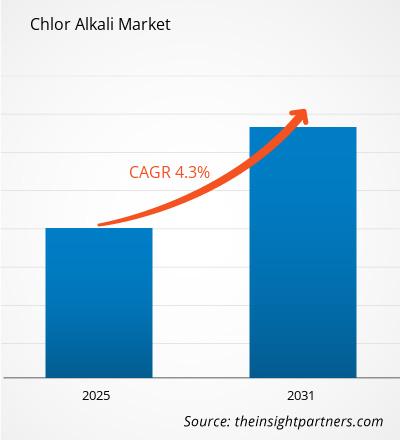
The Chlor Alkali Market represents a foundational chemical value chain serving water treatment, chemical processing, pulp and paper, detergents, textiles, food processing, and multiple industrial applications. The market is valued at US$ 110.40 Billion in 2025 and is projected to reach US$ 143.19 Billion by 2034, expanding at a CAGR of 2.93% during 2026–2034. Growth reflects steady consumption of chlorine, caustic soda, soda ash, and related inorganic chemicals across essential downstream industries.
North America remains strategically important because of integrated chemical manufacturing, established chlorine and caustic soda infrastructure, and sustained demand from water treatment and industrial processing. The Chlor Alkali Market size outlook in the region is supported by an estimated 2.4–3.0% CAGR through 2034, with membrane-cell modernization, energy optimization, and replacement investment supporting capacity competitiveness.
Chlor Alkali Market Assessment and Insights
- North America: North America is estimated to account for a 24–28% Chlor Alkali Market share in 2025, with the market growing at a 2.4–3.0% CAGR between 2026 and 2034, supported by integrated production, water treatment demand, and established vinyls value chains.
- U.S.: The U.S. represents approximately 82–87% of the North American share in 2025, expanding at a 2.3–2.9% CAGR during 2026–2034, supported by chlorine, caustic soda, and downstream chemical demand.
- Europe: Europe is estimated at 18–22% share in 2025 and is projected to grow at a 1.8–2.5% CAGR during 2026–2034, with Germany, France, Italy, the Netherlands, and Spain remaining important industrial markets.
- Asia Pacific: Asia Pacific holds approximately 43–48% share in 2025 and is expected to register a 3.2–4.0% CAGR between 2026–2034, led by China, India, Japan, and South Korea through expanding chemical processing and infrastructure requirements.
- Largest Segment: Caustic Soda is estimated at 39–43% market share in 2025, with a 2.8–3.4% CAGR during 2026–2034, reflecting broad industrial and processing applications.
- High Growth Segment: Water Treatment is estimated to represent 14–18% share in 2025, with a 3.5–4.2% CAGR during 2026–2034, supported by municipal and industrial treatment requirements.
- Key companies analyzed in detail: Olin Corporation, Solvay SA, Tata Chemicals Limited, Occidental Petroleum Corporation, Westlake Corporation, Akzo Nobel N.V., Formosa Plastics Corporation, Hanwha Solutions Corporation, Tosoh Corporation, and Nirma Limited.
Source: The Insight Partners' analysis based on proprietary research, government publications, company annual reports, investor presentations, industry databases, and expert interviews.
The technology base has moved from traditional mercury cell and diaphragm cells to membrane cells which reduce energy requirements and enhance efficiency. More integrated companies are beginning to balance chlorine, hydrogen, and caustic soda production rather than considering the products as individual units. This approach increases equipment utilization while facilitating production of vinyls, hydrochloric acid, hypochlorites, and other derivative products.
Further development will involve efficiency enhancement, digitization of control process, green power procurement, and selective bottleneck alleviation rather than unlimited expansion in the greenfield. In Asia, scale economies will continue to remain competitive while the companies in North America will concentrate on feedstock economics. European plants have increasing pressure to lower energy requirements and carbon footprint.
Chlor Alkali Market Report Scope
| Report Attribute | Details |
|---|---|
| Market size in 2025 | US$ 110.40 Billion |
| Market Size by 2034 | US$ 143.19 Billion |
| Global CAGR (2026 - 2034) | 2.93% |
| Historical Data | 2021-2024 |
| Forecast period | 2026-2034 |
Chlor Alkali Market Analysis
Growth of the Chlor Alkali Market demand is highly dependent on the consumption of chlorine and caustic soda in downstream industries. Chlorine is an important component of many chemicals, disinfectants, and polymer chains, while caustic soda is widely applied for pulp manufacturing, refining of alumina, soap, detergent production, textile and chemical industry. The supply chain thus includes salt producers, electricity producers, membrane cell companies, distributors, and downstream users.
Supply economics in the Chlor Alkali Market are highly dependent on the costs of electricity and salt due to the energy intensive process of electrolysis. Transporting chlorine is a difficult task, which stimulates its manufacturing close to consumers, while caustic soda is relatively easy to transport via logistics channels. Manufacturers thus prefer integrated facilities which use their chlorine on-site and sell caustic soda and hydrogen. Such supply chain makes it impossible to compare capacities and operate rates become important competitive factors.
Chlor Alkali Market analysis reveals a fragmented competition structure with some vertically integrated firms. Olin Corporation is dominant in chlorine and caustic soda capacity in North America, Westlake Corporation has vertical integration in its chlor-alkali business alongside vinyls. Solvay SA is engaged in the European chemicals value chain, Formosa Plastics Corporation and Hanwha Solutions Corporation have their Asian and international capacity presence.
Investments focus more on energy-efficient cells, reliability improvement, debottlenecking and downstream integration. Tata Chemicals Limited is key in soda ash and other inorganic chemical business, Nirma Limited operates in the Indian manufacturing sector. Tosoh Corporation integrates chlor-alkali chemistry along with materials downstream, and Occidental Petroleum Corporation enjoys the benefit of integrated chemicals and industrial infrastructure. Akzo Nobel N.V. offers downstream significance with coatings and chemicals downstream application.
● REPORT CUSTOMIZATION
Tailor This Report To Align With Your Specific Business Requirements
This report can be customized to align precisely with your business objectives, scope, and target markets. Customization options include tailored segmentation, geography, competitive analysis, and strategic insights to support informed decision-making.
Customize This Report →WHAT YOU CAN ADJUST
- ● Segmentations
- ● Geography
- ● Competitive Analysis
- ● Language Preferences
Chlor Alkali Market: Strategic Insights

Regional Insights
North America Chlor Alkali Market
North America accounts for an estimated 24–28% Chlor Alkali Market in 2025, with a projected 2.4–3.0% CAGR through 2034. The U.S. dominates regional demand and production with its abundant chlorine infrastructure, integrated vinyls chain, and usage for water purification, chemical production, and pulp & paper. The Canadian market diversifies supply capacity with industrial chemicals production.
Competitiveness in the region depends heavily on natural gas prices, electricity, salt supply, and logistics. Companies become more interested in efficient and reliable membrane cell plants. Demand is rather stable due to water disinfection needs and more cyclical for construction and industrial chemicals demand. Olin Corporation and Westlake Corporation retain their strategic importance as producers, while integrated plants continue balancing chlorine, caustic soda, and derivatives production.
U.S. Chlor Alkali Market
The United States constitutes around 82%-87% of the North American Chlor Alkali Market share by 2025 and is expected to experience a 2.3%-2.9% CAGR until 2034. There will be large integrated plants for chlorine, caustic soda, hydrochloric acid, hydrogen, bleach, and vinyl intermediates. Demand from applications spans industrial processing, water treatment, chemicals manufacturing, and consumer goods.
Olin Corporation has a strong domestic presence, whereas Westlake Corporation operates a chlor-alkali business together with vinyls. Occidental Petroleum Corporation adds to its value chain via integrated chemicals manufacturing operations. The demand from applications has been shifting towards more dependable water treatment and industrial usage, with cyclical construction-related chemicals demand.
Europe Chlor Alkali Market
Europe is expected to have an 18–22% market share in 2025 with the growth rate forecast to be 1.8–2.5% CAGR until 2034. Europe's main markets include Germany, France, Italy, Netherlands, Spain, and the UK. The cost of electricity and decarbonization drive capacity utilization and technology decisions.
Demand in the UK comes from the water treatment, chemicals, and industrial processing sectors. Germany has an advantage due to its broad chemical industry integration. France enjoys chemical and municipal treatment demand. Italy and Spain keep their applications in detergents, water treatment, food processing, and chemical manufacturing. European producers strive to reduce electricity consumption, use renewable energy sources, and pursue selected downstream integration to stay competitive compared to low-cost foreign products.
APAC Chlor Alkali Market
APAC holds a share of around 43–48% in 2025 and is projected to register a CAGR of 3.2–4.0% till 2034. China continues to be the largest country market, while Japan, South Korea, India, and Australia present a mix of diversified demand. The expansion of chemical processes, water infrastructure, and manufacturing facilities drives demand.
Chemical integration drives China, India is driven by industrialization and infrastructure investments, Japan and South Korea focus on effective manufacture and downstream value addition, while Australia has relatively low manufacturing capacity but a steady demand from mining, water treatment, and industrial processing activities. Manufacturing localization, energy efficiency, and infrastructure drive policy initiatives for sustaining regional demand.
Middle East & Africa Chlor Alkali Market
The Middle East & Africa is expected to expand at a 2.5–3.2% CAGR through 2034. Saudi Arabia is the dominant force in regional development, which has been made possible through its well-integrated petrochemical infrastructure, whereas the UAE has taken advantage of diversification in its industries. South Africa continues to play a vital role for mining activities, water treatment, and manufacturing industries.
The availability of energy in the region would enable competitive electrochemical processes to take place where there is an integrated infrastructure. Saudi Arabia and the UAE have continued to develop their downstream chemical value chains, thus creating further demand for chlorinated and caustic soda products.
Segmentation Analysis
Type
The Type segment covers Caustic Soda, Chlorine, Soda Ash, and Others. Caustic soda remains the largest product category because of its broad utilization in chemical processing, pulp and paper, detergents, textiles, and alumina-related applications. The segment is expected to register a 2.8–3.4% CAGR during 2026–2034. Product economics remain closely tied to electricity costs, capacity utilization, and chlorine balancing.
- Caustic Soda: Demand is supported by alumina refining, pulp and paper, detergents, textiles, and chemical synthesis. Its transportability compared with chlorine enables broader international trade and regional supply balancing.
- Chlorine: Consumption is concentrated near production because of transportation constraints. Demand remains linked to PVC, disinfectants, chlorinated intermediates, pharmaceuticals, and water treatment, making integrated facilities strategically important.
- Soda Ash: Demand is concentrated in glass, detergents, chemicals, and emerging solar-glass applications. Supply additions and regional pricing conditions significantly influence producer utilization and investment decisions.
Application
The Application segment comprises Chemical Processing, Soaps and Detergents, Water Treatment, Paper and Pulp, Textile, Food Processing, and Others. Chemical Processing remains the largest application group, while water treatment is expected to expand comparatively faster. The segment is projected to register a 2.6–3.3% CAGR during 2026–2034. The Chlor Alkali Market scope, therefore, spans both essential infrastructure and cyclical manufacturing industries.
- Chemical Processing: Chlorine and caustic soda serve as foundational intermediates for solvents, polymers, inorganic chemicals, and numerous downstream synthesis routes, sustaining broad industrial consumption.
- Soaps and Detergents: Caustic soda supports saponification and formulation processes, while chlorine-derived chemicals contribute to bleaching and sanitation products. Household and institutional cleaning demand supports recurring consumption.
- Water Treatment: Chlorine, hypochlorites, and caustic soda are widely used for disinfection, pH adjustment, and treatment chemistry. Municipal upgrades and industrial water reuse strengthen long-term application relevance.
- Paper and Pulp: Caustic soda supports pulping and bleaching-related chemistry, while chlorine derivatives contribute to selected treatment processes. Packaging and tissue production provide additional downstream demand.
- Textile: Caustic soda is used in mercerization and textile processing, supporting fiber treatment and finishing. Manufacturing activity in Asia provides an important demand base.
- Food Processing: Chlorine-based sanitation and caustic soda cleaning solutions support hygiene programs across food-processing facilities, particularly where automated cleaning systems require controlled chemical dosing.
Opportunity Snapshot
| Application | Revenue Contribution (High/Medium/Low) | Trend Tag | Adoption Stage |
|---|---|---|---|
| Chemical Processing | High | Integrated Chemistry | Mature |
| Soaps and Detergents | High | Hygiene Chemistry | Mature |
| Water Treatment | High | Water Reuse | Scaling |
| Paper and Pulp | Medium | Process Efficiency | Mature |
| Textile | Medium | Fiber Processing | Mature |
| Food Processing | Medium | Sanitation Systems | Scaling |
Chlor Alkali Market Growth Drivers and Impact Analysis
Expansion of Industrial and Municipal Water Treatment
The demand for water treatment continues to be structurally robust due to the indispensable nature of chlorine and caustic soda in the disinfection process, pH correction, neutralization, and other water treatment needs. Local municipal utility providers need consistent access to chemicals despite the periodicity of production, while industrial firms are increasingly adopting the practice of treating their own wastewater. Increasing discharge requirements and upgrading of infrastructure can result in greater demands for chemical usage even in the presence of minimal increases in industrial production. For producers, the spatially dispersed nature of water-treatment demand creates an element of demand stability in their sales of chlorine derivatives. This becomes especially important in Asian and Middle Eastern countries where urbanization and industrialization are necessitating increased treatment capacity.
Broad Chemical Processing and Downstream Integration
A key area of demand is that of chemical processing since both chlorine and caustic soda are intermediates rather than just being end use chemicals. Chlorine plays a key role in vinyl chloride monomer, chlorinated solvents, hydrochloric acid, disinfectants, and other derivatives, whereas caustic soda is involved in chemical processing, refining, pulp manufacture, and detergents. As such, integrated production leads to multiplier benefits throughout the value chain. Increased capacities in polymers, specialty chemicals, and industrial processes do not have to translate into equal increases in all downstream product areas. Companies with integrated capabilities benefit from internal consumption of chlorine and marketing of caustic soda to the external marketplace.
Membrane Technology and Energy-Efficiency Investment
The effect of electrolysis means that electricity is the key variable cost of chlor-alkali production, thus making efficient membrane technology and process management increasingly valuable. Upgrading from older cells can be used to cut electricity consumption intensity, ensure greater uniformity of products and satisfy more stringent environmental standards. Renewable electricity procurement agreements, on-site electricity production, improved monitoring and process automation are now being considered together with traditional expansions. This not only helps deal with volatile power costs, but also decreases carbon intensity. However, the implications of such a move go beyond operational costs, as more efficient plants will stay competitive for longer due to higher carbon costs.
Chlor Alkali Market Future Trends
Low-Carbon Electrolysis and Renewable Power Integration
The most significant Chlor Alkali Market trends are expected to involve lower-carbon electricity sourcing, advanced membrane systems, digital energy management, and greater recovery of hydrogen generated during electrolysis. Evaluations of renewable energy contracts, on-site production, and flexible electricity purchases have been made by producers to mitigate their vulnerability in relation to volatile energy market conditions. The future plants will probably integrate efficient cells along with systems that automatically control current density, brine quality, and power consumption. Hydrogen production will serve as yet another profit stream for integrated plants especially when refineries, chemical companies, or mobility applications nearby create demands for hydrogen. Industrial and carbon emission regulations will help to speed up investments in cleaner processes. All the mentioned changes will eventually put operators of efficient plants and efficient power management at an advantage.
Digitalized Plants and Flexible Production Management
Digital transformation is expected to move beyond basic monitoring toward predictive operating models that connect electrolyzers, utilities, storage, logistics, and downstream plants. Artificial intelligence and advanced analytics can identify equipment degradation, optimize power consumption, anticipate membrane replacement requirements, and coordinate chlorine production with derivative demand. Flexible production management will become increasingly valuable where electricity prices fluctuate throughout the day or where renewable power availability changes rapidly. Producers may integrate digital twins with process control systems to evaluate production scenarios before adjusting operating conditions. Automated quality monitoring can further support high-purity applications in electronics, pharmaceuticals, and advanced manufacturing. The combination of digital tools and process engineering should improve asset availability and reduce unplanned downtime. Over time, technology investment may become a stronger competitive differentiator than nominal installed capacity.
Chlor Alkali Market Opportunities
Integrated Low-Carbon Chlorine Derivative Platforms
Investment opportunities are emerging around integrated facilities that combine electrolysis with downstream chlorine derivatives, hydrochloric acid, hypochlorite, PVC intermediates, and hydrogen utilization. Such platforms can reduce merchant exposure and improve chlorine balancing by converting co-products into transportable or higher-value products. Developers should prioritize locations with reliable salt supplies, competitive electricity, established chemical clusters, and nearby industrial customers. Renewable power procurement can further improve the environmental profile of new facilities while reducing exposure to long-term fossil-energy volatility. Strategic partnerships between chlor-alkali producers, utilities, chemical manufacturers, and technology providers can distribute capital requirements and accelerate commercialization. The opportunity is particularly attractive in regions expanding domestic chemical production because integrated projects can replace imported derivatives while supporting downstream manufacturing and industrial resilience.
Water Treatment and Regional Supply Localization
The Chlor Alkali Market Forecasts indicate an attractive opportunity for suppliers that align production capacity with municipal water treatment, industrial reuse, and desalination investments in water-stressed regions. Localized chlorine, caustic soda, and hypochlorite production can reduce transportation risks and improve supply reliability for critical infrastructure operators. Investors can target modular facilities or capacity expansions near major utility corridors rather than relying exclusively on large centralized plants. Partnerships with engineering contractors, water-treatment companies, and municipal authorities can provide predictable demand through long-term supply agreements. Emerging markets in the Middle East, South Asia, Southeast Asia, and Africa offer potential where water infrastructure is expanding faster than local chemical supply. Producers that combine dependable logistics, appropriate product grades, and energy-efficient equipment can capture durable infrastructure-linked demand while reducing exposure to commodity-market fluctuations.
Recent Developments
- June 2026: Grasim Industries Limited and Lubrizol Advanced Materials inaugurated Phase 1 of a CPVC resin manufacturing facility at Grasim's chlor-alkali complex in Vilayat, Gujarat. The facility has an annual production capacity of 50,000 metric tons and is designed to strengthen domestic CPVC manufacturing for plumbing, water management, fire safety, and industrial piping applications.
- December 2025: Chlorum Solutions USA LLC announced a definitive agreement to acquire Eddyville Chlor-Alkali, LLC, a Cargill subsidiary operating a chlor-alkali facility in Iowa. The plant produces sodium hypochlorite, hydrochloric acid, and caustic soda using membrane technology. The acquisition supports Chlorum's strategy of localized production near customers and strengthens chlor-alkali supply reliability across the U.S. Midwest.
- September 2025: DCM Shriram Limited and Aarti Industries Limited announced a long-term strategic agreement for chlorine supply to Aarti Industries' upcoming downstream chemicals facility in Jhagadia, Gujarat. The companies plan to establish a jacketed underground chlorine pipeline, with Aarti expected to purchase an additional 200 tonnes of chlorine per day at steady state beyond its existing 150 tonnes per day supply.
Frequently Asked Questions

- Comprehensive Market Sizing and Forecast Analysis
- Detailed Segmentation Analysis
- In-Depth Market Dynamics Assessment
- Regional and Country-Level Insights
- Competitive Landscape and Company Benchmarking
- Strategic Business Intelligence
Recent Reports
Testimonials

The Insight Partners provided valuable market intelligence that supported our global go-to-market strategy. Their team was professional, responsive, and attentive to our feedback, providing thoughtful analysis and helpful methodological clarifications throughout the project.
Junmo Kim Chief Financial Officer (CFO), Enertech Co., Ltd.
The Insight Partners' SCADA System Market report is comprehensive, with valuable insights on current trends and future forecasts. The team was highly professional, responsive, and supportive throughout. We are very satisfied and highly recommend their services.
RAN KEDEM Partner, Reali Technologies LTDs
I requested a report on a very specific software market and the team produced the report in a few days. The information was very relevant and well presented. I then requested some changes and additions to the report. The team was again very responsive and I got the final report in less than a week.
JEAN-HERVE JENN Chairman, Future Analytica
We worked with The Insight Partners for an important market study and forecast. They gave us clear insights into opportunities and risks, which helped shape our plans. Their research was easy to use and based on solid data. It helped us make smart, confident decisions. We highly recommend them.
PIYUSH NAGPAL Sr. Vice President, High Beam Global
The Insight Partners delivered insightful, well-structured market research with strong domain expertise. Their team was professional and responsive throughout. The user-friendly website made accessing industry reports seamless. We highly recommend them for reliable, high-quality research services
YUKIHIKO ADACHI CEO, Deep Blue, LLC.
This is the first time I have purchased a market report from The Insight Partners.While I was unsure at first, I visited their web site and felt more comfortable to take the risk and purchase a market report.I am completely satisfied with the quality of the report and customer service. I had several questions and comments with the initial report, but after a couple of dialogs over email with their analyst I believe I have a report that I can use as input to our strategic planning process.Thank you so much for taking the extra time and making this a positive experience.I will definitely recommend your service to others and you will be my first call when we need further market data.
JOHN SUZUKI President and Chief Executive Officer, Board Director, BK Technologies
I wish to appreciate your support and the professionalism you displayed in the course of attending to my request for information regarding to infectious disease IVD market in Nigeria. I appreciate your patience, your guidance, and the fact that you were willing to offer a discount, which eventually made it possible for us to close a deal. I look forward to engaging The Insight Partners in the future, all thanks to the impression you have created in me as a result of this first encounter.
DR CHIJIOKE ONYIA MANAGING DIRECTOR, PineCrest Healthcare Ltd.Reason to Buy
- Informed Decision-Making
- Understanding Market Dynamics
- Competitive Analysis
- Identifying Emerging Markets
- Customer Insights
- Market Forecasts
- Risk Mitigation
- Boosting Operational Efficiency
- Strategic Planning
- Investment Justification
- Tracking Industry Innovations
- Aligning with Regulatory Trends





 Get Free Sample for