
Cigarette Packaging Market Share, Growth & Forecast by 2034
Coverage: By Material Type (Paper and Paperboard, Aluminum Foil, Plastic, Others); Packaging Type (Primary, Secondary, Tertiary) , and Geography (North America, Europe, Asia Pacific, and South and Central America)
- Status : Data Released
- Report Code : TIPRE00025917
- Category : Chemicals and Materials
- No. of Pages : 150
- Available Report Formats :


- Last update date : October 26, 2026


2025 Market Size
US$ 13.66 Bn
Base year value
2034 Forecast
US$ 17.75 Bn
Projected by 2034
CAGR 2026-2034
2.95 %
Growth rate
Addressable Market
US$ 142.58 Bn
(2026-2034)
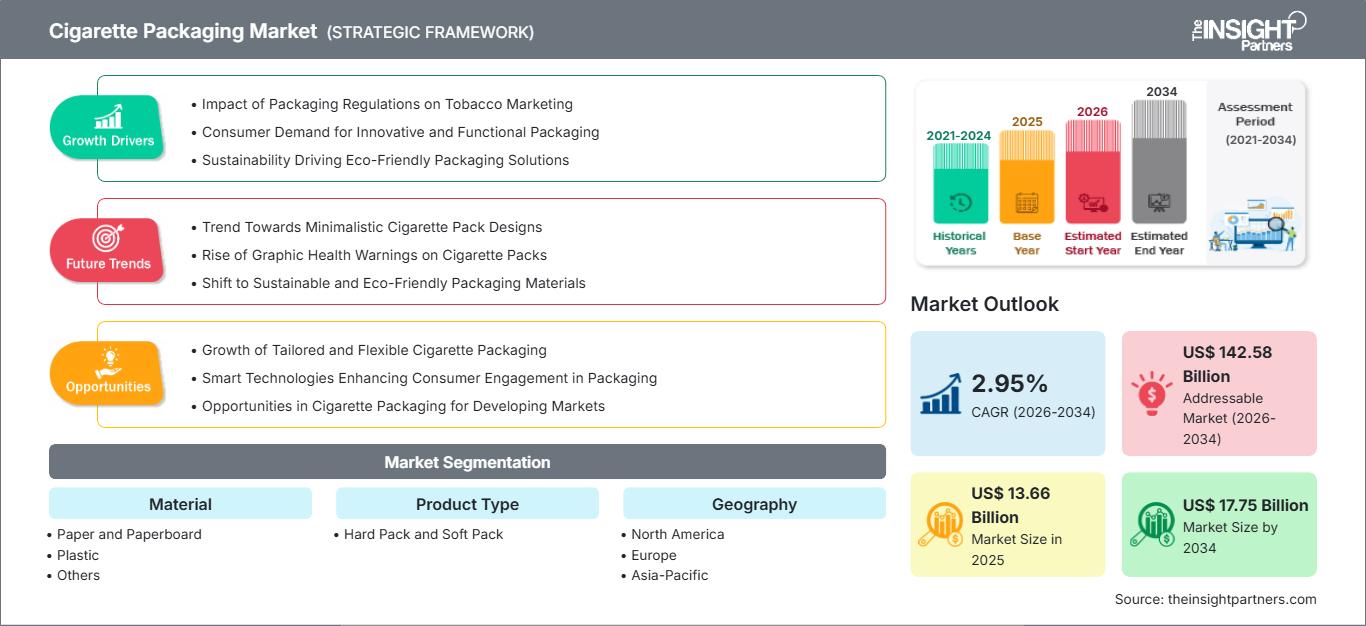
The cigarette packaging market was valued at US$ 13.66 Billion in 2025 and is projected to reach US$ 17.75 Billion by 2034, expanding at a CAGR of 2.95% from 2026 to 2034. Demand remains linked to cigarette production, packaging replacement cycles, regulatory labeling requirements, material optimization, and premium pack formats. Paper and paperboard continue to provide structural rigidity and printability, while plastic and barrier materials support moisture protection and specialized packaging requirements.
North America is expected to maintain moderate expansion, supported by regulatory-driven packaging modifications and demand for durable, compliant pack structures. The cigarette packaging market size assessment considers approximately 2.5–3.5% regional CAGR, with suppliers focusing on lightweighting, recyclable substrates, tamper-evident features, and efficient printing. The U.S. remains the principal regional demand center because of its established cigarette manufacturing base, sophisticated packaging supply chain, and stringent product and labeling requirements.
Cigarette Packaging Market Assessment and Insights
- North America: North America is estimated to represent an 18–22% share in 2025 and expand at a 2.5–3.5% CAGR between 2026 and 2034, supported by regulatory compliance, packaging replacement, premium formats, and investments in efficient converting and printing technologies.
- U.S.: The U.S. represents approximately 78–83% of North America's 2025 demand and is projected to grow at a 2.6–3.6% CAGR between 2026–2034, supported by established cigarette manufacturing and packaging requirements.
- Europe: Europe is estimated to hold a 20–24% share in 2025, growing at a 1.8–2.8% CAGR between 2026 and 2034. Germany, the UK, Italy, France, and Spain remain important markets, with regulation, standardized warnings, sustainability, and material efficiency shaping packaging procurement.
- Asia Pacific: Asia Pacific is estimated to account for a 39–43% share in 2025 and expand at a 3.2–4.2% CAGR between 2026 and 2034. China, India, Japan, Indonesia, and South Korea lead demand through large cigarette manufacturing bases and extensive distribution networks.
- Largest Segment: Paper and Paperboard accounts for an estimated 58–63% market share in 2025 and is projected to grow at a 2.8–3.8% CAGR during 2026–2034, supported by rigid pack production and recyclability.
- High Growth Segment: Plastic represents approximately 19–23% market share in 2025 and is expected to grow at a 3.2–4.2% CAGR during 2026–2034, supported by barrier films and lightweight packaging applications.
- Key companies analyzed in detail: Siegwerk Druckfarben AG & Co. KGaA, LLFlex LLC, Haomei Aluminum Co., Ltd., ElvalHalcor Hellenic Copper and Aluminum Industry S.A., WestRock Company, ITC Limited, British American Tobacco p.l.c., Graphic Packaging Holding Company, Amcor plc, Smurfit Westrock plc.
Source: The Insight Partners' analysis based on proprietary research, government publications, company annual reports, investor presentations, industry databases, and expert interviews.
Improvements in paperboard qualities, gravure and offset printing, barrier coating, aluminum foil laminate, and high speed converting techniques have influenced packaging format evolution. Hard packs have seen improvement in structural integrity and compatibility with filling machines, while soft packs continue to find relevance due to their lightweight and efficient nature. There have been changes to regulatory warnings that have impacted how space within a pack is used, hence requiring precision in printing, coloration, and substrate usage.
Future evolution in the Cigarette Packaging Market may center on recyclable fiber constructions, reduction in materials used, water based coating, digital authentication, and better barrier characteristics. The new markets emerging in Asia will present volume opportunity for growth, while Europe and North America will be concentrating more on regulations and environmental performance. Investing in converting automation, inspection, serialization, and digitally controlled printing will increase production accuracy.
Cigarette Packaging Market Report Scope
| Report Attribute | Details |
|---|---|
| Market size in 2025 | US$ 13.66 Billion |
| Market Size by 2034 | US$ 17.75 Billion |
| Global CAGR (2026 - 2034) | 2.95% |
| Historical Data | 2021-2024 |
| Forecast period | 2026-2034 |
Cigarette Packaging Market Analysis
The increase in cigarette packaging market growth depends significantly on cigarette volume sales, replacement, regulations, and package format. The ecosystem comprises paperboard converters, foil producers, film manufacturers, ink makers, printers, tobacco manufacturers, and logisticians. Hard packages necessitate folding cartons, inner liners, gluing solutions, inks, and overwrap packaging, whereas soft packages utilize flexible paper, foil, film, and coatings. Packaging procurement thus requires cost-effectiveness, machine compatibility, barriers, printability, and regulatory compliance.
Supply chains in the Cigarette Packaging Market are increasingly driven by material costs and sustainability needs. Paperboard providers have to achieve a compromise between fibers quality, rigidity, printability, and recyclability, while plastic providers focus on barrier and downgauging capabilities. Aluminum foil is crucial for inner liners since it shields tobacco from moisture, oxidation, and aroma loss. Equipment running at high speed also calls for stable-size and fold/seal properties of packaging materials. Large-scale tobacco manufacturers usually have several suppliers qualified for their needs.
The market analysis for the cigarette packaging sector entails competition within integrated packaging conglomerates, specialty materials makers, printing ink producers, and cigarette companies that have significant in-house packaging operations. Amcor plc and Smurfit Westrock plc deliver large scale packaging expertise while WestRock Company and Graphic Packaging Holding Company add carton converting know-how. Siegwerk Druckfarben AG & Co. KGaA contributes to the value chain with its unique printing inks and coatings for the tobacco segment.
The positioning strategy increasingly revolves around sustainable substrate, efficient manufacturing processes, customization, and regulatory compliance. ITC Limited and British American Tobacco p.l.c. offer critical downstream demand. LLFlex LLC and Haomei Aluminum Co., Ltd. offer specialty foil and barrier capabilities respectively. ElvalHalcor Hellenic Copper and Aluminum Industry S.A. brings metal packaging materials expertise. The investment priorities are lightweighting, automatic inspection, recyclable structures, digital printing, and improved barrier coatings.
● REPORT CUSTOMIZATION
Tailor This Report To Align With Your Specific Business Requirements
This report can be customized to align precisely with your business objectives, scope, and target markets. Customization options include tailored segmentation, geography, competitive analysis, and strategic insights to support informed decision-making.
Customize This Report →WHAT YOU CAN ADJUST
- ● Segmentations
- ● Geography
- ● Competitive Analysis
- ● Language Preferences
Cigarette Packaging Market: Strategic Insights
Regional Insights
North America Cigarette Packaging Market
North America is estimated to account for 18–22% cigarette packaging market share in 2025 and expand at a 2.5–3.5% CAGR through 2034. The United States continues to be the largest regional market due to its existing cigarette manufacturing, retail distribution and conversion expertise. The Canadian contribution comes from regulation of tobacco packaging and warning standards. The requirements are more stringent in terms of precision printing, compliance with pack specifications, speed of machine conversion and materials specifications.
The packaging companies also have to cope with the challenges brought about by sustainable packaging practices. Paperboard continues to be an important component of hard packs, whereas flexible films and aluminum foils add up to inner protection. The converters continue investing in quality control, automation and waste minimization in order to keep economics of production alive. Sometimes, the changes in regulations may force frequent revision of artwork, which calls for flexible printing services and fast production cycle.
U.S. Cigarette Packaging Market
The U.S. represents approximately 78–83% of North America's 2025 cigarette packaging demand and is projected to grow at a 2.6–3.6% CAGR through 2034. The established cigarette manufacturing sector helps sustain regular requirements for cartons, hard packs, soft packs, inner liners, labels, and overwrap components. The companies supplying the packaging products have to meet the strict specifications related to sizes, printability, substrate capabilities, and manufacturability.
Examples of some packaging and printing value chain players include WestRock Company, Graphic Packaging Holding Company, Amcor plc, and Siegwerk Druckfarben AG & Co. KGaA. The role of hard packs is significant because of their strength and capability of being run on automated lines, whereas the significance of soft packs lies in their material flexibility.
Europe Cigarette Packaging Market
Europe is estimated to hold 20–24% cigarette packaging market share in 2025 and grow at a 1.8–2.8% CAGR through 2034. Demand in Germany is high due to the strong manufacturing sector, and a sophisticated packaging conversion ecosystem. The UK still provides demand for compliant highly standardized packaging formats. France, Italy, and Spain still provide demand via cigarette distribution and manufacturing networks. Regulations greatly impact packaging format, artwork, and substrate choice.
The UK demand is dictated by stringent tobacco control regulations and standardized presentation rules. Hence, packagers focus on warning placement accuracy, print quality, and pack dimensions. Demand for recycling friendly materials and low plastic structures is growing as a result of brand owner response to environmental policies.
Germany has a strong converting and industrial packaging ecosystem. Thus, packaging demand includes paperboard cartons, specialty coatings, inks, and barriers. Machine compatibility and production efficiency are very important. Premium finishing technology is relevant, but is limited by the regulatory restrictions imposed on branding area on cigarette packs.
France, Italy, and Spain still have mature tobacco markets, which growth is limited by the current state of consumption and regulations. Packaging demand in such countries is driven by replacement volumes, compliance update, materials substitution, and production efficiencies rather than rapid unit volumes growth.
APAC Cigarette Packaging Market
APAC is estimated to represent 39–43% cigarette packaging market share in 2025 and expand at a 3.2–4.2% CAGR through 2034. With respect to markets, China is the dominant country, then followed by India, Japan, South Korea, Indonesia, and finally Australia. High manufacturing quantities, expansive distribution networks, and diverse cigarette packaging designs facilitate regional demands.
Factors such as large-scale production and policy trends influence procurement. China and India have high demands for cartons and inner liners, Japan and South Korea place greater emphasis on high-end printing and material uniformity, while Australia has tight restrictions on packaging. Companies are incorporating lightweight packaging, automation, serialization, and recyclable paper packaging designs.
Middle East & Africa Cigarette Packaging Market
The Middle East and Africa are expected to expand at a 2.8–3.8% CAGR through 2034, with Saudi Arabia, the UAE, and South Africa representing important markets. Packaging demand in this region is driven by cigarette production, imports of tobacco-related goods, distribution growth, and changing requirements for labeling. South Africa is another market with a substantial converting and tobacco processing industry.
The modern retail network and efficient logistics facilities exist in Saudi Arabia and the UAE; South Africa also has an established manufacturing base along with export opportunities in the region. The rest of MEA is quite fragmented, so distributor connections and flexible manufacturing processes are essential in this region.
Segmentation Analysis
Material
Material includes Paper and Paperboard, Plastic, and Others. The segment is projected to grow at a 2.7–3.7% CAGR from 2026 to 2034. Paper and paperboard remain central because cigarette cartons require stiffness, dimensional stability, printability, and efficient folding. Plastic provides moisture resistance and flexible barrier performance, while other materials address specialized inner liners, coatings, foils, and composite structures. The cigarette packaging market scope, therefore, encompasses material selection across rigid and flexible pack production.
- Paper and Paperboard: Paper and paperboard provide rigidity, printability, foldability, and compatibility with high-speed carton equipment. Their recyclability and established converting infrastructure strengthen their strategic position in cigarette pack production.
- Plastic: Plastic materials provide flexibility, moisture resistance, sealing performance, and lightweight construction. Films remain important for overwraps and specialized barrier applications where protection and material efficiency are required.
- Others: Other materials include specialized laminates, coatings, foil-containing structures, and niche substrates. These materials support barrier performance, aroma retention, decoration, and specialized packaging requirements.
Product Type
Product Type comprises Hard Pack and Soft Pack. The segment is expected to expand at a 2.9–3.9% CAGR during 2026–2034. Hard packs remain widely used because folding cartons provide crush resistance, consistent geometry, and compatibility with automated packaging lines. Soft packs remain relevant where lightweight construction, flexible materials, and efficient transportation are priorities. Product development increasingly focuses on downgauging, recyclable components, stronger barriers, and precise machine performance.
- Hard Pack: Hard packs provide structural strength, consistent presentation, and protection during transportation. Their established compatibility with automated cigarette packaging equipment supports continued use across mature and emerging tobacco markets.
- Soft Pack: Soft packs use flexible paper, foil, films, and laminates to provide lightweight construction and adaptable packaging performance. They remain relevant in cost-sensitive markets and selected high-volume applications.
Opportunity Snapshot
| Product Type | Revenue Contribution | Trend Tag | Adoption Stage |
|---|---|---|---|
| Hard Pack | High | Rigid Cartons | Mature |
| Soft Pack | Medium | Lightweight Packs | Scaling |
Cigarette Packaging Market Growth Drivers and Impact Analysis
Regulatory Requirements Increase Packaging Specification Complexity
Tobacco packaging regulations increasingly influence artwork, warning placement, labeling, pack dimensions, serialization, and material requirements. Regulatory changes may lead to the need for packaging revisions in different markets for tobacco companies, making continuous demand for flexible manufacturing by converters inevitable. Suppliers need to ensure that they produce the right print quality, tolerance, and compliance with print requirements in the presence of constant artwork modifications. Regulatory demands for serialization and authentication can further make the demand for digital printing and inspection machines, as well as coding equipment, higher. This creates the importance of suppliers that are able to incorporate printing, converting, inspecting, and variable data within a production environment. The complexity of regulations makes it necessary for tobacco companies to work with different packaging suppliers; thus, there is an opportunity for converters that have flexibility and high-quality performance.
Demand for Recyclable and Lower-Material Packaging Structures
Sustainability considerations are pressuring package suppliers to use less plastic and unnecessary lightweighting, enhance recyclability, and create coatings that are more environmentally friendly. Paperboard offers the advantage of proven recycling methods and excellent compatibility with folding carton production lines. In addition, plastic continues to play a critical role in barrier protection applications, thus necessitating thinner plastic films and better combinations. The tobacco industry is increasingly measuring packaging suppliers by their material efficiency, waste minimization, recycled content, and end-of-life considerations. Such a trend creates an opportunity for coated fiber products, water-based inks, recyclable laminations, and more effective foil construction. Package suppliers that are able to retain barrier functionality and minimize material usage have a chance to get customer recognition. It goes without saying that such developments have commercial consequences since new substrates may need new print, fold, glue, seal, and packaging line settings.
Growth of Premium and Differentiated Pack Formats
Premium cigarette products require packaging that combines structural integrity, print quality, tactile characteristics, and precise finishing. Although tobacco-control policies restrict conventional branding in several markets, differentiated physical construction remains relevant where regulations permit variation. Embossing, specialty coatings, metallic effects, textured surfaces, and high-quality paperboard can support product differentiation. Premium formats also require tighter quality control because visible defects can affect brand perception. Packaging converters are consequently investing in advanced printing presses, inspection technologies, specialty coatings, and automated finishing equipment. Hard packs are particularly suited to premium applications because their rigid structures support precise geometry and high-quality surface treatment. Suppliers able to combine efficient mass production with specialized finishing can serve both mainstream and premium portfolios. This capability can improve equipment utilization while reducing dependence on a single packaging format or customer segment.
Cigarette Packaging Market Future Trends
Fiber-Based Structures and Reduced Plastic Content
Sustainability will increasingly influence the cigarette packaging market trends as tobacco companies and packaging suppliers seek lower-plastic structures without compromising product protection. Paper and paperboard are positioned to benefit because they provide rigidity, printability, and established recycling pathways. Future development is likely to focus on fiber-based overwraps, recyclable coatings, lower-plastic laminates, and improved paperboard barrier performance. Water-based inks and coatings can support the transition by reducing dependence on solvent-intensive systems. Suppliers will need to validate moisture resistance, foldability, sealing, and machine compatibility before replacing established materials. The strongest commercial opportunities are likely to emerge where fiber-based structures can achieve comparable performance at competitive cost. Material changes will also require coordinated testing among substrate producers, converters, tobacco manufacturers, and packaging-equipment suppliers, making collaborative development increasingly important across the value chain.
Digital Authentication and Smarter Production Systems
Digital technologies are expected to become increasingly important as manufacturers seek stronger production control, traceability, and anti-counterfeiting capabilities. Variable-data printing can support serialization, authentication codes, and market-specific information without requiring entirely separate printing platforms. Automated vision inspection can detect color deviations, missing warnings, registration errors, folds, and print defects at production speed. Artificial intelligence can further support predictive maintenance, process optimization, and quality monitoring. These capabilities can reduce waste while improving consistency across high-volume packaging lines. Over time, digital production systems may enable shorter runs and more frequent artwork changes, which is valuable in markets with diverse regulatory requirements. Suppliers combining printing, inspection, data management, and converting capabilities can therefore improve responsiveness while reducing the operational cost associated with increasingly complex packaging specifications.
Cigarette Packaging Market Opportunities
Development of Recyclable High-Barrier Packaging
Packaging suppliers can pursue opportunities by developing recyclable structures that retain the moisture, aroma, light, and mechanical protection traditionally provided by multilayer materials. This requires improvements in paper coatings, fiber density, barrier chemistry, and compatible adhesives. Suppliers should prioritize structures that can run on existing cigarette packaging equipment with minimal modification, because equipment compatibility can determine adoption speed. Collaboration with tobacco manufacturers can accelerate testing and qualification by linking substrate development directly to pack-line performance. Companies with established paperboard, coating, printing, and converting capabilities are well-positioned to develop integrated solutions. The cigarette packaging market Forecasts indicate that sustainability-led material substitution will be incremental rather than immediate, making scalable transition pathways commercially attractive. Suppliers should therefore develop solutions that combine recyclability, cost control, reliable machinability, and consistent print quality.
Expansion of Specialized Packaging Solutions in Emerging Markets
Emerging markets provide opportunities for suppliers that can deliver cost-efficient packaging while adapting to local regulatory and distribution conditions. India, Southeast Asia, selected Middle Eastern markets, and parts of Africa have diverse cigarette formats, manufacturing structures, and logistical requirements. Localized production can reduce transportation costs and improve responsiveness to customer artwork changes. Suppliers can also develop packaging grades suited to humid climates, where barrier performance is particularly important for maintaining product quality. Partnerships with regional tobacco manufacturers can support qualification and establish long-term supply agreements. Investment in flexible converting capacity, automated inspection, and scalable printing platforms can help suppliers serve both high-volume standard products and specialized formats. Market participants should prioritize local technical support, reliable raw-material sourcing, and regulatory knowledge when entering fragmented markets. Such capabilities can reduce execution risks and strengthen customer retention.
Recent Developments
- May 2025: Indonesian Ministry of Health — Indonesia's Ministry of Health prepared regulations requiring standardized packaging for tobacco products and electronic cigarettes, including uniform packaging colors and designs, while retaining brand names and health warnings. The proposed requirements follow the country's Health Law and Government Regulation No. 28 of 2024 and include a 12-month transition period, potentially increasing demand for compliant packaging redesign, printing, and conversion services.
- June 2026: Indonesia Ministry of Health — Indonesia's Ministry of Health is formulating regulations to standardize cigarette and vape packaging, including plain packaging requirements, standardized colors, and pictorial health warnings. Brand names and fonts would remain permitted, subject to the regulations. The proposed rules follow Indonesia's Health Law No. 17 of 2023 and Government Regulation No. 28 of 2024, with a 12-month transition period planned for implementation.
Frequently Asked Questions

- Comprehensive Market Sizing and Forecast Analysis
- Detailed Segmentation Analysis
- In-Depth Market Dynamics Assessment
- Regional and Country-Level Insights
- Competitive Landscape and Company Benchmarking
- Strategic Business Intelligence
Recent Reports
Testimonials

The Insight Partners provided valuable market intelligence that supported our global go-to-market strategy. Their team was professional, responsive, and attentive to our feedback, providing thoughtful analysis and helpful methodological clarifications throughout the project.
Junmo Kim Chief Financial Officer (CFO), Enertech Co., Ltd.
The Insight Partners' SCADA System Market report is comprehensive, with valuable insights on current trends and future forecasts. The team was highly professional, responsive, and supportive throughout. We are very satisfied and highly recommend their services.
RAN KEDEM Partner, Reali Technologies LTDs
I requested a report on a very specific software market and the team produced the report in a few days. The information was very relevant and well presented. I then requested some changes and additions to the report. The team was again very responsive and I got the final report in less than a week.
JEAN-HERVE JENN Chairman, Future Analytica
We worked with The Insight Partners for an important market study and forecast. They gave us clear insights into opportunities and risks, which helped shape our plans. Their research was easy to use and based on solid data. It helped us make smart, confident decisions. We highly recommend them.
PIYUSH NAGPAL Sr. Vice President, High Beam Global
The Insight Partners delivered insightful, well-structured market research with strong domain expertise. Their team was professional and responsive throughout. The user-friendly website made accessing industry reports seamless. We highly recommend them for reliable, high-quality research services
YUKIHIKO ADACHI CEO, Deep Blue, LLC.
This is the first time I have purchased a market report from The Insight Partners.While I was unsure at first, I visited their web site and felt more comfortable to take the risk and purchase a market report.I am completely satisfied with the quality of the report and customer service. I had several questions and comments with the initial report, but after a couple of dialogs over email with their analyst I believe I have a report that I can use as input to our strategic planning process.Thank you so much for taking the extra time and making this a positive experience.I will definitely recommend your service to others and you will be my first call when we need further market data.
JOHN SUZUKI President and Chief Executive Officer, Board Director, BK Technologies
I wish to appreciate your support and the professionalism you displayed in the course of attending to my request for information regarding to infectious disease IVD market in Nigeria. I appreciate your patience, your guidance, and the fact that you were willing to offer a discount, which eventually made it possible for us to close a deal. I look forward to engaging The Insight Partners in the future, all thanks to the impression you have created in me as a result of this first encounter.
DR CHIJIOKE ONYIA MANAGING DIRECTOR, PineCrest Healthcare Ltd.Reason to Buy
- Informed Decision-Making
- Understanding Market Dynamics
- Competitive Analysis
- Identifying Emerging Markets
- Customer Insights
- Market Forecasts
- Risk Mitigation
- Boosting Operational Efficiency
- Strategic Planning
- Investment Justification
- Tracking Industry Innovations
- Aligning with Regulatory Trends





 Get Free Sample for