
Clinical Trail Software Market Size, Share & Demand by 2034
Coverage: By Component (Software and Services [Implementation & Integration Services, Consulting Services, Training & Support Services, Others]), Deployment Model (Cloud, On-Premise, Hybrid), Application (Clinical Data Management, Reporting and Analytics, Trial Design and Protocol Management, Regulatory Compliance Management, Design and Planning, Others), End User (Pharmaceutical Companies, Contract Research Organizations (CROs), Biotechnology Companies, Academic and Research Institutes, Medical Device Companies, Hospitals and Healthcare Providers, Government and Regulatory Organizations), and Geography (North America, Europe, Asia Pacific, Middle East and Africa, and South and Central America)
- Status : Published
- Report Code : TIPRE00044061
- Category : Technology, Media and Telecommunications
- No. of Pages : 362
- Available Report Formats :


- Last update date : October 07, 2026


2025 Market Size
US$ 1.99 Bn
Base year value
2034 Forecast
US$ 6.38 Bn
Projected by 2034
CAGR 2026-2034
13.8 %
Growth rate
Addressable Market
US$ 36.12 Bn
(2026-2034)
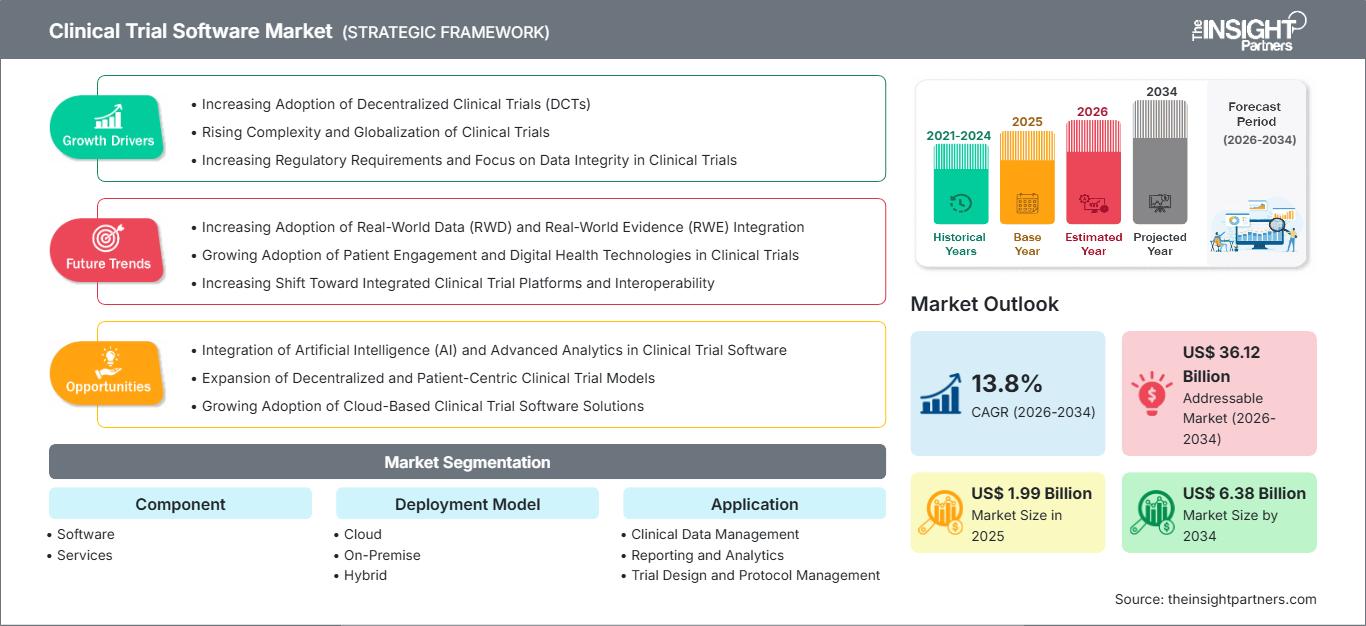
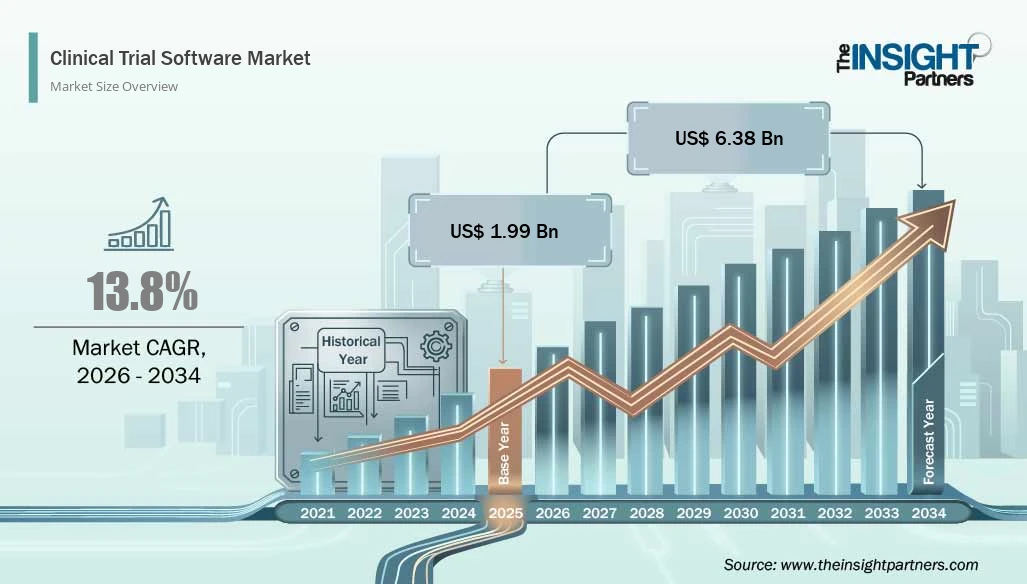
Clinical Trail Software Market was valued at US$ 1.99 Billion in 2025 and is projected to reach US$ 6.38 Billion by 2034, expanding at a CAGR of 13.8% during 2026–2034. The market is gaining strategic importance as sponsors, contract research organizations, research sites, and healthcare institutions replace fragmented workflows with connected platforms for study planning, data capture, operational oversight, analytics, and regulatory documentation.
North America remains a structurally important demand center and is expected to expand at a CAGR of 14.2% through 2034. Clinical Trial Software Market growth in the region is supported by high clinical research activity, established pharmaceutical and biotechnology portfolios, strong CRO participation, and sustained investment in cloud-based, validated systems that improve study visibility and inspection readiness.
Clinical Trail Software Market Assessment and Insights
- North America held 36.5-40.2% share in 2025 and is growing at a CAGR of 14.1-14.5% between 2026–2034, supported by sponsor-led digital transformation, mature research networks, and demand for validated cloud platforms.
- US represented 79.5-82.54% of North America in 2025 and is growing at a CAGR of 14.1-14.5% between 2026–2034, driven by complex trial portfolios, decentralized study models, and regulatory emphasis on data integrity.
- Europe accounted for 26.5-28.8% share in 2025 and is growing at a CAGR of 12.1-13.4% between 2026–2034, led by Germany, the UK, France, Italy, and Spain.
- Asia Pacific captured 22.3-25.45% share in 2025 and is growing at a CAGR of 14.3-15.8% between 2026–2034, with China, Japan, South Korea, India, and Australia expanding clinical research capacity.
- Largest Segment Software held 65.5-68.3% market share in 2025 and is growing at a CAGR of 13.2-14.5% between 2026–2034.
- High Growth Segment Cloud deployment held 49.5-52.12% market share in 2025 and is growing at a CAGR of 12.5-14.4% between 2026–2034.
- Key companies analyzed in detail: MasterControl Solutions, Inc., Oracle Corp, IQVIA Holdings Inc, Dassault Systemes SE, Wipro Ltd, Veeva Systems Inc, Signant Health, DATATRAK International Inc, Advarra Inc., MedNet Solutions, Inc., Clinion, Clario Holdings, Inc., Suvoda LLC, Medrio, and eClinical Solutions LLC.
Source: The Insight Partners' analysis based on proprietary research, government publications, company annual reports, investor presentations, industry databases, and expert interviews.
Technology procurement is shifting from stand-alone point solutions toward unified clinical operating environments. Sponsors increasingly expect clinical data management, trial management, electronic document workflows, analytics, and regulatory controls to exchange information without repeated reconciliation. This change is raising the value of configurable software, implementation expertise, validation support, and disciplined integration with laboratory, safety, imaging, electronic health record, and patient-facing systems.
Future demand will be driven by decentralization/hybrid studies, complexity of protocols, risk-based monitoring, analytics at the portfolio level, and higher standards of traceability. Large corporations will keep on consolidating their platforms in global projects, while SMEs will opt for more modular cloud-based subscription services, thus requiring less infrastructure and faster deployments. Service providers will be relevant in cases where the customer needs to redesign his processes or migrate.
Clinical Trail Software Market Report Scope
| Report Attribute | Details |
|---|---|
| Market size in 2025 | US$ 1.99 Billion |
| Market Size by 2034 | US$ 6.38 Billion |
| Global CAGR (2026 - 2034) | 13.8% |
| Historical Data | 2021-2024 |
| Forecast period | 2026-2034 |
Clinical Trail Software Market Analysis
The demand is increasing as the clinical studies produce more information on operations, patients, laboratories, images, safety, and devices compared to the traditional methods which cannot handle them effectively. The Clinical Trial Software Market development will be very much associated with the requirement of visibility of all data from a single source, quick review, efficient audit trail, and early risk detection.
Ecosystem players include software developers, implementation partners, cloud providers, validation experts, CROs, clinical study centers, and data services companies. Integration is now a competitive advantage as customers demand harmonization of master data and seamless handover between EDC, CTMS, eTMF, RTSM, eCOA, safety, and analytics systems. Vendors who streamline the process through automated reconciliation can benefit from better adoption rates and subscription revenue.
Competition spans global enterprise suites, specialist clinical platforms, site-focused products, and technology-enabled service providers. Oracle Corp, IQVIA Holdings Inc, Dassault Systemes SE, and Veeva Systems Inc compete through broad portfolios and large-program scalability. Signant Health, Clario Holdings, Inc., Suvoda LLC, Medrio, Clinion, eClinical Solutions LLC, DATATRAK International Inc, Advarra Inc., and MedNet Solutions, Inc. compete through differentiated workflow depth, patient technologies, data services, site connectivity, or mid-market flexibility.
Priorities for investment are shifting towards interoperable cloud architecture, configuration of study build, automation, AI-based review, real time reporting, and security of systems. MasterControl Solutions provides quality and compliance workflow solutions, whereas Wipro Limited adds consultancy, integration and managed services. For all of the competitive companies, competitive advantage will depend upon implementation rigor, regulatory credibility, usability, support, and cycle time reduction.
● REPORT CUSTOMIZATION
Tailor This Report To Align With Your Specific Business Requirements
This report can be customized to align precisely with your business objectives, scope, and target markets. Customization options include tailored segmentation, geography, competitive analysis, and strategic insights to support informed decision-making.
Customize This Report →WHAT YOU CAN ADJUST
- ● Segmentations
- ● Geography
- ● Competitive Analysis
- ● Language Preferences
Clinical Trail Software Market: Strategic Insights
Regional Insights
North America Clinical Trial Software Market
North America held 36.5-40.2% share in 2025 and is expected to grow at a CAGR of 14.1-14.5% during 2026–2034. The region benefits from a dense concentration of pharmaceutical sponsors, biotechnology developers, CROs, academic medical centers, and specialized research sites. Demand is strongest for validated cloud platforms that connect data management, study operations, patient engagement, and compliance oversight.
The other factors supporting adoption are decentralization aspects of trials, remote monitoring, digitized endpoints, and attempts by sponsors to harmonize technology within therapeutic areas. Purchasers are beginning to evaluate vendors for integration, security, auditability, rapid deployment, and total cost of ownership. Enterprise vendors dominate large global programs, while modular vendors serve new biotech firms and research consortia.
U.S. Clinical Trial Software Market
The US accounted for 79.5-82.54% of North America in 2025 and is projected to grow at a CAGR of 14.1-14.5% from 2026–2034. Demand is concentrated among large pharmaceutical companies, growth-stage biotechnology firms, CROs, medical device sponsors, cancer centers, and multisite research organizations. Cloud procurement is rising as customers seek faster study activation and consistent governance across dispersed teams.
The market favors providers that can support electronic data capture, trial management, regulatory documentation, randomization, patient-reported outcomes, analytics, and compliance within connected environments. Regulatory expectations around decentralized activities, participant protection, source-data reliability, and system validation strengthen the business case for controlled digital workflows and durable audit evidence.
Europe Clinical Trial Software Market
Europe represented 26.5-28.8% share in 2025 and is forecast to grow at a CAGR of 12.1-13.4% through 2034. Germany is a leading demand center due to its life-sciences base and research infrastructure, while the UK, France, Italy, and Spain contribute through sponsor activity, CRO operations, academic networks, and multinational study participation.
European buyers place particular emphasis on privacy, data residency, participant rights, multilingual study execution, and cross-border regulatory consistency. Hybrid trial models and remote data collection are expanding, but procurement decisions remain closely linked to validation evidence, governance controls, vendor accountability, and the ability to configure country-specific workflows without fragmenting the global study record.
APAC Clinical Trial Software Market
APAC held 22.3-25.45% share in 2025 and is expected to grow at a CAGR of 14.3-15.8% during 2026–2034. China, Japan, South Korea, India, and Australia are expanding clinical research capacity, creating demand for scalable platforms that support local languages, regional regulations, large site networks, and globally sponsored protocols.
Growth is reinforced by biotechnology investment, broader CRO delivery capabilities, improving digital infrastructure, and the increasing inclusion of Asia-based sites in multinational studies. Vendors that combine cloud scalability with regional implementation teams, local support, configurable compliance logic, and reliable integration can capture demand from both global sponsors and domestic life-sciences companies.
Segmentation Analysis
Component
Component, Software is expected to grow at a CAGR of 12.4-13.9% during 2026–2034. The segment includes configurable platforms used to plan studies, manage data, coordinate sites, monitor progress, prepare reports, and maintain compliance evidence. Services remain essential because clinical systems must be integrated, validated, adopted by users, and supported throughout long study lifecycles.
- Software forms the core recurring-revenue segment, covering clinical data, trial operations, analytics, protocol workflows, regulatory controls, and connected study execution.
- Implementation & Integration Services support configuration, migration, validation, interfaces, security controls, and deployment across existing clinical and enterprise systems.
- Consulting Services help customers redesign processes, select architecture, establish governance, prepare validation evidence, and improve operating models.
- Training & Support Services improve user adoption, standardize study execution, reduce errors, and sustain compliance as products and regulations evolve.
- Others include managed services, data conversion, custom development, validation maintenance, and specialized operational support.
Deployment Model
Deployment Model, Cloud is projected to grow at a CAGR of 12.4-13.9% from 2026–2034. Cloud delivery is becoming the preferred model because it supports distributed teams, quicker upgrades, elastic capacity, and lower infrastructure ownership. On-premises environments remain relevant for organizations with strict control requirements, while hybrid models bridge legacy systems and newer cloud services.
- Cloud supports rapid deployment, remote access, subscription pricing, centralized upgrades, and scalable use across sponsors, CROs, and sites.
- On-Premises remains relevant where customers require direct infrastructure control, customized security architecture, or continued use of deeply embedded legacy environments.
- Hybrid combines controlled internal systems with cloud applications, allowing phased modernization while preserving selected data, integrations, and operating processes.
Opportunity Snapshot
| Application | Revenue Contribution | Trend Tag | Adoption Stage |
| Clinical Data Management | High | Unified Data | Mature |
| Reporting and Analytics | High | Risk Signals | Scaling |
| Trial Design and Protocol Management | Medium | Adaptive Design | Emerging |
| Regulatory Compliance Management | Medium | Audit Readiness | Scaling |
| Design and Planning | Medium | Faster Start-Up | Scaling |
| Others | Medium | Specialist Workflows | Developing |
Clinical Trail Software Market Growth Drivers and Impact Analysis
Rising trial complexity and pressure for faster decisions
It has been observed that clinical trials are growing larger in terms of number of participating countries, participating sites, data sources, endpoints, vendors, and changes in the protocol. Manual coordination is expensive for sponsor companies, and it makes them vulnerable to late identification of issues, inconsistencies, and longer database lock time. Connected software offers clinical organizations unified operational pictures at all stages of clinical trial, including recruitment, site activation, monitoring, data review, and document status.
Decentralized and hybrid trials expand the digital workflow
The remote visit, the interaction in a local healthcare setting, the electronic consent process, the connection with smart devices, direct to patient logistics, and digital outcome assessments move clinical research outside of the typical clinical research center setting. These approaches need identity management, secure data transmission, appropriate delegation, ongoing monitoring, and audit trail evidence. The clinical trial software is the coordination layer for connecting all parties involved. The interoperability of these applications is critical for hybrid protocols for the safety of the participants and accurate data.
Regulatory scrutiny increases demand for traceable systems
The need for sponsors to prove completeness, attribution, auditing, and protection of records during a trial process leads to increased requirements for the control of access, electronic signature, audit trails, configuration validation, and change control. Consequently, regulatory compliance is not an additional feature but rather an integral part of the platform design, implementation, support, and operation. It is now easier for vendors who can integrate good workflow with compliance to prepare for inspection and reduce costs of documentation management.
Clinical Trail Software Market Future Trends
AI-assisted oversight and automated clinical operations
Clinical Trial Software Market trends will increasingly center on practical automation rather than isolated AI demonstrations. Platforms are expected to assist with protocol interpretation, study configuration, medical coding, query prioritization, enrollment forecasting, site-risk detection, and narrative reporting. Adoption will depend on transparency, validation, human review, privacy, and the ability to explain system recommendations. The strongest commercial use cases will be those that remove repetitive work while preserving accountable clinical judgment and a clear record of decisions.
Unified data fabric across the study lifecycle
The current trend among sponsors is towards architectures where operational, clinical, document, safety, laboratory, imaging, and patient-generated data are linked using common identifiers and metadata management. Having a unified data layer can help decrease the need for reconciliations, cross-study analysis, and learning at a portfolio level without making everything fit into one application. This will benefit vendors providing open interfaces, reuseable data models, configurable governance, and reliable integration services. It will also allow for niche vendors to exist in the clinical technology landscape.
Clinical Trail Software Market Opportunities
Modular platforms for biotechnology firms and regional CROs
There is a need for effective controls in the case of growth stage biotech companies and regional CROs, but they do not have sufficient funds or employees to go through an extended enterprise transformation process. This void can be filled by vendors with flexible subscription services, pre-packaged study templates, smooth validation processes, clear pricing structures, and implementation packages suited to small groups. Tools that are easy to use yet can handle international projects can develop along with their customers.
Site-centered workflow and emerging-market expansion
Research sites still face difficulties with duplicated logins, redundant data entry, sponsor-specific procedures, and lack of transparency in the process of conducting trials. Tools designed to make site operations easier from the very beginning, help in exchanging documents, booking participants, managing budgets, and transferring data can help to enhance capacity and retention rates. In developing countries, multilingual, mobile-friendly, locally hosted solutions will also play an important role. Providers who will decrease administrative overhead for sites but keep sponsors in control will benefit from network effects.
Recent Developments
- September 2025: IQVIA (NYSE: IQV), a leading global provider of clinical research services, commercial insights, and healthcare intelligence to the life sciences and healthcare industries, announced the launch of its Clinical Trial Financial Suite (CTFS), an AI-enabled platform orchestrating all financial aspects of clinical trials. CTFS is designed to eliminate inefficiencies created by siloed systems and fragmented processes. In contrast to other industry offerings, CTFS unifies budgeting, contracting, forecasting, and payment workflows with shared data and end-to-end processes.
- June 2026: Dassault Systèmes (Euronext Paris: FR0014003TT8, DSY.PA) announced that it signed a definitive agreement to acquire ArisGlobal, the leading AI-native enterprise compliance platform for the Life Sciences industry. Under the terms of the agreement, Dassault Systèmes will acquire ArisGlobal for approximately $1.8 billion in cash at closing, plus up to US$200 million in additional consideration tied to multi-year AI-related revenue milestones. The transaction was unanimously approved by the Board of Directors of Dassault Systèmes.
- August 2025: Veeva Systems (NYSE: VEEV) has announced a strategic collaboration with Amgen to enhance clinical trial innovation and improve operational efficiencies. As a leading global biotechnology company, Amgen will leverage the Veeva Clinical Platform to streamline clinical trial processes and identify opportunities for greater efficiency. The partnership supports Amgen’s ongoing mission to accelerate the development of innovative medicines for patients living with serious diseases.
Frequently Asked Questions

- Comprehensive Market Sizing and Forecast Analysis
- Detailed Segmentation Analysis
- In-Depth Market Dynamics Assessment
- Regional and Country-Level Insights
- Competitive Landscape and Company Benchmarking
- Strategic Business Intelligence
Recent Reports
Testimonials

The Insight Partners' SCADA System Market report is comprehensive, with valuable insights on current trends and future forecasts. The team was highly professional, responsive, and supportive throughout. We are very satisfied and highly recommend their services.
RAN KEDEM Partner, Reali Technologies LTDs
I requested a report on a very specific software market and the team produced the report in a few days. The information was very relevant and well presented. I then requested some changes and additions to the report. The team was again very responsive and I got the final report in less than a week.
JEAN-HERVE JENN Chairman, Future Analytica
We worked with The Insight Partners for an important market study and forecast. They gave us clear insights into opportunities and risks, which helped shape our plans. Their research was easy to use and based on solid data. It helped us make smart, confident decisions. We highly recommend them.
PIYUSH NAGPAL Sr. Vice President, High Beam Global
The Insight Partners delivered insightful, well-structured market research with strong domain expertise. Their team was professional and responsive throughout. The user-friendly website made accessing industry reports seamless. We highly recommend them for reliable, high-quality research services
YUKIHIKO ADACHI CEO, Deep Blue, LLC.
This is the first time I have purchased a market report from The Insight Partners.While I was unsure at first, I visited their web site and felt more comfortable to take the risk and purchase a market report.I am completely satisfied with the quality of the report and customer service. I had several questions and comments with the initial report, but after a couple of dialogs over email with their analyst I believe I have a report that I can use as input to our strategic planning process.Thank you so much for taking the extra time and making this a positive experience.I will definitely recommend your service to others and you will be my first call when we need further market data.
JOHN SUZUKI President and Chief Executive Officer, Board Director, BK Technologies
I wish to appreciate your support and the professionalism you displayed in the course of attending to my request for information regarding to infectious disease IVD market in Nigeria. I appreciate your patience, your guidance, and the fact that you were willing to offer a discount, which eventually made it possible for us to close a deal. I look forward to engaging The Insight Partners in the future, all thanks to the impression you have created in me as a result of this first encounter.
DR CHIJIOKE ONYIA MANAGING DIRECTOR, PineCrest Healthcare Ltd.Reason to Buy
- Informed Decision-Making
- Understanding Market Dynamics
- Competitive Analysis
- Identifying Emerging Markets
- Customer Insights
- Market Forecasts
- Risk Mitigation
- Boosting Operational Efficiency
- Strategic Planning
- Investment Justification
- Tracking Industry Innovations
- Aligning with Regulatory Trends





 Get Free Sample for