
Coconut Sugar Market Growth, Trends & Demand by 2034
Coverage: By Packaging Type (Bottles and Jars, Pouches, and Others), Category (Organic and Conventional), Distribution Channel (Supermarkets and Hypermarkets, Convenience Stores, Online Retail, and Others), and Geography
- Status : Data Released
- Report Code : TIPRE00008142
- Category : Food and Beverages
- No. of Pages : 150
- Available Report Formats :


- Last update date : May 22, 2026


2025 Market Size
US$ 2.91 Bn
Base year value
2034 Forecast
US$ 4.57 Bn
Projected by 2034
CAGR 2026-2034
5.14 %
Growth rate
Addressable Market
US$ 33.93 Bn
(2026-2034)
The global coconut sugar market size is projected to reach US$ 4.57 billion by 2034 from US$ 2.91 billion in 2025. The market is anticipated to register a CAGR of 5.14% during the forecast period 2026–2034.
Key market dynamics include a heightening global focus on low-glycemic index alternatives to refined cane sugar, rising consumer awareness regarding the mineral content of coconut-derived sweeteners, and a significant shift toward clean-label and minimally processed ingredients. Additionally, the market is expected to benefit from the growing popularity of plant-based diets, expansion in organic retail channels across North America and Europe, and the increasing inclusion of coconut sugar in high-value functional segments like health bars and specialty chocolates.
Coconut Sugar Market Analysis
The coconut sugar market analysis highlights a significant expansion into non-food, particularly the cosmetics and personal care industry. Manufacturers are increasingly utilizing coconut sugar in body scrubs, lotions, and exfoliating creams due to its toxin-free properties and natural alpha-hydroxy acids. Furthermore, the analysis indicates a move toward multi-cropping strategies in Southeast Asia, where farmers integrate coconut palm cultivation with other high-value crops to stabilize income against sap-yield fluctuations caused by climate stress. Strategic opportunities are also emerging in the pharmaceutical industry, where coconut sugar is being tested as a natural carrier for pediatric syrups and herbal lozenges due to its superior taste profile compared to synthetic alternatives. However, the analysis notes that the high labor intensity of manual sap tapping remains a primary challenge, necessitating investments in vacuum-drying and automated collection technologies to ensure long-term scalability.
Coconut Sugar Market Overview
Coconut sugar has transitioned from a traditional sweetener in Southeast Asian households to a globally recognized superfood ingredient. The coconut sugar is characterized by a surge in product innovation, including the development of extra-fine powder formats designed for rapid dissolution in cold beverages and dairy alternatives. Both established agri-business leaders and boutique organic brands are competing for market share by emphasizing the presence of inulin, a prebiotic fiber that supports digestive health. While granular forms currently dominate the retail landscape, liquid coconut nectar is gaining traction in the craft cocktail and specialty coffee segments. The market overview suggests that while Asia-Pacific remains the production powerhouse, the North American market is becoming a key center for innovation, with health-conscious consumers driving demand for blended sweeteners that combine coconut sugar with other natural extracts like monk fruit to achieve specific caloric targets. The US market is primarily fueled by health-conscious millennials and a robust fitness culture. Consumers increasingly favor coconut sugar for its clean-label appeal and low-glycemic properties. Its widespread availability in organic grocery chains and integration into functional snacks, keto-friendly treats, and plant-based desserts further drive adoption.
Market Assessment and Insights
- Global market for Coconut Sugar was valued at US$ 2.91 Billion in 2025
- Annual market size is expected to reach US$ 4.57 Billion by 2034
- Total addressable market (TAM) during 2026-2034 is projected to reach approximately US$ 33.93 Billion
- Market is anticipated to register a CAGR of 5.14% during the forecast period
- The United States represents a key market, supported by Increasing Demand for Refined Sugar Alternatives, as well as evolving industry dynamics
- Market analysis covers North America, Europe, Asia-Pacific, South and Central America, Middle East and Africa, with growth evaluated across the forecast period
- Market opportunities such as Rising Demand in Southeast Asia are expected to influence market dynamics and addressable market
- Report profiles industry participants, including Betterbody Foods, Big Tree Farms, Bob, while analyzing competitive strategies and innovation developments
-
Source: The Insight Partners' analysis based on proprietary research, government publications, company annual reports, investor presentations, industry databases, and expert interviews.
● REPORT CUSTOMIZATION
Tailor This Report To Align With Your Specific Business Requirements
This report can be customized to align precisely with your business objectives, scope, and target markets. Customization options include tailored segmentation, geography, competitive analysis, and strategic insights to support informed decision-making.
Customize This Report →WHAT YOU CAN ADJUST
- ● Segmentations
- ● Geography
- ● Competitive Analysis
- ● Language Preferences
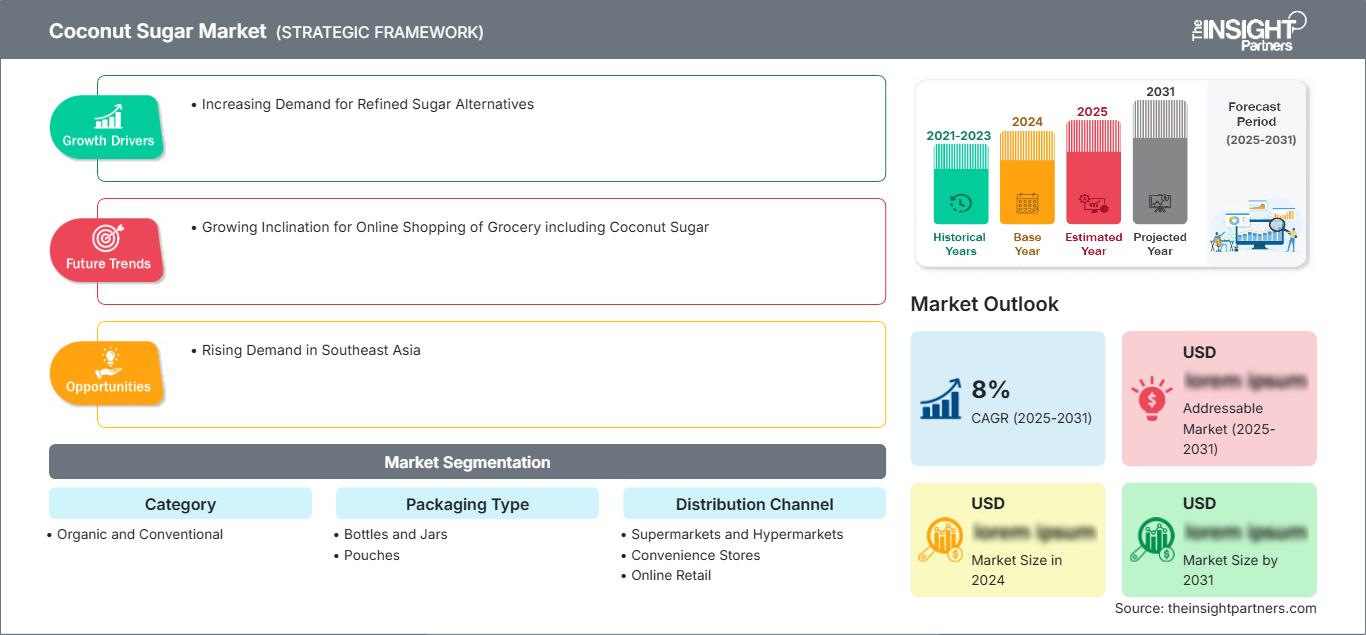
Coconut Sugar Market: Strategic Insights
-
Get Top Key Market Trends of this report.This FREE sample will include data analysis, ranging from market trends to estimates and forecasts.
Coconut Sugar Market Drivers and Opportunities
Market Drivers:
- Superior Nutritional Profile and Low Glycemic Index: Coconut sugar contains inulin, a prebiotic fiber that slows glucose absorption. This nutritional benefit, along with growing interest in natural sugar alternatives, is driving its popularity among diabetic-friendly food manufacturers.
- Premiumization of the Global Natural Sweetener Category: The expansion of gourmet retail and specialty baking aisles has sustained high demand for coconut-based inputs. As consumers trade up to artisanal experiences, organic-certified coconut sugar continues to see stable volume gains.
- Rapid Expansion of Digital and E-commerce Channels: Online retail has removed traditional geographic barriers for niche sweeteners. This is particularly evident in the rapid adoption of coconut sugar pouches and bulk packs in regions like North America and the Middle East.
Market Opportunities:
- Expansion into Adult and Sports Nutrition: Beyond baking, coconut sugar offers significant opportunities in high-performance energy gels and recovery drinks for athletes seeking sustained energy release.
- Growth in Emerging APAC Corridors: Forming strategic partnerships between Southeast Asian suppliers and regional distributors may facilitate access to high-margin market segments in China and India, where demand for premium, clean-label plant products is increasing.
- Diversification into Specialty Certifications: There is a growing opportunity for producers to target specific demographics through certifications such as Organic, Non-GMO, and Kosher, as seen in recent successful retail expansions in the European market.
Coconut Sugar Market Report Segmentation Analysis
The Coconut Sugar Market share is analyzed across various segments to provide a clearer understanding of its structure, growth potential, and emerging trends. Below is the standard segmentation approach used in industry reports:
By Packaging Type:
- Pouches: The most popular packaging format due to ease of storage, resealability, and lower shipping costs. It is the preferred choice for the majority of organic brands.
- Bottles and Jars: Frequently used for liquid coconut nectar or premium crystal variants, offering a high-end shelf presence in gourmet retail sections.
- Others: Includes bulk industrial bags and drums used for B2B supply in the bakery and confectionery manufacturing.
By Category:
- Organic: A fast-growing niche that aligns with global sustainability trends. It is increasingly preferred by high-income consumers who prioritize chemical-free production and ethical farming.
- Conventional: The dominant volume driver, particularly within the local markets of producing nations and for large-scale industrial food processing, due to cost efficiencies.
By Distribution Channel:
- Supermarkets & Hypermarkets: Remains the primary channel for household consumption, benefiting from the expansion of dedicated organic and health-food sections.
- Convenience Stores: Offers a select but growing range of small-format coconut sugar packs and individual servings in urban markets.
- Online Retail: The fastest-rising channel, especially for D2C artisanal farm brands, enabling cross-border premium imports and bulk consumer purchases.
- Others: Includes specialty health food stores and direct B2B sales to bakeries and cafes.
By Geography:
- North America
- Europe
- Asia Pacific
- South & Central America
- Middle East & Africa
Coconut Sugar Market Report Scope
| Report Attribute | Details |
|---|---|
| Market size in 2025 | US$ 2.91 Billion |
| Market Size by 2034 | US$ 4.57 Billion |
| Global CAGR (2026 - 2034) | 5.14% |
| Historical Data | 2021-2024 |
| Forecast period | 2026-2034 |
| Segments Covered |
By Packaging Type
|
| Regions and Countries Covered |
North America
|
| Market leaders and key company profiles |
|
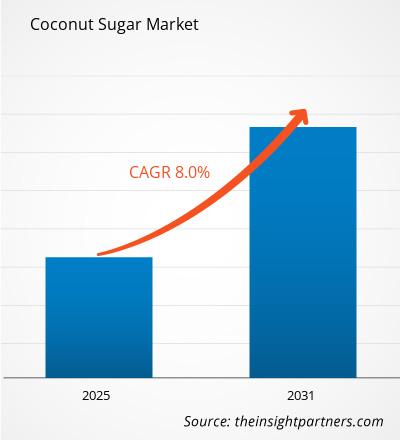
Coconut Sugar Market Players Density: Understanding Its Impact on Business Dynamics
The Coconut Sugar Market is growing rapidly, driven by increasing end-user demand due to factors such as evolving consumer preferences, technological advancements, and greater awareness of the product's benefits. As demand rises, businesses are expanding their offerings, innovating to meet consumer needs, and capitalizing on emerging trends, which further fuels market growth.
Coconut Sugar Market Share Analysis by Geography
Asia-Pacific is expected to remain the largest producer and a significant consumer market. North America and Europe represent the highest growth potential for premium and organic segments.
The coconut sugar market is experiencing a significant transformation, moving from a traditional Southeast Asian staple to a global high-value functional sweetener. Growth is driven by the rising prevalence of metabolic health concerns, a surge in clean-label demand, and the expansion of the plant-based food industry. Below is a summary of market share and trends by region:
1. North America
- Market Share: A major consumption hub experiencing a rapid growth trajectory, driven by premium retail and industrial food innovation.
- Key Drivers:
- Rising consumer preference for low-glycemic index (GI) sweeteners to manage blood sugar and obesity.
- Mainstreaming of organic and unrefined sugars in high-end grocery chains and specialty coffee franchises.
- Increasing inclusion of coconut sugar in functional snacks, keto-friendly treats, and vegan protein bars.
- Trends: Successful adoption of specialty certifications like Non-GMO and Fair Trade to appeal to socially conscious millennials and Gen Z consumers.
2. Europe
- Market Share: Holds a substantial share of the global import market, anchored by mature health-food in Germany, the UK, France, and the Netherlands.
- Key Drivers:
- Strict EU regulations favoring natural ingredients over synthetic additives and highly refined sugars.
- Established processing infrastructure for high-end organic confectionery and bakery products.
- Strong government and NGO support for sustainable sourcing and fair-trade partnerships with developing nations.
- Trends: A strategic shift toward organic-certified coconut sugar, which is gaining immense traction as a cruelty-free, vegan alternative to bone-char refined cane sugar.
3. Asia-Pacific
- Market Share: The dominant region globally, with Indonesia and the Philippines serving as the primary export engines.
- Key Drivers:
- Vast agricultural resources and a long history of traditional coconut palm cultivation.
- Government-led agricultural initiatives focused on value-added exports rather than raw copra.
- Rapid urbanization in China and India is leading to a preference for westernized, luxury, healthy snacks.
- Trends: Heavy reliance on B2B contracts for high-volume supply to global food giants and an increasing focus on liquid coconut nectar for the burgeoning beverage industry.
4. South and Central America
- Market Share: An emerging market with a steady growth rate, particularly in countries like Brazil and Chile.
- Key Drivers:
- Increasing awareness of the nutritional superiority of coconut sugar, specifically its potassium and magnesium content.
- Modernization of retail channels providing greater access to imported natural sweeteners.
- Trends: Growth of boutique brands incorporating coconut sugar into traditional regional sweets to differentiate from the dominant domestic cane sugar market.
5. Middle East and Africa
- Market Share: A developing market with a growing appetite for premium health products in affluent urban centers like Dubai and Riyadh.
- Key Drivers:
- High demand for shelf-stable natural sweeteners in arid climates.
- Strategic investments in smart agriculture and food diversification to reduce reliance on refined commodity imports.
- Trends: Growing use of coconut sugar in the luxury hospitality and high-end artisanal bakeries.
High Market Density and Competition
Competition is intensifying due to the presence of established leaders such as Big Tree Farms, Nutiva, and Madhava. Regional experts and niche players also contribute to a diverse and rapidly expanding market landscape.
This competitive environment pushes vendors to differentiate through:
- Premiumization and functional branding: Positioning coconut sugar as a superior nutritional alternative to cane sugar by emphasizing its mineral content and low glycemic index.
- Product diversification: Offering various formats, including liquid nectar, fine-ground powders, and flavored variants to cater to diverse culinary needs.
- Supply chain transparency: Managing the process from sap collection to packaging to ensure quality and meet ethical clean-label standards.
Opportunities and Strategic Moves
- Targeting the Beverage and Nutraceutical Sectors: Partner with high-end tea and coffee brands to replace refined sugar with coconut sugar, tapping into the surging demand for natural, low-GI beverage formulations.
- Focus on Industrial B2B Partnerships: Strengthen ties with bakery and confectionery giants looking for unrefined, vegan-friendly bulk ingredients to meet clean-label packaging requirements.
Major Companies operating in the Coconut Sugar Market are:
- Betterbody Foods
- Big Tree Farms
- Bob’s Red Mill Natural Foods
- Celebes Coconut Corporation
- Coco Sugar Indonesia
- Health Garden USA
- Natural Zing
- Now Foods
- Nutiva
- Treelife
Disclaimer: The companies listed above are not ranked in any particular order.
Coconut Sugar Market News and Recent Developments
- In January 2026, Mirova Invests USD 10 Million in Big Tree Farms to Accelerate Sustainable Land Use in Asia.
- In August 2025, Big Tree Farms announced to turn up the heat on innovation at Newtopia 2025 to meet Gen Z's and the nation's craving for bold, layered flavors and feel-good ingredients and products. At Booth 1133, Big Tree Farms will debut its vibrant new brand design, infused with the magic and madness of Bali's food scene, and showcase a lineup that pairs exciting new category launches with its top-selling Coconut Aminos and Coconut Sugar, reflecting the brand's continued momentum across categories.
Coconut Sugar Market Report Coverage and Deliverables
The Coconut Sugar Market Size and Forecast (2021–2034) report provides a detailed analysis of the market covering below areas:
- Coconut Sugar Market size and forecast at global, regional, and country levels for all the key market segments covered under the scope
- Coconut Sugar Market trends, as well as market dynamics such as drivers, restraints, and key opportunities
- Detailed PEST and SWOT analysis
- Coconut Sugar Market analysis covering key market trends, global and regional framework, major players, regulations, and recent market developments
- Industry landscape and competition analysis covering market concentration, heat map analysis, prominent players, and recent developments in the Coconut Sugar Market.
- Detailed company profiles
Frequently Asked Questions

- Comprehensive Market Sizing and Forecast Analysis
- Detailed Segmentation Analysis
- In-Depth Market Dynamics Assessment
- Regional and Country-Level Insights
- Competitive Landscape and Company Benchmarking
- Strategic Business Intelligence
Recent Reports
Testimonials

The Insight Partners' SCADA System Market report is comprehensive, with valuable insights on current trends and future forecasts. The team was highly professional, responsive, and supportive throughout. We are very satisfied and highly recommend their services.
RAN KEDEM Partner, Reali Technologies LTDs
I requested a report on a very specific software market and the team produced the report in a few days. The information was very relevant and well presented. I then requested some changes and additions to the report. The team was again very responsive and I got the final report in less than a week.
JEAN-HERVE JENN Chairman, Future Analytica
We worked with The Insight Partners for an important market study and forecast. They gave us clear insights into opportunities and risks, which helped shape our plans. Their research was easy to use and based on solid data. It helped us make smart, confident decisions. We highly recommend them.
PIYUSH NAGPAL Sr. Vice President, High Beam Global
The Insight Partners delivered insightful, well-structured market research with strong domain expertise. Their team was professional and responsive throughout. The user-friendly website made accessing industry reports seamless. We highly recommend them for reliable, high-quality research services
YUKIHIKO ADACHI CEO, Deep Blue, LLC.
This is the first time I have purchased a market report from The Insight Partners.While I was unsure at first, I visited their web site and felt more comfortable to take the risk and purchase a market report.I am completely satisfied with the quality of the report and customer service. I had several questions and comments with the initial report, but after a couple of dialogs over email with their analyst I believe I have a report that I can use as input to our strategic planning process.Thank you so much for taking the extra time and making this a positive experience.I will definitely recommend your service to others and you will be my first call when we need further market data.
JOHN SUZUKI President and Chief Executive Officer, Board Director, BK Technologies
I wish to appreciate your support and the professionalism you displayed in the course of attending to my request for information regarding to infectious disease IVD market in Nigeria. I appreciate your patience, your guidance, and the fact that you were willing to offer a discount, which eventually made it possible for us to close a deal. I look forward to engaging The Insight Partners in the future, all thanks to the impression you have created in me as a result of this first encounter.
DR CHIJIOKE ONYIA MANAGING DIRECTOR, PineCrest Healthcare Ltd.Reason to Buy
- Informed Decision-Making
- Understanding Market Dynamics
- Competitive Analysis
- Identifying Emerging Markets
- Customer Insights
- Market Forecasts
- Risk Mitigation
- Boosting Operational Efficiency
- Strategic Planning
- Investment Justification
- Tracking Industry Innovations
- Aligning with Regulatory Trends





 Get Free Sample for