Cold Planers Market Size & Overview
The Cold Planers Market reached US$ 1.32 Billion in 2025 and is projected to attain US$ 2.21 Billion by 2034, expanding at a CAGR of 5.89% during 2026–2034. The market includes wheel-type and crawler-type machines used for road construction and pavement maintenance, as well as manned and unmanned configurations. Demand reflects recurring pavement rehabilitation, selective surface removal, and preparation of reclaimed asphalt pavement for reuse in new mixes.
North America remains a critical demand center, with an estimated ~5% CAGR through 2034. The Cold Planers Market size in the region is supported by recurring rehabilitation of mature highway networks, multiyear public funding, and contractor replacement of older fleets with connected machines. Integrated grade control, remote diagnostics, and better material handling strengthen utilization by reducing rework and unplanned downtime across high-production milling programs.
Growth of the Cold Planers Market is driven by two categories of demand: network growth which generates new milling demands and rehabilitation of existing pavements. Road authorities, municipalities, airports, utility companies, and specialized contractors generate project scopes based on surveys which decide on the required machine size, capacity, and maneuverability. Higher production projects prefer crawler chassis and front conveyor, while local repair works need smaller wheeled machines that can maneuver in restricted spaces. The eco-system within the Cold Planers Market includes engines, hydraulics, drums, picks, leveling devices, conveyors, telematics, dealers, rental services, and asphalt recyclers. Economies of supply are tied to steel availability, however, operational uptime determines purchasing decisions for construction equipment. This means that part support, drum replacement time, diagnostic capabilities, mobility, and end-of-life value are considered by customers besides the price. Recycled asphalt pavement connects the milling process to the circular economy of materials.
The Cold Planers Market analysis reveals a focused technology competition among high capacity machines, and fragmented competition among compact machines and attachments. The battle between Wirtgen GmbH and Caterpillar Inc. is based on technology integration and services, while SANY Group Co., Ltd. and Sakai Heavy Industries, Ltd. offer their products based on price-performance and local application needs. Dynapac Compaction Equipment AB and Astec Industries, Inc. keep their expertise in road equipment. Capital expenditure for the Cold Planers Market industry includes automation software, remote diagnosis, protection of the operator, low emission engines, and cutting system configurability. Simex S.r.l. and Schwamborn Gerätebau GmbH reinforce specialized segments, while Multihog Limited and Rhino Equipment cover multipurpose segments. Positioning is becoming increasingly dependent on the transformation of machine data to business-related actions regarding production, accounting, and maintenance. Machine suppliers offering training, financing, rental, and prompt wear parts supply have the opportunity to maintain their margins due to cyclic government procurements.
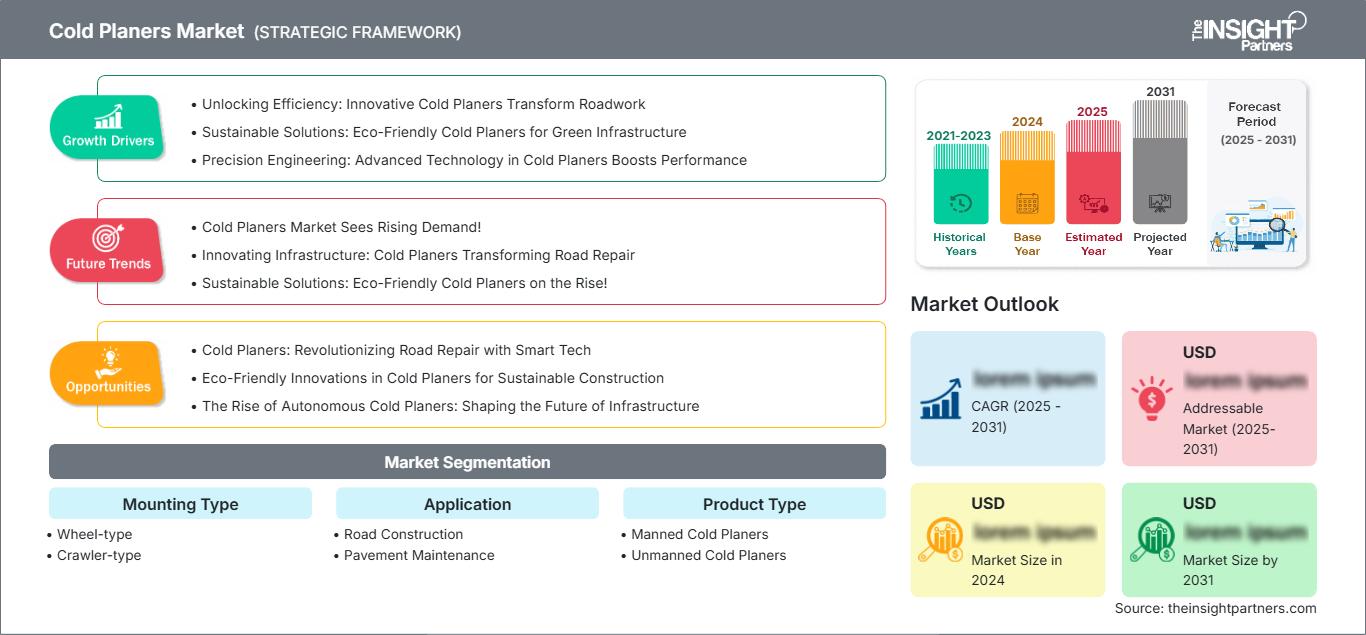
Cold Planers Market Assessment and Insights
Regional Outlook
- North America: ~34% of the global Cold Planers Market share in 2025 | ~5% CAGR through 2034. Market position: The region ranks first, supported by an extensive paved-road base, recurring resurfacing cycles, established rental channels, and strong demand for high-capacity crawler machines.
- US: ~81% of North American market revenue in 2025 | ~5% CAGR through 2034. Market position: The US leads North America as contractors adopt telematics, precision grade control, and high-output milling for interstate, airport, municipal, and utility restoration work.
- Europe: ~30% of the global market in 2025 | ~5% CAGR through 2034. Market position: A mature fleet and stringent emissions requirements sustain replacement demand, with Germany leading and the UK, France, Italy, and Spain contributing substantial rehabilitation activity.
- Asia Pacific: ~27% of the global market in 2025 | ~8% CAGR through 2034. Market position: Asia Pacific is the fastest-growing region as China leads installed demand while India expands highways and Japan, South Korea, and Australia renew mature corridors.
Segment Outlook
- Mounting Type: ~57% Share in 2025 | ~6% CAGR through 2034. Market position: Mounting Type is the largest main segment because crawler platforms dominate high-production highway work, where traction, stability, deep cutting, and conveyor throughput determine contractor economics.
- Product Type: ~20% Share in 2025 | ~9% CAGR through 2034. Market position: Product Type is the high-growth main segment as remote operation, automated controls, and labor constraints accelerate interest in unmanned-capable systems while manned machines retain the installed-base majority.
Competitive Coverage
Caterpillar Inc., Schwamborn Gerätebau GmbH, Dynapac Compaction Equipment AB, Astec Industries, Inc., Multihog Limited, Sakai Heavy Industries, Ltd., Rhino Equipment, Simex S.r.l., Wirtgen GmbH, SANY Group Co., Ltd.
Methodology
The Insight Partners follows Data Collection & Secondary Research, Primary Research, Data Analysis, and Data Triangulation & Final Review to validate market estimates and insights.
Source: The Insight Partners' analysis based on proprietary research, government publications, company annual reports, investor presentations, industry databases, and expert interviews.
Cold Planers Market Trends
Automation Will Progress from Assistance to Supervised Autonomy
Cold Planers Market trends point toward incremental autonomy rather than immediate operator removal. Near-term systems will automate steering guidance, depth consistency, obstacle alerts, drum-speed selection, and production reporting while a trained operator supervises exceptions. Controlled environments such as airports, closed highway lanes, and repetitive full-width passes offer the clearest validation path. Over time, remote supervision could separate personnel from dust, noise, and traffic exposure. Adoption will depend on reliable perception, positioning redundancy, cybersecurity, and clear responsibility for safe operation. Manufacturers that design automation around existing workflows and provide transparent override controls should achieve faster contractor acceptance than suppliers pursuing fully autonomous operation without service infrastructure.
Low-Emission Powertrains Will Expand by Machine Class
Electrification is likely to advance first in compact machines used near buildings, enclosed sites, and noise-sensitive urban zones, where shorter duty cycles and accessible charging improve feasibility. Large planers face higher continuous power requirements, making efficient combustion, hybrid assistance, and demand-managed dual-engine concepts more practical interim pathways. Procurement standards will increasingly evaluate local emissions, noise, fuel intensity, and carbon documentation alongside output. This will broaden competition from mechanical efficiency to energy-system integration. Suppliers must match powertrain choices to real milling loads, charging conditions, transport limits, and residual-value expectations rather than applying a uniform technology across the portfolio.
Cold Planers Market Growth Factors
Recurring Rehabilitation of Aging Pavement Networks
The road infrastructure becomes worn due to axles, freeze-thaw action, heat, water infiltration, and utility work. This results in maintenance becoming a continuous need and not a once-off capital project. The cold planer machine allows the removal of old layers through exact cutting prior to overlays, the correction of cross-sloping and ruts, and ensuring no unnecessary pavement elevation occurs. From the perspective of the contractor, the consequence is continual use through periodic resurfacing projects. Large machines benefit from highway and airport configurations, whereas smaller planers are for municipal streets and spot repairs.
Reclaimed Asphalt and Resource-Efficient Construction
Cold milling creates reclaimed asphalt pavement material that can be utilized in new mixes or as base materials. This method ensures that the need for new aggregate materials is reduced and also minimizes the waste of asphalt by providing material to owners that can be recycled. Selective milling ensures that only the unsound upper layers are removed while leaving the sound lower layers intact, making it economically superior to total removal. Machines that ensure consistent gradation, accurate depth control, and clean loading of material become increasingly important as recyclers and asphalt plants make stringent demands for feedstock.
Digital Controls Improve Output and Fleet Availability
Automated leveling, engine load balancing, traction control, camera systems, telematics, and remote diagnostics solve problems of expensive variability in milling. Consistent depth will reduce the amount of extra asphalt needed for the new layer, and the connectivity will help with faster fault detection and maintenance scheduling outside of production times. Documentation is also needed for billing and quality check. Such features move the discussion about buying away from horsepower ratings to cost per area milled and machine availability. For big contractors, fleet-level visibility of machine usage is helpful, whereas for small contractors, ease of controls and dealer support is valuable.
Cold Planers Market Opportunities
Build Service-Led Platforms for Emerging Contractor Fleets
Rapid highway expansion in Asia Pacific and selective infrastructure growth in the Middle East create an opening for manufacturers to pair equipment with financing, operator training, wear-part stocking, and mobile service. Cold Planers Market Forecasts indicate that access and uptime can matter as much as acquisition price in markets where specialist fleets are still developing. Local assembly or component hubs may reduce lead times, but channel capability remains decisive. Investors should prioritize distributors able to diagnose electronic systems, manage cutting-tool inventory, and support both compact and crawler machines. Rental programs can seed adoption among contractors that lack predictable utilization for outright ownership.
Monetize Production Data and Pavement-Recovery Workflows
Connected planers can generate records of location, depth, milled area, fuel use, downtime, and recovered material. Turning those records into contractor workflows creates opportunity beyond hardware. Suppliers can offer planning tools, automated job reports, maintenance forecasting, and interfaces with paving, trucking, and agency asset systems. Commercial value arises when data reduces disputes, improves truck coordination, or demonstrates material recovery and emissions performance. Partnerships with positioning providers, fleet platforms, and asphalt producers could accelerate adoption. The strongest offerings will translate raw telemetry into decisions while giving owners control over data access, retention, and interoperability.
Segmentation Analysis
Mounting Type
The Cold Planers Market scope under this segment spans wheel-type machines optimized for maneuverability and crawler-type units designed for traction and high production. Contractor choice depends on cutting depth, surface condition, transport constraints, closure duration, and truck-loading needs. Crawler platforms support large rehabilitation packages, while wheel-type machines preserve strategic relevance in urban and localized maintenance.
- Wheel-type: Compact dimensions, road mobility, and tight turning favor wheel-type planers for patching, curb work, intersections, utility reinstatement, and short urban assignments where rapid relocation and minimal traffic disruption matter.
- Crawler-type: High traction, stable depth control, and broad cutting widths position crawler-type machines for motorways, airports, and full-lane rehabilitation. Their productivity supports contractors managing strict possession windows and large material volumes.
Application
Application demand is expected to grow at ~6% CAGR during 2026–2034. New-road programs create initial profiling and correction work, but recurring pavement preservation produces a steadier utilization base. Agencies increasingly select milling depth according to structural condition, surface defects, drainage, and overlay design. This supports machines that can switch drums, document quantities, and maintain accurate grade across varied materials and traffic-management environments.
- Road Construction: Expressways, arterial roads, airports, and new urban corridors require profiling, tie-ins, and correction before paving. Larger machines benefit where continuous production and coordinated truck loading determine schedule performance.
- Pavement Maintenance: Resurfacing, rut correction, delamination removal, bridge-deck preparation, and patch repair generate recurring demand. Selective milling limits material removal and enables reclaimed asphalt recovery, making maintenance strategically important for fleet utilization.
Product Type
By product type, the market is divided into Manned Cold Planers and Unmanned Cold Planers. Manned machines remain the commercial standard, but automation is redistributing operator tasks toward supervision, quality control, and logistics. Unmanned-capable platforms will advance first in repeatable, controlled environments where positioning, obstacle detection, connectivity, and fail-safe systems can be validated. Adoption will depend on regulation, labor economics, and contractor confidence.
- Manned Cold Planers: Direct operator judgment remains essential around traffic, utilities, variable pavement, and confined sites. Ergonomic cabins, intuitive controls, cameras, and automation reduce fatigue while preserving human oversight and broad application flexibility.
- Unmanned Cold Planers: Remote and autonomous functions promise consistent paths, safer separation from dust and traffic, and better repeatability. Strategic importance is highest for controlled corridors, repetitive passes, and contractors facing skilled-operator shortages.
Opportunity Snapshot
| Application | Revenue Contribution | Trend Tag | Adoption Stage |
| Road Construction | High | Corridor Expansion | Mature |
| Pavement Maintenance | High | Lifecycle Renewal | Scaling |
Regional Insights
North America Cold Planers Market
North America holds an estimated ~34% Cold Planers Market share in 2025 and is expected to expand at ~5% CAGR through 2034. Its leadership is founded on the substantial existing road base, cyclical pattern of rehabilitation, well-established asphalt recycling practices, and the preference for fast production machinery among contractors to reduce lane closures. Interstate resurfacing and airport rehabilitation help crawlers, while urban patching and utilities restoration help compact wheeled equipment.
Replacement decisions have become increasingly focused on grade-and-slope control, telematics, remote software services, and operator comfort. Higher availability of dealers and rentals makes adoption easier for small firms. Growth will be more stable compared to Asia Pacific due to its current saturation level, but regular maintenance spending and extreme climate conditions will ensure demand for precision milling.
U.S. Cold Planers Market
The US represents ~81% of North American revenue in 2025 and is projected to record ~5% CAGR through 2034. It is the leading country in North America, supported by federal and state highway programs, extensive municipal networks, airport pavement work, and a large specialist-contractor base. Applications range from full-lane removal to fine milling, bridge-deck preparation, shoulder correction, and trench restoration.
Caterpillar Inc., Astec Industries, Inc., and Wirtgen GmbH benefit from established distribution and service coverage, while attachment suppliers address localized work. Contractors increasingly connect utilization, fuel, maintenance, and production data to fleet systems. Procurement favors machines that shorten setup, document completed area, improve truck loading, and maintain depth accuracy during night work and restricted closures.
Europe Cold Planers Market
Europe accounts for ~30% of global revenue in 2025 and is forecast to expand at ~5% CAGR through 2034. The market has a developed fleet of machines and high environmental and occupational protection standards. Germany is the top market in Europe, which is related to the country’s machinery industry for producing road machines, good transportation links, and strong contractor capabilities. Wirtgen GmbH and Schwamborn Gerätebau GmbH add expertise in local engineering, while EU Stage V regulations determine replacement strategies.
The United Kingdom focuses on motorway rehabilitation and urban resurfacing, where time possession periods increase the importance of reliability of equipment. In France, there are national road programs along with municipal programs. In Italy and Spain, demand is created by regional road rehabilitation projects, tourism roads, and weather-driven surface deterioration.
Replacement strategy includes reduction of dust emissions, noise, documentation, and optimal fuel consumption. Reclaimed asphalt helps to support cold milling as the selective demolition of layers allows saving of material and reducing excavation. Growth is steady rather than fast, but recurring rehabilitation and tough worksite requirements drive the introduction of advanced technology.
APAC Cold Planers Market
Asia Pacific holds ~27% of global revenue in 2025 and is the fastest-growing region at ~8% CAGR through 2034. China is the dominant nation in Asia Pacific owing to the high highway coverage, local production of machinery and provincial maintenance needs, which provide wide market reach. India has growth-driven purchases, while Japan and South Korea pay attention to accurate rehabilitation of existing infrastructure.
High specification machines are favored in Australia due to spread-out highway systems and aviation developments. The industrial capacity in the region is increasing the accessibility and cost-effectiveness of parts, and government infrastructure investments expand the base of contractors. Purchasing decisions favor telematics, automatic leveling, transport weight and dealership services over power rating.
Middle East & Africa Cold Planers Market
The Middle East & Africa is projected to expand at ~6% CAGR through 2034. Saudi Arabia is the leading country in the Middle East & Africa where large transport, logistics, and urban-development programs support road construction and rehabilitation. The UAE emphasizes high-quality urban and airport surfaces, creating demand for precise, low-disruption milling.
South Africa anchors established demand in Africa through national and municipal road maintenance, while the Rest of MEA remains project-led and sensitive to financing and parts support. Heat, abrasive materials, and long transport distances elevate cooling, cutting-tool durability, and service responsiveness. Rental and distributor partnerships can improve access where fleet ownership remains limited.
Cold Planers Market Report Scope
| Report Attribute | Details |
|---|---|
| Market size in 2025 | US$ 1.32 Billion |
| Market Size by 2034 | US$ 2.21 Billion |
| Global CAGR (2026 - 2034) | 5.89% |
| Historical Data | 2021-2024 |
| Forecast period | 2026-2034 |
| Segments Covered | Mounting Type, Application, Product Type |
| Region scope | North America, Europe, Asia-Pacific, South and Central America, Middle East and Africa |
Recent Developments
- May 2025: Simex S.r.l. At bauma 2025 presented the ART 1000 GEN II for in-situ regeneration of deteriorated asphalt. Updated onboard electronics provide a new operator interface, real-time progress and additive data, speed-linked rejuvenator dosing, and easier access for tank, grille, and crusher-drum maintenance.
- April 2025: Wirtgen GmbH publicly introduced the W 250 XF large milling machine at bauma. Its dual-engine system delivers 900 kW, while MILL ASSIST manages power according to demand. Multiple cutting assemblies support widths from 2.2 meters to 3.8 meters, and digital documentation connects production information with fleet workflows.
- March 2025: Caterpillar upgraded its PM600 and PM800 series cold planers (PM620, PM622, PM820, PM822, and PM825) with remote diagnostics and over-the-air software update capabilities. Cat Remote Troubleshoot lets dealers diagnose a running machine so technicians arrive with the right parts, while Remote Flash lets fleets update onboard software without a technician. The upgrade also adds an improved operator workstation, a redesigned anti-slab plow and sealing for better milling efficiency, and a heavy-duty rotor drive system with automatic belt tensioning.
Frequently Asked Questions

Recent Reports






