
Commercial Floor Cleaning Machine Market Size, Demand & Growth by 2034
Coverage: By Product Type (Floor Scrubbers, Vacuum Cleaners, Sweeper, Others); End User (Retail and Hospitality, Transportation and Travel, Healthcare, Education, Government, Others), and Geography (North America, Europe, Asia Pacific, and South and Central America)
- Status : Data Released
- Report Code : TIPRE00015728
- Category : Manufacturing and Construction
- No. of Pages : 150
- Available Report Formats :


- Last update date : November 09, 2026


2025 Market Size
US$ 15.32 Bn
Base year value
2034 Forecast
US$ 32.19 Bn
Projected by 2034
CAGR 2026-2034
8.60 %
Growth rate
Addressable Market
US$ 213.04 Bn
(2026-2034)
The Commercial Floor Cleaning Machine Market was valued at US$ 15.32 Billion in 2025 and is projected to reach US$ 32.19 Billion by 2034, expanding at a CAGR of 8.60% during 2026–2034. The market includes powered floor scrubbers, vacuum cleaners, and sweepers deployed across commercial facilities such as healthcare institutions, retail spaces, transportation hubs, educational campuses, hospitality venues, and government buildings. Rising emphasis on hygiene compliance, labor efficiency, and automated facility management continues to support expansion.
Across North America, adoption remains driven by large commercial facility footprints, high labor costs, and increasing deployment of robotic cleaning systems. The Commercial Floor Cleaning Machine Market size outlook in the region remains favorable, with North America forecast to advance at approximately ~8% CAGR through 2034. Demand is supported by replacement cycles for aging equipment, expanding logistics infrastructure, and growing procurement of smart cleaning solutions integrated with fleet-management and predictive maintenance capabilities.
Commercial Floor Cleaning Machine Market Assessment and Insights
Regional Outlook
- North America: ~34% of the global Commercial Floor Cleaning Machine Market share in 2025 | ~8% CAGR through 2034. Market position: Mature commercial infrastructure, strong automation adoption, higher spending on facility maintenance, and widespread use of robotic scrubbers sustain regional leadership.
- US: ~78% of North American market revenue in 2025 | ~8% CAGR through 2034. Market position: Large institutional facilities, strong vendor presence, and growing demand from warehousing, healthcare, and transportation sectors support continued expansion.
- Europe: ~29% of the global market in 2025 | ~8% CAGR through 2034. Market position: A highly developed market led by Germany, the UK, and France, supported by sustainability standards and replacement demand.
- Asia Pacific: ~27% of the global market in 2025 | ~10% CAGR through 2034. Market position: Fastest-growing region, led by China, Japan, and India, benefiting from commercial construction growth and modernization of cleaning operations.
Segment Outlook
- Product Type: ~55% Share in 2025 | ~9% CAGR through 2034. Market position: Equipment purchases directly drive market revenue, with floor scrubbers representing significant spending due to productivity and labor-saving benefits.
- End User: ~45% Share in 2025 | ~10% CAGR through 2034. Market position: Demand growth is supported by stricter cleanliness requirements across healthcare, hospitality, transportation, and public facilities.
Competitive Coverage
BISSELL BIGGREEN COMMERCIAL, Boss Cleaning Equipment Company, Cleanfloor Equipments, Clemas & Co Limited, Hako GmbH, Rawlins, Roots Multiclean Ltd., Santoni Electric Co. P. Ltd., Techtronic Floor Care Technology Limited, Tennant Company
Methodology
The Insight Partners follows Data Collection & Secondary Research, Primary Research, Data Analysis, and Data Triangulation & Final Review to validate market estimates and insights.
Source: The Insight Partners' analysis based on proprietary research, government publications, company annual reports, investor presentations, industry databases, and expert interviews.
Business cleaning companies have shifted from manually intensive maintenance towards technology-led facility management. This includes developments in battery-operated scrubbers, autonomous navigation capabilities, telemetry and filtration innovations. Manufacturers of these equipment pay more attention now to the reduction of water usage, increased run time and cost savings. These trends provide the grounds for productive growth at airports, hospitals, educational institutions and retailers.
With regard to future perspectives, the growth of investments is anticipated in Asia Pacific and some Middle Eastern countries owing to the increasing commercial facilities construction. The sustainability standards that promote resource efficiency, lower emission levels and chemical consumption have an impact on the purchasing process. With the implementation of monitoring tools and shortages in professional cleaning staff, these trends create positive conditions for business growth.
Commercial Floor Cleaning Machine Market Report Scope
| Report Attribute | Details |
|---|---|
| Market size in 2025 | US$ 15.32 Billion |
| Market Size by 2034 | US$ 32.19 Billion |
| Global CAGR (2026 - 2034) | 8.60% |
| Historical Data | 2021-2024 |
| Forecast period | 2026-2034 |
Commercial Floor Cleaning Machine Market Analysis
Growth of the Commercial Floor Cleaning Machine Market is greatly dependent on operators' efforts to attain efficiency. Cleaning of large surfaces should be done efficiently in terms of labor, consistency, and hygiene standards. Healthcare centers, transport hubs, and hospitality establishments are increasingly adopting the use of machines for cleaning purposes due to workforce limitations.
Value Chain activities include component suppliers, machinery manufacturers, distributors, facility management organizations, and end-users. Innovations in batteries, sensor technology, and software platforms keep improving the adoption of smart machinery. Supply side is bolstered by manufacturing facilities located in North America, Europe, and Asia regions.
The Commercial Floor Cleaning Machine market analysis reveals that the competitive landscape is influenced by innovation, servicing, and automation. While companies consider cost of ownership and productivity during equipment selection, Tennant Company, Hako GmbH, and Roots Multiclean Ltd. are focused on developing scrubber technologies. Specialist manufacturers retain their regional strengths through service and distribution capabilities.
Increasing investments are being made into robotics, intelligent cleaning platforms, and fleet management systems. BISSELL BIGGREEN COMMERCIAL, Techtronic Floor Care Technology Limited, Clemas & Co Limited, and Santoni Electric Co. P. Ltd. are diversifying their product portfolios to meet the efficiency-driven demand.
● REPORT CUSTOMIZATION
Tailor This Report To Align With Your Specific Business Requirements
This report can be customized to align precisely with your business objectives, scope, and target markets. Customization options include tailored segmentation, geography, competitive analysis, and strategic insights to support informed decision-making.
Customize This Report →WHAT YOU CAN ADJUST
- ● Segmentations
- ● Geography
- ● Competitive Analysis
- ● Language Preferences
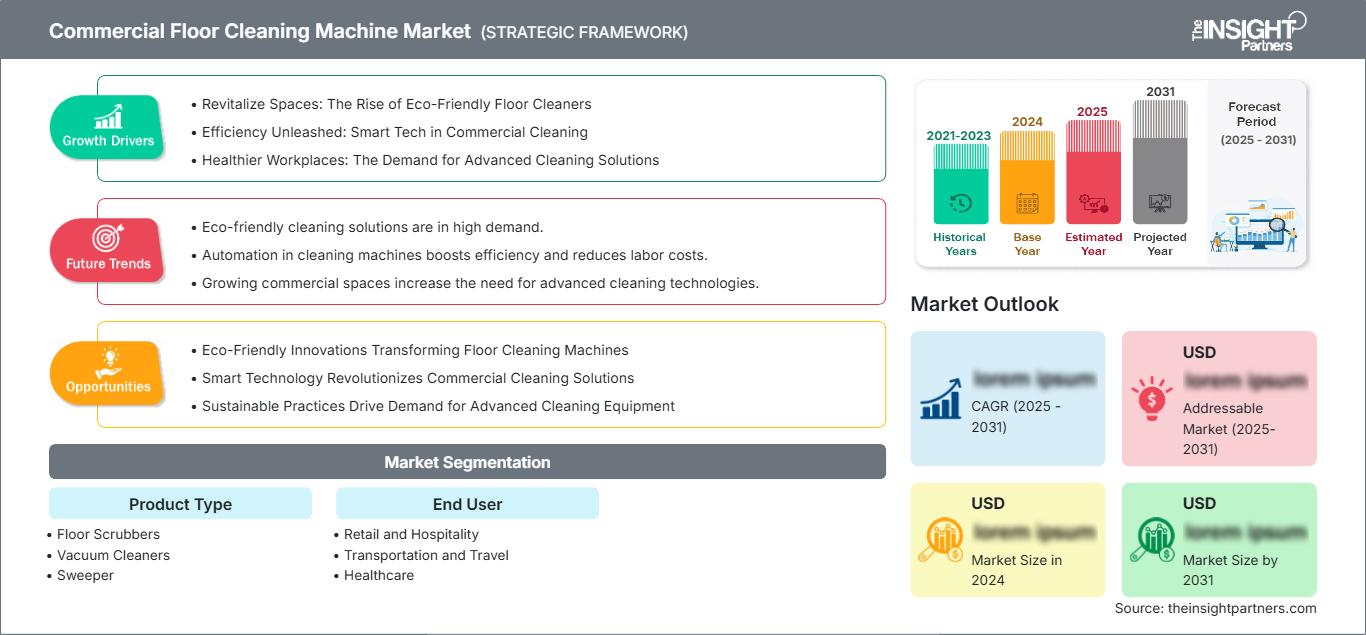
Commercial Floor Cleaning Machine Market: Strategic Insights
Regional Insights
North America Commercial Floor Cleaning Machine Market
North America represents around ~34% of total market revenues and is projected to grow at ~8% CAGR during 2024 to 2034. This region enjoys advantages including presence of large number of commercial real estate, advanced facility management services, and adoption of automated cleaning solutions. Distribution centers, healthcare facilities, universities, and transport hubs will continue being key buyers.
Commercial Floor Cleaning Machine Market leading position in North America can be attributed to replacement demand and adoption of autonomous cleaning machines. Cost pressures related to labor continue to spur investments in efficiency enhancing products, while ESG-driven facility management fuels adoption of water efficient & battery-operated machines.
Moreover, the increasing focus on efficiency is leading to investments by commercial property owners in better floor cleaning equipment. Increasingly, big facilities tend to choose ride-on scrubbers, walk-behind scrubbers, as well as robotic cleaning equipment that can work consistently in large areas of flooring. The rising popularity of e-commerce and third-party logistics services is also boosting the need for robust floor cleaning equipment which can be used continuously in warehousing and distribution facilities. Companies are making efforts to manufacture more ergonomic floor cleaning equipment and also improve battery performance and ease of maintenance. Technology upgrades and preventive maintenance programs, and equipment leasing are also being used to handle capital investments in equipment.
U.S. Commercial Floor Cleaning Machine Market
The United States accounts for around ~78% of North American sales and is forecasted to expand at ~8% CAGR up to 2034. Demand is influenced by big hospitals, retail organizations, airports, and logistics facilities. The presence of many vendors positively impacts market development.
Increasing use of autonomous floor scrubbers, smart fleet management systems, and high-performing vacuuming solutions shapes the market purchase trends. Today, productivity, efficiency, and total cost of ownership are important criteria when organizations consider which machine to buy.
Also, the growing size of commercial establishments opens the door for manufacturers of multi-functional technology-based cleaning machines. Hospitals and healthcare institutions need efficient machines that allow adhering to hygiene guidelines while causing minimal disruption of normal activities. Retail organizations and shopping malls are interested in equipment that can work efficiently outside peak hours and keep floors looking good. Machines with bigger tanks, robust components, and navigation abilities are becoming increasingly popular in the industrial and logistics segments. Furthermore, connected machines allow facility managers to control utilization, plan maintenance, and optimize routes. The availability of operator training, spare parts, and after-sales service is an important factor in equipment purchases made by companies managing large fleets.
Europe Commercial Floor Cleaning Machine Market
Europe has ~29% share of total revenue in 2025, and the region is expected to grow at a CAGR of ~8% until 2034. Factors contributing to demand include the need for cleanliness of workplaces, sustainability goals, and modernization of public infrastructure. Intelligent cleaning is being implemented in commercial buildings for increased efficiency with less impact on environment.
Germany is the most dominant country in Europe owing to its well-established industry, commercial infrastructure and manufacturers of equipment. There is substantial demand in UK from the sectors of hospitality, healthcare, and transportation. France has gained from its investment in commercial buildings and public infrastructure.
Adoption via hospitality-oriented approach from Italy and Spain is possible. In this area of Europe, battery-operated machines and autonomous systems become increasingly popular as businesses strive for efficiency and savings on resources.
Also, because of the environmental performance emphasis, Europe shows willingness to use machines that reduce water consumption, power consumption and cleaning materials usage. Facility owners take into account total cost of ownership when choosing equipment, which includes cost of maintenance, batteries and service life of the equipment. Airports, railway stations, shopping centers and educational establishments are promising for equipment manufacturers providing large capacity and silent cleaning systems. Additionally, the well-established equipment production industry in this region enables innovations, distribution channels and technical services. Finally, shortage of labor force in some sectors of facility management boosts interest in automation for cleaning.
APAC Commercial Floor Cleaning Machine Market
The Asia-Pacific region is responsible for almost ~27% of total revenue and is predicted to grow by ~10% CAGR, which makes it the fastest-growing region. Urbanization, building of new commercial buildings, and greater mechanization of the cleaning process drive growth.
Among the countries in the Asia-Pacific region, China is the leading one because of its vast manufacturing environment and commercial buildings. Japan and South Korea focus on automation and high-tech cleaning equipment, while India and Australia have growing institutional and commercial facilities.
Urbanization and increase in number of commercial spaces in the region have resulted in growing demand for solutions that help keep floors clean in an efficient manner. Malls, office buildings, hotels, hospitals, and colleges are now increasingly employing mechanized devices for maintaining cleanliness in their floor space. Manufacturing strength in China and sourcing networks of suppliers have ensured that these devices become available in the region, while Japan and South Korea are adding their demand for precise and automated floor cleaners. Infrastructure developments in airports, metro systems, business zones, and organized retail spaces are providing new avenues of business for the equipment suppliers in India. Cost-effectiveness continues to be an issue in some emerging economies in the region and this is fueling demand for scrubbers at entry level and multi-tasking machines.
Middle East & Africa Commercial Floor Cleaning Machine Market
The Middle East and Africa region market is forecasted to grow by ~9% CAGR till 2034. Infrastructure development such as airports, hospitals, hotels, and commercial projects drives demand in the region.
The most promising economies in the region are Saudi Arabia owing to its massive investments in infrastructure and commercial development, United Arab Emirates owing to their investment in hospitality and transport sector, and South Africa in the retail and institutional sectors.
Tourism, international business travels, and large entertainment centers are generating more business opportunities for commercial floor cleaning equipment manufacturers. Hotels, convention centers, shopping centers, and premium offices need effective solutions which can keep the high presentation standards in large indoor spaces. In the Gulf countries, infrastructure developments and smart city projects have been driving the interest in automated scrubbers, ride-ons, and battery-operated machines. Another point to consider here is water conservation because of the harsh climatic conditions. This factor drives customers to look for machines that use minimum water volume but still provide efficient results. In Africa, urbanization processes, development of the healthcare and education sector, and construction of retail centers are gradually increasing the customer base for floor cleaning equipment.
Segmentation Analysis
Product Type
Product Type is projected to advance at ~9% CAGR through 2034. The segment benefits from continuous product innovation, battery-powered systems, robotic functionality, and increasing demand for efficient cleaning across large commercial facilities. The Commercial Floor Cleaning Machine Market scope within this segment continues expanding as organizations seek productivity gains and operational consistency.
- Floor Scrubbers: Widely adopted across airports, hospitals, warehouses, and retail facilities due to superior productivity and cleaning consistency on large floor areas.
- Vacuum Cleaners: Important across hospitality, education, offices, and healthcare environments where dust management and indoor air quality remain operational priorities.
- Sweeper: Frequently deployed in industrial facilities, logistics centers, and transportation environments requiring efficient debris collection and large-area maintenance.
End User
End User is projected to grow at ~10% CAGR through 2034. Demand is driven by hygiene regulations, customer experience requirements, workforce efficiency goals, and expansion of commercial infrastructure worldwide.
- Retail and Hospitality: Continuous cleaning requirements, customer-facing environments, and high foot traffic support steady investment in floor-maintenance equipment.
- Transportation and Travel: Airports, railway stations, and transit facilities utilize mechanized cleaning solutions to maintain operational efficiency and cleanliness standards.
- Healthcare: Infection prevention requirements and strict sanitation protocols make advanced cleaning equipment a critical operational asset.
- Education: Universities and school campuses increasingly adopt machine-based cleaning to improve productivity across large facilities.
- Government: Public buildings, administrative complexes, and municipal facilities contribute recurring demand through ongoing maintenance programs.
Opportunity Snapshot
| End User | Revenue Contribution | Trend Tag | Adoption Stage |
| Retail and Hospitality | High | Guest Hygiene | Mature |
| Transportation and Travel | High | Terminal Automation | Scaling |
| Healthcare | High | Infection Control | Mature |
| Education | Medium | Campus Efficiency | Scaling |
| Government | Medium | Smart Facilities | Scaling |
Commercial Floor Cleaning Machine Market Growth Drivers and Impact Analysis
Automation Adoption Across Commercial Facilities
Organizations increasingly deploy autonomous scrubbers and connected machines to address labor shortages, improve cleaning consistency, and reduce operating costs. Robotic systems enable extended operating hours and provide measurable productivity benefits in transportation hubs, warehouses, healthcare facilities, and educational campuses. The integration of artificial intelligence, advanced sensors, and real-time monitoring capabilities is further improving navigation, obstacle detection, and cleaning route optimization. These technologies allow facility managers to monitor machine performance, track cleaning coverage, and schedule maintenance more effectively. Autonomous equipment also helps reduce dependence on manual intervention for repetitive cleaning tasks, allowing employees to focus on specialized maintenance activities. As technology costs gradually become more manageable, adoption is expected to increase across large commercial facilities, particularly among organizations seeking scalable cleaning solutions and improved long-term operational efficiency.
Rising Hygiene and Compliance Requirements
Heightened awareness regarding workplace cleanliness and public health continues influencing purchasing decisions. Healthcare providers, hospitality operators, and government agencies are upgrading equipment to improve sanitation outcomes while maintaining operational efficiency across large facilities. Commercial establishments increasingly prioritize machines that deliver consistent cleaning performance, minimize cross-contamination risks, and support established hygiene protocols. Hospitals, clinics, laboratories, and food-related commercial environments require equipment suited to frequent cleaning schedules and demanding sanitation standards. Similarly, hotels, shopping centers, and transportation facilities must maintain clean floors to enhance visitor confidence and provide a positive customer experience. Manufacturers are responding by developing equipment with improved water recovery, efficient filtration, and user-friendly maintenance features. Regular equipment upgrades and preventive maintenance practices are also gaining importance as organizations seek reliable performance, reduced downtime, and greater compliance with applicable workplace safety and cleanliness requirements.
Expansion of Commercial Infrastructure
New airports, logistics centers, retail developments, educational facilities, and mixed-use commercial projects are creating ongoing demand for mechanized floor cleaning equipment. Growth in emerging markets further supports procurement activity across multiple end-user industries. As commercial buildings increase in size and complexity, facility operators require machines capable of cleaning extensive floor areas efficiently while maintaining consistent results. Large warehouses and distribution centers are driving demand for ride-on scrubbers and high-capacity equipment, whereas offices, hotels, and educational institutions often require compact machines suitable for varied indoor environments. Investments in public transportation networks, healthcare infrastructure, and modern retail formats are also expanding the potential customer base. In developing economies, rising urbanization and the growth of organized commercial real estate are accelerating the transition from manual cleaning methods to mechanized solutions. This infrastructure expansion is expected to create sustained opportunities for manufacturers offering durable, energy-efficient, and technologically advanced floor cleaning equipment.
Commercial Floor Cleaning Machine Market Future Trends
Robotics and AI-Based Cleaning Ecosystems
The Commercial Floor Cleaning Machine Market trends increasingly point toward integrated robotics platforms combining autonomous navigation, analytics, and fleet management capabilities. Future deployments are expected to emphasize predictive maintenance and performance optimization through connected data ecosystems. Artificial intelligence is enabling cleaning machines to identify obstacles, adapt routes, and optimize cleaning schedules based on facility layouts and usage patterns. Integration with building management systems is also expected to improve coordination between cleaning operations and broader facility services. Connected platforms allow operators to monitor equipment utilization, track cleaning coverage, and identify performance inefficiencies across multiple locations. As businesses continue addressing labor constraints and rising operational expenses, demand for intelligent cleaning solutions is likely to increase. Manufacturers are expected to focus on developing scalable robotic platforms, intuitive control interfaces, and advanced software capabilities that improve productivity, reduce equipment downtime, and support data-driven facility management decisions.
Greater Focus on Sustainability Metrics
Manufacturers are expected to prioritize water-efficient designs, battery innovations, recyclable materials, and environmentally responsible cleaning processes. Sustainability performance is likely to become a more important purchasing parameter across commercial sectors. Facility managers are increasingly evaluating cleaning equipment based on energy consumption, water usage, chemical requirements, and overall lifecycle environmental impact. Battery-powered machines are gaining attention because they can reduce reliance on conventional fuel-based systems and support quieter operation in indoor environments. Improvements in battery charging efficiency and operational runtime are also expected to enhance equipment productivity while minimizing energy-related expenses. In addition, advanced water recovery systems and optimized detergent dispensing technologies can help reduce resource consumption during routine cleaning activities. Manufacturers may increasingly incorporate durable components, repairable designs, and recyclable materials to extend equipment life and reduce waste. These developments are expected to strengthen the role of sustainability considerations in procurement strategies, particularly among organizations with established environmental, social, and governance objectives.
Commercial Floor Cleaning Machine Market Opportunities
Expansion in High-Growth Emerging Commercial Markets
The Commercial Floor Cleaning Machine Market Forecasts indicate significant investment potential across rapidly urbanizing economies where commercial infrastructure is expanding. Vendors capable of offering localized service, financing options, and efficient solutions can strengthen market penetration. Countries experiencing growth in organized retail, healthcare infrastructure, logistics networks, hospitality, and educational facilities are creating new opportunities for mechanized cleaning equipment suppliers. As businesses modernize their facility management practices, demand is expected to increase for walk-behind scrubbers, ride-on machines, industrial vacuum cleaners, and autonomous cleaning systems. However, affordability and access to reliable maintenance services remain important considerations for customers in developing markets. Manufacturers can address these challenges by establishing regional distribution networks, partnering with local service providers, and offering flexible purchasing arrangements. Developing products suited to local operating conditions and facility requirements can further improve adoption. These strategies can help suppliers expand their customer base, strengthen brand presence, and establish long-term growth opportunities across emerging commercial markets.
Service-Based Equipment Business Models
Subscription contracts, equipment-as-a-service offerings, and performance-based maintenance programs present attractive opportunities. These models reduce upfront capital burdens for end users while creating recurring revenue streams for suppliers. Instead of purchasing equipment outright, commercial facility operators can access cleaning machines through periodic payments that may include servicing, repairs, technical support, and equipment upgrades. This approach is particularly attractive to organizations managing multiple facilities or seeking to preserve capital for other operational priorities. Service-based arrangements can also improve equipment utilization by providing access to suitable machines without requiring customers to manage every aspect of ownership. For manufacturers and distributors, recurring contracts create opportunities to build stronger customer relationships and generate more predictable revenue. Connected equipment and remote monitoring technologies can further support these models by enabling preventive maintenance, performance tracking, and timely service interventions. As businesses increasingly prioritize cost predictability and operational flexibility, service-oriented equipment offerings are expected to gain traction across commercial cleaning applications.
Recent Developments
- August 2025: Tennant Company showcased the X6 ROVR autonomous cleaning platform and expanded commercialization of robotic floor-care technologies for large commercial environments, strengthening its automation-focused portfolio.
- February 2025: Hako GmbH strengthened its market presence through a partnership initiative in India designed to expand advanced cleaning equipment deployment and sustainable cleaning solutions across multiple commercial sectors.
- October 2025: Techtronic Industries Floor Care announced relocation and expansion of its North American floorcare business operations to Anderson, South Carolina, supporting innovation and future product development initiatives.
Frequently Asked Questions

- Comprehensive Market Sizing and Forecast Analysis
- Detailed Segmentation Analysis
- In-Depth Market Dynamics Assessment
- Regional and Country-Level Insights
- Competitive Landscape and Company Benchmarking
- Strategic Business Intelligence
Recent Reports
Testimonials

The Insight Partners provided valuable market intelligence that supported our global go-to-market strategy. Their team was professional, responsive, and attentive to our feedback, providing thoughtful analysis and helpful methodological clarifications throughout the project.
Junmo Kim Chief Financial Officer (CFO), Enertech Co., Ltd.
The Insight Partners' SCADA System Market report is comprehensive, with valuable insights on current trends and future forecasts. The team was highly professional, responsive, and supportive throughout. We are very satisfied and highly recommend their services.
RAN KEDEM Partner, Reali Technologies LTDs
I requested a report on a very specific software market and the team produced the report in a few days. The information was very relevant and well presented. I then requested some changes and additions to the report. The team was again very responsive and I got the final report in less than a week.
JEAN-HERVE JENN Chairman, Future Analytica
We worked with The Insight Partners for an important market study and forecast. They gave us clear insights into opportunities and risks, which helped shape our plans. Their research was easy to use and based on solid data. It helped us make smart, confident decisions. We highly recommend them.
PIYUSH NAGPAL Sr. Vice President, High Beam Global
The Insight Partners delivered insightful, well-structured market research with strong domain expertise. Their team was professional and responsive throughout. The user-friendly website made accessing industry reports seamless. We highly recommend them for reliable, high-quality research services
YUKIHIKO ADACHI CEO, Deep Blue, LLC.
This is the first time I have purchased a market report from The Insight Partners.While I was unsure at first, I visited their web site and felt more comfortable to take the risk and purchase a market report.I am completely satisfied with the quality of the report and customer service. I had several questions and comments with the initial report, but after a couple of dialogs over email with their analyst I believe I have a report that I can use as input to our strategic planning process.Thank you so much for taking the extra time and making this a positive experience.I will definitely recommend your service to others and you will be my first call when we need further market data.
JOHN SUZUKI President and Chief Executive Officer, Board Director, BK Technologies
I wish to appreciate your support and the professionalism you displayed in the course of attending to my request for information regarding to infectious disease IVD market in Nigeria. I appreciate your patience, your guidance, and the fact that you were willing to offer a discount, which eventually made it possible for us to close a deal. I look forward to engaging The Insight Partners in the future, all thanks to the impression you have created in me as a result of this first encounter.
DR CHIJIOKE ONYIA MANAGING DIRECTOR, PineCrest Healthcare Ltd.Reason to Buy
- Informed Decision-Making
- Understanding Market Dynamics
- Competitive Analysis
- Identifying Emerging Markets
- Customer Insights
- Market Forecasts
- Risk Mitigation
- Boosting Operational Efficiency
- Strategic Planning
- Investment Justification
- Tracking Industry Innovations
- Aligning with Regulatory Trends





 Get Free Sample for