
Composite Film Market Share, Demand & Growth by 2034
Coverage: by Resin Film Type (Polyethylene, Polypropylene, Epoxy, Others); Curing Type (Autoclave, Out-of-autoclave); Function (Lightning Strike Protection, Surface Protection, Others); Application (Automotive, Aerospace and Defense, Marine, Construction, Others) , and Geography (North America, Europe, Asia Pacific, and South and Central America)
- Status : Data Released
- Report Code : TIPRE00009764
- Category : Chemicals and Materials
- No. of Pages : 150
- Available Report Formats :


- Last update date : September 02, 2026


2025 Market Size
US$ 416.17 Mn
Base year value
2034 Forecast
US$ 712.24 Mn
Projected by 2034
CAGR 2026-2034
6.15 %
Growth rate
Addressable Market
US$ 5,108.08 Mn
(2026-2034)
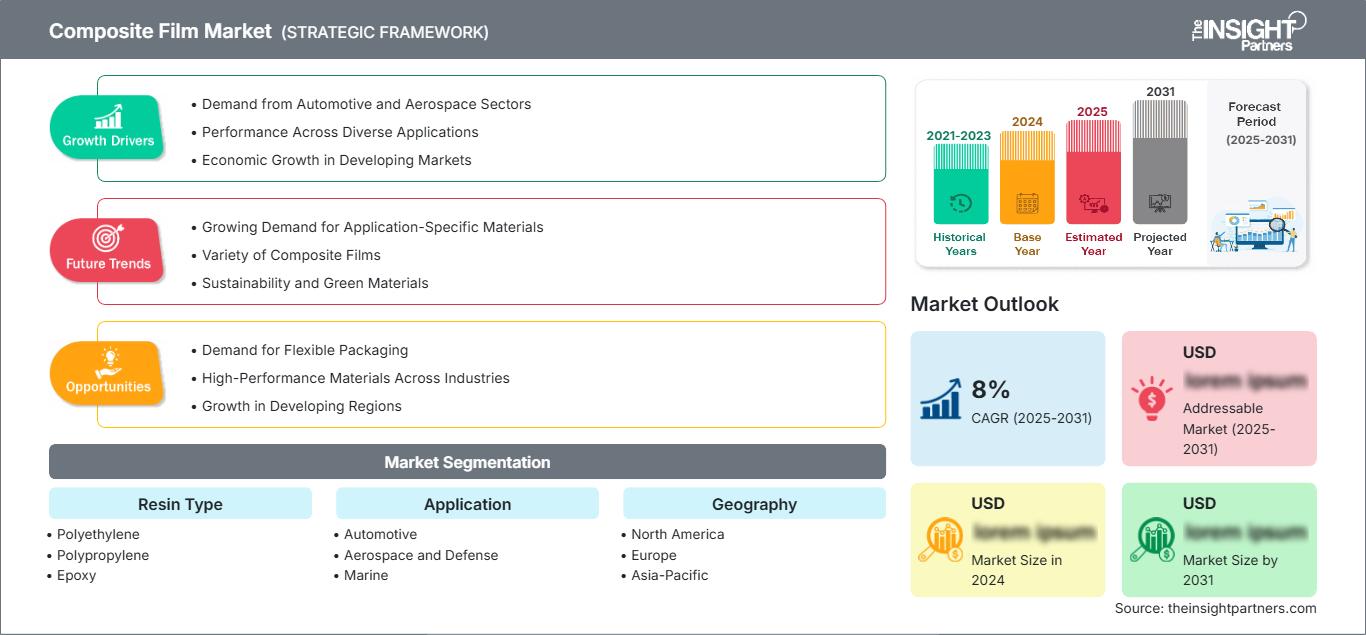
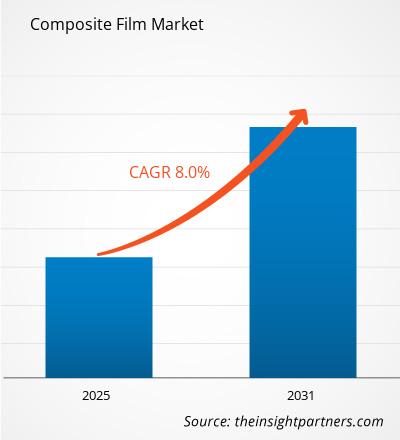
The Composite Film Market size is expected to reach US$ 416.17 Million in 2025 and grow to US$ 712.24 Million by 2034, expanding at a CAGR of 6.15% between 2026 and 2034. It includes resins forming films that are useful in improving bonding, surface protection, lightweighting, and performance in composites. Its growth will be driven by growing adoption of composites where control on film thickness, process reliability, and surface functionality are key considerations.
North America continues to remain a strategically significant manufacturing hub, and the Composite Film Market is driven by aerospace production, defense spending, automotive lightweighting, and the presence of established capabilities in composites. The region is expected to grow at a CAGR of 5.8%–6.5% between 2026 and 2034. Aircraft production recovery and automated composite processing will drive demand.
Composite Film Market Assessment and Insights
- North America: North America is estimated to account for 31–35% Composite Film Market share in 2025 and grow at a CAGR of 5.8–6.5% during 2026–2034, supported by aerospace structures, defense platforms, and mature composite manufacturing.
- US: The US represents 25–29% of global demand and is growing at a CAGR of 5.7–6.4%, reflecting strong aerospace, defense, and advanced automotive applications.
- Europe: Europe holds a 24–28% share in 2025 and is projected to grow at 5.6–6.3%, led by Germany, France, the UK, Italy, and Spain through aerospace and automotive composite adoption.
- Asia Pacific: Asia Pacific commands 25–29% share in 2025 and is expected to grow at 6.8–7.6%, with China, Japan, South Korea, and India benefiting from aircraft, automotive, and industrial composite capacity expansion.
- Largest Segment: Epoxy resin type holds a 52–58% market share in 2025 and is expected to expand at a CAGR of 5.7–6.2%, reflecting established aerospace bonding and surfacing applications.
- High Growth Segment: Polypropylene resin type holds a 9–13% market share in 2025 and is estimated to grow at 7.0–8.0%, supported by lightweight automotive and industrial applications.
- Key companies analyzed in detail: 3M Company, Solvay S.A., Gurit Holding AG, Henkel AG & Co. KGaA, Toray Industries, Inc., SOCOMORE, Axiom Materials, Inc., Northern Composites, LLC, Park Aerospace Corp., and Hexcel Corporation.
Source: The Insight Partners' analysis based on proprietary research, government publications, company annual reports, investor presentations, industry databases, and expert interviews.
The composite film market report indicates that the market has progressed from specialized bonding and surface-treating films to the creation of functional composite films with resin properties, controlled thickness, curing, surfaces, and processing capability. The aerospace industry continues to be an important yardstick of technology because of the severe demands in terms of temperature, chemistry, mechanics, and environment that the products must withstand. Process development focuses on out-of-autoclave processing, fast curing, ease of processing, and less finishing.
Future demand will be coming from aircraft manufacture, defense upgrades, advanced mobility, and light-weight vehicle structures. The importance of Asia Pacific grows due to the growth in the aerospace and automotive capacities whereas North America and Europe continue to have a strong position in the high qualification industries. Reduced emission criteria indirectly favor lightweight composites.
Composite Film Market Report Scope
| Report Attribute | Details |
|---|---|
| Market size in 2025 | US$ 416.17 Million |
| Market Size by 2034 | US$ 712.24 Million |
| Global CAGR (2026 - 2034) | 6.15% |
| Historical Data | 2021-2024 |
| Forecast period | 2026-2034 |
Composite Film Market Analysis
Demand for composites is driven by their increased use in aerospace, automotive, marine, and building and construction sectors. Growth of the market for composite film is a function of its ability to bond, its finishing properties, moisture resistance, and light weight multi-functional capabilities. The value chain starts with the polymers and resin suppliers, then film formulations, coating or impregnation, converting, testing and qualifying of the film.
The supply chain depends upon resin chemistry, reinforcement, thickness, curing process and qualifying. Aerospace buyers place greater importance on consistency and qualification than the lowest material costs, thereby making entry into the market difficult for new suppliers. Buyers in the automotive and industrial markets stress production rate, cost and process flexibility. Suppliers have created grades suitable for autoclave, out-of-autoclave, automated lay up, bonding and finishing.
Competition includes diversified materials firms along with specialty composites manufacturers. The 3M Company contributes with structural adhesive films and composite surfacing products whereas Solvay S.A., Hexcel Corporation, and Toray Industries, Inc. have advanced material offerings of various types. This market analysis also takes into account the impact of qualification depth on choosing suppliers.
Strategic positioning now involves faster processing, low-temperature curing, better surface finish, and qualification capability. For instance, Hexcel Corporation’s 2025 aerospace program included focus on automation and quick manufacturing processes of composites along with experts having niche performance capabilities. Investments will also be made in thermoplastic technology, sustainable chemicals, and technologies for reduced finishing activities. Competitive advantage will thus rely on formulation capability, application engineering, supply reliability, and qualification capability.
● REPORT CUSTOMIZATION
Tailor This Report To Align With Your Specific Business Requirements
This report can be customized to align precisely with your business objectives, scope, and target markets. Customization options include tailored segmentation, geography, competitive analysis, and strategic insights to support informed decision-making.
Customize This Report →WHAT YOU CAN ADJUST
- ● Segmentations
- ● Geography
- ● Competitive Analysis
- ● Language Preferences
Composite Film Market: Strategic Insights
Regional Insights
North America Composite Film Market
North America holds a market share of 31–35% for the Composite Films Market in 2025 and is projected to grow by 5.8–6.5% between 2026–2034. The US leads in regional consumption due to its well-developed aerospace manufacturing industry, its defense programs, composite component manufacturing, and qualified film-adhesive qualification infrastructure. Aerospace manufacturing in Canada and transportation application contribute to the demand, while Mexico has contributions through automotive manufacturing.
The major regional drivers include aerospace manufacturing, specifically structural adhesive films, surfacing films, and lightning strike protection films. Adoption of materials that can be used in automatic tape layup process, automatic fiber placement process, and out of autoclave manufacturing process is being observed. There are other small yet important regional drivers such as the automotive and marine segments due to lightweighting and corrosion resistance.
U.S. Composite Film Market
The US accounts for 25%-29% of world demand and around 78-84% of North America’s market share. It is expected to expand at a CAGR of 5.7%-6.4% during 2034. Aerospace structures, military planes, spacecrafts and advanced mobility vehicles generate continuous needs for structural adhesive films, surfacing films and protective films. Companies such as 3M Company, Hexcel Corporation, Park Aerospace Corp., and Axiom Materials, Inc. add strength to local production capacity.
Application trends support the use of automation, quick curing, minimal finishing and environmental resistance. Programs in defense and space prefer materials that have been tested, processable and offer good performance. Automotive applications will focus on light-weight structures whereas the maritime applications will focus on durable and water resistant materials.
Europe Composite Film Market
Europe has 24-28% market share in 2025 and it is expected to have growth of 5.6-6.3% in the period 2026-2034. Germany has the most significant position on account of automotive engineering, industrial composites and aerospace manufacturing. In addition, the UK and France have significant aerospace manufacturing capability whereas Italy and Spain manufacture aircrafts, automobiles, marine and industrial composite components.
There is strong support for the UK market through aerospace structures, defense and advanced manufacturing. High performance adhesives and surfacing films are preferred for lightweight structures and stringent qualifications. The French market receives support from the aerospace and aircraft propulsion systems industry. Germany automotive and industrial sector diversifies its applications beyond aerospace.
APAC Composite Film Market
APAC accounts for 25-29% of market share in 2025 and will grow at 6.8-7.6% until 2034, which makes APAC the fastest-growing major region. The leading countries in the region by consumption include China, Japan, South Korea, India, and Australia. Consumption in APAC is driven by aerospace localization, automotive manufacturing, electronics manufacturing, and industrial composite manufacturing.
The growing aircraft and automotive manufacturing drives China, while Japan possesses its advanced materials knowledge. South Korea has aerospace, automotive, and shipbuilding capabilities. India is enhancing its aerospace manufacturing and defense localization, while Australia contributes to aerospace, marine, and defense application.
Middle East & Africa Composite Film Market
Middle East and Africa is estimated to grow at 5.0–5.8% during 2026–2034. Saudi Arabia and the UAE are leading regional demand centers because aerospace, defense, infrastructure, and industrial diversification programs are increasing advanced-material requirements. South Africa contributes through aerospace, defense, automotive, and marine capabilities, while the rest of MEA remains smaller and project-driven.
Energy and infrastructure investment creates opportunities for corrosion-resistant composite structures. Aerospace and defense provide the strongest demand for qualified film technologies, while marine and construction offer diversification. Local initiatives may improve conversion, although many high-performance films will continue to rely on established international suppliers.
Segmentation Analysis
Resin Type
Epoxy remains the dominant resin category because of aerospace qualification, strong adhesion, predictable curing, and compatibility with carbon-fiber structures. The segment is estimated to grow at a CAGR of 5.7–6.2% during 2026–2034. Polyethylene and polypropylene provide opportunities where flexibility, lower density, or thermoplastic compatibility outweigh epoxy's qualification history. The Composite Film Market scope varies by processing route and end-use performance.
- Polyethylene: Polyethylene films support applications requiring flexibility, chemical resistance, moisture protection, and economical processing. Their strategic role is stronger where extreme structural performance is less critical than handling, durability, and cost.
- Polypropylene: Polypropylene films benefit from low density, chemical resistance, and thermoplastic processing advantages. Demand is supported by automotive lightweighting and applications seeking faster manufacturing cycles and recyclable material pathways.
- Epoxy: Epoxy films remain central to high-performance composite bonding and surfacing because of strong adhesion, established aerospace qualification, and controlled cure behavior. Their strategic importance is highest in safety-critical structures.
Curing Type
Curing Type is projected to expand at 6.2–6.8% CAGR during 2026–2034. Autoclave processing remains deeply established for aerospace components requiring tightly controlled temperature and pressure, but manufacturers are increasingly evaluating alternatives that reduce capital intensity, cycle time, and energy consumption.
- Autoclave: Autoclave-compatible films remain strategically important for qualified aerospace programs where high pressure and temperature control help deliver consistent surfaces, low void content, and repeatable composite component quality.
- Out-of-autoclave: OOA technologies are gaining strategic importance as manufacturers pursue higher production rates, reduced energy use, lower capital requirements, larger component processing, and greater flexibility in aerospace manufacturing.
Function
Function is forecast to register approximately 6.0–6.6% CAGR during 2026–2034. Functional requirements increasingly combine surface quality with environmental durability and electrical protection. Carbon-fiber structures require engineered solutions because composite airframes do not inherently conduct lightning currents like traditional metallic structures.
- Lightning Strike Protection: Conductive meshes, foils, or screens integrated with surfacing films provide an efficient route for protecting composite aircraft structures while limiting additional weight and reducing separate manufacturing operations.
- Surface Protection: Protective surfacing films improve aerodynamic surface quality, facilitate paint adhesion, reduce porosity-related finishing work, and provide resistance against environmental exposure, helping manufacturers lower downstream finishing requirements.
Application
Application demand is led by aerospace because composite structures require controlled bonding, surfacing, protection, and manufacturing processes. The segment is estimated to grow at a CAGR of 5.8–6.4% during 2026–2034. Automotive emphasizes cycle time and cost, while marine and construction prioritize durability and service life. Requirements therefore differ by certification intensity and production scale.
- Automotive: Automotive applications emphasize lightweighting, corrosion resistance, productivity, and repeatable bonding. Film adoption can increase where manufacturers seek cleaner processing and reduced mechanical fastening for composite-intensive vehicle structures.
- Aerospace and Defense: Aerospace and defense represent high-value applications requiring qualified materials, predictable cure behavior, surface protection, and stringent environmental performance. Long certification cycles create durable supplier relationships and technical barriers.
- Marine: Marine applications value moisture resistance, durability, low weight, and compatibility with composite hull and structural fabrication. Film systems can reduce manual adhesive handling while supporting consistent bonding and finishing.
- Construction: Construction applications offer potential in lightweight panels, reinforcement systems, and specialized structures. Adoption depends on installed cost, field processing requirements, durability, and compatibility with existing composite construction methods.
Opportunity Snapshot
| Application | Revenue Contribution | Trend Tag | Adoption Stage |
|---|---|---|---|
| Automotive | Medium | Lightweighting | Scaling |
| Aerospace and Defense | High | Aircraft Composites | Mature |
| Marine | Medium | Corrosion Resistance | Scaling |
| Construction | Low | Panel Reinforcement | Emerging |
Composite Film Market Growth Drivers and Impact Analysis
Aircraft production and lightweight structural requirements
Aerospace manufacturing and the use of composites will generate sustainable demand for film adhesives, surfacing film, and protective film. Composite films provide consistency of bonding and surface finish as well as less variability of manual intervention. The effect is felt most keenly in aerospace due to the nature of the qualification process, which promotes material relationship and restricts substitution. Increasing volumes favor films that can be applied through automated lay-up processes with more rapid curing times. Films that can be used out-of-autoclave may help to cope with reduced capital intensity and shorter cycle times. With maturing aircraft programs, demand for recurrent production and repair becomes an important element of volume consistency.
Automotive lightweighting and faster composite processing
Automotive manufacturers are evaluating composites and bonded structures to reduce vehicle mass while maintaining stiffness, durability, and design flexibility. Film bonding can offer controlled application, reduced waste, and cleaner production than manually mixed adhesives. The commercial impact is particularly relevant for electric vehicles, where weight reduction can support energy efficiency and range. Automotive adoption requires lower material costs and shorter cycle times than aerospace, creating a pathway for thermoplastic and lower-temperature films. Suppliers combining mechanical performance with automated application and scalable manufacturing can expand beyond niche components. Automotive demand can diversify the customer base where films support high-volume composite assemblies.
Demand for multifunctional surface protection
Composite structures increasingly require films combining surface finishing, erosion resistance, chemical protection, moisture resistance, or electrical protection. Multifunctional systems can reduce processing steps and improve consistency. The impact is strongest where surface preparation and finishing are labor-intensive. Aerospace manufacturers are especially interested in films reducing sanding, filling, and rework before painting. Automotive and marine producers can benefit when protective layers extend service life or improve appearance. This encourages suppliers to combine resin chemistry with conductive meshes, additives, or enhanced surface characteristics. This shifts value toward engineered film systems whose economics depend on process savings and component performance rather than material cost alone.
Composite Film Market Future Trends
Higher-performance films for automated composite manufacturing
The Composite Film Market trends favor films engineered for automated layup, rapid curing, and out-of-autoclave manufacturing. Formulations will balance tack, shelf life, cure kinetics, and surface quality for high-rate production. Digital monitoring may improve placement, thickness, and cure control. Aerospace will remain the main qualification environment, but successful technologies can migrate into automotive, marine, and industrial applications. This favors suppliers with integrated formulation, testing, and application engineering because customers increasingly evaluate films as part of a complete manufacturing process rather than standalone materials. Development priorities will increasingly connect material performance with measurable productivity improvements and lower processing requirements.
Thermoplastic and recyclable film systems gain attention
Thermoplastic films are gaining strategic importance as manufacturers seek faster consolidation, weldability, reprocessability, and improved end-of-life options. Polypropylene-based systems are positioned to benefit in applications where low density and rapid processing are priorities, while higher-performance thermoplastic matrices can target demanding aerospace structures. Recycling considerations will encourage compatibility with thermoplastic architectures and reversible joining. Rapid displacement of epoxy is unlikely because qualification and installed infrastructure remain important constraints. Suppliers are more likely to pursue portfolios serving established thermoset applications alongside emerging thermoplastic platforms. This can create opportunities in electric vehicles, advanced air mobility, unmanned systems, and high-rate industrial composite manufacturing.
Composite Film Market Opportunities
Localized supply and technical support in Asia Pacific
Asia Pacific offers an attractive expansion opportunity because aircraft production, automotive manufacturing, defense localization, and advanced composite fabrication are developing simultaneously. Suppliers can strengthen positions by establishing regional technical centers, qualification support, and converting capabilities close to major customers. China, Japan, South Korea, and India offer different entry requirements, making localized application engineering particularly important. Regional strategy should prioritize aerospace and defense because qualification creates stronger retention, then extend proven technologies into automotive and marine. Partnerships with fabricators, research institutes, and tier suppliers can shorten qualification cycles. Regional inventory and technical service can reduce supply-chain risk for scheduled programs.
Low-temperature and sustainable film technology
Investment opportunities are emerging around film systems that lower curing temperatures, reduce processing time, minimize finishing work, or incorporate more sustainable chemistry. Low-temperature films can reduce energy requirements and expand composite manufacturing outside traditional autoclave environments. Sustainable formulations can address customer requirements for lower environmental impact without sacrificing handling or structural performance. Suppliers should prioritize applications where process savings justify premium pricing, including aerospace tooling, mobility, and high-performance automotive components. Development should combine resin chemistry, film converting, and manufacturing validation. These Composite Film Market Forecasts favor investments tied to measurable process savings. Credible qualification data can capture value from customers seeking lower production time, energy use, and waste.
Recent Developments
- October 2025: Kuraray presented its MOWITAL PVB adhesive-film portfolio at K 2025, including 50, 100, and 250 micrometer grades for industrial laminating. The films are used in fiber-composite safety equipment, lightweight components, aerospace adhesive prepregs, automotive applications, and carbon- or glass-fiber laminates, while ISCC PLUS certification supports the company's sustainable-material positioning.
- September 2025: Hexcel Corporation expanded its official Americas aerospace distribution network to include Composites One, GracoRoberts, Heatcon, Krayden, and Pacific Coast Composites. The move improves access to advanced composite materials for aerospace customers, including emerging unmanned vehicle, eVTOL, hypersonics, defense, and space programs, strengthening regional responsiveness for qualified materials.
Frequently Asked Questions

- Comprehensive Market Sizing and Forecast Analysis
- Detailed Segmentation Analysis
- In-Depth Market Dynamics Assessment
- Regional and Country-Level Insights
- Competitive Landscape and Company Benchmarking
- Strategic Business Intelligence
Recent Reports
Testimonials

The Insight Partners' SCADA System Market report is comprehensive, with valuable insights on current trends and future forecasts. The team was highly professional, responsive, and supportive throughout. We are very satisfied and highly recommend their services.
RAN KEDEM Partner, Reali Technologies LTDs
I requested a report on a very specific software market and the team produced the report in a few days. The information was very relevant and well presented. I then requested some changes and additions to the report. The team was again very responsive and I got the final report in less than a week.
JEAN-HERVE JENN Chairman, Future Analytica
We worked with The Insight Partners for an important market study and forecast. They gave us clear insights into opportunities and risks, which helped shape our plans. Their research was easy to use and based on solid data. It helped us make smart, confident decisions. We highly recommend them.
PIYUSH NAGPAL Sr. Vice President, High Beam Global
The Insight Partners delivered insightful, well-structured market research with strong domain expertise. Their team was professional and responsive throughout. The user-friendly website made accessing industry reports seamless. We highly recommend them for reliable, high-quality research services
YUKIHIKO ADACHI CEO, Deep Blue, LLC.
This is the first time I have purchased a market report from The Insight Partners.While I was unsure at first, I visited their web site and felt more comfortable to take the risk and purchase a market report.I am completely satisfied with the quality of the report and customer service. I had several questions and comments with the initial report, but after a couple of dialogs over email with their analyst I believe I have a report that I can use as input to our strategic planning process.Thank you so much for taking the extra time and making this a positive experience.I will definitely recommend your service to others and you will be my first call when we need further market data.
JOHN SUZUKI President and Chief Executive Officer, Board Director, BK Technologies
I wish to appreciate your support and the professionalism you displayed in the course of attending to my request for information regarding to infectious disease IVD market in Nigeria. I appreciate your patience, your guidance, and the fact that you were willing to offer a discount, which eventually made it possible for us to close a deal. I look forward to engaging The Insight Partners in the future, all thanks to the impression you have created in me as a result of this first encounter.
DR CHIJIOKE ONYIA MANAGING DIRECTOR, PineCrest Healthcare Ltd.Reason to Buy
- Informed Decision-Making
- Understanding Market Dynamics
- Competitive Analysis
- Identifying Emerging Markets
- Customer Insights
- Market Forecasts
- Risk Mitigation
- Boosting Operational Efficiency
- Strategic Planning
- Investment Justification
- Tracking Industry Innovations
- Aligning with Regulatory Trends





 Get Free Sample for