
Compressor Oil Market Size, Trends & Growth by 2034
Coverage: By Compressor Type (Dynamic Compressor, Positive Displacement Compressor); Application (Gas Compressor, Air Compressor); Base Oil (Synthetic Oil, Mineral Oil, Semi-Synthetic Oil, Bio-Based Oil); End Use Industry (General Manufacturing, Construction, Oil and Gas, Mining, Chemical and Petrochemical, Power Generation, Others) , and Geography (North America, Europe, Asia Pacific, and South and Central America)
- Status : Data Released
- Report Code : TIPRE00005976
- Category : Chemicals and Materials
- No. of Pages : 150
- Available Report Formats :


- Last update date : September 03, 2026


2025 Market Size
US$ 10.68 Bn
Base year value
2034 Forecast
US$ 15.49 Bn
Projected by 2034
CAGR 2026-2034
4.22 %
Growth rate
Addressable Market
US$ 118.86 Bn
(2026-2034)
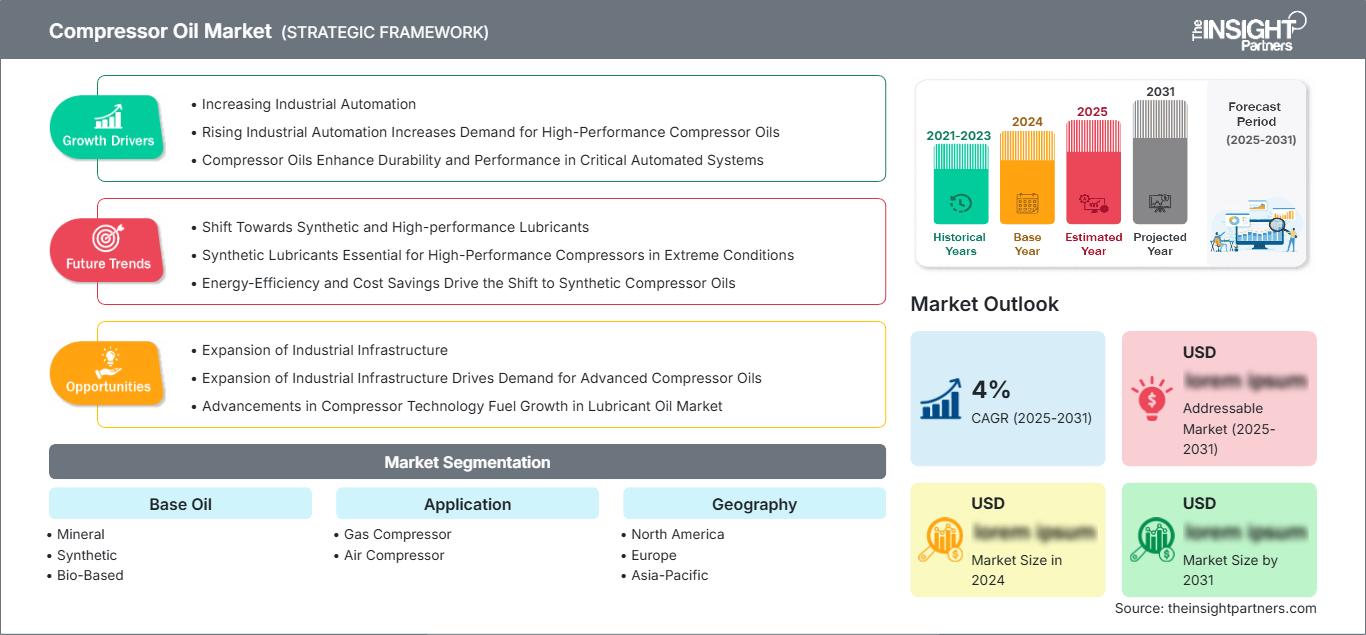
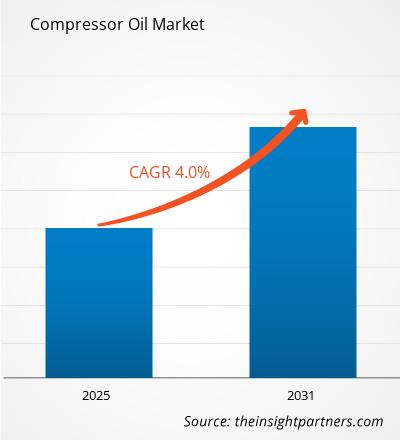
The global Compressor Oil market was valued at US$ 10.68 billion in 2025 and is expected to reach US$ 15.49 billion by 2034; it is estimated to record a CAGR of 4.22% during 2026-2034.
Compressor Oil Market Assessment and Insights
- North America: North America is estimated to account for 28–32% of the Compressor Oil Market share in 2025 and expand at a 4.20–4.70% CAGR during 2026–2034, supported by mature industrial infrastructure and natural gas compression demand.
- US: The US represents 23–27% of the global market in 2025 and is expected to grow at a 4.30–4.80% CAGR, driven by natural gas, manufacturing, and petrochemical applications.
- Europe: Europe is estimated to hold 21–25% of 2025 demand and grow at 3.80–4.40% through 2034, with Germany, the UK, France, Italy, and Spain supporting industrial compressor lubricant consumption.
- Asia Pacific: Asia Pacific is estimated at 29–33% of 2025 demand and is projected to expand at 5.20–5.80%, led by China, India, Japan, South Korea, and Australia amid industrial capacity expansion.
- Largest Segment: Positive displacement compressors represented a modelled 64–68% market share in 2025 and are expected to register 4.6–5.1% CAGR during 2026–2034, reflecting extensive deployment of rotary screw and reciprocating equipment.
- High Growth Segment: Synthetic oil represented a modelled 31–35% market share in 2025 and is expected to register 5.8–6.4% CAGR during 2026–2034, supported by extended lubricant life and demanding operating environments.
- Key companies analyzed in detail: BP p.l.c., Chevron Corporation, Exxon Mobil Corporation, FUCHS SE, Indian Oil Corporation Limited, Public Joint Stock Company LUKOIL, Petroliam Nasional Berhad, Shell plc, China Petroleum & Chemical Corporation, and TotalEnergies SE.
Source: The Insight Partners' analysis based on proprietary research, government publications, company annual reports, investor presentations, industry databases, and expert interviews.
There has been significant development of compressor oils from conventional mineral-based oils into high-performance oils which are capable of operating at high temperatures, small clearance, and extended maintenance periods. There has been improvement in refining process, additives, and formulation of lubricants, which have allowed better oxidation resistance and deposit control. There has been a close association between compressor oil formulation and compressors such as screw, reciprocating, vane, and gas compressors.
Further growth will be seen in the Asia Pacific region, Middle East, and some selected emerging industrial nations. There will be investment in natural gas processing, manufacturing industries, chemicals, food processing industries, metals, and infrastructure development, which will promote usage of compressors. Environmental issues will lead to development of more environmentally friendly compressor oils. High-performance oils will become popular in cases where cost of purchase can be compensated by the extended periods of service interval and reduced fluid consumption.
Compressor Oil Market Report Scope
| Report Attribute | Details |
|---|---|
| Market size in 2025 | US$ 10.68 Billion |
| Market Size by 2034 | US$ 15.49 Billion |
| Global CAGR (2026 - 2034) | 4.22% |
| Historical Data | 2021-2024 |
| Forecast period | 2026-2034 |
Compressor Oil Market Analysis
The level of demand depends upon the installed base, operating hours, compression method used, and maintenance of the industrial machinery. Value chain consists of the base stock suppliers, additive suppliers, lubricants manufacturers, compressor OEMs, lubricants distributors, maintenance contractors, and end-users. Base-stock rationalization could influence supply conditions due to the availability of Group I, Group II, Group III, PAO, ester, and various other speciality base stocks.
Compressor applications represent a vast pool of demand comprising manufacturing industries, food & beverages, pharmaceuticals, electronics, mining, and general industrial facilities. In addition to air compressors, the demand pool includes gas compressors which represent a specific stream of demand because of the natural gas industry and petrochemical applications. Selection of lubricants depends on the type of compressor, discharge temperature, composition of gases, pressures, lubrication system, and OEM specifications.
According to the Compressor Oil Market report, competition is made up of integrated energy companies, lubricants manufacturers, and national oil companies having extensive distribution channels. Shell plc, Chevron Corporation, Exxon Mobil Corporation, FUCHS SE, and TotalEnergies SE engage in competition through their wide range of industry offerings and compressor applications that are application-oriented. China Petroleum & Chemical Corporation, Indian Oil Corporation Limited, Petroliam Nasional Berhad, Public Joint Stock Company LUKOIL, and BP p.l.c. enhance regional logistics and access to integrated base oils and lubricant ecosystems.
The Compressor Oil Market forecast indicates that investments are increasingly being made in local blending and production of specialty base oils, formulation, technical services, and logistics capabilities. Exxon Mobil Corporation has invested in its high-end lubricant and base oil products, while other regional competitors continue investing in their facilities for manufacturing and distribution. The positioning among the competitors is becoming based increasingly on overall economic performance rather than just the price of the lubricant itself.
● REPORT CUSTOMIZATION
Tailor This Report To Align With Your Specific Business Requirements
This report can be customized to align precisely with your business objectives, scope, and target markets. Customization options include tailored segmentation, geography, competitive analysis, and strategic insights to support informed decision-making.
Customize This Report →WHAT YOU CAN ADJUST
- ● Segmentations
- ● Geography
- ● Competitive Analysis
- ● Language Preferences
Compressor Oil Market: Strategic Insights
Regional Insights
North America Compressor Oil Market
The region is projected to account for 28–32% of global demand in 2025 and grow at a CAGR of 4.20–4.70% until 2034. The US is the major regional consumer due to the presence of natural gas operations, pipeline compressors, petrochemical plants, manufacturing, and extensive compressor fleets. Canada will be contributing via energy, mining, and industrial operations, whereas Mexico will contribute via manufacturing and energy installations.
This regional market features advanced lubricant selection, well-established OEM partnerships, and high importance of uptime of equipment. Gas compressors have formulations which can withstand the properties of hydrocarbons, high pressure, and gas composition, whereas air compressors are used in manufacturing and processing plants. Synthetic and premium mineral formulations gain an advantage due to long drain periods requirement and oxidation resistance.
U.S. Compressor Oil Market
It is estimated that the US will have a market share of 80–84% of North American demand in 2025 with a CAGR of 4.30-4.80% until 2034, owing to the high number of installations in natural gas infrastructures, petrochemical processes, industrial manufacturing, and compressor maintenance services. Lubricant vendors are present both commercially and technically in those applications.
Gas compression is strategically essential because compressors assist in the process of production, gathering, processing, storage, and transportation. Air compressors are used in factories, refineries, chemical plants, food processing plants, and other industries. Total cost of ownership includes criteria such as drain interval, lubricant usage, labor costs, energy efficiency, and equipment protection. Customers now consider total cost of ownership when selecting their lubricants. Synthetic lubricants are preferred for applications that require severe duty.
Europe Compressor Oil Market
Europe is estimated to account for 21–25% of global demand in 2025 and expand at a 3.80–4.40% CAGR through 2034. Germany is the leading country, followed by the UK, France, Italy, and Spain. Industrial modernization, energy efficiency requirements, chemicals, manufacturing, and process industries sustain compressor lubricant demand.
The UK maintains demand across energy infrastructure, manufacturing, and process applications, while Germany benefits from its large industrial machinery and manufacturing base. France, Italy, and Spain contribute through automotive, chemicals, food processing, machinery, and general manufacturing. European buyers increasingly emphasize extended lubricant life, lower maintenance requirements, and environmental characteristics. This favors advanced synthetic and bio-based formulations in technically demanding installations, although mineral oils remain important in cost-sensitive applications.
APAC Compressor Oil Market
APAC is expected to account for 29-33% of global demand by 2025 and record a CAGR of 5.20-5.80% till 2034. China is the leading country followed by Japan, South Korea, India, and Australia. Expansion in manufacturing, chemicals, metals, energy infrastructure, and automation facilitate usage of compressors.
Demand from China and India accounts for significant growth driven by increased industrial production and infrastructure. Demand in Japan and South Korea is driven by advanced applications, while Australia derives from mining and energy operations. Policies in industries, manufacturing investments, energy infrastructure projects, and localized production capabilities help in driving lubricant consumption in the region. Advanced synthetic lubricants are becoming important in situations of higher operating temperatures and low maintenance costs.
Middle East & Africa Compressor Oil Market
Middle East and Africa Compressor Oil Market is concentrated in Saudi Arabia, the UAE, South Africa, and the Rest of MEA. Saudi Arabia is the leading market, supported by oil and gas processing, petrochemicals, gas compression, and industrial infrastructure. Regional demand is projected to expand at a 4.50–5.10% CAGR during 2026–2034.
The UAE benefits from energy, logistics, manufacturing, and infrastructure investment, while South Africa contributes through mining and industrial operations. Compressor lubricant demand is strongly connected with energy-intensive facilities and natural gas systems. High ambient temperatures and demanding operating conditions increase the importance of oxidation stability, viscosity control, and deposit management, creating opportunities for higher-performance formulations.
Segmentation Analysis
Compressor Type
Compressor Type is projected to register a modelled 4.5–5.0% CAGR during 2026–2034. The Compressor Oil Market scope covers equipment ranging from centrifugal process compressors to rotary screw and reciprocating positive displacement machines. Lubricant selection varies considerably with compressor design, operating pressure, temperature, gas composition, lubricant circulation, and OEM specifications.
- Dynamic Compressor: Centrifugal and axial systems are important within high-volume gas processing, petrochemical, pipeline, power, and industrial applications where bearing protection, oxidation resistance, cleanliness, and stable viscosity are critical.
- Positive Displacement Compressor: Rotary screw, vane, and reciprocating equipment create substantial lubricant demand across manufacturing, construction, mining, and process industries because lubricant performs cooling, sealing, wear-control, and deposit-management functions.
Application
Application is projected to expand at a modelled 4.6–5.1% CAGR during 2026–2034. Air compressors generate recurring lubricant consumption across industrial facilities, while gas compressors require specialized fluids designed around the compressed gas, operating pressure, temperature, sealing requirements, and materials compatibility.
- Gas Compressor: Gas compressor lubricants support hydrocarbon processing, pipelines, industrial gases, petrochemicals, refrigeration-related systems, and energy infrastructure, requiring strong chemical stability and compatibility with process gases.
- Air Compressor: Air compressor oils constitute an established consumption base across factories, workshops, construction, mining, utilities, and processing plants where compressed air functions as a major industrial energy-transfer medium.
Base Oil
Base Oil is expected to register a modelled 5.0–5.5% CAGR during 2026–2034. Base-stock selection increasingly depends on drain interval, thermal severity, volatility, operating temperature, compressor design, and lifecycle economics. Synthetic formulations gain importance as operators seek greater oxidation resistance and longer service life.
- Synthetic Oil: PAO, PAG, ester, and other synthetic formulations target severe operating conditions, longer drain periods, high temperatures, low volatility, deposit control, and broad operating-temperature capability.
- Mineral Oil: Mineral formulations retain significant demand in standard-duty compressors where temperatures, operating hours, OEM requirements, and maintenance schedules allow conventional lubricants to deliver economical performance.
- Semi-Synthetic Oil: Semi-synthetic products provide an intermediate performance and cost proposition for users seeking improved oxidation stability and lubricant life without moving completely to premium synthetic formulations.
- Bio-Based Oil: Bio-based alternatives are gaining selective importance in environmentally sensitive operations where biodegradability, renewable feedstock content, spill risk, and corporate sustainability objectives influence procurement.
End Use Industry
End Use Industry is projected to register a modelled 4.5–5.0% CAGR during 2026–2034. Compressor lubricant consumption remains diversified because compressed air and process-gas compression are foundational utilities across industrial production and infrastructure. Operating hours, compressor population, maintenance frequency, and severity determine consumption intensity.
- General Manufacturing: Manufacturing represents a major consumption base as pneumatic systems, automation, material handling, assembly equipment, machining operations, packaging machinery, and process controls depend extensively on compressed air.
- Construction: Mobile and stationary compressors support drilling, pneumatic tools, concrete operations, blasting, and site utilities, generating lubricant demand under dusty, variable-temperature, and high-load operating conditions.
- Oil and Gas: Upstream production, gathering, gas processing, pipelines, LNG-related infrastructure, refining, and supporting utilities require specialized compressor lubricants capable of handling severe process conditions.
- Mining: Mines use compressed air across drilling, ventilation-related equipment, pneumatic systems, mineral processing, workshops, and maintenance operations, creating demand for robust lubricants resistant to heat and contamination.
- Chemical and Petrochemical: Continuous-process facilities employ compressors for gases, process streams, utilities, and refrigeration, requiring high reliability, oxidation control, materials compatibility, and appropriately selected synthetic or mineral fluids.
- Power Generation: Compressor oils support plant compressed-air systems, instrumentation, gas turbines, auxiliary equipment, and maintenance operations where reliability and long operating intervals remain important procurement considerations.
Opportunity Snapshot
| Application | Revenue Contribution (High/Medium/Low) | Trend Tag | Adoption Stage |
| Gas Compressor | High | Gas Infrastructure | Mature |
| Air Compressor | High | Factory Automation | Mature |
Compressor Oil Market Growth Drivers and Impact Analysis
Expansion of Natural Gas Compression Infrastructure
Compression of natural gas requires taking place in multiple steps including gathering, processing, transmission, storage, and delivery of the fuel. This means that expansion of gas systems creates a consistent need for lubricants which can be used reliably during constant use and in the presence of difficult gas composition. Lubricants' choice becomes increasingly judged by compressor companies based on their impact on equipment reliability, carryover of oil, deposits and the need for service intervals. This means that there is an increasing market share to be obtained not only through basic commodity products but also through technically differentiated ones. The existing market of North America is well-established while the markets of Middle East and Asia represent growth opportunities. Companies that provide lubricants for compressors along with application engineering, specific formulations for gases, condition monitoring and quick deliveries can gain market share in the replacement business.
Industrial Automation and Higher Equipment Utilization
The Compressor Oil Market trends show that manufacturing facilities increasingly depend on compressed air systems for automation, pneumatic equipment, instrumentation, packaging, and production processes. As industrial plants raise utilization rates and reduce tolerance for downtime, compressor maintenance becomes more closely connected to production continuity. Higher equipment utilization can increase lubricant stress through longer operating periods, elevated temperatures, and reduced maintenance windows. These conditions encourage demand for formulations with stronger oxidation stability, deposit control, and extended service capabilities. The impact is particularly relevant in electronics, automotive, food processing, pharmaceuticals, and general manufacturing. Suppliers can benefit by combining lubricants with technical monitoring, oil analysis, maintenance planning, and equipment-specific recommendations. Such service integration can increase customer retention and shift purchasing decisions toward performance-based evaluations rather than unit-price comparisons.
Base-Stock Optimization and Supply Chain Resilience
Changes in global refining economics are reshaping the availability and economics of lubricant base stocks. Rationalization of lower-value refinery streams, increasing demand for higher-quality base oils, and regional differences in refining capacity can influence lubricant formulation costs and supply security. Compressor oil manufacturers are therefore strengthening sourcing strategies, expanding local blending capabilities, and developing formulations that can use multiple qualified base-stock pathways without compromising performance. This creates opportunities for integrated producers with access to base oils and additives, while independent formulators may focus on specialty applications and technical differentiation. Greater supply resilience also becomes important for multinational customers operating standardized equipment across several countries. Suppliers able to provide consistent specifications, dependable availability, and technical equivalence across markets can improve procurement efficiency and strengthen long-term industrial relationships.
Compressor Oil Market Future Trends
Digital Condition Monitoring and Predictive Lubrication
Digital monitoring is expected to become more influential in lubricant management as industrial operators connect compressor systems with sensors, maintenance platforms, and asset-management software. Instead of relying solely on fixed replacement intervals, operators can increasingly use temperature, pressure, vibration, operating hours, and oil-condition information to determine maintenance requirements. This trend can support more precise lubricant utilization and reduce unnecessary oil changes. Suppliers are likely to respond by integrating oil analysis, remote monitoring, and technical advisory services into lubricant contracts. Data-driven maintenance can also improve product differentiation because lubricant performance becomes measurable through equipment indicators and maintenance outcomes. Over time, compressor oil procurement may therefore shift toward service-oriented models in which suppliers are evaluated on equipment availability, lubricant life, maintenance efficiency, and measurable operational performance.
Low-Impact Formulations and Circular Base Oils
Sustainability considerations are expected to influence compressor lubricant development beyond conventional biodegradability claims. Formulators are likely to explore renewable feedstocks, biodegradable esters, re-refined base oils, and formulations designed to reduce lubricant consumption through longer service intervals. Adoption will vary by application because compressor reliability and OEM compatibility remain essential requirements. Industrial customers with environmental procurement targets may adopt lower-impact products earlier, particularly where leakage or accidental discharge creates environmental exposure. Circular base oils could gain additional relevance as lubricant manufacturers seek to reduce dependence on virgin feedstocks. Product development will therefore increasingly balance environmental attributes with oxidation stability, viscosity retention, deposit control, equipment compatibility, and total operating cost.
Compressor Oil Market Opportunities
Premium Lubricants for High-Temperature Compressor Operations
High-temperature environments create an opportunity for suppliers to expand premium compressor lubricant portfolios across refineries, petrochemical facilities, gas processing plants, mining operations, and heavy manufacturing sites. These environments place greater stress on lubricant oxidation stability and deposit control, increasing the value of formulations engineered for extended service. Suppliers can pursue this opportunity through synthetic base oils, advanced additive packages, application-specific viscosity grades, and technical support. Commercial strategies should focus on demonstrating measurable maintenance savings rather than relying solely on product specifications. Oil analysis programs can provide evidence of lubricant condition and support optimized drain intervals. Partnerships with compressor OEMs and maintenance contractors can further strengthen market access. The opportunity is particularly attractive where production interruptions carry substantial economic costs.
Localized Blending and Technical Service Networks
Localized production and technical service capabilities provide opportunities in fast-growing industrial markets where imported lubricant supply can create lead-time, inventory, or cost constraints. Establishing regional blending, packaging, warehousing, and laboratory capabilities can improve responsiveness while allowing suppliers to adapt formulations and service models to local equipment requirements. India, China, Southeast Asia, the Middle East, and selected African markets offer potential because industrial compressor fleets are expanding alongside manufacturing, energy, and infrastructure investment. Companies can differentiate through application engineering, oil-condition analysis, training, and maintenance support rather than competing exclusively on price. Local sourcing can also improve supply resilience and enable closer relationships with distributors and equipment manufacturers. A combined product-and-service approach can increase customer retention and support higher-value lubricant adoption.
Recent Developments
- March 2026: Hitachi Industrial Equipment Systems Co., Ltd. (hereinafter HIES, part of Hitachi, Ltd. Connective Industries (CI) Sector) launched “GREEN SCREW OIL”, a plant-based lubricant for oil-flooded screw air compressors. Because the plant-derived raw materials absorb CO₂ during growth, the new lubricant cuts manufacturing stage CO₂ emissions by approximately 90%. Even including emissions at disposal, its CO2 emissions across the entire lifecycle can be reduced by approximately 40%(estimated value) compared to conventional synthetic oils.
- May 2026: Ingersoll Rand and Garrett Motion entered a multiyear strategic partnership to advance next generation oil‑free compressor technology for industrial air compression systems across key verticals, including food and beverage and life sciences. Collaboration with Garrett Motion on advanced oil‑free centrifugal compressor modules strengthens Ingersoll Rand’s system‑level compression leadership and capabilities, supporting the development of differentiated solutions that improve efficiency, reliability, and sustainability for customers.
Frequently Asked Questions

- Comprehensive Market Sizing and Forecast Analysis
- Detailed Segmentation Analysis
- In-Depth Market Dynamics Assessment
- Regional and Country-Level Insights
- Competitive Landscape and Company Benchmarking
- Strategic Business Intelligence
Recent Reports
Testimonials

The Insight Partners provided valuable market intelligence that supported our global go-to-market strategy. Their team was professional, responsive, and attentive to our feedback, providing thoughtful analysis and helpful methodological clarifications throughout the project.
Junmo Kim Chief Financial Officer (CFO), Enertech Co., Ltd.
The Insight Partners' SCADA System Market report is comprehensive, with valuable insights on current trends and future forecasts. The team was highly professional, responsive, and supportive throughout. We are very satisfied and highly recommend their services.
RAN KEDEM Partner, Reali Technologies LTDs
I requested a report on a very specific software market and the team produced the report in a few days. The information was very relevant and well presented. I then requested some changes and additions to the report. The team was again very responsive and I got the final report in less than a week.
JEAN-HERVE JENN Chairman, Future Analytica
We worked with The Insight Partners for an important market study and forecast. They gave us clear insights into opportunities and risks, which helped shape our plans. Their research was easy to use and based on solid data. It helped us make smart, confident decisions. We highly recommend them.
PIYUSH NAGPAL Sr. Vice President, High Beam Global
The Insight Partners delivered insightful, well-structured market research with strong domain expertise. Their team was professional and responsive throughout. The user-friendly website made accessing industry reports seamless. We highly recommend them for reliable, high-quality research services
YUKIHIKO ADACHI CEO, Deep Blue, LLC.
This is the first time I have purchased a market report from The Insight Partners.While I was unsure at first, I visited their web site and felt more comfortable to take the risk and purchase a market report.I am completely satisfied with the quality of the report and customer service. I had several questions and comments with the initial report, but after a couple of dialogs over email with their analyst I believe I have a report that I can use as input to our strategic planning process.Thank you so much for taking the extra time and making this a positive experience.I will definitely recommend your service to others and you will be my first call when we need further market data.
JOHN SUZUKI President and Chief Executive Officer, Board Director, BK Technologies
I wish to appreciate your support and the professionalism you displayed in the course of attending to my request for information regarding to infectious disease IVD market in Nigeria. I appreciate your patience, your guidance, and the fact that you were willing to offer a discount, which eventually made it possible for us to close a deal. I look forward to engaging The Insight Partners in the future, all thanks to the impression you have created in me as a result of this first encounter.
DR CHIJIOKE ONYIA MANAGING DIRECTOR, PineCrest Healthcare Ltd.Reason to Buy
- Informed Decision-Making
- Understanding Market Dynamics
- Competitive Analysis
- Identifying Emerging Markets
- Customer Insights
- Market Forecasts
- Risk Mitigation
- Boosting Operational Efficiency
- Strategic Planning
- Investment Justification
- Tracking Industry Innovations
- Aligning with Regulatory Trends





 Get Free Sample for