
Concrete Polishing and Grinding Machines Market Size, Trends & Demand by 2034
Coverage: By Grinding Machine Type (Single and Double Headed Grinders, Three and Four Headed Grinders); Polishing Machine Type (Hand Held Machines, Walk Behind Machines, Ride-on Polishing Machines); Application (Residential, Non-residential) , and Geography (North America, Europe, Asia Pacific, and South and Central America)
- Status : Data Released
- Report Code : TIPRE00021532
- Category : Manufacturing and Construction
- No. of Pages : 150
- Available Report Formats :


- Last update date : November 05, 2026


2025 Market Size
US$ 1.62 Bn
Base year value
2034 Forecast
US$ 2.61 Bn
Projected by 2034
CAGR 2026-2034
5.44 %
Growth rate
Addressable Market
US$ 19.18 Bn
(2026-2034)
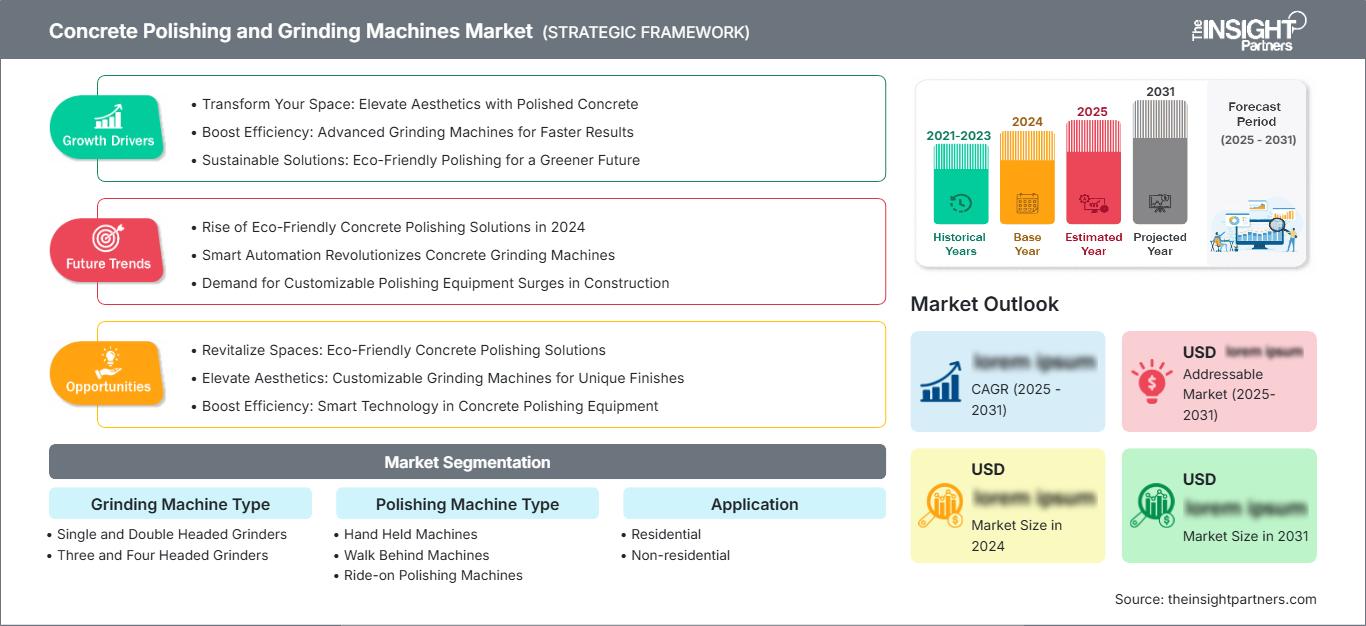
The Concrete Polishing and Grinding Machines Market is projected to expand from US$ 1.62 Billion in 2025 to US$ 2.61 Billion by 2034, registering a CAGR of 5.44% during 2026–2034. The market covers dedicated equipment used to prepare, level, hone, and polish concrete surfaces across residential and non-residential settings, including single and double headed grinders, three and four headed grinders, handheld polishers, walk behind machines, and ride-on polishing machines.
North America is expected to advance at ~5% CAGR through 2034 as warehouse refurbishment, retail renovation, and institutional flooring programs create recurring surface-preparation demand. The Concrete Polishing and Grinding Machines Market size also benefits from contractor preference for durable exposed concrete floors and from stricter jobsite dust-control practices that encourage integrated grinders, extractors, and matched diamond tooling.
Concrete Polishing and Grinding Machines Market Assessment and Insights
Regional Outlook
- North America: ~34% of the global Concrete Polishing and Grinding Machines Market share in 2025 | ~5% CAGR through 2034. Market position: The region leads through a large installed base of commercial floors, mature specialty contractors, rental access, and strong enforcement of silica-dust controls.
- US: ~81% of North American market revenue in 2025 | ~5% CAGR through 2034. Market position: The US leads North America as logistics facilities, retail conversions, schools, and manufacturing plants sustain demand for high-productivity planetary systems and dust extraction.
- Europe: ~27% of the global market in 2025 | ~5% CAGR through 2034. Market position: Mature refurbishment demand and worker-safety requirements support replacement purchases, with Germany leading in Europe and the UK, France, Italy, and Spain contributing specialized contractor demand.
- Asia Pacific: ~31% of the global market in 2025 | ~7% CAGR through 2034. Market position: Asia Pacific is the fastest-growing region as industrial buildings, malls, transport facilities, and contractor mechanization expand, led by China within Asia Pacific.
Segment Outlook
- Application: ~68% Share in 2025 | ~6% CAGR through 2034. Market position: Non-residential work drives the application segment through larger floor plates, repeat contracts, specification-led finishes, and stronger economics for multi-head and ride-on equipment.
- Polishing Machine Type: ~39% Share in 2025 | ~7% CAGR through 2034. Market position: Demand rises as contractors add walk-behind and ride-on polishers to deliver consistent gloss, reduce labor intensity, and service large commercial floors.
Competitive Coverage
Achilli S.r.l., Blastrac, Bosch Limited, Diamatic USA, Fujian Xingyi Polishing Machine Co., Ltd., Husqvarna AB, Levetec, SASE Company, LLC, Scanmaskin Sverige AB, Xtreme Polishing Systems
Methodology
The Insight Partners follows Data Collection & Secondary Research, Primary Research, Data Analysis, and Data Triangulation & Final Review to validate market estimates and insights.
Source: The Insight Partners' analysis based on proprietary research, government publications, company annual reports, investor presentations, industry databases, and expert interviews.
Machine designs have evolved from simple rotating grinders to planetary drives, variable speed, remote control and dust management packages. Standardization of diamond tools and quick change plates is affecting productivity as much as motor power since contractors will go through the stages of coating stripping, grinding, honing and polishing all in one job. Manufacturers have started selling families of grinders, extractors, tooling, chemicals and training instead of just machines. Manufacturing is still geographically diverse with European and North American experts competing with increasingly advanced Asian manufacturers on width, durability, controls and life cycle costs.
Investment will increasingly target construction and refurbishment of industrial buildings in Asia Pacific, megaprojects in the Gulf, and renovations in mature markets through 2034. Silica exposure limitations, indoor air quality regulations, and customers' desire for low maintenance floors will be driving closed dust capturing processes. Mechanical floor grinding will become commonplace in developing countries where labor costs increase and specifications become more exacting, and distributors who provide demonstrations, tool selection, financing and field service support will convert initial sales to consumable sales.
Concrete Polishing and Grinding Machines Market Report Scope
| Report Attribute | Details |
|---|---|
| Market size in 2025 | US$ 1.62 Billion |
| Market Size by 2034 | US$ 2.61 Billion |
| Global CAGR (2026 - 2034) | 5.44% |
| Historical Data | 2021-2024 |
| Forecast period | 2026-2034 |
Concrete Polishing and Grinding Machines Market Analysis
Drivers for Concrete Polishing and Grinding Machines Market include warehouses, factories, data centers, retailers, hospitals, educational institutions, and residential buildings that demand floor surfaces which are flat, durable, and homogeneous. The reason owners prefer polished concrete is the possibility to use the slab not only as a substrate but also as the finished product without any coverings. Contractors react to the requirements by balancing the weight of machinery, heads, engine power, tool bonding, and dust collection according to the slab density and aggregate exposure needed.
The supply chain includes motors, drive units, manufacturing of machines' frames, control systems, diamond tools production companies, chemical producers, machines assembly companies, distributors, rental firms, and specialized flooring contractors. The dependability of supply includes replacement tools, bearings, belts, electronic parts, and technical support in the region. The constant diamond consumption can provide better business model than selling of machines once.
Concrete Polishing & Grinding Machines Market analysis suggests a fragmented market structure characterized by differences in systems and brands on a global basis. Husqvarna AB has incorporated the Blastrac product line in grinders, extraction, and diamond tools; Bosch Limited is more competitive with its hand-held machines; SASE Company, LLC & Xtreme Polishing Systems specialize in workflow solutions for contractors; and Fujian Xingyi Polishing Machine Co., Ltd. is competitive in all kinds of machines.
Other competitors Achilli S.r.l., Diamatic USA, Levetec, and Scanmaskin Sverige AB are holding their ground with experience, channels, and rugged machinery. The capital is flowing towards self-operative or remote operated machines, sealing, telemetry, ergonomic handling, and tool changes. Winning the competition involves demonstrating productivity per labor hour without compromising serviceability on various floor surfaces.
● REPORT CUSTOMIZATION
Tailor This Report To Align With Your Specific Business Requirements
This report can be customized to align precisely with your business objectives, scope, and target markets. Customization options include tailored segmentation, geography, competitive analysis, and strategic insights to support informed decision-making.
Customize This Report →WHAT YOU CAN ADJUST
- ● Segmentations
- ● Geography
- ● Competitive Analysis
- ● Language Preferences
Concrete Polishing and Grinding Machines Market: Strategic Insights
Regional Insights
North America Concrete Polishing and Grinding Machines Market
North America represents ~34% of global revenue in 2025 and is forecast to expand at ~5% CAGR through 2034. Market share for concrete polishing and grinding machines relies on established professional floor contractors, extensive leasing of machines, and abundant supply of warehouses, factories, schools, hospitals, and retail buildings which require surface resurfacing and coating stripping. Specifications for polished concrete enjoy advantages like durability, cleanliness, and lesser reliance on floor replacements.
Regulation of silica dust encourages the demand for paired grinders and efficient extractors over individual machines. Larger planetary grinders take care of open floor plates, while smaller and handheld machines work well on edges, stairways, and renovation issues. Demonstration by dealers, information about tools, and fast availability of machine parts greatly affect buying decisions of floor contractors as floor hardness and coatings may vary from job to job.
U.S. Concrete Polishing and Grinding Machines Market
The US contributes ~81% of North American Concrete Polishing and Grinding Machines Market in 2025 and is projected to grow at ~5% CAGR through 2034. Maintenance of logistics floor, manufacturing investments, retail reuse, education remodeling, and decorative residential concrete help to keep up an extensive pipeline of projects. High cost of labor makes three and four head grinders, walk behind polishes and select ride on models which can clean bigger area in less passes, economically attractive options.
Husqvarna AB, Blastrac, SASE Company, LLC, Diamatic USA, Levetec, and Xtreme Polishing Systems have established presence through distributors or contractors in the country. Increasingly purchases are made keeping in mind compatibility with extractors, availability of power supply, weight for transportation, remote control capability and usage of tools. Hand held machines are important for edge works, details and residential projects.
Europe Concrete Polishing and Grinding Machines Market
Europe holds ~27% of global Concrete Polishing and Grinding Machines Market in 2025 and is expected to grow at ~5% CAGR through 2034. Germany is the leader in Europe backed by industrial renovations, logistics, trades, and strict worker protection procedures. The UK mixes up its warehouse renovations with office and retail conversions, while France incorporates public building renovations and commercial flooring applications.
Italy helps via stone processing skills, smaller specialist firms, and manufacturers like Achilli S.r.l. Spain gains through hospitality renovations, retail spaces, and urban renovations. In all these nations, mature installed equipment focuses on replacements, reduced vibrations, dust containment, economics of tool life, and transportable machines.
Scanmaskin Sverige AB and Husqvarna AB help in bolstering the regional engineering prowess, while distributors help in international brands. More and more contractors consider system evaluations of machines including grinders, extractors, diamond tools, densifiers, and guards. Electrical machines continue to be the norm in indoor projects despite power availability considerations.
APAC Concrete Polishing and Grinding Machines Market
Asia Pacific accounts for ~31% of global Concrete Polishing and Grinding Machines Market in 2025 and is the fastest-growing region at ~7% CAGR through 2034. China is the leading country in Asia Pacific through manufacturing scale, industrial construction, and a deep supplier base led in part by Fujian Xingyi Polishing Machine Co., Ltd. India gains from warehouses, factories, malls, and gradual contractor mechanization.
Japan and South Korea emphasize precision, reliability, and renovation, while Australia supports commercial, mining-service, and retail flooring. Infrastructure programs and industrial localization expand addressable floor area, but training and after-sales support remain decisive. Suppliers that pair machines with application guidance can reduce rework and accelerate adoption.
Middle East & Africa Concrete Polishing and Grinding Machines Market
Middle East & Africa is expected to grow at ~6% CAGR through 2034. Saudi Arabia is the leading country in the Middle East & Africa where large commercial, tourism, logistics, and industrial projects create sizable new floor areas. The UAE adds premium retail, hospitality, and warehouse applications, while South Africa anchors regional demand through industrial maintenance and commercial renovation.
Rest of MEA remains distributor-led and project-sensitive. Energy, logistics, and infrastructure investment expands non-residential surfaces, but heat, dust, power quality, and parts availability affect equipment choice. Robust machines, efficient extraction, and stocked consumables are therefore more important than broad model ranges alone.
Segmentation Analysis
Grinding Machine Type
Grinding Machine Type is projected to expand at ~6% CAGR during 2026–2034. The segment addresses coating removal, leveling, surface opening, aggregate exposure, and preparation before polishing or overlay installation. Concrete Polishing and Grinding Machines Market scope within this category ranges from compact single-head units to high-output planetary platforms. Adoption depends on floor area, removal depth, electrical supply, transport access, and the contractor’s need for consistent scratch patterns.
- Single and Double Headed Grinders: These machines serve edge work, small rooms, residential renovation, and localized coating removal. Portability and lower acquisition cost sustain demand among smaller contractors, rental users, and crews requiring flexible access.
- Three and Four Headed Grinders: Multi-head planetary systems lead larger commercial workflows by distributing pressure, improving flatness, and supporting progressive tooling sequences. Their strategic value rises where labor productivity, finish consistency, and large-area coverage determine contract economics.
Polishing Machine Type
Polishing Machine Type segment in the Concrete Polishing and Grinding Machines Market is forecast to grow at ~7% CAGR during 2026–2034. The segment benefits as exposed concrete becomes a specified finish in logistics, retail, institutional, and selected residential spaces. Contractors compare maneuverability, head pressure, rotational control, water delivery, dust integration, and gloss consistency. Walk-behind machines provide the broadest balance of output and transportability, while ride-on systems address very large floor plates.
- Hand Held Machines: Hand held polishers remain essential for edges, stairs, columns, countertops, repairs, and confined zones. Their strategic role is complementary, enabling crews to finish areas that larger walk-behind or ride-on equipment cannot reach.
- Walk Behind Machines: Walk-behind polishers form the core professional category because they combine controlled pressure, repeatable tooling paths, and manageable transport. Demand spans medium and large floors where contractors require consistent finish quality without ride-on capital intensity.
- Ride-on Polishing Machines: Ride-on platforms target warehouses, factories, airports, and other expansive facilities. They reduce walking fatigue and improve coverage, but adoption depends on project scale, transport logistics, utilization rates, and a sufficient pipeline of large-area work.
Application
Application is projected to expand at ~6% CAGR during 2026–2034 and represents the largest main segment at ~68% share in 2025. Non-residential demand is the principal revenue pool because larger, specification-led floors justify high-capacity equipment and multi-stage polishing systems. Residential adoption remains valuable for garages, basements, patios, and decorative interiors, especially where contractors can deploy portable machines and compact dust extraction.
- Residential: Residential demand centers on garages, basements, kitchens, patios, and renovation projects. Buyers prioritize portability, single-phase power, dust control, and decorative finish flexibility, creating opportunities for compact grinders and hand held polishers.
- Non-residential: Non-residential projects dominate machine utilization across warehouses, factories, retail, healthcare, education, and transport facilities. Large floor areas, repeat maintenance, and formal surface specifications support multi-head grinders, walk-behind polishers, and ride-on systems.
Opportunity Snapshot
| Application | Revenue Contribution | Trend Tag | Adoption Stage |
| Residential | Medium | Decorative Floors | Scaling |
| Non-residential | High | Warehouse Renewal | Mature |
Concrete Polishing and Grinding Machines Market Growth Drivers and Impact Analysis
Expansion of Durable Exposed-Concrete Flooring
The use of concrete slabs in warehouses, manufacturing plants, retail outlets, and institutional facilities is becoming more common as they choose concrete slab as the final finishing surface rather than having replaceable flooring. More money is being spent on slab correction, grinding, densification, and successive polishing. The effect of this change in machine demand is immediate because bigger floor areas make it possible to use multi-head grinders and walk behind machines, while maintenance work done several times creates further demands for smaller machines and tooling. The owners like the idea of abrasion resistance, cleanability, and the fact that worn-out areas of the floor can be refurbished without replacing the whole floor structure.
Worker-Safety and Dust-Control Requirements
Concrete grinding can release respirable crystalline silica, making engineering controls central to professional workflows. Contractors increasingly procure grinders together with shrouds, hoses, high-efficiency dust extractors, separators, and suitable filters. This raises the value of complete systems and favors suppliers that test airflow compatibility across machines and extraction units. The driver affects replacement as well as first-time demand because older equipment may lack effective sealing or convenient connections. Better capture also improves visibility, reduces cleanup time, and protects adjacent operations during indoor renovation. Manufacturers therefore compete on dust-path design, sealed components, filter monitoring, and tool changes that limit exposure, not only on grinding output.
Labor Productivity and Contractor Mechanization
Floor preparation is labor-intensive when crews rely on small tools or repeated manual passes. Rising wage pressure and tighter project schedules improve the payback case for wider machines, powered drive, remote controls, and ride-on configurations. Mechanization allows one operator to supervise more productive equipment while other crew members handle edges, extraction, slurry, and tooling changes. The effect is strongest on large non-residential floors, where consistent pass speed and pressure reduce rework. Smaller contractors can participate through rental or financing, expanding the installed base. Suppliers that provide training and application setup are more likely to convert nominal machine capacity into measurable output.
Concrete Polishing and Grinding Machines Market Future Trends
Self-Operating and Data-Assisted Grinding
Concrete Polishing and Grinding Machines Market trends are moving toward self-operating navigation, remote control, and live display of power, speed, and machine status. These functions can separate operator presence from continuous machine steering, allowing crews to focus on edging, tooling, and quality checks. Through 2034, adoption should begin with large contractors and rental fleets that can keep premium equipment utilized. The commercial test will be repeatable productivity rather than novelty. Safety certification, obstacle detection, simple setup, and serviceable electronics will determine whether automated platforms move beyond flagship projects into routine warehouse and industrial work.
Integrated Machine, Tooling, and Extraction Platforms
Product ecosystems will become more tightly coordinated as vendors standardize quick-change tooling, match extraction airflow to grinder size, and organize abrasives by application and performance tier. Contractors gain when one supplier can troubleshoot the full process from removal through final polish. Connected parts catalogs and application selectors may reduce tool-choice errors across varying slab hardness. The trend does not eliminate independent tooling specialists, but it raises expectations for cross-compatibility and documented outcomes. Manufacturers with broad portfolios can use consumables and service to stabilize revenue, while specialists can compete through superior niche tooling, education, and faster field support.
Concrete Polishing and Grinding Machines Market Opportunities
Mechanization Packages for Emerging Contractor Markets
Concrete Polishing and Grinding Machines Market Forecasts support investment in distributor-led demonstration centers, operator certification, financing, and starter packages across India, Southeast Asia, the Gulf, and selected African markets. Selling a grinder alone can leave contractors exposed to incorrect tooling, weak extraction, or poor finish control. Bundled machines, dust collectors, diamonds, chemicals, and training reduce adoption risk. Suppliers should prioritize industrial and logistics corridors where project density can support local inventory and technicians. Used-equipment programs and rental partnerships can broaden access while creating a future pipeline for new machines and consumables.
Large-Floor Automation and Ride-on Services
Warehouses, manufacturing plants, airports, and distribution centers create an opportunity for high-output grinding and polishing delivered through ride-on, remote-controlled, or self-operating platforms. Equipment makers can target specialist contractors with utilization planning, fleet financing, and service contracts rather than conventional unit sales. Rental companies can build dedicated surface-preparation fleets for contractors facing occasional large projects. The business case improves when machines reduce labor hours, maintain consistent overlap, and generate project data for quality assurance. Partnerships among equipment suppliers, diamond-tool companies, and flooring contractors can accelerate reference projects and establish repeatable specifications.
Recent Developments
- April 2025: Husqvarna AB – Husqvarna Construction unveiled the Autogrinder 8 D, a self-operating planetary floor grinder based on the PG 8 DR platform. The system uses proprietary navigation and certified safety functions to grind and polish while freeing the operator for other finishing tasks, with European sales scheduled to begin at year-end.
- January 2025: SASE Company, LLC – SASE expanded contractor access to its updated 8K and 8KP grinder-polisher platforms, emphasizing improved operator visibility, LED lighting, adjustable grinding pressure, transport tie-downs, and compatibility with industrial dust extraction. The electric and propane configurations address high-output commercial floor preparation where power availability and ventilation requirements differ.
- November 2024: Scanmaskin Sverige AB – Scanmaskin advanced its professional floor-grinding offer around the Scanmaskin 750, a 750 mm, three-disc unit engineered with reinforced bearings, shafts, drive belts, and a steel frame. The platform targets concrete grinding, polishing, and heavy-coating removal across residential renovation and large commercial projects.
Frequently Asked Questions

- Comprehensive Market Sizing and Forecast Analysis
- Detailed Segmentation Analysis
- In-Depth Market Dynamics Assessment
- Regional and Country-Level Insights
- Competitive Landscape and Company Benchmarking
- Strategic Business Intelligence
Recent Reports
Testimonials

The Insight Partners provided valuable market intelligence that supported our global go-to-market strategy. Their team was professional, responsive, and attentive to our feedback, providing thoughtful analysis and helpful methodological clarifications throughout the project.
Junmo Kim Chief Financial Officer (CFO), Enertech Co., Ltd.
The Insight Partners' SCADA System Market report is comprehensive, with valuable insights on current trends and future forecasts. The team was highly professional, responsive, and supportive throughout. We are very satisfied and highly recommend their services.
RAN KEDEM Partner, Reali Technologies LTDs
I requested a report on a very specific software market and the team produced the report in a few days. The information was very relevant and well presented. I then requested some changes and additions to the report. The team was again very responsive and I got the final report in less than a week.
JEAN-HERVE JENN Chairman, Future Analytica
We worked with The Insight Partners for an important market study and forecast. They gave us clear insights into opportunities and risks, which helped shape our plans. Their research was easy to use and based on solid data. It helped us make smart, confident decisions. We highly recommend them.
PIYUSH NAGPAL Sr. Vice President, High Beam Global
The Insight Partners delivered insightful, well-structured market research with strong domain expertise. Their team was professional and responsive throughout. The user-friendly website made accessing industry reports seamless. We highly recommend them for reliable, high-quality research services
YUKIHIKO ADACHI CEO, Deep Blue, LLC.
This is the first time I have purchased a market report from The Insight Partners.While I was unsure at first, I visited their web site and felt more comfortable to take the risk and purchase a market report.I am completely satisfied with the quality of the report and customer service. I had several questions and comments with the initial report, but after a couple of dialogs over email with their analyst I believe I have a report that I can use as input to our strategic planning process.Thank you so much for taking the extra time and making this a positive experience.I will definitely recommend your service to others and you will be my first call when we need further market data.
JOHN SUZUKI President and Chief Executive Officer, Board Director, BK Technologies
I wish to appreciate your support and the professionalism you displayed in the course of attending to my request for information regarding to infectious disease IVD market in Nigeria. I appreciate your patience, your guidance, and the fact that you were willing to offer a discount, which eventually made it possible for us to close a deal. I look forward to engaging The Insight Partners in the future, all thanks to the impression you have created in me as a result of this first encounter.
DR CHIJIOKE ONYIA MANAGING DIRECTOR, PineCrest Healthcare Ltd.Reason to Buy
- Informed Decision-Making
- Understanding Market Dynamics
- Competitive Analysis
- Identifying Emerging Markets
- Customer Insights
- Market Forecasts
- Risk Mitigation
- Boosting Operational Efficiency
- Strategic Planning
- Investment Justification
- Tracking Industry Innovations
- Aligning with Regulatory Trends





 Get Free Sample for