
Conformal Coatings Market Share, Demand & Growth by 2034
Coverage: by Type (Acrylics, Epoxy, Urethane, Silicone, Others); End-Use Industry (Automotive and Transportation, Electronics, Aerospace and Defense, Others) , and Geography (North America, Europe, Asia Pacific, and South and Central America)
- Status : Data Released
- Report Code : TIPRE00006418
- Category : Chemicals and Materials
- No. of Pages : 150
- Available Report Formats :


- Last update date : August 28, 2026


2025 Market Size
US$ 13.54 Bn
Base year value
2034 Forecast
US$ 23.89 Bn
Projected by 2034
CAGR 2026-2034
6.51 %
Growth rate
Addressable Market
US$ 169.26 Bn
(2026-2034)
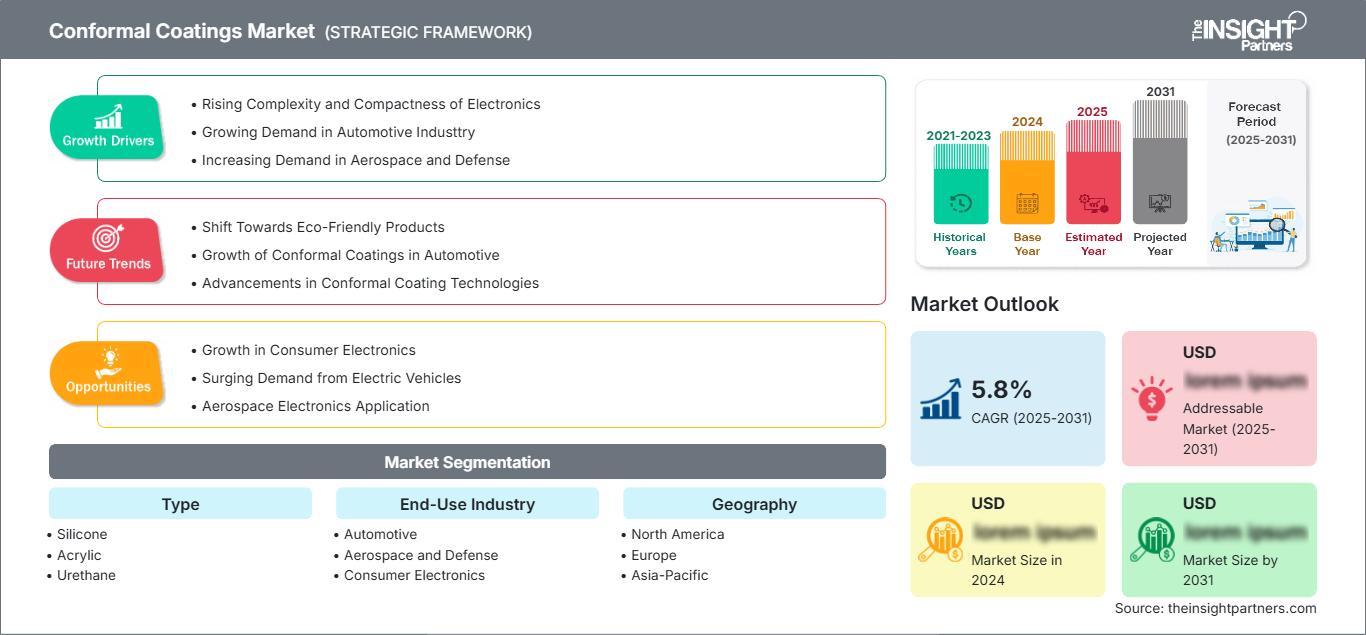
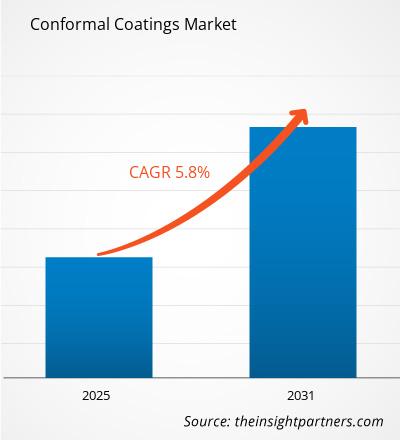
The Conformal Coatings Market was valued at US$ 13.54 Billion in 2025 and is projected to reach US$ 23.89 Billion by 2034, registering a CAGR of 6.51% during 2026–2034. Growth is supported by increasing electronic content across vehicles, industrial equipment, medical devices, and aerospace systems. Greater circuit density, exposure to moisture and chemicals, and reliability requirements are also encouraging manufacturers to use protective coating technologies across increasingly demanding operating environments.
North America remains an important production and consumption center, supported by aerospace electronics, automotive electrification, defense systems, and advanced industrial equipment. The Conformal Coatings Market size outlook indicates a CAGR of approximately 5.8–6.5% during 2026–2034. Structural demand is strengthened by high-reliability electronics requirements and continued investment in domestic semiconductor, electronics assembly, electric vehicle, and defense manufacturing capabilities.
Conformal Coatings Market Assessment and Insights
- North America: North America is expected to hold a 26–30% share in 2025 and expand at a 5.8–6.5% CAGR between 2026–2034, supported by aerospace, defense electronics, automotive electrification, and industrial automation.
- US: The US is estimated to represent 80–84% of North America's 2025 demand, with a 5.9–6.6% CAGR between 2026–2034, led by defense electronics, electric vehicles, and advanced manufacturing.
- Europe: Europe is estimated to account for 21–25% share in 2025 and grow at a 5.0–5.8% CAGR between 2026–2034, with Germany, the UK, France, Italy, and Spain supporting automotive and industrial electronics demand.
- Asia Pacific: Asia Pacific is projected to command a 34–38% share in 2025 and grow at a 7.2–8.1% CAGR between 2026–2034, led by China, Japan, South Korea, India, and expanding electronics manufacturing.
- Largest Segment: Silicone is estimated to hold a 31–35% market share in 2025, with a 6.1–6.8% CAGR during 2026–2034 because of thermal stability and flexible protection.
- High Growth Segment: Aerospace and Defense is estimated at a 13–17% share in 2025, with a 7.0–7.8% CAGR during 2026–2034 as mission-critical electronics require environmental protection.
- Key companies analyzed in detail: Chase Corporation, Dow Inc., Dymax Corporation, Electrolube, Europlasma NV, H.B. Fuller Company, Henkel Adhesives Technologies Private Limited, KISCO LTD., MG Chemicals, and Shin-Etsu Chemical Co., Ltd.
Source: The Insight Partners' analysis based on proprietary research, government publications, company annual reports, investor presentations, industry databases, and expert interviews.
The evolution of technology has moved the industry from solvent-borne traditional protection to fast curing, low-VOC, dual cure, and selective application technology. Competitions among silicone, acrylic, urethane, and epoxy formulations occur based on thermal resistance, flexibility, adhesion, reworkability, and processing time. Examples include Dow, which offers solvent-free silicone formulations cured by UV or moisture, and Dymax technologies with rapid light curing coupled with secondary heat or moisture curing for shadow areas.
The future growth of the company will be largely directed at the electronics manufacturing market in the Asia Pacific region, defense and automotive market in North America, and high-reliability market in Europe. The regulatory constraints on solvents and hazardous materials will create opportunities for those products that will minimize VOCs while maintaining the dielectric protection. The investment is also focused on dispensing, UV/LED curing, inspection equipment, and coatings for smaller printed circuit assemblies.
Conformal Coatings Market Report Scope
| Report Attribute | Details |
|---|---|
| Market size in 2025 | US$ 13.54 Billion |
| Market Size by 2034 | US$ 23.89 Billion |
| Global CAGR (2026 - 2034) | 6.51% |
| Historical Data | 2021-2024 |
| Forecast period | 2026-2034 |
Conformal Coatings Market Analysis
Conformal Coatings market demand is correlated with increased electronic content in cars, machinery, medical devices, and aerospace platforms. Environmental protection of the PCBs from moisture, salt mist, chemicals, dust, vibrations, and temperature changes is especially critical where the PCB failure leads to disproportional service costs. The supply chain includes raw materials and additives suppliers, formulation companies, coaters, cure ovens, assembly and original equipment manufacturing companies.
The industry is also becoming process-oriented. More and more customers assess not only the quality of the coating itself but its dispensing accuracy, cure cycle time, reworkability, and production speed. It provides advantages for suppliers that are able to offer coatings as well as applications expertise. The supply of materials remains differentiated by technology, where silicone technology requires special polymers and additives while acrylic and urethane technologies have competitive processes and eco-qualities. Localization of production in Asia benefits electronics companies.
Positioning in the Conformal Coatings Market Report has become dependent upon formulating capabilities and solving application-based reliability issues. Dow offers silicone based systems for moisture curing and UV curing or dual curing systems, whereas Dymax focuses on fast light curing coatings for electronic assemblies. H.B. Fuller offers several different curing chemistries for circuit board protection that include thermal, UV, UV & moisture and RTV type systems.
Strategic investments are being made in reducing solvent content, reduced processing time, increased reliability and compatibility with automation for selective coating. The launch of Loctite Stycast UV 7998 by Henkel in 2026 exemplifies the competitive focus on no solvent system, UL 94 V-0 performance, cost effective and general electronics applications. Suppliers with proven qualifications have an edge in aerospace and defense applications whereas quick product launches are critical for consumer electronics and automotive applications.
● REPORT CUSTOMIZATION
Tailor This Report To Align With Your Specific Business Requirements
This report can be customized to align precisely with your business objectives, scope, and target markets. Customization options include tailored segmentation, geography, competitive analysis, and strategic insights to support informed decision-making.
Customize This Report →WHAT YOU CAN ADJUST
- ● Segmentations
- ● Geography
- ● Competitive Analysis
- ● Language Preferences
Conformal Coatings Market: Strategic Insights
Regional Insights
North America Conformal Coatings Market
North America will account for 26–30% of the total demand in 2025 and will experience growth at a 5.8–6.5% CAGR from 2025 to 2034. The United States will lead the regional consumption due to the need of protecting the PCBs in aerospace, defense, automotive, medical electronics, and industrial automation industries. In addition, manufacturing activities in the electronics industry will contribute to material qualification and availability.
The contributions made by Canada will come from the aerospace, transportation equipment, telecommunications, and industrial electronics. Mexico's contribution will come from its increasing relevance in automotive and electronics assembly plants, where boards will be exposed to vibration, moisture, and thermal cycles. The criteria used in making purchase decisions will include UL and IPC compliance, uniformity of the applications, reworkability, and long-term reliability. Silicone and urethane coatings will continue to be relevant in harsh conditions.
U.S. Conformal Coatings Market
The US is forecasted to contribute 80-84% of North America's 2025 consumption and will experience a 5.9-6.6% CAGR between 2024-2034. The position of the US is backed by aerospace and defense, automotive electronics, medical devices, industrial controls, and telecommunications manufacturing. Leading manufacturers provide extensive technical and distribution coverage within the US market.
More applications are found in advanced driver-assistance systems, power electronics, avionics, radar, medical electronics, and industrial controls. US customers generally prefer products with qualification experience, dielectric characteristics, cure stability, and suitability for automated dispensing. Specifications and traceability are also important in defense and aerospace sectors. Dow, Chase Corporation, Dymax Corporation, H.B. Fuller Company, and Henkel offer competing electronics protection products, but specialized companies differentiate through their chemistry and processes.
Europe Conformal Coatings Market
The European market segment is expected to possess an estimated 21–25% share in 2025 and grow at a CAGR of 5.0–5.8% up to 2034. The German national market segment is the biggest in Europe, benefiting from automotive electronics, industrial automation, machinery, and highly reliable engineering. The UK, France, Italy, and Spain contribute due to their aerospace, defense, automotive, electronics, and industrial manufacturing industries.
Germany still holds the lead position in Europe owing to automotive and industrial industry segments that create consistent demand for PCBs' protection. The UK has strong capabilities in the aerospace, defense, and electronics industry sectors, whereas France profits from aerospace, transportation, defense, and medical technology manufacturing industries. Italy and Spain bring demand due to automotive parts, industrial machinery, renewable energy equipment, and electronics assembly.
APAC Conformal Coatings Market
APAC is estimated to contribute between 34-38% of worldwide demand by 2025, growing at a CAGR of 7.2-8.1% until 2034. Consumption is dominated by China, followed by Japan and South Korea, with further potential coming from India and Australia. The electronics manufacturing hub is the primary structural strength.
China leverages electronics manufacturing, automotive and battery production, as well as industrial manufacturing. Japan and South Korea are home to high reliability semiconductors and electronics manufacturing. India offers additional demand through electronics manufacturing growth. Australia is a relatively small market, but gains from defense and industrial applications. Growth comes from increased use of automated coating and curing systems among regional manufacturers, as well as the push for electronics localization in industrial policy.
Middle East & Africa Conformal Coatings Market
MEA is a lesser share of global consumption but presents strategic opportunities in sectors such as aerospace & defense, energy, telecommunications, and industrial infrastructure. Saudi Arabia and the UAE lead consumption within MEA, whereas South Africa leads in sub-Saharan Africa. Estimated growth rate in MEA stands at 5.2%–6.0% CAGR until 2034.
The key drivers behind growing consumption in Saudi Arabia and UAE include diversification and development of industries, defense systems, digital infrastructures, and advanced manufacturing. South Africa brings in mining equipment, industrial electronics, transport, and telecoms. The remainder of MEA is rather fragmented in terms of consumption, which centers on infrastructure development projects and electronics in particular. Harsh heat, dusty, humid, and corrosive conditions reinforce the technical justification for protective coatings in certain applications.
Segmentation Analysis
Type
The type segment in the Conformal Coatings Market is expected to expand at a 6.2–6.9% CAGR during 2026–2034. Chemistry selection depends on thermal exposure, flexibility, dielectric requirements, chemical resistance, cure method, and rework requirements. Silicone maintains strong relevance in harsh environments, while acrylic, urethane, and epoxy compete through processability and application-specific performance.
- Silicone: Silicone coatings are preferred where electronics encounter wide temperature fluctuations, moisture, vibration, and mechanical stress. Their flexibility and thermal stability support automotive, aerospace, industrial, and outdoor electronics.
- Acrylic: Acrylic coatings provide straightforward processing, rapid drying, and comparatively easy rework. They remain relevant for general-purpose PCB protection where extreme chemical or thermal performance is not the primary requirement.
- Urethane: Urethane coatings address applications requiring strong chemical, abrasion, and moisture resistance. They are particularly relevant where boards experience demanding industrial environments and require a more robust protective film.
- Epoxy: Epoxy coatings provide hard, durable protection with strong adhesion and chemical resistance. Their use is concentrated in applications where mechanical robustness and long-term environmental protection outweigh easy rework requirements.
End-Use Industry
The end-use industry segment in the Conformal Coatings Market is projected to grow at a 6.5–7.2% CAGR during 2026–2034. Automotive and consumer electronics provide substantial volume, while aerospace and defense command higher reliability requirements. Medical and industrial applications broaden demand across specialized electronics requiring dependable environmental protection.
- Automotive: Electrification, advanced driver-assistance systems, infotainment, battery management, and power electronics increase PCB exposure to thermal cycling and vibration, strengthening demand for reliable protective coatings.
- Aerospace and Defense: Avionics, radar, communication systems, and navigation electronics require protection from temperature extremes, vibration, humidity, salt spray, and chemical exposure, supporting premium material qualification.
- Consumer Electronics: Compact devices, wearables, smart appliances, and connected equipment require protection within smaller assemblies. High production volumes favor fast-curing formulations compatible with automated coating and inspection.
- Medical: Diagnostic equipment, monitoring systems, imaging electronics, and portable devices require stable electrical performance and environmental protection. Material selection is influenced by reliability, cleanliness, biocompatibility considerations, and process controls.
- Industrial: Automation controllers, power electronics, sensors, motor drives, and control systems require protection against dust, moisture, chemicals, and temperature cycling, particularly in factories and outdoor installations.
Opportunity Snapshot
| End-Use Industry | Revenue Contribution | Trend Tag | Adoption Stage |
|---|---|---|---|
| Automotive | High | EV Electronics | Scaling |
| Aerospace and Defense | Medium | Avionics Protection | Mature |
| Consumer Electronics | High | Miniaturized Devices | Mature |
| Medical | Medium | Device Reliability | Scaling |
| Industrial | Medium | Smart Automation | Scaling |
Conformal Coatings Market Growth Drivers and Impact Analysis
Increasing electronic content in vehicles
Vehicle electrification is increasing the number and criticality of electronic control units, sensors, power-management systems, and communication modules. These assemblies face vibration, humidity, temperature cycling, and chemical exposure, creating stronger requirements for reliable PCB protection. The impact extends beyond electric passenger cars into commercial vehicles, charging equipment, battery systems, and advanced driver-assistance platforms. Suppliers that can demonstrate adhesion, dielectric stability, thermal cycling resistance, and automated application compatibility are positioned to capture specification-driven demand. Automotive qualification cycles can also create durable customer relationships because approved materials are difficult to replace without additional validation. Consequently, growth in vehicle electronics supports both material consumption and demand for higher-performance formulations, particularly silicone and urethane technologies.
Expansion of high-reliability aerospace and defense electronics
Aerospace and defense electronics operate under environmental conditions that can combine temperature extremes, vibration, humidity, salt exposure, chemical contamination, and long service periods. These requirements make PCB protection an engineering consideration rather than a simple finishing operation. Increasing electronic functionality in avionics, unmanned systems, communications, radar, and navigation equipment therefore creates demand for qualified coatings with predictable electrical and mechanical behavior. Qualification standards also raise barriers to entry because manufacturers must demonstrate consistent formulation and production quality. Suppliers able to support testing, application engineering, inspection, and rework can participate in higher-value programs. This driver particularly benefits silicone, urethane, and advanced dual-cure systems where flexibility and environmental resistance are important design criteria.
Growth of automated electronics manufacturing
Electronics manufacturers are increasingly integrating automated dispensing, selective coating, optical inspection, and controlled curing into production lines. Automation changes purchasing priorities because coating materials must provide predictable viscosity, wetting, curing behavior, and inspection characteristics. Light-curable systems are particularly relevant where manufacturers need shorter processing cycles and reduced work-in-progress. Dymax, for example, highlights UV and LED curing in seconds, with secondary curing mechanisms available for shadowed areas. As production volumes rise, automation can lower material handling and labor requirements while improving coating consistency. This creates opportunities for suppliers that develop formulations specifically optimized for robotic dispensing, selective coating, fluorescent inspection, and integrated curing equipment.
Conformal Coatings Market Future Trends
Shift toward low-VOC and solvent-free formulations
Environmental requirements and factory-level safety considerations in the Conformal Coatings Market Trends are likely to accelerate the development of solvent-free and low-VOC formulations. Future products will increasingly combine environmental advantages with thin-film performance, rapid curing, and compatibility with automated dispensing. Dual-cure architectures should remain important because light can rapidly cure exposed surfaces while moisture or heat addresses shadowed regions beneath components. Material developers are also likely to optimize formulations for lower application thicknesses without sacrificing dielectric reliability. This trend will gradually change purchasing decisions from chemistry-based selection toward total process evaluation, incorporating curing energy, cycle time, workplace handling, rework, and waste. Competitive differentiation will therefore depend on demonstrating measurable manufacturing benefits alongside environmental performance.
Greater integration of coating and inspection processes
Future electronics production lines are likely to connect coating deposition, curing, fluorescent inspection, and process-data collection more closely. Such integration can reduce variation caused by manual application and improve traceability for high-reliability products. Formulations may increasingly incorporate inspection characteristics that enable automated optical systems to identify coverage gaps, contamination, or incomplete curing. Suppliers will also develop materials with narrower viscosity windows designed for specific spray, jetting, or selective coating platforms. This convergence could encourage partnerships between material formulators and equipment providers rather than standalone product development. The result should be a more application-specific competitive environment in which coating suppliers compete on complete process compatibility, data visibility, and production yield rather than only on resin chemistry.
Conformal Coatings Market Opportunities
Local formulation and technical support in Asia
Asia Pacific Conformal Coatings Market Forecast offers an attractive opportunity for suppliers to expand localized formulation, distribution, and application-engineering capabilities alongside electronics manufacturing clusters. China, Japan, South Korea, and India contain large concentrations of electronics assemblers, automotive suppliers, industrial manufacturers, and component producers. Local technical centers can shorten qualification cycles, support dispensing trials, and adapt formulations to regional production equipment. Investors should prioritize facilities close to major electronics clusters rather than broad geographic coverage. The opportunity is strongest for suppliers offering low-VOC, rapid-cure, and automated-application materials because these products can address both production efficiency and environmental requirements. Partnerships with contract manufacturers and equipment integrators can further accelerate adoption and provide direct visibility into emerging application requirements.
Specialized coatings for power and harsh-environment electronics
A second opportunity lies in formulations designed specifically for power electronics, charging infrastructure, industrial controls, and harsh-environment systems. These applications require combinations of dielectric protection, thermal cycling resistance, moisture resistance, and mechanical durability that can exceed requirements for conventional consumer boards. Suppliers can differentiate by developing chemistry and application packages around specific substrate materials, component geometries, and curing equipment. EV charging infrastructure illustrates this opportunity because electronic modules must operate reliably outdoors while supporting high electrical loads. Dymax has documented use of light-curable conformal coatings for EV charging station PCB applications, emphasizing faster curing and process efficiency. Such specialized formulations can command stronger technical differentiation than broadly positioned general-purpose products.
Recent Developments
- July 2026: Electroninks, the leader in metal complex inks for additive manufacturing and advanced semiconductor packaging, expanded strategic collaboration with SIIX Corporation to advance additive high-frequency electromagnetic interference (EMI) shielding solutions across a range of electronics applications in Japan and global markets. The collaboration is designed to support growing market demand for conformal EMI shielding approaches capable of reducing weight, simplifying integration, and enabling greater design flexibility across next-generation electronics platforms in automotive and many other industries.
- February 2026: Henkel expanded conformal coating portfolio with solvent-free, cost-competitive, UL 94 V-0 rated formulation. Henkel announced the market availability of Loctite Stycast UV 7998, the latest formulation in the company’s line of award-winning conformal coatings. Uniting sustainability, UL 94 V-0 certification, and cost efficiency, the new Henkel material answers the market need for excellent electronics protection at a competitive price-performance ratio. The material is well-suited for many applications, including home appliances, lighting, consumer electronics, and automotive.
Frequently Asked Questions

- Comprehensive Market Sizing and Forecast Analysis
- Detailed Segmentation Analysis
- In-Depth Market Dynamics Assessment
- Regional and Country-Level Insights
- Competitive Landscape and Company Benchmarking
- Strategic Business Intelligence
Recent Reports
Testimonials

The Insight Partners' SCADA System Market report is comprehensive, with valuable insights on current trends and future forecasts. The team was highly professional, responsive, and supportive throughout. We are very satisfied and highly recommend their services.
RAN KEDEM Partner, Reali Technologies LTDs
I requested a report on a very specific software market and the team produced the report in a few days. The information was very relevant and well presented. I then requested some changes and additions to the report. The team was again very responsive and I got the final report in less than a week.
JEAN-HERVE JENN Chairman, Future Analytica
We worked with The Insight Partners for an important market study and forecast. They gave us clear insights into opportunities and risks, which helped shape our plans. Their research was easy to use and based on solid data. It helped us make smart, confident decisions. We highly recommend them.
PIYUSH NAGPAL Sr. Vice President, High Beam Global
The Insight Partners delivered insightful, well-structured market research with strong domain expertise. Their team was professional and responsive throughout. The user-friendly website made accessing industry reports seamless. We highly recommend them for reliable, high-quality research services
YUKIHIKO ADACHI CEO, Deep Blue, LLC.
This is the first time I have purchased a market report from The Insight Partners.While I was unsure at first, I visited their web site and felt more comfortable to take the risk and purchase a market report.I am completely satisfied with the quality of the report and customer service. I had several questions and comments with the initial report, but after a couple of dialogs over email with their analyst I believe I have a report that I can use as input to our strategic planning process.Thank you so much for taking the extra time and making this a positive experience.I will definitely recommend your service to others and you will be my first call when we need further market data.
JOHN SUZUKI President and Chief Executive Officer, Board Director, BK Technologies
I wish to appreciate your support and the professionalism you displayed in the course of attending to my request for information regarding to infectious disease IVD market in Nigeria. I appreciate your patience, your guidance, and the fact that you were willing to offer a discount, which eventually made it possible for us to close a deal. I look forward to engaging The Insight Partners in the future, all thanks to the impression you have created in me as a result of this first encounter.
DR CHIJIOKE ONYIA MANAGING DIRECTOR, PineCrest Healthcare Ltd.Reason to Buy
- Informed Decision-Making
- Understanding Market Dynamics
- Competitive Analysis
- Identifying Emerging Markets
- Customer Insights
- Market Forecasts
- Risk Mitigation
- Boosting Operational Efficiency
- Strategic Planning
- Investment Justification
- Tracking Industry Innovations
- Aligning with Regulatory Trends





 Get Free Sample for