
Continuous Basalt Fibers Market Growth, Share & Trends by 2034
Coverage: By Type (Direct Roving, Assembled Roving, Gun Roving); Application (Building and Construction, Automotive, Aerospace, Electrical and Electronics, Others) , and Geography (North America, Europe, Asia Pacific, and South and Central America)
- Status : Data Released
- Report Code : TIPRE00023805
- Category : Chemicals and Materials
- No. of Pages : 150
- Available Report Formats :


- Last update date : September 01, 2026


2025 Market Size
US$ 157.46 Mn
Base year value
2034 Forecast
US$ 304.01 Mn
Projected by 2034
CAGR 2026-2034
7.58 %
Growth rate
Addressable Market
US$ 2,078.60 Mn
(2026-2034)
The Continuous Basalt Fibers Market is valued at US$ 157.46 Million in 2025 and is projected to reach US$ 304.01 Million by 2034, expanding at a CAGR of 7.58% during 2026–2034. The market is moving into its next stage of commercialization, with engineered reinforcement shifting from specialty composites to infrastructure, transport, and electrical applications. Growth will be driven by the requirement for lightweight corrosion-resistant reinforcements as well as increasing acceptance of continuous fibers from basalt in such performance-critical applications.
CAGR forecast for North America for the period 2022-2034 is at 6.5-7.1%, with the growth underpinned by need for infrastructure upgrades and reinforcement needs that include non-corrosion properties. Continuous basalt fibers market size is poised to benefit from applications where non-conductive properties, chemical resistance, and durability may make up for added qualification needs versus standard reinforcements.
Continuous Basalt Fibers Market Assessment and Insights
- North America: North America is expected to account for a 20–24% share in 2025 and grow at a CAGR of 6.5–7.1% during 2026–2034, supported by infrastructure rehabilitation, composite adoption, and corrosion-resistant reinforcement demand.
- US: The US represents approximately 70–74% of North America's 2025 revenue and is projected to grow at a CAGR of 6.4–7.0%, led by infrastructure, transportation, and advanced composite applications.
- Europe: Europe is estimated to hold an 18–22% share in 2025 and expand at a CAGR of 6.9–7.5%, with Germany, France, Italy, Spain, and the UK supporting automotive, construction, and industrial composite adoption.
- Asia Pacific: Asia Pacific is estimated to command a 48–52% share in 2025 and expand at a CAGR of 8.0–8.7%, led by China, Japan, South Korea, and India through manufacturing scale and infrastructure investment.
- Largest Segment: Building and Construction is estimated to hold a 48–52% market share in 2025 and grow at a 7.2–7.8% CAGR, supported by corrosion-resistant reinforcement applications.
- High Growth Segment: Automotive is estimated at a 15–19% market share in 2025 and projected to expand at an 8.4–9.0% CAGR as lightweight composite penetration increases.
- Key companies analyzed in detail: HG GBF Basalt Fiber Co., Ltd.; Shanxi Basalt Fiber Technology Co., Ltd.; Jiangsu Tianlong Basalt Continuous Fiber Co., Ltd.; ARMBAS; MAFIC; Technobasalt Invest; Kamenny Vek; Sudaglass Fiber Technology; LAVAintel; Basalt Fiber Tech.
Source: The Insight Partners' analysis based on proprietary research, government publications, company annual reports, investor presentations, industry databases, and expert interviews.
Technology development has seen a move from relatively small melting processes through fiber drawing to automated monitoring and specialized sizing. Direct roving continues to be key to downstream conversion into composites, while assembled roving enables higher linear density needs. The ASTM D8448/D8448M standard specification offers an accepted system for basalt fiber strands, which include rovings and chopped strands.
The coming years will see investment mainly in bigger melt facilities, process control, applications engineering, and regional conversion capacity. The emerging market demand in India, the Middle East, and certain parts of Europe will expand the customer base outside existing infrastructure customers. Qualification problems for basalt and glass FRP reinforcement, including ASTM D8505/D8505M, can be minimized when standard mechanical/physical properties are needed by engineers.
Continuous Basalt Fibers Market Report Scope
| Report Attribute | Details |
|---|---|
| Market size in 2025 | US$ 157.46 Million |
| Market Size by 2034 | US$ 304.01 Million |
| Global CAGR (2026 - 2034) | 7.58% |
| Historical Data | 2021-2024 |
| Forecast period | 2026-2034 |
Continuous Basalt Fibers Market Analysis
Continuous Basalt Fibers Market growth is driven by infrastructure durability specifications, lightweighting, and the possibility of replacing steel or traditional glass fibers in specific applications. The supply chain starts with the appropriate selection and preparation of basalt rocks, followed by melting, fiber pulling, sizing, winding, and further formation of composite intermediaries. Consequently, suppliers must be competitive both in terms of fiber characteristics and filament uniformity, tex management, sizing suitability, and technical assistance.
Demand is highest where there is an opportunity for life cycle cost savings from either corrosion, thermal, electrical insulation, or lightweighting. Infrastructure reinforcement currently consumes the most fiber, whereas construction in the automotive and aerospace segments requires a high level of quality control and resin compatibility. Current supply dynamics remain geographically clustered, especially in Asia, with regional production facilities being developed in order to mitigate shipping costs and qualify customers.
Competitive positioning in the Continuous Basalt Fibers Market report will be influenced by production consistency and applications development more than by strength of fibers per se. Kamenny Vek and LAVAintel are positioning themselves through their unique roving configurations, while MAFIC and Sudaglass Fiber Technology are competing in applications that require technical reinforcements. Technobasalt Invest and ARMBAS have good construction-oriented positioning, and HG GBF Basalt Fiber Co., Ltd. and Shanxi Basalt Fiber Technology Co., Ltd. are good examples of Asian suppliers.
Investment decisions are becoming application-oriented, certification-driven, and geographically localized. Jiangsu Tianlong Basalt Continuous Fiber Co., Ltd. and Basalt Fiber Tech can focus on the demand for industrial rovings, and Sudaglass Fiber Technology and MAFIC can capitalize on their higher-value composite applications. Competitive differentiation will become based more and more on chemical consistency of melt, energy savings, supply chain management, and component-level performance translation.
● REPORT CUSTOMIZATION
Tailor This Report To Align With Your Specific Business Requirements
This report can be customized to align precisely with your business objectives, scope, and target markets. Customization options include tailored segmentation, geography, competitive analysis, and strategic insights to support informed decision-making.
Customize This Report →WHAT YOU CAN ADJUST
- ● Segmentations
- ● Geography
- ● Competitive Analysis
- ● Language Preferences
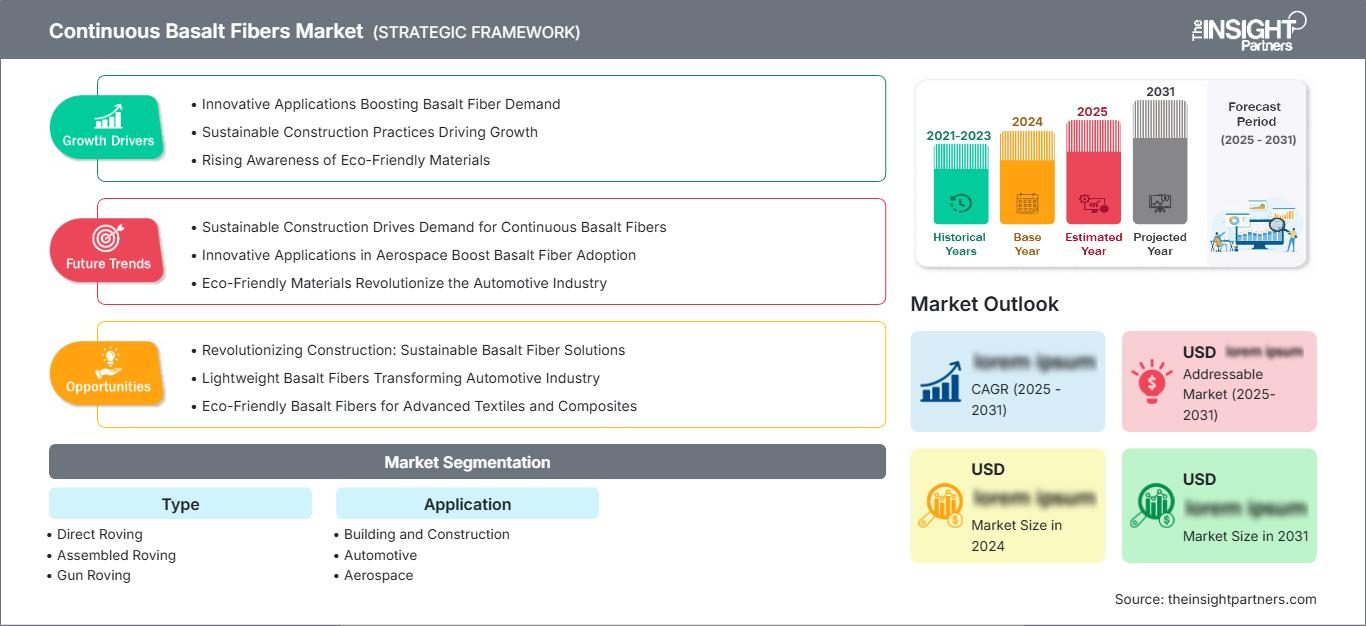
Continuous Basalt Fibers Market: Strategic Insights
Regional Insights
North America Continuous Basalt Fibers Market
North America is expected to account for 20–24% of the Continuous Basalt Fibers Market in 2025 revenue and is forecasted to grow at a 6.5–7.1% CAGR till 2034. The US is the leading region, driven by increasing focus on non-metallic reinforcement assessment in bridges, marine structures, transport, and environments with corrosion. Canada is contributing in infrastructure rehabilitation and composites.
Moreover, the opportunities in North America extend to automotive, electrical, and industrial composites, where weight reduction and electrical insulating properties become relevant. Technical qualifications become an important issue since buyers normally expect predictability in fiber sizing, compatibility with resins used, mechanical uniformity, and processed parameters. Domestic application development becomes crucial to shorten the qualification process and increase revenues. Slow public investment in infrastructure and lifecycle costs assessment should allow gradual substitution of conventional glass and steel reinforcements. North American producers and distributors can thus concentrate on applications engineering, qualification, and delivery in addition to fiber pricing.
U.S. Continuous Basalt Fibers Market
In the US, it is predicted that there will be 70–74% of the total revenue in North America in 2025 and a CAGR of 6.4–7.0% till 2034. The application demand includes bridges, pre-stressed structures, marine structures, transportation infrastructure, and special composite elements. Corrosion resistance becomes an essential factor where ordinary steel bars require repeated maintenance work.
Application diversification becomes an increasingly critical issue. Automotive companies may utilize continuous fibers in some lightweight composite products, whereas aerospace and electrical companies test the fiber resistance to heat, electric charge, and chemical agents. MAFIC, Sudaglass Fiber Technology, Technobasalt Invest, and Basalt Fiber Tech become relevant companies in terms of the larger regional competition landscape. Specifications for basalt strands and FRP reinforcement by ASTM create a more detailed technical reference for engineers and procurement managers. Therefore, the implementation of basalt fiber will occur in a particular project context, involving qualified suppliers and proven lifecycle costs.
Europe Continuous Basalt Fibers Market
Europe has an 18–22% market share in 2025 and is forecast to grow at a 6.9–7.5% CAGR rate. Germany is the key nation, with France, Italy, the UK, and Spain following, and where applications range from transportation, industrial composites, construction, and advanced materials. Europeans pay close attention to the material’s efficiency, durability, and its environmental performance.
The UK keeps its market vibrant through the use of infrastructure programs and composite engineering, whereas Germany boasts about its strengths in auto and industrial manufacturing. Aerospace, transportation, construction, and technical textiles are the potential areas of France and Italy, while Spain provides opportunity in infrastructural redevelopment and renewable energy composites. This area is known for the availability of engineering know-how and the composite value chain, albeit with high qualification costs. The companies with assured sizing, manufacturing traceability, and technical data for specific applications find it easy to penetrate procurement and development programs.
APAC Continuous Basalt Fibers Market
APAC is expected to account for 48–52% of revenues in 2025 and grow at 8.0-8.7% CAGR. China is expected to lead the countries due to manufacturing capability, infrastructure development, and the presence of the well-developed supply chain. Higher-value composites will be offered by Japan and South Korea, and India is becoming relevant through investments in infrastructure.
Australia is considered a relatively small but technologically interesting country for anti-corrosion reinforcements and composite infrastructure. Favorable policies, infrastructure upgrading, automotive lightweighting, and local manufacturing of materials are favorable for adoption. China will dominate supply, whereas India and Southeast Asia may serve as additional demand centers.
Middle East & Africa Continuous Basalt Fibers Market
MEA and Africa demand is anticipated to grow at a CAGR of 9.0 – 9.8%. Saudi Arabia and the UAE are considered key growth countries. Infrastructure projects, desalination facilities, marine constructions and industry installations form applications, where corrosion resistance may lead to a need for composite reinforcements. The demand in South Africa comes from the infrastructure and mining-related projects.
The UAE has special strategic importance due to the fact that the production of continuous basalt fibers has developed to a commercial use in infrastructure projects. The development of construction and industry diversification programs in Saudi Arabia may stimulate future demand, while the demand in South Africa will be driven by a need for durable reinforcements. Energy availability, infrastructure investment and availability of basalt reserves play a crucial role in economic attractiveness of projects.
Segmentation Analysis
Type
The Type segment in the Continuous Basalt Fibers Market is expected to grow at a 7.4–8.0% CAGR during 2026–2034. Product selection depends on downstream processing, required linear density, winding characteristics, and composite architecture. Direct roving remains foundational, while assembled and gun rovings address specialized manufacturing requirements and higher-volume reinforcement formats.
- Direct Roving: Direct roving remains the principal intermediate for fabrics, pultruded profiles, meshes, rebars, and composite structures. Its untwisted configuration supports controlled impregnation and efficient conversion across diverse manufacturing processes.
- Assembled Roving: Assembled roving combines multiple strands to achieve higher linear density and is suited to applications requiring greater throughput, stable feeding, and reinforcement distribution during composite processing.
- Gun Roving: Gun roving supports spray-up composite fabrication and other processes requiring chopped reinforcement delivery. Its commercial importance is linked to automated deposition, production speed, and relatively simple handling.
Application
The Application segment in the Continuous Basalt Fibers Market is projected to advance at a 7.7–8.3% CAGR from 2026 to 2034. Building and Construction provides the largest demand base, while automotive, aerospace, and electrical and electronics applications offer higher-value opportunities requiring specific mechanical, thermal, or dielectric performance.
- Building and Construction: Construction represents the broadest application base because basalt reinforcement resists corrosion and can support concrete, masonry, mesh, rebar, and composite infrastructure products in demanding environments.
- Automotive: Automotive applications emphasize weight reduction, dimensional stability, and reinforcement efficiency. Adoption depends on component-level validation, resin compatibility, processing productivity, and the ability to meet vehicle manufacturers' quality requirements.
- Aerospace: Aerospace demand is application-specific and qualification intensive. Continuous basalt fibers can support selected lightweight structures and thermal or fire-resistant components where performance requirements justify longer validation cycles.
- Electrical and Electronics: Electrical and electronics applications value dielectric behavior, thermal stability, and nonconductivity. Demand can develop in insulation, technical textiles, composite housings, and components exposed to electromagnetic or thermal stresses.
Opportunity Snapshot
| Application | Revenue Contribution (High/Medium/Low) | Trend Tag | Adoption Stage |
|---|---|---|---|
| Building and Construction | High | Corrosion Resistance | Scaling |
| Automotive | Medium | Lightweight Composites | Scaling |
| Aerospace | Low | Thermal Reinforcement | Emerging |
| Electrical and Electronics | Medium | Dielectric Components | Emerging |
Continuous Basalt Fibers Market Growth Drivers and Impact Analysis
Infrastructure durability requirements favor noncorrosive reinforcement
A major driver is the need to extend infrastructure service life in environments where steel reinforcement faces corrosion from moisture, salts, chemicals, or marine exposure. Basalt-based reinforcement provides a nonmetallic option with high chemical resistance and low electrical conductivity. This advantage is particularly relevant to bridges, seawalls, roads, industrial floors, water infrastructure, and precast structures. The commercial impact extends beyond fiber sales because continuous basalt fibers can feed into rebars, meshes, fabrics, and pultruded profiles. ASTM D8505/D8505M provides a formal specification route for basalt and glass FRP bars, supporting greater engineering confidence. As owners increasingly assess maintenance costs rather than initial material prices alone, suppliers with documented durability performance can gain access to projects previously dominated by steel or glass reinforcement.
Lightweighting expands composite opportunities in transportation
Transportation manufacturers are under continuing pressure to reduce component weight while maintaining mechanical performance, dimensional stability, and durability. Continuous basalt fibers offer a middle ground between conventional glass reinforcement and higher-cost carbon fiber in applications where maximum stiffness is not the sole design criterion. Automotive manufacturers can evaluate basalt reinforcement for body structures, underbody components, panels, and technical parts, while aerospace applications remain more selective because qualification requirements are substantially higher. The impact is strongest when manufacturers can integrate basalt fibers into established resin systems and processing equipment without major redesign. As composite converters gain experience with sizing compatibility and fiber architecture, the addressable application base can broaden. Suppliers that provide stable quality, customized roving specifications, and component-level technical assistance are likely to capture more transportation-related demand.
Industrial demand for electrically insulating composite materials
Electrical insulation and thermal resistance create another structural demand pathway. Continuous basalt fibers are nonconductive and can retain useful performance under elevated temperatures and chemically aggressive conditions, making them relevant to selected electrical, electronics, industrial equipment, and technical textile applications. The opportunity is not based solely on material substitution. Instead, manufacturers can use basalt reinforcement to modify composite designs where electrical isolation, dimensional stability, or fire resistance is important. This can support demand for woven materials, pultruded profiles, molded components, and insulation products. Adoption will depend on compatibility with existing polymers, production temperatures, and component qualification. Over time, collaboration between fiber producers, resin suppliers, compounders, and component manufacturers can create application-specific formulations that improve conversion efficiency and reduce the technical barriers associated with switching reinforcement systems.
Continuous Basalt Fibers Market Future Trends
Application-specific fiber engineering will become more important
The Continuous Basalt Fibers Market trends are moving toward application-specific products rather than standardized reinforcement alone. Producers are expected to differentiate fiber diameter, sizing chemistry, tex, winding configuration, and surface treatment according to resin systems and downstream processes. This development can improve impregnation, reduce processing defects, and make basalt reinforcement easier to integrate into automated manufacturing lines. Direct roving suppliers may increasingly provide grades optimized for pultrusion, filament winding, textile production, or thermoplastic compounding. Such specialization can also support higher-value pricing where performance improvements are measurable at component level. In construction, tailored sizing for cementitious systems can improve dispersion and bonding. The resulting competitive landscape should favor producers with process-control capabilities and application laboratories capable of converting generic fiber specifications into validated manufacturing parameters for individual customers.
Regional production networks will reduce qualification and logistics barriers
Regionalization is likely to become a stronger feature of the Continuous Basalt Fibers Market as customers seek shorter supply chains and more responsive technical support. Large Asian producers can continue supplying cost-sensitive applications, while European, North American, and Middle Eastern operations may emphasize proximity, qualification assistance, and specialized products. New plants can also be located near suitable basalt resources and downstream composite clusters, reducing transportation requirements for bulky intermediate products. This model could encourage partnerships between fiber manufacturers and pultruders, concrete-product producers, textile companies, and infrastructure contractors. Over time, regional production networks may improve supply reliability while creating opportunities for local standards and project approvals. Producers that combine scalable manufacturing with local technical service are likely to be better positioned as applications move from pilot projects toward repeat commercial procurement.
Continuous Basalt Fibers Market Opportunities
Develop integrated reinforcement solutions for infrastructure projects
The Continuous Basalt Fibers Market Forecasts indicate an opportunity for suppliers to move beyond selling roving and participate in integrated reinforcement solutions. Fiber producers can partner with rebar manufacturers, mesh converters, pultruders, concrete formulators, and engineering contractors to develop complete systems for bridges, marine structures, roads, and water infrastructure. Such partnerships can address a key adoption barrier: infrastructure buyers generally purchase performance-certified systems rather than raw fibers. Suppliers can therefore create value by providing application specifications, installation guidance, durability testing, and lifecycle-cost documentation alongside reinforcement products. Regional projects in the Middle East, North America, and Asia Pacific provide potential testing grounds because corrosion and maintenance considerations are prominent. A solution-oriented model can also increase customer retention by embedding the fiber specification within project designs and contractor workflows.
Target premium composite applications with technical qualification support
Higher-value opportunities exist where continuous basalt reinforcement can deliver a balanced combination of strength, weight, thermal resistance, and cost. Automotive, aerospace, electrical, and industrial component manufacturers can represent attractive targets, but successful commercialization requires engineering support rather than commodity distribution. Producers should prioritize joint development programs with composite molders and original equipment manufacturers, focusing on component qualification, resin compatibility, processing speed, and repeatability. Investment in application laboratories can shorten development cycles and generate proprietary processing knowledge. The opportunity is particularly relevant for manufacturers seeking alternatives between glass and carbon fiber. By demonstrating measurable component-level benefits, suppliers can reduce price sensitivity and establish differentiated product grades. This strategy also creates pathways into adjacent applications, allowing producers to diversify beyond construction while improving margins and customer relationships.
Recent Developments
- February 2026: Arab Basalt Fiber Company (ABFC), a world-class manufacturer of continuous basalt fiber reinforcements, announced a strategic partnership with Orlimex, a specialist in engineered composite systems under the UK-based Orlitech Group. The partnership brings together ABFC’s advanced basalt fiber production capabilities with Orlimex’s composite engineering expertise to accelerate the adoption of high-performance, low-carbon composite solutions across construction, infrastructure, industrial, and advanced manufacturing sectors – particularly within the GCC’s fast-growing megaproject pipeline.
- January 2025: Michelman, a global developer of advanced materials, collaborated with FibreCoat, a high performance materials company based in Aachen, Germany, to support the launch of FibreCoat’s aluminum-coated basalt fiber. This new fiber, AluCoat, was developed by FibreCoat to address the need for lightweight, conductive materials in applications such as electromagnetic interference (EMI) and radio-frequency interference (RFI) shielding, as well as thermal management for electric vehicles, consumer electronics, and energy storage.
Frequently Asked Questions

- Comprehensive Market Sizing and Forecast Analysis
- Detailed Segmentation Analysis
- In-Depth Market Dynamics Assessment
- Regional and Country-Level Insights
- Competitive Landscape and Company Benchmarking
- Strategic Business Intelligence
Recent Reports
Testimonials

The Insight Partners' SCADA System Market report is comprehensive, with valuable insights on current trends and future forecasts. The team was highly professional, responsive, and supportive throughout. We are very satisfied and highly recommend their services.
RAN KEDEM Partner, Reali Technologies LTDs
I requested a report on a very specific software market and the team produced the report in a few days. The information was very relevant and well presented. I then requested some changes and additions to the report. The team was again very responsive and I got the final report in less than a week.
JEAN-HERVE JENN Chairman, Future Analytica
We worked with The Insight Partners for an important market study and forecast. They gave us clear insights into opportunities and risks, which helped shape our plans. Their research was easy to use and based on solid data. It helped us make smart, confident decisions. We highly recommend them.
PIYUSH NAGPAL Sr. Vice President, High Beam Global
The Insight Partners delivered insightful, well-structured market research with strong domain expertise. Their team was professional and responsive throughout. The user-friendly website made accessing industry reports seamless. We highly recommend them for reliable, high-quality research services
YUKIHIKO ADACHI CEO, Deep Blue, LLC.
This is the first time I have purchased a market report from The Insight Partners.While I was unsure at first, I visited their web site and felt more comfortable to take the risk and purchase a market report.I am completely satisfied with the quality of the report and customer service. I had several questions and comments with the initial report, but after a couple of dialogs over email with their analyst I believe I have a report that I can use as input to our strategic planning process.Thank you so much for taking the extra time and making this a positive experience.I will definitely recommend your service to others and you will be my first call when we need further market data.
JOHN SUZUKI President and Chief Executive Officer, Board Director, BK Technologies
I wish to appreciate your support and the professionalism you displayed in the course of attending to my request for information regarding to infectious disease IVD market in Nigeria. I appreciate your patience, your guidance, and the fact that you were willing to offer a discount, which eventually made it possible for us to close a deal. I look forward to engaging The Insight Partners in the future, all thanks to the impression you have created in me as a result of this first encounter.
DR CHIJIOKE ONYIA MANAGING DIRECTOR, PineCrest Healthcare Ltd.Reason to Buy
- Informed Decision-Making
- Understanding Market Dynamics
- Competitive Analysis
- Identifying Emerging Markets
- Customer Insights
- Market Forecasts
- Risk Mitigation
- Boosting Operational Efficiency
- Strategic Planning
- Investment Justification
- Tracking Industry Innovations
- Aligning with Regulatory Trends





 Get Free Sample for