
Converting Paper Market Size, Share, Trends & Demand by 2034
Coverage: By Pulp Type (Mechanical Wood Pulp, Semi-chemical Pulp, Chemical Wood Pulp, Non-Wood Pulp, Recycled Pulp); End Use (Packaging, Food Service, Printing, Consumer Goods, Others) , and Geography (North America, Europe, Asia Pacific, and South and Central America)
- Status : Data Released
- Report Code : TIPRE00023156
- Category : Chemicals and Materials
- No. of Pages : 150
- Available Report Formats :


- Last update date : September 01, 2026


2025 Market Size
US$ 128.76 Bn
Base year value
2034 Forecast
US$ 185.57 Bn
Projected by 2034
CAGR 2026-2034
4.14 %
Growth rate
Addressable Market
US$ 1,427.22 Bn
(2026-2034)
Converting Paper Market is valued at US$ 128.76 Billion in 2025 and is projected to reach US$ 185.57 Billion by 2034, advancing at a CAGR of 4.14% during 2026–2034. The market encompasses paper converted into application-ready formats through cutting, coating, laminating, folding, printing, and related finishing processes. Demand is shaped by packaging substitution, food-service consumption, consumer goods distribution, and continuing requirements for selected print applications.
North American Converting Paper Market size is supported by established packaging infrastructure, high consumption of corrugated and flexible paper formats, and investments in lightweight grades. Regional growth is expected at approximately 3.7–4.4% CAGR through 2034, with e-commerce fulfillment, food-service packaging, and recyclable fiber-based formats providing structural support despite mature printing demand.
Converting Paper Market Assessment and Insights
- North America: North America represented an estimated 27–31% Converting Paper Market share in 2025 and is expected to expand at a 3.7–4.4% CAGR between 2026–2034, supported by packaging conversion, food-service demand, and efficient distribution networks.
- US: The US accounted for approximately 22–25% share in 2025 and is projected to grow at a 3.6–4.3% CAGR between 2026–2034, led by packaging and consumer goods conversion.
- Europe: Europe held about 23–27% share in 2025 and is expected to register a 3.2–4.0% CAGR between 2026–2034, with Germany, Italy, France, the UK, and Spain supported by recycling infrastructure and packaging demand.
- Asia Pacific: Asia Pacific captured approximately 30–34% share in 2025 and is forecast to grow at a 4.8–5.6% CAGR between 2026–2034, led by China, India, Japan, South Korea, and Australia as packaging capacity expands.
- Largest Segment: Packaging is estimated to hold a 48–53% market share in 2025 and grow at a 4.6–5.3% CAGR during 2026–2034, making it the largest end-use segment.
- High Growth Segment: Recycled Pulp is estimated to represent 18–22% of pulp-type demand and expand at a 5.0–5.8% CAGR during 2026–2034, reflecting circular-material adoption.
- Key companies analyzed in detail: American Eagle Paper Mills, LLC; Canfor Corporation; Clearwater Paper Corporation; Domtar Corporation; Georgia-Pacific LLC; International Paper Company; Mitsubishi Paper Mills Limited; P.H. Glatfelter Company; Stora Enso Oyj; UPM-Kymmene Corporation.
Source: The Insight Partners' analysis based on proprietary research, government publications, company annual reports, investor presentations, industry databases, and expert interviews.
The Converting Paper Market has moved from traditional printing conversions to a more diverse portfolio of conversions which revolves around packaging, food service packaging and fiber consumer goods. Both mechanical and chemical pulp still play an important role, but recycled fiber has become strategically significant. More converters are relying on coating, barrier treatments, accurate slitting, digital printing and lightweighting to fulfill their performance needs without necessarily increasing material usage. Integration within supply chains has grown because of the entry of large paper makers into packaging operations.
Looking into the future, Asia Pacific capacity growth, North American packaging investments, and Europe’s circular economy initiatives will have more influence over the developments in the converting industry. Sustainability issues such as recyclability, fiber sourcing, and emission performance are emerging as buying considerations next to basis weight, strength, printability and barrier performance. Investments may be made in operations that can switch grades, reduce energy intensity and serve local customers quickly. Demand growth in India and Southeast Asia could widen the geographical contribution of converting activities.
Converting Paper Market Report Scope
| Report Attribute | Details |
|---|---|
| Market size in 2025 | US$ 128.76 Billion |
| Market Size by 2034 | US$ 185.57 Billion |
| Global CAGR (2026 - 2034) | 4.14% |
| Historical Data | 2021-2024 |
| Forecast period | 2026-2034 |
Converting Paper Market Analysis
Converting Paper Market growth is facilitated by packaging substitution, food-service demand, and standardized format needs in logistics and retail sales. The value chain extends from forest resources and recycled fiber collection, to pulping, paper manufacturing, coating, conversion, printing, distribution and end-use manufacturing. In that regard, paper manufacturers compete not only in terms of fiber quality but also in terms of machine efficiency, coating effectiveness, conversion yields, and specification flexibility. Packaging demands lead to higher benefits from integrated supply relationships.
Availability of raw materials is still a very important factor of supply. According to FAO statistics, world production of paper and paperboard was 423 million tonnes in 2024, while recovery and trading of recovered paper were significant as well, highlighting the importance of secondary fiber. Moreover, according to European statistics, packaging grades were superior to graphic paper, and Asia was adding capacity. Under such circumstances, suppliers that can manage virgin and recovered fiber supplies, energy costs and fast converting grades are preferred.
Converting Paper Market Analysis shows that the competitive environment is a combination of diversified forest product firms, regional mills, and specialty paper makers. International Paper Company is enhancing packaging abilities, Stora Enso Oyj is focusing on renewable packaging materials. UPM-Kymmene Corporation is rationalizing communication papers' exposure, and Domtar Corporation is optimizing their mill operations. Georgia-Pacific LLC and Clearwater Paper Corporation hold strong positions in North America, while Mitsubishi Paper Mills Ltd and P.H. Glatfelter Company offer specialized grades.
Firms are investing in efficient asset productivity, packaging conversion, fiber recycling, and premium specialty paper production rather than capacity expansion. Positioning strategy requires geographic proximity to the consumers, fiber access, efficient energy consumption, and compliance with the changes in barrier and recyclability requirements. Canfor Corporation and American Eagle Paper Mills, LLC are participating in this competitive environment, and differentiated grades allow smaller firms to avoid competing with commodity scale assets.
● REPORT CUSTOMIZATION
Tailor This Report To Align With Your Specific Business Requirements
This report can be customized to align precisely with your business objectives, scope, and target markets. Customization options include tailored segmentation, geography, competitive analysis, and strategic insights to support informed decision-making.
Customize This Report →WHAT YOU CAN ADJUST
- ● Segmentations
- ● Geography
- ● Competitive Analysis
- ● Language Preferences
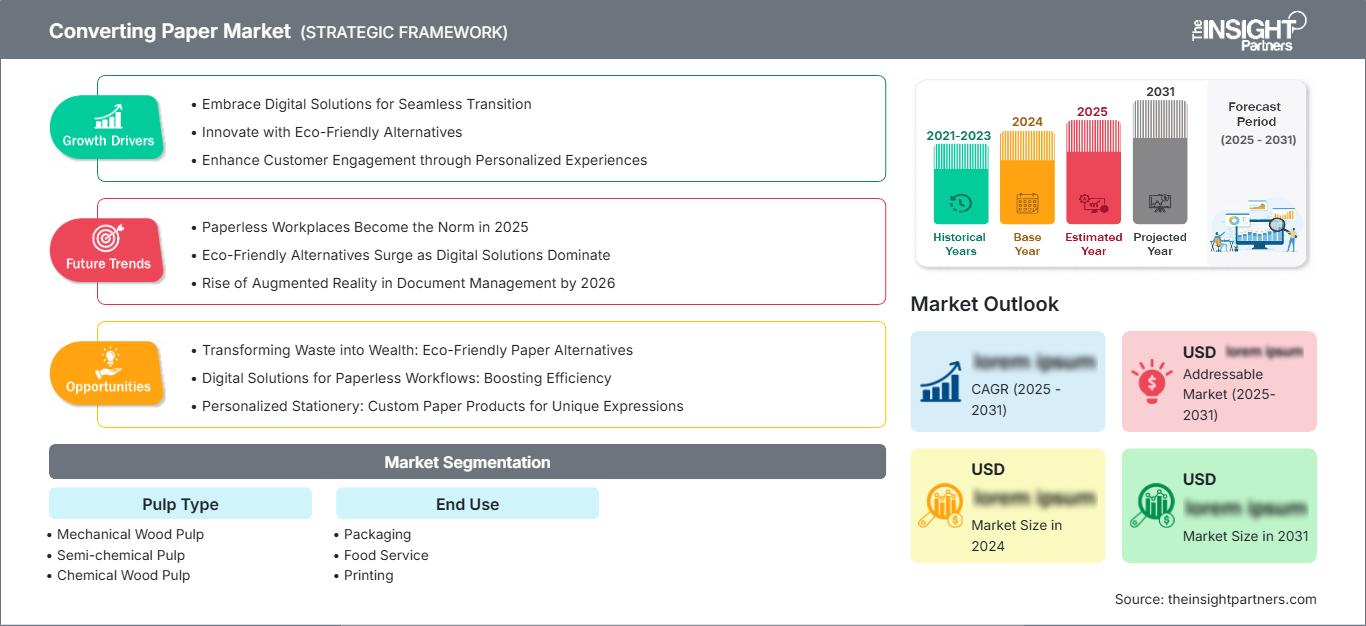
Converting Paper Market: Strategic Insights
Regional Insights
North America Converting Paper Market
North America accounted for approximately 27–31% share in 2025 and is expected to grow at a 3.7–4.4% CAGR through 2034. In terms of conversion infrastructure, there is mature converting capability in North America, with robust corrugating packaging facilities and food service channels. E-commerce order fulfillment drives requirements for protection/transportation grades of paper, and recycling fiber makes packaging applications more circular.
The graphic paper conversion market is transitioning towards packaging and specialty grades. Purchase factors include lightweighting, moisture resistance, printability, and machineability. Fiber-based formats are being considered by food service operators for applications where regulations and brand requirements dictate the use of materials other than conventional plastics. Canada is contributing through forest products and pulp manufacture, but the US is still the key consumption country. Energy prices and mill shutdowns can reduce local supply.
U.S. Converting Paper Market
The US represented about 76–81% of North American Converting Paper Market in 2025 and is projected to grow at a 3.6–4.3% CAGR through 2034. International Paper Company, Georgia-Pacific LLC, Clearwater Paper Corporation, Domtar Corporation, and American Eagle Paper Mills, LLC back up the diverse domestic source base. Packaging is still the main end-use, while the food-service and consumer goods conversion add supplementary demands.
The key areas of investments become the development of light-weighted containerboard, the production of corrugated packaging materials, different coatings, and effective converting facilities. The demands from e-commerce, quick-service food, and distribution of household products make repetitive needs for standard paper products. Printing has an important structural role but faces the substitution by digital communication. So, the US industry increasingly relies on the packaging conversion and reliable service.
Europe Converting Paper Market
Europe held approximately 23–27% share in 2025 and is expected to expand at a 3.2–4.0% CAGR through 2034. Germany is an established hub in terms of converting, backed by industrial packaging and consumer goods production. The UK and France offer high food service and retail packaging needs, while Italy and Spain are contributing to the market via food, beverages, and flexible paper converting. Circularity requirements boost recycled-fiber demand.
Germany is an established converting equipment user with a good combination of industrial and automotive packaging needs as well as well-developed recycling infrastructure. The UK has a highly developed retail and food service ecosystem, where the fiber-based packaging can help to address sustainability needs. France enjoys its food, luxury, and consumer packaging applications, while Italy and Spain enjoy their food and beverages converting facilities.
APAC Converting Paper Market Market
APAC represented approximately 30–34% share in 2025 and is projected to grow at a 4.8–5.6% CAGR through 2034. China is still the major market backed up with huge capacities for packaging and manufacturing. India, Japan, South Korea, and Australia participate with their contributions in terms of food, consumer goods, retail, and industrial uses. Recycling policies as well as support for domestic packaging manufacturing help to sustain regional conversion demands.
While China represents scale, India shows faster structural growth on account of organized retail, food processing, and logistics. The focus of Japan and South Korea is put on quality and specialization, while Australia profits from food service and retail use. More investments in the region go towards automation of conversion process, recycled fibers, light-weight packaging, and high-performing coatings. This helps to move towards differentiated applications in paper.
Middle East & Africa Converting Paper Market Market
Middle East and Africa is smaller than the leading regions but is expected to expand at approximately 3.8–4.7% CAGR through 2034. Saudi Arabia and the UAE are leading demand centers, supported by food service, retail development, logistics infrastructure, and manufacturing diversification. South Africa contributes established paper and packaging capabilities, while the rest of MEA remains more import dependent.
Saudi Arabia and the UAE are increasing investments in logistics, food processing, and consumer infrastructure, creating demand for converted packaging grades. South Africa provides a more mature recycling and manufacturing base. Across the region, energy availability, water constraints, import economics, and infrastructure quality influence production decisions. Local converting capacity is likely to expand where converters can secure reliable fiber, efficient equipment, and access to rapidly developing consumer markets.
Segmentation Analysis
Pulp Type
Pulp Type is expected to expand at a 3.8–4.8% CAGR during 2026–2034. Grade selection depends on strength, surface properties, printability, opacity, barrier compatibility, and cost. Recycled and chemical pulps are gaining importance in packaging, while mechanical grades retain relevance in selected printing applications. The Converting Paper Market scope therefore reflects a gradual portfolio shift toward application-specific fiber combinations.
- Mechanical Wood Pulp: Maintains relevance in publication and printing grades where bulk, opacity, and cost efficiency matter. Demand is comparatively mature, with producers focusing on lightweighting and improved machine performance.
- Semi-chemical Pulp: Supports packaging grades requiring a balance of strength, yield, and process economics. Its position is strengthened by applications where fiber performance must withstand converting and distribution stresses.
- Chemical Wood Pulp: Provides high-strength and clean fiber characteristics for premium packaging, food-service, and specialty applications. Its strategic importance rises where converting performance and appearance justify higher material costs.
- Non-Wood Pulp: Serves differentiated applications using agricultural residues and alternative fibers. Adoption is supported by regional feedstock availability, sustainability objectives, and opportunities to diversify fiber sourcing.
- Recycled Pulp: Benefits from circularity targets, recovered-paper availability, and packaging demand. Converters increasingly use recycled grades where adequate strength, cleanliness, and printability can be achieved without compromising process efficiency.
End Use
End Use is projected to grow at a 4.0–5.0% CAGR during 2026–2034. Packaging is the principal demand center, while food service gains from fiber-based substitution and regulatory pressure. Printing remains important but structurally mature, and consumer goods conversion benefits from branding, retail presentation, and protective packaging requirements.
- Packaging: Represents the largest demand base, covering corrugated, folding carton, wrapping, bags, labels, and other converted formats. Growth is supported by logistics, e-commerce, FMCG distribution, and recyclable packaging requirements.
- Food Service: Expands through cups, trays, wraps, containers, and related formats. Demand depends on food delivery, quick-service restaurants, institutional catering, and substitution toward fiber-based materials with suitable barrier performance.
- Printing: Remains strategically important for books, commercial materials, labels, and selected publications. Demand is more mature, encouraging converters to emphasize specialty papers, premium finishes, digital workflows, and short-run economics.
- Consumer Goods: Includes converted papers used for household, personal care, retail, and branded product applications. Demand benefits from shelf presentation, product protection, and customization across consumer-facing categories.
Opportunity Snapshot
| Application | Revenue Contribution | Trend Tag | Adoption Stage |
|---|---|---|---|
| Packaging | High | E-commerce Packs | Mature |
| Food Service | Medium | Fiber Substitution | Scaling |
| Printing | Medium | Premium Print | Mature |
| Consumer Goods | Medium | Retail Formats | Scaling |
Converting Paper Market Growth Drivers and Impact Analysis
Expansion of Fiber-Based Packaging Applications
The shift towards packaging conversion is occurring because logistics companies, retailers, food services, and consumer goods need material that protects the product, is machine-friendly, serves as an opportunity for branding, and is recyclable. The impact is felt through the entire chain – paper mills change their grades, converters buy faster machinery, and packaging companies are looking for consistent basis weight and surface characteristics. Increased activity in e-commerce leads to an increased need for protective products and standardized shipping products, while food service needs coated and barrier grades. This trend rewards those pulp and paper companies who integrate upstream as it makes it easier to control the quality and specifications of fiber.
Greater Use of Recycled and Circular Fiber Systems
Recovered fiber is becoming a strategic input rather than simply a cost-saving alternative. Recycling systems create a stronger connection between collection networks, sorting facilities, paper mills, converters, and brand owners. With growth in packaging consumption, the need for reliable supplies of recovered paper would help in creating an impetus for deinking, cleaning, and quality control operations. Manufacturers able to use both recycled and virgin fiber would be able to meet the performance standards in response to their customers' sustainability goals. The business effect is not the same across regions due to differences in the quality of collection, transport costs, contamination rates, and regulatory framework. Europe is especially advanced in recycling facilities, whereas North America and Asia Pacific have been developing their facilities for recovery and utilization.
Automation and Higher-Precision Converting Operations
Automation within the converting industry can be increased to increase yield and decrease set-up time while keeping quality uniform during smaller production runs. More automated modern slitting, folding, coating, printing, and inspection machines can save on material waste and increase dimensional precision and surface uniformity. This is especially pertinent to packaging and food service clients that have very specific requirements for large-scale productions. Automated machinery can also compensate for labor shortages and allow for faster changeovers of customized formats. The cost-effectiveness of such investments would depend more on digital process control and predictive maintenance capabilities. Smaller converters can adopt an approach involving either modern machinery purchases or partnerships with larger pulp and paper mills. Over time, production efficiency can become a differentiating factor even more important than the price of paper.
Converting Paper Market Future Trends
Barrier-Engineered Paper Formats
Converting Paper Market trends are moving towards barrier-engineered products that provide water, oil, oxygen, and scent resistance while maintaining recyclable properties. Future innovation in products will be in the direction of developing thin coatings with better compatibility with fibers as well as material composition to make it easier for recycling. Food service and flexible packaging markets will probably emerge as test markets in future due to the requirement of higher functional performance from these coated papers. Producers will need to work with coating providers, converters, food producers, and recycling organizations for proving their end-of-life performance before launching the product into the market. The strategic value will lie in systems that deliver both performance and recyclability predictability.
Data-Driven Grade and Production Optimization
Digitalization is likely to influence grade selection, production scheduling, quality control, and customer service more deeply through the forecast period. Converters can use machine data to identify waste sources, predict equipment failures, and optimize cutting patterns. Paper producers can combine demand signals with mill information to reduce inventory and improve grade allocation. For customers, digital specifications and traceability can simplify procurement and quality assurance. These capabilities may become particularly valuable as product portfolios diversify into more specialized packaging formats and shorter production runs. Data integration across mills, warehouses, converters, and customers can reduce working capital while improving service responsiveness. Suppliers that develop interoperable systems will be better positioned to manage complex orders without sacrificing throughput or consistency.
Converting Paper Market Opportunities
Localized Conversion Capacity in High-Growth Asian Markets
Converting Paper Market Forecasts indicate attractive opportunities for localized conversion capacity in India and selected Southeast Asian economies where packaging, organized retail, food processing, and logistics are expanding. Investment cases can focus on modular facilities close to major consumption centers rather than large integrated mills. Such plants can specialize in folding cartons, food-service formats, bags, labels, or lightweight packaging grades. Investors should prioritize access to recovered fiber, reliable utilities, skilled operators, and efficient transportation. Partnerships with established paper producers can reduce feedstock risk while providing technical support. The opportunity is strongest where imported converted products face freight disadvantages or long lead times. Regional facilities can also tailor grades and dimensions to local customers more effectively than distant centralized production.
Premium Specialty Conversion for Sustainable Consumer Applications
A second opportunity lies in premium converted papers designed for food, personal care, household, and branded consumer applications where functionality and presentation support higher value capture. Investors can target coating, embossing, printing, laminating, and precision-cutting capabilities rather than competing solely on commodity paper volumes. Product development should prioritize recyclable structures, controlled barrier performance, attractive surfaces, and compatibility with high-speed filling equipment. Partnerships with consumer brands can accelerate qualification because application requirements often differ by product category. The opportunity also allows established mills to move downstream and capture additional value from specialty grades. Capital allocation should favor flexible lines capable of producing multiple formats, enabling manufacturers to respond to changing brand specifications and avoid excessive dependence on one application.
Recent Developments
- May 2026: International Paper (NYSE: IP; LSE: IPC), a leader in sustainable packaging solutions, acquired Delmarva Corrugated Packaging in Dover, Delaware. The strategic acquisition of this facility will enhance International Paper's capabilities, expand its market presence, and increase its capacity to produce the highest-quality sustainable packaging solutions for customers.
- February 2026: Türkiye’s Eruslu Hygienic Products moved into tissue production after investing in six Futura and Plusline-supplied Andromeda Tissue converting lines, to be installed at its site in Bursa. The greenfield project includes a whole tissue machine, logistics, and warehouse for jumbo rolls and finished products.
Frequently Asked Questions

- Comprehensive Market Sizing and Forecast Analysis
- Detailed Segmentation Analysis
- In-Depth Market Dynamics Assessment
- Regional and Country-Level Insights
- Competitive Landscape and Company Benchmarking
- Strategic Business Intelligence
Recent Reports
Testimonials

The Insight Partners' SCADA System Market report is comprehensive, with valuable insights on current trends and future forecasts. The team was highly professional, responsive, and supportive throughout. We are very satisfied and highly recommend their services.
RAN KEDEM Partner, Reali Technologies LTDs
I requested a report on a very specific software market and the team produced the report in a few days. The information was very relevant and well presented. I then requested some changes and additions to the report. The team was again very responsive and I got the final report in less than a week.
JEAN-HERVE JENN Chairman, Future Analytica
We worked with The Insight Partners for an important market study and forecast. They gave us clear insights into opportunities and risks, which helped shape our plans. Their research was easy to use and based on solid data. It helped us make smart, confident decisions. We highly recommend them.
PIYUSH NAGPAL Sr. Vice President, High Beam Global
The Insight Partners delivered insightful, well-structured market research with strong domain expertise. Their team was professional and responsive throughout. The user-friendly website made accessing industry reports seamless. We highly recommend them for reliable, high-quality research services
YUKIHIKO ADACHI CEO, Deep Blue, LLC.
This is the first time I have purchased a market report from The Insight Partners.While I was unsure at first, I visited their web site and felt more comfortable to take the risk and purchase a market report.I am completely satisfied with the quality of the report and customer service. I had several questions and comments with the initial report, but after a couple of dialogs over email with their analyst I believe I have a report that I can use as input to our strategic planning process.Thank you so much for taking the extra time and making this a positive experience.I will definitely recommend your service to others and you will be my first call when we need further market data.
JOHN SUZUKI President and Chief Executive Officer, Board Director, BK Technologies
I wish to appreciate your support and the professionalism you displayed in the course of attending to my request for information regarding to infectious disease IVD market in Nigeria. I appreciate your patience, your guidance, and the fact that you were willing to offer a discount, which eventually made it possible for us to close a deal. I look forward to engaging The Insight Partners in the future, all thanks to the impression you have created in me as a result of this first encounter.
DR CHIJIOKE ONYIA MANAGING DIRECTOR, PineCrest Healthcare Ltd.Reason to Buy
- Informed Decision-Making
- Understanding Market Dynamics
- Competitive Analysis
- Identifying Emerging Markets
- Customer Insights
- Market Forecasts
- Risk Mitigation
- Boosting Operational Efficiency
- Strategic Planning
- Investment Justification
- Tracking Industry Innovations
- Aligning with Regulatory Trends





 Get Free Sample for