
Crop Sprayers Market Demand, Trends & Forecast by 2034
Coverage: by Type (Handheld, Self-Propelled, Tractor-mounted, Trailed, Aerial); Power Source (Fuel-based, Electric and Battery-driven, Solar, Manual); Capacity (Ultra-low Volume, Low Volume, High Volume); Technology (Hydraulic Nozzle Spray Technology, Air-Assisted Electrostatic Spray Technology, Variable Rate Technology, Others) , and Geography (North America, Europe, Asia Pacific, and South and Central America)
- Status : Data Released
- Report Code : TIPRE00009419
- Category : Manufacturing and Construction
- No. of Pages : 150
- Available Report Formats :


- Last update date : September 07, 2026


2025 Market Size
US$ 5.86 Bn
Base year value
2034 Forecast
US$ 10.96 Bn
Projected by 2034
CAGR 2026-2034
7.21 %
Growth rate
Addressable Market
US$ 75.91 Bn
(2026-2034)
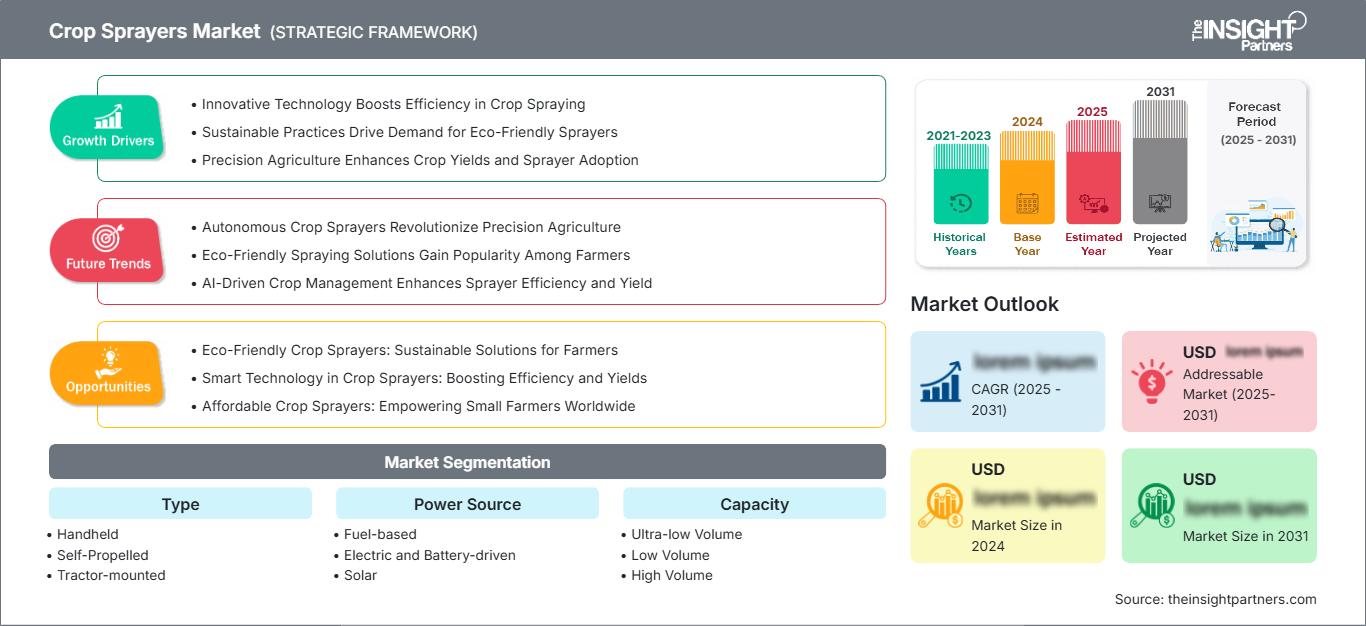
The crop sprayers market is entering a sustained expansion cycle, rising from US$ 5.86 Billion in 2025 to US$ 10.96 Billion by 2034. The market is projected to record a CAGR of 7.21% during 2026–2034, reflecting stronger demand for timely crop protection, mechanized application, and precision equipment that enables growers to manage input use while responding to tighter operating windows and increasingly variable pest pressure.
Across North America, the crop sprayers market size is expected to advance at a 6.8–7.4% CAGR through 2034. Large row-crop farms, high replacement intensity, and broad use of telematics support demand for self-propelled and retrofit precision systems. Dealer-led service networks also lower technology risk, while individual-nozzle control and camera-guided spraying improve the economics of application amid labor constraints and rising chemical costs.
Crop Sprayers Market Assessment and Insights
- North America: Accounted for 28–31% crop sprayers market share in 2025 and is projected to grow at 6.8–7.4% CAGR between 2026–2034, supported by commercial farm scale, precision retrofits, and established dealer service.
- US: Represented 83–86% of North America in 2025 and is expected to expand at 6.9–7.5% CAGR between 2026–2034 as targeted spraying gains adoption.
- Europe: Held 30–33% share in 2025 and is forecast to grow at 6.4–7.0% CAGR between 2026–2034, led by Germany, France, the UK, Italy, and Spain.
- Asia Pacific: Captured 34–37% share in 2025 and is anticipated to rise at 7.8–8.5% CAGR between 2026–2034, with China, India, Japan, South Korea, and Australia advancing mechanization.
- Largest Segment: Tractor-mounted systems held 37–40% market share in 2025 and are projected to grow at 6.6–7.2% CAGR between 2026–2034.
- High Growth Segment: Aerial systems represented 8–11% market share in 2025 and are projected to grow at 13.5–15.5% CAGR between 2026–2034.
- Key companies analyzed in detail: AGCO Corporation, Deere & Company, CNH Industrial N.V., Kubota Corporation, Mahindra & Mahindra Limited, EXEL Industries SA, Bucher Industries AG, AMAZONEN-WERKE H. DREYER SE & Co. KG, STIHL Holding AG & Co. KG, and SZ DJI Technology Co., Ltd.
Source: The Insight Partners' analysis based on proprietary research, government publications, company annual reports, investor presentations, industry databases, and expert interviews.
Machine development has progressed from mechanical boom-controlled systems to networked platforms featuring integrated guidance, pressure control, section shutoff, and application data. The industry continues to bifurcate between large volumes of worldwide equipment firms and niche manufacturers catering to orchards, vineyards, small farms, and aerial spraying. Key component requirements have evolved to include reliable pumps, low-drift nozzles, sensors, cameras, and software interoperability. This trend means that electronics, calibration assistance, and spare parts access become critical considerations along with tank size, boom width, and power output.
By 2034, investment is expected to increase for Asia Pacific region services, battery operated portable equipment, and precision add-ons for current fleets. Mechanization plans in India, low altitude economics in China, and revised European sprayer regulations provide an impetus for adoption. Companies offering bundled hardware along with operator training, financing, and traceable application data will succeed in fragmented markets where ownership is impractical and compliance has become commercially significant.
Crop Sprayers Market Report Scope
| Report Attribute | Details |
|---|---|
| Market size in 2025 | US$ 5.86 Billion |
| Market Size by 2034 | US$ 10.96 Billion |
| Global CAGR (2026 - 2034) | 7.21% |
| Historical Data | 2021-2024 |
| Forecast period | 2026-2034 |
Crop Sprayers Market Analysis
The primary driver for growth in the global crop sprayers market is the need for protection of yields with fewer labor hours and better controlled chemical application. The need for equipment able to do this work in limited weather periods, to lower overlap levels, and to record operations increases the demand not only for new units but also for nozzle bodies, pumps, sensors, controllers, and software updates.
The value chain in the crop sprayers market includes component makers, original equipment manufacturers, distributors, dealers, custom applicators, and farms. The reliability of the supply chain relies on the availability of electronics, hydraulics, batteries, and competent technicians. Local assembly and platform parts increase logistics efficiency, while renting equipment and hiring custom applicators broaden the reach of smallholders. The aftermarket business is crucial due to calibration, maintenance, and consumables replacing impacting application quality.
Competitive space of global crop sprayers market report reveals two major approaches. Deere & Company, AGCO Corporation, and CNH Industrial N.V. offer a combination of sprayers with guidance systems, connected-farming platforms, financing, and dealership services. EXEL Industries SA, Bucher Industries AG, and AMAZONEN-WERKE H. DREYER SE & Co. KG distinguish themselves with crop-specific engineering, boom management, and application know-how.
Kubota Corporation, Mahindra & Mahindra Limited, and STIHL Holding AG & Co. KG have their competitive strengths in channels for compact equipment, whereas SZ DJI Technology Co., Ltd. advances aerial spraying capabilities with payload, autonomy, and training ecosystem. Investments move towards machine vision technology, direct injection, electrification, and retrofit kits. Strategic value creation becomes more about the proof of inputs reduction, reliability of operation, and fleet integration.
● REPORT CUSTOMIZATION
Tailor This Report To Align With Your Specific Business Requirements
This report can be customized to align precisely with your business objectives, scope, and target markets. Customization options include tailored segmentation, geography, competitive analysis, and strategic insights to support informed decision-making.
Customize This Report →WHAT YOU CAN ADJUST
- ● Segmentations
- ● Geography
- ● Competitive Analysis
- ● Language Preferences
Crop Sprayers Market: Strategic Insights
Regional Insights
North America crop sprayers market
The region represented 28–31% of global crop sprayers market in 2025 and is projected to expand at a 6.8–7.4% CAGR during 2026–2034. The factors that underpin crop sprayer market share include the presence of extensive acreage for row crops, equipment usage, and good dealer presence. More farmers want individual nozzle control, variable rate application, and camera-based weed identification due to issues with labor availability and chemical costs.
Canada's contributions to the demand for crop sprayers include cereals and oil seeds, while horticulture and protected cropping needs drive Mexico's demands. In replacement cycles, self-propelled units suit commercial farming while mounted units work better with diversification farming. Retrofits have appeal since they prolong the useful life of machines and offer section control and application information. Adoption however is dependent on agricultural income, interest rates, seasonal climate, and availability of technicians for integration of hardware and software.
U.S. Crop Sprayers Market
The U.S. accounted for 83–86% of North American crop sprayers market in 2025 and is forecast to grow at a 6.9–7.5% CAGR through 2034. The farming of corn, soybean, cotton, wheat, and specialty crops requires a variety of machinery types. Deere & Company, AGCO Corporation, and CNH Industrial N.V. have large market, financial, and distribution presence, further solidifying the use in larger farms and custom applicator operations.
Current application trends include precision application of herbicides, application using two products simultaneously, wider booms, and digital documentation of jobs. The share of herbicide tolerant soybeans in 2024 and 2025 was 96% according to the data published by USDA, which shows continuing intensive crop protection practices. Camera guided technology and separate control of nozzles provide cost reductions by not spraying everywhere, and aftermarket add-ons present another route requiring less initial investments.
Europe Crop Sprayers Market
Europe held 30–33% of global revenue in 2025 and is projected to grow at a 6.4–7.0% CAGR during 2026–2034. Germany takes the lead based on its machinery portfolio, large-scale agricultural farming, and high level of usage of equipment. UK maintains its replacement demand through mandatory inspection of professional pesticides spray equipment while contractors have need for adaptable trailed and self-propelled platforms for cereals, oilseed rape, and potato crops.
France blends broadacre demand with vineyard and orchards that require wide boom or air assisted equipment. Italy and Spain maintain demand for specialized equipment for vineyards, olives, citrus, and horticulture where spray penetration and drift control is a factor. The recent ISO 16122 inspection update further ensures quality maintenance and replacement in the lifecycle. Germany takes the lead through AMAZONEN-WERKE H. DREYER SE & Co. KG among others.
APAC Crop Sprayers Market
Asia Pacific captured 34–37% of global revenue in 2025 and is forecast to rise at a 7.8–8.5% CAGR through 2034. The lead is provided by China with its drone production, service facilities, and mechanization. The guidelines issued in India for 2025 include custom hire, testing, and Kisan Drone demonstrations, making it easier for fragmentized farms to use drones.
While Japan and South Korea prefer small-sized and automated facilities due to labor shortages on their farms, Australia needs large-sized equipment for their wide grain production. China retains its leadership, and India provides the most service-driven potential.
Middle East & Africa Crop Sprayers Market
The Middle East and Africa market is projected to expand at a 6.8–7.6% CAGR during 2026–2034. Saudi Arabia leads regional investment through food-security programs, greenhouse production, and water-efficient horticulture. The UAE emphasizes controlled-environment agriculture, where low-volume and electrostatic systems can improve coverage with limited water.
According to the crop sprayers market forecast, South Africa contributes commercial grain, fruit, and vineyard demand, while the rest of MEA relies more heavily on portable and tractor-mounted equipment. Solar and battery systems suit areas with costly fuel or weak infrastructure. Adoption depends on financing, operator training, parts access, and regulatory acceptance of aerial application.
Segmentation Analysis
Type
The Type segment is projected to grow at a 7.0–7.6% CAGR during 2026–2034. The crop sprayers market scope ranges from low-cost portable units to autonomous aerial and high-capacity self-propelled platforms. Farm size, terrain, crop value, labor availability, and application frequency determine purchasing. Tractor-mounted systems retain scale advantages, while aerial equipment creates the fastest expansion through service-based access.
- Handheld: Portable units remain essential for small plots, nurseries, spot treatment, and difficult terrain, with affordability, repair simplicity, and lightweight construction driving widespread baseline demand.
- Self-Propelled: Commercial farms and contractors select these machines for speed, tank capacity, clearance, telematics, and precision integration, making uptime support and financing critical competitive factors.
- Tractor-mounted: This configuration leads because it leverages installed tractor fleets, offers flexible capacity, and balances capital cost with productivity across mixed farms and diversified crop rotations.
- Trailed: Trailed platforms serve medium and large farms seeking wide booms and substantial tanks without self-propelled pricing, although maneuverability and tractor availability shape utilization.
- Aerial: Spray drones address fragmented, wet, sloped, or inaccessible fields and support custom-service models, but operator certification, payload limits, battery logistics, and chemical approvals govern expansion.
Power Source
The Power Source segment is expected to expand at a 7.2–7.9% CAGR during 2026–2034. Fuel systems remain important for high-duty machines, while batteries improve portability, noise, and maintenance economics. Solar configurations attract off-grid applications but require practical charging and storage design. Manual equipment continues to provide low-cost access where plot size, income, and service availability limit mechanized adoption.
- Fuel-based: Diesel and petrol systems dominate demanding field operations because refueling is rapid and power density supports pumps, propulsion, and wide booms across long working days.
- Electric and Battery-driven: Battery systems gain ground in handheld equipment, compact platforms, and drones, supported by lower routine maintenance, quieter operation, and improving energy density and charging workflows.
- Solar: Solar-assisted sprayers serve remote farms and low-duty applications where grid reliability is weak, offering operating-cost benefits when paired with durable batteries and local maintenance capability.
- Manual: Lever-operated equipment retains strategic relevance in smallholder farming, horticulture, and spot treatment because purchase cost is low, components are familiar, and field repair is straightforward.
Capacity
The Capacity segment is forecast to grow at a 6.9–7.5% CAGR during 2026–2034. Selection reflects crop architecture, chemical formulation, water access, refilling distance, and desired field speed. Low-volume systems balance coverage and productivity across many uses. Ultra-low-volume designs support water conservation and aviation, while high-volume equipment remains important where canopy density or application protocols require substantial carrier volume.
- Ultra-low Volume: These systems minimize carrier water and suit aerial, vector-control, and selected specialty applications, but require precise droplet management, formulation compatibility, and strong operator discipline.
- Low Volume: Low-volume equipment holds broad appeal by reducing refill downtime while maintaining practical coverage, supporting orchards, field crops, and service providers seeking efficient daily throughput.
- High Volume: High-volume sprayers remain important for dense canopies and specialty crops where thorough wetting is required, although water availability, runoff control, and refill logistics affect economics.
Technology
The Technology segment is projected to record a 7.5–8.2% CAGR during 2026–2034. Hydraulic nozzles provide the installed base and cost benchmark. Electrostatic systems improve deposition in complex canopies, while variable-rate platforms connect prescriptions, sensors, and section control. Adoption depends on measurable input savings, calibration simplicity, data compatibility, and access to technicians who can diagnose integrated mechanical and digital systems.
- Hydraulic Nozzle Spray Technology: Hydraulic systems remain the standard because they are familiar, scalable, and supported by extensive nozzle choices, although drift control and pressure consistency drive upgrades.
- Air-Assisted Electrostatic Spray Technology: Charged droplets and directed airflow improve canopy penetration and surface coverage in orchards and vineyards, supporting chemical efficiency where crop geometry complicates conventional application.
- Variable Rate Technology: Prescription maps, sensors, and nozzle-level control enable location-specific dosing, making this technology strategically important for reducing overlap, documenting applications, and linking spraying with farm data platforms.
Opportunity Snapshot
| Type | Revenue Contribution | Trend Tag | Adoption Stage |
| Handheld | Medium | Battery Portability | Mature |
| Self-Propelled | High | Smart Booms | Scaling |
| Tractor-mounted | High | Fleet Retrofit | Mature |
| Trailed | Medium | Capacity Expansion | Mature |
| Aerial | Medium | Drone Services | Scaling |
Crop Sprayers Market Growth Drivers and Impact Analysis
Precision Application Economics Improve Equipment Payback
Increasing costs of chemicals, labor, and fuel make spray accuracy an economic issue in itself. Individual nozzle control, turn compensation, camera recognition, and prescription dispensing allow reduction of wasteful overlap. According to Deere, See & Spray Ultimate is able to reduce residual herbicide applications by over two-thirds, while its ExactApply enhancements are able to yield savings up to 12% of herbicides and pesticides based on cited operational figures. This improves ROI arguments for both factory installed systems and retrofit installations. The effect ripples through the supply chain as dealers earn money from installations and calibration services, while farmers keep their chassis investments intact. Systems that record application areas assist contractors in justifying their charges, while helping farmers to deal with growing environmental responsibility requirements.
Mechanization Addresses Labor and Timing Constraints
Protection of crops is quite time-sensitive, and failure to apply within a window may affect yields or need expensive treatments. Larger tank sizes, wide booms, automatic guidance, and aerial application enable more hectares to be treated during a shift and decrease reliance on the rare operators. The mechanization paradigm adopted by FAO recognizes that technology enhances productivity, input efficiency, and timeliness, especially where machines complement local farming practices. In India, the Sub-Mission on Agricultural Mechanization until 2025 involves custom hiring centers, village machinery banks, equipment demonstrations, and Kisan Drone Training. The facilities turn the high capital investment into service charges and reach more smallholders. Market effects of the technologies, hence, are seen not just in machines’ sales but also in the renting fleet, operator certification, spare parts, battery logistics, and seasonal contracting businesses.
Application Standards Accelerate Replacement and Upgrades
Increased standards for equipment inspection and proper stewardship of pesticides increase the value of spray machines that are serviceable and functional. The ISO 16122 series provides criteria to be met in the inspections of horizontal boom sprayers, bush, tree crop, fixed and semi-mobile spray machines, with an emphasis on leaks, pump performance, agitation, controls and environmental risks. In the United Kingdom, professionals boom sprayers over 3 meters have to undergo regular inspections every three years, thus increasing the need for maintenance and replacements. Aerial spraying brings yet another set of considerations such as operation approval, control of the drift and licensing of the operators. Manufacturers address these challenges by developing diagnostic tools, direct injection systems, low drift nozzles, pressure stability and electronic logs.
Crop Sprayers Market Future Trends
Machine Vision Moves Toward Continuous Agronomic Sensing
The crop sprayers market trends will not be limited to the distinction between crops and weeds. Cameras fitted on booms will progressively generate information such as stand counts, biomass variations, weed pressures, and application verification during routine field operations. The sprayers will transform from being seasonal applicators to recurrently functioning sensors. Real-time prescription will be able to regulate rates without any additional scouting exercises, while field maps created through such practices will aid in chemical applications and resistance management. Commercial viability will require nighttime functionality, edge computation, model accuracy, and clarity of ownership of agronomic data.
Energy and Payload Optimization Reshapes Aerial Spraying
This will happen through an increase in payload size, fast recharging, dual battery systems, autonomous recharging, and fleet management. The 2026 Agras T55 from DJI can hold up to 50 liters for spray application, and the T100 dual battery system is designed for large fields; this highlights how there is separation through product lines based on mission. Future acceptance will be based less on unit sales and more on total systems including trailers, mixing facilities, servicing, mapping, insurance, and skilled pilots. Better radar, vision, and route planning will broaden its applicability in orchards and rougher terrains. Harmonization of regulations and label approvals will be crucial since technical capacity alone cannot approve pesticide application.
Crop Sprayers Market Opportunities
Build Retrofit Portfolios for Mixed and Aging Fleets
The existing number of machines cannot be a reason for replacement at once, providing an opportunity for the implementation of modular control systems, camera kits, direct injection, and nozzles. World market projections for crop sprayers favor investment in systems designed for several generations of machines by certified dealers. Compatibility charts, installation time, financing, and free core functions need to be provided by the manufacturers to decrease the purchase hesitation. Demonstration of the effect of savings on chemicals could be made for each particular crop and field. Cooperations with coops and custom applicators should be made as they will distribute the capital cost per hectare.
Scale Service-Led Access in Fragmented Farm Markets
Asia Pacific and some African countries have good potential in terms of market due to fragmented farms making it difficult for individual ownership. Manufacturers can make their investments in the form of entrepreneurs who would provide sprays per hectare in portable, tractorized, or aerial forms. Such an approach not only reduces the initial cost of the consumer but also brings in regular income in the form of equipment, batteries, consumables, service charges, and operator training. India’s model of custom hiring makes it easier for investors to partner with the government to make such investments, while dealerships can ensure performance and safety.
Recent Developments
- July 2026: SZ DJI Technology Co., Ltd. launched the DJI Agras T55 and the T100 Dual Battery Spraying System globally. The T55 supports a 50-liter spraying payload, while the T100 configuration targets high-productivity large-field operations. DJI also reported more than 600,000 agricultural drones operating across over 100 countries.
- June 2026: AMAZONEN-WERKE H. DREYER SE & Co. KG introduced an upgraded Pantera 4504 self-propelled sprayer with a redesigned cab, improved sound insulation, simplified controls, standard LED work lights, and optional Category 4 filtration. Existing application features include ContourControl boom guidance, SwingStop damping, and AmaSelect individual-nozzle control.
- January 2026: Deere & Company announced Model Year 2027 application updates, including See & Spray Gen 2, four-wheel steering, enhanced precision tools, and expanded targeted application for crops including wheat, barley, and canola. The unified platform offers single- or dual-tank configurations and optional ExactApply or Individual Nozzle Control Pro systems.
Frequently Asked Questions

- Comprehensive Market Sizing and Forecast Analysis
- Detailed Segmentation Analysis
- In-Depth Market Dynamics Assessment
- Regional and Country-Level Insights
- Competitive Landscape and Company Benchmarking
- Strategic Business Intelligence
Recent Reports
Testimonials

The Insight Partners provided valuable market intelligence that supported our global go-to-market strategy. Their team was professional, responsive, and attentive to our feedback, providing thoughtful analysis and helpful methodological clarifications throughout the project.
Junmo Kim Chief Financial Officer (CFO), Enertech Co., Ltd.
The Insight Partners' SCADA System Market report is comprehensive, with valuable insights on current trends and future forecasts. The team was highly professional, responsive, and supportive throughout. We are very satisfied and highly recommend their services.
RAN KEDEM Partner, Reali Technologies LTDs
I requested a report on a very specific software market and the team produced the report in a few days. The information was very relevant and well presented. I then requested some changes and additions to the report. The team was again very responsive and I got the final report in less than a week.
JEAN-HERVE JENN Chairman, Future Analytica
We worked with The Insight Partners for an important market study and forecast. They gave us clear insights into opportunities and risks, which helped shape our plans. Their research was easy to use and based on solid data. It helped us make smart, confident decisions. We highly recommend them.
PIYUSH NAGPAL Sr. Vice President, High Beam Global
The Insight Partners delivered insightful, well-structured market research with strong domain expertise. Their team was professional and responsive throughout. The user-friendly website made accessing industry reports seamless. We highly recommend them for reliable, high-quality research services
YUKIHIKO ADACHI CEO, Deep Blue, LLC.
This is the first time I have purchased a market report from The Insight Partners.While I was unsure at first, I visited their web site and felt more comfortable to take the risk and purchase a market report.I am completely satisfied with the quality of the report and customer service. I had several questions and comments with the initial report, but after a couple of dialogs over email with their analyst I believe I have a report that I can use as input to our strategic planning process.Thank you so much for taking the extra time and making this a positive experience.I will definitely recommend your service to others and you will be my first call when we need further market data.
JOHN SUZUKI President and Chief Executive Officer, Board Director, BK Technologies
I wish to appreciate your support and the professionalism you displayed in the course of attending to my request for information regarding to infectious disease IVD market in Nigeria. I appreciate your patience, your guidance, and the fact that you were willing to offer a discount, which eventually made it possible for us to close a deal. I look forward to engaging The Insight Partners in the future, all thanks to the impression you have created in me as a result of this first encounter.
DR CHIJIOKE ONYIA MANAGING DIRECTOR, PineCrest Healthcare Ltd.Reason to Buy
- Informed Decision-Making
- Understanding Market Dynamics
- Competitive Analysis
- Identifying Emerging Markets
- Customer Insights
- Market Forecasts
- Risk Mitigation
- Boosting Operational Efficiency
- Strategic Planning
- Investment Justification
- Tracking Industry Innovations
- Aligning with Regulatory Trends





 Get Free Sample for