
Dental Compressors Market Growth, Trends & Forecast by 2034
Coverage: By Product ( Dental lubricated compressors, Dental oil-free compressors ); Technology ( Desiccant based compressors, Membrane based compressors ); Application ( Handpieces, Scalers, Chair Valves, Others ), and Geography (North America, Europe, Asia Pacific, and South and Central America)
- Status : Data Released
- Report Code : TIPRE00018629
- Category : Life Sciences
- No. of Pages : 150
- Available Report Formats :


- Last update date : August 24, 2026


2025 Market Size
US$ 421.27 Mn
Base year value
2034 Forecast
US$ 626.29 Mn
Projected by 2034
CAGR 2026-2034
4.50 %
Growth rate
Addressable Market
US$ 4,755.38 Mn
(2026-2034)
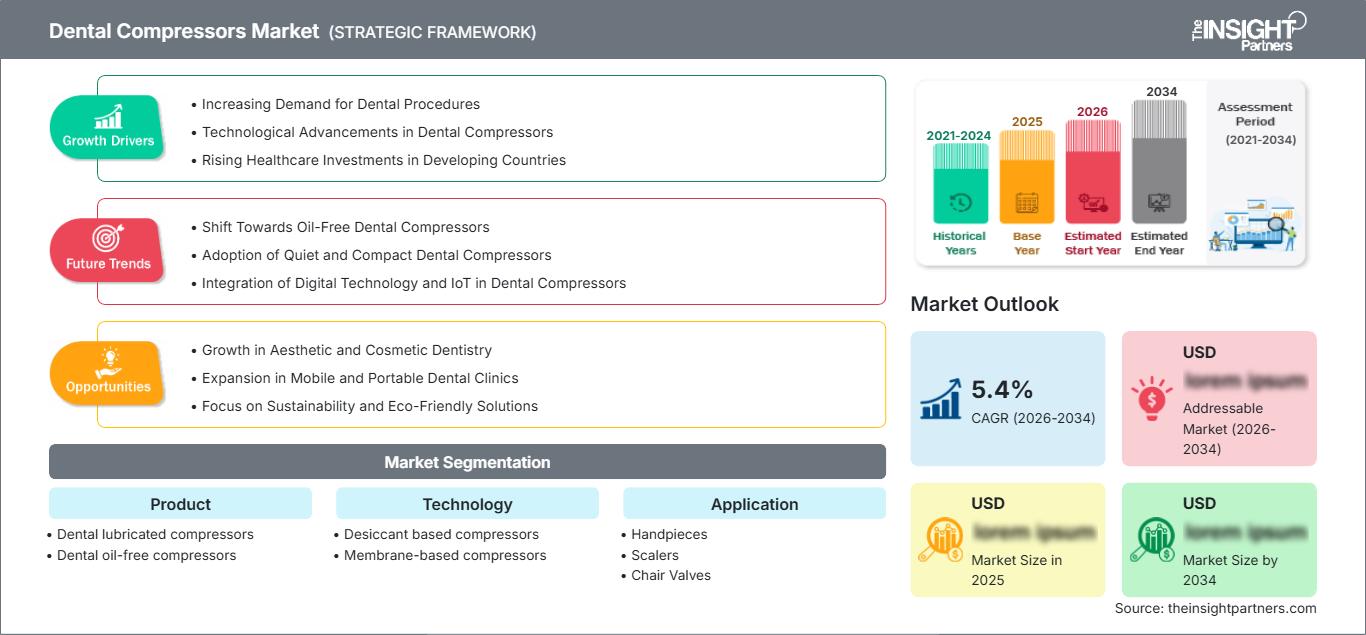
The Dental Compressors Market is positioned within the dental equipment ecosystem as practices prioritize dependable, clean, dry compressed air for powered instruments and treatment units. The market value is anticipated to be US$ 421.27 Million in 2025 and further expected to achieve US$ 626.29 Million by 2034, growing at a CAGR of 4.50% between 2026 and 2034. Factors affecting demand for the product include oil-free compression, better air management, low sound operation, and equipment reliability.
Market in North America is backed by the presence of existing dental facilities, replacement need, use in multi-chair settings, and air quality concerns. The regional market is anticipated to grow at a CAGR of 4.2-4.8% through 2026-2034. Dental Compressors Market size projection also gets positive support from DSO growth and procurement requirements of larger clinic networks.
Dental Compressors Market Assessment and Insights
- North America: North America represents a 34–37% share in 2025 and is projected to grow at a CAGR of 4.2–4.8% between 2026–2034, supported by mature dental infrastructure, replacement cycles, and multi-chair clinic expansion.
- US: The US accounts for 87–91% of North America's 2025 revenue and is expected to expand at a CAGR of 4.1–4.7% between 2026–2034, led by DSO networks and modernization.
- Europe: Europe holds a 26–30% share in 2025 and is forecast to grow at a CAGR of 4.0–4.6% between 2026–2034, with Germany, Italy, France, and the UK providing substantial demand through established dental manufacturing and equipment replacement.
- Asia Pacific: Asia Pacific represents a 24–28% share in 2025 and is expected to record a CAGR of 5.5–6.1% between 2026–2034, with China, Japan, India, South Korea, and Australia supporting clinic infrastructure investment.
- Largest Segment: Dental oil-free compressors hold a 58–62% market share in 2025 and are expected to grow at a CAGR of 4.1–4.7% between 2026–2034, reflecting hygiene and maintenance priorities.
- High Growth Segment: Dental lubricated compressors represent a 38–42% market share in 2025 and are projected to grow at a CAGR of 6.2–6.7% between 2026–2034, mainly across cost-sensitive markets.
- Key companies analyzed in detail: Tech West, Inc., Kaeser Dental, Air Techniques, Inc., Aixin Medical Equipment Co., Ltd., DENTALEZ, Inc., Diplomat Dental s.r.o., Midmark Corporation, DÜRR DENTAL SE, Gnatus, A-dec, Inc., and Quincy Compressor.
Source: The Insight Partners' analysis based on proprietary research, government publications, company annual reports, investor presentations, industry databases, and expert interviews.
Dental Compressors Market has developed from simple compressed air provision to system integration with oil-free compressors, air drying, filtration, noise reduction, and capacity tailored for specific applications. The manufacturers are improving materials used for pistons, heat management, capacity of the receiver tanks and dryers, in order to maintain air supply stability. Air quality is one of the key parameters now, as per the ISO 22052 guidelines for central dental compressed air systems.
Future development trends may include connected mechanical rooms, modular capacity, predictive maintenance and smart energy controls. Compact systems may be adopted by new markets in dentistry, which will grow from single-chair offices to multi-chair facilities. The compliance of regulations with the standards for dental equipment can help with replacing old equipment due to insufficient capabilities for moisture removal, filtration, noise and documentation.
Dental Compressors Market Report Scope
| Report Attribute | Details |
|---|---|
| Market size in 2025 | US$ 421.27 Million |
| Market Size by 2034 | US$ 626.29 Million |
| Global CAGR (2026 - 2034) | 4.50% |
| Historical Data | 2021-2024 |
| Forecast period | 2026-2034 |
Dental Compressors Market Analysis
Demand is closely related to dental hand pieces, scalers, chair valves, and treatment unit layouts, which makes the selection of a compressor based on airflow, pressure consistency, duty cycle, and air quality. The Growth of the Dental Compressor Market is therefore driven equally by the number of operatories and equipment replacement. The market consists of compressor companies, air dryer and filtration suppliers, dental equipment companies, distribution companies, installers, and service companies.
The supply situation is favorable towards specialized manufacturers that can integrate compression with air quality and acoustics. Oil-free systems have become more popular since the dental air needs to be free from any contamination that would otherwise harm the tools or procedures. ISO 22052 lays down the requirements and tests of central compressed air source equipment including the dental air quality and manufacturer information.
The competition lies on reliability, operating noise, lifecycle costs, serviceability, and technical differences. As shown in the Dental Compressors Market Report, traditional players tend to use complete mechanical room systems instead of the traditional compressors. Tech West, Air Techniques, Midmark, DÜRR DENTAL, Kaeser Dental, and DENTALEZ focus on specialization in dental technology; Gnatus, Aixin, Diplomat Dental, and A-dec focus on regional and integrated equipment.
Strategic positioning becomes more and more dependent on scale and bundled equipment options. In 2025, Air Techniques released the new product called AirStar Flex, and DÜRR DENTAL added to their compressor line the new Tornado family. It is worth noting that Midmark focuses on the development of connected operatory and mechanical room solutions.
● REPORT CUSTOMIZATION
Tailor This Report To Align With Your Specific Business Requirements
This report can be customized to align precisely with your business objectives, scope, and target markets. Customization options include tailored segmentation, geography, competitive analysis, and strategic insights to support informed decision-making.
Customize This Report →WHAT YOU CAN ADJUST
- ● Segmentations
- ● Geography
- ● Competitive Analysis
- ● Language Preferences
Dental Compressors Market: Strategic Insights
Regional Insights
North America Dental Compressors Market
North America held a Dental Compressors Market share of 34–37% in 2025 and will be growing at a CAGR of 4.2–4.8% until 2034. North America's dental infrastructure development, high replacement rates, well-established distributor network, and relatively high adoption of oil-free technology are among the contributing factors. Capacity and reliability have become crucial purchase considerations for large-scale practices in the region due to the need for air flow stability throughout operatories.
The United States is the largest national market, with Canada participating due to the presence of the well-established private sector infrastructure in the country. In addition, there is demand from dental service organizations due to standardization of equipment specifications in multiple locations. Air quality, drying efficiency, noise level, and maintenance are some of the critical purchase considerations.
U.S. Dental Compressors Market
The US represents approximately 87–91% of North America's 2025 revenue and is expected to grow at a CAGR of 4.1–4.7% through 2034. Its position reflects a large installed base of dental practices, continued DSO consolidation, replacement of aging utility equipment, and demand for dependable systems serving multiple operatories.
Use of such devices is focused primarily on handpieces, scalers, and pneumatic chair features, with high-speed handpieces posing some especially tough demands concerning pressure stability and dry air. Midmark, Air Techniques, Tech West, DENTALEZ, Kaeser Dental, and A-dec continue to stay visible in the market due to their range of dental equipment and partnerships. Standardization processes in groups of dentists are likely to make companies with such capabilities competitive.
Europe Dental Compressors Market
Europe had an existing share of 26-30%, with a projected growth rate of 4.0–4.6% during 2025-2034. Germany is the dominant market in this region, with reasons including developed dental machinery, technical sophistication and stringent requirements, and good supply availability in the country. Countries like the UK, France, Italy, and Spain also offer high demand from private clinics and hospitals for dental compressors.
The UK market is distinguished by its developed installed base and high focus on reliable clinical facilities. Germany has the benefit of its own engineering capability and DÜRR DENTAL and Kaeser Dental as companies. France, Italy, and Spain have developed dental practice combined with scope for modernization. European buyers are looking more at drying, filtration, acoustic characteristics along with the main compressor capacity.
APAC Dental Compressors Market
APAC accounted for a market share of 24-28% in 2025 and is expected to increase at a CAGR of 5.5-6.1%. The Chinese market dominates this region, followed by Japan, South Korea, India, and Australia via modernization efforts, setting up private clinics, and increasing access to dental care services. The previous studies from the same region have also found China to be the leading nation, and India a fast-growing market.
Industrialization and investments in health facilities drive the demand for standardized compressed air systems. India and China have huge potential in the form of greenfield clinics, while Japan and South Korea focus on the quality and reliability of equipment. Australia gains from clinical standards and the need for replacements. The region increasingly adopts oil-free systems and drying technology due to increasing speed of instruments and digital dental treatments.
Middle East & Africa Dental Compressors Market
Middle East & Africa comprises a regional share of around 7-9% in 2025 and is projected to grow at a CAGR of 4.8%-5.5%. Saudi Arabia and UAE lead regional demand on account of their efforts toward building up healthcare infrastructure and setting up private hospitals, along with dental tourism. South Africa continues to be a key market for dental practices.
The rest of MEA provides future growth potential on the back of improvements in healthcare infrastructure and expansion by the private sector. Ambient high temperatures and inconsistent performance in facilities make thermal management and drying crucial considerations. This will provide suppliers with regional presence and technical expertise a chance, as uptime will take priority over minimum purchase costs.
Segmentation Analysis
Product
Product segmentation is shaped by contamination control, lifecycle cost, noise, maintenance requirements, and purchasing budgets. Dental oil-free compressors remain the leading configuration, while lubricated compressors retain relevance where upfront economics dominate. The segment is projected to grow at a CAGR of 4.3–5.0% from 2026–2034 as replacement demand remains steady and emerging markets broaden their equipment base.
- Dental lubricated compressors: These systems remain relevant in price-sensitive installations where buyers prioritize acquisition economics and conventional maintenance practices. Their strategic importance is strongest in smaller clinics and developing markets.
- Dental oil-free compressors: Oil-free designs occupy the leading position because they support clean compressed air, reduce oil-related contamination concerns, and align with modern dental equipment quality expectations.
Technology
Technology segmentation in the Dental Compressors Market reflects the method used to remove moisture and stabilize compressed air quality. Desiccant-based systems currently dominate because of established performance and broad availability. The technology segment is estimated to expand at a CAGR of 4.6–5.3% through 2034, with membrane systems gaining attention where continuous dry-air delivery and compact integration are priorities.
- Desiccant based compressors: Desiccant drying remains strategically important for moisture removal and established dental installations, particularly where reliable air treatment is required across multiple daily treatment cycles.
- Membrane-based compressors: Membrane technology supports compact, continuous drying and is increasingly relevant for clinics seeking integrated systems, lower maintenance requirements, and consistent performance during extended operating periods.
Application
Application segmentation in the Dental Compressors Market is driven by airflow demand, pressure sensitivity, instrument duty cycles, and the number of connected treatment functions. Handpieces account for the largest application share because high-speed instruments require dependable compressed air. The application segment is projected to grow at a CAGR of 4.9–5.6% from 2026–2034 as procedure volumes and multi-chair utilization increase.
- Handpieces: Handpieces represent the principal compressed-air application because high-speed operation requires stable pressure and appropriately treated air. Compressor performance directly affects instrument consistency and clinical workflow.
- Scalers: Scalers require reliable pneumatic support and stable airflow during repetitive procedures. Their strategic importance increases as preventive and periodontal treatment volumes expand across established and emerging practices.
- Chair Valves: Chair valves support pneumatic control within treatment units and benefit from dependable pressure availability. Their importance increases as dental chairs integrate more functions into centralized utility systems.
Opportunity Snapshot
| Application | Revenue Contribution (High/Medium/Low) | Trend Tag (MAX 2 words) | Adoption Stage |
|---|---|---|---|
| Handpieces | High | High-Speed Air | Mature |
| Scalers | Medium | Air Scaling | Scaling |
| Chair Valves | Medium | Pneumatic Control | Scaling |
Dental Compressors Market Growth Drivers and Impact Analysis
Expansion of Multi-Chair Dental Practices
Growing use of multi-chair clinics adds to the need for more compressed air since a number of treatment stations may be in use at any one time. Thus larger facilities will focus on the importance of receiver capacity, air flow stability, redundancy, and constant drying of the air, rather than merely choosing equipment based upon its motor size. DSO consolidation adds to this driver by favoring standardized equipment specifications in a number of facilities. This leads to a greater preference for scalable compressor setups that are able to handle an expansion of operatories without requiring a major overhaul of the infrastructure. Equipment suppliers with different capacity classes of equipment are able to help out here.
Stricter Emphasis on Dental Air Quality
Air quality is becoming a more explicit procurement criterion as dental equipment manufacturers and healthcare providers recognize the effects of moisture, particles, and oil contamination on instruments and treatment workflows. ISO 22052 provides a formal framework for central dental compressed-air equipment, including requirements related to dental-air quality and equipment testing. This encourages buyers to evaluate compressors together with filtration and drying systems. The market impact is particularly significant for replacement purchases because older installations may provide adequate pressure while lacking modern air-treatment capabilities. Suppliers can therefore differentiate through integrated dryers, filtration, monitoring, and documented performance. Over time, quality-focused procurement should reinforce oil-free systems and encourage upgrades from basic compressor units toward complete compressed-air treatment packages.
Rising Dental Procedure Complexity and Equipment Utilization
Greater utilization of high-speed handpieces, air scalers, and digitally enabled dental equipment increases the need for consistent compressed-air delivery. The compressor has become an enabling component for clinical productivity because unstable pressure or excessive moisture can affect instrument performance and maintenance. Growing use of CAD/CAM and other digitally intensive workflows also raises expectations for clean and dry air, although laboratory applications remain distinct from the scope of ISO 22052. The resulting market impact extends beyond new installations to replacement and capacity upgrades. Practices increasingly assess compressor performance according to duty cycle, airflow stability, acoustic profile, and dryer capability, strengthening demand for application-specific systems rather than generalized industrial compressors.
Dental Compressors Market Future Trends
Connected Mechanical Rooms and Predictive Service
Connected compressor systems are likely to become more common in the Dental Compressors Market Trends as dental practices seek earlier warnings of overheating, pressure abnormalities, filter deterioration, and excessive operating hours. Future platforms can combine sensors, controller data, and service records to create maintenance alerts before performance degradation interrupts treatment. This trend should move supplier relationships toward lifecycle management rather than one-time equipment transactions. Multi-site dental groups could particularly benefit because centralized monitoring can compare utilization across practices and identify underused or overloaded systems. Integration with broader practice-management infrastructure may eventually enable service scheduling based on actual operating conditions rather than fixed intervals. The strategic consequence is a stronger role for software, remote diagnostics, and service contracts in compressor purchasing decisions.
Higher Efficiency Through Modular Capacity
Future systems are expected to place greater emphasis on modular capacity, allowing dental practices to match compressed-air production with actual utilization. Modular configurations can reduce the need to oversize equipment during the initial installation while providing expansion paths as operatories are added. Manufacturers may increasingly combine multiple compressor heads, variable control strategies, improved cooling, and advanced drying into compact packages. Such architecture can also improve resilience because individual components may be serviced without shutting down the entire compressed-air supply. Energy performance will remain important as practices face rising operating costs and sustainability expectations. The strongest designs are therefore likely to balance airflow availability, duty cycle, noise, serviceability, and electricity consumption rather than optimizing any single technical specification.
Dental Compressors Market Opportunities
Greenfield Clinic Infrastructure in Emerging Economies
Emerging markets in the Dental Compressors Market Forecast present an opportunity for suppliers to establish standardized compressed-air platforms during the construction of new dental facilities. Greenfield projects allow manufacturers to influence compressor selection before utility rooms, piping, and treatment units are finalized. Vendors can package compressors with dryers, filtration, receivers, controls, and installation support to reduce integration complexity. India, China, Southeast Asia, and selected Middle Eastern markets offer attractive conditions where private dental networks are expanding. A modular product architecture could serve single-chair clinics initially while allowing later capacity additions. Investors and manufacturers should prioritize local service partnerships because technical support can materially influence purchasing decisions in markets where replacement parts and specialized maintenance expertise are less readily available. Such strategies can create durable installed-base relationships.
Lifecycle Service and Retrofit Programs
A substantial opportunity exists in replacing aging compressors where the installed equipment remains functional but no longer satisfies current expectations for drying, noise, energy efficiency, or maintenance. Retrofit programs can target installed systems with replacement compressors, upgraded dryers, filtration assemblies, monitoring equipment, and control panels. Suppliers can improve conversion rates by offering capacity assessments that calculate actual airflow demand across operatories rather than selling standardized units. Service agreements can then combine scheduled maintenance with replacement-part availability and remote diagnostics. The Dental Compressors Market Forecasts should therefore be considered not only through new clinic construction but also through the recurring lifecycle requirements of the installed base. Vendors with strong field-service capabilities may capture value beyond initial equipment sales.
Recent Developments
- May 2026: Air Techniques, Inc. expanded its 2026 commercial offering around AirStar compressor and Mojave vacuum bundles, with a promotion running from May 1 through October 15, 2026. The program combines compressor and vacuum purchases with upgraded equipment, illustrating continued emphasis on bundled dental utility systems and practice-level procurement.
- February 2026: Midmark Corporation announced next-generation connected dental operatory and smart mechanical-room solutions, emphasizing connectivity, reliability, performance, and ongoing technology improvements. The launch indicates a broader move toward integrated dental infrastructure in which mechanical-room equipment becomes part of a connected clinical environment rather than an isolated utility asset.
- December 2025: DÜRR DENTAL SE announced that its new Tornado dental compressor received a German Design Award 2026 in the Excellent Product Design category. The recognition followed the company's 2025 introduction of the Tornado platform, which emphasizes durability, performance, oil-free dry air, and operation under demanding practice conditions.
Frequently Asked Questions

- Comprehensive Market Sizing and Forecast Analysis
- Detailed Segmentation Analysis
- In-Depth Market Dynamics Assessment
- Regional and Country-Level Insights
- Competitive Landscape and Company Benchmarking
- Strategic Business Intelligence
Recent Reports
Testimonials

The Insight Partners' SCADA System Market report is comprehensive, with valuable insights on current trends and future forecasts. The team was highly professional, responsive, and supportive throughout. We are very satisfied and highly recommend their services.
RAN KEDEM Partner, Reali Technologies LTDs
I requested a report on a very specific software market and the team produced the report in a few days. The information was very relevant and well presented. I then requested some changes and additions to the report. The team was again very responsive and I got the final report in less than a week.
JEAN-HERVE JENN Chairman, Future Analytica
We worked with The Insight Partners for an important market study and forecast. They gave us clear insights into opportunities and risks, which helped shape our plans. Their research was easy to use and based on solid data. It helped us make smart, confident decisions. We highly recommend them.
PIYUSH NAGPAL Sr. Vice President, High Beam Global
The Insight Partners delivered insightful, well-structured market research with strong domain expertise. Their team was professional and responsive throughout. The user-friendly website made accessing industry reports seamless. We highly recommend them for reliable, high-quality research services
YUKIHIKO ADACHI CEO, Deep Blue, LLC.
This is the first time I have purchased a market report from The Insight Partners.While I was unsure at first, I visited their web site and felt more comfortable to take the risk and purchase a market report.I am completely satisfied with the quality of the report and customer service. I had several questions and comments with the initial report, but after a couple of dialogs over email with their analyst I believe I have a report that I can use as input to our strategic planning process.Thank you so much for taking the extra time and making this a positive experience.I will definitely recommend your service to others and you will be my first call when we need further market data.
JOHN SUZUKI President and Chief Executive Officer, Board Director, BK Technologies
I wish to appreciate your support and the professionalism you displayed in the course of attending to my request for information regarding to infectious disease IVD market in Nigeria. I appreciate your patience, your guidance, and the fact that you were willing to offer a discount, which eventually made it possible for us to close a deal. I look forward to engaging The Insight Partners in the future, all thanks to the impression you have created in me as a result of this first encounter.
DR CHIJIOKE ONYIA MANAGING DIRECTOR, PineCrest Healthcare Ltd.Reason to Buy
- Informed Decision-Making
- Understanding Market Dynamics
- Competitive Analysis
- Identifying Emerging Markets
- Customer Insights
- Market Forecasts
- Risk Mitigation
- Boosting Operational Efficiency
- Strategic Planning
- Investment Justification
- Tracking Industry Innovations
- Aligning with Regulatory Trends





 Get Free Sample for