
Dental Mirror Handles Market Size, Growth & Trends by 2034
Coverage: By Product (Stainless Steel Handle, Plastic Handle, Aluminium Handle, Others); Application (Hospital, Dental Clinics, Others), and Geography (North America, Europe, Asia Pacific, and South and Central America)
- Status : Data Released
- Report Code : TIPRE00015213
- Category : Life Sciences
- No. of Pages : 150
- Available Report Formats :


- Last update date : August 27, 2026


2025 Market Size
US$ 454.43 Mn
Base year value
2034 Forecast
US$ 791.12 Mn
Projected by 2034
CAGR 2026-2034
6.35 %
Growth rate
Addressable Market
US$ 5,634.69 Mn
(2026-2034)
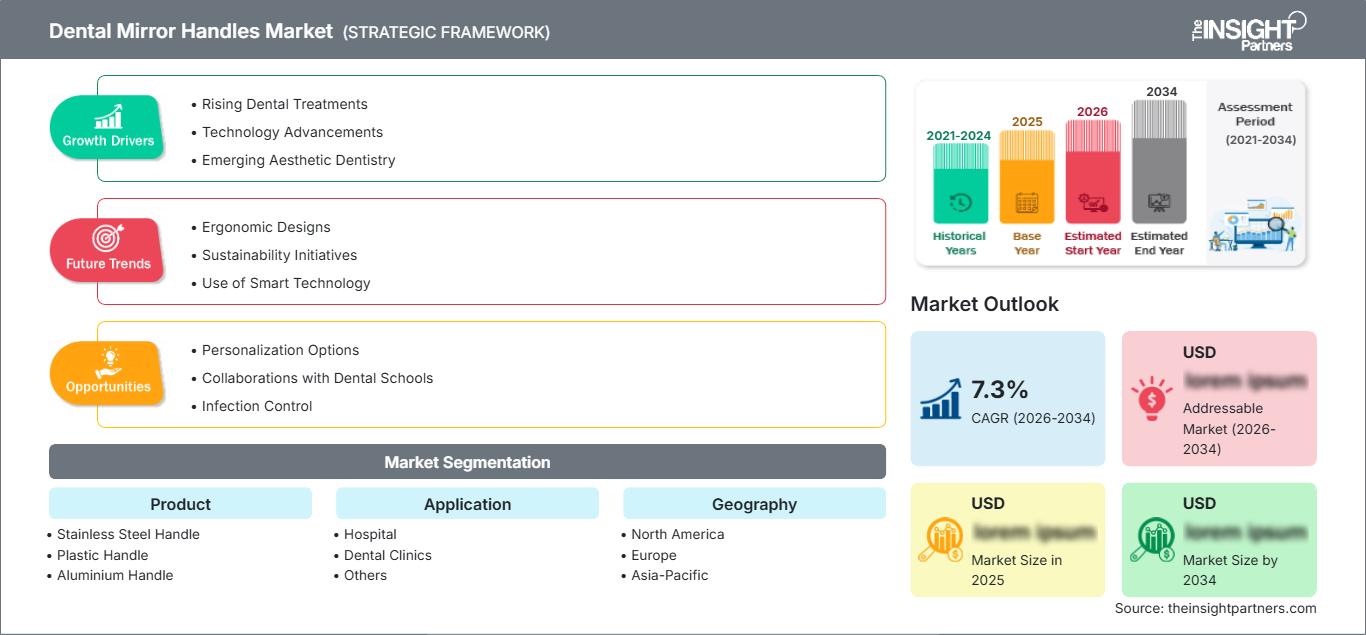
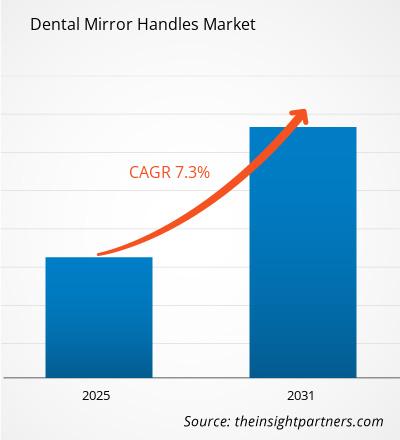
The Dental Mirror Handles Market is projected to expand from US$ 454.43 Million in 2025 to US$ 791.12 Million by 2034, registering a CAGR of 6.35% during 2026–2034. The market encompasses handles manufactured from stainless steel, plastic, aluminum, and other materials, serving hospital and dental clinic applications. Demand is shaped by routine diagnostic procedures, instrument durability requirements, infection-control protocols, ergonomic design, and replacement purchasing across established and developing dental-care systems.
North America is positioned for steady expansion, supported by established dental infrastructure, recurring instrument replacement, higher utilization of reusable clinical tools, and stringent expectations for cleanability and durability. The Dental Mirror Handles Market size is also influenced by dental service organizations, specialty practices, and procurement consolidation, with regional growth expected at approximately 5.8–6.4% CAGR between 2026 and 2034.
Dental Mirror Handles Market Assessment and Insights
- North America: The region is expected to hold a 31–35% Dental Mirror Handles Market share in 2025, supported by mature dental infrastructure and replacement demand, while growing at a CAGR of 5.8–6.4% between 2026–2034.
- US: The US represents approximately 78–82% of North American demand in 2025, with purchasing supported by organized dental practices and replacement cycles, growing at a CAGR of 5.7–6.3%.
- Europe: Europe is estimated at a 27–31% share in 2025, with Germany, the UK, France, Italy, and Spain providing established demand and growing at a CAGR of 5.4–6.0% between 2026–2034.
- Asia Pacific: Asia Pacific accounts for an estimated 22–26% share in 2025, led by China, Japan, India, South Korea, and Australia, with infrastructure expansion supporting a 6.7–7.4% CAGR.
- Largest Segment: Stainless steel handles represent an estimated 54–58% market share in 2025, benefiting from durability and sterilization compatibility, with a 6.1–6.4% CAGR.
- High Growth Segment: Plastic handles hold an estimated 18–22% share in 2025 and are positioned for a 6.8–7.3% CAGR through 2034.
- Key companies analyzed in detail: DynaFlex, Karl Schumacher Dental, LLC, AR Instrumed Deutschland GmbH, DENTSPLY SIRONA Inc., LM-Instruments Oy, Nichrominox, Hager & Werken GmbH & Co. KG, HuFriedyGroup, Kentzler-Kaschner Dental GmbH, A. Titan Instruments.
Source: The Insight Partners' analysis based on proprietary research, government publications, company annual reports, investor presentations, industry databases, and expert interviews.
Product design trends in the Dental Mirror Handles Market include improved ergonomics, good balance of mass, anti-corrosion capability, and resistance to frequent cleaning/sterilization. Stainless steel is useful in cases where product durability and physical toughness are necessary, while polymeric materials help achieve lightweight designs and distinguish the color. Manufacturing will have more influence of precision engineering, surface technology, material traceability, and reduced variability in dimensions within high-volume product lines.
Opportunities for future growth in the Dental Mirror Handles Market will arise from Asia-Pacific and Middle East markets, where there is increasing development in dental care systems. Purchase organizations are now focused on total cost of ownership as opposed to purchase cost only. This will favor manufacturers that can prove product durability, reusability, and predictable replacement intervals.
Dental Mirror Handles Market Report Scope
| Report Attribute | Details |
|---|---|
| Market size in 2025 | US$ 454.43 Million |
| Market Size by 2034 | US$ 791.12 Million |
| Global CAGR (2026 - 2034) | 6.35% |
| Historical Data | 2021-2024 |
| Forecast period | 2026-2034 |
Dental Mirror Handles Market Analysis
The demand for the product is supported by the repeated usage of the mirrors during examinations, restoration work, periodontics, orthodontics, and surgery procedures. This makes the Dental Mirror Handles Market growth related to procedure frequency, dental chair installations, replacement of instruments, and hygiene. The value chain comprises suppliers of steel and polymer, machinists, molders, finishers, assembly of instruments, distributors, and dental offices.
The supply differs depending on materials used. While stainless steel needs forming, machining, polishing, and finishing abilities, the polymer-based products rely mostly on injection molding and formulation of material. The distribution is still significant as the practices buy not only handles but also the mirrors and other instruments. The supplier sustainability is becoming more and more dependent on the constant material quality, efficient manufacturing lots, documentation, and availability of different handles types.
Competitive positioning is segmented among diversified dental instruments companies and niche instrument manufacturers. The Dental Mirror Handles Market report suggests that existing brands compete on instrument range, distributor connections, manufacturing quality, and familiarity among clinicians. Established brands such as DENTSPLY SIRONA Inc. and HuFriedyGroup leverage their diversified professional offerings, whereas Karl Schumacher Dental, LLC, A. Titan Instruments, and LM-Instruments Oy rely more on specialized instruments and manufacturing expertise.
The focus of investment decisions becomes more oriented toward manufacturing efficiency, ergonomics, consistent product delivery, and channel expansion as opposed to disruptive technological innovation. LM-Instruments Oy has increased manufacturing capacity in Finland, and DENTSPLY SIRONA Inc. is constantly building commercial and technology distribution relationships. Niche instrument brands including AR Instrumed Deutschland GmbH and Kentzler-Kaschner Dental GmbH & Co. KG might have competitive advantage through customization and specialization.
● REPORT CUSTOMIZATION
Tailor This Report To Align With Your Specific Business Requirements
This report can be customized to align precisely with your business objectives, scope, and target markets. Customization options include tailored segmentation, geography, competitive analysis, and strategic insights to support informed decision-making.
Customize This Report →WHAT YOU CAN ADJUST
- ● Segmentations
- ● Geography
- ● Competitive Analysis
- ● Language Preferences
Dental Mirror Handles Market: Strategic Insights
Regional Insights
North America Dental Mirror Handles Market
North America is estimated to command a 31–35% share in 2025 and expand at a 5.8–6.4% CAGR through 2034. The US controls regional demand due to well-developed dental infrastructure, structured procurement, periodic replacement of instruments, and the extensive usage of reusable examination instruments.
Canada is involved due to private dental clinics, institutional dentistry, and specialists. Sterilization requirements, ergonomic factors, and the need for instrument replacements impact the demand. Procurement tends to favor providers that can deliver consistent dimensions and reliable delivery. The same applies to dental service organizations that favor standardization of instrument specifications across various sites for repeated procurement and portfolio optimization.
U.S. Dental Mirror Handles Market Market
The US represents approximately 78–82% of North American demand in 2025 and is projected to grow at a 5.7–6.3% CAGR through 2034. Routine practices, DSOs, hospitals, and specialized clinics provide continuity in purchasing activity. Participation of DynaFlex, Karl Schumacher Dental, LLC, HuFriedyGroup, and A. Titan Instruments ensures wide availability within professional supply chains.
The need for handles is limited to diagnostic and clinical applications when repeated cleaning and sterilization are required. Stainless steel remains an essential material due to its durability, but lightweight polymer versions allow practices to stand out in terms of ergonomics. Balance, ease of grip, surface quality, and compatibility with the existing mirror heads become crucial purchasing criteria.
Europe Dental Mirror Handles Market Market
Europe is estimated at a 27–31% share in 2025 and is expected to grow at a 5.4–6.0% CAGR through 2034, with Germany leading regional demand. UK, Germany, France, Italy, and Spain provide the principal national markets, supported by established dental networks and regulatory discipline.
These two nations are regarded as major sources of demand as a result of existing infrastructure in dentistry, procurement networks of professionals, and widespread adoption of reusable surgical equipment. Germany further has an advantage of being home to a highly developed manufacturing base of precision instruments used in dentistry and medicine. In addition, France, Italy, and Spain contribute as complementary sources of demand.
APAC Dental Mirror Handles Market Market
APAC is estimated to represent 22–26% of global demand in 2025 and is forecast to grow at a 6.7–7.4% CAGR. China is at the forefront, followed by Japan, India, South Korea, and Australia. Growth in dental infrastructure and increased presence of private clinics will boost the demand.
The development of industry in China and India improves manufacturing capacity, whereas Japan and South Korea pay attention to accuracy and quality. Australia gets the benefit of having well-established clinical standards. Programs for public health, dental education, urbanization, and private investments will help with replacing and procuring instruments.
Middle East & Africa Dental Mirror Handles Market Market
Middle East and Africa demand is expected to expand at a 5.9–6.6% CAGR, with Saudi Arabia leading the regional opportunity. UAE and South Africa remain important procurement centers, while the rest of MEA represents a longer-term infrastructure opportunity.
Saudi Arabia and UAE benefit from healthcare investment, private-clinic development, and modern facility construction. South Africa provides an established dental market within the region, while other MEA countries remain more dependent on imported instruments. Energy revenues and healthcare infrastructure investment can support procurement, although affordability, distribution coverage, and supply continuity remain important constraints.
Segmentation Analysis
Product
The product segment is expected to expand at a 6.0–6.6% CAGR between 2026–2034. Material selection is driven by durability, sterilization compatibility, weight, grip comfort, manufacturing cost, and clinician preference. Stainless steel remains structurally important because it supports repeated processing, while polymers and aluminum create opportunities for lighter designs and differentiated ergonomics. The Dental Mirror Handles Market scope therefore spans both established reusable products and evolving lightweight configurations.
- Stainless Steel Handle: Remains the principal configuration for practices prioritizing mechanical strength, corrosion resistance, repeated sterilization, and long service life. Its established clinical familiarity supports continued procurement across hospitals and dental clinics.
- Plastic Handle: Addresses demand for lightweight construction, ergonomic handling, color identification, and cost-sensitive procurement. Polymer molding also enables design flexibility and efficient production of standardized handle formats.
- Aluminium Handle: Provides a balance between low weight and metallic durability. Adoption is relevant where clinicians value reduced instrument mass while retaining a rigid handle structure for routine diagnostic procedures.
- Others: Covers alternative constructions and specialized designs serving differentiated clinical preferences, niche applications, or product configurations where manufacturers combine materials to achieve specific handling characteristics.
Application
The application segment is projected to grow at a 5.7–6.3% CAGR during 2026–2034. Hospitals require dependable instruments for high-frequency clinical workflows, while dental clinics represent a broad recurring customer base. Procurement increasingly reflects instrument standardization, reprocessing requirements, ergonomics, and replacement economics. The Dental Mirror Handles Market analysis indicates that purchasing patterns differ according to procedure intensity, facility size, sterilization infrastructure, and centralized procurement practices.
- Hospital: Hospitals require durable handles capable of supporting repeated examination procedures, centralized sterilization, and standardized inventory management. Procurement decisions emphasize reliability, compatibility, lifecycle cost, and availability through established medical-device distributors.
- Dental Clinics: Dental clinics constitute a broad demand base, with purchasing shaped by routine examinations, restorative care, ergonomic preferences, and replacement of worn instruments. Independent practices and organized groups create varied procurement models.
- Others: Includes educational, institutional, mobile, and specialized dental-care settings where smaller instrument inventories and specific procedural needs influence purchasing. Demand is typically shaped by training requirements, portability, and budget considerations.
Opportunity Snapshot
| End User | Revenue Contribution (High/Medium/Low) | Trend Tag | Adoption Stage |
|---|---|---|---|
| Hospital | High | Sterile Reuse | Mature |
| Dental Clinics | High | Ergonomic Grip | Mature |
| Others | Low | Portable Care | Scaling |
Dental Mirror Handles Market Growth Drivers and Impact Analysis
Rising Global Burden of Oral Disease
Global oral care needs form a sustainable underlying demand basis to study the examination instruments. According to the World Health Organization, 3.5 billion people worldwide suffer from oral diseases; untreated caries remains one of the most common conditions and 1 billion people suffer from severe periodontal disease. Such statistics result in an increased number of people who would require diagnosis, treatment, and monitoring. In terms of demand from manufacturers, the higher procedure intensity translates to greater recurring demand for examination tools that include handles and mirror assemblies. The greatest influence is seen in the markets where the availability of dental services expands from the urban areas towards the secondary cities. The increased use does not necessarily mean the adoption of high-end products.
Expansion of Organized Dental Care Networks
Changes in the growing level of organization of dental practices are affecting the way in which purchasing is shifting from individual purchases made by clinicians to standardizing inventory purchases. The larger orders made by dental service organizations, hospital chains, university health care services, and multi-clinic organizations will be more demanding on product quality and uniform dimensions in product packaging and labeling as well as product delivery. These changes will favor suppliers that are able to deliver such requirements. The role of distributors will also become more important since centralized purchasing organizations are likely to require greater distribution capacity and delivery reliability. For the manufacturing companies, organized purchasing means lower sales cost per unit and higher competitive pressure on pricing and deliveries.
Stricter Reprocessing and Instrument Quality Expectations
Infection prevention requirements are strengthening attention to the materials and construction of reusable dental instruments. Handles used in clinical environments must withstand repeated cleaning and sterilization without excessive corrosion, deformation, surface deterioration, or loss of functional integrity. Accordingly, purchasing departments now measure the lifecycle performance rather than just the cost of the first purchase. Stainless steel items stand to gain due to the focus on this factor, since the mechanical and corrosion properties of stainless steel allow for the reprocessing of the material, provided that it was made and maintained correctly. Items made out of polymer and aluminum materials may also stand to gain market share in those cases where the design of the item is validated and meets the demands of cleaning, durability, and handling.
Dental Mirror Handles Market Future Trends
Ergonomic and Lightweight Instrument Architecture
The Dental Mirror Handles Market trends indicate that in terms of future innovation, product development will focus on ergonomic geometry, proper center of gravity, gripping surfaces, and lighter weight instruments. Manufacturers can achieve such an outcome with the help of polymer design, using aluminum and other materials, along with surface coatings and combinations of materials. It is especially relevant in light of the fact that clinicians have to repeat procedures during the entire working day. It does not mean that manufacturers should get rid of stainless steel altogether – different types of products will remain on the market together. Moreover, digital manufacturing technologies will allow for the quick creation of prototypes of grip shapes and improvement of designs. In the long term, the purchase decision could involve sterilization properties as well as ergonomics.
Traceable Manufacturing and Sustainable Reprocessing
The manufacture of products is likely to pay more attention to traceable material composition, production documentation, reparability, and environmentally friendly reprocessing. Healthcare institutions are starting to evaluate the implications of reusable equipment regarding its lifecycle performance, which includes such aspects as durability, packaging, servicing, and recycling. In case of dental instruments, a longer life cycle can help minimize the number of replacements and thus the consumption of materials involved, if at the same time their clinical performance and hygienic conditions are met. The process of production of products may include automated testing, recording of the quality of products electronically, as well as an effective finishing stage. Sustainable packaging and minimizing of waste during the process of manufacturing will not affect the clinical purpose of the product.
Dental Mirror Handles Market Opportunities
Localized Production and Regional Distribution Platforms
Manufacturers can pursue regional production or assembly strategies in markets where dental infrastructure is expanding but supply chains remain import dependent. Localized operations can shorten lead times, reduce exposure to freight disruption, and enable closer adaptation to regional procurement preferences. Asia Pacific offers a particularly relevant setting because large patient populations coexist with growing private dental networks and increasingly capable manufacturing ecosystems. Partnerships with regional distributors can provide another route to expansion without requiring immediate large-scale fixed investment. Companies should prioritize standardized high-volume configurations while maintaining a limited range of premium ergonomic products. The Dental Mirror Handles Market Forecasts can therefore support investment decisions around manufacturing footprint, inventory positioning, and channel partnerships where expected procedure growth is sufficient to offset localization costs.
Portfolio Bundling Across Clinical Instrument Categories
A second opportunity lies in bundling mirror handles with complementary diagnostic and examination instruments. Dental practices frequently procure multiple instrument categories through the same distributor, allowing suppliers to improve account penetration without relying solely on individual handle sales. Bundles can be tailored to general dentistry, periodontal care, orthodontics, education, or hospital use, with different material and ergonomic specifications. Manufacturers with broader portfolios can integrate handles into standardized kits, while specialists can partner with distributors that already serve high-frequency clinical accounts. The strategy should focus on practical procurement efficiencies rather than excessive product proliferation. Clear compatibility specifications, replenishment programs, and standardized packaging can make bundled offerings attractive to centralized buyers while helping suppliers defend relationships against single-product competitors.
Recent Developments
- March 2026: LM-Dental commissioned a new production hall in Kaarina, Finland, adding modern turning technology, robotics, silicone manufacturing, and other machinery. The company said the facility also brings selected component production in-house, strengthening production flexibility, delivery reliability, and quality control while supporting continued instrument manufacturing expansion.
- February 2026: DENTSPLY SIRONA Inc. reported fourth-quarter 2025 net sales of US$961 million and announced a restructuring initiative expected to redirect approximately US$120 million annually toward its Return-to-Growth plan, including innovation, clinical education, and commercial capabilities. It also established several new distribution agreements covering dental products and technology.
- February 2026: DynaFlex featured its Norris 20/26 bracket system as a new orthodontic platform emphasizing treatment efficiency, passive self-ligation, arch-form technology, and enhanced torque and tip control. The product illustrates continued development of specialized dental instrumentation and orthodontic workflows alongside the company’s broader dental product portfolio.
Frequently Asked Questions

- Comprehensive Market Sizing and Forecast Analysis
- Detailed Segmentation Analysis
- In-Depth Market Dynamics Assessment
- Regional and Country-Level Insights
- Competitive Landscape and Company Benchmarking
- Strategic Business Intelligence
Recent Reports
Testimonials

The Insight Partners' SCADA System Market report is comprehensive, with valuable insights on current trends and future forecasts. The team was highly professional, responsive, and supportive throughout. We are very satisfied and highly recommend their services.
RAN KEDEM Partner, Reali Technologies LTDs
I requested a report on a very specific software market and the team produced the report in a few days. The information was very relevant and well presented. I then requested some changes and additions to the report. The team was again very responsive and I got the final report in less than a week.
JEAN-HERVE JENN Chairman, Future Analytica
We worked with The Insight Partners for an important market study and forecast. They gave us clear insights into opportunities and risks, which helped shape our plans. Their research was easy to use and based on solid data. It helped us make smart, confident decisions. We highly recommend them.
PIYUSH NAGPAL Sr. Vice President, High Beam Global
The Insight Partners delivered insightful, well-structured market research with strong domain expertise. Their team was professional and responsive throughout. The user-friendly website made accessing industry reports seamless. We highly recommend them for reliable, high-quality research services
YUKIHIKO ADACHI CEO, Deep Blue, LLC.
This is the first time I have purchased a market report from The Insight Partners.While I was unsure at first, I visited their web site and felt more comfortable to take the risk and purchase a market report.I am completely satisfied with the quality of the report and customer service. I had several questions and comments with the initial report, but after a couple of dialogs over email with their analyst I believe I have a report that I can use as input to our strategic planning process.Thank you so much for taking the extra time and making this a positive experience.I will definitely recommend your service to others and you will be my first call when we need further market data.
JOHN SUZUKI President and Chief Executive Officer, Board Director, BK Technologies
I wish to appreciate your support and the professionalism you displayed in the course of attending to my request for information regarding to infectious disease IVD market in Nigeria. I appreciate your patience, your guidance, and the fact that you were willing to offer a discount, which eventually made it possible for us to close a deal. I look forward to engaging The Insight Partners in the future, all thanks to the impression you have created in me as a result of this first encounter.
DR CHIJIOKE ONYIA MANAGING DIRECTOR, PineCrest Healthcare Ltd.Reason to Buy
- Informed Decision-Making
- Understanding Market Dynamics
- Competitive Analysis
- Identifying Emerging Markets
- Customer Insights
- Market Forecasts
- Risk Mitigation
- Boosting Operational Efficiency
- Strategic Planning
- Investment Justification
- Tracking Industry Innovations
- Aligning with Regulatory Trends





 Get Free Sample for