
Depth Filtration Market Demand, Size & Forecast by 2034
Depth Filtration Market Size and Forecasts (2021–2034), Global and Regional Share, Trends, and Growth Opportunity Analysis Report Coverage : by Media Type (Activated Carbon, Diatomaceous Earth, Cellulose, Perlite); Product (Cartridge Filters, Capsule Filters); Application (Final Product Processing, Cell Clarification, Raw Material Filtration, Blood Separation); and Geography (North America, Europe, Asia Pacific, and South and Central America)
- Status : Data Released
- Report Code : TIPRE00040105
- Category : Life Sciences
- No. of Pages : 150
- Available Report Formats :


- Last update date : September 09, 2026


2025 Market Size
US$ 3.01 Bn
Base year value
2034 Forecast
US$ 6.35 Bn
Projected by 2034
CAGR 2026-2034
9.78 %
Growth rate
Addressable Market
US$ 44.46 Bn
(2026-2034)
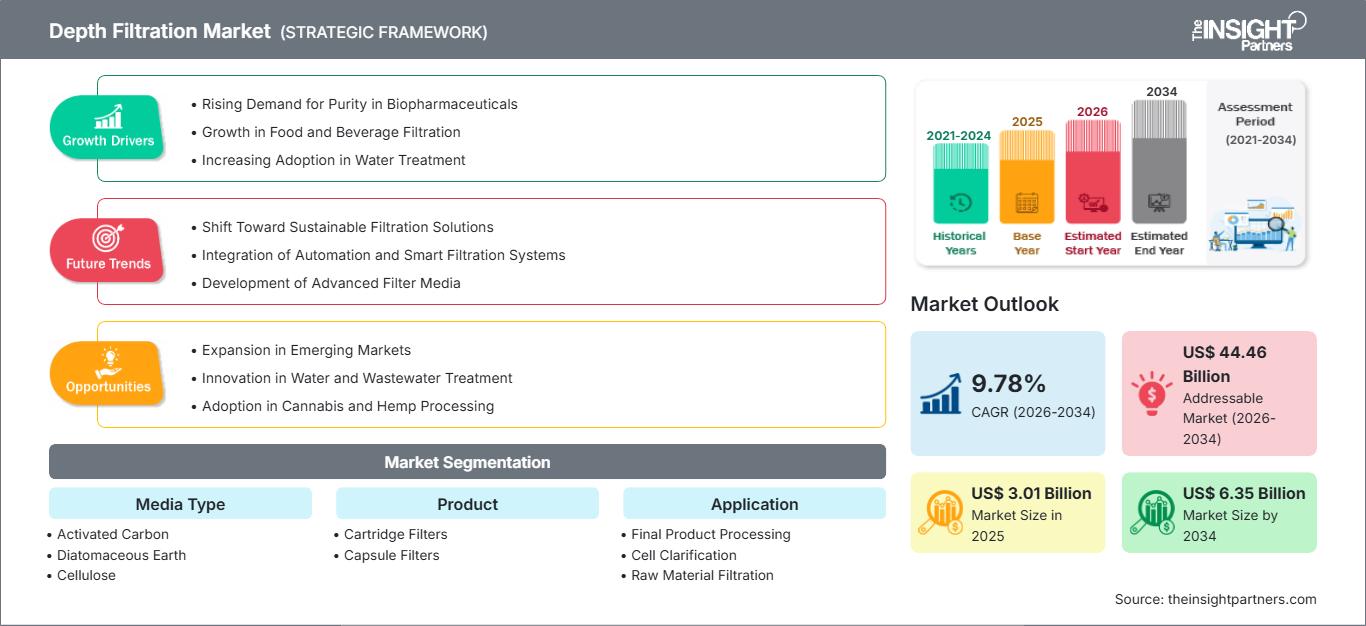
The Depth Filtration Market generated revenue of US$ 3.01 Billion in 2025 and is projected to reach US$ 6.35 Billion by 2034, expanding at a CAGR of 9.78% during 2026–2034. Market offerings include separation media based on depth filtration along with their configurations for holding suspended solids, colloids, biological substances, and other contaminations in pharmaceuticals, biotechnology, food and beverages, chemicals, and various industries.
In North America, the Depth Filtration Market benefits from a strong presence of biopharmaceutical production, well-established food and beverages processing industry, and significant development in flexible production plants. Forecast suggests a CAGR of 9.2–9.8% in North America up to 2034 owing to single use processing, strict quality standards, and replacement of conventional clarification systems with filtration systems.
Depth Filtration Market Assessment and Insights
- North America: North America is expected to hold a 33–36% share in 2025 and expand at a CAGR of 9.2–9.8% between 2026–2034, supported by biopharmaceutical manufacturing, food processing, and advanced process infrastructure.
- US: The US represents 72–76% of North American revenue in 2025 and is projected to grow at a CAGR of 9.0–9.6% between 2026–2034, led by pharmaceutical and biotechnology applications.
- Europe: Europe is estimated at a 25–28% share in 2025 and a CAGR of 9.0–9.5% during 2026–2034. Germany, the UK, France, Italy, and Spain provide established pharmaceutical, beverage, and specialty chemical demand.
- Asia Pacific: Asia Pacific is estimated at a 23–26% share in 2025 and a CAGR of 10.5–11.1% during 2026–2034, with China, Japan, India, and South Korea driving capacity expansion.
- Largest Segment: Cellulose is estimated at a 40–43% market share in 2025, with a CAGR of 9.3–9.9% during 2026–2034, reflecting broad process compatibility and established usage.
- High Growth Segment: Capsule Filters are estimated at an 18–22% market share in 2025 and a CAGR of 10.8–11.6% during 2026–2034, supported by single-use processing.
- Key companies analyzed in detail: Merck KGaA, Pall Corporation, Eaton Corporation plc, Donaldson Company, Inc., Sartorius AG, Filtration Group Corporation, Parker Hannifin Corporation, Graver Technologies, LLC, MicroPure Filtration, Inc., Danaher Corporation.
Source: The Insight Partners' analysis based on proprietary research, government publications, company annual reports, investor presentations, industry databases, and expert interviews.
There has been a lot of progress in the development of depth filtration in terms of changing from basic porous media filtration technology to an engineered filter that is concerned more with high capacity for retaining dirt, pressure drop control, selective retention, and process continuity. Cellulose is still important because of its economic and filtration characteristics, while activated carbon aids in achieving adsorptive filtration.
In the future, capacity building in Asia Pacific, growth of biologics production, and the shift to flexible process trains will help maintain demand for depth filtration technology. Regulatory requirements for contamination control and filter validation will also make it easier for suppliers demonstrating consistent performance of filters across production scales. Generally, the industrial landscape is mixed; however, investment in healthcare manufacturing will help drive demand.
Depth Filtration Market Report Scope
| Report Attribute | Details |
|---|---|
| Market size in 2025 | US$ 3.01 Billion |
| Market Size by 2034 | US$ 6.35 Billion |
| Global CAGR (2026 - 2034) | 9.78% |
| Historical Data | 2021-2024 |
| Forecast period | 2026-2034 |
Depth Filtration Market Analysis
The demand rests on the fundamental requirement to characterize and define process streams before downstream purification, filling or packaging. In biopharmaceuticals, there is the requirement for reliable cell and particulate removal. For beverages and foods, it is all about clarity, taste and consistency. The Depth Filtration Market value chain is made up of media producers, filter element manufacturers, system integration providers, distributors and end users. Availability of raw materials for cellulose, diatomaceous earth, perlite and activated carbon continues to be strategic, as media properties have a direct bearing on throughput and economics.
Supply continues to favor suppliers providing standard formats with appropriate media grades based on application needs. Cartridges provide a proven method of scale-up, while capsules cater to applications where quick and easy installation and minimal cleaning is essential. Buyers are becoming more interested in total filtration costs, which is much more than just the acquisition cost of filters. It includes filter life, pressure drop, disposability, labor, validation and downstream protection.
Positioning in competition is becoming more diverse, as established media filtration companies leverage media expertise with application engineering and global distribution networks. Merck KGaA, Pall Corporation, Sartorius AG, Eaton Corporation plc, and Donaldson Company, Inc. have distinct positions in bioprocessing, industry and food filtration markets. The Depth Filtration Market Report diversification initiatives of Filtration Group Corporation and Parker Hannifin Corporation focus on filtration technologies, whereas the process-specific solutions are delivered by Graver Technologies, LLC and MicroPure Filtration, Inc.
Investment strategies are focused on larger media capacity, disposability, process intensification and manufacturing robustness. Sartorius AG has been continuously increasing its filtration and bioprocess production capabilities, while Eaton Corporation plc has developed depth filtration systems with longer lifetimes and enhanced adsorption. It is possible to suggest that differentiation of companies’ strategies is moving towards performance throughout the product lifecycle and application specificity.
● REPORT CUSTOMIZATION
Tailor This Report To Align With Your Specific Business Requirements
This report can be customized to align precisely with your business objectives, scope, and target markets. Customization options include tailored segmentation, geography, competitive analysis, and strategic insights to support informed decision-making.
Customize This Report →WHAT YOU CAN ADJUST
- ● Segmentations
- ● Geography
- ● Competitive Analysis
- ● Language Preferences
Depth Filtration Market: Strategic Insights
Regional Insights
North America Depth Filtration Market
North America is estimated to make up 33-36% of the Depth Filtration Market share by 2025 with a CAGR of 9.2-9.8% until 2034. This region enjoys a high concentration of pharmaceutical manufacturing, biotech R&D, food processing, and filtration supply chain networks. The US continues to be the dominant demand hub, and Canada also participates via its food/beverages/healthcare/industrial processing applications.
Validation, process repeatability, and operating costs are the key considerations behind regional purchases. The need for validated performance and integrity testing for filters increases demand for characterization documentation, especially in products entering sterile manufacturing processes. Cartridge and capsule filters are popular among North American manufacturers because of the possibility of simplifying changeovers and allowing multi-product operations without the need for any major infrastructure changes.
U.S. Depth Filtration Market
The U.S. accounts for 72% – 76% of North America consumption in 2025 and is anticipated to grow at a CAGR of 9.0% – 9.6% till 2034. The pharmaceutical and biotechnology production industry offers the highest application base, with the participation of well-established players such as Merck KGaA, Pall Corporation, Sartorius AG, Eaton Corporation plc, Donaldson Company, Inc., and Danaher Corporation.
Application trends have become more associated with flexible manufacturing, cell clarification, raw material protection, and final product filtration. Filter validation, integrity, single use format, and reliable media performance have gained higher importance for end-users. The concentration of biopharmaceutical research and commercial manufacture in the region ensures a repeated need for filtration products.
Europe Depth Filtration Market
It is expected that Europe will be responsible for 25-28% of global revenue in 2025, growing at a CAGR of 9.0-9.5% until 2034. Germany takes the lead, due to the presence of pharmaceutical production, filtration technology and beverage industry. Other countries of the region include the United Kingdom, France, Italy and Spain contributing to demand for filters in life sciences, food processing and specialty chemicals.
The United Kingdom boasts of the solid pharmaceutical and biotech sector where filtration demand is driven by process development, cell clarification and final product processing. Germany features pharmaceutical production and filtration manufacturing and engineering making consumption and production equally developed. France profits from biopharmaceutical and food processing uses, whereas Italy and Spain benefit the segment with pharmaceutical production, beverages and industrial processing.
APAC Depth Filtration Market
The APAC region is expected to have a share of 23-26% in the market during 2025 with a CAGR of 10.5-11.1%. China leads the market, followed by Japan, India, South Korea, and Australia. Pharmaceutical localization, biotechnology capabilities, and food processing modernization help drive adoption.
Growth in industrial investment and government-driven healthcare sector expansion is boosting filtration needs. The economic strength of India and increased manufacturing capabilities of Asia are additional factors that aid growth in building new production facilities and process equipment. Increasing focus on regional manufacturing in cartridge and capsule formats by suppliers is aiding growth.
Middle East & Africa Depth Filtration Market
Middle East and Africa is projected to expand at a CAGR of 7.5–8.5% through 2034. Saudi Arabia leads regional demand, followed by the UAE and South Africa, while the Rest of MEA provides opportunities through water, food, pharmaceutical, and industrial applications.
High energy usage during production and modern infrastructure are factors that affect purchase decisions, especially for filtration that will ensure protection of machinery and enhanced quality of liquids. The UAE and Saudi Arabia are making investments in diverse industrial facilities, whereas South Africa offers an already developed base for foods and beverages, mining, and health care.
Segmentation Analysis
Media Type
Media Type remains central to performance in the Depth Filtration Market because retention, adsorption, pressure drop, and chemical compatibility depend on the selected material. The segment is projected to expand at a CAGR of 9.1–9.8% during 2026–2034. Cellulose maintains broad adoption, while activated carbon addresses applications requiring molecular adsorption and color or odor correction.
- Activated Carbon: Activated carbon provides adsorptive filtration for organic impurities, discoloration, taste, and odor. Its strategic importance is increasing where clarification and impurity removal must occur within a compact process step.
- Diatomaceous Earth: Diatomaceous earth remains important for high-solids clarification and beverage processing, particularly where high permeability and established precoat practices support consistent throughput.
- Cellulose: Cellulose offers broad compatibility, established processing knowledge, and favorable economics. Its strong position reflects extensive use across pharmaceutical, food, beverage, and industrial clarification workflows.
- Perlite: Perlite provides a lightweight, chemically stable filtration medium suited to applications requiring high permeability and controlled pressure drop, including selected beverage and industrial liquid-processing operations.
Product
Product demand in the Depth Filtration Market is projected to grow at a CAGR of 9.5–10.2% during 2026–2034 as users shift toward standardized, scalable filter formats. Cartridge filters retain a broad installed base, while capsule filters benefit from single-use manufacturing and simplified installation requirements.
- Cartridge Filters: Cartridge filters remain widely deployed because established housings, replacement practices, and scalable surface-area configurations simplify integration into existing production lines.
- Capsule Filters: Capsule filters gain strategic relevance where single-use operation, rapid deployment, reduced cleaning requirements, and lower contamination risk improve manufacturing flexibility.
Application
Application is projected to expand at a CAGR of 9.6–10.3% during 2026–2034, reflecting filtration requirements across upstream preparation, clarification, downstream processing, and specialized separation workflows. Biopharmaceutical processing in the Depth Filtration Market remains a major demand generator, while blood separation adds a specialized healthcare application base.
- Final Product Processing: Final product processing prioritizes consistent impurity removal and product protection before filling or packaging, making dependable depth-media performance strategically important.
- Cell Clarification: Cell clarification supports removal of cellular material and particulates from biological process streams, helping protect downstream purification steps and maintain process throughput.
- Raw Material Filtration: Raw material filtration protects manufacturing processes from particulate contamination and variability in incoming liquids, supporting consistent production and downstream equipment protection.
- Blood Separation: Blood separation requires controlled handling of biological fluids and reliable removal of targeted particulate components, supporting specialized healthcare and plasma-related processing requirements.
Opportunity Snapshot
| Application | Revenue Contribution (High/Medium/Low) | Trend Tag (MAX 2 words) | Adoption Stage (Emerging/Scaling/Mature) |
|---|---|---|---|
| Final Product Processing | High | Process Intensification | Mature |
| Cell Clarification | High | Cell Harvest | Scaling |
| Raw Material Filtration | Medium | Feed Protection | Mature |
| Blood Separation | Low | Plasma Processing |
Depth Filtration Market Growth Drivers and Impact Analysis
Expansion of Biopharmaceutical Manufacturing Capacity
The expansion of biologics and advanced therapy manufacturing directly increases the number of clarification and impurity-removal steps requiring depth filtration. Commercial and development facilities increasingly need scalable filtration formats that can support changing batch sizes without extensive equipment redesign. This favors standardized cartridges, capsules, and media grades that can transition from development to production. Sartorius AG has continued expanding production infrastructure supporting bioprocessing demand. The commercial impact is significant because every additional production train can generate recurring filter consumption throughout development, validation, scale-up, and routine manufacturing. Suppliers able to combine media consistency with application support can therefore secure longer customer relationships and reduce qualification barriers.
Demand for Higher Throughput and Longer Filter Service Life
Industrial users increasingly evaluate filtration through throughput, pressure differential, service interval, and downstream protection rather than nominal retention alone. Higher dirt-holding capacity can reduce changeovers, labor requirements, and process interruptions, particularly in beverage, food, and high-volume industrial operations. Eaton Corporation plc introduced depth filter cartridges designed to increase particle-holding capacity and extend service life relative to conventional pleated depth filters. Such developments influence purchasing criteria across the market by shifting value toward measurable operating performance. Longer service intervals can also reduce material consumption and disposal frequency, giving buyers an economic rationale for premium filtration products when process volumes are sufficiently high.
Stricter Process Quality and Contamination-Control Requirements
Quality expectations across pharmaceutical, biotechnology, food, and beverage production are increasing the importance of controlled filtration performance. Pharmaceutical manufacturers must consider filter compatibility, process conditions, validation, and integrity testing when establishing filtration processes. This encourages procurement teams to favor suppliers with documented performance, traceability, consistent manufacturing, and established technical support. The impact extends beyond sterile applications because food and beverage processors also require predictable clarity, taste, and contamination control. Consequently, filtration suppliers increasingly compete through qualification documentation and application engineering as well as product specifications. The resulting market structure favors established vendors while creating openings for specialists that can demonstrate differentiated media behavior in demanding process conditions.
Depth Filtration Market Future Trends
Integrated Single-Use Filtration Architectures
Single-use depth filtration is likely to become more integrated with broader disposable process architectures as manufacturers seek shorter changeovers and reduced cleaning requirements. Future systems will increasingly combine filtration media, closed connections, preassembled components, and application-specific validation documentation. This approach can simplify deployment in multiproduct facilities and reduce the infrastructure needed for smaller production campaigns. The trend is particularly relevant to contract manufacturers and emerging therapy developers, where production flexibility has direct economic value. Suppliers are expected to develop filter assemblies that connect more easily with automated process platforms while retaining consistent performance across scale. Greater standardization could also shorten technology-transfer timelines by reducing the number of unique components requiring qualification.
Digital Performance Monitoring and Smarter Media Selection
Future Depth Filtration Market Trends are expected to incorporate greater use of sensors, process data, and predictive analytics to improve filter utilization. Monitoring differential pressure, flow behavior, batch conditions, and filter loading can help operators determine replacement timing based on actual process performance rather than fixed schedules. Data generated during filtration may also support faster media selection during process development by linking feed characteristics with retention and capacity outcomes. This direction complements broader manufacturing digitalization and process intensification. Over time, suppliers could differentiate through software-enabled performance records, remote technical support, and predictive maintenance capabilities. Such systems would shift filtration from a largely consumable purchasing decision toward a more data-driven process-management function.
Depth Filtration Market Opportunities
Localized Manufacturing and Supply-Chain Resilience in Asia
Asia offers an opportunity for filtration suppliers to establish localized manufacturing, application laboratories, and technical service capabilities near expanding pharmaceutical and food-processing clusters. Regional production can shorten lead times, reduce exposure to cross-border logistics disruption, and improve responsiveness to application-specific requirements. China, India, Japan, and South Korea provide distinct demand bases spanning established pharmaceutical manufacturing and rapidly expanding biotechnology capacity. Suppliers can strengthen Depth Filtration Market Forecast by qualifying local media inputs while maintaining globally consistent specifications. Partnerships with regional distributors and contract manufacturers can further reduce customer acquisition barriers. Investment should prioritize facilities capable of producing multiple filter formats and media grades, allowing suppliers to serve both established industrial customers and emerging bioprocessing operations.
Premium Adsorptive Media for High-Value Processing
Advanced activated carbon depth media present an opportunity where customers require simultaneous particulate filtration and removal of dissolved organic impurities, color, taste, or odor. Eaton Corporation plc expanded its activated-carbon media portfolio with an additional depth filter sheet, extending coverage across pharmaceutical, biopharmaceutical, cosmetics, food, beverage, and fine chemical applications. The opportunity extends beyond conventional clarification because high-value liquids can justify premium media when a single filtration step reduces downstream processing or handling. Suppliers can target this opportunity through application-specific grades, validated scale-up pathways, and enclosed formats that simplify operator handling and reduce contamination risks.
Recent Developments
- August 2026: Parker Hannifin Corporation completed its acquisition of Filtration Group Corporation, adding engineered filtration technologies and application expertise across life sciences, industrial, and related markets. The transaction is expected to expand Parker’s filtration platform, strengthen aftermarket capabilities, and increase exposure to recurring filtration demand across North America and international markets.
- June 2026: Sartorius AG reported continued expansion of its global production infrastructure, including filtration and membrane capacity, while highlighting ongoing investment across the Americas, Europe, and Asia. The company’s 2025 investment program totaled €442 million, with additional capacity development supporting bioprocessing growth and supply resilience.
- April 2026: Eaton Corporation plc introduced the BECO CARBON ACF 04 depth filter sheet, expanding its activated-carbon media portfolio across pharmaceutical, biopharmaceutical, cosmetics, food and beverage, and fine chemical applications. The product provides an additional porosity option and is available across laboratory, pilot, and production-scale formats.
Frequently Asked Questions

- Comprehensive Market Sizing and Forecast Analysis
- Detailed Segmentation Analysis
- In-Depth Market Dynamics Assessment
- Regional and Country-Level Insights
- Competitive Landscape and Company Benchmarking
- Strategic Business Intelligence
Recent Reports
Testimonials

The Insight Partners' SCADA System Market report is comprehensive, with valuable insights on current trends and future forecasts. The team was highly professional, responsive, and supportive throughout. We are very satisfied and highly recommend their services.
RAN KEDEM Partner, Reali Technologies LTDs
I requested a report on a very specific software market and the team produced the report in a few days. The information was very relevant and well presented. I then requested some changes and additions to the report. The team was again very responsive and I got the final report in less than a week.
JEAN-HERVE JENN Chairman, Future Analytica
We worked with The Insight Partners for an important market study and forecast. They gave us clear insights into opportunities and risks, which helped shape our plans. Their research was easy to use and based on solid data. It helped us make smart, confident decisions. We highly recommend them.
PIYUSH NAGPAL Sr. Vice President, High Beam Global
The Insight Partners delivered insightful, well-structured market research with strong domain expertise. Their team was professional and responsive throughout. The user-friendly website made accessing industry reports seamless. We highly recommend them for reliable, high-quality research services
YUKIHIKO ADACHI CEO, Deep Blue, LLC.
This is the first time I have purchased a market report from The Insight Partners.While I was unsure at first, I visited their web site and felt more comfortable to take the risk and purchase a market report.I am completely satisfied with the quality of the report and customer service. I had several questions and comments with the initial report, but after a couple of dialogs over email with their analyst I believe I have a report that I can use as input to our strategic planning process.Thank you so much for taking the extra time and making this a positive experience.I will definitely recommend your service to others and you will be my first call when we need further market data.
JOHN SUZUKI President and Chief Executive Officer, Board Director, BK Technologies
I wish to appreciate your support and the professionalism you displayed in the course of attending to my request for information regarding to infectious disease IVD market in Nigeria. I appreciate your patience, your guidance, and the fact that you were willing to offer a discount, which eventually made it possible for us to close a deal. I look forward to engaging The Insight Partners in the future, all thanks to the impression you have created in me as a result of this first encounter.
DR CHIJIOKE ONYIA MANAGING DIRECTOR, PineCrest Healthcare Ltd.Reason to Buy
- Informed Decision-Making
- Understanding Market Dynamics
- Competitive Analysis
- Identifying Emerging Markets
- Customer Insights
- Market Forecasts
- Risk Mitigation
- Boosting Operational Efficiency
- Strategic Planning
- Investment Justification
- Tracking Industry Innovations
- Aligning with Regulatory Trends





 Get Free Sample for