
Dermatological Products Market Growth, Share & Trends by 2034
Coverage: By Disease (Acne, Dermatitis, Psoriasis, Skin Cancer, Rosacea, Alopecia, Others); Drug Type (Prescription-Based Drugs, Over-the-Counter Drugs); Gender Type (Female, Male), and geography, and Geography (North America, Europe, Asia Pacific, and South and Central America)
- Status : Data Released
- Report Code : TIPRE00021565
- Category : Life Sciences
- No. of Pages : 150
- Available Report Formats :


- Last update date : June 23, 2026


2025 Market Size
US$ 64.26 Bn
Base year value
2034 Forecast
US$ 86.4 Bn
Projected by 2034
CAGR 2026-2034
3.77 %
Growth rate
Addressable Market
US$ 699.07 Bn
(2026-2034)
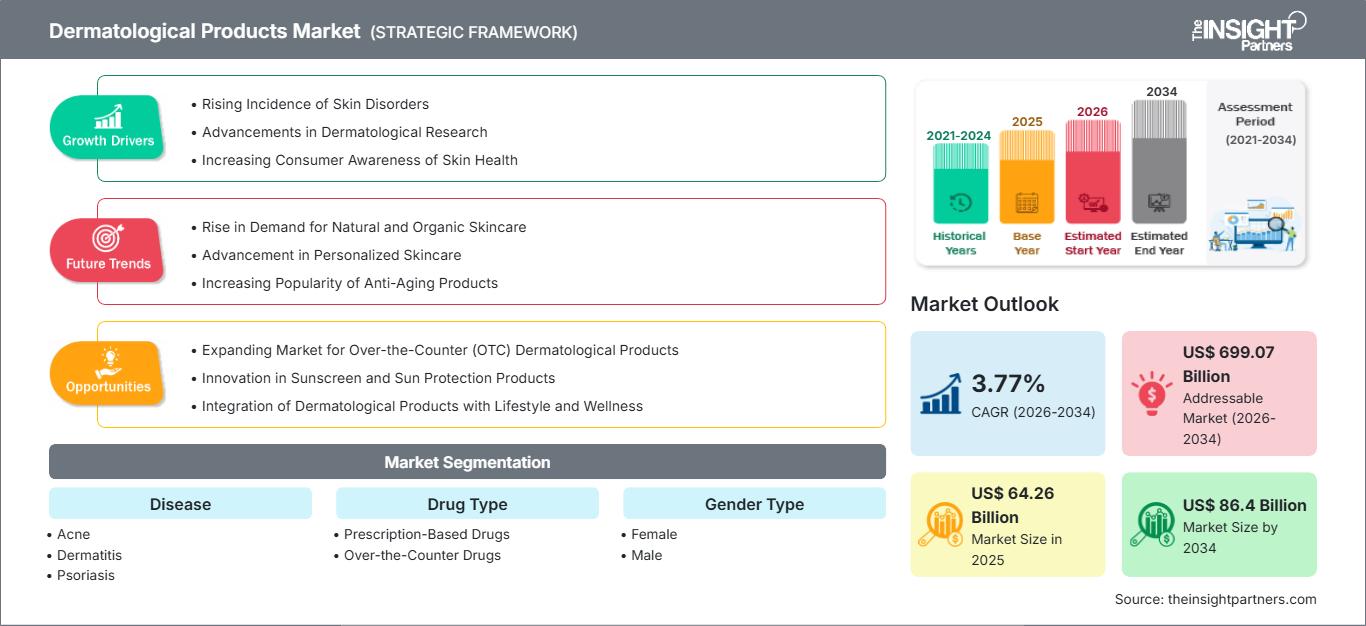
The Dermatological Products Market represents a critical segment of the global healthcare industry, encompassing therapies for chronic and acute skin disorders across prescription and over-the-counter categories. The market was valued at US$ 64.26 billion in 2025 and is projected to reach US$ 86.4 billion by 2034, advancing at a CAGR of 3.77% during 2026–2034. Rising disease prevalence, increasing dermatology consultations, and expanding access to innovative therapies continue to shape market development across both developed and emerging healthcare systems.
North America remains the largest regional contributor to the Dermatological Products Market and is anticipated to register an estimated CAGR of approximately 3.5%–4.0% through 2034. Growth is supported by high diagnosis rates of acne, psoriasis, and dermatitis, alongside strong adoption of biologics and specialty dermatology drugs. Expanding teledermatology services, growing awareness of skin health, and favorable reimbursement frameworks further strengthen regional demand across both prescription and consumer dermatology products.
Dermatological Products Market Assessment and Insights
- Market Size (2025): US$ 64.26 Billion
- Market Size (2034): US$ 86.4 Billion
- CAGR (2026–2034): 3.77%
- Leading Region: North America
- Fastest-Growing Region: Asia-Pacific
- Leading Segment: Prescription-Based Drugs
- Key Innovation / Competitive Trend: Expansion of biologics, targeted immunotherapies, and digital dermatology solutions
Source: The Insight Partners' analysis based on proprietary research, government publications, company annual reports, investor presentations, industry databases, and expert interviews.
The Dermatological Products Market has evolved from a predominantly topical treatment landscape into a diversified therapeutic ecosystem that includes biologics, targeted immunomodulators, specialty injectables, and advanced skincare formulations. Improvements in disease understanding, particularly for inflammatory and autoimmune skin conditions, have expanded treatment possibilities while encouraging earlier intervention and long-term disease management.
Market prospects remain supported by rising patient awareness, aging populations, and greater emphasis on skin health as part of overall wellness. Pharmaceutical companies including Bayer AG, Johnson & Johnson, Pfizer Inc., Novartis AG, GlaxoSmithKline plc, AstraZeneca, Galderma S.A., Amgen Inc., AbbVie Inc., and Merck KGaA continue investing in dermatology portfolios, contributing to a steady flow of product innovations and lifecycle management strategies.
Dermatological Products Market Report Scope
| Report Attribute | Details |
|---|---|
| Market size in 2025 | US$ 64.26 Billion |
| Market Size by 2034 | US$ 86.4 Billion |
| Global CAGR (2026 - 2034) | 3.77% |
| Historical Data | 2021-2024 |
| Forecast period | 2026-2034 |
Dermatological Products Market Analysis
Growing incidence of acne vulgaris, atopic dermatitis, psoriasis, rosacea, and alopecia is creating sustained demand across therapeutic categories. Urban lifestyles, environmental pollution, changing dietary patterns, and increased exposure to allergens are contributing to higher diagnosis rates. The market also benefits from improved healthcare access and broader availability of dermatology specialists in both mature and developing economies.
The value chain spans pharmaceutical manufacturers, biologic developers, contract manufacturers, distributors, specialty pharmacies, hospitals, dermatology clinics, and retail pharmacies. Digital health platforms increasingly influence diagnosis, patient monitoring, prescription fulfillment, and treatment adherence, creating a more integrated dermatology ecosystem.
Competition is characterized by a mix of multinational pharmaceutical companies and specialized dermatology-focused organizations. Established players leverage broad commercial infrastructures, while focused dermatology companies compete through innovation, targeted therapies, and physician engagement programs. Product differentiation increasingly depends on efficacy, safety profiles, convenience, and long-term disease control.
Investment activity continues to target biologics, immunology-based treatments, dermatological aesthetics, and AI-assisted diagnostic solutions. Strategic collaborations, licensing agreements, and portfolio expansions are becoming common as companies seek to strengthen therapeutic offerings and address unmet needs across chronic skin disorders. Emerging technologies supporting personalized dermatology are also attracting significant research attention.
● REPORT CUSTOMIZATION
Tailor This Report To Align With Your Specific Business Requirements
This report can be customized to align precisely with your business objectives, scope, and target markets. Customization options include tailored segmentation, geography, competitive analysis, and strategic insights to support informed decision-making.
Customize This Report →WHAT YOU CAN ADJUST
- ● Segmentations
- ● Geography
- ● Competitive Analysis
- ● Language Preferences
Dermatological Products Market: Strategic Insights
Regional Insights
North America Dermatological Products Market
North America accounts for the largest share of the Dermatological Products Market and is expected to expand at a CAGR of approximately 3.5%–4.0% through 2034. High healthcare expenditure, favorable reimbursement environments, and widespread access to dermatology specialists support market leadership. The region also benefits from extensive clinical research activity and strong adoption of innovative biologics.
Increasing prevalence of psoriasis, dermatitis, skin cancer, and rosacea continues to drive treatment demand. Consumer awareness regarding preventive skincare and early diagnosis further supports market growth. Advanced digital health infrastructure and teledermatology adoption enhance treatment accessibility, particularly for chronic disease management.
U.S. Dermatological Products Market
The United States represents roughly 75%–80% of the North American market and is projected to grow at a CAGR near 3.8% during the forecast period. Strong pharmaceutical innovation, high prescription volumes, and significant healthcare spending maintain the country's dominant position within the global dermatology landscape.
Major industry participants maintain extensive commercial and research operations in the country. Growing utilization of biologics for psoriasis and dermatitis, increasing demand for alopecia treatments, and wider use of specialty dermatology clinics support market expansion. Integration of AI-assisted skin assessment tools and telemedicine platforms is further transforming patient engagement and treatment delivery.
Europe Dermatological Products Market
Europe contributes approximately 25%–30% of global Dermatological Products Market revenue and is anticipated to grow at a CAGR of around 3.4%. Strong healthcare systems, expanding dermatology awareness campaigns, and increasing availability of advanced therapies support regional development. Germany remains the leading national market due to its large patient population and advanced healthcare infrastructure.
The UK benefits from growing demand for chronic skin disease management and increasing use of biologics in dermatology practice. Public awareness regarding eczema, psoriasis, and skin cancer continues to support diagnosis and treatment uptake, contributing to steady market expansion.
Germany leads the regional landscape through strong pharmaceutical manufacturing capabilities, substantial dermatology research activity, and widespread access to specialist care. Adoption of innovative prescription therapies and reimbursement support further strengthen market performance.
France, Italy, and Spain collectively contribute significant market demand through expanding dermatology services and rising patient awareness. Increasing acceptance of specialty therapies and growing emphasis on preventive skincare are expected to support sustained regional growth across these countries.
APAC Dermatological Products Market
Asia-Pacific is projected to be the fastest-growing regional market, expanding at an estimated CAGR of 5.0%–5.5%. The region currently accounts for roughly 20%–25% of global revenue and benefits from improving healthcare infrastructure, rising disposable incomes, and increasing awareness of skin health. China represents the largest market within the region.
China continues to expand access to dermatology treatments through healthcare modernization and growing pharmaceutical investment. Rising prevalence of acne and inflammatory skin conditions among urban populations further contributes to market demand.
Japan and South Korea maintain strong positions through advanced healthcare systems, aging populations, and high adoption of premium dermatology products. Innovation in dermatological therapeutics and skincare technologies remains a major regional advantage.
India and Australia are experiencing increasing demand for both prescription and OTC dermatology products. Government healthcare initiatives, improved diagnostic capabilities, and expanding specialist networks support market growth while enhancing treatment accessibility.
Middle East & Africa Dermatological Products Market
The Middle East & Africa market is expected to record a CAGR of approximately 4.5%. Expanding healthcare infrastructure, growing urbanization, and rising awareness regarding dermatological disorders are contributing to regional market development. Saudi Arabia currently represents the leading national market.
Saudi Arabia and the UAE are investing heavily in healthcare modernization, specialty care facilities, and pharmaceutical access programs. Growing diagnosis rates of chronic skin disorders and increasing demand for advanced therapies support market expansion.
South Africa serves as an important regional healthcare hub with improving dermatology services and growing treatment accessibility. Enhanced awareness of skin health and increasing healthcare investments continue to strengthen market fundamentals.
The broader MEA region benefits from ongoing healthcare infrastructure development and rising pharmaceutical distribution networks. Improved physician access and expanding insurance coverage are expected to support long-term market growth across multiple countries.
Segmentation Analysis
Disease
- Acne: Remains a high-volume treatment category due to widespread prevalence among adolescents and adults, supporting consistent demand for topical therapies, systemic medications, and emerging targeted treatment approaches.
- Dermatitis: Growing diagnosis rates and increasing environmental triggers drive demand for corticosteroids, biologics, immunomodulators, and long-term disease management solutions across diverse patient populations.
- Psoriasis: Strong adoption of biologics and advanced immunotherapies continues transforming treatment outcomes, making psoriasis one of the most innovation-driven segments within dermatology.
- Skin Cancer: Rising screening rates, aging demographics, and increasing awareness of ultraviolet exposure risks support demand for therapeutic interventions and specialized dermatology services.
- Rosacea: Growing recognition of symptoms and improved diagnosis contribute to expanding use of prescription therapies, topical treatments, and combination management approaches.
- Alopecia: Increasing consumer awareness and expanding treatment innovation are driving demand for both medical therapies and specialized hair restoration solutions.
Drug Type
- Prescription-Based Drugs: Represent the largest revenue contributor due to utilization in chronic inflammatory conditions, advanced biologic therapies, and physician-supervised treatment regimens.
- Over-the-Counter Drugs: Benefit from strong consumer accessibility, self-care trends, and increasing demand for non-prescription skincare and symptom management products.
Gender Type
- Female: Higher skincare engagement, treatment-seeking behavior, and utilization of dermatology services support substantial market contribution across therapeutic categories.
- Male: Rising awareness of skin health, grooming trends, and increasing diagnosis rates contribute to growing adoption of dermatological treatments and preventive care products.
Opportunity Snapshot
| Drug Type | Revenue Contribution | Trend Tag | Adoption Stage |
| Prescription-Based Drugs | High | Biologics | Mature |
| Over-the-Counter Drugs | Medium | Self-care | Scaling |
Dermatological Products Market Growth Drivers and Impact Analysis
Rising Global Burden of Chronic Skin Disorders
The growing prevalence of chronic dermatological conditions remains one of the most significant market drivers. Conditions such as psoriasis, dermatitis, rosacea, and alopecia increasingly require long-term management rather than short-term intervention. Environmental factors, urban lifestyles, stress, and changing immune-related disease patterns contribute to expanding patient populations worldwide.
Healthcare providers are prioritizing earlier diagnosis and proactive treatment strategies, which increases prescription volumes and follow-up care requirements. Chronic disease management also encourages recurring product utilization, supporting stable revenue generation across therapeutic categories. As awareness campaigns improve public understanding of dermatological health, more individuals seek medical attention rather than relying solely on self-treatment. This trend strengthens demand for both specialty therapies and supportive skincare products while expanding the addressable market for pharmaceutical manufacturers.
Advancements in Biologics and Targeted Therapies
Scientific progress in immunology and molecular medicine has transformed the treatment landscape for severe dermatological conditions. Biologics and targeted therapies now offer improved efficacy and disease control for patients who previously experienced limited treatment success with conventional approaches.
These innovations have elevated treatment expectations among physicians and patients alike. Pharmaceutical companies continue investing heavily in research programs focused on inflammatory pathways, immune regulation, and precision medicine applications. As clinical outcomes improve, healthcare systems increasingly recognize the value of advanced therapies for reducing disease burden and improving quality of life. The resulting expansion of premium treatment categories enhances overall market value and creates opportunities for differentiated product positioning within highly competitive therapeutic areas.
Growing Integration of Digital Dermatology Platforms
Digital transformation is changing the landscape of dermatology care with teleconsultations, remote monitoring, AI-assisted diagnostics, and electronic prescription management. They also help to improve patient access to specialist services, particularly in areas where there are shortages of dermatologists.
Digital tools can accelerate diagnosis, ensure treatment adherence, and facilitate ongoing disease management. Patients receive greater convenience, and healthcare providers benefit from improved workflow efficiency and data visibility. Pharma companies are increasingly incorporating digital engagement strategies into patient support programs. With the infrastructure for digital healthcare continuing to mature across the globe, dermatological care is expected to see significant gains in terms of accessibility and effectiveness, setting the stage for greater treatment adoption and market expansion.
Dermatological Products Market Future Trends
Expansion of Precision Dermatology and Biomarker-Based Treatment Selection
The future of dermatology increasingly centers on precision medicine approaches that match therapies to individual patient characteristics. Biomarker research, genetic profiling, and advanced diagnostics are improving the understanding of disease mechanisms and treatment response variability.
As these tools become more established, physicians will be more skilled at choosing treatments with better chances for success and reducing the likelihood of switching therapies. Drug developers are embedding biomarker approaches in development programs for inflammatory and autoimmune skin diseases. In the long run, they anticipate that this transformation could lead to better outcomes for patients and improved utilization of resources. Precision dermatology may also ultimately reform treatment algorithms, encouraging the development of tailored therapeutics aimed at selected patient groups.
Convergence of Therapeutic Dermatology and Consumer Skin Health
Boundaries between medical dermatology and consumer skincare continue to narrow. Patients increasingly seek comprehensive skin health solutions that combine disease management, prevention, and aesthetic improvement.
Companies are addressing this need by building an integrated portfolio that includes prescription therapies, dermatological skincare, and wellness products. Formulation advances and improved patient literacy around dermatology will drive this shift. We see growth potential in new hybrid care models where therapeutic management and routine skin upkeep coexist. This could increase patient adherence and generate additional revenue along the dermatology value chain.
Dermatological Products Market Opportunities
Untapped Potential in Emerging Healthcare Markets
Many emerging economies continue to experience underdiagnosis and undertreatment of dermatological disorders despite large patient populations. Expanding healthcare access, increasing insurance coverage, and improving specialist availability create substantial opportunities for market participants.
An organization that sets up efficient distribution channels and cost-effective solutions is bound to reap the fruits of sustained growth in demand. Localized marketing, physicians' education programs, and collaboration with health facilities will help increase penetration even faster. Investing in new markets means tapping into growing patient populations in addition to diversified income streams.
Development of Next-Generation Alopecia and Inflammatory Disease Therapies
Significant unmet needs remain in alopecia, dermatitis, and other chronic inflammatory skin disorders. Patients continue seeking treatments that offer superior efficacy, safety, and convenience compared with existing options.
Organizations investing in innovation, such as new mechanisms of action, regeneration therapy, and targeted immunotherapy, may find a significant competitive advantage. Commercialization within these fields will offer considerable business potential, considering the large number of patients and demand for better treatment. Strategic alliances and licensing agreements will continue to play an important role in exploiting value in these innovative therapeutic fields.
Recent Developments
- June, 2026: Eucerin, a dermatologist-recommended brand with over 100 years of skin science and the 1 Global Even Skincare Brand, is expanding its beloved Radiant Tone Collection and unveiling two new body products. The clinically proven formulas are designed to improve skin's radiance in as little as two weeks and visibly reduce the appearance of dark spots from sun exposure and aging with regular use. The brand's Radiant Tone Face Collection launched in 2025 and has been a favorite among dermatologists and consumers alike, and this launch extends the same efficacy into the body category for the first time.
- March, 2026: Neutrogena, Aveeno, and Rogaine release new dermatology research and clinical skincare innovations on healthy aging, moisturization, sun protection, and acne. New data and onsite activations reveal scientific advances in UV absorption technologies, lasting hydration, barrier-supporting ingredients, and preferred acne solutions at the 2026 American Academy of Dermatology Annual Meeting (AAD 2026)
- March, 2026: Sonoma Pharmaceuticals, Inc. announced the launch of Aquanil AD, a hypochlorous acid-based dermatology product line for sensitive skin, developed exclusively for Person & Covey, Inc. for distribution through its established over-the-counter dermatology channels in the United States.
Frequently Asked Questions

- Comprehensive Market Sizing and Forecast Analysis
- Detailed Segmentation Analysis
- In-Depth Market Dynamics Assessment
- Regional and Country-Level Insights
- Competitive Landscape and Company Benchmarking
- Strategic Business Intelligence
Recent Reports
Testimonials

The Insight Partners' SCADA System Market report is comprehensive, with valuable insights on current trends and future forecasts. The team was highly professional, responsive, and supportive throughout. We are very satisfied and highly recommend their services.
RAN KEDEM Partner, Reali Technologies LTDs
I requested a report on a very specific software market and the team produced the report in a few days. The information was very relevant and well presented. I then requested some changes and additions to the report. The team was again very responsive and I got the final report in less than a week.
JEAN-HERVE JENN Chairman, Future Analytica
We worked with The Insight Partners for an important market study and forecast. They gave us clear insights into opportunities and risks, which helped shape our plans. Their research was easy to use and based on solid data. It helped us make smart, confident decisions. We highly recommend them.
PIYUSH NAGPAL Sr. Vice President, High Beam Global
The Insight Partners delivered insightful, well-structured market research with strong domain expertise. Their team was professional and responsive throughout. The user-friendly website made accessing industry reports seamless. We highly recommend them for reliable, high-quality research services
YUKIHIKO ADACHI CEO, Deep Blue, LLC.
This is the first time I have purchased a market report from The Insight Partners.While I was unsure at first, I visited their web site and felt more comfortable to take the risk and purchase a market report.I am completely satisfied with the quality of the report and customer service. I had several questions and comments with the initial report, but after a couple of dialogs over email with their analyst I believe I have a report that I can use as input to our strategic planning process.Thank you so much for taking the extra time and making this a positive experience.I will definitely recommend your service to others and you will be my first call when we need further market data.
JOHN SUZUKI President and Chief Executive Officer, Board Director, BK Technologies
I wish to appreciate your support and the professionalism you displayed in the course of attending to my request for information regarding to infectious disease IVD market in Nigeria. I appreciate your patience, your guidance, and the fact that you were willing to offer a discount, which eventually made it possible for us to close a deal. I look forward to engaging The Insight Partners in the future, all thanks to the impression you have created in me as a result of this first encounter.
DR CHIJIOKE ONYIA MANAGING DIRECTOR, PineCrest Healthcare Ltd.Reason to Buy
- Informed Decision-Making
- Understanding Market Dynamics
- Competitive Analysis
- Identifying Emerging Markets
- Customer Insights
- Market Forecasts
- Risk Mitigation
- Boosting Operational Efficiency
- Strategic Planning
- Investment Justification
- Tracking Industry Innovations
- Aligning with Regulatory Trends





 Get Free Sample for