
Diaphragm Pump Market Size, Trends & Growth by 2034
Coverage: By Operation (Double acting, Single acting); Mechanism (Electrically operated, Air operated, Others); End-User (Pharmaceuticals, Water and Wastewater, Chemicals, Others), and Geography (North America, Europe, Asia Pacific, and South and Central America)
- Status : Data Released
- Report Code : TIPRE00014555
- Category : Manufacturing and Construction
- No. of Pages : 150
- Available Report Formats :


- Last update date : July 28, 2026


2025 Market Size
US$ 6.89 Bn
Base year value
2034 Forecast
US$ 13.49 Bn
Projected by 2034
CAGR 2026-2034
7.74 %
Growth rate
Addressable Market
US$ 91.70 Bn
(2026-2034)
The diaphragm pump market is projected to grow from US$ 6.89 Billion in 2025 to US$ 13.49 Billion by 2034, registering a CAGR of 7.74% during 2026–2034. Demand is supported by the pump’s ability to handle corrosive, abrasive, viscous, and shear-sensitive fluids in controlled transfer environments across pharmaceuticals, water and wastewater, and chemical processing.
North America is expected to record a 6.8–7.2% CAGR, supported by wastewater infrastructure renewal and higher adoption of electrically operated dosing systems. The diaphragm pump market size in the region is shaped by pharmaceutical capacity upgrades, chemical safety compliance, and replacement demand from municipal treatment plants seeking leak-free transfer of sludge, acids, and metering chemicals.
Diaphragm Pump Market Assessment and Insights
- North America accounted for 26–28% share in 2025 and is growing at a CAGR range of 6.8–7.2% during 2026–2034, led by wastewater upgrades and pharmaceutical dosing demand.
- US represented 78–82% of North America in 2025 and is growing at a CAGR range of 6.9–7.3% during 2026–2034.
- Europe held 22–24% share in 2025 and is growing at a CAGR range of 6.4–6.8% during 2026–2034, with Germany, the UK, France, Italy, and Spain leading demand.
- Asia Pacific captured 34–36% share in 2025 and is growing at a CAGR range of 8.6–9.1% during 2026–2034, supported by China, India, Japan, South Korea, and Australia.
- Largest Segment Water and Wastewater held 38–42% market share in 2025, with a CAGR range of 7.6–8.0% during 2026–2034, driven by municipal and industrial treatment.
- High Growth Segment Electrically operated pumps held 30–34% market share in 2025, with a CAGR range of 8.8–9.3% during 2026–2034, supported by energy efficiency.
- Key companies analyzed in detail: LEWA GmbH, ABEL GmbH, Tapflo Group, Yamada Corporation, Flowserve Corporation, Grundfos Pumps India Private Limited, Xylem Inc., Graco Inc., SPX FLOW, Inc., IDEX Corporation.
Source: The Insight Partners' analysis based on proprietary research, government publications, company annual reports, investor presentations, industry databases, and expert interviews.
Technology evolution in the diaphragm pump market has moved from purely pneumatic transfer toward integrated electric drives, smart condition monitoring, and materials engineered for aggressive chemistries. Manufacturers are enhancing diaphragm durability, valve design, and seal integrity, whereas purchasers value the overall cost of ownership. In addition, production trends are changing owing to the fact that international manufacturers are localizing assemblies, establishing distribution networks, and developing modular design solutions for faster deliveries in water treatment and process applications.
Future needs will be growing in India, Southeast Asia, the Gulf region, and Eastern Europe due to investments in industrial water recycling, pharmaceutical production, and specialty chemicals. Requirements for hazardous material containment and effluent discharge will drive the need for positive displacement solutions without leaks. The diaphragm pump market will also benefit from brownfield upgrades where operators replace aging centrifugal and metering pumps with safer equipment suited to corrosive and particulate-laden media.
Diaphragm Pump Market Report Scope
| Report Attribute | Details |
|---|---|
| Market size in 2025 | US$ 6.89 Billion |
| Market Size by 2034 | US$ 13.49 Billion |
| Global CAGR (2026 - 2034) | 7.74% |
| Historical Data | 2021-2024 |
| Forecast period | 2026-2034 |
Diaphragm Pump Market Analysis
Diaphragm Pump Market growth demand is rooted in wastewater treatment, pharmaceutical dosing, and chemical transfer applications where containment and not circulation is needed. The industrial buyers prefer pumps with the ability to operate in a dry state, self-priming capabilities, and compatibility with acids, solvents, slurries, and viscous liquids. There is an ongoing increase in preventive maintenance budgets at utilities and process industries as well.
Value chain participants include producers of diaphragm elastomers, manufacturers of metal and plastic components, drive makers, assemblers, distributors, EPCs, and end-users. The supply situation still remains influenced by delivery times of corrosion-resistant materials, motor supplies, and after-market support. The firms having service facilities in regions have a competitive advantage as diaphragm replacements, valve inspections, and chemical compatibility tests determine repeat orders.
Market conditions include medium consolidation at the international level, while fragmentation is evident when it comes to specialist applications. LEWA GmbH, Flowserve Corporation, Graco Inc., IDEX Corporation, Xylem Inc., and SPX FLOW, Inc. operate in the engineered systems segment, whereas ABEL GmbH, Tapflo Group, and Yamada Corporation have maintained their leadership in air-operated pumps and application-specific pumps.
The market analysis of diaphragm pumps indicates the trend of investment in electrically driven pumps, monitoring pumps, and hygienic pumps. Grundfos Pumps India Private Limited, along with other local players, enjoys the advantage of localized demand, while international companies leverage their channel reach and spare parts accessibility to safeguard the installed base.
● REPORT CUSTOMIZATION
Tailor This Report To Align With Your Specific Business Requirements
This report can be customized to align precisely with your business objectives, scope, and target markets. Customization options include tailored segmentation, geography, competitive analysis, and strategic insights to support informed decision-making.
Customize This Report →WHAT YOU CAN ADJUST
- ● Segmentations
- ● Geography
- ● Competitive Analysis
- ● Language Preferences
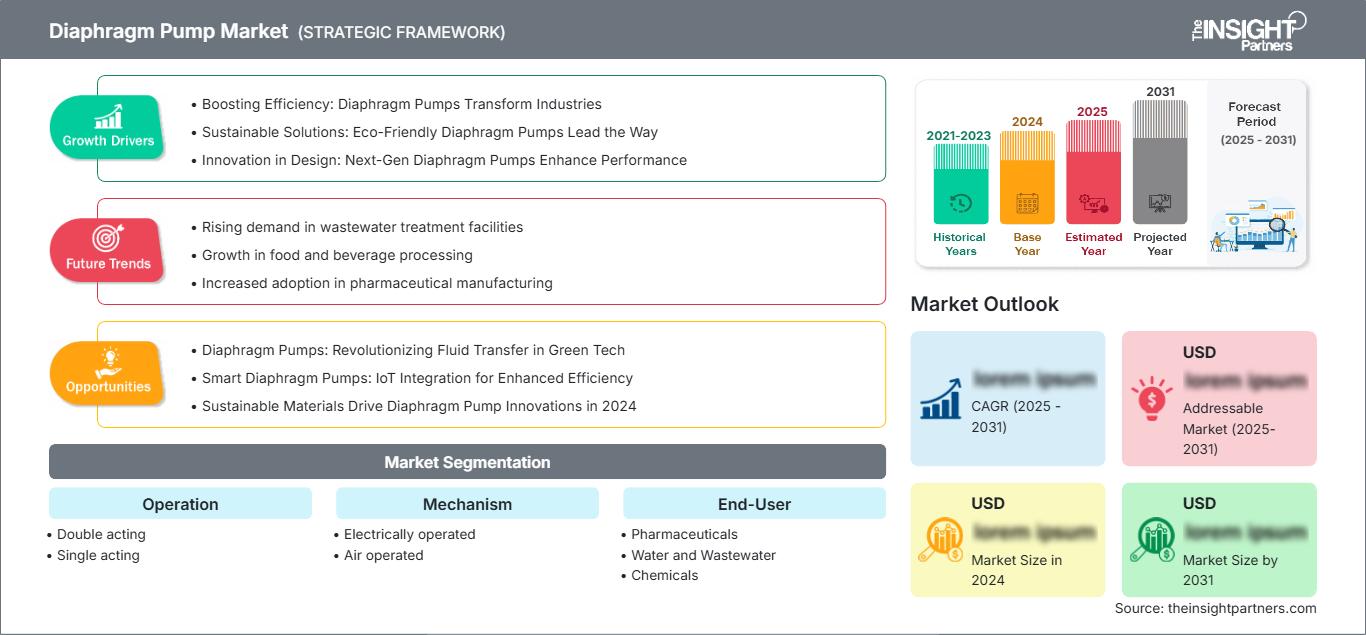
Diaphragm Pump Market: Strategic Insights
Regional Insights
North America diaphragm pump market
North America held 26–28% of the global diaphragm pump market share in 2025 and is expected to expand at a 6.8–7.2% CAGR through 2034. Demand is strong in municipal wastewater plant improvements, pharmaceutical manufacturing, specialty chemicals, and mining fluids. The region has a well-developed maintenance culture and is focused on preventing leaks via regulation.
The replacement market is important as many facilities run aging plants requiring improved dose control and chemical resistance. Electro-mechanical systems are getting more traction among facilities that monitor energy and compressed air consumption. Growth in the region is stable versus explosive and driven by compliance purchases and aftermarket activity.
U.S. Diaphragm Pump Market
The U.S. accounted for 78–82% of North America in 2025 and is projected to grow at a 6.9–7.3% CAGR. The large installed bases in water utilities, chemical corridors, and biopharmaceuticals ensure continued demand for diaphragms, valves, and pump replacements.
The geographic footprint of companies involved in the industry is wide, including Flowserve Corporation, Graco Inc., IDEX Corporation, Xylem Inc., and SPX FLOW, Inc. Trends in applications include dosing of chemicals in water treatment applications, pumping of corrosive fluids, and replacement of air-operated pumps that are questioned for their efficiency with compressed air.
Europe Diaphragm Pump Market
Europe represented 22–24% share in 2025 and is growing at a 6.4–6.8% CAGR, with Germany leading due to chemicals, precision engineering, and environmental compliance. The UK provides support for demand via water utilities modernization and pharmaceutical processing, while Germany is most advanced in engineered dosing, hazardous transfer, and export-oriented pump manufacturing.
Demand from France, Italy, and Spain is supplemented by municipal wastewater, food processing, specialty chemicals, and industrial maintenance. The European customers focus on life cycle efficiency, ATEX compliance, and material traceability. LEWA GmbH, ABEL GmbH, and Tapflo Group benefit from being located close to the customers, whereas foreign vendors compete based on their service networks and certified products.
APAC Diaphragm Pump Market
APAC held 34–36% share in 2025 and is expected to grow at an 8.6–9.1% CAGR, the fastest regional pace. China dominates via chemicals, batteries, waste water, and manufacturing volumes, whereas India generates impetus from industrial corridors, pharmaceutical production, and investment in water infrastructure.
Japan and South Korea make contributions in terms of demand from high-spec chemical and electronics fluids, while Australia is contributing to mining slurry and treatment applications. Effluent management and manufacturing within the country policies drive purchases of positive displacement pumps, which can be relied upon.
Middle East & Africa Diaphragm Pump Market
Middle East and Africa is projected to grow at a 7.2–7.7% CAGR, supported by energy, desalination, wastewater, and industrial infrastructure. Saudi Arabia drives regional demand using petrochemicals, water recycling and industrial diversification, while the UAE relies on pumps for utilities, construction-related treatment plants and special processing.
South Africa’s contribution comes from mining, municipal treatment plants, and chemicals, while the rest of MEA depends on projects. Tough operational environments require tough air-operated designs and corrosion-resistant materials. Growth will depend on budget allocations to public infrastructure, oil and gas maintenance, and industrial wastewater compliance in the private industry.
Segmentation Analysis
Operation
Operation is expected to register a 7.4–7.9% CAGR during 2026–2034 as users choose pump configurations according to pressure stability, flow consistency, and maintenance tolerance. The diaphragm pump market scope across operation types remains broad, with double-acting designs preferred for steadier flow and single-acting units retained in simpler dosing and transfer duties.
- Double acting pumps are positioned for applications requiring smoother discharge, higher throughput, and lower pulsation, making them strategically relevant in chemicals, wastewater sludge handling, and continuous industrial transfer lines.
- Single acting pumps remain important for compact systems, intermittent dosing, lower flow transfer, and cost-sensitive installations where simpler mechanics, easier maintenance, and space efficiency influence buyer preference.
Mechanism
Mechanism is forecast to expand at a 7.9–8.4% CAGR during 2026–2034 as actuation choices shift with energy pricing, automation needs, and plant safety requirements. Air-operated pumps dominate rugged and hazardous fluid duties, while electrically operated units gain share where operators seek lower energy loss, precise control, and integration with digital monitoring systems.
- Electrically operated pumps are scaling quickly in automated plants because they reduce compressed air dependency, improve controllability, and support energy reporting for sustainability-focused industrial operations.
- Air operated pumps retain a mature position in hazardous, portable, and abrasive-fluid applications because they tolerate dry running, variable viscosity, and challenging site conditions with limited electrical infrastructure.
End-User
End-User demand is projected to grow at a 7.6–8.1% CAGR during 2026–2034, supported by regulated fluid handling, contamination control, and effluent management. Water and wastewater leads by installed base, pharmaceuticals emphasize hygienic dosing and validation, and chemicals require corrosion resistance, containment, and compatibility with aggressive fluids.
- Pharmaceuticals use diaphragm pumps for metered dosing, transfer of sensitive fluids, and controlled cleaning processes where contamination prevention, validation documentation, and material compatibility are essential procurement factors.
- Water and wastewater remain the largest end-user area because plants require reliable chemical dosing, sludge movement, pH adjustment, and effluent treatment across municipal and industrial systems.
- Chemicals represent a strategic demand base as manufacturers handle acids, solvents, resins, and abrasive liquids that require leak-free transfer, corrosion resistance, and reduced operator exposure.
Opportunity Snapshot
| Segment Name | Revenue Contribution | Trend Tag | Adoption Stage |
|---|---|---|---|
| Pharmaceuticals | Medium | Hygienic Dosing | Scaling |
| Water and Wastewater | High | Effluent Reuse | Mature |
| Chemicals | High | Corrosive Transfer | Mature |
Diaphragm Pump Market Growth Drivers and Impact Analysis
Wastewater Compliance Expands Replacement Demand
There has been an increased purchase of diaphragm pumps by municipal and industrial wastewater operators due to the need for reliable chemical dosing, sludge transportation, and pH control, due to the regulations that dictate effluent discharges. In addition, the pumps utilized in these applications should be able to withstand abrasive particles, corrosion from the chemicals involved in water treatment, and irregular operations. The resulting effect is the increased replacement of aging transport pumps in water treatment plants, which are undergoing renovation of their clarification, filtration, and disinfection process units. The other reason why buyers are going for these types of pumps is due to their reduced risk of leaking and maintenance shutdowns.
Pharmaceutical Capacity Requires Controlled Fluid Transfer
The needs of pharmaceutical manufacturers for pumps that offer validated dosing, clean-in-place capabilities, and liquid flow without contamination become apparent. The solution comes from diaphragm pumps, because the liquid pathway does not necessarily come in contact with the drive unit, lowering risk levels for the process. The increased prevalence of biologic drugs, vaccines, and injectables contributes to the need for accurate metering and appropriate materials. The consequences on the market become evident through premium purchasing decisions when certification and technical support outstrip cost. Suppliers who offer hygienic designs benefit greatly from having better access to manufacturing sites. Increased investments into pharmaceutical manufacturing facilities, higher demands for the quality of products, and automation of the production line contribute to the growth of demand.
Chemical Safety Pushes Leak-Free Pump Adoption
Chemical processors utilize diaphragm pumps for the transportation of acids, solvents, polymers, coatings, and abrasive slurries, where any leak or failure of the seals could pose a risk to operations and safety. As companies upgrade their plants, buyers are demanding that diaphragm pumps be constructed of corrosion-resistant materials, have better diaphragms, and be appropriate for hazardous locations. This moves the buying decision away from commoditized replacements to engineered pumps for applications. The effect this will have on the diaphragm pump industry is increased value per install, better after-market sales, and an increased need for technical service knowledge related to fluid compatibility and preventative maintenance. Increased focus on worker safety, environmental protection, and reliability is prompting companies to standardize on high-performance diaphragm pumps.
Diaphragm Pump Market Future Trends
Electrification of Positive Displacement Pumping
Electrically operated diaphragm pumps will gain wider adoption as plants measure compressed air losses and prioritize controllable equipment. The shift is not limited to energy savings; electric platforms can improve metering accuracy, reduce noise, and support automation. Future diaphragm pump market trends will therefore center on variable-speed control, digital diagnostics, and compact systems that integrate with supervisory control platforms. Suppliers that combine mechanical reliability with electronics and service tools will be better positioned in new facilities and retrofit programs.
Material Innovation for Aggressive Fluids
Future product differentiation will rely on diaphragms, valves, and wetted parts that have been optimized to increase longevity against chemicals, wear, and temperature changes. End users who handle specialty chemicals, batteries and their components, and high solids content wastewater will want more proof of material compatibility prior to buying a new system. New material types, including advanced elastomers, PTFE-based components, and non-metallic pump cases, will lower maintenance intervals and provide better margin for error.
Continuous research into advanced polymers, composite materials, and enhanced manufacturing processes will further improve product durability, operational efficiency, and lifecycle performance. These innovations will help manufacturers address demanding industrial applications while supporting regulatory compliance, reducing ownership costs, and increasing confidence in long-term pump reliability across challenging operating environments.
Diaphragm Pump Market Opportunities
Aftermarket Services for Installed Pump Bases
Manufacturers and distributors can capture higher recurring revenue by expanding diaphragm replacement kits, valve assemblies, compatibility audits, and predictive maintenance services. Many end users operate mixed fleets across water, chemical, and pharmaceutical sites, creating demand for standardized service contracts and faster parts availability. This opportunity is especially strong where unplanned downtime carries compliance or production risk. The diaphragm pump market forecasts indicate that suppliers offering lifecycle support, training, and condition-monitoring packages can improve customer retention while reducing procurement dependence on lowest-price equipment bids.
Localized Manufacturing in High-Growth Regions
Localization benefits for Asia Pacific and Middle East projects include assembly, parts stock, and application engineering in close proximity to the end customer. Regional manufacturing may improve delivery schedules, decrease vulnerability to imports, and facilitate localization for specific fluids, regulations, and pricing levels. Those companies combining their globally designed products with regional sales teams will be able to compete successfully with low-cost suppliers. The resources should be allocated for distributor education, parts storage facilities, and collaborations with engineering contractors participating in wastewater treatment, chemicals, mining, and pharmaceutical plants building activities.
Moreover, such a strategy will help to increase customer orientation, improve after-sales services, increase supply chain flexibility, and implement projects more quickly. Local manufacturing capabilities will provide the opportunity to adjust to regional regulations, decrease logistical expenses, and develop closer relations with industrial customers in need of reliable equipment availability and long-term technical assistance.
Recent Developments
- March 2026: KNF is introduced four completely new diaphragm pump solutions with advanced Intelligent Pump Features: Flow Control, Pressure Control, Vacuum Control, and Versatile Dosing. These innovations mark a significant leap forward in diaphragm pump technology, delivering unprecedented precision, reliability, and adaptability for critical applications
- September 2025: ARO announced the introduction of its latest innovation, the ARO electric double diaphragm pump EVO 210. Designed to deliver a dependable and economical solution for general transfer and batching tasks, this new pump expands ARO's renowned double diaphragm range with a powerful electric option. The ARO EVO 210 is engineered to provide enhanced efficiency and savings, especially in applications where compressed air is not an available resource or higher efficiency is desired. This model strikes a perfect balance between performance and simplicity, ensuring a cost-effective diaphragm pump solution without compromising on reliability.
- April 2025: Graco Inc. launched an upgraded QUANTM electric double diaphragm pump platform for chemical and industrial fluid transfer, emphasizing lower energy consumption compared with conventional air-operated equipment and targeting users replacing compressed-air systems in process facilities.
Frequently Asked Questions

- Comprehensive Market Sizing and Forecast Analysis
- Detailed Segmentation Analysis
- In-Depth Market Dynamics Assessment
- Regional and Country-Level Insights
- Competitive Landscape and Company Benchmarking
- Strategic Business Intelligence
Recent Reports
Testimonials

The Insight Partners' SCADA System Market report is comprehensive, with valuable insights on current trends and future forecasts. The team was highly professional, responsive, and supportive throughout. We are very satisfied and highly recommend their services.
RAN KEDEM Partner, Reali Technologies LTDs
I requested a report on a very specific software market and the team produced the report in a few days. The information was very relevant and well presented. I then requested some changes and additions to the report. The team was again very responsive and I got the final report in less than a week.
JEAN-HERVE JENN Chairman, Future Analytica
We worked with The Insight Partners for an important market study and forecast. They gave us clear insights into opportunities and risks, which helped shape our plans. Their research was easy to use and based on solid data. It helped us make smart, confident decisions. We highly recommend them.
PIYUSH NAGPAL Sr. Vice President, High Beam Global
The Insight Partners delivered insightful, well-structured market research with strong domain expertise. Their team was professional and responsive throughout. The user-friendly website made accessing industry reports seamless. We highly recommend them for reliable, high-quality research services
YUKIHIKO ADACHI CEO, Deep Blue, LLC.
This is the first time I have purchased a market report from The Insight Partners.While I was unsure at first, I visited their web site and felt more comfortable to take the risk and purchase a market report.I am completely satisfied with the quality of the report and customer service. I had several questions and comments with the initial report, but after a couple of dialogs over email with their analyst I believe I have a report that I can use as input to our strategic planning process.Thank you so much for taking the extra time and making this a positive experience.I will definitely recommend your service to others and you will be my first call when we need further market data.
JOHN SUZUKI President and Chief Executive Officer, Board Director, BK Technologies
I wish to appreciate your support and the professionalism you displayed in the course of attending to my request for information regarding to infectious disease IVD market in Nigeria. I appreciate your patience, your guidance, and the fact that you were willing to offer a discount, which eventually made it possible for us to close a deal. I look forward to engaging The Insight Partners in the future, all thanks to the impression you have created in me as a result of this first encounter.
DR CHIJIOKE ONYIA MANAGING DIRECTOR, PineCrest Healthcare Ltd.Reason to Buy
- Informed Decision-Making
- Understanding Market Dynamics
- Competitive Analysis
- Identifying Emerging Markets
- Customer Insights
- Market Forecasts
- Risk Mitigation
- Boosting Operational Efficiency
- Strategic Planning
- Investment Justification
- Tracking Industry Innovations
- Aligning with Regulatory Trends





 Get Free Sample for